belt Oldsmobile Alero 2003 s Service Manual
[x] Cancel search | Manufacturer: OLDSMOBILE, Model Year: 2003, Model line: Alero, Model: Oldsmobile Alero 2003Pages: 354, PDF Size: 16.74 MB
Page 60 of 354
Supplemental Restraint
System
(SRS)
This part explains the Supplemental Restraint
System
(SRS) or air bag system.
Your vehicle has air bags
- one air bag for the driver
and another air bag for the right front passenger.
Frontal air bags are designed to help reduce the risk of
injury from the force of an inflating air bag. But these
air bags must inflate very quickly to do their job
and comply with federal regulations.
Here are the most important things to know about the
air bag system:
You ~-.i be severely ..., ured or killed in a crash
if you aren’t wearing your safety belt
- even if
you have air bags. Wearing your safety belt
during a crash helps reduce your chance of
hitting things inside the vehicle or being
ejected from
it. Air bags are designed to work
with safety belts, but don’t replace them. Air
bags are designed to work only in moderate to
severe crashes where the front of your vehicle
hits something. They aren’t designed to inflate
at all
in rollover, rear or low-speed frontal
crashes, or in many side crashes. And, for
some unrestrained occupants, air bags may
provide less protection in frontal crashes than
more forceful air bags have provided in the
past. Everyone in your vehicle should wear a
an air bag for that person.
QUIGL~ u~nc pa wrrn ~y wwn~~cnn~n VI nnwc ~~nrn L. Y e.m#n+w, kml+ munnemlss ~ ..,hn+hnr mn+ +knwn’e
1-53
Page 61 of 354
Air bags inflate with great force, faster than the blink of an eye. If you’re too close to an
inflating air bag, as you would be if you were
leaning forward,
it could seriously injure you.
Safety belts help keep you
in position before
and during a crash. Always wear your safety
belt, even with air bags. The driver should
sit
as far back as possible while still maintaining
control of the vehicle.
A CAU,TION:
Anyone who is up against, or very close to,
any air bag when
it inflates can be seriously
injured or killed. Air bags plus lap-shoulder
belts offer the best protection for adults, but
not for young children and infants.Neither the
vehicle’s safety belt system nor its air bag system is designed for them. Young children
and infants need the protection that a child restraint system can provide. Always secure
children properly in your vehicle. To read how,
see the parts of this manual called “Older
Children” and “Infants and Young Children”.
1-54
Page 64 of 354
If your vehicle strikes something that will move or
deform, such as a parked car, the threshold level will be
higher. The air bag is not designed to inflate in
rollovers, rear impacts, or in many side impacts because
inflation would not help the occupant.
In any particular crash, no one can say whether an air
bag should have inflated simply because of the damage
to a vehicle or because of what the repair costs were.
Inflation is determined by the angle of the impact
and how quickly the vehicle slows down in frontal and
near-frontal impacts.
What Makes an Air Bag Inflate?
In an impact of sufficient severity, the air bag sensing
system detects that the vehicle is in a crash. The
sensing system triggers a release of gas from the
inflator, which inflates the air bag. The inflator, air bag
and related hardware are all part of the air bag modules
inside the steering wheel and in the instrument panel
in irorli ui ine rigni ironi passenger.
How Does an Air Bag Restrain?
In moderate to severe frontal or near-frontal collisions,
even belted occupants can contact the steering wheel or
the instrument panel. Air bags supplement the
protection provided by safety belts. Air bags distribute
the force of the impact more evenly over the occupant’s
upper body, stopping the occupant more gradually.
But air bags would not help you in many types
of
collisions, including rollovers, rear impacts and many
side impacts, primarily because an occupant’s motion is
not toward those air bags. Air bags should never be
regarded as anything more than a supplement to safety
belts, and then only
in moderate to severe frontal or
near-frontal collisions.
What Will You See After an Air Bag
Inflates?
After an air bag inflates, it quickly deflates, so quickly
that some people may not even realize the air bag
iniiated. some components
of the air bag module - the
steering wheel hub for the driver’s air bag or the
instrument panel for the right front passenger’s
bag
- will be hot for a short time. The parts of the
bag that come into contact with you may be warm,
but not
too hot to touch.
1-57
Page 65 of 354
There will be some smoke and dust coming from the
vents
in the deflated air bags. Air bag inflation doesn’t
prevent the driver from seeing or being able to steer the
vehicle, nor does it stop people from leaving the
vehicle.
When an air bag inflates, there
is dust in the
air. This dust could cause breathing problems
for people with a history of asthma or other
breathing trouble.
To avoid this, everyone in
the vehicle should get out as soon as it is safe
to do
so. If you have breathing problems but
can’t get out of the vehicle after an air bag inflates, then get fresh air by opening a
window or a door.
In many crashes severe enough to inflate an air bag,
windshields are broken by vehicle deformation.
Additional windshield breakage may also occur from the
right front passenger air bag.
e
e
e
Air bags are designed to inflate only once. After an
air bag inflates, you’ll need some new parts for
your air bag system.
If you don’t get them, the air
bag system won’t be there to help protect you
in another crash.
A new system will include air bag
modules and possibly other parts. The service
manual for your vehicle covers the need to replace
other parts.
Your vehicle is equipped with a crash sensing and
diagnostic module, which records information
about the air bag system. The module records
information about the readiness of the system, when
the system commands air bag inflation and
driver’s safety belt usage at deployment.
Let only qualified technicians work on your air bag
system. Improper service can mean that your air bag system won’t work properly. See your dealer for
service.
Notice: If you damage the covering for the driver’s
or the right front passenger’s air bag, the bag
may not work properly. You may have to replace the
air bag module
in the steering wheel or both the
air bag module and the instrument panel for
the right front passenger’s air bag.
Do not open or
break the air bag coverings.
1-58
Page 67 of 354
Restraint System Check
Checking Your Restraint Systems
Now and then, make sure the safety belt reminder light
and all your belts, buckles, latch plates, retractors
and anchorages are working properly. Look for any other
loose or damaged safety belt system parts. If you see
anything that might keep a safety belt system from doing
its job, have it repaired.
Torn or frayed safety belts may not protect you in a
crash. They can rip apart under impact forces.
If a belt
is torn or frayed, get
a new one right away.
Also look for any opened or broken air bag covers, and
have them repaired or replaced. (The air bag system
does not need regular maintenance.)
Replacing Restraint System Parts
After a Crash
A crash can damage the restrain1 (stems in
your vehicle.
A damaged restraint system may
not properly protect the person using
it,
resulting in serious injury or even death in a
crash.
To help make sure your restraint
systems are working properly after
a crash,
have them inspected and any necessary
replacements made as soon as possible.
1-60
Page 68 of 354
If you’ve had a crash, do you need new belts or LATCH If your seat adjuster won’t work after a crash, the
system parts? special part
of the safety belt that goes through the seat
After a very minor collision, nothing may be necessary.
But
if the belts were stretched, as they would be if If an air bag inflates, you’ll need to replace air bag
worn during a more severe crash, then you need system parts. See
Supplemental Restraint System
to the adjuster may need to be replaced.
new parts. If the LATCH system was being used during a more
severe crash, you may need new LATCH system parts.
If belts are cut or damaged, replace them. Collision
damage also may mean you will need to have LATCH
system, safety belt or seat parts repaired or replaced.
New parts and repairs may be necessary even
if the belt
or LATCH system wasn’t being used at the time of
the collision.
(SRS) on page 1-53.
1-61
Page 76 of 354
Doors and Locks
Door Lcnks
~~ -
Unlocked doors can be dangerous.
Passengers - especially children - can
easily open
the doors and fall out of a
moving vehicle. When a door
is locked, the
handle won’t open
it. You increase the
chance of being thrown out of the vehicle
in a crash if the doors aren’t locked. So,
wear safety belts properly and lock the
doors whenever you drive.
vehicles may be unable to get out.
A child
can be overcome by extreme heat and can
from heat stroke. Always lock your vehicle
whenever you leave
it.
unlocked door when you slow down or
stop your vehicle. Locking your doors can
help prevent
this from happening.
Young children who get into unlocked
szcer per!?laK!n! i!?;wies cr e‘!e!? del!!?
0 Outsiders can easily enter through an There are
several ways to lock and unlock your vehicle.
From the outside, use your key or remote keyless
entry system, if your vehicle
is equipped with this
feature.
If your vehicle has remote keyless entry, you
can only use your key to unlock the driver’s side door.
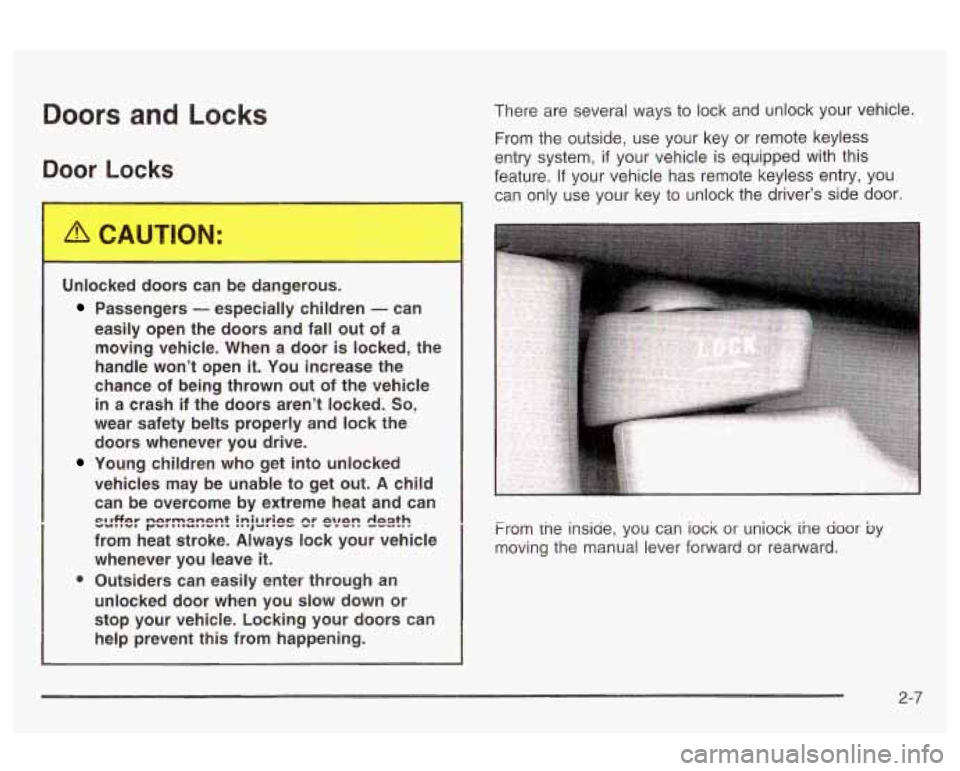
From tne insiae, you can iock or uniock
ine door by
moving the manual lever forward or rearward.
2-7
Page 106 of 354
Section 3 Instrument Panel
Instrument Panel Overview ............................... 3.4
Hazard Warning Flashers
.......... .............. 3.6
Other Warning Devices
................................... 3.6
Horn
............................................................. 3.6
Tilt Wheel
..................................................... 3.7
Turn SignaVMultifunction Lever
......................... 3.7
Exterior Lamps
............................................. 3.13
Interior Lamps
.............................................. 3.16
Accessory Power Outlets
............................... 3.17
Ashtrays and Cigarette Lighter
........................ 3.18
Climate Controls
........................................... -3-1 9
Climate Control System
................................. 3.19
Outlet Adjustment
......................................... 3.22
Warning Lights, Gages and Indicators
............. 3.23
Instrument Panel Cluster
................................ 3.24
Speedometer and Odometer
........................... 3.25
Tachometer
................................................. 3.25
Safety Belt Reminder Light
............................. 3.26
Air
Eag Reauiness iighi 3-LW
Charging System Light .................................. 3.27
fi cln ................................
Up-Shift Light .............................. .......... 3-28
Brake System Warning Light
........, .......... 3-28
Anti-Lock Brake System
Enhanced Traction System
Enhanced Traction System
Warning
bight
........................................ 3-29
Warning Light
........................................... 3-29
Active Light
.............................................. 3-30
Engine Coolant Temperature Gage
.................. 3-31
Low Coolant Warning Light
............................ 3-31
Malfunction Indicator Lamp
............................. 3-31
Oil Pressure Light
......................................... 3-34
Low Oil Level Light
....................................... 3-35
Security Light
............................................... 3-36
Cruise Control Light
...................................... 3-36
%??:ice ‘!ehic!n see!? Light ........................... ._ 2-36
Fuel Gage ................................................... 3-37
Change Engine
Oil Light
................................ 3-35
Low Washer Fluid Warning Light
..................... 3-36
3-
1
Page 131 of 354
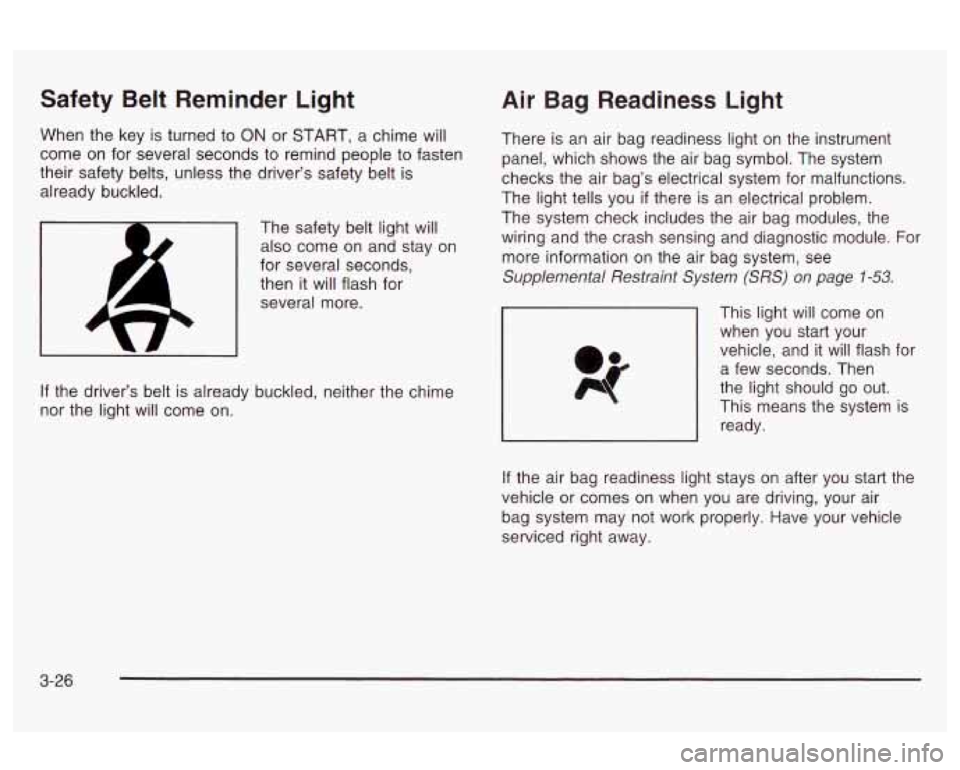
Safety Belt Reminder Light
When the key is turned to ON or START, a chime will
come on for several seconds to remind people to fasten
their safety belts, unless the driver’s safety belt is
already buckled.
The safety belt light will also come on and stay on
for several seconds,
then it will flash for
several more.
If the driver’s belt is already buckled, neither the chime
nor the light will come on.
Air Bag Readiness Light
There is an air bag readiness light on the instrument
panel, which shows the air bag symbol. The system
checks the air bag’s electrical system for malfunctions.
The light tells you
if there is an electrical problem.
The system check includes the air bag modules, the
wiring and the crash sensing and diagnostic module. For
more information on the air bag system, see
Supplemental Restraint System (SRS) on page 1-53.
This light will come on
when you start your
vehicle, and it will flash for
a few seconds. Then
the light should
This means the
ready.
go out.
system is
If the air bag readiness light stays on after you start the
vehicle or comes on when you are driving, your air
bag system may not work properly. Have your vehicle
serviced right away.
3-26
Page 132 of 354
Charging System Light
If the air bag readiness light stays on after you
start your vehicle,
it means the air bag system
may not be working properly. The air bags
in
your vehicle may not inflate in a crash, or they
could even inflate without a crash.
To help avoid
injury to yourself or others, have your vehicle
serviced right away if the air bag readiness
light
stays on after you start your vehicle.
The air bag readiness light should flash for a few
seconds when you turn the ignition key to
ON. If the
light doesn’t come on then, have it fixed
so it will
be ready to warn you
if there is a problem.
4
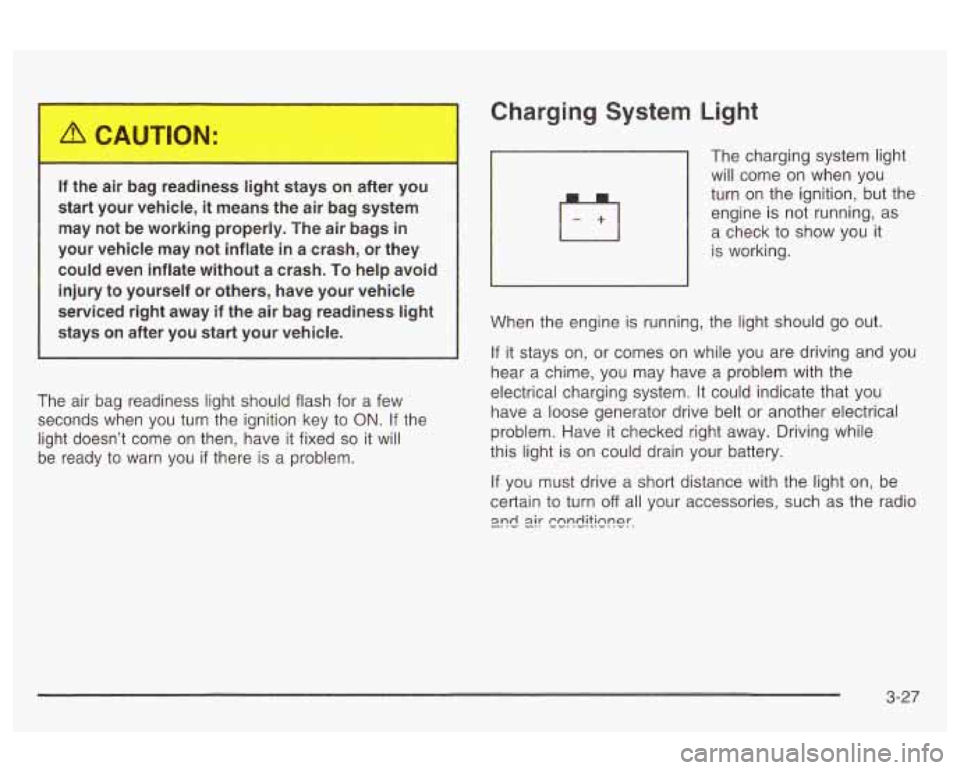
The charging system light
will come on when you
turn on the ignition, but the
engine is not running, as
a check to show you it
is working.
When the engine is running, the light should go out.
If it stays on, or comes on while you are driving and you
hear a chime, you may have a problem with the
electrical charging system. It could indicate that you
have a loose generator drive belt or another electrical
problem. Have it checked right away. Driving while
this light is on could drain your battery.
If you must drive a short distance with the light on, be
certain to turn
off all your accessories, such as the radio
2nd 2i!- c93diti9ner.
3-27