brake light OLDSMOBILE BRAVADA 1994 User Guide
[x] Cancel search | Manufacturer: OLDSMOBILE, Model Year: 1994, Model line: BRAVADA, Model: OLDSMOBILE BRAVADA 1994Pages: 248, PDF Size: 14.54 MB
Page 129 of 248

Driving In Water
Light rain causes no special off-road
driving problems. But heavy rain can
mean flash flooding, and flood waters
demand extreme caution.
Find
out how deep the water is before
you drive through it. If it’s deep enough
to cover your wheel hubs, axles, or
exhaust pipe, don’t
try it - you
probably won’t get through.
Also, water
that deep can damage your axle and
other vehicle parts.
If the water isn’t too deep, then drive
through it slowly. At fast speeds, water
splashes on your ignition system and
your vehicle can stall. Stalling can also
occur
if you get your tailpipe under
water.
And, as long as your tailpipe is
under water, you’ll never be able to
start your engine. When you go through
water, remember that when your brakes
get wet, it may take you longer to stop.
After OtY-Road Driving
Remove any brush or debris that has
collected on the underbody, chassis or
under the hood. These accumulations
can be a fire hazard.
After operation
in mud or sand, have
the brake linings cleaned and checked.
These substances can cause glazing and
uneven braking. Check the body
structure, steering, suspension, wheels,
tires, and exhaust system for damage.
Also, check the fuel lines and cooling
system for any leakage.
Your vehicle
will require more frequent
service due to off-road use. Refer to the
Maintenance Schedule for additional
information.
L
123
ProCarManuals.com
Page 136 of 248

Your Driving and the Road
130
Winter Driving
Here are some tips for winter driving:
Have your Oldsmobile in good shape
for winter. Be sure your engine
coolant mix is correct.
You may want to put winter
emergency supplies in your vehicle.
Include an ice scraper,
a small brush or
broom,
a supply of windshield washer
fluid,
a rag, some winter outer clothing,
a small shovel, a flashlight, a red cloth,
and a couple of reflective warning
triangles. And, if you will be driving
under severe conditions, include a small
bag of sand, a piece of old carpet or a
couple
of burlap bags to help provide
traction. Be sure you properly secure
these items in your vehicle.
Driving on Snow or Ice
Most of the time, those places where
your tires meet the road probably have
good traction.
However,
if there is snow or ice
between your tires and the road, you
can have a very slippery situation.
You’ll have a lot less traction or “grip”
and will need to be very careful.
What’s the worst time for this? “Wet
ice.” Very cold snow or ice can be slick
and hard to drive on. But wet ice can be
even more trouble because it may offer
the least traction of all. You can get
“wet ice” when it’s about freezing
(32°F; 0.C) and freezing rain begins to
fall. Try to avoid driving on wet ice until
salt and sand crews can get there. Whatever
the condition
- smooth ice,
packed, blowing or loose snow
- drive
with caution.
Accelerate gently. Try not to break the
fragile traction. If you accelerate too fast,
the drive wheels will spin and polish the
surface under the tires even more.
Your anti-lock brakes improve your ability to make a hard stop on
a slippery
road. Even though you have an anti-lock
braking system, you’ll want to begin
stopping sooner than you would on dry
pavement. See
Anti-Lock in the Index.
Allow greater following distance on
any slippery road.
Watch for slippery spots. The road
might be fine until you hit a spot
that’s covered with ice. On an
otherwise clear road, ice patches may
appear in shaded areas where the sun
can’t reach: around clumps of trees,
behind buildings, or under bridges.
Sometimes the surface of a curve or
an overpass may remain icy when the
surrounding roads are clear.
If you see
a patch of ice ahead of you, brake
before you are on it. Try not to brake
while you’re actually on the ice, and
avoid sudden steering maneuvers.
ProCarManuals.com
Page 141 of 248
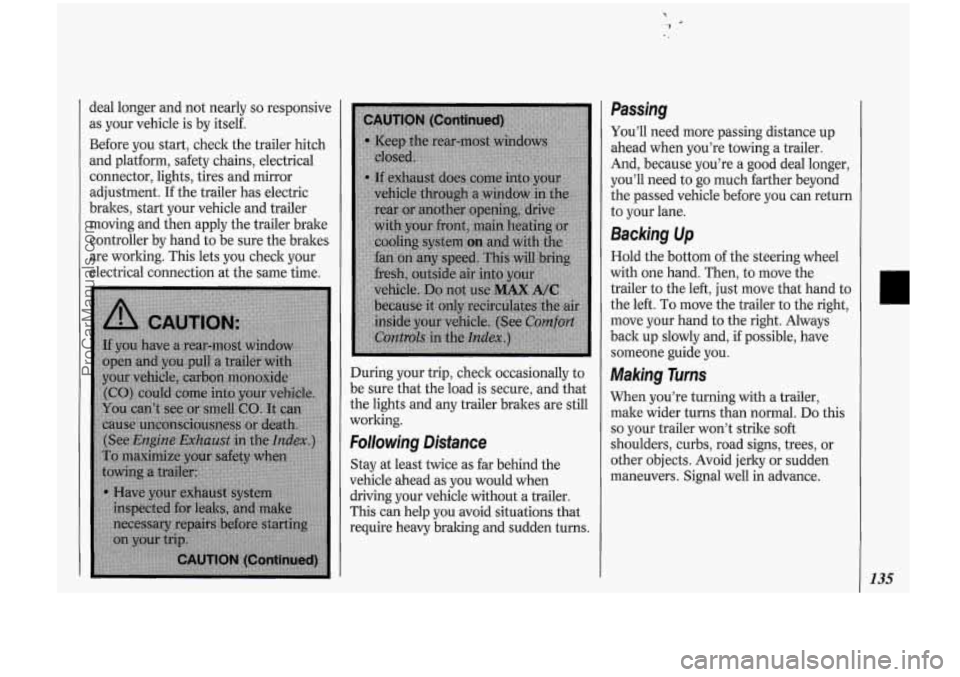
deal longer and not nearly so responsive
as your vehicle is by itself.
Before you start, check the trailer hitch
and platform, safety chains, electrical
connector, lights, tires and mirror
adjustment.
If the trailer has electric
brakes, start your vehicle and trailer
moving and then apply the trailer brake
controller by hand to be sure the brakes
are working. This lets you check your
electrical connection at the same time.
During your trip, check occasionally to
be sure that the load is secure, and that
the lights and any trailer brakes are still
working.
following Distance
Stay at least twice as far behind the
vehicle ahead as you would when
driving your vehicle without a trailer.
This can help
you avoid situations that
require heavy braking and sudden turns.
Passing
You’ll need more passing distance up
ahead when you’re towing a trailer.
And, because you’re a good deal longer,
you’ll need to go much farther beyond
the passed vehicle before you can return
to your lane.
Backing Up
Hold the bottom of the steering wheel
with one hand. Then, to move the
trailer to the left, just move that hand to
the left. To move the trailer to the right,
move your hand to the right. Always
back up slowly and, if possible, have
someone guide you.
Making Turns
When you’re turning with a trailer,
make wider turns than normal. Do this
so your trailer won’t strilte soft
shoulders, curbs, road signs, trees, or
other objects. Avoid jerky or sudden
maneuvers. Signal well in advance.
LI
ProCarManuals.com
Page 142 of 248

Your Driving and the Road
Turn Signals When Towing a
Trailer
When you tow a trailer, your vehicle has
to have a different turn signal flasher
and extra wiring. The green arrows on
your instrument panel will flash
whenever you signal a turn or lane
change. Properly hooked up, the trailer
lights will also flash, telling other
drivers you’re about to turn, change
lanes or stop.
When towing a trailer, the green arrows
on your instrument panel will flash for
turns even if the bulbs on the trailer are
burned out. Thus, you may think
drivers behind you are seeing your
signal when they are not, It’s important
to check occasionally to be sure the
trailer bulbs are still working.
Driving On Grades
Reduce speed and shift to a lower gear
before you start down a long or steep
downgrade. If you don’t shift
down, you
might have to use your brakes
so much
that they would get hot and no longer
work well. On
a long uphill grade, shift down and
reduce your speed
to around 45 mph
(70 km/h) to reduce the possibility of
engine and transmission overheating.
If you are towing a trailer that weighs
more than
3,000 pounds (1 350 kg), it’s
best to drive in
D instead of Overdrive
(or, as you need to, a lower gear). This
will minimize heat build-up and extend
the life of your transmission.
Parking on Hills
You really should not park your vehicle,
with a trailer attached, on a hill.
If
something goes wrong, your rig could
start to move. People can be injured,
and both your vehicle and the trailer
can be damaged.
But if you ever have to park your rig on
a hill, here’s how to do it:
1. Apply your regular brakes, but don’t
shift into
P (Park) yet.
2. Have someone place chocks under
the trailer wheels.
3. When the wheel chocks are in place,
release the regular brakes until the
chocks absorb the load.
4. Reapply the regular brakes. Then
apply your parking brake and then
shift to
P (Park).
5. Release the regular brakes.
When You Are Ready to Leave
After Parking on
a Hill
1. Apply your regular brakes and hold
the pedal down while you:
Start your engine;
Shift into a gear; and
Release the parking brake.
2. Let up on the brake pedal.
3. Drive slowly until the trailer is clear
4. Stop and have someone pick up and
of
the chocks.
store the chocks.
Maintenance When Trailer Towing
Your vehicle will need service more
often when you’re pulling a trailer. See
the Maintenance Schedule for more on
this. Things that are especially
important in trailer operation are
automatic transmission fluid (don’t
overfill), engine oil, axle lubricant, belt,
cooling system, and brake adjustment.
Each of these is covered in this manual,
ProCarManuals.com
Page 143 of 248
and the Index will help you find them
quickly. If you’re trailering, it’s a good
idea to review these sections before
you
start your trip.
Check periodically to see that all hitch
nuts and bolts are tight.
See the next section,
Trailer Wiring
Harness.
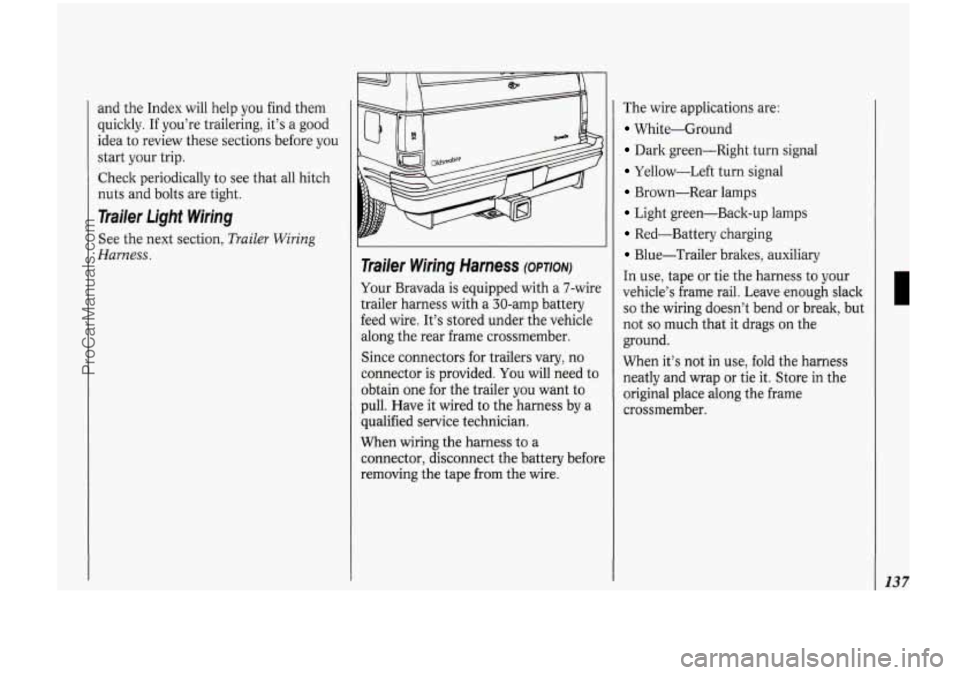
Trailer Wiring Harness (OPTION)
Your Bravada is equipped with a 7-wire
trailer harness with a 30-amp battery
feed wire. It’s stored under the vehicle
along the rear frame crossmember.
Since connectors for trailers vary, no
connector is provided.
You will need to
obtain one for the trailer
you want to
pull. Have it wired to the harness by a
qualified service technician.
When wiring the harness to a
connector, disconnect the battery before
removing the tape from the wire. The
wire applications are:
White-Ground
Dark green-Right turn signal
Yellow-Left turn signal
Brown-Rear lamps
Light green-Back-up lamps
Red-Battery charging
Blue-Trailer brakes, auxiliary
In use, tape or tie the harness to your
vehicle’s frame rail. Leave enough slack
so the wiring doesn’t bend or break, but
not
so much that it drags on the
ground.
When it’s not in use, fold the harness
neatly and wrap or tie it. Store in the
original place along the frame
crossmember.
137
ProCarManuals.com
Page 147 of 248

NOTICE:
~~
Ignoring these steps could result in
costly damage to your vehicle that
wouldn’t be covered by your
warranty. Trying to start your
Oldsmobile by pushing or pulling it
won’t work, and it could damage
your vehicle.
To Jump Start Your Oldsmobile:
1. Check the other vehicle. It must have
a 12-volt battery with a negative
ground system.
NOTICE:
If the other system isn’t a 12-volt
system with a negative ground,
both vehicles can be damaged.
2. Get the vehicles close enough so the
jumper cables can reach, but be sure
the vehicles aren’t touching each
other. If they are, it could cause a
ground connection you don’t want.
You wouldn’t be able to start your
Oldsmobile, and the bad grounding
could damage the electrical systems.
You could be injured if the vehicles roll.
Set the parking brake
firmly on each
vehicle. Put an automatic transmission
in P (Park) or a manual transmission in
N (Neutral).
3. Turn off the ignition on both
vehicles. Turn
off all lights that aren’t
needed, and radios. This will avoid
sparks and help save both batteries.
And it could save your radio!
NOTICE:
If you leave your radio on, it could
be badly damaged. The repairs
wouldn’t be covered by your
warranty.
4. Open the hoods and locate the
batteries. Find the positive
(+) and
negative
(-) terminals on each
battery.
II
141
ProCarManuals.com
Page 151 of 248

When your vehicle is being towed, have
the ignition key off. The steering wheel
should be clamped in a straight-ahead
position, with a clamping device
designed for towing service.
Do not use
the vehicle’s steering column lock for
this. The transmission should be in
P (Park) and the parking brake
released.
Don’t have your Bravada towed with
the wheels in contact with the ground.
If your vehicle is being towed with
sling-type or wheel-lift equipment,
either the front or rear wheels must be
supported on a dolly.
If towing your Bravada with a car
carrier, block supports may be required
to prevent damage to the vehicle.
Engine Overheating
You will find a coolant temperature
;age and the warning light about
a hot
mgine on your Oldsmobile’s instrument
)anel.
If Steam Is Coming From Your
Engine
!45
ProCarManuals.com
Page 185 of 248

NOTICE:
DOT-5 silicone brake fluid can
Don’t let someone put in the
damage
your vehicle. Don’t use it.
wrong kind of fluid. For example,
just a few drops of mineral-based
oil, such as engine oil, in your
brake system can damage brake
system parts
so badly that they’ll
have to be replaced.
Brake fluid can damage paint, so
be careful not to spill brake fluid
on your vehicle. If you do, wash it
off immediately. See Appearance
Care
in the Index.
Brake Wear
Your Oldsmobile has front disc brakes
and rear
drum brakes.
Disc brake pads have built-in wear
indicators that make a high-pitched
warning sound when the brake pads are
worn and new pads are needed. The
sound may come and go or be heard all
the time your vehicle is moving (except
when you are pushing
on the brake
pedal firmly).
I NOTICE:
I
Continuing to drive with worn-out
brake pads could result in costly
brake repair.
Some driving conditions or climates
may cause a brake squeal when the
brakes are first applied or lightly
applied. This does not mean something
is wrong with your brakes.
Your rear
drum brakes don’t have wear
indicators, but if you ever hear a rear
brake rubbing noise, have the rear brake
linings inspected.
Also, the rear brake
drums should be removed and
inspected each time the tires are
removed for rotation or changing. When you
have the front brakes replaced,
have the rear brakes inspected, too.
Brake linings should always be replaced
as complete axle sets.
Brake Pedal Travel
See your dealer if the brake pedal does
not return
to normal height, or if there
is a rapid increase in pedal travel.
This
could be a sign of brake trouble.
Brake Adjustment
Every time you make a brake stop, your
disc brakes adjust for wear.
If your brake pedal goes down farther
than normal, your rear drum brakes
may need adjustment. Adjust them by
backing up and firmly applying the
brakes a few times.
Replacing Brake System Parts
The braking system on a modern vehicle
is complex. Its many parts have to be of
top quality and work well together
if the
vehicle is to have really good braking.
Vehicles we design and test have top-
quality
GM brake parts in them, as your
Oldsmobile does when it is new. When
you replace parts
of your braking system
- for example, when your brake linings 179
ProCarManuals.com
Page 196 of 248

Service & Appearance Care
190
NOTICE:
The wrong wheel can also cause
problems with bearing life, brake
cooling, speedometer/odometer calibration, headlight aim, bumper
height, vehicle ground clearance,
and tire clearance to the body and
chassis.
Used Replacement Wheels
Tire Chains
NOTICE:
Don’t use tire chains; they can
damage your vehicle.
I Appearance Care
Remember, cleaning products can be
hazardous. Some are toxic. Others can
burst into flame if you strike a match or
get them
on a hot part of the vehicle.
Some are dangerous
if you breathe their
fumes in a closed space. When
you use
anything from a container to clean your
Oldsmobile, be sure to follow the
manufacturer’s warnings and
instructions. And always open your
doors or windows when you’re cleaning
the inside.
Never use these to clean your vehicle:
Gasoline
Benzene
Naphtha
Carbon Tetrachloride
Acetone
Paint Thinner
Turpentine
Lacquer Thinner
Nail Polish Remover
They can all be hazardous
- some
more than others
- and they can all
damage your vehicle, too.
NOTICE:
Don’t use any of these unless this
manual says you can. In many uses,
these will damage your vehicle:
Laundry Soap
Bleach
Reducing Agents
I Cleaning the Inside of Your
Oldsmobile
Use a vacuum cleaner often to get rid of
dust and loose dirt. Wipe vinyl or
leather with a clean, damp cloth.
Your Oldsmobile dealer has two
GM
cleaners, a solvent-type spot lifter and a
foam-type powdered cleaner. They will
clean normal spots and stains very well.
Do not use them
on vinyl or leather.
ProCarManuals.com
Page 203 of 248

INST LPS PWR ACC
HORNIDM IGNIGAU BRAKE STOPIHAZ
h TAIL LPS TURNIBU HTR A/C RADIO
%se Usage
Position
INST LPS
PWR ACC
HORN/DM
IGN/GAU BRAKE
STOP/HAZ
TAIL LPS
TURNDU HTR A/C RADIO
ECM B
ECM I
PWR WDO
WIPER
CRANK
TRAILER*
Rating
(AMP.)
5
30
20
20
15
15
20
15
25
15
15
10
30
25
3
30
UNDERHOOD':' 4
CD PLAYER 10
"In-line fuse.
Circuitry
Instrument Panel Lights, Headlight Warning Buzzer, Heater
Light, Ashtray Light, Radio Illumination Light, Rear Wiper
Switch Light
Power Door Locks, Rear Defogger, Console Accessory
Receptacles, CD Player
Horn, Dome Lights, Glove
Box Light, Clock, Lighter, Lighted
Vanity Mirror, Outside Rearview Mirror, Courtesy Lights
Indicator Lights and Gages, Rear Defogger Relay, Cruise
Control, Rear Defogger Switch, Seat Belt Timer
Four Wheel Anti-lock Brake Module, Digital Ratio Adapter
Module (Speedometer)
Stop Lights, Hazard Warning Lights, Chime Module, Center
High Mounted Stop Light (CHMSL)
Light Switch, TaiVPark Lights, Electronic Cluster, License Light
Turn Signals
& Back-up Lights
Heating and Air Conditioning
Radio, Inside Rearview Mirror Map Lights, Rear Wiper, Rear
Washer, Compass
Electronic Control Module, Fuel Pump
Electronic Control Module
Power Windows
Windshield Wipers and Washer
Electronic Control Module
Trailer Wiring Harness
Underhood Light
CD Player (attached to fuse block)
197
ProCarManuals.com