light OLDSMOBILE BRAVADA 1994 Owner's Guide
[x] Cancel search | Manufacturer: OLDSMOBILE, Model Year: 1994, Model line: BRAVADA, Model: OLDSMOBILE BRAVADA 1994Pages: 248, PDF Size: 14.54 MB
Page 96 of 248

Features & Controls
90
CHECK
OAGES
Battery Light (STANDARD CLUSTER)
The battery light will come on briefly
when you turn on the ignition as a
check to show you it is working. It
should go out once the engine
is
running. If it stays on, or comes on
while you are driving, you may have a
loose belt or other problem with the
electrical charging system. Have it
checked right away. Driving while this
light is on could drain your battery.
If
you must drive a short distance with
the light
on, be certain to turn off all
your accessories, such as the radio and
air conditioner.
I
CHECK
GAGES
Check Gages Ljght
(STANDARD CLUSTER)
This light will come on briefly when you
are starting the engine. If the light
comes on and stays on while you are
driving, check your various gages to see
if they are in the warning zones.
ProCarManuals.com
Page 98 of 248

Comfort Cont'rok &Audio Systems
LO HI
Climate Control System
Your vehicle's heater and air
conditioner work best
if you keep your
windows closed. Your vehicle also has
flow-through ventilation, described later
in this section, to bring outside air into
your vehicle.
3f Fan Lever: The lever at the top has
four positions. Move it toward
HI to
increase the air flow. To decrease the
air flow, move it toward
LO.
Temperature Lever: Slide the lever on
the left to control the temperature of the
air flow into the vehicle. Move the lever
up for warmer air, down for cooler air.
Function Lever: Slide the lever on the
right to select the function desired. The
air conditioner compressor will operate
in all settings except
VENT and HTR
(Heater) when the outside temperature
is above freezing. When the air
conditioner compressor cycles
on, you
may sometimes notice slight changes in
your vehicle's engine performance and
power. This is normal, because the
system is designed to keep the desired
cooling level and help fuel economy. There are
three air conditioning
settings:
MAX A/C, NORM A/C, and
BI-LEV A/C. On very hot days, your
vehicle will cool down more quickly and
economically in any of these settings
if
you open the windows long enough to
let hot inside air escape. For all settings,
adjust the temperature control lever and
fan speed as desired.
MAX A/C: Select this setting to get
maximum cooling or quick cool-down
on very hot days. This setting
recirculates much of the air inside your
vehicle. It should not be used for long
periods
of time because the air may
become too cold and dry.
Also slide the temperature control lever
down to the coolest setting and adjust
the fan speed as desired.
NORM A/C: Use this setting for
normal cooling on hot days. This setting
cools outside air and directs it through
the instrument panel outlets.
BI-LEV A/C: Use on cool but sunny
days. This setting brings in outside air,
but directs it two ways-through the
instrument panel outlets and the heater
ProCarManuals.com
Page 100 of 248

Comfort Con&ols &Audio Systems
94
Rear Window Defogger
Press ON to warm the defogger grid on
:he rear window. The indicator light
will glow while the rear window
iefogger is operating. The defogger will
:urn off automatically after about
10
ninutes. If you turn it on again, the
iefogger will operate for about five
ninutes only.
You can turn the defogger
Iff by turning off the ignition or
?ressing
OFF.
Do not attach a temporary vehicle
.icense across the defogger grid on the
:ear window.
NOTICE:
Don't use a razor blade or
something else sharp on the inside
of the rear window. If you do, you
could cut or damage the warming
grid, and the repairs wouldn't be
covered by your warranty.
Flow-Through Ventilation System
Your vehicle's flow-through ventilation
system supplies outside air into the
vehicle when
it is moving. Outside air
will also enter the vehicle when the
heater
or the air conditioning fan is
running.
Ventilation Tips
Keep the hood and front air inlet free
of ice, snow, or any other obstruction
(such as leaves). The heater and
defroster will work far better,
reducing the chance of fogging the
inside
of your windows.
weather, slide the function lever to
HTR and turn the blower fan to HI
for a few moments before driving off.
When you enter a vehicle in cold
ProCarManuals.com
Page 103 of 248

AmSt: When you’re tuned to an AM
station that broadcasts
in stereo, the
STEREO light will come on. If the
signal is weak, press
AmSt to turn the
feature
off. You’ll get better reception.
Press
AmSt again to turn the feature
back on for strong signals.
SEEK Each time you press SEEK, you
will tune
in the next station on the AM
or FM radio band.
SCAN: Press to listen for a few seconds
to the next station on the AM or FM
band; the scan
will continue every few
seconds until you either press
SCAN
again or press the VOLBAL knob to
stop on a particular station.
To Preset Radio Stations:
The four pushbuttons can be used to
preset up to
14 radio stations (seven
AM and seven FM stations).
1. Turn the lower control knob (TUNE)
to the station you want.
2. Press SET. The SET indicator will
appear
on the digital screen for five
seconds.
3. While the SET indicator is displayed,
press one of the four pushbuttons.
The station is now preset. You can
tune to it immediately by pressing the
same button.
4. Repeat steps 1-3 for each of four AM
and four FM stations. ~. ,.I
Up to three additional stati6flS bn.each
band may be preset by “pairing”
pushbuttons:
1. Tune in the desired station.
2. Press SET, and within five seconds
press any two adjacent pushbuttons
at the same time.
3. The station can be tuned in when the
same
two pushbuttons are pressed at
the same time.
To Play a Cassette Tape:
Press PWR (Power) to turn the radio
on. Then push a cassette into the
cassette entry door (the tape side goes
in first). Using tapes that are longer
than
90 minutes (45 minutes on each
side) is not recommended.
FWD (Fast Forward): Press to advance
the tape rapidly; press again to play.
REV (Reverse): Press to reverse the
tape rapidly; press again to play tape.
SEARCH: Push this switch to the right
and the
FWD and REV buttons will
function as a “music search,” stopping
the tape at the next selection on the
tape. (There must be at least a 3-second
gap between selections
on the tape.)
The
ON light will indicate the music
search is selected.
Program: Press the VOL-BAL knob to
change the side of tape being played.
When the arrow pointing up is lighted,
the selections listed on the top side of
the tape are played. When the
arrow
pointing down is lighted, selections
listed on the bottom side of the tape are
played. The tape player automatically
begins playing the other side when
it
reaches the end of the tape.
Cr02: This button sets tape bias. When
playing high bias chrome or metal tapes,
press the button to turn the button light
on. When playing standard tapes, press
again to turn the light
off.
EJECT Press to have the cassette tape
ejected (the radio will then play). The
cassette tape
will be ejected automatically
when the radio is turned
off.
L
97
ProCarManuals.com
Page 107 of 248

To Unlock After a Power Loss:
When battery power is lost and then
resupplied to a secured unit,
LOC will
appear on the display. Follow these
steps to unlock the unit:
1. Turn the ignition to the Accessory or
2. Make sure the radio is off.
3. Press SET. The display will show
4. Press SEEK to the right and hold it
Run position.
000.
until the second and third numbers of
your secret code appear.
5. Press SCAN until the first number of
your secret code appears.
6. Press BAND-TUNE. The display will
show 000.
7. Press SEEK to the right and hold it
until the fifth and sixth numbers of
your secret code appear.
8. Press SCAN until the fourth number
of your secret code appears.
9. Press BAND-TUNE. If the display
shows the time of day, the unit is no
longer locked. If the display shows
LOC, it is still secured (the numbers
did not match either your secret code
or the factory’s back-up code).
Understanding Radio Reception
FM Stereo
FM Stereo will give you the best sound,
but FM signals will reach only about
10
to 40 miles (16 to 65 km). Tall buildings
or hills can interfere with FM signals,
causing the sound to come and go.
AM
The range for most AM stations is
greater than for FM, especially at night.
The longer range, however, can cause
stations to interfere with each other.
AM can also pick up noise from things
like storms and power lines. To lower
this noise, try reducing the treble level.
AM Stereo
Your Delco@ system may be able to
receive C-QuamB stereo broadcasts.
Many AM stations around the country
use C-Quam@ to produce stereo,
though some do not. C-Quam@
is a
registered trademark of Motorola, Inc.
If your Delco@ system can get C-
Quam@ signals, your stereo indicator
light will come
on when you are
receiving it.
ProCarManuals.com
Page 108 of 248

Comfort Controls &Audio Systems
102
Care of Your Cassette Tape
Player
A tape player that is not cleaned
regularly is subject to reduced sound
quality, ruining the cassette, or
damaging the mechanism. Tape
cassettes that are not properly stored in
their plastic cases away from
contaminants, direct sunlight, and
extreme heat may not operate properly
and could cause premature failure of
the tape player.
Your tape player should be cleaned
monthly or with every
15 hours of use,
as regular maintenance. If you notice a
reduction in sound quality,
try a good
cassette to see if the tape or the tape
1
player is at fault. If the second cassette
results in no improvement in sound
quality, try cleaning the tape player.
Proper tape player cleaning should be
done with a
wiping action nonabrasive
cleaner cassette.
To properly clean your
tape player,
you should follow the
directions on the cleaning cassette.
Cassettes are subject to wear and the
sound quality may degrade over time.
Always verify that the cassette tape is in
good condition before obtaining service
on your tape player.
Care of Your Compact Discs
Handle discs carefully. Store them in
their original cases or other protective
cases and away from direct sunlight and
dust. If the surface of a disc is soiled,
dampen a clean, soft cloth in a mild,
neutral detergent solution and clean it,
wiping from the center to the edge.
Be sure never to touch the signal
surface when handling discs. Pick up
discs by grasping the outer edges or the
edge of the hole and the outer edge.
ProCarManuals.com
Page 109 of 248
Fixed Mast Antenna
The fixed mast antenna can withstand
most car washes without being
damaged.
If the mast should ever
become slightly bent, you can straighten
it out by hand.
If the mast is badly bent,
as
it might be by vandals, you should
replace it.
Check every once in a while to be sure
the mast is still tightened to the fender.
103
ProCarManuals.com
Page 113 of 248
1
1
I
I
1 r
E
e
1
1
1
t
I
I
c
I
j
i
~~
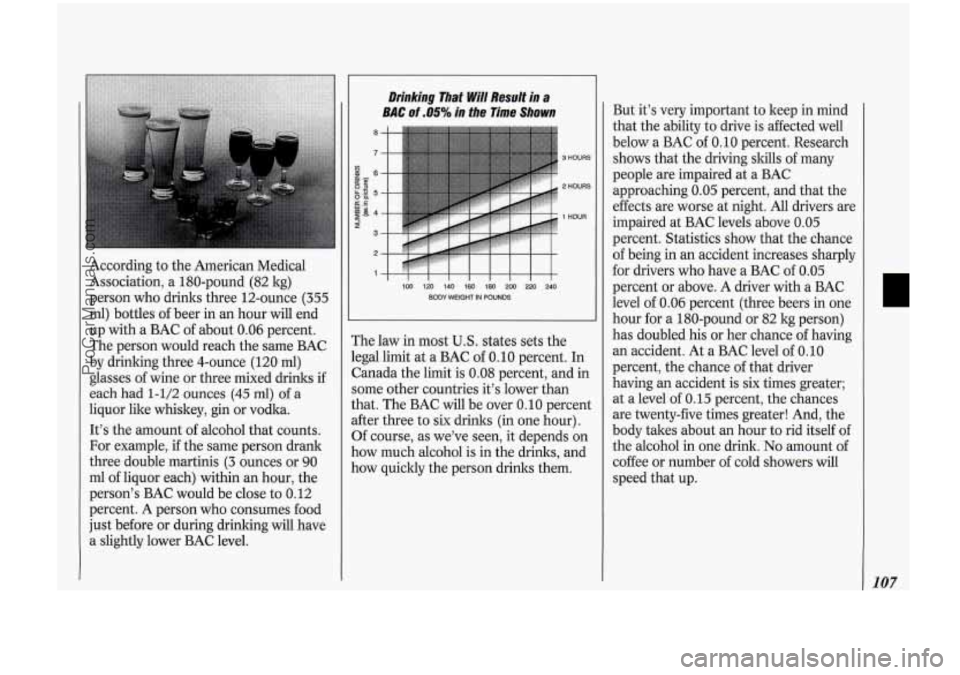
Qccording to the American Medical
Qssociation, a 180-pound (82 kg)
?erson
who drinks three 12-ounce (355
nl) bottles of beer in an hour will end
~p with a
BAC of about 0.06 percent.
The person would reach the same
BAC
)y drinking three 4-ounce (120 ml)
glasses of wine or three mixed drinks if
?ach had 1-1/2 ounces (45 ml) of a
iquor like whiskey, gin or vodka.
It’s the amount
of alcohol that counts.
?or example,
if the same person drank
:hree double martinis
(3 ounces or 90
nl of liquor each) within an hour, the
?erson’s
BAC would be close to 0.12
sercent.
A person who consumes food
ust before or during drinking
will have
slightly lower
BAC level.
r
~ ~~
rhe law in most U.S. states sets the
legal
lirnit at a BAC of 0.10 percent. In
Canada the
limit is 0.08 percent, and in
some other countries
it’s lower than
that. The
BAC will be over 0.10 percent
after three to
six drinks (in one hour).
Of course, as we’ve seen, it depends on
how much alcohol’is in the
drinks, and
how quickly the person drinks them. But
it’s very
important to keep in mind
that the ability to drive
is affected well
below
a BAC of 0.10 percent. Research
shows that the driving skills
of many
people are impaired at
a &IC
approaching 0.05 percent, and that the
effects are worse at night.
All drivers are
impaired at
BAC levels above 0.05
percent. Statistics show that the chance
of being in an accident increases sharply
for drivers who have a BAC of 0.05
percent or above. A driver with a BAC
level of -0.06 percent (three beers in one
hour for a 180-pound or
82 kg person)
has doubled
his or her chance of having
an accident.
At a BAC level of 0.10
percent, the chance
of that driver
having
an accident is six times greater;
at a level
of 0.15 percent, the chances
are twenty-five times greater! And, the
body takes about an hour to rid itself
of
the alcohol in one drink. No amount of
coffee or number of cold showers will
speed that up.
107
ProCarManuals.com
Page 118 of 248
Your Driving and the Road
112
Steering in Emergencies
There are times when steering can be
more effective than braking. For
example, you come over a hill and find
a truck stopped in your lane,
or a car
suddenly pulls out from nowhere, or a
child darts out from between parked
cars and stops right in front of you.
You
can avoid these problems by braking -
if you can stop in time. But sometimes
you can’t; there isn’t room. That’s the
time for evasive action
- steering
around the problem.
Your Oldsmobile can perform very well
in emergemies like these. First apply
your brakes. It is better to remove as
much speed as
you can from a possible collision. Then
xeer around the
problem, to the left or right depending
on the space available.
An emergency like this requires close
attention and
a quick decision. If you
are holding the steering wheel at the
recommended
9 and 3 o’clock positions,
you can turn it a
full 180 degrees very
quickly without removing either hand.
But you have to act fast, steer quickly,
and just as quickly straighten the wheel
once
you have avoided the object.
The fact that such emergency situations
are always possible is
a good reason to
practice defensive driving at all times
and wear safety belts properly.
, IOFF ROAD RECOVERY /
Off-Road Recovery
You may find sometime that your right
wheels have dropped off the edge of a
road onto the shoulder while you’re
driving.
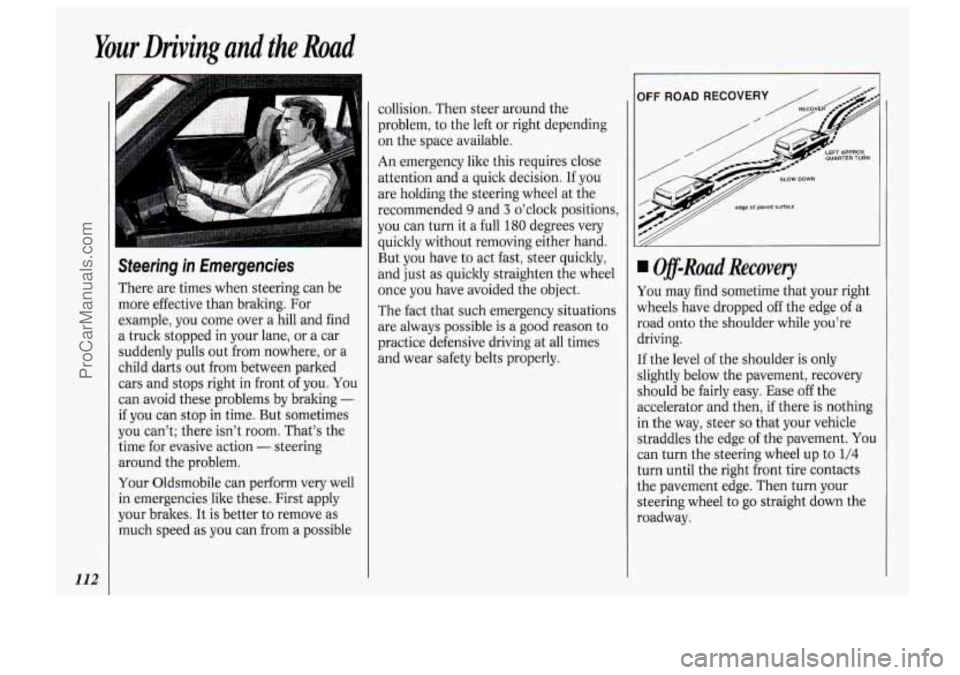
If the level of the shoulder is only
slightly below the pavement, recovery
should be fairly easy. Ease
off the
accelerator and then, if there is nothing
in the way, steer
so that your vehicle
straddles the edge of the pavement.
You
can turn the steering wheel up to 1/4
turn until the right front tire contacts
the pavement edge. Then turn your
steering wheel to
go straight down the
roadway.
ProCarManuals.com
Page 119 of 248

Passing
The driver of a vehicle about to pass
another on a two-lane highway waits for
just the right moment, accelerates,
moves around the vehicle ahead, then
goes back into the right lane again.
A
simple maneuver?
Not necessarily! Passing another vehicle
on a two-lane highway is a potentially
dangerous move, since the passing
vehicle occupies the same lane as
oncoming traffic for several seconds.
A
miscalculation, an error in judgment, or
a brief surrender to frustration or anger
can suddenly put the passing driver face
to face with the worst of all traffic
accidents
- the head-on collision.
So here are some tips for passing:
“Drive ahead.” Look down the road,
to the sides, and to crossroads for
situations that might affect your
passing patterns. If you have any
doubt whatsoever about making a
successful pass, wait for a better time.
markings, and lines. If you can see a
sign up ahead that might indicate a
turn or an intersection, delay your
Watch for traffic signs, pavement pass.
A broken
center line usually
indicates it’s all right to pass
(providing the road ahead
is clear).
Never cross a solid line on your side
of the lane or a double solid line, even
if the road seems empty of
approaching traffic.
Do not get too close to the vehicle you
want to pass while you’re awaiting an
opportunity. For one thing, following
too closely reduces your area of vision,
especially
if you’re following a larger
vehicle.
Also, you won’t have
adequate space
if the vehicle ahead
suddenly slows or stops. Keep back a
reasonable distance.
When it looks like a chance to pass is
coming up, start to accelerate but stay
in the right lane and don’t get too close.
Time your move
so you will be
increasing speed as the time comes to
move into the other lane. If the way is
clear to pass, you
will have a “running
start” that more than makes up for the
distance you would lose by dropping
back. And
if something happens to
cause you to cancel your pass, you need
only slow down and drop back again
and wait for another opportunity.
If other cars are lined up to pass a
slow vehicle, wait your turn. But take
care that.someone isn’t trying to pass
you as you pull out to pass the slow
vehicle. Remember to glance over your
shoulder and check the blind spot.
Check your mirrors, glance over your
shoulder, and start your left lane
change signal before moving out of the
right lane to pass. When you are far
enough ahead of the passed vehicle to
see its front in your inside mirror,
activate your right lane change signal
and move back into the right lane.
(Remember that your right outside
mirror is convex. The vehicle you just
passed may seem to be farther away
from
you than it really is.)
Try not to pass more than one vehicle
at a time on two-lane roads. Reconsider
before passing the next vehicle.
Don’t overtake a slowly moving
vehicle
too rapidly. Even though the
brake lights are not flashing, it may be
slowing down or starting to turn.
If you’re being passed, make it easy
for the following driver to get ahead of
you. Perhaps you can ease a little to
the right.
113
ProCarManuals.com