light OLDSMOBILE BRAVADA 1994 Workshop Manual
[x] Cancel search | Manufacturer: OLDSMOBILE, Model Year: 1994, Model line: BRAVADA, Model: OLDSMOBILE BRAVADA 1994Pages: 248, PDF Size: 14.54 MB
Page 141 of 248
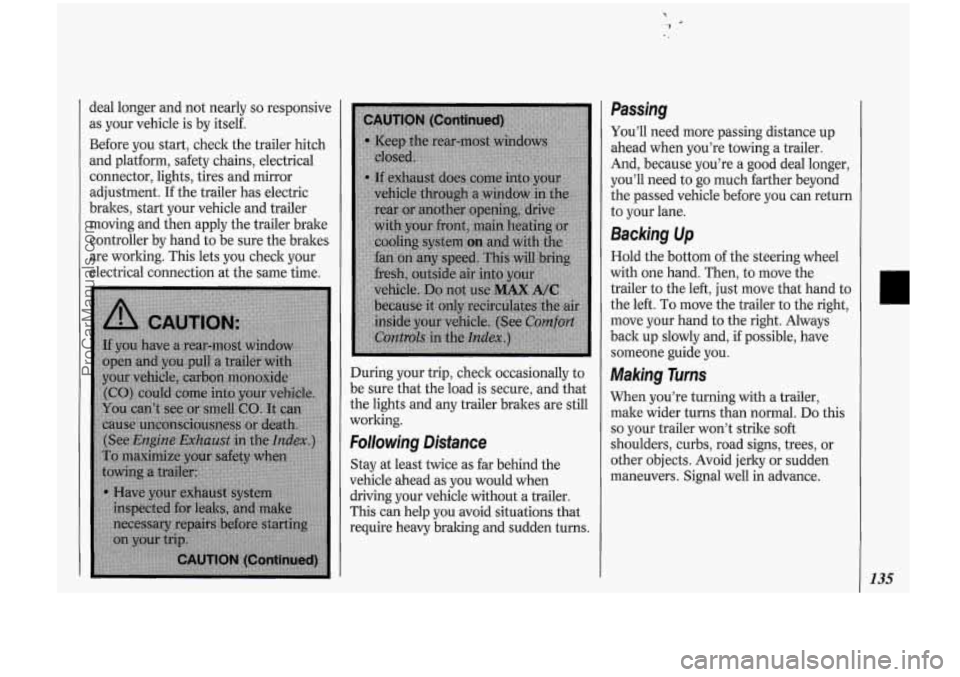
deal longer and not nearly so responsive
as your vehicle is by itself.
Before you start, check the trailer hitch
and platform, safety chains, electrical
connector, lights, tires and mirror
adjustment.
If the trailer has electric
brakes, start your vehicle and trailer
moving and then apply the trailer brake
controller by hand to be sure the brakes
are working. This lets you check your
electrical connection at the same time.
During your trip, check occasionally to
be sure that the load is secure, and that
the lights and any trailer brakes are still
working.
following Distance
Stay at least twice as far behind the
vehicle ahead as you would when
driving your vehicle without a trailer.
This can help
you avoid situations that
require heavy braking and sudden turns.
Passing
You’ll need more passing distance up
ahead when you’re towing a trailer.
And, because you’re a good deal longer,
you’ll need to go much farther beyond
the passed vehicle before you can return
to your lane.
Backing Up
Hold the bottom of the steering wheel
with one hand. Then, to move the
trailer to the left, just move that hand to
the left. To move the trailer to the right,
move your hand to the right. Always
back up slowly and, if possible, have
someone guide you.
Making Turns
When you’re turning with a trailer,
make wider turns than normal. Do this
so your trailer won’t strilte soft
shoulders, curbs, road signs, trees, or
other objects. Avoid jerky or sudden
maneuvers. Signal well in advance.
LI
ProCarManuals.com
Page 142 of 248

Your Driving and the Road
Turn Signals When Towing a
Trailer
When you tow a trailer, your vehicle has
to have a different turn signal flasher
and extra wiring. The green arrows on
your instrument panel will flash
whenever you signal a turn or lane
change. Properly hooked up, the trailer
lights will also flash, telling other
drivers you’re about to turn, change
lanes or stop.
When towing a trailer, the green arrows
on your instrument panel will flash for
turns even if the bulbs on the trailer are
burned out. Thus, you may think
drivers behind you are seeing your
signal when they are not, It’s important
to check occasionally to be sure the
trailer bulbs are still working.
Driving On Grades
Reduce speed and shift to a lower gear
before you start down a long or steep
downgrade. If you don’t shift
down, you
might have to use your brakes
so much
that they would get hot and no longer
work well. On
a long uphill grade, shift down and
reduce your speed
to around 45 mph
(70 km/h) to reduce the possibility of
engine and transmission overheating.
If you are towing a trailer that weighs
more than
3,000 pounds (1 350 kg), it’s
best to drive in
D instead of Overdrive
(or, as you need to, a lower gear). This
will minimize heat build-up and extend
the life of your transmission.
Parking on Hills
You really should not park your vehicle,
with a trailer attached, on a hill.
If
something goes wrong, your rig could
start to move. People can be injured,
and both your vehicle and the trailer
can be damaged.
But if you ever have to park your rig on
a hill, here’s how to do it:
1. Apply your regular brakes, but don’t
shift into
P (Park) yet.
2. Have someone place chocks under
the trailer wheels.
3. When the wheel chocks are in place,
release the regular brakes until the
chocks absorb the load.
4. Reapply the regular brakes. Then
apply your parking brake and then
shift to
P (Park).
5. Release the regular brakes.
When You Are Ready to Leave
After Parking on
a Hill
1. Apply your regular brakes and hold
the pedal down while you:
Start your engine;
Shift into a gear; and
Release the parking brake.
2. Let up on the brake pedal.
3. Drive slowly until the trailer is clear
4. Stop and have someone pick up and
of
the chocks.
store the chocks.
Maintenance When Trailer Towing
Your vehicle will need service more
often when you’re pulling a trailer. See
the Maintenance Schedule for more on
this. Things that are especially
important in trailer operation are
automatic transmission fluid (don’t
overfill), engine oil, axle lubricant, belt,
cooling system, and brake adjustment.
Each of these is covered in this manual,
ProCarManuals.com
Page 143 of 248
and the Index will help you find them
quickly. If you’re trailering, it’s a good
idea to review these sections before
you
start your trip.
Check periodically to see that all hitch
nuts and bolts are tight.
See the next section,
Trailer Wiring
Harness.
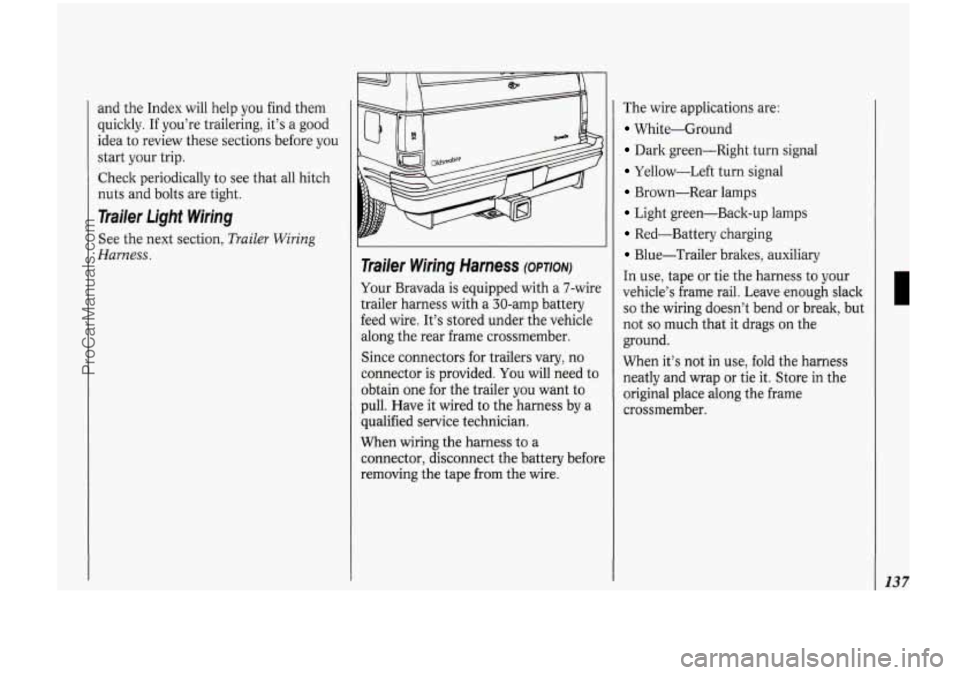
Trailer Wiring Harness (OPTION)
Your Bravada is equipped with a 7-wire
trailer harness with a 30-amp battery
feed wire. It’s stored under the vehicle
along the rear frame crossmember.
Since connectors for trailers vary, no
connector is provided.
You will need to
obtain one for the trailer
you want to
pull. Have it wired to the harness by a
qualified service technician.
When wiring the harness to a
connector, disconnect the battery before
removing the tape from the wire. The
wire applications are:
White-Ground
Dark green-Right turn signal
Yellow-Left turn signal
Brown-Rear lamps
Light green-Back-up lamps
Red-Battery charging
Blue-Trailer brakes, auxiliary
In use, tape or tie the harness to your
vehicle’s frame rail. Leave enough slack
so the wiring doesn’t bend or break, but
not
so much that it drags on the
ground.
When it’s not in use, fold the harness
neatly and wrap or tie it. Store in the
original place along the frame
crossmember.
137
ProCarManuals.com
Page 146 of 248

Probkms on the Road
140
I Hazard Warning Flashers
Your hazard warning flashers let you
warn others. They also let police know
you have a problem. Your front and rear
turn signal lights will flash on and off.
But they won’t flash if you’re braking. Press
the button in to make your front
md rear turn signal lights flash on and
3ff.
Your hazard warning flashers work no
natter what position your key is in, and
wen if the key isn’t in.
To turn off the flashers, pull out on the
collar.
When the hazard warning flashers are
on, your turn signals won’t work.
Other Warning Devices
If you carry reflective triangles, you can
set one up at the side of the road about
300 feet (1 00 m) behind your vehicle.
Jump Starting
If your battery has run down, you may
want to use another vehicle and some
jumper cables to start your Oldsmobile.
But please follow the steps below to do
it safely.
ProCarManuals.com
Page 147 of 248

NOTICE:
~~
Ignoring these steps could result in
costly damage to your vehicle that
wouldn’t be covered by your
warranty. Trying to start your
Oldsmobile by pushing or pulling it
won’t work, and it could damage
your vehicle.
To Jump Start Your Oldsmobile:
1. Check the other vehicle. It must have
a 12-volt battery with a negative
ground system.
NOTICE:
If the other system isn’t a 12-volt
system with a negative ground,
both vehicles can be damaged.
2. Get the vehicles close enough so the
jumper cables can reach, but be sure
the vehicles aren’t touching each
other. If they are, it could cause a
ground connection you don’t want.
You wouldn’t be able to start your
Oldsmobile, and the bad grounding
could damage the electrical systems.
You could be injured if the vehicles roll.
Set the parking brake
firmly on each
vehicle. Put an automatic transmission
in P (Park) or a manual transmission in
N (Neutral).
3. Turn off the ignition on both
vehicles. Turn
off all lights that aren’t
needed, and radios. This will avoid
sparks and help save both batteries.
And it could save your radio!
NOTICE:
If you leave your radio on, it could
be badly damaged. The repairs
wouldn’t be covered by your
warranty.
4. Open the hoods and locate the
batteries. Find the positive
(+) and
negative
(-) terminals on each
battery.
II
141
ProCarManuals.com
Page 151 of 248

When your vehicle is being towed, have
the ignition key off. The steering wheel
should be clamped in a straight-ahead
position, with a clamping device
designed for towing service.
Do not use
the vehicle’s steering column lock for
this. The transmission should be in
P (Park) and the parking brake
released.
Don’t have your Bravada towed with
the wheels in contact with the ground.
If your vehicle is being towed with
sling-type or wheel-lift equipment,
either the front or rear wheels must be
supported on a dolly.
If towing your Bravada with a car
carrier, block supports may be required
to prevent damage to the vehicle.
Engine Overheating
You will find a coolant temperature
;age and the warning light about
a hot
mgine on your Oldsmobile’s instrument
)anel.
If Steam Is Coming From Your
Engine
!45
ProCarManuals.com
Page 165 of 248
NOTICE:
Spinning your wheels can destroy
parts
of your vehicle as well as the
tires.
If you spin the wheels too fast
while shifting your transmission
back and forth, you can destroy
your transmission.
Rocking Your Vehicle to Get it Out:
First, turn your steering wheel left and
right. That will clear the area around
your front wheels. Then shift back and
forth between
R (Reverse) and a
forward gear, spinning the wheels as
little as possible. Release the accelerator
pedal while you shift, and press lightly
on the accelerator pedal when the
transmission
is in gear. If that doesn’t
get you out after a few tries, you may
need
to be towed out. If you do need to
be towed out, see
Towing Your Truck
in the Index.
159
ProCarManuals.com
Page 169 of 248

Fuel
Use regular unleaded gasoline rated at
87 octane or higher. Use premium
unleaded gasoline rated at 91 octane or
higher for high power performance,
when towing a trailer or with a high
payload requirement. But when
operating with a light load as
a normal
condition, you may use middle grade or
regular unleaded gasolines.
The gasoline you use should meet
specifications ASTM D4814 in the U.S.
and CGSB
3.5-92 in Canada. These
fuels should have the proper additives,
so you should not have to add anything
to the fuel.
In the
U.S. and Canada, it’s easy to be
sure you get the right kind of gasoline
(unleaded). You’ll see “UNLEADED” right
on the pump. And only unleaded
nozzles will fit into your vehicle’s filler
neck.
Be sure the posted octane is at least 91
for premium, 89 for middle grade and
87 for regular.
If the octane is less than
87, you may get a heavy knocking noise
when you drive. If it’s bad enough, it
can damage your engine.
If you’re using fuel rated at 91 octane or
higher and you still hear heavy
knocking, your engine needs service.
But don’t worry
if you hear a little
pinging noise when you’re accelerating
or driving up a hill. That’s normal, and
you don’t have to buy a higher octane
fuel to get rid of it. It’s the heavy,
constant knock that means you have a
problem.
What about gasoline with blending
materials that contain oxygen
(oxygenates), such as MTBE or
alcohol?
MTBE is “methyl tertiary-butyl ether.”
Fuel that
is no more than 15% MTBE is
fine for your vehicle.
Ethanol is ethyl or grain alcohol.
Properly-blended fuel that is no more than
10% ethanol is
fine for your
vehicle.
Methanol is methyl or wood alcohol.
NOTICE:
Fuel that is more than 5%
methanol is bad for your vehicle.
Don’t use it. It can corrode metal
parts in your fuel system and also
damage plastic and rubber parts.
That damage wouldn’t be covered
under your warranty. And even at
5% or less, there must be
“cosolvents” and corrosion
preventers in this fuel to help avoid
these problems.
GasoUnes for Cleaner Air
Your use of gasoline with deposit
control additives will help prevent
deposits from forming in your engine
and fuel system. That helps keep your
engine in tune and your emission
control system working properly. It’s
good for your vehicle, and you’ll be
doing your part for cleaner air.
Many gasolines are now blended with
oxygenates. General Motors
163
ProCarManuals.com
Page 172 of 248

Service &Appearance Care
Then go to the front of the vehicle and
pull up on the underhood release.
Lift the hood. The
prop rod may be hot due to
increased engine temperatures under
the hood. Use the prop rod sleeve when
handling the prop rod.
Press down on the prop rod to release it
from its storage clip. Then put the end
of the prop rod into the slot in the
underside of the hood. Before closing
the
hood, be sure all the
filler caps are on properly. Then lift the
hood to relieve pressure on the prop
rod. Remove the prop rod from the slot
in the hood and return the prop to its
retainer. Then just let the hood down
and close it firmly.
Underhood Light
Your underhood light will come on
whenever
you open the hood.
ProCarManuals.com
Page 181 of 248

Let the warning lights and gages work
What to Use
Use a mixture of one-half clean water
(preferably distilled) and one-half
antifreeze that meets
“GM Specification
6038-M,” which won’t damage
aluminum parts. If you use this mixture,
you don’t need
to add anything else.
as
they should.
NOTICE:
If you use an improper coolant mix,
your engine could overheat and be
badly damaged. The repair cost
wouldn’t be covered by your
warranty. Too much water in the
mix can freeze and crack the
engine, radiator, heater core and
other parts.
Some conditions, such as air trapped in
the cooling system, can affect the
coolant level in the radiator. Check the
coolant level when the engine is cold
and follow the steps under
Adding
Coolant for the proper way to add
coolant.
If you have to add coolant more than
four times a year, have your dealer
check your cooling system.
NOTICE:
If you use the proper coolant, you
don’t have to add extra inhibitors
or additives which claim to improve
the system. These can be harmful.
~~
Adding Coolant
To Check Coolant
When your engine is cold, the coolant
level should be at
ADD, or a little
higher. When your engine is warm, the
level should be up to
FULL HOT, or a
little higher.
L
175
ProCarManuals.com