light OLDSMOBILE BRAVADA 1994 Repair Manual
[x] Cancel search | Manufacturer: OLDSMOBILE, Model Year: 1994, Model line: BRAVADA, Model: OLDSMOBILE BRAVADA 1994Pages: 248, PDF Size: 14.54 MB
Page 185 of 248

NOTICE:
DOT-5 silicone brake fluid can
Don’t let someone put in the
damage
your vehicle. Don’t use it.
wrong kind of fluid. For example,
just a few drops of mineral-based
oil, such as engine oil, in your
brake system can damage brake
system parts
so badly that they’ll
have to be replaced.
Brake fluid can damage paint, so
be careful not to spill brake fluid
on your vehicle. If you do, wash it
off immediately. See Appearance
Care
in the Index.
Brake Wear
Your Oldsmobile has front disc brakes
and rear
drum brakes.
Disc brake pads have built-in wear
indicators that make a high-pitched
warning sound when the brake pads are
worn and new pads are needed. The
sound may come and go or be heard all
the time your vehicle is moving (except
when you are pushing
on the brake
pedal firmly).
I NOTICE:
I
Continuing to drive with worn-out
brake pads could result in costly
brake repair.
Some driving conditions or climates
may cause a brake squeal when the
brakes are first applied or lightly
applied. This does not mean something
is wrong with your brakes.
Your rear
drum brakes don’t have wear
indicators, but if you ever hear a rear
brake rubbing noise, have the rear brake
linings inspected.
Also, the rear brake
drums should be removed and
inspected each time the tires are
removed for rotation or changing. When you
have the front brakes replaced,
have the rear brakes inspected, too.
Brake linings should always be replaced
as complete axle sets.
Brake Pedal Travel
See your dealer if the brake pedal does
not return
to normal height, or if there
is a rapid increase in pedal travel.
This
could be a sign of brake trouble.
Brake Adjustment
Every time you make a brake stop, your
disc brakes adjust for wear.
If your brake pedal goes down farther
than normal, your rear drum brakes
may need adjustment. Adjust them by
backing up and firmly applying the
brakes a few times.
Replacing Brake System Parts
The braking system on a modern vehicle
is complex. Its many parts have to be of
top quality and work well together
if the
vehicle is to have really good braking.
Vehicles we design and test have top-
quality
GM brake parts in them, as your
Oldsmobile does when it is new. When
you replace parts
of your braking system
- for example, when your brake linings 179
ProCarManuals.com
Page 187 of 248

Halogen Bulbs
Headliuht Bulb Rerolacement
For the type of bulb, see the Index
under Replacement Bulbs.
1. Remove the four Phillips-head screws
from the headlight retainer. retainer.
3. Unplug
the headlight.
4. Plug in the new bulb and put it in
5. Install the retainer to the headlight.
6. Install the screws.
place.
181
ProCarManuals.com
Page 188 of 248
182
Service & Appearance Care
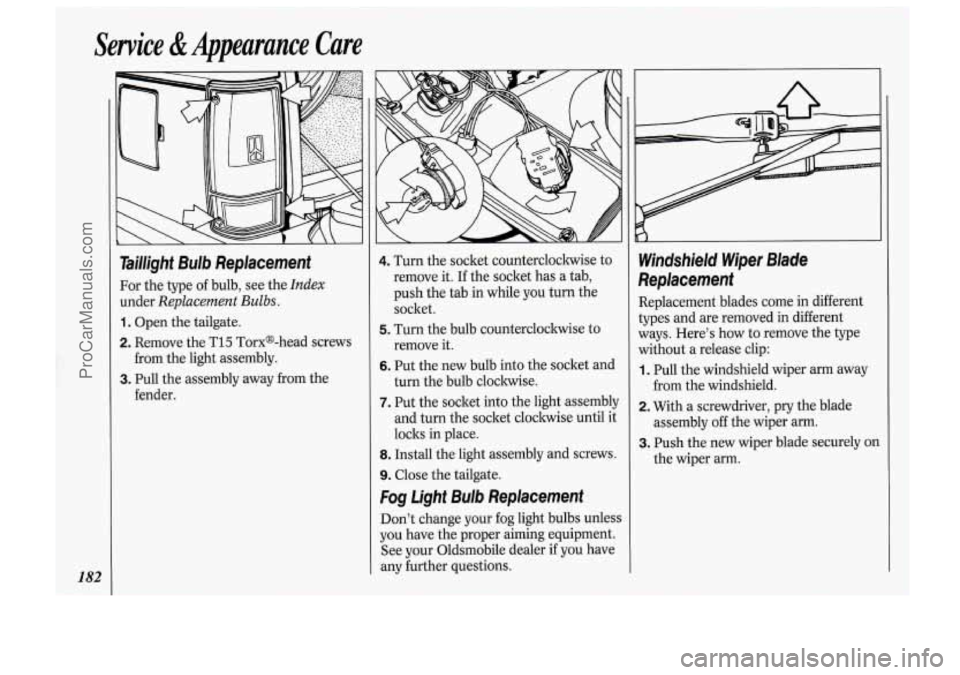
Taillight Bulb Replacement
For the type of bulb, see the Index
under Replacement Bulbs.
1. Open the tailgate.
2. Remove the T15 Torxs-head screws
3. Pull the assembly away from the
from
the light assembly.
fender.
4. Turn the socket countercloclwise to
remove it. If the socket has a tab,
push the tab in while you turn the
socket.
5. Turn the bulb countercloclwise to
remove it.
6. Put the new bulb into the socket and
turn the bulb cloclwise.
7. Put the socket into the light assembly
and turn the socket cloclwise until it
loclts in place.
8. Install the light assembly and screws.
9. Close the tailgate.
Fog Light Bulb Replacement
Don’t change your fog light bulbs unless
you have the proper aiming equipment.
See your Oldsmobile dealer if you have
any further questions.
Windshield Wiper Blade
Replacement
Replacement blades come in different
types and are removed in different
ways. Here’s how to remove the type
without a release clip:
1. Pull the windshield wiper arm away
2. With a screwdriver, pry the blade
3. Push the new wiper blade securely on
from the windshield.
assembly off the wiper arm.
the wiper arm.
ProCarManuals.com
Page 190 of 248

Sewice & Appearance Care
Payload
The Payload Capacity is shown on the
Certificationflire label. This is the
maximum load capacity that your
vehicle can carry. Be sure to include the
weight of the people inside as part of
your load. If you added any accessories
or equipment after your vehicle left the
factory, remember to subtract the weight
of these things from the payload.
Your dealer can help you with this.
Trailering Package
If your vehicle comes with the trailering
package, there is also a load rating
which includes the weight of the vehicle
and the trailer it tows. This rating is
called the Gross Combination Weight
Rating (GCWR)
.
When you weigh your trailer, be sure to
include the weight of everything you put
in it. And, remember to figure the weight
of the people inside as part
of your load.
Your dealer can help you determine
your GCWR.
Add-on Equipment
When you carry removable items, you
may need to put a limit on how many
people you carry inside your vehicle. Be
sure to weigh your vehicle before you
buy and install the new equipment.
NOTICE:
Your warranty doesn’t cover parts
or components that fail because of
overloading.
I Single Belt Accessory Drive
Your new vehicle uses a serpentine belt
that is lighter, more durable and fuel
efficient than systems with several belts.
The belt runs over or around the pulleys
on the engine.
A tensioner is used to
keep the belt tight at all times. The
tensioner also makes replacing the belt
easier.
If you need to replace the belt, be
sure to get the correct replacement belt.
Your dealership or parts supplier can
help you with this. The Accessory Drive
Belt Routing label on your vehicle will
show you how to route the belt your
vehicle uses.
I Air Conditioning
Every now and then have your
dealership check your air conditioning
system to be sure it has not lost any
cooling ability. If you think the system
is not working properly, have your
dealership check it out as soon as
possible.
The air conditioning will not work when
the temperature is below
40°F (4°C).
ProCarManuals.com
Page 196 of 248

Service & Appearance Care
190
NOTICE:
The wrong wheel can also cause
problems with bearing life, brake
cooling, speedometer/odometer calibration, headlight aim, bumper
height, vehicle ground clearance,
and tire clearance to the body and
chassis.
Used Replacement Wheels
Tire Chains
NOTICE:
Don’t use tire chains; they can
damage your vehicle.
I Appearance Care
Remember, cleaning products can be
hazardous. Some are toxic. Others can
burst into flame if you strike a match or
get them
on a hot part of the vehicle.
Some are dangerous
if you breathe their
fumes in a closed space. When
you use
anything from a container to clean your
Oldsmobile, be sure to follow the
manufacturer’s warnings and
instructions. And always open your
doors or windows when you’re cleaning
the inside.
Never use these to clean your vehicle:
Gasoline
Benzene
Naphtha
Carbon Tetrachloride
Acetone
Paint Thinner
Turpentine
Lacquer Thinner
Nail Polish Remover
They can all be hazardous
- some
more than others
- and they can all
damage your vehicle, too.
NOTICE:
Don’t use any of these unless this
manual says you can. In many uses,
these will damage your vehicle:
Laundry Soap
Bleach
Reducing Agents
I Cleaning the Inside of Your
Oldsmobile
Use a vacuum cleaner often to get rid of
dust and loose dirt. Wipe vinyl or
leather with a clean, damp cloth.
Your Oldsmobile dealer has two
GM
cleaners, a solvent-type spot lifter and a
foam-type powdered cleaner. They will
clean normal spots and stains very well.
Do not use them
on vinyl or leather.
ProCarManuals.com
Page 197 of 248

Here are some cleaning tips:
Always read the instructions on the
cleaner label.
Clean up stains as soon as you can -
before they set.
Use a clean cloth or sponge, and
change to a clean area often. A soft
brush may be used
if stains are
stubborn.
ventilated area only.
If you use them,
don’t saturate the stained area.
If a ring forms after spot cleaning,
clean the entire area immediately or it
will set.
Use solvent-type cleaners in a well-
Using Foam-Type Cleaner on
Fabric
Vacuum and brush the area to remove
Always clean a whole trim panel or
any
loose dirt.
section. Mask surrounding trim along
stitch or welt lines.
Mix Multi-Purpose Powdered Cleaner
following the directions on the
container label.
Use suds only and apply with a clean sponge.
Don’t
saturate the material.
Don’t rub it roughly.
As soon as you’ve cleaned the section,
use a sponge to remove the suds.
Rinse the section with a clean, wet
sponge.
Wipe off what’s left with a slightly
damp paper towel or cloth.
Then dry it immediately with a blow
dryer or a heat lamp.
NOTICE:
Be careful with a hair dryer or heat
lamp.
You could scorch the fabric.
Wipe with a clean cloth.
Using Solvent-Type Cleaner on
Fabric
First, see if you have to use solvent-type
cleaner at all. Some spots and stains
will clean off better with just water and
mild soap.
If you need to use a solvent:
Gently scrape excess soil from the trim material with
a clean, dull knife or
scraper. Use very little cleaner, light
pressure and clean cloths (preferably
cheesecloth). Cleaning should start at
the outside of the stain, “feathering”
toward the center. Keep changing to a
clean section of the cloth.
When you clean a stain from fabric,
immediately dry the area with an air
hose, hair dryer, or heat lamp to help
prevent a cleaning ring. (See the
previous NOTICE.)
Special Cleaning Problems
Greasy or Oily Stains
Such as grease, oil, butter, margarine,
shoe polish, coffee with cream, chewing
gum, cosmetic creams, vegetable oils,
wax crayon, tar and asphalt.
Carefully scrape off excess stain.
Follow the solvent-type instructions
Shoe polish, wax crayon, tar and
described
earlier.
asphalt will stain
if left on a vehicle
seat fabric. They should be removed
as soon as possible. Be careful,
because the cleaner will dissolve them
and may cause them to spread.
191
ProCarManuals.com
Page 198 of 248
Service & Appearance Care
192
~.
Non-Greasy Stains
Such as catsup, coffee (black), egg,
fruit, fruit juice, milk, soft drinks, wine,
vomit, urine and blood.
Carefully scrape off excess stain, then
sponge the soiled area with cool water.
If a stain remains, follow the foam-
type instructions described earlier.
If an odor lingers after cleaning vomit
or urine, treat the area with a
waterhaking soda solution:
1
teaspoon (5 ml) of baking soda to 1
cup (250 ml) of lukewarm water.
If needed, clean lightly with solvent-
type cleaner.
Combination Stains
Such as candy, ice cream, mayonnaise,
chili sauce and unknown stains.
Carefully scrape off excess stain, then
If a stain remains, clean it with
clean
with cool water and allow to
dry.
solvent-type cleaner.
weaning Vinyl
Use warm water and a clean cloth.
Rub with a clean, damp cloth to
remove dirt. You may have to do it
more than once.
polish will stain if you don’t get them
off quickly. Use a clean cloth and a
solvent-type vinyl cleaner.
Things like tar, asphalt and shoe
Cleaning Leather
Use a soft cloth with lukewarm water
and a mild soap or saddle soap.
For stubborn stains, use a mild
solution
of 10% isopropyl alcohol
(rubbing alcohol) and
90% water.
Never use oils, varnishes, solvent-
based or abrasive cleaners, furniture
polish or shoe polish on leather.
Soiled leather should be cleaned
immediately.
If dirt is allowed to work
into finish, it can harm the leather.
Cleaning the Top of the
Instrument Panel
Use only mild soap and water to clean
the top surfaces
of the instrument
panel. Sprays containing silicones or waxes
may cause annoying reflections
in the windshield and even make it
difficult to see through the windshield
under certain conditions.
4 Care of Safety Belts
Keep belts clean and dry.
Glass
Glass should be cleaned often. GM
Glass Cleaner (GM Part No. 1050427)
or a liquid household glass cleaner will
remove normal tobacco smoke and
dust films.
Don’t use abrasive cleaners on glass,
because they may cause scratches.
Avoid placing decals on the inside rear
window, since they may have to be
scraped off later. If abrasive cleaners are
ProCarManuals.com
Page 203 of 248

INST LPS PWR ACC
HORNIDM IGNIGAU BRAKE STOPIHAZ
h TAIL LPS TURNIBU HTR A/C RADIO
%se Usage
Position
INST LPS
PWR ACC
HORN/DM
IGN/GAU BRAKE
STOP/HAZ
TAIL LPS
TURNDU HTR A/C RADIO
ECM B
ECM I
PWR WDO
WIPER
CRANK
TRAILER*
Rating
(AMP.)
5
30
20
20
15
15
20
15
25
15
15
10
30
25
3
30
UNDERHOOD':' 4
CD PLAYER 10
"In-line fuse.
Circuitry
Instrument Panel Lights, Headlight Warning Buzzer, Heater
Light, Ashtray Light, Radio Illumination Light, Rear Wiper
Switch Light
Power Door Locks, Rear Defogger, Console Accessory
Receptacles, CD Player
Horn, Dome Lights, Glove
Box Light, Clock, Lighter, Lighted
Vanity Mirror, Outside Rearview Mirror, Courtesy Lights
Indicator Lights and Gages, Rear Defogger Relay, Cruise
Control, Rear Defogger Switch, Seat Belt Timer
Four Wheel Anti-lock Brake Module, Digital Ratio Adapter
Module (Speedometer)
Stop Lights, Hazard Warning Lights, Chime Module, Center
High Mounted Stop Light (CHMSL)
Light Switch, TaiVPark Lights, Electronic Cluster, License Light
Turn Signals
& Back-up Lights
Heating and Air Conditioning
Radio, Inside Rearview Mirror Map Lights, Rear Wiper, Rear
Washer, Compass
Electronic Control Module, Fuel Pump
Electronic Control Module
Power Windows
Windshield Wipers and Washer
Electronic Control Module
Trailer Wiring Harness
Underhood Light
CD Player (attached to fuse block)
197
ProCarManuals.com
Page 204 of 248

Service & Appearance Care
198
Headlight Wiring
The headlight wiring is protected by a
circuit breaker in the light switch. An
electrical overload will cause the lights
to go on and off, or in some cases to
remain off. If this happens, have your
headlight system checked right away.
Trailer Wiring Harness
The seven-wire trailer wiring harness is
protected by an in-line fuse in the
battery feed wire. This fuse is near the
junction block. See the
Index under
Trailer Wiring Harness.
Windshield Wipers
The windshield wiper motor is
protected by a circuit breaker and a
fuse.
If the motor overheats due to
heavy snow, etc., the wiper will stop
until the motor cools.
If the overload is
caused by some electrical problem, have
it fixed.
Power Windows and Other Power
Accessories
Circuit breakers in the fuse panel
protect the power windows and other
power accessories. When the current
load is too heavy, the circuit breaker
opens and closes, protecting the circuit
until the problem is fixed or goes away.
Before you wire any other electrical
accessories into your fuse block, please
check with your Oldsmobile dealer.
ProCarManuals.com
Page 208 of 248

Service & Appearance Care
202
.
Replacement Bulbs
OUTSIDE LIGHTS BULB
Back-up Lights ........................................................................\
.. 1156
Front Parlting/Turn Signal Lights
............................................ 2057
License Plate Light
.................................................................... 67
Front Sidemarker Lights
........................................................... 194
Underhood
........................................................................\
......... 93
INSIDE LIGHTS
Courtesy Light ........................................................................\
... 1003
Reading Lights
Dome Lights
Halogen Headlights
................................................................... H6054
Stop/Tail/Turn Signal Lights
................................................... 2057
Fog ........................................................................\
..................... 11513798H3
Front
........................................................................\
............. 562
Center
........................................................................\
........... 561
Rear
........................................................................\
.............. 561
Glove
Box Light ........................................................................\
1003
Indicator Lights
........................................................................\
. 174
Ashtray Light
........................................................................\
..... 161
Windshield Wiper Switch Light
................................................ 194
Cargo Light
........................................................................\
........ 28
Instrument Cluster Illumination .............................................. 168, 194
Turn
Signal Indicators
.............................................................. 174
Heater Light
........................................................................\
...... 194
ProCarManuals.com