brakes OLDSMOBILE BRAVADA 1996 Owner's Manual
[x] Cancel search | Manufacturer: OLDSMOBILE, Model Year: 1996, Model line: BRAVADA, Model: OLDSMOBILE BRAVADA 1996Pages: 340, PDF Size: 17.49 MB
Page 175 of 340
0
0
If you’ll be pulling a trailer that, when loaded, will
weigh more than 2,000 Ibs. (900 kg), be sure to use a
properly mounted, weight-distributing hitch and
sway control of the proper size. This equipment is
very important for proper vehicle loading and good
handling when you’re driving.
Will you have to make any holes
in the body of your
vehicle when you install a trailer hitch?
If you do, then be sure to seal the holes later when
you remove the hitch. If you don‘t seal them, deadly
carbon monoxide
(CO) from your exhaust can get
into your vehicle (see “Carbon Monoxide”
in the
Index). Dirt and water can, too.
Safety Chains
You should always attach chains between your vehicle
and your trailer. Cross the safety chains under the tongue
of the trailer
so that the tongue will not drop to the road
if it becomes separated from the hitch. Instructions
about safety chains may be provided by
the hitch
manufacturer or by the trailer manufacturer. Follow the
manufacturer’s recommendation for attaching safety
chains and do not attach them to
the bumper. Always
leave just enough slack
so you can turn with your rig.
And, never allow safety chains to drag on the ground.
Trailer Brakes
If your trailer weighs more than 1,000 lbs. (450 kg)
loaded,
then it needs its own brakes -- and they must be
adequate. Be sure to read and follow the instructions for
the trailer brakes
so you’ll be able to install, adjust and
maintain them properly.
Your trailer’s brake system can tap into the vehicle’s
hydraulic brake system only
if:
0 The trailer parts can withstand 3,000 psi
(20 650
kPa) of pressure.
0 The trailer’s brake system will use less than
0.02 cubic inch (0.3 cc) of fluid from your vehicle’s
master cylinder. Otherwise,
both braking systems
won’t work well. You could even lose your brakes.
If everything checks out this far, then make the brake
fluid tap at the port on the master cylinder that sends
fluid to the rear brakes.
But don’t use copper tubing for
this.
If you do, it will bend and finally break off. Use
steel brake tubing.
4-47
~
ProCarManuals.com
Page 176 of 340

Driving with a Trailer
A CAUTION:
If you have a rear-most window open and you
pull
a trailer with your vehicle, carbon monoxide
(CO) could come into your vehicle. You can’t see
or smell CO. It can cause unconsciousness or
death. (See “Engine Exhaust” in the Index.)
To
maximize your safety when towing a trailer:
a
a
a
Have your exhaust system inspected for
leaks, and make necessary repairs before
starting on your trip.
Keep the rear-most windows closed.
If exhaust does come into your vehicle
through
a window in the rear or another
opening, drive with your front, main
heating or cooling system on and with the
fan on any speed. This will bring fresh,
outside air into your vehicle.
Do not use
MAX A/C because.it only recirculates the
air inside your vehicle. (See “Comfort
Controls” in the Index.)
L
Towing a trailer requires a certain amount of experience.
Before setting out for the open road, you’ll want to get
to know your rig. Acquaint yaurself with the feel of
handling and braking with the added weight of the
trailer. And always keep in mind that the vehicle
you are
driving is now a good deal longer and not nearly as
responsive as your vehicle is by itself.
Before you start, check the trailer hitch and platform
(and attachments), safety chains, electrical connector,
’
lamps, tires and mirror adjustment. If the trailer has
electric brakes, start your vehicle and trailer moving and
then apply the trailer brake controller by hand to be sure
the brakes are working. This lets-you check your
electrical connection at the same time.
During your trip, check occasionally to be sure that the
load is secure, and that the ,lamps and any trailer brakes
are still working.
4-48
ProCarManuals.com
Page 178 of 340

When towing a trailer, the green arrows on your
instrument panel
will flash for turns even if the bulbs on
the trailer are burned out. Thus, you may think drivers
behind you are seeing your signal when they are not. It’s
important
to check occasionally to be sure the trailer
bulbs are still working.
Driving On Grades
Reduce speed and shift to a lower gear before you start
down
a long or steep downgrade. If you don’t shift
down, you might have to use
your brakes so much that
they would get hot and no longer work well.
On a long uphill grade, shift down and reduce your
speed to around
45 mph (70 km/h) to reduce the
possibility of engine and transmission overheating.
You should use THIRD (3) when towing a trailer.
Operating your vehicle
in THIRD (3) when towing a
trailer will minimize heat buildup and extend
the life of
your transmission.
Parking on Hills
You really should not park your vehicle, with a trailer
attached, on
a hill. Tf something goes wrong, your rig
could start to move. People can be injured, and both
your vehicle and the trailer can be damaged.
But
if you ever have to park your rig on a hill, here’s
how to do it:
1. Apply your regular brakes, but don’t shift into
PARK
(P) yet. Then turn your wheels into the curb if
facing downhill or into traffic if facing uphill.
2. Have someone place chocks under the trailer wheels.
3. When the wheel chocks are in place, release the
regular brakes
until the chocks absorb the load.
4. Reapply the regular brakes. Then apply your parking
brake and shift into PARK (P).
5. Release the regular brakes.
4-50
ProCarManuals.com
Page 179 of 340
When You Are Ready to Leave
After Parking on a Hill
1. Apply your regular brakes and hold the pedal down
while you:
Start your engine;
0 Shift into a gear; and
0 Release the parking brake.
2. Let up on the brake pedal.
3. Drive slowly until the trailer is clear of the chocks.
4. Stop and have someone pick up and store the chocks.
Maintenance When Trailer Towing
Your vehicle will need service more often when you’re
pulling a trailer. See the Maintenance Schedule for more
on this. Things that are especially important
in trailer
operation are automatic transmission fluid (don’t
overfill), engine
oil, axle lubricant, belt, cooling system
and brake adjustment. Each
of these is covered in this
manual, and the Index
will help you find them quickly.
If you’re trailering, it’s a good idea to review these
sections before you start your trip.
Check periodically to
see that all hitch nuts and
bolts are tight.
ProCarManuals.com
Page 180 of 340
Trailer Wiring Harness
The light duty trailer wiring is a six-wire harness
assembly. The optional heavy duty trailer wiring is an
eight-wire harness assembly. The harnesses are stored
under the vehicle, on the driver’s side corner frame
crossmember. The heavy duty trailer wiring
has a
30-amp feed wire with an inline fuse located by the
junction block. See “Fuses and Circuit Breakers”
in the
Index. Both harnesses have no connector and should be
wired by a qualified electrical technician. The technician
can use the following color code chart when connecting
the wiring harness to your trailer.
0 DARK BLUE: Use for electric trailer brakes or
auxiliary wiring.
0 RED: Use for battery charging; it connects to the
starter solenoid (eight-wire harness only).
0 LIGHT GREEN: Back-up lamps (eight-wire
harness only).
BROWN: Taillamps and parking lamps.
YELLOW: Left stoplamp and turn signal.
DARK GREEN: Right stoplamp and turn signal.
WHITE (Heavy Gage): Ground wire.
WHITE (Light Gage): Auxiliary stoplamp.
Securely attach the harness to the trailer, then tape or
strap
it to your vehicle’s frame rail. Be sure you leave it
loose enough
so the wiring doesn’t bend or break, but
not
so loose that it drags on the ground. Store the
harness
in its original place. Wrap the harness together
and tie
it neatly so it won’t be damaged.
ProCarManuals.com
Page 237 of 340
~~ ~ NOTICE:
0
0
0
0
When using concentrated washer fluid,
follow
the manufacturer’s instructions
for
adding water.
Don’t mix water with ready-to-use washer
fluid. Water can cause the solution to freeze
and damage your washer fluid tank and
other parts of the washer system. Also,
water doesn’t clean as well as washer fluid.
Fill your washer fluid tank only
three-quarters full when it’s very cold. This
allows for expansion, which could damage
the tank if it is completely full.
Don’t use radiator antifreeze
in your
windshield washer. It can damage your
washer system and paint.
Brakes
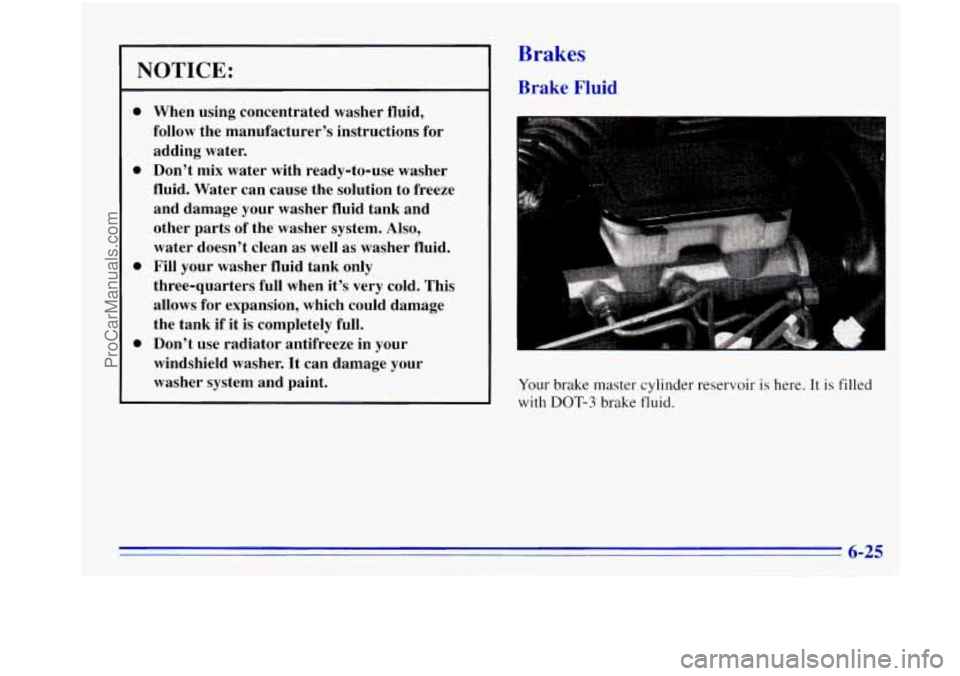
Brake Fluid
Your brake master cylinder reservoir is here. It is filled
with DOT-3 brake fluid.
ProCarManuals.com
Page 238 of 340
There are only two reasons why the brake fluid level in
the reservoir might go down. The first is that the brake
fluid goes down
to an acceptable level during normal
brake lining wear. When new linings are put
in, the fluid
level goes back up. The other reason is that fluid is
leaking out
of the brake system. If it is, you should have
your brake system fixed, since a leak means that sooner
or later your brakes won’t work well, or won’t work
at all.
So, it isn’t a good idea to “top off’ your brake fluid.
Adding brake fluid won’t correct a leak. If you
add fluid
when your linings are worn, then you’ll have too much
fluid when you get new brake linings.
You should add
(or remove) brake fluid, as necessary, only when work is
done
on the brake hydraulic system.
If you have too much brake fluid, it can spill
on the engine. The fluid will burn
if the engine
is hot enough. You or others could be burned,
and your vehicle could be damaged. Add brake
fluid only when work
is done on the brake
hydraulic system.
Refer to the Maintenance Schedule to determine when to
check your brake fluid. See “Periodic Maintenance
Inspections”
in the Index.
ProCarManuals.com
Page 239 of 340
Checking Brake Fluid What
to Add
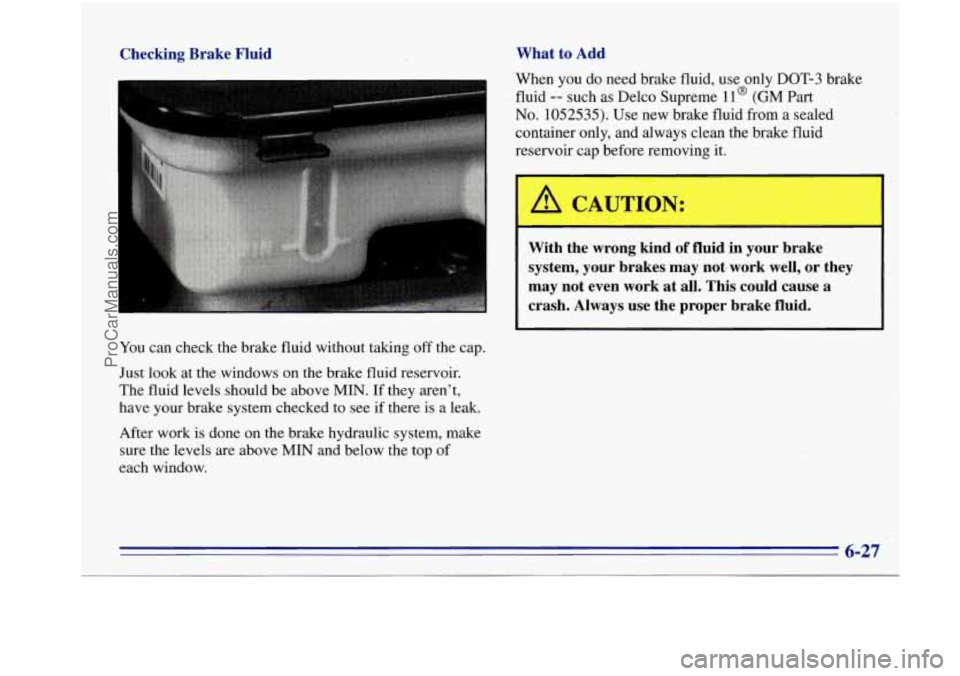
You can check the brake fluid without taking off the cap.
Just look at
the windows on the brake fluid reservoir.
The fluid levels should be above MIN. If they aren’t,
have your brake system checked to see if there is a leak.
After work is done on the brake hydraulic system, make
sure the levels are above MIN and below the
top of
each window. When
you do need brake fluid, use only
DOT-3 brake
fluid
-- such as Delco Supreme 11 @ (GM Part
No. 1052535). Use new brake fluid from a sealed
container only, and always clean the brake fluid
reservoir cap before removing it.
A CAUTION:
With the wrong kind of fluid in your brake
system, your brakes may nott work well, or they
may not even work at all. This could cause a
crash. Always use the proper brake fluid.
6-27
ProCarManuals.com
Page 240 of 340

~~
~ NOTICE:
0
0 Using the wrong fluid can badly damage
brake system parts. For example, just a few
drops of mineral-based oil, such as engine
oil, in your brake system can damage brake
system parts
so badly that they’ll have to be
replaced. Don’t let someone put in the
wrong kind of fluid.
If you spill brake fluid on your vehicle%
painted surfaces, the paint finish can be
damaged. Be careful not
to spill brake fluid
on your vehicle.
If you do, wash.it off
immediately. See “Appearance Care” in
the Index.
Brake Wear
Your Oldsmobile has front disc brakes and rear
drum brakes.
Disc brake pads have built-in wear indicators that
make a high-pitched warning sound when the brake
pads are worn and new pads
are needed. The sound may
come and go or be heard all
the time your vehicle is
moving (except when you are pushing on the brake
pedal firmly).
I
The brake wear warning sound means that
sooner or later your brakes won’t work well.
That could lead to an accident. When you hear
the brake wear warning sound, have your
vehicle serviced.
6-28
ProCarManuals.com
Page 241 of 340
1 NOTICE:
Continuing to drive with worn-out brake pads
could result in costly brake repair.
Some driving conditions or climates may cause a brake
squeal when the brakes are first applied or lightly
applied. This does not mean something is wrong
with
your brakes.
Your rear drum brakes don’t have wear indicators, but
if
you ever hear a rear brake rubbing noise, have the rear
brake linings inspected. Also, the rear brake drums
should be removed and inspected each time the tires are
removed for rotation or changing. When you have
the
front brakes replaced, have the rear brakes inspected, too.
Brake linings should always be replaced as complete
axle sets.
Brake Pedal Travel
See your retailer if the brake pedal does not return to
normal height, or if there is
a rapid increase in pedal
travel. This could be
a sign of brake trouble.
Brake Adjustment
Every time you make a brake stop, your disc brakes
adjust for wear.
If your brake pedal goes down farther than normal, your
rear drum brakes may need adjustment. Adjust them by
backing up and firmly applying the brakes a few times.
Replacing Brake System Parts
The braking system on a modern vehicle is complex.
Its many parts have to be of top quality and work well
together
if the vehicle is to have really good braking.
Vehicles we design and test have top-quality
GM brake
parts
in them, as your Oldsmobile does when it is new.
When you replace parts
of your braking system -- for
example, when your brake linings wear down and
you
have to have new ones put in -- be sure you get new
genuine
GM replacement parts. If you don’t, your
brakes
may no longer work properly. For example, if
someone puts in brake linings that are wrong for your
vehicle, the balance between your front and rear brakes
can change
-- for the worse. The braking performance
you’ve come to expect can change
in many other ways
someone puts
in the wrong replacement brake parts. if
ProCarManuals.com