parking brake OLDSMOBILE BRAVADA 1997 User Guide
[x] Cancel search | Manufacturer: OLDSMOBILE, Model Year: 1997, Model line: BRAVADA, Model: OLDSMOBILE BRAVADA 1997Pages: 358, PDF Size: 18.02 MB
Page 109 of 358
Brake System Warning Light
Your Oldsmobile’s hydraulic brake system is divided
into two parts.
If one part isn’t working, the other part
can still work and stop you. For good braking, though,
you need both parts working well.
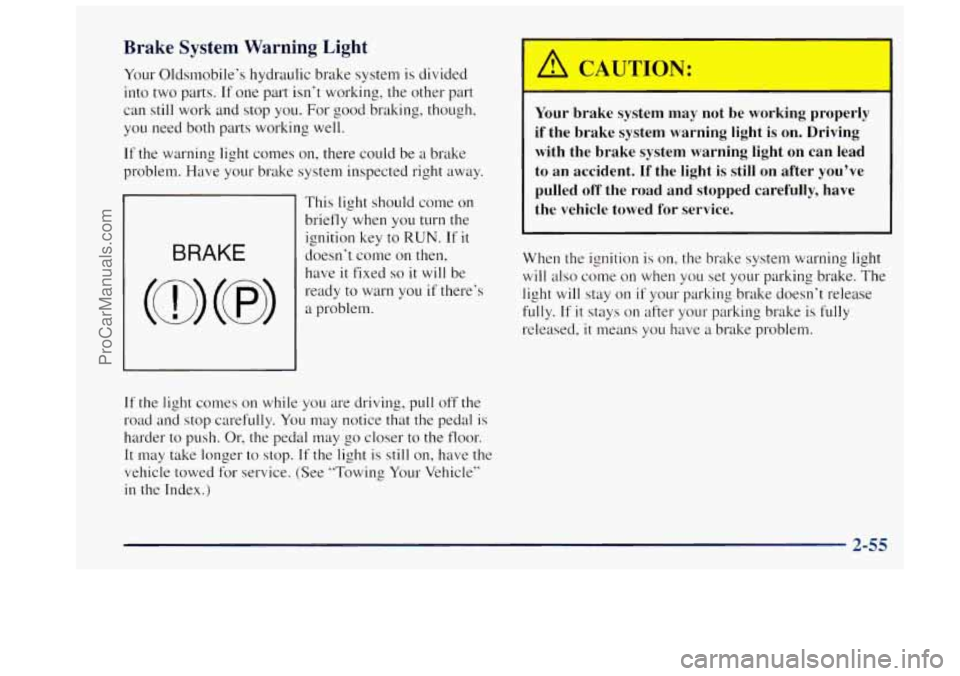
If the warning light comes on, there could be a brake
problem. Have
your brake system inspected right away.
This light should come on
briefly when you
turn the
ignition key to
RUN. If it
doesn’t come on then,
have
it fixed so it will be
ready
to warn you if there’s
a problem.
A CAUTION:
-
Your brake system may not be working properly
if the brake system warning light is on. Driving
with the brake system warning light on can lead
to an accident. If the light
is still on after you’ve
pulled off the road and stopped carefully, have
the vehicle towed
for service.
When the ignition is on, the brake system warning light
will also come on when you set your parking brake. The
light
will stay on if your parking brake doesn’t release
fully.
If it stays on after your parking brake is fully
released, it means you have a brake problem.
If the light comes on
while you are driving, pull off the
road and stop carefully. You may notice that the pedal is
harder to push. Or, the pedal may go closer to the floor.
It may take longer to stop. If the light is still on, have the
vehicle towed for service. (See “Towing Your Vehicle”
in the Index.)
2-55
ProCarManuals.com
Page 114 of 358

A reading in the low pressure zone may be caused by a
dangerously low oil level or other problems causing low
oil pressure.
Don’t keep driving if the oil pressure is low. If
you do, your engine can become so hot that it
catches fire. You or others could be burned.
Check your
oil as soon as possible and have yo1
vehicle serviced.
NOTICE:
Damage to your engine from neglected oil
problems can be costly and is not covered by
your warranty.
Daytime Running Lamps Indicator Light
:::(-J 0.0
Check Gages Light
CHECK
GAGES
You may have t.his light on
the instrument panel.
It goes on whenever the
DRL are on, the ignition is
on, the headlamp switch is
off and the parking brake
is released.
The
CHECK GAGES light
will come on briefly when
you are starting the engine.
If the light comes on and
stays on while
you are
driving, check your coolant
temperature and engine oil
pressure gages to see
if they
are
in the warning zones.
2-60
ProCarManuals.com
Page 153 of 358

0 Ease up on your speed as you approach the top of
the hill.
Attach a flag to the vehicle to make you more visible
to approaching traffic on trails or hills.
Sound the horn as you approach the top of the hill to
let opposing traffic know you’re there.
0 Use your headlamps even during the day. They make
you more visible to oncoming traffic.
Driving to the top (crest)
of a hill at full speed can
cause an accident. There could be a drop-off,
embankment, cliff, or even another vehicle. You
could be seriously injured or killed.
As you near
the top
of a hill, slow down and stay alert. What should
I do
if my vehicle stalls, or is about
to stall, and
I can’t make it up the hill?
A: If this happens, there are some things you should
do, and there are some things you must not do.
First, here’s what you
sI~ouZc1 do:
Push the brake pedal to stop the vehicle ‘and keep it
from rolling backwards. Also, apply the parking brake.
0 If your engine is still running, shift the transmission
to REVERSE
(R), release the parking brake, and
slowly back down the
hill in REVERSE (R).
If your engine has stopped running, you’ll need to
restart it. With the brake pedal depressed and the
parking brake still applied, shift the transmission to
PARK
(P) and restart the engine. Then, shift to
REVERSE
(R), release the parking brake, and
slowly back down the
hill as straight as possible in
REVERSE (R).
4-2 1
ProCarManuals.com
Page 154 of 358

0 As you are backing down the hill, put your left hand
on the steering wheel at the 12 o’clock position. This
way, you’ll be able to tell
if your wheels are straight
and maneuver as you back down. It’s best that you
back down
the hill with your wheels straight rather
than in the left or right direction. Turning the wheel
too far to the left or right will increase the possibility
of a rollover.
Here are
some things you mist not do if you stall,
or are about to stall, when going
up a hill.
0 Never attempt to prevent a stall by shifting into
NEUTRAL (N) to “rev-up” the engine and regain
forward momentum. This won’t work. Your vehicle
will roll backwards very quickly and you could go
out of control.
Instead, apply the regular brake to stop the vehicle.
Then apply the parking brake. Shift to REVERSE
(R),
release the parking brake, and slowly back straight down.
0 Never attempt to turn around if you are about to stall
when going up
a hill. If the hili is steep enough to
stall your vehicle, it’s steep enough to cause you to
roll over
if you turn around. If you can’t make it up
the
hill, you must back straight down the hill.
Q: Suppose, after stalling, I try to back down the
hill and decide
I just can’t do it. What should
I do?
A: Set the parking brake, put your transmission in
PARK (P) and turn off the engine. Leave the
vehicle and go get some help. Exit
on the uphill
side and stay clear of
the path the vehicle would
take
if it rolled downhill.
Driving Downhill
When off-roading takes you downhill, you’ll want to
consider
a number of things:
0
0
0
0
How steep is the downhill? Will I be able to maintain
vehicle control?
What’s the surfice like? Smooth? Rough? Slippery?
Hard-pac ked dirt‘? Gravel?
Are there. hidden surface obstacles‘? Ruts?
Logs? Boulders?
What’s at the bottom
of the hill‘? Is there a hidden
creek bank
or even a river bottom with large rocks‘?
4-22
ProCarManuals.com
Page 155 of 358

If you decide you can go down a hili safely, then try to
keep your vehicle headed straight down, and use a
low
gear. This way, engine drag can help your brakes and
they won’t have to do
all the work. Descend slowly,
keeping your vehicle under control at all times.
CAWTION: I
When driving downhill, avoid turns that take you
across the incline of the
hill. A hill that’s not too
steep to drive down may be too steep to drive across.
You could roll over
if you don’t drive straight down.
Never go downhill with the transmission in
NEUTRAL (N). This is called “free-wheeling.” Your
brakes
will have to do all the work and could
overheat and fade.
Heavy braking when going down a hill can cause
your brakes to overheat and fade. This could
, cause loss of control and a serious accident.
Apply the brakes lightly when descending a hill
and use a low gear to keep vehicle speed
under control. ~
Q.’ Are there some things I should not do when
driving down a hill?
A: Yes! These are important because if you ignore them
you could lose
control and have a serious accident.
Q.’ Am I likely to stall when going downhill?
A: It’s much more likely to happen going uphill. But if
it happens going downhill, here’s what to do.
Stop your vehicle by applying the regular brakes.
Apply the parking brake.
Shift to PARK (Pj and, while still braking, restart
the engine.
Shift back to
a low gear, release the parking brake,
and drive straight down.
0 If the engine won’t start, get out and get help.
4-23
ProCarManuals.com
Page 183 of 358

Driving On Grades
Reduce speed and shift to a lower gear before you start
down a long or steep downgrade.
If you don’t shift
down, you might have to use your brakes
so much that
they would get hot and no longer work well.
On a long uphill grade, shift down and reduce your
speed to around
45 mph (70 km/h) to reduce the
possibility of engine and transmission overheating.
You should use THIRD
(3) when towing a trailer.
Operating your vehicle in THIRD
(3) when towing a
trailer will minimize heat buildup and extend the life of
your transmission.
Parking on Hills
You really should not park your vehicle, with a trailer
attached, on a hill. If something goes wrong, your rig
could start to move. People can be injured, and both
your vehicle and the trailer can be damaged.
But if
YOU ever have to park your rig on a hill, here’s
how to do it:
1. Apply your regular brakes, but don’t shift into
PARK
(I?) yet. Then turn your wheels into the curb if
facing downhill or into traffic if facing uphill.
2. Have someone place chocks under the trailer wheels.
3. When the wheel chocks are in place, release the
regular brakes until the chocks absorb the load.
4. Reapply the regular brakes. Then apply your parking
brake and shift into PARK
(P).
5. Release the regular brakes.
4-51
ProCarManuals.com
Page 184 of 358

When You Are Ready to Leave After
Parking on a Hill
1. Apply your regular brakes and hold the pedal down
while you:
0 Start your engine;
0 Shift into a gear; and
0 Release the parking brake.
2. Let up on the brake pedal.
3. Drive slowly until the trailer is clear of the chocks.
4. Stop and have someone pick up and store the chocks.
Maintenance When Trailer Towing
Your vehicle will need service more often when you’re
pulling a trailer. See the Maintenance Schedule for more
on this. Things that are especially important
in trailer
operation are automatic transmission fluid (don’t
overfill), engine
oil, axle lubricant, belt, cooling system
and brake adjustment. Each of these
is covered in this
manual, and the Index will help you find them quickly.
If you’re trailering, it’s a good idea to review these
sections before you start your trip.
Check periodically to see that all hitch nuts and bolts
are tight.
4-52
ProCarManuals.com
Page 185 of 358

Trailer Wiring Harness
The light duty trailer wiring is a six-wire harness
assembly. The optional heavy-duty trailer wiring is an
eight-wire harness assembly. The harnesses are stored
under the vehicle,
on the driver’s side corner frame
crossmember. The heavy-duty trailer wiring has
a
30-amp feed wire with an inline fuse located by the
junction block. See “Fuses and Circuit Breakers”
in the
Index. Both harnesses have no connector and should be
wired by
ilt qualified electrical technician. The technician
can use the following color code chart when connecting
the wiring harness to your trailer.
Dark Blue: Use for electric trailer brakes or
auxiliary wiring.
Red: Use for battery charging: it connects to the
starter solenoid (eight-wire harness only).
Light Green: Back-up lamps (eight-wire
harness only).
Brown: Taillamps and parking lamps.
Yellow: Left stoplamp and turn signal.
Dark Green: Right stoplamp and turn signal.
0 White (Heavy Gage): Ground wire.
White (Light Gage): Auxiliary stoplamp.
Securely attach the harness to the trailer, then tape or
strap
it to your vehicle’s frame rail. Be sure you leave it
loose enough so the wiring doesn’t bend or break, but
not
so loose that it drags on the ground. Store the
harness
in its original place. Wrap the harness together
and tie
it neatly so it won’t be damaged.
4-53
ProCarManuals.com
Page 190 of 358

2. Get the vehicles close enough so the jumper cables
can reach, but be sure the vehicles aren’t touching
each other. If they are, it could cause a ground
connection you don’t want. You wouldn’t be able
to start your vehicle, and the bad grounding could
damage the electrical systems.
You could be injured if the vehicles roll. Set the
parking brake firmly on each vehicle. Put an
automatic transmission in
PARK (P). Put a
manual transmission in NEUTRAL (N).
I unnecessary accessories plugged into the cigarette
lighter, or accessory power outlets, if you have this
option. Turn
off all lamps that aren’t needed as well
as radios. This will avoid sparks and help to save
both batteries. In addition, it could save your radio!
3. Turn off the ignition on both vehicles. Unplug
NOTICE:
If you leave your radio on, it could be badly
damaged. The repair wouldn’t be covered by
your warranty.
An electric fan can start up even when the engine
is not running and can injure you. Keep hands,
clothing and tools away from any underhood
electric fan.
I ‘ 5-4
ProCarManuals.com
Page 194 of 358
-
To help avoid injury to you or others:
0 Never let passengers ride in a vehicle that is
0 Never tow faster than safe or posted speeds.
Never tow with damaged parts not fully secured.
0 Never get under your vehicle after it has
0 Always use separate safety chains on each
0 Never use J-hooks. Use T-hooks instead.
being towed.
been lifted
by the tow truck.
side when towing a vehicle.
A vehicle can fall from a car carrier if it isn’t
adequately secured. This can cause
a collision,
serious personal injury and vehicle damage. The
vehicle should be tightly secured with chains
or
steel cables before it is transported.
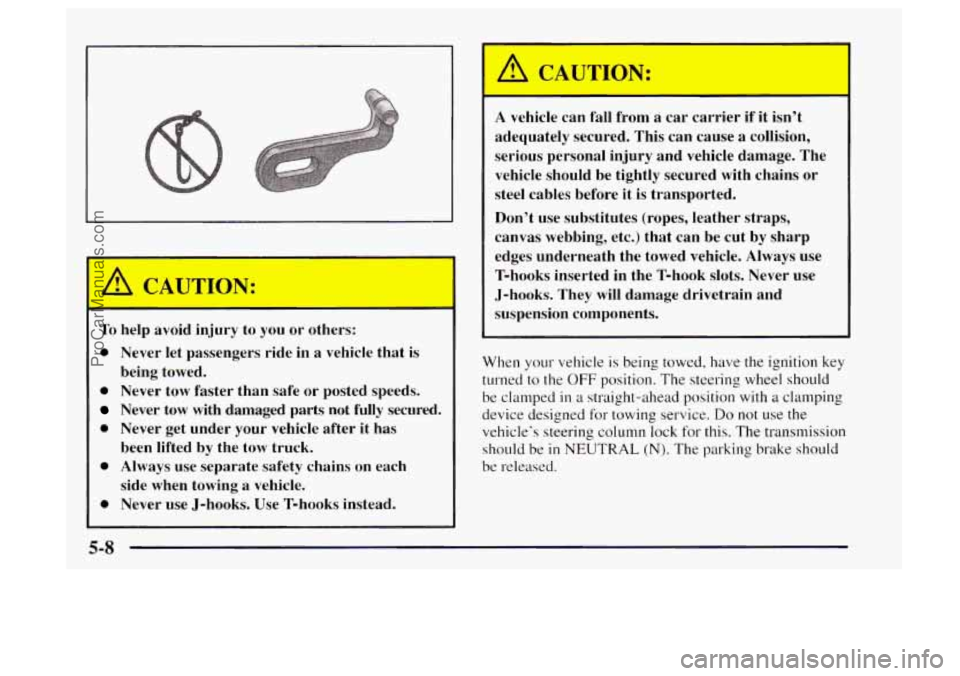
Don’t use substitutes (ropes, leather straps,
canvas webbing, etc.) that can be cut by sharp
edges underneath the towed vehicle. Always use
T-hooks inserted in the T-hook slots. Never use
J-hooks. They will damage drivetrain and
suspension components.
When your vehicle is being towed, have
the ignition key
turned
to the OFF position. The steering wheel should
be clamped
in a straight-ahead position with a clamping
device designed for
towing service. Do not use the
vehicle’s steering column lock for this.
The transmission
should
be in NEUTRAL (N). The parking brake should
be released.
5-8
ProCarManuals.com