parking brake OLDSMOBILE BRAVADA 1997 Owner's Manual
[x] Cancel search | Manufacturer: OLDSMOBILE, Model Year: 1997, Model line: BRAVADA, Model: OLDSMOBILE BRAVADA 1997Pages: 358, PDF Size: 18.02 MB
Page 207 of 358

If a Tire Goes Flat
It’s Llnusual for a tire to ”blow out.’ while you’re driving,
especially
if you maintain your tires properly. If air goes
out of a tire, it’s much more likely to leak out slowly.
But
if you should ever have a “blowout,” here are a few
tips about what to expect and what to do:
If a front tire fails, the flat tire will create a drag that
pulls the vehicle toward that side. Take your
f-bot off the
accelerator pedal and grip the steering wheel
firmly.
Steer to maintain lane position, and then gently brake to
a stop well out of the traffic lane.
A rear blowout. particularly on a curve, acts much like a
skid and may require the same conxxtion you’d use in a
skid. In any rear blowout, remove your foot from the
accelerator pedal. Get the vehicle under control by
steering the way
you want the vehicle to go. It may be
very bumpy and noisy, but
YOLI can still steer. Gently
brake to
a stop -- well off the road if possible.
If a tire goes flat, the next part shows how to use your
jacking equipment to change a flat tire safely.
Changing a Flat Tire
If a tire goes flat, avoid further tire and wheel damage
by driving slowly to
a level place. Turn on your hazard
warning flashers.
c
A CAUTION:
Changing a tire can cause an injury. The vehicle
can slip off the jack and roll over you
or other
people. You and they could be badly injured.
Find a level place to change your tire.
To help
prevent the vehicle from moving:
1. Set the parking brake firmly.
2. Put the shift lever in PARK (P).
3. Turn off the engine.
To be even more certain the vehicle won’t move,
you can put blocks at the front and rear of the
tire farthest away from the one being changed.
That would be the tire on the other side of the
vehicle, at the opposite end.
The following steps
will tell you how to use the jack and
change
a tire.
5-21
ProCarManuals.com
Page 236 of 358

Checking Transmission Fluid Cold
A cold check is made after the vehicle has been sitting
for eight hours or more
with the engine off and is used
only as a reference. Let the engine run at idle for five
minutes if outside temperatures are 50°F
(10°C) or
more. If it's colder than
50°F (IO'C), you may have to
idle the engine longer. Should the fluid level be
low
during a cold check, you must perform a hot check
before adding fluid. This will give
you a more accurate
reading
of the fluid level.
Checking the Fluid Hot or Cold
0
0
0
Park your vehicle on a level place. Keep the
engine running.
With the parking brake applied, place the shift lever
in PARK (P).
With your foot on the brake pedal, move the shift
lever through each gear range, pausing for about
three seconds
in each range. Then, position the shift
lever in
PARK (P).
Let the engine run at idle for three minutes or more. Then, without shutting
off the engine, follow these steps:
1. Flip
the handle up and then pull out the dipstick and
wipe
it with a clean rag or paper towel.
2. Push it back in all the way, wait three seconds and
then
pull it back out again.
6-16
ProCarManuals.com
Page 289 of 358
Short Trip/City Maintenance Schedule
The services shown in this schedule up to 100,000 miles
( 166 000 kmj should be performed after 100,000 miles
(166 000 kmj at the same intervals. The services shown
at
150,000 miles (240 000 km) should be performed at
the same interval after
150,000 miles (240 000 km).
Footnotes
7 The U.S. Environmental Protection Agency or the
California Air Resources Board has determined that the
failure to perform this maintenance item will
not nullify
the emission warranty or limit recall liability prior to the
completion of the vehicle’s useful life. We, however,
urge that all recommended maintenance services be
performed at the indicated intervals and the maintenance
be recorded.
## Lubricate the front suspension, ball joints, steering
linkage, parking brake cable guides, propshaft splines,
universal joints and brake pedal springs.
+ A good time to check your brakes is during tire
rotation. See “Brake System Inspection” under “Periodic
Maintenance Inspection’’ in Part
C of this schedule.
‘b‘k Drive axle service (see “Recommended Fluids and
Lubricants”
in the Index for proper lubricant to usej:
Drain and refill at first oil change. At subsequent oil
changes, check fluid level and add fluid
as needed. If
driving in dusty areas or towing a trailer, drain fluid
and refill every
15,000 miles (25 000 km).
More frequent lubrication may be required for
off-paved-road use.
7-7
ProCarManuals.com
Page 310 of 358
Long; Trip/Highway Maintenance Schedule
The services shown in this schedule up to 100,000 miles
(166
000 km) should be performed after 100,000 miles
(166
000 km) at the same intervals. The services shown
at 150,000 miles
(240 000 km) should be performed at
the same interval after 150,000 miles
(240 000 km).
Footnotes
The U.S. Environmental Protection Agency or the
California Air Resources Board has determined that the failure to perform this maintenance item will not nullify
the emission warranty or limit recall liability prior to the
completion of the vehicle’s useful life. We, however,
urge that all recommended maintenance services be
performed at the indicated intervals and the maintenance
be recorded.
# Lubricate the front suspension, ball joints, steering
linkage, parking brake cable guides, propshaft splines,
universal joints and brake pedal springs.
+ A good time to check your brakes is during tire
rotation. See “Brake System Inspection’’ under “Periodic
Maintenance Inspections” in Part C of this schedule.
**Drive axle service (see “Recommended Fluids and
Lubricants”
in the Index for proper lubricant to use):
0 Drain and refill at first oil change. At subsequent oil
changes, check fluid level and add fluid as needed.
7-28
ProCarManuals.com
Page 323 of 358

Starter Switch Check
A CA’., TION:
Brake-Transmission Shift Interlock (BTSI) Check
I
When you are doing this check, the vehicle could
move suddenly.
If it does, you or others could be
injured. Follow the steps below.
1.
-. 3
3.
Before you start, be sure you have enough room
around the vehicle.
Firmly apply both the parking brake (see “Parking
Brake” in the Index if necessary) and the regular brake.
NOTE:
Do not use the accelerator pedal, and be
ready to turn off the engine immediately
if it starts.
Try
to start the engine in each gear. The starter
should work only
in PARK (P) or NEUTRAL (N). If
the starter works in any other position, your vehicle
needs service.
1 A CAUTION:
I
When you are doing this check, the vehicle could
move suddenly.
If it does, you or others could be
injured. Follow the steps below.
I I
1. Before you start, be sure you have enough room
around the vehicle.
It should be parked on a
level surface.
2. Firmly apply the parking brake (see “Parking Brake”
in the Index if necessary).
NOTE: Be ready to apply the regular brake
immediately
if the vehicle begins to move.
3. With the engine off, turn the key to the RUN
position, but don’t start the engine. Without applying
the regular brake,
try to move the shift lever out of
PARK (P)
with normal effort. If the shift lever
moves out of PARK
(P), your vehicle’s BTSI
needs service.
7-41
ProCarManuals.com
Page 324 of 358

Steering Column Park Lock Check
While parked, and with the parking brake set, try to turn
the ignition key to LOCK in each shift lever position.
The key should turn to LOCK only when the shift
lever is
in PARK (P).
0 The key should come out only in LOCK.
Parking Brake and Automatic Transmission
PARK (P) Mechanism Check
When you are doing this check, your vehicle
could begin to move.
You or others could be
injured and property could be damaged. Make
sure there is room in front
of your vehicle in case
it begins to
roll. Be ready to apply the regular
brake at once should the vehicle begin to move.
Park on a hirly steep hill, with the vehicle facing
downhill. Keeping your foot on the regular brake, set the
parking brake.
To check the parking brake’s holding ability:
With the engine running and transmission
in
NEUTRAL (N), slowly remove foot pressure from
the regular brake pedal. Do this until the vehicle is
held by the parking brake only.
0 To check the PARK (P) mechanism’s holding ability:
With the engine running,
shift to PARK (P). Then
release all brakes.
Underbody Flushing Service
At least every spring, use plain water to flush any
corrosive materials from the underbody. Take care
to
clean thoroughly any areas where mud and other debris
can collect.
7-42
ProCarManuals.com
Page 326 of 358

Throttle Linkage Inspection
Inspect the throttle linkage for interference or binding,
and for damage or missing parts. Replace parts
as
needed. Replace any cables that have high effort or
excessive wear.
Do not lubricate accelerator and cruise
control cables.
Drive Axle Service
Check rear/front axle fluid level and add as needed.
Check constant velocity joints and axle seals for leaking.
Transfer Case (All-Wheel Drive) Inspection
Every 12 months or at oil change intervals, check front
axle and transfer case and
add lubricant when necessary.
Oil the control lever pivot point and
all exposed control
linkage. Check vent hose at transfer case
for kinks and
proper installation.
Brake System Inspection
Inspect the complete system. Inspect brake lines and
hoses for proper hook-up, binding, leaks, cracks,
chafing, etc. Inspect disc brake pads for wear and rotors
for surface condition. Inspect other brake parts,
including calipers, parking brake, etc. Check parking
brake adjustment.
You may need to have your brakes
inspected more often
if your driving habits or conditions
result
in frequent braking.
7-44
ProCarManuals.com
Page 327 of 358
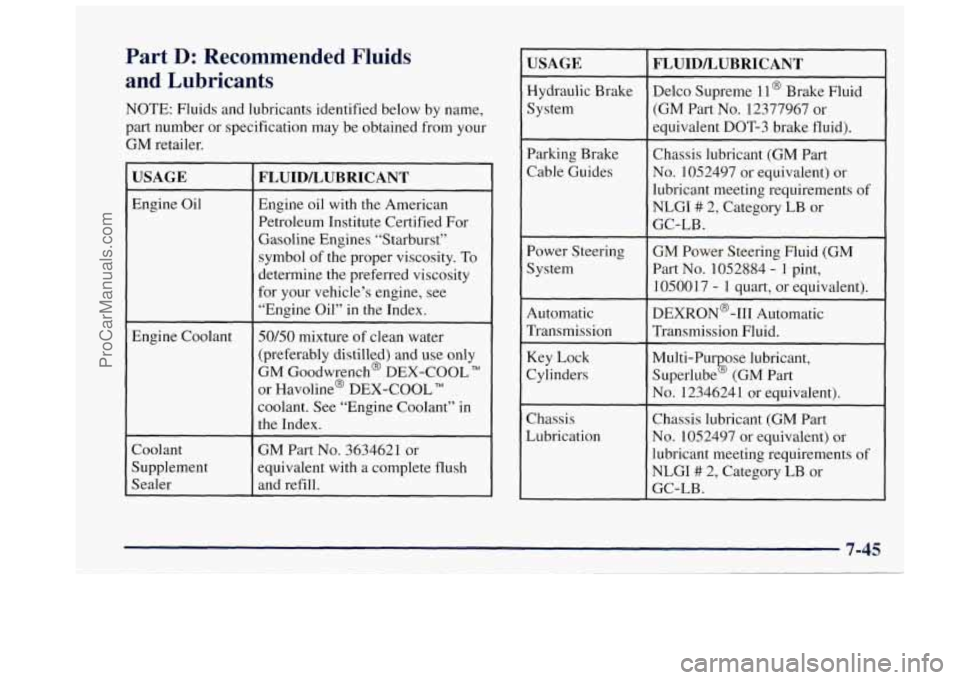
Part D: Recommended Fluids
and Lubricants
NOTE: Fluids and lubricants identified below by name,
part number or specification may be obtained from your
GM retailer.
USAGE
Engine Oil
Engine Coolant
Coolant
Supplement
Sealer
FLUIDLUBRICANT I ~~~ ~
Engine oil with the American
Petroleum Institute Certified For
Gasoline Engines “Starburst”
symbol of the proper viscosity.
To
determine the preferred viscosity
for your vehicle’s engine, see
“Engine Oil” in the Index.
50150 mixture of clean water
(preferably distilled) and use only
GM Goodwrench@ DEX-COOL
TM
or Havoline@ DEX-COOL TM
coolant. See “Engine Coolant” in
the Index.
GM Part No. 3634621 or
equivalent with a complete flush
and refill.
USAGE
Hydraulic Brake
System
Parking Brake
Cable Guides
Power Steering
System
Automatic
Transmission
Key Lock
Cylinders
Chassis
Lubrication
FLUIDLUBRICANT
Delco Supreme 11 @I Brake Fluid
(GM Part
No. 12377967 or
equivalent DOT-3 brake fluid).
Chassis lubricant
(GM Part
No. 1052497 or equivalent) or
lubricant meeting requirements of
NLGI
# 2, Category LB or
GC-LB.
GM Power Steering Fluid (GM
Part No. 1052884
- 1 pint,
1050017
- 1 quart, or equivalent).
DEXRON@-I11 Automatic
Transmission Fluid.
Multi-Pu ose lubricant, Superlube
% (GM Part
No. 12346241 or equivalent).
Chassis lubricant (GM Part
No. 1052497 or equivalent) or
lubricant meeting requirements of
NLGI
# 2, Category LB or
GC-LB.
7-45
ProCarManuals.com
Page 344 of 358

Better Business Bureau Mediation ................... 8-7
Blizzard. Driving In ............................. 4-40
BrakeFluid
.................................... 6-25
Brake. Parking
................................. 2-18
Brake System Warning Light
...................... 2-55
Brakes Adjustment
.................................. 6-28
Master Cylinder .............................. 6-25
PedalTravel ................................. 6-28
Replacing System Parts
........................ 6-29
Trailer
...................................... 4-48
Wear ....................................... 6-28
Brake-Transmission
Shift Interlock Check ........... 7-41
Braking
........................................ 4-6
In Emergencies ................................ 4-9
Brightness Control .............................. 2-31
BTSICheck ................................... 7-41
Bulb Replacement
.............................. 6-30
Capacities and Specifications
............... 6-60.6-6 1
Carbon Monoxide ................ 2.8. 2-22.4-41,4-49
Cargo Security Shade
............................ 2-40
Cargo Tie
Downs ............................... 2-41
Certificatian/Tire Label
.......................... 4-42
Chains Safety
........................ ......... 4-48
Tire ........................................ 6-43
Changing a Flat Tire ............................. 5-21
Charging System Light
.......................... 2-53
Checking Your Restraint Systems
.................. 1-44
Chcrnical
Paint Spotting .......................... 6-51
Child Restraints
................................ 1-34
Center Seat Positions
.......................... 1-38
Securing in a Rear Outside Seat Position ........... 1-36
Securing
in the Right Front Seat Position .......... 1-38
Where to Put
................................ 1-34
Cigarette Lighter
............................... 2-42
Circuit Breakers and Fuses
....................... 6-55
Cleaner. Air
................................... 6-13
Cleaning
Aluminum Wheels ............................ 6-50
Fabric ...................................... 6-45
Glass ....................................... 6-47
Inside
of Your Oldsmobile ...................... 6-44
Instrument Panel
............................. 6-47
Leather
..................................... 6-47
Outside
of Your Oldsmobile .................... 6-48
Stains
...................................... 6-46
Tires
....................................... 6-50
Vinyl ....................................... 6-46
Weatherstrips
................................ 6-48
Wheels ..................................... 6-50
Windshield . Backglass and Wiper Blades .......... 6-48
Check
Gages Light
.............................. 2-57
Topstrap
................................... 1-35
9-2
.. ~ . _._- -
ProCarManuals.com
Page 349 of 358

Net. Convenience .............................. 2-40
Neutral
....................................... 2-17
New Vehicle “Break-In”
......................... 2- 1 1
Night Vision ................................... 4-29
Normal Maintenance Replacement Parts
............. 6-60
Odometer
.................................... 2-5 1
Off-Road Driving .............................. 4- 15
Off-Road Recovery ............................. 4- I I
Oil. Engine ..................................... 6-9
Outside Mirrors
................................ 2-34
Overdrive. Automatic Transmission
................ 2- I7
Overhead Console .............................. 2-36
Overheating Engine
............................. 5- 12
Owner and Service Publications
................... 8- IO
Owner Checks and Services ....................... 7-39
Ordering Owner
and Service Publications
............ 8- IO
Paint Spotting. Chemical ........................ 6-5 1
Park ......................................... 2-15
Shifting Into
................................. 2- 19
Shifting Out of ............................... 2-2 1
AtNight .................................... 2-11
Brake
...................................... 2-18
Brake Mechanism Check
....................... 7-42
Parking Lots
....................................... 2-11
On
Hills with a Trailer ......................... 4-51
Over Things That Burn ........................ 2-22
Passing
....................................... 4-12
Payload
....................................... 4-44
Periodic Maintenance Inspections
.................. 7-43
Power
Accessory Outlets
............................ 2-43
Door Locks
................................... 2-5
Remote Control Mirror
........................ 2-35
Powerseat ................................... 1-2
Steering ..................................... 4-9
Steering Fluid ................................ 6-23
Windows
................................... 2-24
Pregnancy
. Usc 01‘ Safety Belts .................... 1-24
Problems on the Road
............................ 5-1
Publications. Service and Owner ................... 8-10
Radialor. Adding Coolant ....................... 5-18
Radiator Pressure Cap ........................... 6-23
Radio Reception
................................ 3-15
Radios Cassette
Tape Player ........................... 3-6
Cassette Tape Player Care
................. 3- 16. 7-39
Compact Disc Player
........................... 3-9
Theft-Deterrent Feature. CD Player
.............. 3-13
Rain . Driving .................................. 4-30
ProCarManuals.com