change time OLDSMOBILE CUTLASS 1997 User Guide
[x] Cancel search | Manufacturer: OLDSMOBILE, Model Year: 1997, Model line: CUTLASS, Model: OLDSMOBILE CUTLASS 1997Pages: 353, PDF Size: 16.72 MB
Page 158 of 353
0
0
0
0
Check your mirrors, glance over your shoulder, and start your left lane change signal before moving out
of the right lane to pass. When you are far enough
ahead of the passed vehicle to see its front in your
inside mirror, activate your right lane change signal
and move back into the right lane. (Remember that
your right outside mirror is convex. The vehicle you
just passed may seem to be farther away from you
than it really is.)
Try not to pass more than one vehicle at a time on
two-lane roads. Reconsider before passing the
next vehicle.
Don’t overtake a slowly moving vehicle too rapidly.
Even though the brake lamps are not flashing, it may
be slowing down or starting to
turn.
If you’re being passed, make
following driver to get ahead
can ease a little to the right. it easy
for the
of you. Perhaps
you
Loss of Control
Let’s review what driving experts say about what
happens when the three control systems (brakes, steering
and acceleration) don’t have enough friction where the
tires meet the road
to do what the driver has asked.
In any emergency, don’t give up. Keep trying to steer and
constantly seek
an escape route or area of less danger.
Skidding
In a skid, a driver can lose control of the vehicle.
Defensive drivers avoid most skids by taking reasonable
care suited to existing conditions, and by not “overdriving”\
those conditions. But skids are always possible.
The three types
of skids correspond to your
Oldsmobile’s three control systems. In the braking
skid,
your wheels aren’t rolling. In the steering or cornering
skid, too much speed or steering
in a curve causes tires
to slip and lose cornering force. And in the acceleration
skid, too much throttle causes the driving wheels to spin.
4-13
ProCarManuals.com
Page 178 of 353
Your vehicle can tow a trailer if it is equipped with the
proper trailer towing equipment.
To identify what the vehicle trailering capacity is for
your vehicle, you should read the information in
“Weight of the Trailer” that appears later in this section.
But trailering is different than just driving your vehicle
by itself. Trailering means changes
in handling,
durability and fuel economy. Successful, safe trailering
takes correct equipment, and it has to be used properly.
That’s the reason for this part. In it are many
time-tested, important trailering tips and safety rules.
Many of these are important for your safety and that of
your passengers.
So please read this section carefully
before you pull a trailer.
Load-pulling components such as the engine, transaxle,
wheel assemblies and tires are forced to work harder
against the drag of the added weight. The engine is
required to operate at relatively higher
speeds^ and under
greater loads, generating extra heat. What’s more, the
trailer adds considerably to wind resistance, increasing
the pulling requirements.
If You Do Decide To Pull A Trailer
If you do, here are some important points:
0
0
0
0
e
There are many different laws, including speed limit
restrictions, having to
do with trailering. Make sure
your rig will be legal, not only where
you live but
also where you’ll be driving.
A good source for this
information can be state or provincial police.
Consider using a sway control. You can ask a hitch
dealer about sway controls.
Don’t tow a trailer at all during the first
1,000 miles
(1 600 km) your new vehicle is driven. Your engine,
axle or other parts could be damaged.
Then, during the first
500 miles (800 krn) that you
tow a trailer, don’t drive over
50 mph (80 km/h) and
don’t make starts at full throttle.
This helps your
engine and other parts of your vehicle wear
in at the
heavier loads.
Obey speed limit restrictions when towing a trailer.
Don’t drive faster than the maximum posted speed
for trailers (or no more than
55 mph (90 km/h)) to
save wear on your vehicle’s parts.
4-33
ProCarManuals.com
Page 248 of 353
Brake Pedal Travel Replacing Brake System Parts
See your retailer if the
brake pedal does not return to
normal height, or if there is a rapid increase in pedal
travel. This could be a sign of brake trouble.
Brake Adjustment
Every time you make a moderate brake stop, your disc
brakes adjust for wear.
If you rarely make a moderate or
heavier stop, then your brakes might not adjust correctly.
If you drive in that way, then -- very carefully -- make
a few moderate brake stops about every
1,000 miles
(1 600 h), so your brakes will adjust properly.
If your brake pedal goes down farther than normal, your
rear drum brakes may need adjustment. Adjust them by
pumping the brake pedal repeatedly while the engine is
running with the shift lever in
PARK (P).
The braking system on a modern vehicle is complex. Its
many parts have to be of top quality and work well
together if the vehicle is to have really good braking.
Your vehicle was designed and tested with top-quality
GM brake parts. When you replace parts of your braking
system
-- for example, when your brake linings wear
down and you have to have new ones put in
-- be sure
you get new approved GM replacement parts.
If you
don’t, your brakes may no longer work properly. For
example, if someone puts in brake linings that are wrong
for your vehicle, the balance between your front and
rear brakes can change
-- for the worse. The braking
performance you’ve come to expect can change in many
other ways if someone puts in the wrong replacement
brake parts.
Battery
Every new Oldsmobile has a Delco Freedom@ battery.
You never have to add water to one of these. When it’s
time for a new battery, we recommend a Delco Freedom
battery. Get one that has the replacement number shown
on the original battery’s label.
6-25
ProCarManuals.com
Page 310 of 353
The services shown in this schedule up to 100,000 miles
(166
000 km) should be performed after 100,000 miles
(166
000 km) at the same intervals. The services shown
at 150,000 miles
(240 000 km) should be perforrned at
the same interval after 150,000 miles
(240 000 km).
See “Owner Checks and Services” and “Periodic
Maintenance Inspections” following.
Footnotes
The U.S. Environmental Protection Agency or the
California Air Resources Board has determined that the
failure to perform this maintenance item will not nullify
the emission warranty or limit recall liability prior to the completion
of the vehicle’s useful life. We, however,
urge that all recommended maintenance services be
performed at the indicated intervals and the maintenance
be recorded.
+ A good time to check your brakes is during tire
rotation. See “Brake System Inspection” under “Periodic
Maintenance Inspections”
in Part C of this schedule.
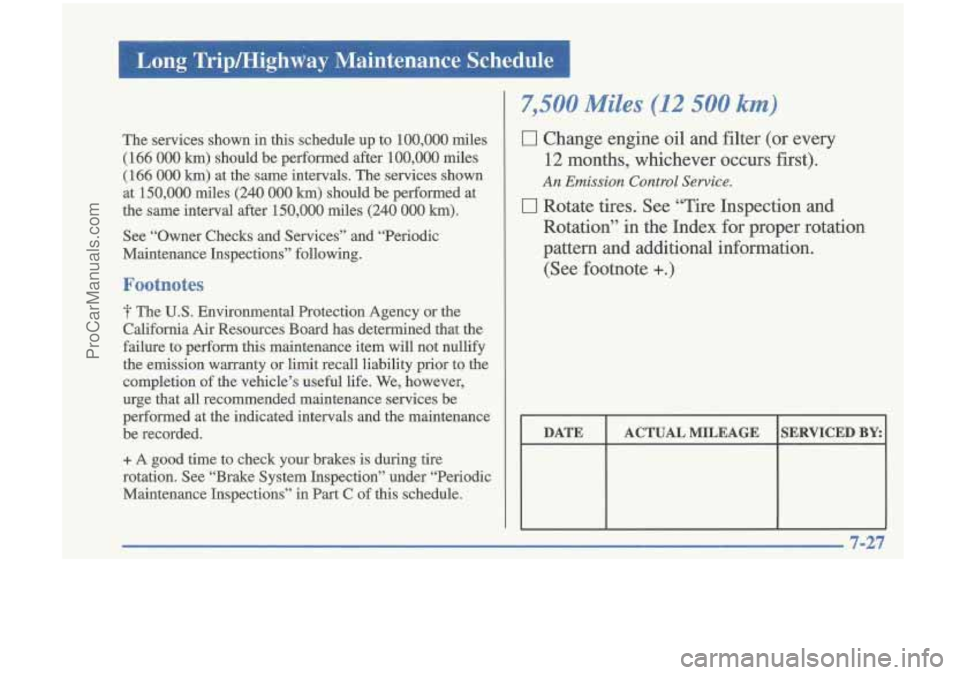
7,500 Miles (12 500 km)
0 Change engine oil and filter (or every
12 months, whichever occurs first).
0 Rotate tires. See “Tire Inspection and
Rotation”
in the Index for proper rotation
pattern and additional information.
(See footnote
+.)
An Emission Control Service.
DATE SERVICED BY: ACTUAL MILEAGE
n an
ProCarManuals.com
Page 351 of 353
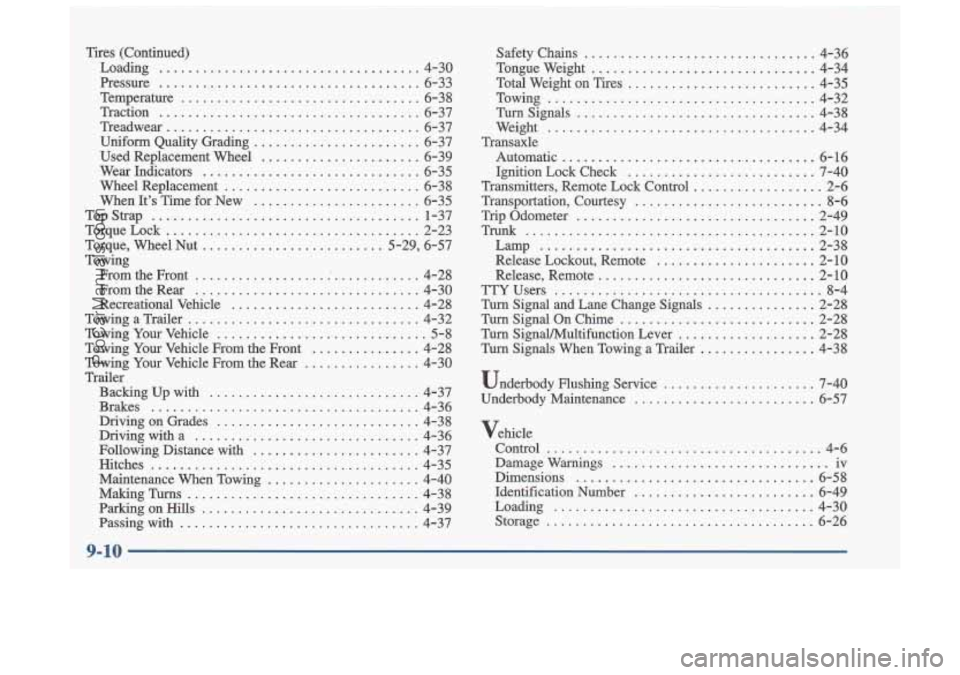
Tires (Continued) Loading
.................................... 4-30
Pressure
.................................... 6-33
Temperature
................................. 6-38
Traction
.................................... 6-37
Treadwear
................................... 6-37
Uniform Quality Grading
....................... 6-37
Used Replacement Wheel
...................... 6-39
Wear Indicators
.............................. 6-35
Wheel Replacement
........................... 6-38
When It’s Time for New
....................... 6-35
TopStrap
..................................... 1-37
TorqueLock
................................... 2-23
Torque. Wheel
Nut ......................... 5-29. 6-57
Towing
From the Front
................................ 4-28
FromtheRear
............................... 4-30
Recreational Vehicle
.......................... 4-28
Towing a Trailer
................................ 4-32
Towing
Your Vehicle ............................. 5-8
Towing Your Vehicle From the Front
............... 4-28
Towing Your Vehicle From the Rear
................ 4-30
Trailer
Backing Up with
............................. 4-37
Brakes
..................................... 4-36
Driving
on Grades ............................ 4-38
Drivingwitha
............................... 4-36
Following Distance
with ....................... 4-37
Hitches
..................................... 4-35
Maintenance When Towing
..................... 4-40
MakingTums
................................ 4-38
ParkingonHills
.............................. 4-39
Passingwith
................................. 4-37 SafetyChains
................................ 4-36
Tongueweight
............................... 4-34
Total Weight on Tires
.......................... 4-35
Towing
..................................... 4-32
Turnsignals
................................. 4-38
Weight ..................................... 4-34
Automatic
................................... 6-16
Ignition Lock Check
.......................... 7-40
Transmitters. Remote Lock Control
.................. 2-6
Transportation. Courtesy
.......................... 8-6
Trip Odometer
................................. 2-49
Transaxle
Trunk
........................................ 2-10
Lamp
...................................... 2-38
Release Lockout. Remote
...................... 2-10
Release. Remote
.............................. 2-10
TTYUsers
..................................... 8-4
Turn Signal and Lane Change Signals
............... 2-28
Turn Signal On Chime
........................... 2-28
Turn Signal/Multifunction Lever
................... 2-28
Turn Signals When Towing a Trailer
................ 4-38
Underbody Flushing Service
..................... 7-40
Underbody Maintenance
......................... 6-57
Vehicle Control
...................................... 4-6
Damagewarnings
.............................. iv
Dimensions
................................. 6-58
Identification Number
......................... 6-49
Loading
.................................... 4-30
Storage
..................................... 6-26
9-10 .
ProCarManuals.com