parking brake OLDSMOBILE CUTLASS 1997 User Guide
[x] Cancel search | Manufacturer: OLDSMOBILE, Model Year: 1997, Model line: CUTLASS, Model: OLDSMOBILE CUTLASS 1997Pages: 353, PDF Size: 16.72 MB
Page 191 of 353
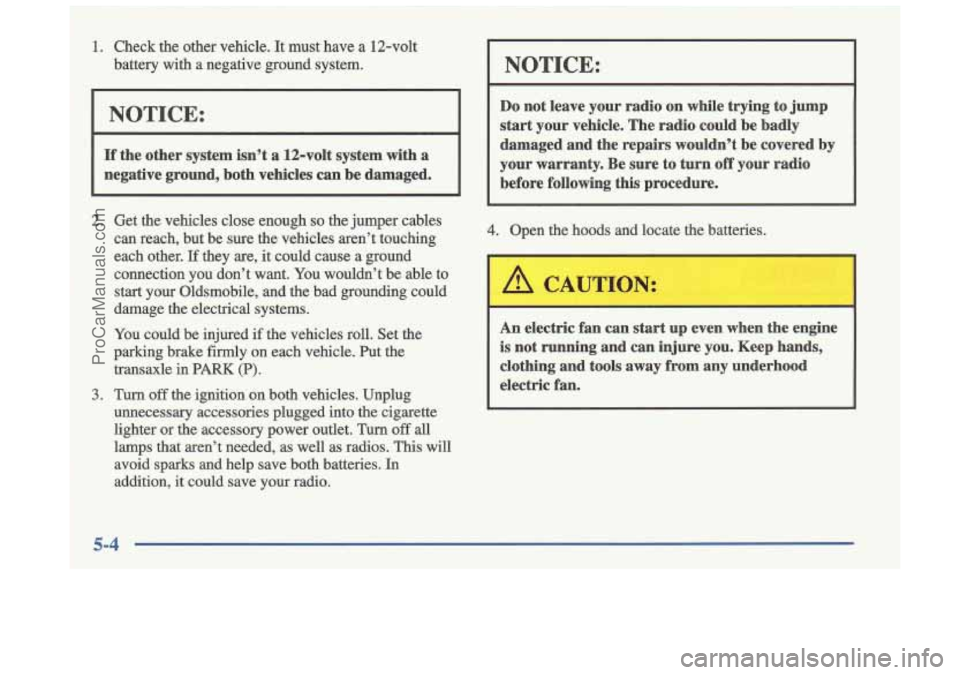
1. Check the other vehicle. It must have a 12-volt
battery with a negative ground system.
NOTICE:
If the other system isn’t a 12-volt system with a
negative ground, both vehicles can be damaged.
2. Get the vehicles close enough so the jumper cables
can reach, but be sure the vehicles aren’t touching
each other.
If they are, it could cause a ground
connection you don’t want. You wouldn’t be able to
start your Oldsmobile, and the bad grounding could
damage the electrical systems.
You could be injured
if the vehicles roll. Set the
parking brake firmly on each vehicle. Put the
transaxle in
PARK (P).
unnecessary accessories plugged into the cigarette
lighter or the accessory power outlet. Turn
off all
lamps that aren’t needed, as well as radios. This will avoid sparks and help save both batteries.
In
addition, it could save your radio.
3. Turn off the ignition on both vehicles. Unplug
I
NOTICE:
Do not leave your radio on while trying to jump
start your vehicle. The radio could be badly
damaged and the repairs wouldn’t be covered by
your warranty. Be sure to turn
off your radio
before following this procedure.
4. Open the hoods and locate the batteries.
I
An electric fan can start up even when the engine
is not running and can injure you. Keep hands,
clothing and tools away from any underhood
electric fan.
5-4
ProCarManuals.com
Page 208 of 353
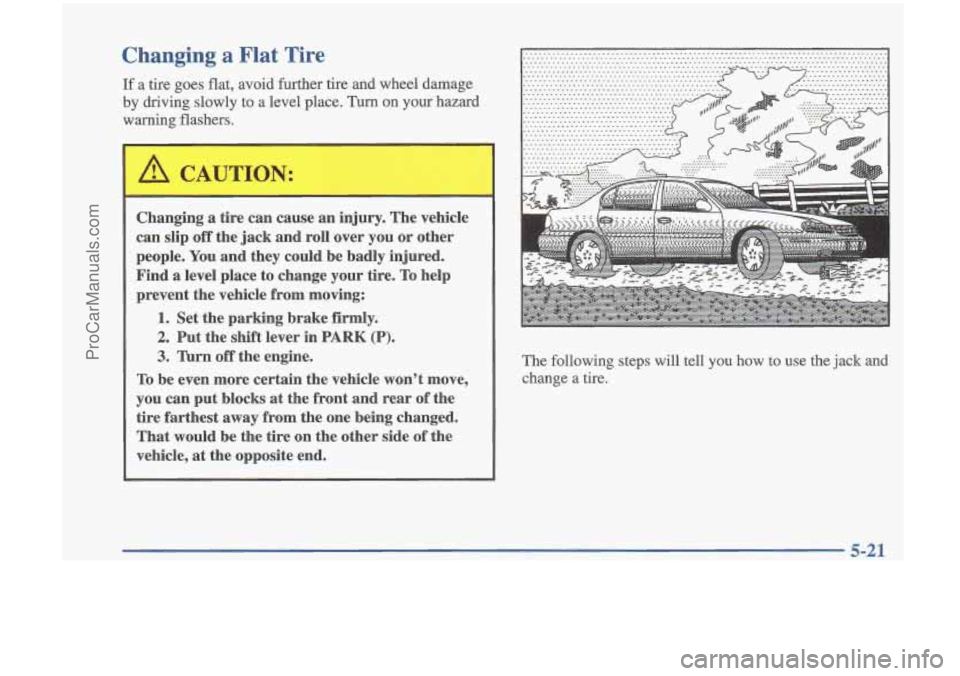
Changing a Flat Tire
If a tire goes flat, avoid further tire and wheel damage
by driving slowly to a level place. Turn
on your hazard
warning flashers.
Changing a tire can cause an injury. The vehicle
can dip off the jack and roll over you or other
people. You and they could be badly injured.
Find a level place to change your tire. To help
prevent the vehicle from moving:
1. Set the parking brake firmly.
2. Put the shift lever in PARK (P).
3. lhrn off the engine.
To be even more certain the vehicle won't move,
you can put blocks at the front and rear of the
tire farthest away from the one being changed.
The following steps will tell you how to use the jack and
change a tire.
ProCarManuals.com
Page 279 of 353
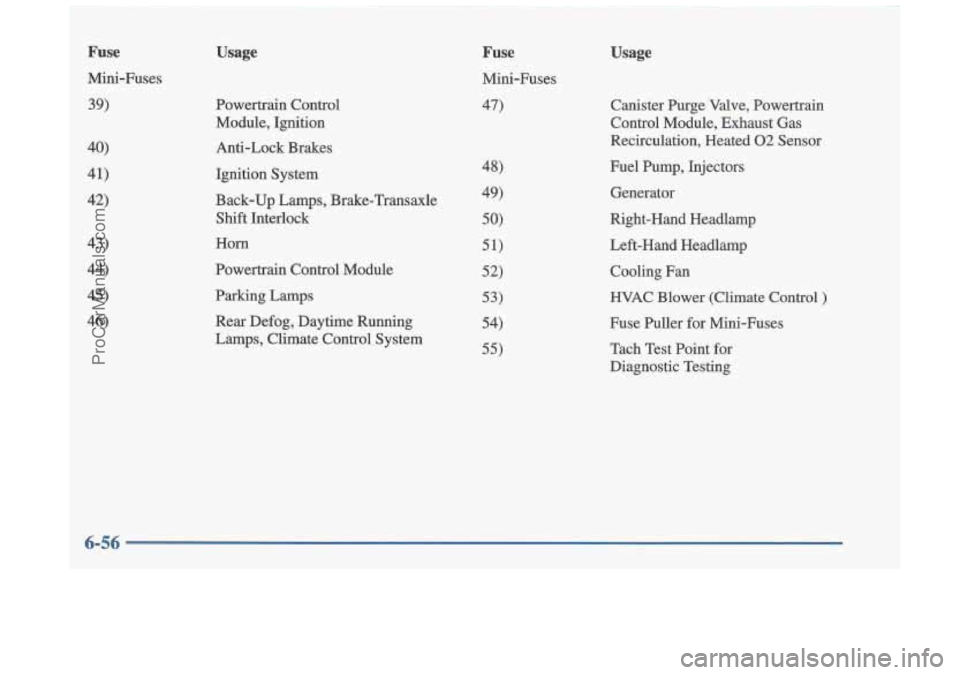
Fuse
Mini-Fuses
39)
40)
41)
42)
43)
44)
Usage
Powertrain Control
Module, Ignition
Anti-Lock Brakes
Ignition System
Back-up Lamps, Brake-Transaxle
Shift Interlock
Horn
Powertrain Control Module
Parking
Lamps
Rear Defog, Daytime Running
Lamps, Climate Control System
Fuse
Mini-Fuses
47)
Usage
Canister Purge Valve, Powertrain
Control Module, Exhaust
Gas
Recirculation, Heated 02 Sensor
Fuel Pump, Injectors Generator
Right-Hand Headlamp
Left-Hand Headlamp
Cooling
Fan
WAC Blower (Climate Control )
Fuse Puller for Mini-Fuses
Tach Test Point for
Diagnostic Testing
6-56
ProCarManuals.com
Page 322 of 353
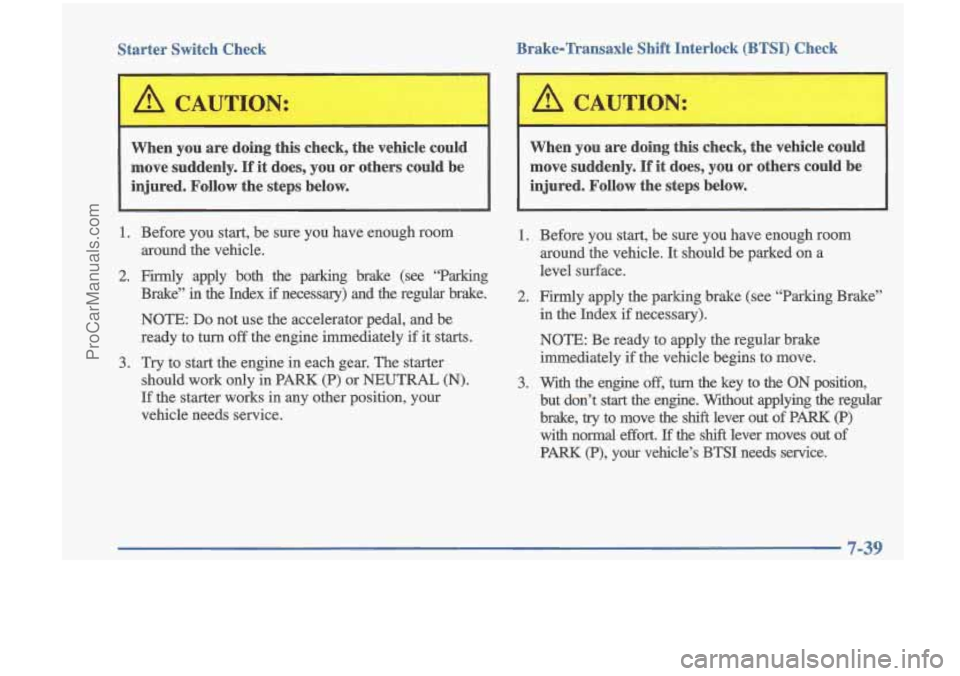
Starter Switch Check Brake-Transaxle Shift Interlock (BTSI) Check
When you are doing
this check, the vehicle could
move suddenly.
If it does, you or others could be
injured. Follow the steps below.
c I
When you are doing this check, the vehicle could
move suddenly.
If it does, you or others could be
injured. Follow the steps below.
1. Before you start, be sure you have enough room
2. Firrnly apply both the parking brake (see “Parking
Brake”
in the Index if necessary) and the regular brake.
NOTE:
Do not use the accelerator pedal, and be
ready to turn
off the engine immediately if it starts.
3.
Try to start the engine in each gear. The starter
should work only in PARK (P) or
NEUTRAL (N).
If the starter works in any other position, your
vehicle needs service. around
the vehicle.
1. Before you start, be sure you have enough room
around the vehicle. It should be parked on a
level surface.
2. Firrnly apply the parking brake (see “Parking Brake”
in the Index if necessary).
NOTE: Be ready to apply the regular brake
immediately if the vehicle begins to move.
3. With the engine off, turn the key to the ON position,
but don’t
start the engine. Without applying the regular
brake,
‘uy to move the shift lever out of PARK (P)
with normal effort. If the shift lever moves out of
PARK (P), your vehicle’s BTSI needs service.
7-39
ProCarManuals.com
Page 323 of 353
Ignition Transaxle Lock Check
While parked, and with the parking brake set, try to turn the ignition key
to OFF in each shift lever position.
The key should turn to OFF only when the shift lever
On all vehicles, the key should come out only in
OFF.
is in PARK (P).
Parking Brake and Automatic Transaxle PARK
(P)
MecT m .-,’ leck
When you are doing this check, your vehicle
could begin to move. You
or others could be
injured and property could be damaged. Make
sure there
is room in front of your vehicle in case
it begins to roll. Be ready to apply the regular
brake
at once should the vehicle begin to move. Park on
a fairly steep hill, with the vehicle facing
downhill. Keeping your foot on the regular brake, set the
parking brake.
To check the parking brake’s holding ability: With
the engine running and transaxle in
NEUTRAL (N),
slowly remove foot pressure from the regular brake
pedal.
Do this until the vehicle is held by the parking
brake only.
To check the PARK (P) mechanism’s holding ability:
With the engine running, shift to PARK
(P). Then
release all brakes.
Underbody Flushing Service
At least every spring, use plain water to flush any corrosive materials from the underbody. Take care to
clean thoroughly any areas where mud and other debris
can collect.
7-40
ProCarManuals.com
Page 324 of 353
Part C: Periodic Maintenance
Inspections
Listed below are inspections and servlces which should be
performed at least twice a year (for instance, each spring
and fall). You should let your
GM retailer’s service
department or other
qualified service center do these jobs.
Make sure
any necessary repairs are completed at once.
Proper procedures to perform these services may be
found
in a GM service manual. See “Service and Owner
Publications” in the Index.
Steering, Suspension and Front Drive Axle
Boot and Seal Inspection
Inspect the front and rear suspension and steering
system for damaged, loose or missing parts, signs of
wear or lack of lubrication. Inspect the power steering
lines and hoses for proper hook-up, binding, leaks,
cracks, chafing, etc. Clean and then inspect the drive
axle boot seals for damage, tears or leakage. Replace
seals if necessary.
Exhaust System Inspection
Inspect the complete exhaust system. Inspect the body near
the exhaust system.
Look for broken, damaged, missing or
out-of-position parts
as well as open seams, holes, loose connections or other conditions
whch could cause a heat
build-up in the floor pan or could let exhaust fumes into
the vehicle.
See “Engine Exhaust” in the Index.
Radiator and Heater Hose Inspection
Inspect the hoses and have them replaced if they are
cracked, swollen or deteriorated. Inspect all pipes,
fittings and clamps; replace
as needed.
Throttle Linkage Inspection
Inspect the throttle linkage for interference or binding,
and for damaged or missing parts. Replace parts as
needed. Replace
any cables that have high effort or
excessive wear.
Do not lubricate accelerator and cruise
control cables.
Brake System Inspection
Inspect the complete system. Inspect brake lines and
hoses for proper hook-up, binding, leaks, cracks,
chafing, etc. Inspect disc brake pads for wear and rotors
for surface condition.
Also inspect drum brake linings
for wear and cracks. Inspect other brake parts, including
drums, wheel cylinders, calipers, parking brake, etc. The
parking brake is self-adjusting and no manual adjustment is required. You may need
to have your
brakes inspected more often
if your driving habits or
conditions result
in frequent braking.
7-41
ProCarManuals.com
Page 351 of 353
Tires (Continued) Loading
.................................... 4-30
Pressure
.................................... 6-33
Temperature
................................. 6-38
Traction
.................................... 6-37
Treadwear
................................... 6-37
Uniform Quality Grading
....................... 6-37
Used Replacement Wheel
...................... 6-39
Wear Indicators
.............................. 6-35
Wheel Replacement
........................... 6-38
When It’s Time for New
....................... 6-35
TopStrap
..................................... 1-37
TorqueLock
................................... 2-23
Torque. Wheel
Nut ......................... 5-29. 6-57
Towing
From the Front
................................ 4-28
FromtheRear
............................... 4-30
Recreational Vehicle
.......................... 4-28
Towing a Trailer
................................ 4-32
Towing
Your Vehicle ............................. 5-8
Towing Your Vehicle From the Front
............... 4-28
Towing Your Vehicle From the Rear
................ 4-30
Trailer
Backing Up with
............................. 4-37
Brakes
..................................... 4-36
Driving
on Grades ............................ 4-38
Drivingwitha
............................... 4-36
Following Distance
with ....................... 4-37
Hitches
..................................... 4-35
Maintenance When Towing
..................... 4-40
MakingTums
................................ 4-38
ParkingonHills
.............................. 4-39
Passingwith
................................. 4-37 SafetyChains
................................ 4-36
Tongueweight
............................... 4-34
Total Weight on Tires
.......................... 4-35
Towing
..................................... 4-32
Turnsignals
................................. 4-38
Weight ..................................... 4-34
Automatic
................................... 6-16
Ignition Lock Check
.......................... 7-40
Transmitters. Remote Lock Control
.................. 2-6
Transportation. Courtesy
.......................... 8-6
Trip Odometer
................................. 2-49
Transaxle
Trunk
........................................ 2-10
Lamp
...................................... 2-38
Release Lockout. Remote
...................... 2-10
Release. Remote
.............................. 2-10
TTYUsers
..................................... 8-4
Turn Signal and Lane Change Signals
............... 2-28
Turn Signal On Chime
........................... 2-28
Turn Signal/Multifunction Lever
................... 2-28
Turn Signals When Towing a Trailer
................ 4-38
Underbody Flushing Service
..................... 7-40
Underbody Maintenance
......................... 6-57
Vehicle Control
...................................... 4-6
Damagewarnings
.............................. iv
Dimensions
................................. 6-58
Identification Number
......................... 6-49
Loading
.................................... 4-30
Storage
..................................... 6-26
9-10 .
ProCarManuals.com