towing Oldsmobile Cutlass 1998 s User Guide
[x] Cancel search | Manufacturer: OLDSMOBILE, Model Year: 1998, Model line: Cutlass, Model: Oldsmobile Cutlass 1998Pages: 348, PDF Size: 17.46 MB
Page 179 of 348

Your vehicle can tow a trailer if it is equipped with the
proper trailer towing equipment. To identify what the
vehicle trailering capacity is for your vehicle, you
should read the information
in “Weight of the Trailer”
that appears later
in this section. But trailering is
different than just driving your vehicle by itself.
Trailering means changes in handling, durability and
fuel economy. Successful, safe trailering takes correct
equipment, and it has to be used properly.
That’s the reason for this part. In it are many
time-tested, important trailering tips and safety rules.
Many of these are important for your safety and that of
your passengers.
So please read this section carefully
before you pull a trailer.
Load-pulling components such as the engine, transaxle,
wheel assemblies and tires are forced to work harder
against the drag
of the added weight. The engine is
required to operate at relatively higher speeds and under greater loads, generating extra heat. What’s more, the
trailer adds considerably to wind resistance, increasing
the pulling requirements.
If You Do Decide To Pull A Trailer
If you do, here are some important points:
0
0
0
0
0
There are many different laws, including speed limit
restrictions, having to do with trailering. Make sure
your rig will be legal, not only where you live but
also where you’ll be driving. A good source for this
information can be state or provincial police.
Consider using a sway control. You can ask
a hitch
dealer about sway controls.
Don’t tow a trailer at all during the first
1,000 miles
(1 600 km) your new vehicle is driven. Your engine,
axle
or other parts could be damaged.
Then, during the first
500 miles (800 Ian) that you
tow a trailer, don’t drive over
50 mph (80 km/h) and
don’t make starts at full throttle.
This helps your
engine and other parts of your vehicle wear in at the
heavier loads.
Obey speed limit restrictions when towing a trailer.
Don’t drive faster than the maximum posted speed
for trailers (or no more than
55 mph (90 lun/h)) to
save wear on your vehicle’s
parts.
4-33
I
Page 183 of 348
Following Distance
Stay at least twice as far behind the vehicle ahead as you
would when driving your vehicle without a trailer. This
can help you avoid situations that require heavy braking
and sudden turns.
Passing
You’ll need more passing distance up ahead when
you’re towing a trailer. And, because you’re a good deal
longer, you’ll need to go much farther beyond the
passed vehicle before you can return to your lane.
Backing Up
Hold the bottom of the steering wheel with one hand.
Then, to move the
trailer to the left, just move that hand
to the left.
To move the trailer to the right, move your
hand to the right. Always back up slowly and, if
possible, have someone guide you.
Making nrns
NOTICE:
Making very sharp turns while trailering could
cause the trailer to come in contact with the
vehicle. Your vehicle could be damaged. Avoid
making very sharp turns while trailering.
When you’re turning with a trailer, make wider tums
than normal. Do this so your trailer won’t strike soft
shoulders, curbs, road signs, trees or other objects.
Avoid jerky or sudden maneuvers. Signal well
in advance.
4-37
Page 184 of 348
Turn Signals When Towing a Trailer
When you tow a trailer, your vehicle may need additional wiring. Check with your retailer. The green
arrows on your instrument panel will flash whenever
you signal a turn or lane change. Properly hooked up,
the trailer lamps will also flash, telling other drivers
you’re about to
turn, change lanes or stop.
When towing a trailer, the green arrows on your instrument panel
will flash for turns even if the bulbs on
the trailer are burned out. Thus, you may think drivers
behind you are seeing your signal when they are not. It’s
important to check occasionally to be sure the trailer
bulbs are still working.
Driving On Grades
NOTICE:
Do not tow on steep continuous grades exceeding
6 miles (9.6 km). Extended, higher than normal
engine and transaxle temperatures may result
and damage your vehicle. Frequent stops are
very important to allow the engine and transaxle
to cool.
Reduce speed and shift to a lower gear before you start
down a long or steep downgrade. If you don’t shift
down, you might have to use your brakes
so much that
they would get hot and no longer work well.
On a long uphill grade, shift down and reduce your
speed to around
45 mph (70 km/h) to reduce the
possibility
of engine and transaxle overheating.
Pay attention to the engine coolant gage. If the indicator
is in the red area, turn
off the air conditioning to reduce
engine load (see “Engine Overheating” in the Index).
4-38
Page 187 of 348
Section 5 Problems on the Road
Here you’ll find what to do about some problems that can occur on the road.
5-2
5-2
5-3
5-8
5-12
Hazard Warning Flashers Other Warning Devices
Jump Starting
Towing Your Vehicle
Engine Overheating 5- 15 Cooling System
5-22 Changing a Flat Tire
5-32 Compact Spare Tire
5-33 If You’re Stuck: In Sand, Mud,
5-22 If a Tire’Goes Flat
Ice or Snow
5-1
Page 194 of 348
Towing Your Vehicle
Try to have a retder or a professional towing service
tow your vehicle. They can provide the right equipment
and
know-how to tow your vehicle without damage.
(See ”Roadside Assistance”
in the Index.)
If your vehicle has been changed or modified since it
was factory-new by adding aftemarket items like
fog
lamps, aero skirting, or special tires and wheels, these
instructions and illustrations may not be correct.
Before you do anything,
turn on the hazard
warning flashers.
When you call, tell the towing service:
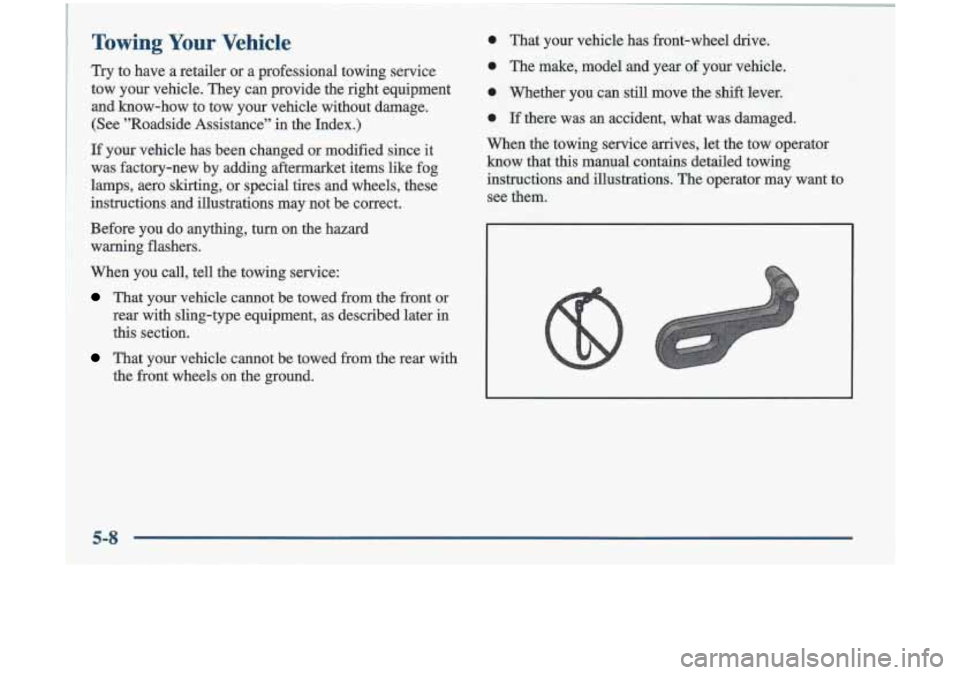
That your vehicle cannot be towed from the front or
rear with sling-type equipment, as described later
in
this section.
That your vehicle cannot be towed from the rear with
the front wheels on the ground.
Page 195 of 348

To help avoid injury to you or others:
--
A vehicle can fall from a car carrier if it isn't
e
e
e
0
e
e
Never let passengers ride in a vehicle that is
bemg towed.
Never tow faster than safe or posted,speeds.
Never tow with damaged parts not
fully secured.
Never get under your vehicle after
it has
been lifted by the tow truck.
Always secure the vehi'cle on each side with
separate safety chains when towing
it.
Never use J-hooks. Use T-hooks instead.
5-9
Page 196 of 348

Front Towing
NOTICE:
Do not tow with sling-type equipment or fascia
damage will occur. Use wheel-lift or car-carrier
equipment. Additional ramping may be required
for car-carrier equipment. Use safety chains and
wheel straps.
NOTICE: (Continued) NOTICE:
(Continued)
Towing
a vehicle over rough surfaces could
damage
a vehicle. Damage can occur from
vehicle to ground or vehicle to wheel-lift
equipment. To help avoid damage, install
a
towing dolly and raise the vehicle until adequate
clearance
is obtained between the ground and/or
wheel-lift equipment.
Do not attach winch cables or J-hooks to
suspension components when using car-carrier
equipment. Always use T-hooks inserted in
the T-hook slots.
Page 197 of 348

Rear Towing
I NOTICE:
Do not tow with sling-type equipment or the rear
bumper valance
will be damaged. Use wheel-lift
or car-carrier equipment. Additional ramping
may be required for carcarrier equipment. Use
safety chains and wheel
straps.
i NOTICE: (Continued) NOTICE: (Continued)
Towing a vehicle over rough surfaces could
damage
a vehicle. Damage can occur from
vehicle to- ground
or vehicle to wheel-lift
equipment. To help avoid damage, install a
towing dolly and raise the vehicle until adequate
clearance is obtained between the ground and/or
wheel-lift equipment.
Do not attach winch cables or J-hooks to
suspension components when using car-carrier
equipment. Always use T-hooks inserted in
the T-hook slots.
5-11
Page 220 of 348

I NOTICE:
Spinning your wheels can destroy parts of your
vehicle as well as the tires. If you spin the wheels
too fast while shifting your transaxle back and
forth, you can destroy your transaxle.
Rocking Your Vehicle To Get It Out
First, turn your steering wheel left and right. That will
clear the area around your front wheels. Then shift back
and forth between REVERSE
(R) and a forward gear,
spinning the wheels
as little as possible. Release the
accelerator pedal while you shift, and press lightly on
the accelerator pedal when the transaxle is in gear. If
that doesn’t get you out after a few tries, you may need
to be towed out. If you do need to be towed out, see
“Towing Your Vehicle” in the Index.
~~
For information about using tire chains on your vehicle,
see “Tire Chains”
in the Index.
5-34
Page 237 of 348
Refer to the Maintenance Schedule to determine when to
replace the air filter.
See “Scheduled Maintenance Services” in the Index.
Operating the engine with the air cleaner off can
cause you or others to be burned. The air cleaner
not
only cleans the air, it stops flame if the engine
backfires.
If it isn’t there, and the engine
backfires, you could be burned. Don’t drive with
it off, and be careful working on the engine with
the air cleaner off.
NOTICE:
If the air cleaner is off, a backfire can cause a
damaging engine fire. And,
dirt can easily get
into your engine, which will damage it. Always
have the air cleaner
in place when you’re driving.
Automatic Transaxle Fluid
It is not necessary to check the transaxle fluid level. A
transaxle fluid leak is the only reason for fluid loss. If a
leak occurs, take the vehicle to your Oldsmobile retail
facility Service Department and have it repaired as soon
as possible. You may also have your fluid level checked
by your retailer or service center when you have your oil changed.
Change both the fluid and filter every
50,000 miles
(83 000 km) if the vehicle is mainly driven under one or
more of these conditions:
In heavy city h.aff.3~ where the outside temperature
0 In hilly or mountainous terrain.
When doing frequent trailer towing.
Uses such as found in taxi, police or delivery service.
If you do not use your vehicle under any of these
conditions, the fluid and filter do not require changing.
regularly reaches
90°F (32” C) or higher.
6-17