lock Oldsmobile Cutlass 1998 s Service Manual
[x] Cancel search | Manufacturer: OLDSMOBILE, Model Year: 1998, Model line: Cutlass, Model: Oldsmobile Cutlass 1998Pages: 348, PDF Size: 17.46 MB
Page 175 of 348
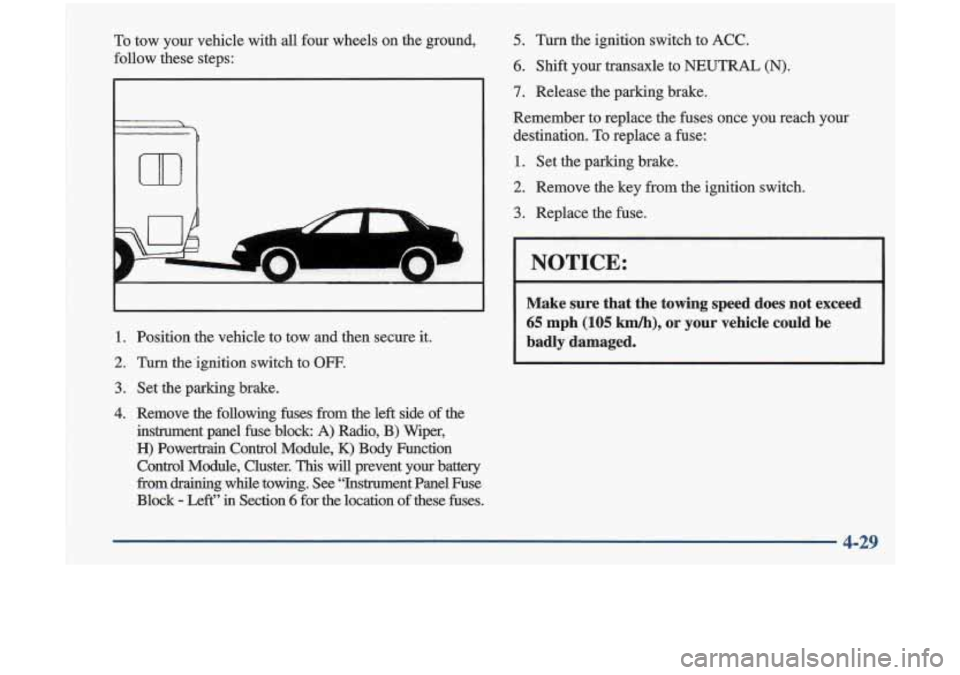
To tow your vehicle with all four wheels on the ground,
follow these steps:
m
A
1. Position the vehicle to tow and then secure it.
2. Turn &.ignition switch to OFF.
3. Set the parking brake.
4. Remove the following fuses from the left side of the
instrument panel fuse block A) Radio, B)
Wiper,
H) Powertrain Control Module, K) Body Function
Control Module, Cluster.
This will prevent your battery
from
draining while towing. See “Instrument Panel Fuse
Block
- Left” in Section 6 for the location of these fuses.
5. Turn the ignition switch to ACC.
6. Shift your transaxle to NEUTRAL (N).
7. Release the parking brake.
Remember to replace the fuses once you reach your
destination.
To replace a fuse:
1. Set the parhg brake.
2. Remove the key from the
3. Replace the fuse. ignition switch.
I NOTICE:
Make sure that the towing speed does not exceed
65 mph (105 km/h), or your vehicle could be
badly damaged.
4-29
Page 182 of 348
Safety Chains
You should always attach chains between your vehicle
and your trailer. Cross the safety chains under the tongue
of the trailer
so that the tongue will not drop to the road
if it becomes separated from the hitch. Instructions
about safety chains may be provided by the hitch
manufacturer or by the trailer manufacturer. Follow the
manufacturer’s recommendation for attaching safety
chains and do not attach them to the bumper. Always
leave just enough slack
so you can turn with your rig.
And, never allow safety chains to drag on the ground.
Trailer ~ ~~ kes
Does your trailer have its own brakes?
Be sure to read and follow the instructions for the trailer
brakes
so you’ll be able to install, adjust and maintain
them properly. And because you have anti-lock brakes,
do not try to tap into
your vehicle’s brake system. If you
do, both systems won’t work well, or at all.
4-36
Page 208 of 348
~~ ~. ~~ ~
If a Tire Goes Flat
It’s unusual
for a tire to “blow out” while you’re driving,
especially if you maintain your tires properly. If air goes
out
of a tire, it’s much more likely to leak out slowly.
But if you should ever have a “blowout,” here
are a few
tips about what to expect and what to do:
If a front tire fails, the flat tire will create a drag that\
pulls the vehicle toward that side. Take your foot off the
accelerator pedal and grip the steering wheel firmly.
Steer to maintain lane position, and then gently brake to
a stop well out of the traffic lane.
A rear blowout, particularly on a curve, acts much like a
skid and may require the same correction you’d use in a
skid.
In any rear blowout, remove your foot from the
accelerator pedal. Get the vehicle under control by
steering the way you want the vehicle to
go. It may be
very bumpy and noisy, but you can still steer. Gently
brake to a stop
-- well off the road if possible.
If a tire goes flat, the next part shows how to use your
jacking equipment to change a flat tire safely.
Changing a Flat Tire
If a tire goes flat, avoid further tire and wheel damage
by driving slowly to
a level place. Turn on your hazard
warning flashers.
:, , ,::*,,
Changing a tire can cause an injury. The vehicle
can slip off the jack and roll over you or other
people. You and they could be badly injured.
Find
a level place to change your tire. To help
prevent the vehicle from moving:
1. Set the parking brake firmly.
2. Put the shift lever in PARK (P).
3. ’krn off the .engine.
To be even more certain the vehicle won’t move,
you can put blocks
at the front and rear of the
tire farthest away from the one being changed.
That would be the’ tire on the other side of the
vehicle, at the opposite end.
5-22
Page 226 of 348

The cap is behind a hinged door on the right side of your
vehicle.
To open the door, insert your finger into the
finger depression next to the fuel door.
While refueling, hang the tethered cap inside the
fuel door. To
remove the cap,
turn it slowly to the left
(counterclockwise). The cap has a spring in it;
if you let
go of the cap
too soon, it will spring back to the right.
If you get gasoline on yourself and then
something ignites it, you could be badly burned.
Gasoline can spray out on
you if you open the
fuel filler cap too quickly. This spray can happen
if your tank is nearly full, and is more Iikely in
hot weather. Open the fuel filler cap slowly and
wait for any 6'hisss' noise to stop. Then unscrew
the cap all the
way.
Be careful not to spill gasoline. Clean gasoline from
painted surfaces as soon
as possible. See "Cleaning the
Outside
of Your Vehicle" in the Index.
6-6
Page 272 of 348
Electrical System
Add-on Electrical Equipment
NOTICE:
Don’t add anything electrical to your vehicle
unless you check with your retailer first. Some
electrical equipment can damage your vehicle
and the damage wouldn’t be covered by your
warranty. Some add-on electrical equipment
can keep other components from working as
they should.
Your vehicle has an air bag system. Before attempting to
add anything electrical to your vehicle, see “Servicing
Your Air Bag-Equipped Oldsmobile” in the Index.
Headlamp Wiring
The headlamp wiring is protected by fuses, one for each
headlamp, in the fuse block.
An electrical overload will
cause the lamps to
turn off. If this happens, have your
headlamp wiring checked right away.
.dshield Wipers
rne windshield wiper motor is protected by an internal
circuit breaker and a fuse.
If the motor overheats due to
heavy snow, etc., the wiper will stop until the motor cools.
If the overload is caused by some electrical
problem and not snow, etc., be sure to get it fixed.
Power Windows and Other Power Options
Circuit breakers in the fuse block protect the power
windows and other power accessories. When the current
load is too heavy, the circuit breaker opens and closes,
protecting the circuit until the problem is fixed or
goes away.
6-52
Page 273 of 348

Fuses and Circuit Breakers
The wiring circuits in your vehicle are protected from
short circuits by a combination of fuses, circuit breakers
and fusible thermal
links in the wiring itself. This
greatly reduces the chance of fires caused by
electrical problems.
Look at the silver-colored band inside the fuse.
If the
band is broken or melted, replace the fuse. Be sure you
replace a bad fuse with a new one of the identical size
and rating.
If you ever have a problem on the road and don’t have a
spare- fuse, you can borrow one that has the same
amperage. Just pick a feature
of your vehicle that you
can get along without
-- like the radio or cigarette
lighter
-- and use its fuse, if it is the correct amperage.
Replace it as soon as you can. Also, there are spare fuses
in the left side instrument panel fuse block.
There are three fuse blocks in your vehicle: two
instmment panel fuse blocks and the engine
compartment fuse block.
Instrument Panel Fuse Block
The instrument panel fuse
blocks are located at each
end of the instrument panel.
To access the fuses, open
the fuse panel door by
To replace the door, insert the hooks at the front end
fiist, then push the door in to the instrument panel to
secure it.
Instrument Panel Fuse Block - Left
In the left instrument panel fuse block, there are spare
fuses and a fuse puller.
6-53
Page 274 of 348
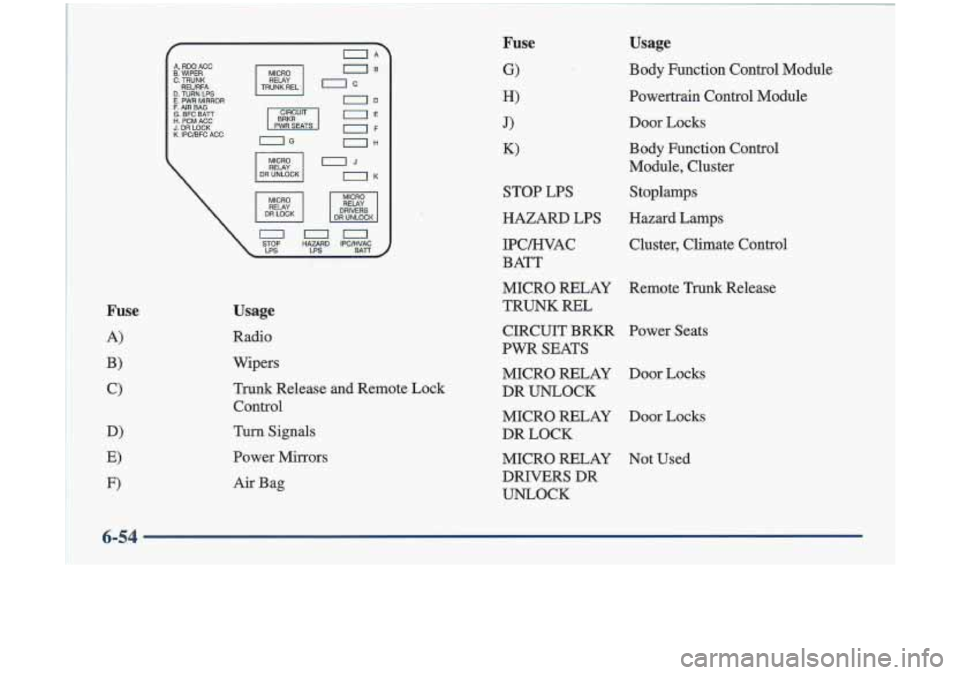
e '4
A, RDO ACC B. WIPER MICRO 1- C. TRUNK
D. TURN LPS
REURFA E. PWFi MIRROR F. AIR BAG G. BFC BAT H. PCM ACC J. DR LOCK
K. IPC/BFC ACC CIRCUIT
PWRSEATS 0
010 OH
MICRO
DR UNLOCK
DR LOCK DR UNLOCK DRIVERS
STOP HWD IPCMVAC LPS LPS BA7T , , -- . ..
Usage
Radio
Wipers Trunk Release and Remote Lock Control
Turn Signals
Power Mirrors
Air Bag
HAZARD LPS
IPCIHVAC BATT
MICRO RELAY
TRUNKREL
CIRCUIT BRKR
PWR SEATS
MICRO RELAY DR UNLOCK
MICRO RELAY DR LOCK
MICRO RELAY
DRIVERS DR
UNLOCK
Usage
Body Function Control~Module
Powertrain Control Module
Door Locks
Body Function Control
Module, Cluster
Stoplamps
Hazard Lamps
Cluster, Climate Control
Remote Trunk Release Power Seats
Door Locks
Door Locks
Not Used
6-54
Page 275 of 348
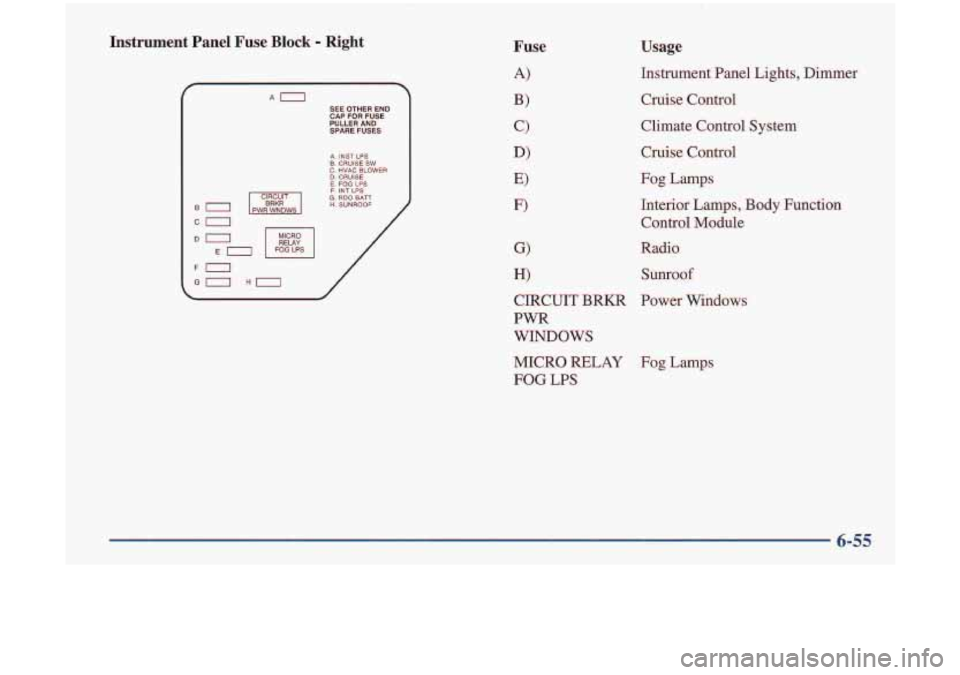
Instrument Panel Fuse Block - Right
SEE OTHER END CAP FOR FUSE PULLER AND SPARE FUSES
A. INST LPS E. CRUISE SW C. HVAC BLOWER D. CRUISE
E. FOG LPS F. INT LPS GtRGUIT G. RDO BATT H. SUNROOF
G)
H>
CIRCUIT BRKR
PWR
mows
MICRO RELAY
FOG LPS
Usage
Instrument Panel Lights, Dimtiiler
Cruise Control
Climate Control System
Cruise Control
Fog Lamps
Interior
Lamps, Body Function
Control Module
Radio
Sunroof
Power Windows
Fog
Lamps
6-55
Page 276 of 348
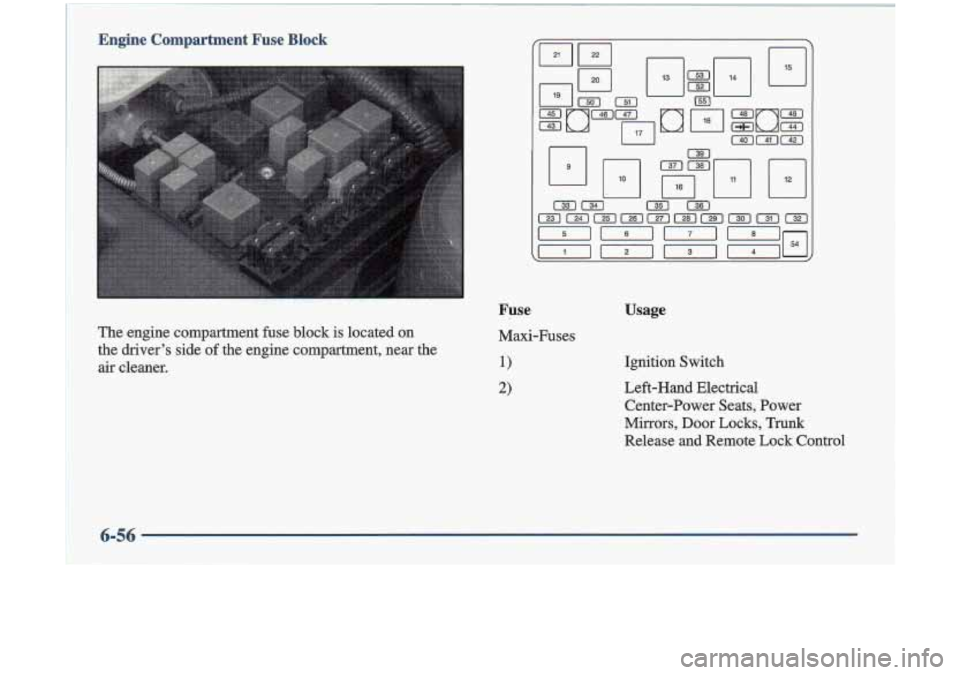
Engine Compartment Fuse Black
I .5d I
The engine compartment fuse block is located on
the driver's side
of the engine compartment, near the
air cleaner.
Fuse
Maxi-Fuses
1)
2)
Usage
Ignition Switch
Left-Hand Electrical
Center-Power Seats, Power
Mirrors,
Door Locks, Trunk
Release and Remote Lock Control
6-56
Page 277 of 348
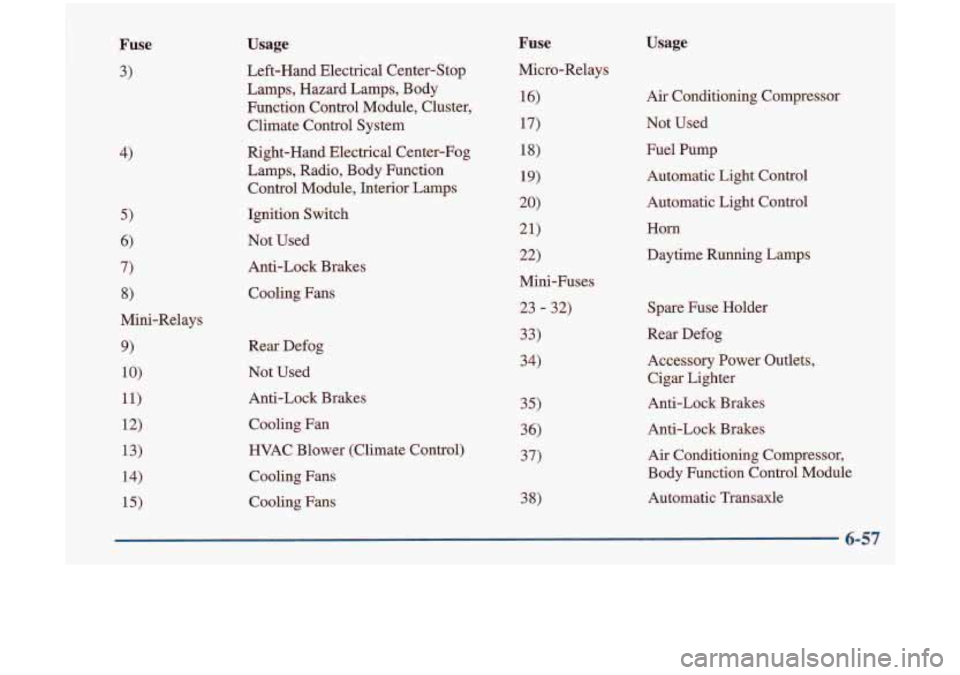
Fuse
3)
4)
Usage
Left-Hand Electrical Center-Stop
Lamps, Hazard Lamps, Body
Function Control Module, Cluster,
Climate Control System
Right-Hand Electrical Center-Fog
Lamps, Radio, Body Function Control Module, Interior Lamps
Ignition Switch
Not Used
Anti-Lock Brakes Cooling Fans
Rear Defog
Not Used
Anti-Lock Brakes Cooling Fan
WAC Blower (Climate Control)
Cooling Fans
Cooling Fans
35)
36)
37)
3
8)
Usage
Air Conditioning Compressor
Not Used Fuel Pump Automatic Light Control Automatic Light Control
Horn
Daytime Running Lamps
Spare Fuse Holder
Rear Defog
Accessory Power Outlets, Cigar Lighter
Anti-Lock Brakes
Anti-Lock Brakes
Air Conditioning Compressor,
Bodv Function Control Module
P-_. mmatic Transaxle
6-57