ESP Oldsmobile Cutlass Supreme 1993 s User Guide
[x] Cancel search | Manufacturer: OLDSMOBILE, Model Year: 1993, Model line: Cutlass Supreme, Model: Oldsmobile Cutlass Supreme 1993Pages: 340, PDF Size: 16.21 MB
Page 222 of 340
Sewice & Appeurunce Care
220
Gasolines for Cleaner Air
Your use of gasoline with detergent
additives will help prevent deposits
from forming in your engine and fuel
system. That helps Beep your engine in
tune and your emission control system
working properly. It’s good for your
vehicle, and you’ll be doing your part
for cleaner air.
Many gasolines are now blended with
materials called oxygenates. General
Motors recommends that you use
gasolines with these blending materials,
such as MTBE and ethanol. By doing
so, you can help clean the air, especially
in those parts of the country that have
high carbon monoxide levels. In
addition, some gasoline suppliers are
now producing reformulated gasolines.
These gasolines are specially designed
to reduce vehicle emissions. General
Motors recommends that you use
reformulated gasoline. By doing
so, you
can help clean the air, especially in
those parts of the country that have
high ozone levels.
You should ask your service station
operators
if their gasolines contain
detergents and oxygenates, and
if they
have been reformulated to reduce
vehicle emissions.
Fuels in Foreign Countries
If you plan on driving in another
country outside the
U.S. or Canada,
unleaded fuel may be hard to find.
Do not use leaded gasoline. If you use
even one tankful, your emission
controls won’t work well or
at all. With
continuous use, spark plugs can get
fouled, the exhaust system can corrode,
and your engine oil can deteriorate
quickly. Your vehicle’s oxygen sensor
will be damaged. All of that means
costly repairs that wouldn’t be covered
by your warranty.
Page 234 of 340
Automatic Transaxle Fluid (CONT.)
Wait at least 30 minutes before
checking the transaxle fluid level
if you
have been driving:
When outside temperatures are above
At high speed for quite awhile.
In heavy traffic-especially in hot
While pulling a trailer.
To get the right reading, the fluid
should be at normal operating
temperature, which is
180°F to 200°F
(82°C to 93°C).
Get the vehicle warmed up by driving
about
15 miles (24 lm) when outside
temperatures are above 50°F
(10°C). If
it's colder than 50°F
(lO"C), you may
have to drive longer.
90°F (32°C).
weather.
To Check the Fluid Level:
Park your vehicle on a level place.
Place the shift lever in P (Park) with
With your foot on the brake pedal,
the
parking brake applied.
move the shift lever through each gear
range, pausing for about three
seconds in each range. Then, position
the shift lever in
P (Park).
Let the engine run at idle for three to
five minutes.
Then, Without Shutting off the
Engine, Follow These Steps:
1. Pull out the dipstick and wipe it with
a clean rag or paper towel.
2. Push it back in all the way, wait three
seconds and then pull it back out
must be in the crosshatched area.
4. If the fluid level is where it should be,
push the dipstick back in all the way.
-
Page 235 of 340
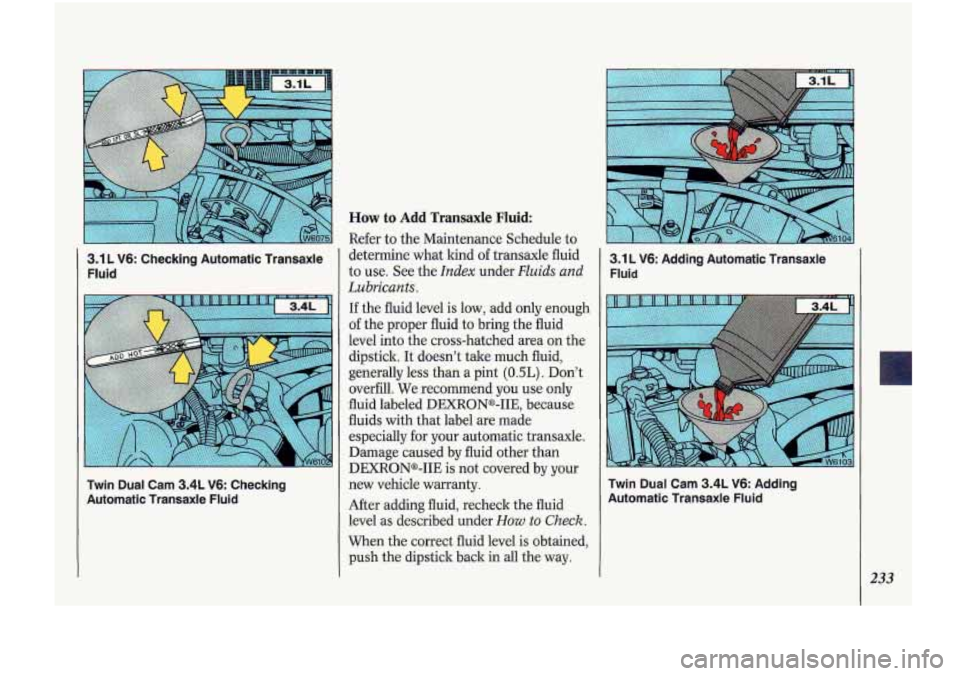
3.1 L V6: Checking Automatic Transaxle
I Fluid
Twin Dual Cam 3.4L V6: Checking
Automatic Transaxle Fluid
How to Add Transaxle Fluid
Refer to the Maintenance Schedule to
determine what kind of transaxle fluid
to use. See the
Index under Fluids and
Lubricants.
If the fluid level is low, add only enough
of the proper fluid to bring the fluid
level into the cross-hatched area on the
dipstick.
It doesn’t take much fluid,
generally less than a pint
(0.5L). Don’t
overfill. We recommend you use only
fluid labeled
DEXRON*-HE, because
fluids with that label are made
especially for your automatic transaxle.
Damage caused by fluid other than
DEXRONB-UE is not covered by your
new vehicle warranty.
After adding fluid, recheck the fluid
level as described under
How to Check.
When the correct fluid level is obtained,
push the dipstick back in all the way.
3.1 L V6 Adding Automatic Transaxle
Fluid
Twin Dual Cam 3.4LV6: Adding
Automatic Transaxle Fluid
r-
233
Page 255 of 340
Inflation-Tire Pressure
The Tire-Loading Information label
which is on the inside of the trunk lid
shows the correct inflation pressures for
your tires, when they’re cold. “Cold”
means your vehicle has been sitting for
at least three hours or driven no more
than a mile. When to Check
Check your tires once a month or
more.
Don’t forget your compact spare
tire. It should be
at 60 psi (420 kPa).
How to Check:
Use a good quality pocket-type gage to
check tire pressure. Simply looking at
the tires will not tell you the pressure,
especially
if you have radial tires-
which may look properly inflated even
if
they’re underinflated.
If your tires have valve caps, be sure to
put them back on. They help prevent
leaks by keeping out dirt and moisture.
c
253
Page 258 of 340
Sewice & Appearance Care
256
1 Uniform Tire Quality
Grading
The following information relates to the
system developed by the United States
National Highway Traffic Safety
Administration which grades tires by
treadwear, traction and temperature
performance. (This applies only to
vehicles sold in the United States.)
Treadwear
The treadwear grade is a comparative
rating based on the wear rate of the tire
when tested under controlled
conditions on a specified government
test course. For example, a tire graded
150 would wear one and a half (1%)
times as well on the government course
as a tire graded
100. The relative
performance of tires depends upon the actual
conditions
of their use, however,
and may depart significantly from the
norm due to variations
in driving habits,
service practices and dif€erences in road
characteristics and climate.
Traction-A, B, C
The traction grades, from highest to
lowest are:
A, B, and C. They represent
the tire’s ability to stop on wet
pavement as measured under controlled
conditions on specified government test
surfaces
of asphalt and concrete. A tire
marked
C may have poor traction
performance.
Warning: The traction grade assigned
to this tire is based on braking (straight-
ahead) traction tests and does not
include cornering (turning) traction.
Temperature-A, B, C
The temperature grades are A (the
highest),
B, and C, representing the
tire’s resistance to the generation of
heat and its ability to dissipate heat
when tested under controlled
conditions on a specified indoor
laboratory test wheel. Sustained high
temperature can cause the material of
the tire to degenerate and reduce tire
life, and excessive temperature can lead
to sudden tire failure. The grade
C
corresponds to a level of performance
which all passenger car tires must meet
under the Federal Motor Vehicle Safety
Standard No.
109. Grades B and A
represent higher levels of performance
on the laboratory test wheel than the
minimum required by law.
Page 259 of 340
Warning: The temperature grade for
this tire is established for a tire that is
properly inflated and not overloaded.
Excessive speed, underinflation, or
excessive loading, either separately
or
in combination, can cause heat
buildup and possible tire failure.
Those grades are molded on the
sidewalls of passenger car tires.
While the tires available as standard or
optional equipment on General Motors
vehicles may vary with respect to these
grades, all such tires meet General
Motors performance standards and
have been approved for use on General
Motors vehicles. All passenger type
(P Metric) tires must conform to
Federal safety requirements in addition
to these grades.
Wheel Alignment and
Tire Balance
The wheels on your vehicle were
aligned and balanced carefully at the
factory to give you the longest tire life
and best overall performance.
In most cases, you will not need to have
your wheels aligned again. However, if
you notice unusual tire wear
or your
vehicle pulling one way
or the other, the
alignment may need to be reset.
If you
notice your vehicle vibrating when
driving on a smooth road, your wheels
may need to be rebalanced.
Wheel Replacement
Replace any wheel that is bent, cracked
or badly rusted. If wheel nuts keep
coming loose, the wheel, wheel bolts,
and wheel nuts should be replaced. If
the wheel leaks air out, replace it
(except some aluminum wheels, which
can sometimes be repaired). See your
Oldsmobile dealer if any of these
conditions exist. Your dealer will know
the kind of wheel you need.
Each new wheel should have
the same
load carrying capacity, diameter, width,
offset, and be mounted the same way as
the one it replaces.
If you need to replace any of your
wheels, wheel bolts, or wheel nuts,
replace them only with new GM
original equipment parts. This way, you
will be sure to have the right wheel,
wheel bolts, and wheel nuts for your
Oldsmobile model.
257
Page 308 of 340
Maintenance Schedule
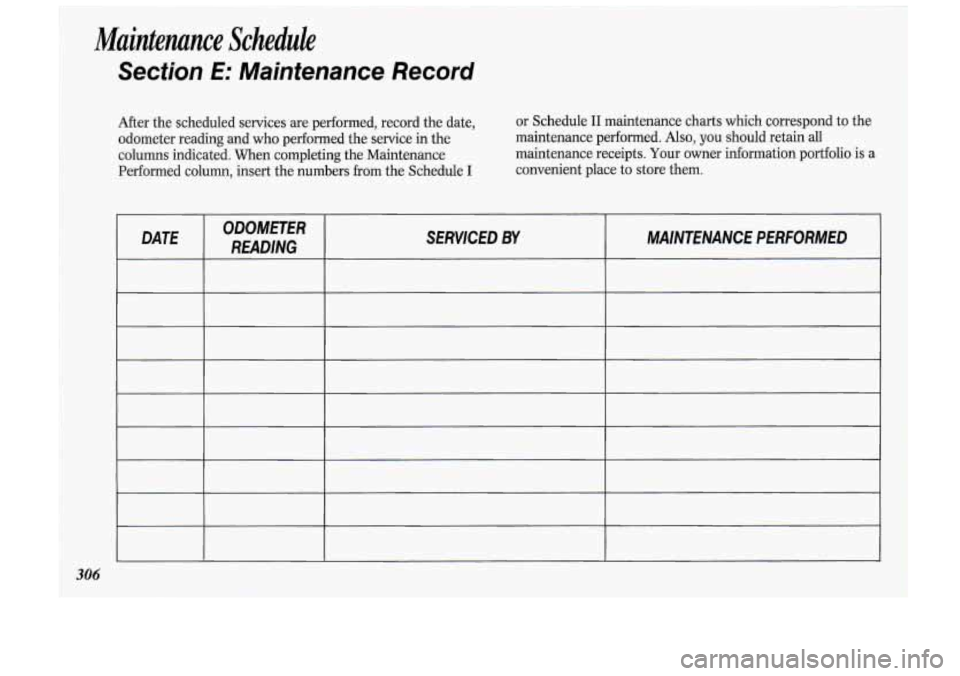
Section E: Maintenance Record
After the scheduled services are performed, record the date,
odometer reading and who performed the service in the
columns indicated. When completing the Maintenance
Performed column, insert the numbers
from the Schedule I
or Schedule I1 maintenance charts which correspond to the
maintenance performed. Also,
you should retain all
maintenance receipts. Your owner information portfolio is a
convenient place to store them.
DATE ODOMETER
READING SERVICED BY MAINTENANCE PERFORMED
306
Page 312 of 340
Customer Assistance Information
31 0
Customer Satisfaction Procedure
Your satisfaction and goodwill are
important to your dealer and
Oldsmobile. Normally, any problems
with the sales transaction or the
operation of your vehicle will be
resolved by your dealer’s Sales or
Service Departments. Sometimes,
however, despite the best intentions of
all concerned, misunderstandings can
occur. If your concern has not been
resolved to your satisfaction, the
following steps should be taken:
STEP ONE: Discuss your problem
with a member of dealership
management. Complaints can often be
quickly resolved at that level. If the
matter has already been reviewed with
the Sales, Service or
Parts Manager,
contact the owner of the dealership or
the General Manager.
STEP TWO: If after contacting a
member of Dealership Management, it
appears your problem cannot be
resolved by the dealership without
further help, contact the Oldsmobile
Customer Assistance Network by
calling 1-800-442-6537. In Canada,
contact GM of Canada Customer
Assistance Center in Oshawa by calling
1-800-263-3777 (English) or
1-800-263-7854 (French).
In Mexico, call 254-17-86. In Puerto
Rico or
U.S. Virgin Islands, call
1-809-763-1315. In all other overseas
locations, contact GM International
Export Sales in Canada by calling
1-416-644-41 12. For
prompt assistance, please have the
following information available to give
the Customer Assistance Representative:
Your name, address, telephone
Vehicle Identification Number (This number
is available from the vehicle
registration or title, or the plate
attached to the left top of the
instrument panel and visible through
the windshield.)
Dealership name and location
Vehicle delivery date and present
Nature of problem
mileage