service Oldsmobile Cutlass Supreme 1993 s User Guide
[x] Cancel search | Manufacturer: OLDSMOBILE, Model Year: 1993, Model line: Cutlass Supreme, Model: Oldsmobile Cutlass Supreme 1993Pages: 340, PDF Size: 16.21 MB
Page 162 of 340
Your Driving and the Road
140
Night Vision
No one can see as well at night as in the
daytime. But as we get older these
differences increase.
A 50-year-old
driver may require at least twice as
much light to see the same thing at
night as a 20-year-old.
What you do in the daytime can also
affect your night vision. For example, if
you spend the day in bright sunshine
you are wise to wear sunglasses. Your
eyes will have less trouble adjusting to
night.
But if you’re driving, don’t wear
sunglasses at night. They may cut down
on glare from headlights, but they
also
make a lot of things invisible that
should remain visible-such as parked
cars, obstacles, pedestrians, or even
trains blocking railway crossings. You
may want to put
on your sunglasses
after you have pulled into a brightly- lighted service
or refreshment area.
Eyes shielded
from that glare may
adjust more quickly to darkness back
on the road. But be sure to remove your
sunglasses before you leave the service
area.
You
can be temporarily blinded by
approaching lights. It
can take a second
or two, or even several seconds, for
your eyes to readjust to the dark. When
you are faced with severe glare (as from
a driver who doesn’t lower the high
beams, or a vehicle with misaimed
headlights), slow down a little. Avoid
staring directly into the approaching
lights. If there is a line of opposing
traffic, make occasional glances over the
line of headlights
to make certain that
one of the vehicles isn’t starting to
move into your lane. Once you are past
the bright lights, give your eyes time to
readjust before resuming speed.
High Beams
If the vehicle approaching you has its
high beams
on, signal by flicking yours
to high and then back to low beam. This
is the usual signal to lower the
headlight beams. If the other driver still
doesn’t lower the beams, resist the
temptation to put your high beams
on.
This only makes two half-blinded
drivers.
On a freeway, use your high beams only
in remote areas where you won’t impair
approaching drivers. In some places,
like cities, using high beams is illegal.
When you follow another vehicle on a
freeway or highway, use low beams.
True, most vehicles now have day-night
mirrors that enable the driver to reduce
glare. But outside mirrors are not of this
type and high beams from behind can
bother the driver ahead.
Page 170 of 340
Your Driving and the Road
Driving a Long Distance
Although most long trips today are
made on freeways, there are still many
made on regular highways.
Long-distance driving on freeways and
regular highways is the same
in some
ways. The trip has to be planned and
the vehicle prepared, you drive at
higher-than-city speeds, and there
are
longer turns behind the wheel. You’ll
enjoy your trip more if you and your
vehicle are in good shape. Here are
some tips for a successful long trip.
Before Leaving on a Long Trip
Make sure you’re ready. Try to be well
rested. If you must start when you’re
not fresh-such as after a day’s work
don’t plan to make too many miles that
first part of the journey. Wear
comfortable clothing and shoes you can
easily drive in.
Is your vehicle ready for a long trip? If
you keep it serviced and maintained, it’s
ready to go. If it needs service, have it
done before starting out. Of course,
you’ll find experienced and able service
experts in Oldsmobile dealerships all
across North America. They’ll be ready
and willing to help if you need it. Here are
some things you can check
before a trip:
Windshield Washer Fluid: Is the
reservoir
full? Are all windows clean
inside and outside?
shape? Have you checked
all levels?
the lenses clean?
safe, trouble-free trip. Is the tread
good enough for long-distance
driving?
Are the tires all inflated to
the recommended pressure?
Weather Forecasts: What’s the
weather outlook along your route?
Should you delay your trip a short
time to avoid a major storm system?
Maps: Do you have up-to-date maps?
Wiper Blades: Are they in good
Fuel, Engine Oil, Other Fluids:
Lights: Are they all working? Are
Tires: They are vitally important to a
Page 194 of 340
Problems on the Road
192
Jump Starting (CONT.)
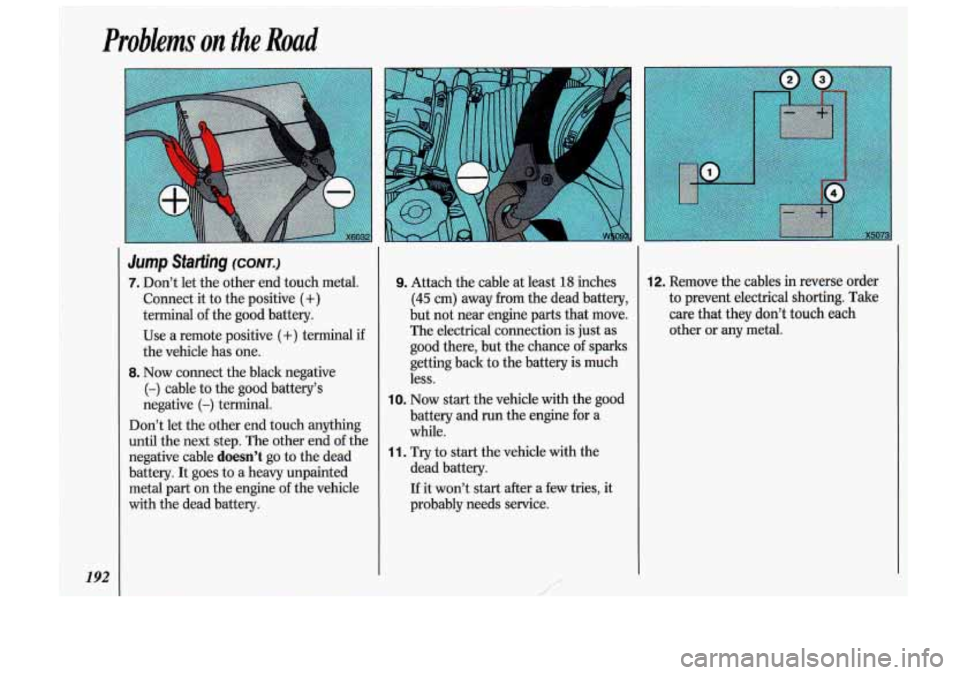
7. Don’t let the other end touch metal.
Connect it to the positive
(+)
terminal of the good battery.
Use a remote positive
(+) terminal if
the vehicle has one.
8. Now connect the black negative
(-) cable to the good battery’s
negative
(-) terminal.
Don’t let the other end touch anything
until the next step. The other end of the
negative cable
doesn’t go to the dead
battery. It goes to a heavy unpainted
metal part on the engine
of the vehicle
with the dead battery.
9. Attach the cable at least 18 inches
(45 cm) away from the dead battery,
but not near engine parts that move.
The electrical connection is just as
good there, but the chance
of sparks
getting back to the battery is much
less.
IO. Now start the vehicle with the good
battery and run the engine for a
while.
11. Try to start the vehicle with the
dead battery.
If it won’t start after a few tries, it
probably needs service.
12. Remove the cables in reverse order
to prevent electrical shorting. Take
care that they don’t touch each
other or
any metal.
Page 195 of 340
A
Towing Your Oldsmobile
Try to have a GM dealer or a
professional towing service tow your
Oldsmobile. The
usual towing
equipment
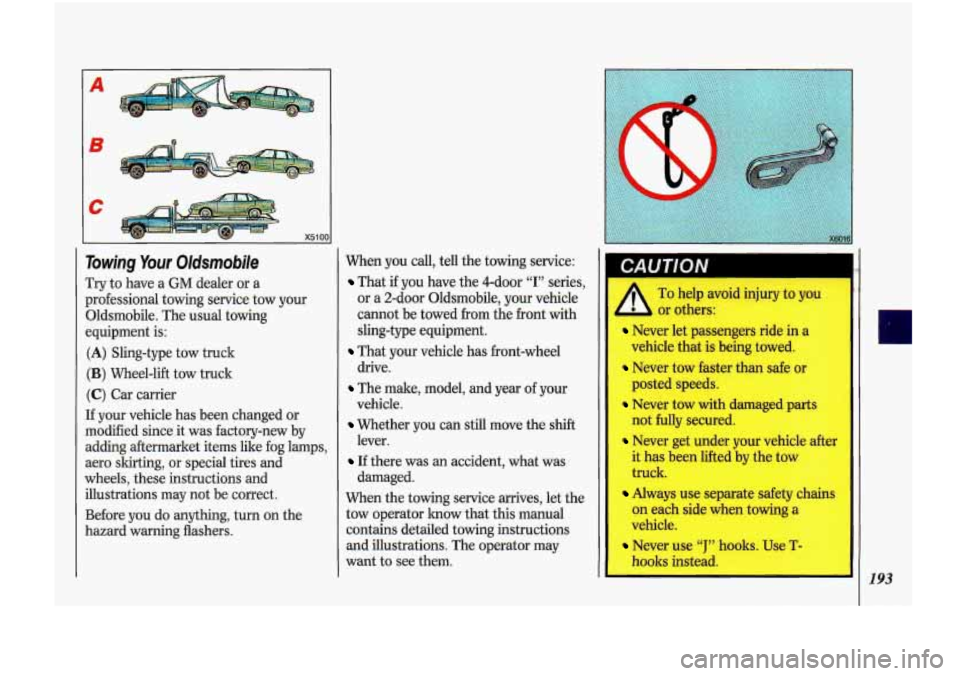
is:
(A) Sling-type tow truck
(B) Wheel-lift tow truck
(C) Car carrier
If your vehicle .has been changed or
modified since it was factory-new by
adding aftermarket items like fog lamps,
aero skirting, or special tires and
wheels, these instructions and
illustrations may not be correct.
Before you do anything, turn on the
hazard warning flashers. When
you
call, tell the towing service:
That if you have the 4-door “I” series,
or a 2-door Oldsmobile, your vehicle
cannot be towed
from the fiont with
sling-type equipment.
drive.
vehicle. lever.
damaged.
That your vehicle has front-wheel
The make, model, and year of your
Whether you can still move the shift
If there was an accident, what was
When the towing service arrives, let the
tow operator know that this manual
contains detailed towing instructions
and illustrations. The operator may
want to see them.
To help avoid injury to you
or others:
Never let passengers ride in a
vehicle that is being towed.
Never tow faster than safe or
posted speeds.
Never tow with damaged parts
not fully secured.
Never get under your vehicle after
it has been lifted by the tow
truck.
Always use separate safety chains
on each side when towing a
vehicle.
Never use “J” hooks. Use T-
I hnnks instead.
193
Page 196 of 340
Problems on the Road
194
Towing Your Oldsmobile (CONTJ
When your vehicle is being towed, have
the ignition key
off. The steering wheel
should be clamped in
a straight-ahead
position, with
a clamping device
designed for towing service. Do not use
the vehicle’s steering column lock for
this. The transaxle should be in
N (Neutral), and the parking brake
released.
Don’t have your vehicle towed on the
front wheels, unless you must. If the
vehicle must be towed on the front
wheels, don’t go more than
35 mph
(56 km/h) or farther than 50 miles
(80 lun) or your transaxle will be
damaged.
If these limits must be
exceeded, then the front wheels have to
be supported on a dolly. A vehicle can fall from a
car
secured. This can cause a collision,
serious personal injury and vehicle
damage. The vehicle should be
tightly secured with chains or steel
cables before it is transported.
Don’t use substitutes (ropes,
leather straps, canvas webbing,
etc.) that can be cut by sharp edges
underneath the towed vehicle.
/A carrier if it isn’t properly
Towing from the Front-
Vehicle Hook-up
Before hooking up to a tow truck, be
sure
to read all the information on
Towing
Your Oldsmobile earlier in this
section.
All Models
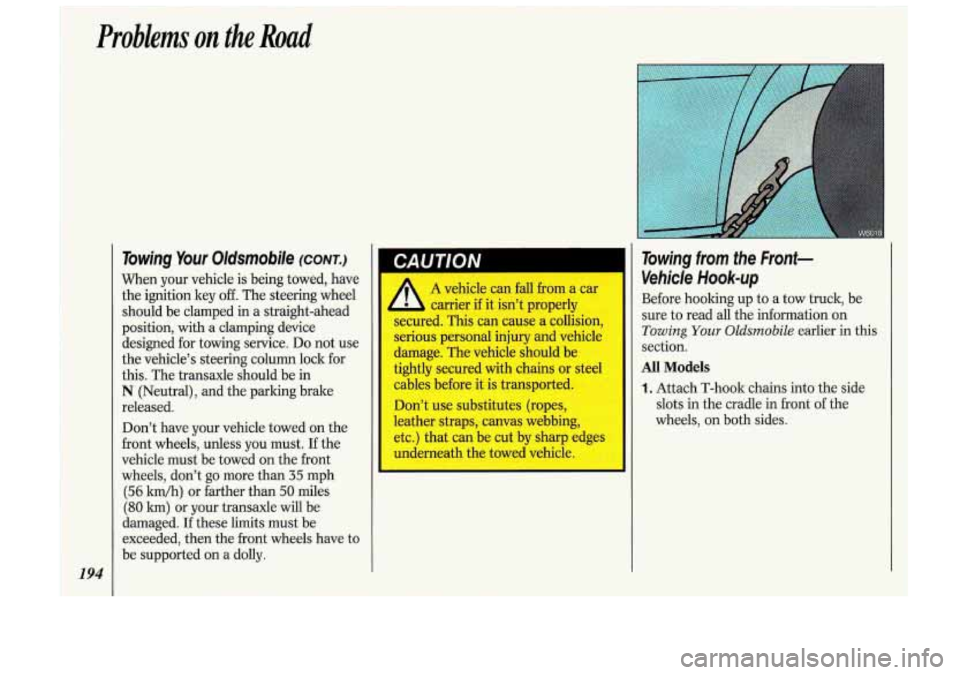
1. Attach T-hook chains into the side
slots in the cradle in front of the
wheels, on both sides.
Page 200 of 340
Probkms on the Road
Engine Overheating (CONTJ
If No Steam is Coming from Your
Engine:
If you get the overheat warning but see
or hear no steam, the problem may not
be too serious. Sometimes the engine
can get a little too hot when you:
Climb a long hill on a hot day.
Stop after high speed driving.
Idle for long periods in traffic.
Tow a trailer.
198
If you get the overheat warning with no
sign of steam, try this for a minute or so:
1. Turn off your air conditioner.
2. Turn on your heater to full hot at the
highest fan speed and open the
window as necessary.
3. Try to keep your engine under load
(in
a drive gear where the engine
runs slower).
If you no longer have the overheat
warning, you can drive. Just to be safe,
drive slower for ab& ten minutes. If
the warning doesn't come back on, you
can drive normally.
If the warning continues, pull over,
stop, and, park your vehicle right away.
f there's still no sign of steam, you can
dle the engine for two or three minutes
vhile you're parked, to see if the
varning stops.
3ut then,
if you still have the warning,
KJRJNOFFTHEENGINEANDGET
WERYONE OUT OF THE VEHICLE
Inti1 it cools
down.
(ou may decide not to lift the hood but
o get service help right away.
Page 201 of 340
Cooling System
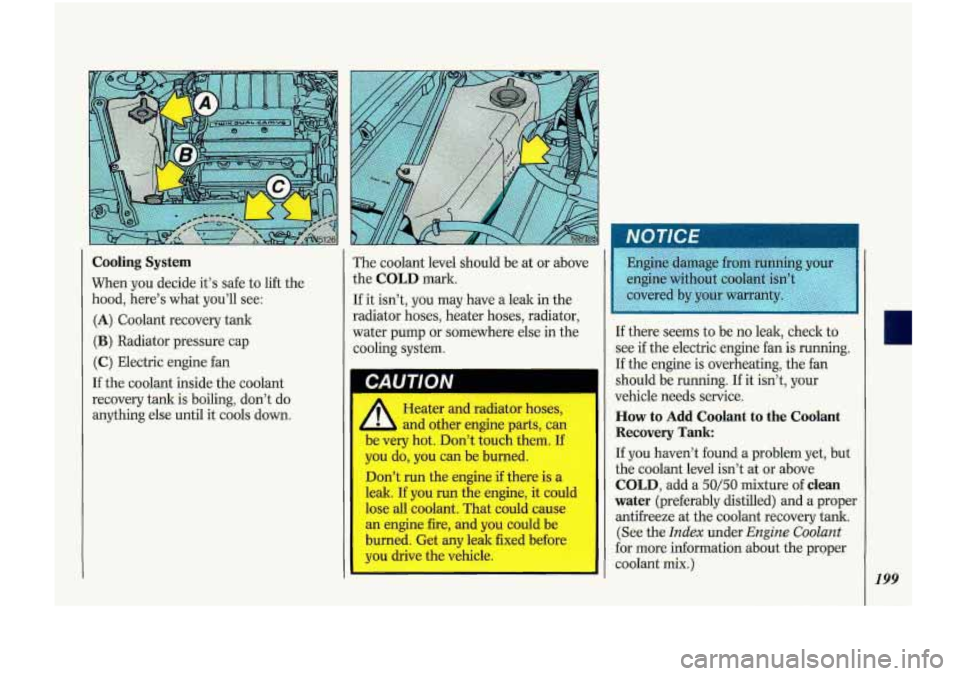
When you decide it’s safe to lift the
hood, here’s what you’ll see:
(A) Coolant recovery tank
(B) Radiator pressure cap
(C) Electric engine fan
If the coolant inside the coolant
recovery tank is boiling, don’t do
anything else until it cools down. The
coolant level should be at or above
the
COLD mark.
If it isn’t,
you may have a leak in the
radiator hoses, heater hoses, radiator,
water pump or somewhere else in the
cooling system.
I
- 1
CAUTION I
Heater and radiator hoses,
and other engine parts, can
1;, ;cry hot. Don’t touch them. If
you do,
you can be burned.
Don’t run the engine
if there is a
leak. If you
run the engine, it could
lose all coolant. That could cause
an engine fire, and you could be
burned. Get any leak fixed before
I
you drive the vehicle.
I
If there seems to be no leak, check to
see
if the electric engine fan is running.
If the engine is overheating, the fan
should be running.
If it isn’t, your
vehicle needs service.
How to Add Coolant to the Coolant
Recovery
Tank:
If you haven’t found a problem yet, but
the coolant level isn’t at or above
COLD, add a
50/50 mixture of clean
water (preferably distilled) and a proper
antifreeze at the coolant recovery
tank.
(See the Index under Engine Coolant
for more information abaut the proper
coolant
mix.)
199
Page 219 of 340
Part 6
Service &Appearance Care
21 7
Page 220 of 340
Service & Appearance Cure
GM -
Service
Your Oldsmobile dealer knows your
vehicle best and wants you to be happy
with it. We hope you’ll go to your dealer
for all your service needs. You’ll get
genuine GM parts and GM-trained and
supported service people.
We hope you’ll want to keep your GM
vehicle all GM. Genuine GM parts have
one
of these marks.
Doing Your Own Service Work
If you want to do some of your own
service work, you’ll want to get the
proper Oldsmobile Service Manual. It
tells you much more about how to
service your Oldsmobile than this
manual can.
To order the proper service
manual, see the
Index under Service
Publications.
You should keep a record with all parts
receipts and list the mileage and the
date
of any service work you perform.
See the
Index under Maintenance
Record.
P
Page 221 of 340
If it’s bad enough, it can damage your
engine.
If you’re using fuel rated at 87 octane or
higher and you still hear heavy
laoclcing, your engine needs service.
But don’t
worry if you hear a little
pinging noise when you’re accelerating
or driving up a hill. That’s normal, and
you don’t have to buy
a higher octane
fuel to get rid
of pinging. It’s the heavy,
constant knock that means you have a
problem.
Fuel Capacity:
16.5 U.S. Gallons (62 L). Use unleaded
fuel only.
What about gasoline with blending
materials that contain oxygen, such
as
MTBE or alcohol?
MTBE is “methyl tertiary-butyl
ether.’’ Fuel that is no more than
15%
MTBE is fine for your vehicle.
Ethanol is ethyl or grain alcohol.
Properly-blended fuel that is no more
than
10% ethanol is fine for your
vehicle.
Methanol is methyl or wood alcohol.
- -1
219