overheating Oldsmobile Cutlass Supreme 1993 Owner's Manuals
[x] Cancel search | Manufacturer: OLDSMOBILE, Model Year: 1993, Model line: Cutlass Supreme, Model: Oldsmobile Cutlass Supreme 1993Pages: 340, PDF Size: 16.21 MB
Page 8 of 340
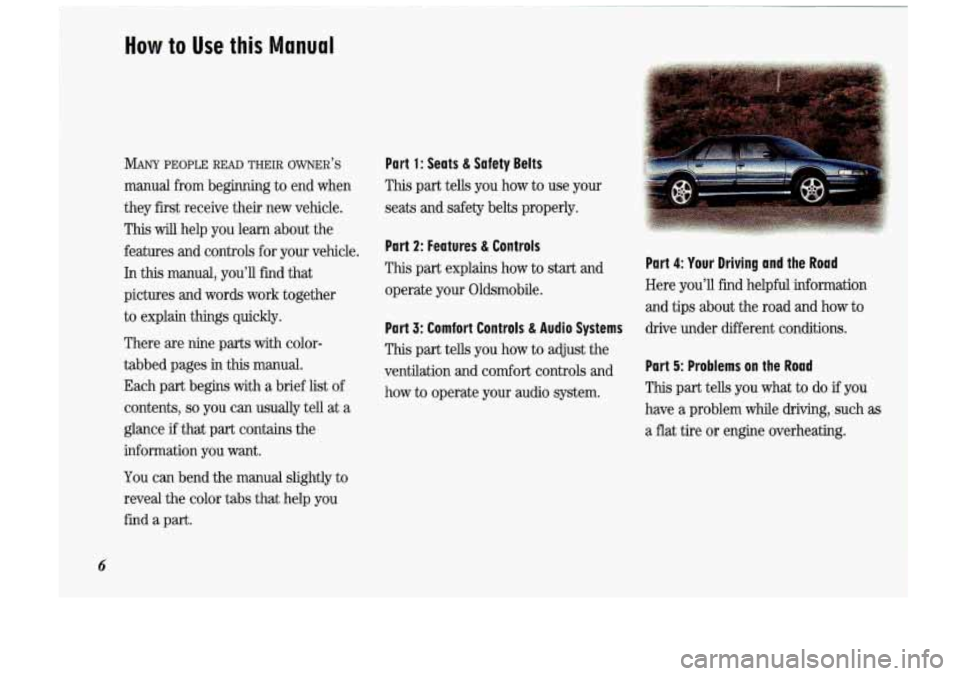
How to Use this Manual
MANY PEOPLE READ THEIR OWNER’S Part 1: Seats & Safety Belts
manual from beginning to end when This part tells you how to use your
they first receive their new vehicle. seats and safety belts properly.
This will help you learn about the
features and controls for your vehicle.
Part 2: Features & Controls
In this manual, you’ll find that This part explains how to start and
pictures and words work together operate your Oldsmobile.
to explain thhgs quickly.
There are nine
parts with color-
tabbed pages
in this manual.
Each part begins with
a brief list of
contents,
so you can usually tell at a
glance if that part contains the
information you want.
Part 4: Your Driving and the Road
Here you’ll find helpful information
and tips about the road and how to
Part 3: Comfort Controls & Audio Systems drive under different conditio%
This part tells you how to adjust the
ventflation and comfort controls
and
how to operate your audio system.
Part 5: Problems on the Road
This part tells you what to do if you
have
a problem while driving, such as
a flat tire or engine overheating.
You can bend the manual slightly to
reveal the color tabs that help you
find a part.
6
Page 184 of 340
Your Driving and the Road
Driving with a Trailer (CONT.)
Making Turns
When you’re turning with a trailer,
make wider turns than normal.
Do this
so your trailer won’t strike soft
shoulders, curbs, road signs, trees, or
other objects. Avoid jerky or sudden
maneuvers. Signal well in advance.
Turn Signals When Towing a Trailer
When you tow a trailer, your vehicle has
to have
a different turn signal flasher
and extra wiring. The green arrows
on
your instrument panel will flash
whenever you signal a turn or lane
change. Properly hooked up, the trailer
lights will also flash, telling other
drivers you’re about to turn, change
lanes or stop. When towing a
trailer, the green arrows
on your instrument panel will flash for
turns even if the bulbs on the trailer are
burned out. Thus, you may think
drivers behind you are seeing your
signal when they are not. It’s important
to check occasionally to be sure the
trailer bulbs are still working.
Driving On Grades
Reduce speed and shift to a lower gear
before you start down a long or steep
downgrade.
If you don’t shift down, you
might have to use your brakes
so much
that they would get hot and
no longer
work well.
On a long uphill grade, shift down and
reduce your speed to around
45 mph
(70 lm/h) to reduce the possibility of
engine and transaxle overheating.
If you are towing a trailer and you have
an automatic transaxle with Overdrive,
you may want to drive in
D instead of
(or, as you need to, a lower gear).
Page 189 of 340
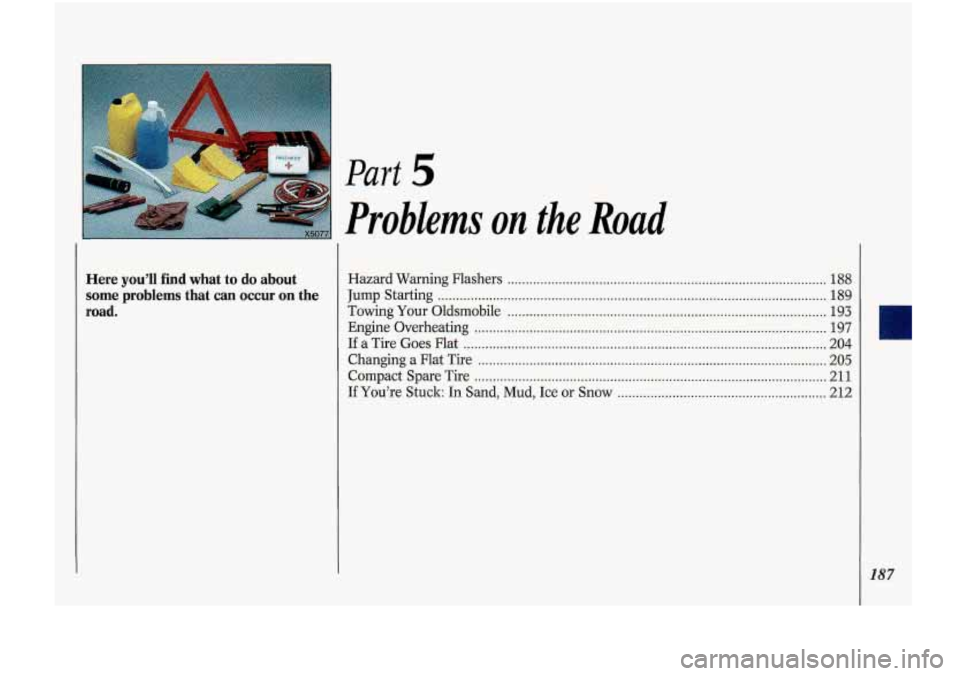
Here you’ll find what to do about
some problems that can occur on the
road
.
Part 5
Problems on the Road
Hazard Warning Flashers ........................................................................\
............... 188
Jump Starting
........................................................................\
.................................. 189
Towing Your Oldsmobile
........................................................................\
............... 193
Engine Overheating
........................................................................\
........................ 197
If a Tire Goes Flat ........................................................................\
........................... 204
Changing a Flat Tire
........................................................................\
....................... 205
Compact Spare Tire ........................................................................\
........................ 211
If You’re Stuck: In Sand, Mud, Ice or Snow ......................................................... 212
187
Page 199 of 340
3. Attach a separate safety chain around
the outboard end of each lower
control
arm.
Engine Overheating
You will find a coolant temperature
gage or the warning light about a hot
engine
on your Oldsmobile’s instrument
panel.
You also have a low coolant
warning light on your instrument panel.
See the
Index under Coolant
Temperature Gage for the gage cluster.
r
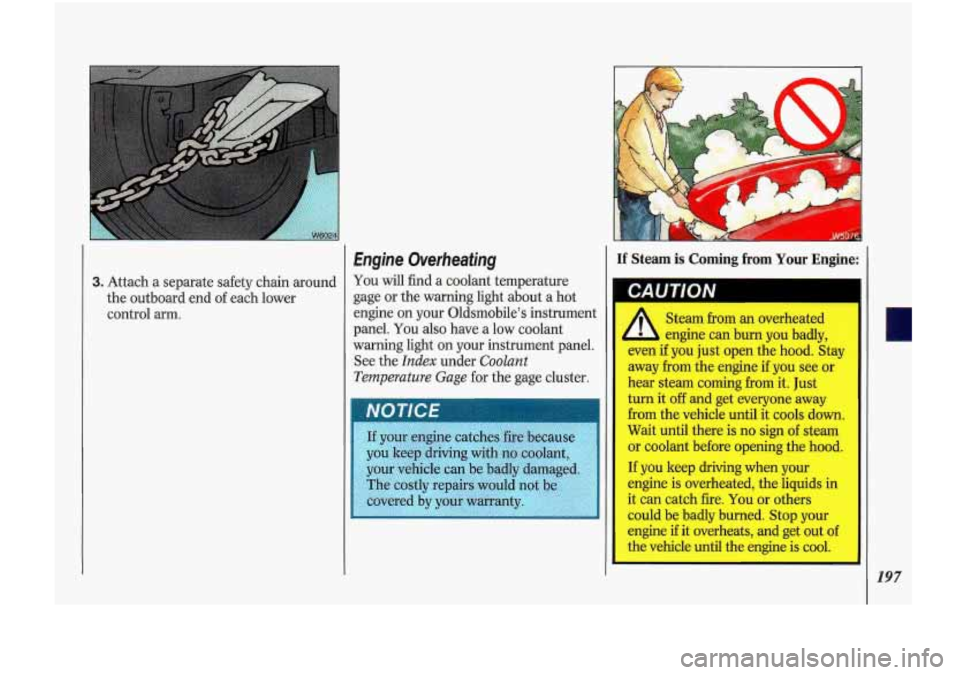
If Steam is Coming from Your Engine:
CAUTION
A
Steam from an overheated
engine can burn you badly,
even if you just open the hood. Stay
away
from the engine if you see or
hear steam coming
from it. Just
turn it off and get everyone away
from the vehicle until it cools down.
Wait until there is no sign of steam
or coolant before opening the hood.
If you keep driving when your
engine is overheated, the liquids in
it can catch fire.
You or others
could be badly burned. Stop your
engine if it overheats, and get out of
the vehicle until the engine is cool.
197
Page 200 of 340
Probkms on the Road
Engine Overheating (CONTJ
If No Steam is Coming from Your
Engine:
If you get the overheat warning but see
or hear no steam, the problem may not
be too serious. Sometimes the engine
can get a little too hot when you:
Climb a long hill on a hot day.
Stop after high speed driving.
Idle for long periods in traffic.
Tow a trailer.
198
If you get the overheat warning with no
sign of steam, try this for a minute or so:
1. Turn off your air conditioner.
2. Turn on your heater to full hot at the
highest fan speed and open the
window as necessary.
3. Try to keep your engine under load
(in
a drive gear where the engine
runs slower).
If you no longer have the overheat
warning, you can drive. Just to be safe,
drive slower for ab& ten minutes. If
the warning doesn't come back on, you
can drive normally.
If the warning continues, pull over,
stop, and, park your vehicle right away.
f there's still no sign of steam, you can
dle the engine for two or three minutes
vhile you're parked, to see if the
varning stops.
3ut then,
if you still have the warning,
KJRJNOFFTHEENGINEANDGET
WERYONE OUT OF THE VEHICLE
Inti1 it cools
down.
(ou may decide not to lift the hood but
o get service help right away.
Page 201 of 340
Cooling System
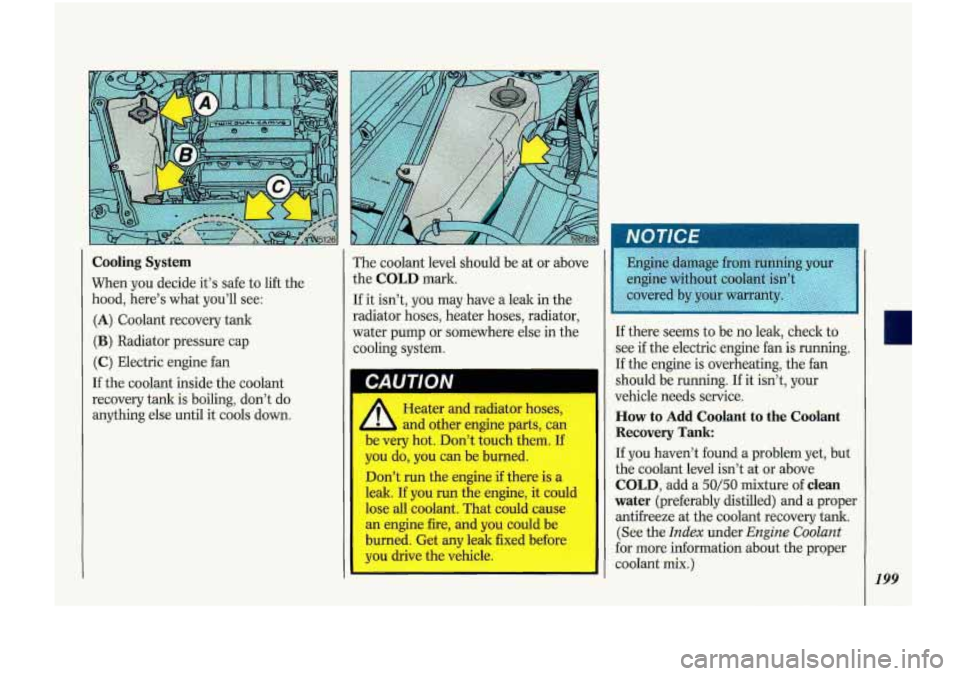
When you decide it’s safe to lift the
hood, here’s what you’ll see:
(A) Coolant recovery tank
(B) Radiator pressure cap
(C) Electric engine fan
If the coolant inside the coolant
recovery tank is boiling, don’t do
anything else until it cools down. The
coolant level should be at or above
the
COLD mark.
If it isn’t,
you may have a leak in the
radiator hoses, heater hoses, radiator,
water pump or somewhere else in the
cooling system.
I
- 1
CAUTION I
Heater and radiator hoses,
and other engine parts, can
1;, ;cry hot. Don’t touch them. If
you do,
you can be burned.
Don’t run the engine
if there is a
leak. If you
run the engine, it could
lose all coolant. That could cause
an engine fire, and you could be
burned. Get any leak fixed before
I
you drive the vehicle.
I
If there seems to be no leak, check to
see
if the electric engine fan is running.
If the engine is overheating, the fan
should be running.
If it isn’t, your
vehicle needs service.
How to Add Coolant to the Coolant
Recovery
Tank:
If you haven’t found a problem yet, but
the coolant level isn’t at or above
COLD, add a
50/50 mixture of clean
water (preferably distilled) and a proper
antifreeze at the coolant recovery
tank.
(See the Index under Engine Coolant
for more information abaut the proper
coolant
mix.)
199
Page 204 of 340
Problems on the Road
202
Engine Overheating (CONTJ
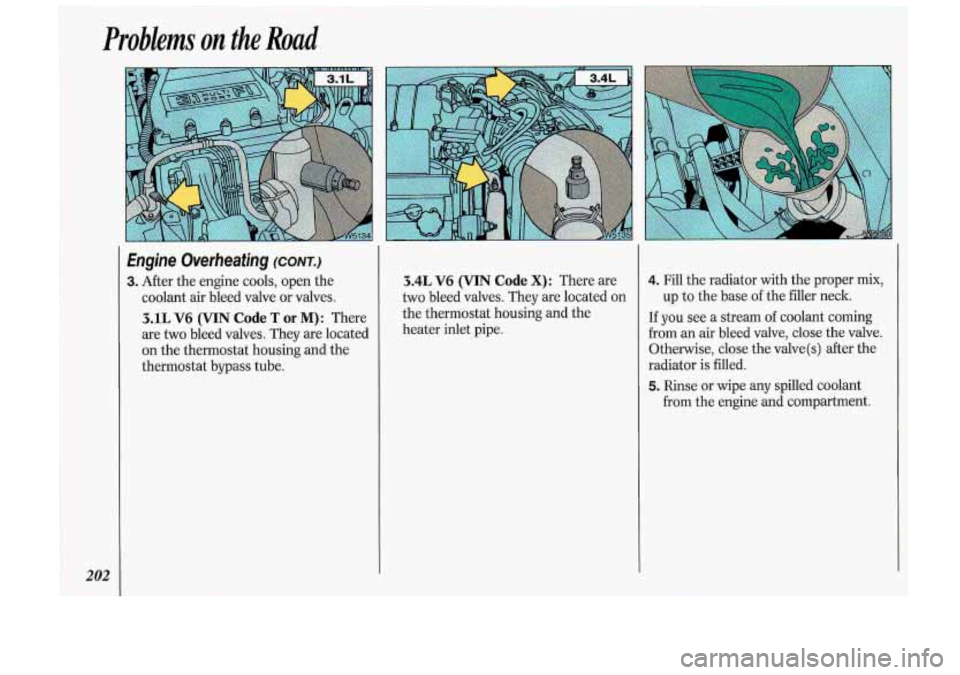
3. After the engine cools, open the
coolant air bleed valve or valves.
3.1L V6 (VIN Code T or M): There
are two bleed valves. They are located
on the thermostat housing and the
thermostat bypass tube.
3.4L V6 (VIN Code X): There are
two bleed valves. They are located on
the thermostat housing and the
heater inlet pipe. 4. Fill the radiator with the proper mix,
up to the base of the filler neck.
If you see a stream of coolant coming
from
an air bleed valve, close the valve.
Otherwise, close the valve(s) after the
radiator is filled.
5. Rinse or wipe any spilled coolant
from the engine and compartment.
Page 206 of 340
204
Problems on the Road
Engine Overheating (cow.)
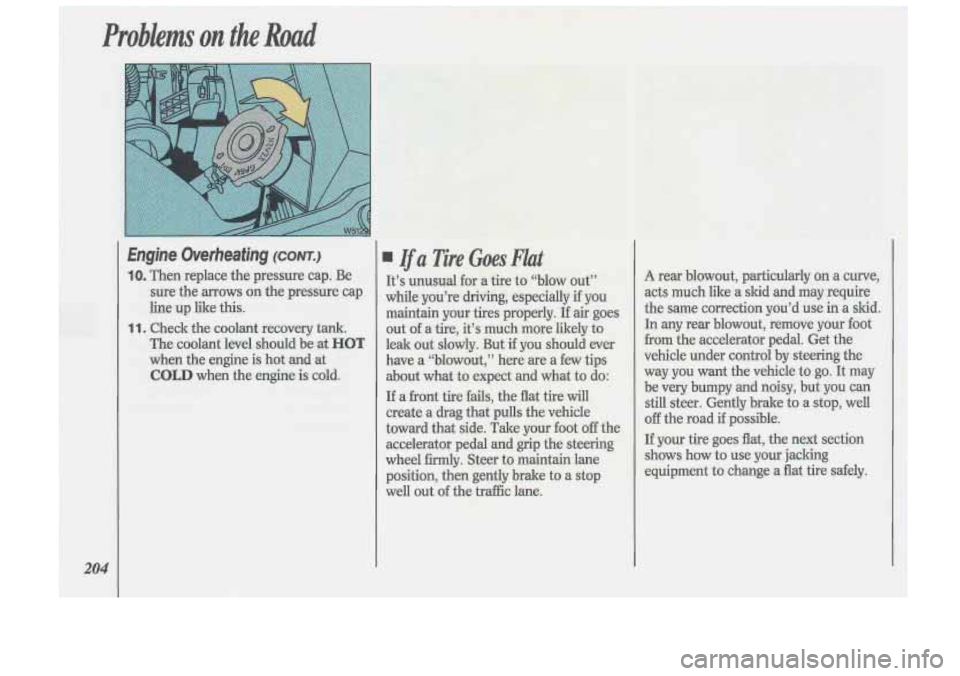
IO. Then replace the pressure cap. Be
sure the
arrows on the pressure cap
line up like this.
1 1. Check the coolant recovery tank.
The coolant level should be at
HOT
when the engine is hot and at
COLD when the engine is cold.
Ifa Tire Goes Flat
It’s unusual for a tire to (‘blow out’’
while you’re driving, especially if you
maintain your tires properly. If air goes
out
of a tire, it’s much more likely to
leak out slowly. But
if you should ever
have a “blowout,” here are a few tips
about what to expect and what to do:
If a front tire fails, the flat tire will
create a drag that pulls the vehicle
toward that side. Take your foot
off the
accelerator pedal and
grip the steering
wheel firmly. Steer to maintain lane
position, then gently brake to a stop
well out of the trafEic lane.
A rear blowout, particularly on a curve,
acts much like a skid and may require
the same correction you’d use in a skid.
In any rear blowout, remove your foot
from the accelerator pedal. Get the
vehicle under control by steering the
way you want the vehicle to go. It may
be very bumpy and noisy, but you can
still steer. Gently brake to a stop, well
off the road if possible.
If your tire goes flat, the
next section
shows how to use your jacking
equipment to change a flat tire safely.
Page 254 of 340
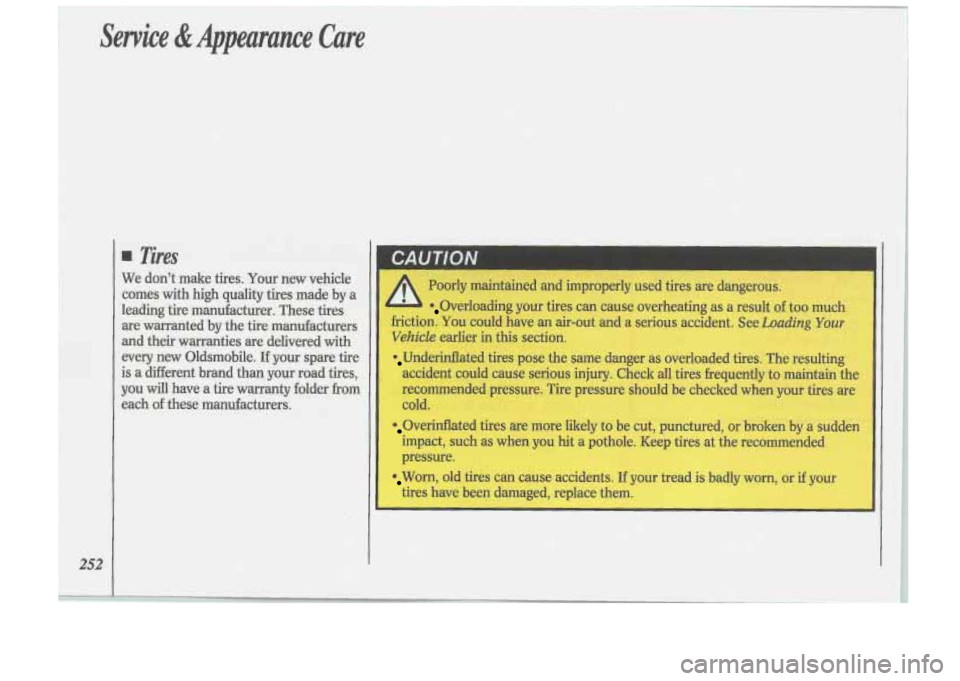
Poorly maintained and improperly used tires are dangerous.
Overloading your tires can cause overheating as a result of too much
friction. You could have an air-out and a serious accident. See
Loading Your
Vehicle earlier in this section.
Underinflated tires pose the same danger as overloaded tires. The resulting
accident could cause serious injury. Check all tires frequently to maintain the
recommended pressure. Tire pressure should be checked when your tires are
cold.
Overinflated tires are more likely to be cut, punctured, or broken by a sudden
impact, such as when you hit a pothole. Keep tires at the recommended
pressure.
Worn, old tires can cause accidents. If your tread is badly worn, or if your
tires have been damaged, replace them.
Page 329 of 340
Console. Rear Seat ............................. 84
Control of
a Vehicle .......................... 147
Convenience Net
............................... 53
Convex Outside Mirror
...................... 81
Coolant (see Engine Coolant)
Cruise Control .................................... 70
Cup Holder
......................................... 83
Curves. Driving on ........................... 154
Customer Assistance Information
... 309
Daytime Running Lights
............... 77
Dead Battery: What to Do
.............. 189
Defects, Reporting Safety
................. 314
Defensive Driving
............................ 144
Defogger, Rear Window
........... 112, 116
Defrosting Windows
......................... 11 1
Disc Brake Wear Indicators ............. 151
Door Locks ........................................ 47
Defogging Your Windows
....... 11 1, 115
Downshifting
........................... 170, 182
Driver Information System
................ 89
Driver Position
.................................. 22
Driving
............................................. 139
At Night
.......................................... 159
City
................................................ 165 Controlling a Skid
.......................... 158
Defensively .................................... 144
Drunken
........................................ 145
Freeway
......................................... 166
Hill and Mountain
........................ 170
In a Foreign Country
..................... 220
In Fog. Mist and Haze
.................. 164
In the Rain
...................................... 161
Long Distance
............................... 168
Loss of Control
.............................. 158
On Curves ..................................... 154
Passing
........................................... 156
Through Deep Standing Water
....... 57
Winter Driving
.............................. 173
With
a Trailer ................................ 181
Drunken Driving ............................. 145
Electric Outside Mirror Control
...... 82
Electrical Equipment. Adding
......... 269
Electronic Climate Control
.............. 1 13
Emergencies. Braking in
.................. 153
Emergencies on the Road ................. 187
Emergencies. Steering in
.................. 155
Emergency Starting ......................... 189 Emergency Towing
.......................... 193
Engine Block Heater
.................. 57. 229
Engine Coolant
................................. 234
Checking
& Adding .............. 235. 278
Proper Mixture to Use
................... 234
Safety Warnings
Temperature Gage
........................... 95
Temperature Warning Light
........... 95
Engine Exhaust
.................................. 66
Engine Identification
........................ 269
Engine Oil
........................................ 226
Additives
........................................ 228
Capacity
.......................................... 276
Checking
& Adding ............... 226, 278
Energy Conserving
......................... 228
Filter
....................................... 229, 283
Temperature Warning Light
........... 96
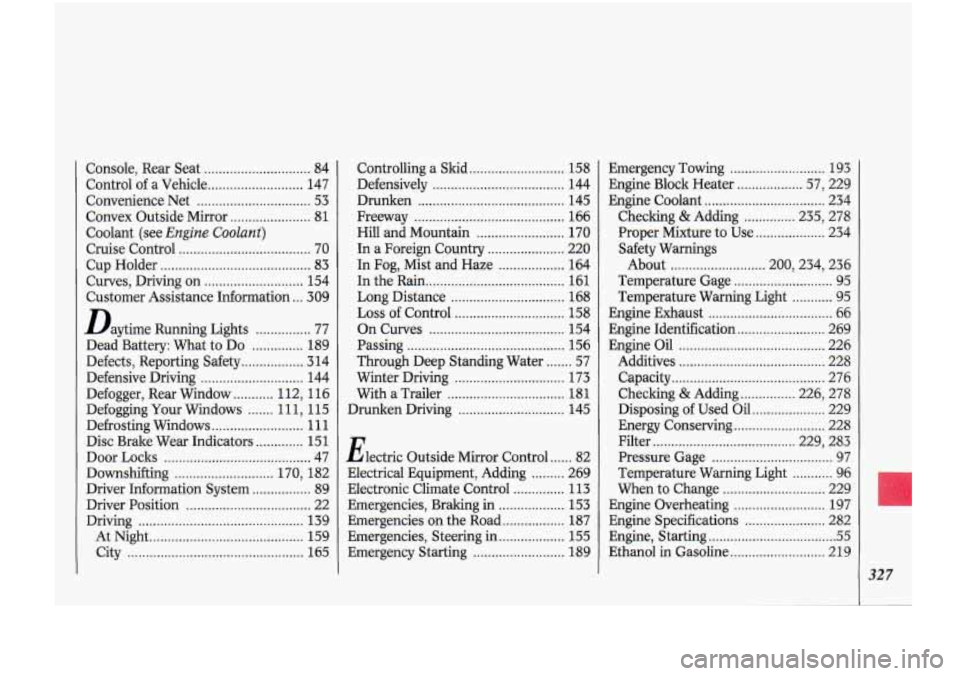
Engine Overheating
......................... 197
Engine Specifications
...................... 282
Engine, Starting
................................... 55
Ethanol in Gasoline .......................... 219
About
.......................... 200. 234. 236
Disposing of Used Oil
.................... 229
Pressure Gage
................................. 97
When to Change
............................ 229
327