reset Oldsmobile Cutlass Supreme 1994 s User Guide
[x] Cancel search | Manufacturer: OLDSMOBILE, Model Year: 1994, Model line: Cutlass Supreme, Model: Oldsmobile Cutlass Supreme 1994Pages: 276, PDF Size: 14.73 MB
Page 124 of 276
Comfort Controls &Audio Systems
122
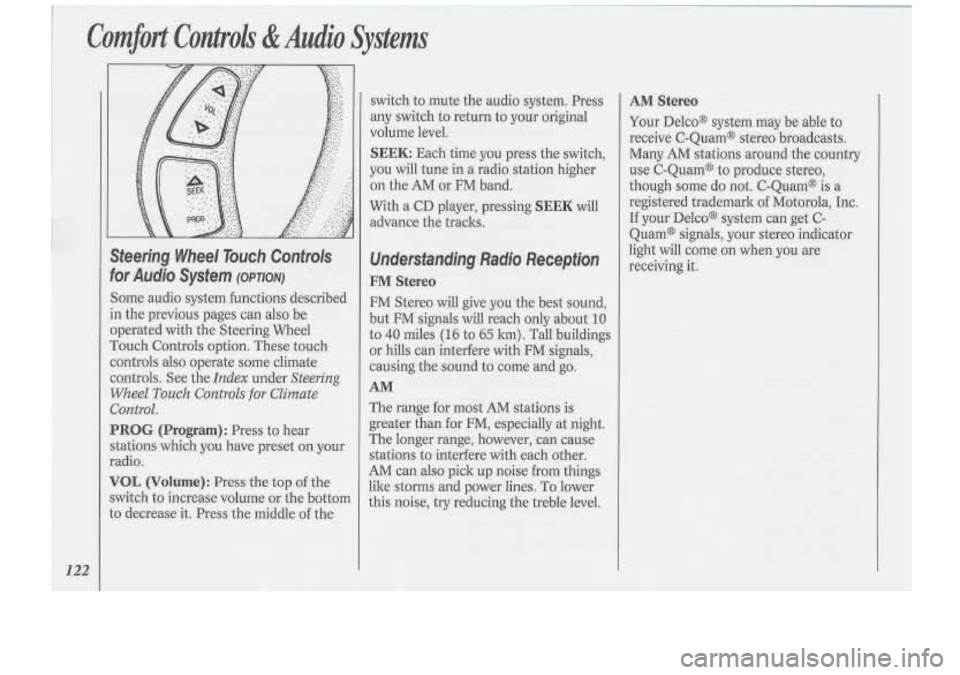
Sfeering Wheel Touch Controls
For Audio System (OPTION)
Some audio system functions described
n the previous pages can also be
Iperated with the Steering Wheel
rouch Controls option. These touch
:ontrols also operate some climate
:ontrols. See the
Index under Steering
Wheel
Touch Controls for Climate
Zontrol.
PROG (Program): Press to hear
;tations which you have preset on your
radio.
VOL (Volume): Press the top of the
switch to increase volume or the botton
to decrease it. Press the middle of the switch
to mute the audio system. Press
any switch to return to your original
volume level.
SEEK: Each time you press the switch,
you will tune in a radio station higher
on the AM or FM band.
With a CD player, pressing
SEEK will
advance the tracks.
Understanding Radio Reception
FM Stereo
FM Stereo will give you the best sound,
but FM signals will reach only about
10
to 40 miles (16 to 65 km) . Tall buildings
or hills can interfere with FM signals,
causing the sound to come and go.
AM
The range for most AM stations is
greater than for FM, especially at night.
The longer range, however, can cause
stations to interfere with each other.
AM can also pick up noise from things
like storms and power lines. To lower
this noise, try reducing the treble level.
AM Stereo
Your Delco@ system may be able to
receive C-Quam@ stereo broadcasts.
Many AM stations around the country
use C-Quam@ to produce. stereo,
though some do not. C-Quam@ is a
registered trademark of Motorola, Inc.
If your Delco@ system can get C-
Quam@ signals, your stereo indicator
light will come on when you are
receiving it.
Page 194 of 276
Service & Appearance Care
Radiator Pressure Cap
NOTICE:
Your radiator cap is a 15 psi
(105kPa) pressure-type cap and
must be tightly. installed
io prevent
coolant loss and possible engine
damage from overheating. Be sure
the arrows on the cap line up with
192
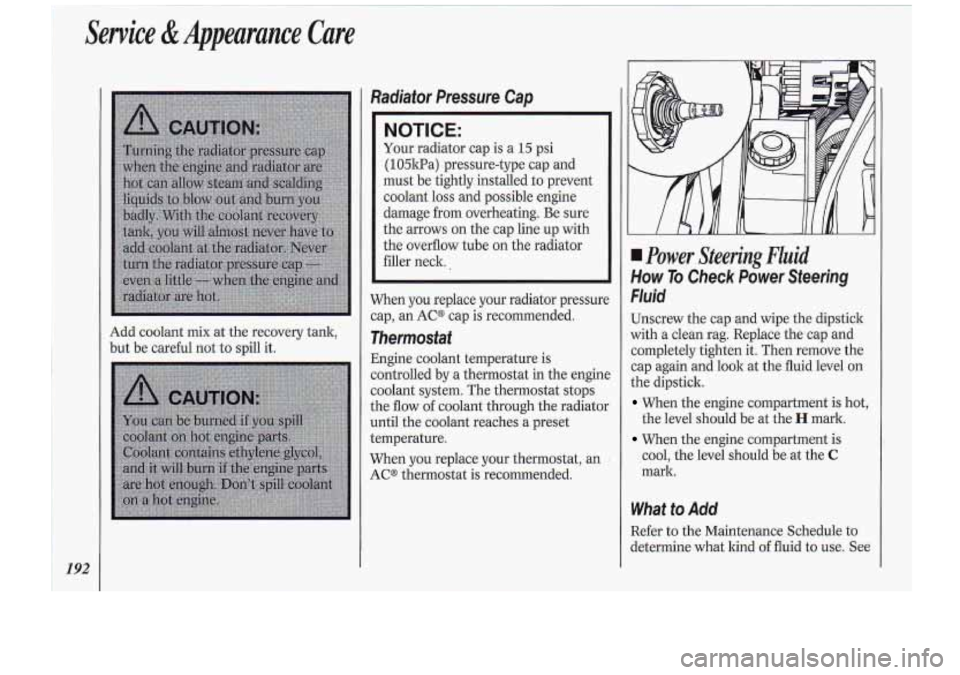
Add coolant mix at the recovery tank,
but be careful not to spill it.
L I
the overflow tube on the radiator
filler neck.
I Power Steering Fluid
How To Check Power Steering
When you replace your radiator premre
cap, an
AC@ cap is recommended.
Thermostat
Engine coolant temperature is
controlled by a thermostat in the engine
coolant system. The thermostat stops
the flow of coolant through the radiator
until the coolant reaches a preset
temperature.
When you replace your thermostat, an
AC@ thermostat is recommended.
Fluid
-
Unscrew the cap and wipe the dipstick
with a clean rag. Replace the cap and
completely tighten it. Then remove the
cap again and look at the fluid level on
the dipstick.
When the engine compartment is hot,
the level should be at the
H mark.
When the engine compartment is
cool, the level 'should be at the
C
mark.
What to Add
Refer to the Maintenance Schedule to
determine what kind of fluid to use. See
Page 212 of 276
Service & Appearance Care
test course. For example, a tire graded
150 would wear one and a half (1 1/2)
times as well on the government course
as a tire graded
100. The relative
performance of tires depends upon the
actual conditions
of their use, however,
and may depart significantly from the
norm due to variations in driving habits,
service practices and differences
in road
characteristics and climate.
Traction - A, B, C
The traction grades, from highest to
lowest are:
A, B, and C. They represent
the tire’s ability to stop onwet
pavement as measured under controlled
conditions on specified government test
surfaces of asphalt and concrete.
A tire
marked
C may have poor traction
performance.
Warning: The traction grade assigned to
this tire is based on braking (straight-
ahead) traction tests and does not
include cornering (turning) traction.
Temperature - A, B, C
The temperature grades are A (the
highest),
B, and C, representing the
tire’s resistance to the generation of
heat and its ability to dissipate heat when
tested under controlled
conditions on a specified indoor
laboratory test wheel. Sustained high
temperature can cause the material of
the tire to degenerate and reduce tire
life, and excessive temperature can lead
to sudden tire failure. The grade
C
corresponds to a level of performance
which all passenger car tires must meet
under the Federal Motor Vehicle Safety
Standard
No. 109. Grades B and A
represent higher levels of performance
on the laboratory test wheel than the
minimum required by law.
Warning: The temperature grade for
this tire is established for a tire that is
properly inflated and not overloaded.
Excessive speed, underinflation, or
excessive loading, either separately or in
combination, can cause heat buildup
and possible tire failure.
These grades are molded
on the
sidewalls
of passenger car tires.
While the tires available as standard or
optional equipment on General Motors
vehicles may vary with respect to these
grades, all such tires meet General
Motors performance standards and have been
approved for use on General
Motors vehicles.
All passenger type (P
Metric) tires must conform to Federal
safety requirements in addition to these
grades.
Wheel Alignment and Tire
Balance
The wheels on your vehicle were
aligned and balanced carefully at the
factory to give you the longest tire life
and best overall performance.
In most cases, you will not need to have
your wheels aligned again. However,
if
you notice unusual tire wear or your
vehicle pulling one way or the other, the
alignment may need to be reset.
If you
notice your vehicle vibrating when
driving on a smooth road, your wheels
may need to be rebalanced.
Wheel Replacement
Replace any wheel that is bent, cracked
or badly rusted. If wheel nuts keep
coming loose, the wheel, wheel bolts,
and wheel nuts should be replaced. If
the wheel leaks air, replace it (except