engine coolant Oldsmobile Cutlass Supreme 1995 s User Guide
[x] Cancel search | Manufacturer: OLDSMOBILE, Model Year: 1995, Model line: Cutlass Supreme, Model: Oldsmobile Cutlass Supreme 1995Pages: 340, PDF Size: 16.68 MB
Page 188 of 340
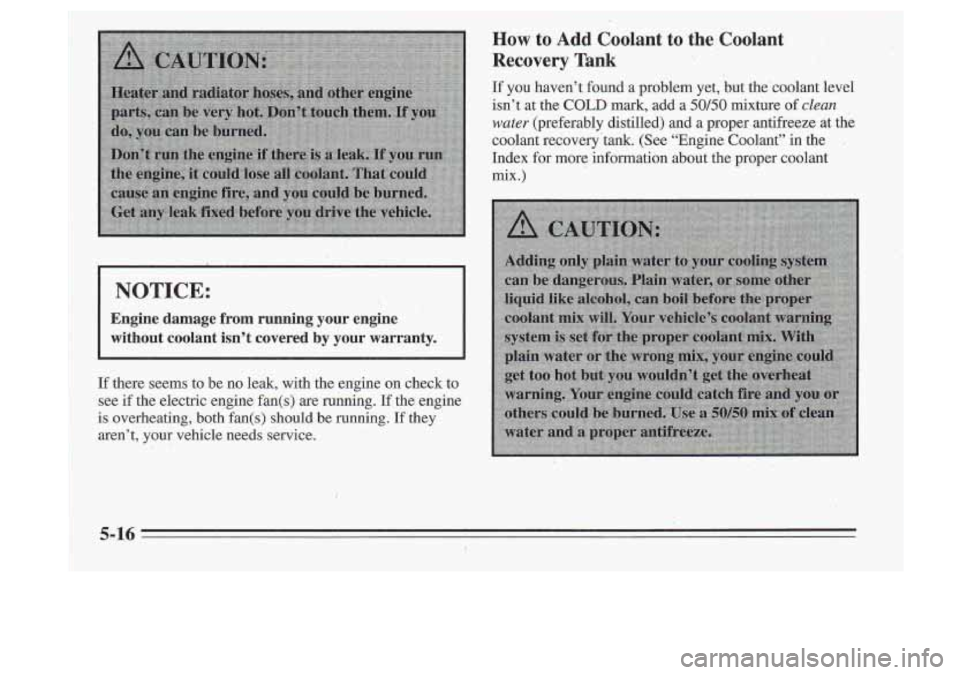
NOTICE:
Engine damage from running your engine
without coolant isn’t covered
by your warranty.
If there seems to be no leak, with the engine on check to
see if
the electric engine fan(s) are running. If the engine
is overheating, both fan(s) should be running. If they
aren’t, your vehicle needs service.
How to Add Coolant to the Coolant
Recovery Tank
If you haven’t found a problem yet, but the’coolant level
isn’t at the
COLD mark, add a 50/50 mixture of clean
water (preferably distilled) and a proper antifreeze at the
coolant recovery ‘tank. (See “Engine Coolant” in the
Index for more information about the proper coolant
mix
.)
5-16
Page 189 of 340
NOTICE:
In cold weather, water can freeze and crack,,the ... , . i . ar
engine, radiator, heater core and other parts.' Use
the recommended coolant.
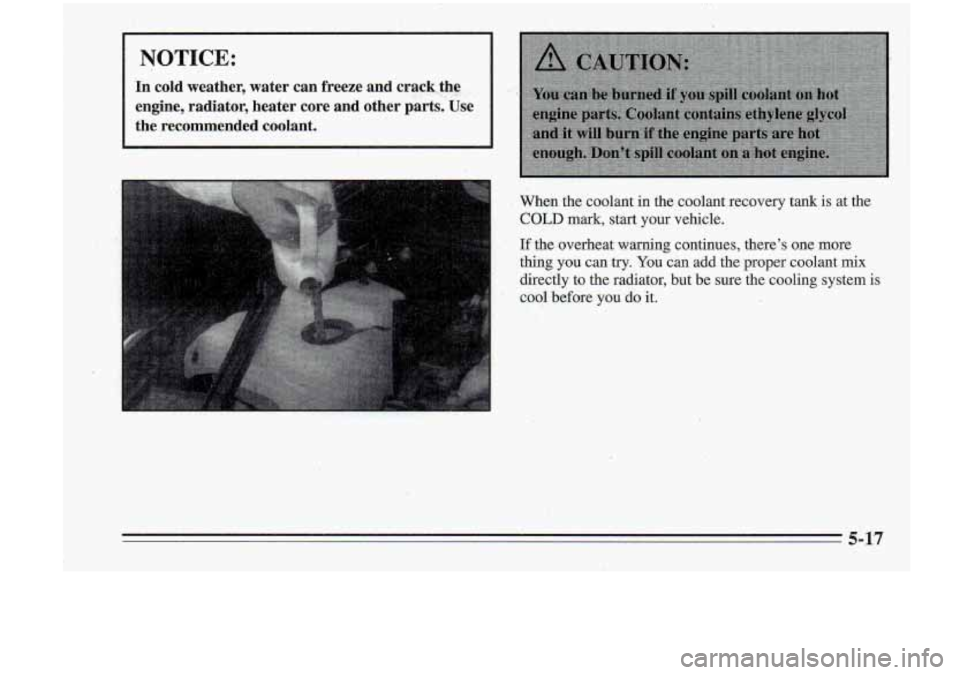
When the coolant in the coolant recovery tank is at the
COLD mark, start your vehicle.
If the overheat warning continues, there's one more
thing you can try.
You can add the proper coolant mix
directly to the radiator, but be sure the cooling system is
cool before you do it.
5-17
Page 191 of 340
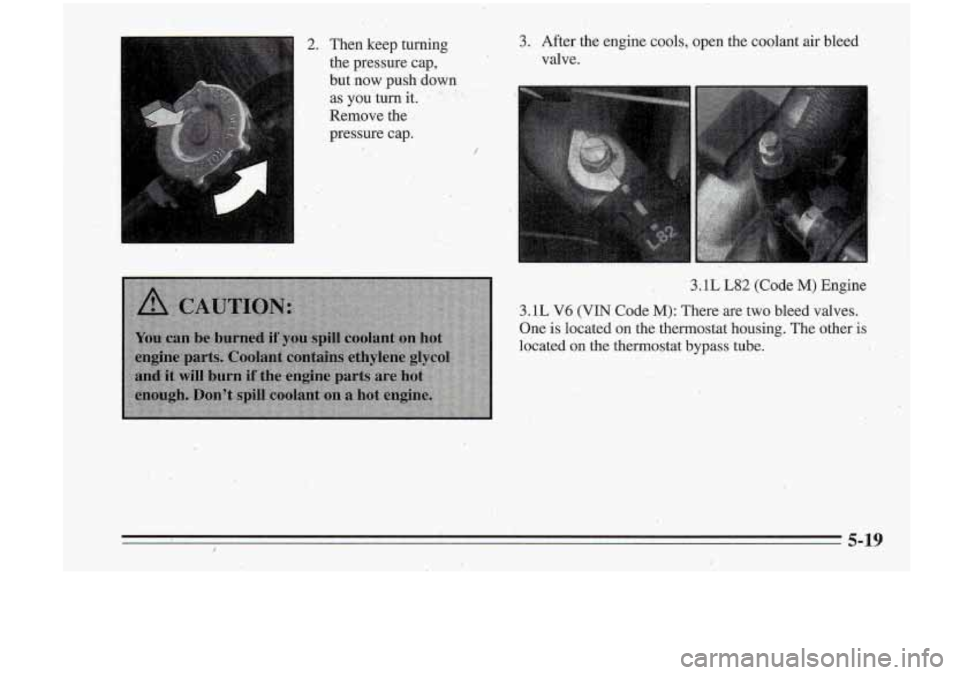
3. After the engine cools, open the coolant air bleed
valve.
3: ...
. -. 1 .. ., ..
,. I, . " "3; 1L L82 (Code M) Engine
3.1L V6 (VIN Code M): There are two bleed valves.
One
is located on the thermostat housing. The other is
located on the thermostat bypass tube.
/ 5-19
Page 192 of 340
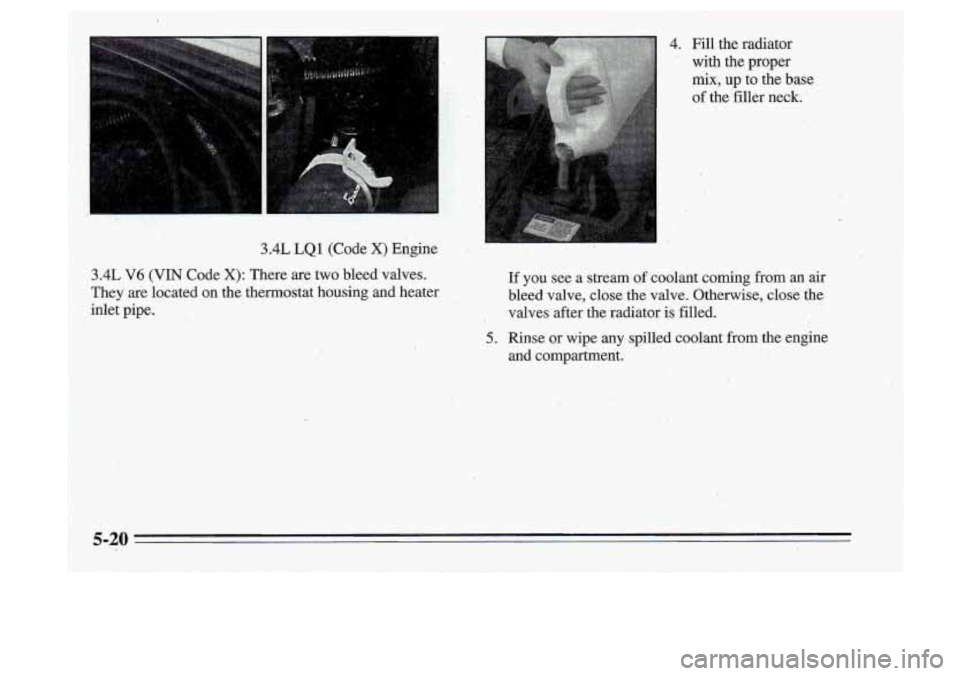
3.4L LQ1 (Code X) Engine
They are located
on the thermostat housing and heater
inlet pipe.
1 3.4L V6 (VIN Code X): There are two bleed valves.
4. Fill the radiator
with the proper
mix,
up. to the base
of the 'filler neck.
If
you see a stream.of coolant coming from an air
bleed valve, close the valve. Otherwise, close the-
valves after the radiator i.s filled.
5. Rinse or wipe any spilled coolant from the engine
and compartment.
Page 193 of 340
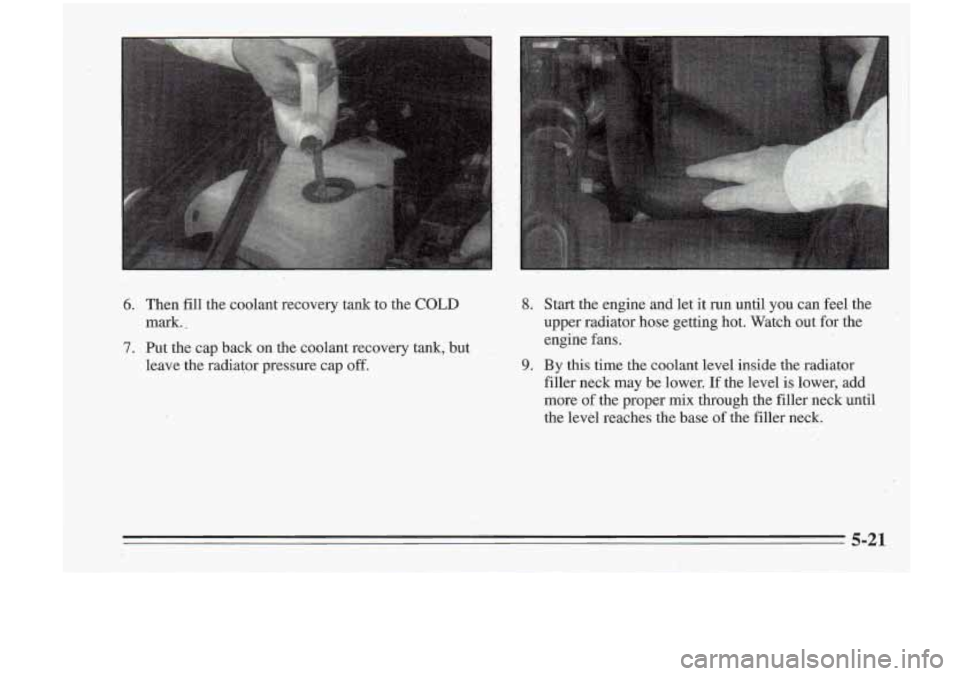
6. Then fill the coolant recovery tank to the COLD
7. Put the cap back on the coolant recovery tank, but
mark.
-
leave the
radiator pressure cap off.
8. Start the engine 'and let it run until you can feel the
upper radiator hose getting hot. Watch out for the
engine fans.
filler neck may be lower. If the level
is lower, add
more of the proper
mix through the filler neck until
the level reaches the base of the filler neck.
9. By this time the coolant level inside the radiator
5-21 ~.
Page 194 of 340
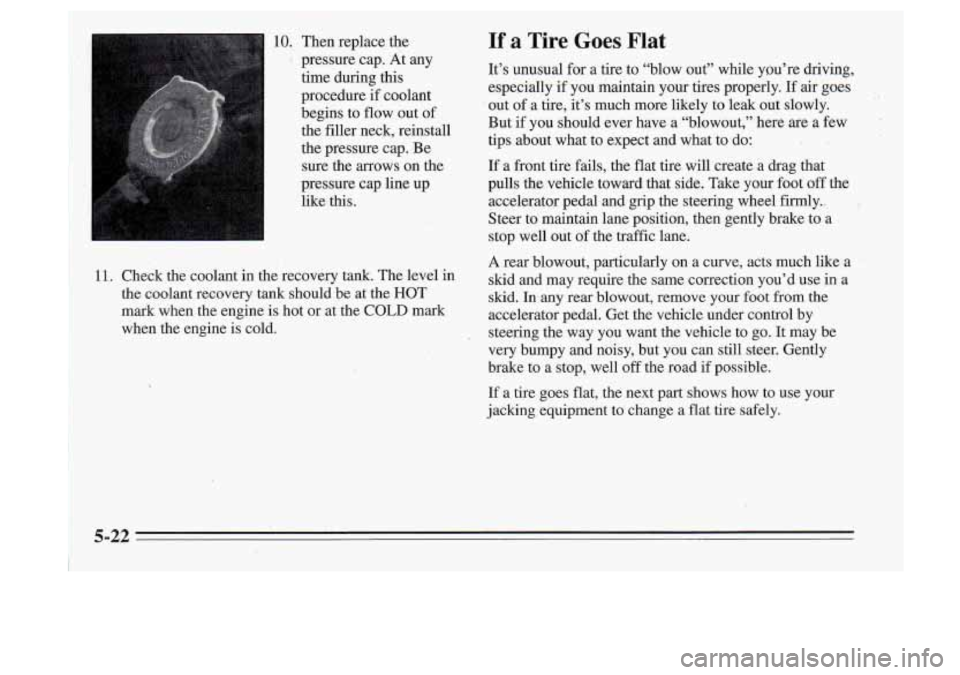
10. Then replace the
’ pressure cap. At any
time during this
procedure if coolant
begins to flow out of
the filler neck, reinstall
the pressure cap. Be
sure the arrows on the
pressure cap line up
like this.
11. Check the coolant in the recovery tank. The level in
the coolant recovery tank should be at the HOT
mark when the engine
is hot or at the COLD mark
when the engine
is cold.
If a Tire Goes Flat
It’s unusual for a tire to “blow out” while you’re \
driving,
especially
if you maintain your tires properly. If air goes
out
of a tire, it’s much more likely to leak out slowly.
But if you should ever have a “blowout,” here are a few
tips about what to expect and what to do:
If a front tire fails, the flat tire will create a drag that
pulls the vehicle toward that side. Take your foot
off the
accelerator pedal and grip the steering wheel firmly.,
Steer to maintain lane position, then gently brake to a
stop well out of the traffic lane.
A rear blowout, particularly on a curve, acts much like a
skid and may require the same correction you’d use in a
skid. In any rear blowout, remove your foot from the
accelerator pedal. Get the vehicle under control by
steering the way you want the vehicle to go.
It may be
very bumpy and noisy, but you can still steer. Gently
brake to a stop, well
off the road if possible.
If a tire goes flat, the next part shows how to
use your
jacking equipment to change a flat tire safely.
Page 213 of 340
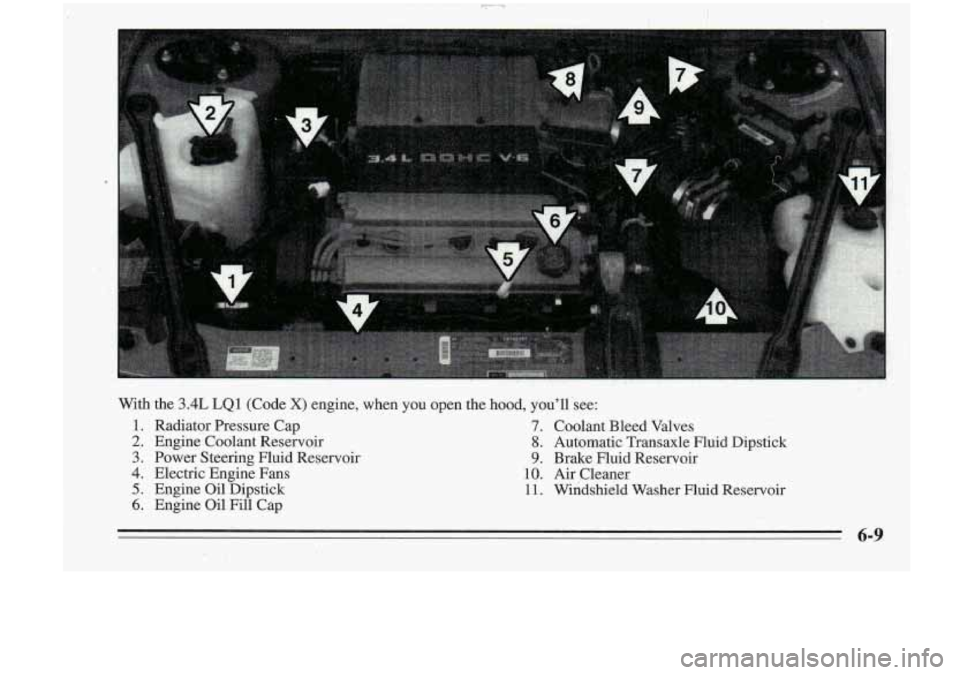
With the 3.4L LQ1 (Code X) engine, when you open the hood, you’ll see:
1. Radiator Pressure Cap
2. Engine Coolant Reservoir
3. Power Steering Fluid Reservoir
4. Electric Engine Fans
5. Engine Oil Dipstick
6. Engine Oil Fill Cap
7. Coolant Bleed Valves
8. Automatic Transaxle Fluid Dipstick
9. Brake Fluid Reservoir
10. Air Cleaner
11. Windshield Washer Fluid Reservoir
6-9
Page 224 of 340
NOTICE:
~f you use an improper coolant mix, your engine
could overheat and be badly damaged. The repair cost wouldn’t be covered by your
warranty. Too much water in the mix can freeze
and crack the engine, radiator, heater core and
other parts.
..
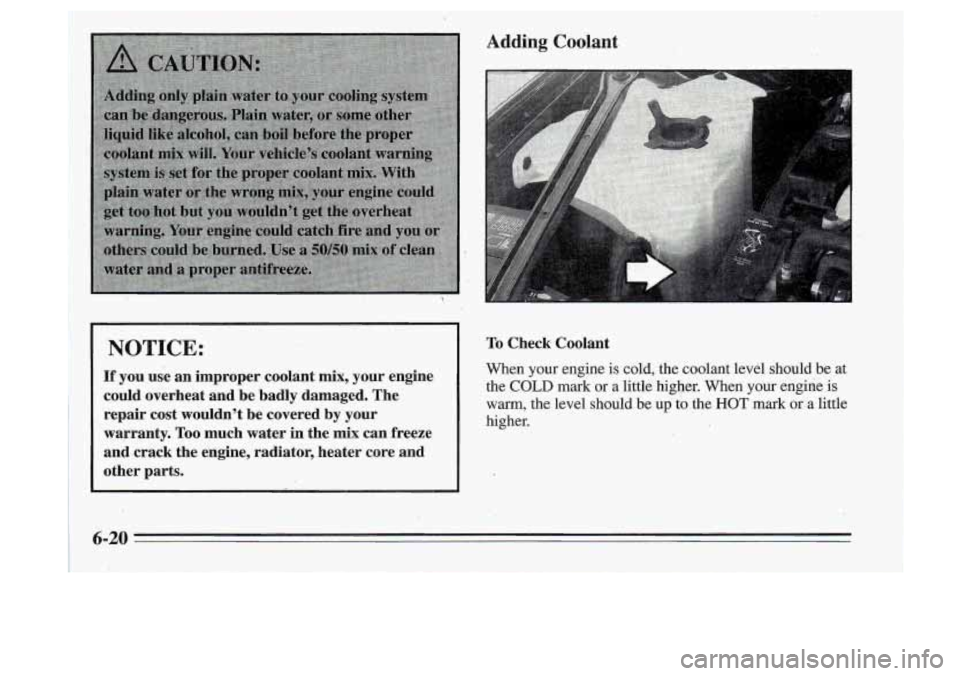
To Check Coolant
When your engine is cold, the coolant level should be at
the
COLD mark or a little higher. When your engine is
warm, the level should be up to the HOT mark or a little
higher.
4-20
Page 225 of 340
/ LOW
il
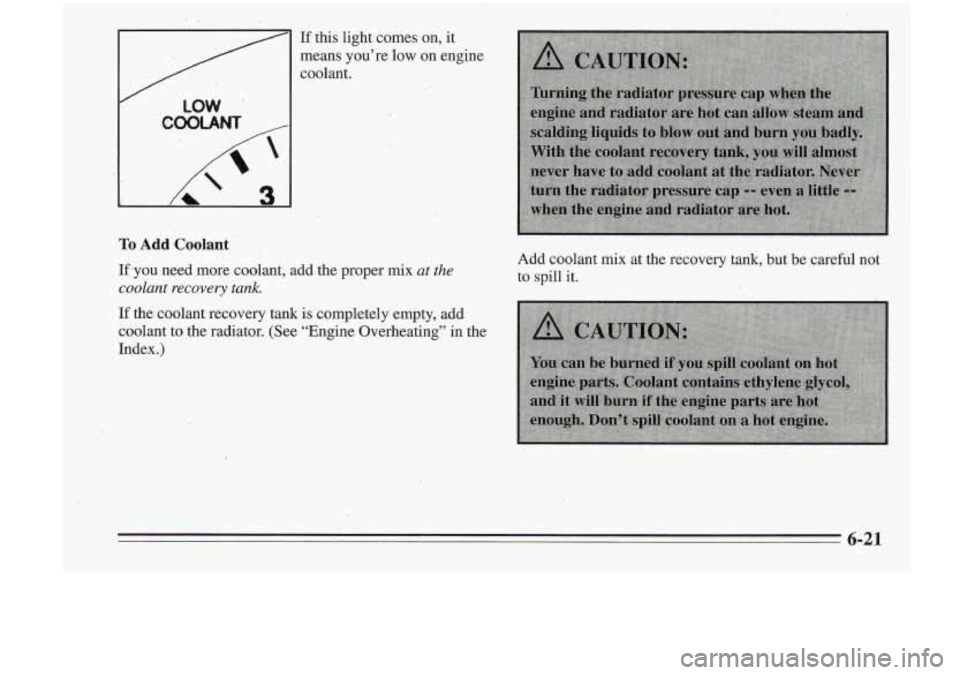
If this 1ight.comes on, it
means you’re low on engine
coolant.
To Add Coolant
Ifjyou need more coolant, add the proper mix at the
coolant recovery tank.
If the coolant recovery tank is completely empty, add
coolant to the radiator. (See “Ennine Overheating” in the
Index.) Add coolant
mix at
the recovery tqk, but be ,careful not
to spill it.
6-21
Page 287 of 340
Maintenance Schedule I
60,000 Miles (100 000 km)
0 Change engine oil and filter (or, every
3 months, whichever occurs first).
An Emission Control Service.
Lubricate the shift linkage, parking brake
c.able guides, underbody contact points and
linkage
(or every-6 months, whichever
occurs first).
Inspect engine accessory drive belt (or
every
24 months, whichever occurs first).
An Emission Control Service. ,
0 Inspect camshaft timing belt. An Emission
Control Service.
.I
0 Replace spark plugs. An Emission
Inspect spark plug wires. An Emission
0 Replace air cleaner filter. Replace filter
Control
Service.
Control Service.
T
more often under dusty conditions.
An Emission Control Service.
0 Inspect fuel tank, cap and lines for damage
or leaks. Inspect fuel cap‘gasket for any
damage. Replace parts as needed.
An
Emission Control Service.
El Drain, flush and refill cooling system (or
every‘
24 months, whichever occurs first).
See “Engine Coolant” in the Index for what
to use. Inspect hoses. Clean radiator,
,
condenser, pressure cap and ‘neck. Pressure
test the cooling system and pressure cap.
An Emission Control Service.
I - - 7-17
I DATE SERVICED BY: ACTUAL MILEAGE
1 I I I