key Oldsmobile Cutlass Supreme 1996 s User Guide
[x] Cancel search | Manufacturer: OLDSMOBILE, Model Year: 1996, Model line: Cutlass Supreme, Model: Oldsmobile Cutlass Supreme 1996Pages: 356, PDF Size: 18.48 MB
Page 70 of 356
New Vehicle aBreak-In”
NOTICE:
Your modern Oldsmobile doesn’t need an
elaborate “break-in.” But
it will perform better
in the long run
if you follow these guidelines:
0
0
0
Don’t drive at any one speed -- fast or
slow
-- for the first 500 miles (804 km).
Don’t make full-throttle starts.
Avoid making hard stops for the fist
200 miles (322 km) or so. During this time
your new brake linings aren’t yet broken
in. Hard stops with new linings can mean
premature wear and earlier replacement.
,
Follow this breaking-in guideline every
time you get new brake linings.
Don’t tow
a trailer during break-in. See
“Towing a nailer” in the Index for
more information.
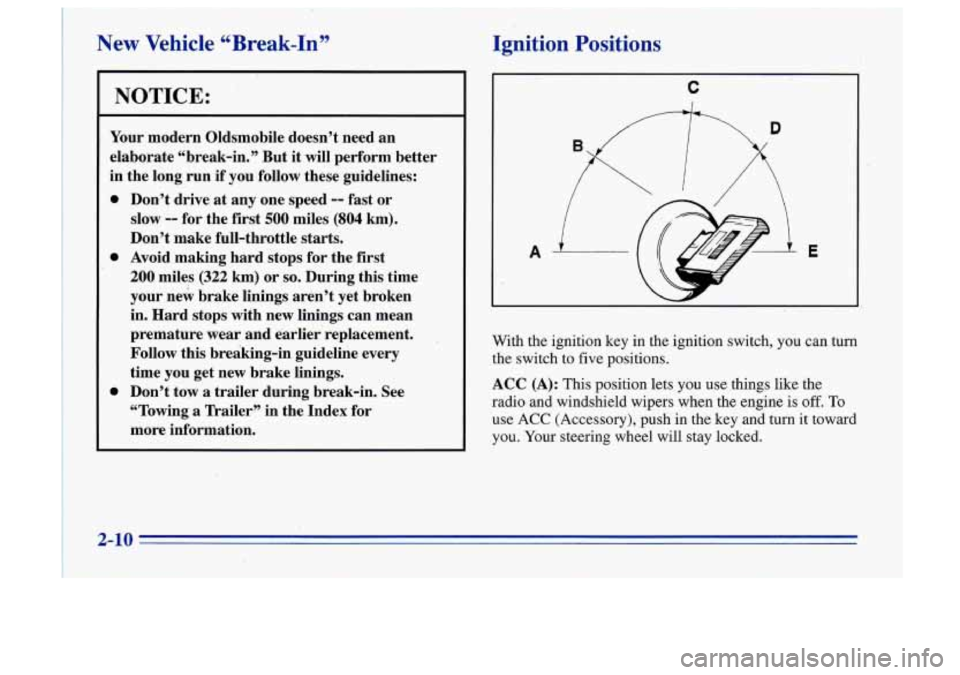
Ignition Positions
C
I
A E
With the ignition key in the ignition switch, you can turn
the switch to five positions.
ACC (A): This position lets you use things like the
radio and windshield wipers when the engine is
off. To
use ACC (Accessory), push in the key and turn it toward
you. Your steering wheel will stay locked.
I
Page 71 of 356
LOCK (B): Before you put the key into the ignition
switch, the switch is in the
LOCK position. It’s also the
only position in which you can remove your key. This
position locks your ignition, steering wheel and
transaxle. It’s a theft-deterrent feature.
OFF (C): This position lets you turn off the engine but
still turn the steering wheel. It doesn’t lock the steering
wheel like
LOCK. Use OFF if you must have your
vehicle pushed or towed.
RUN (D): This position is where the key returns after
you start your vehicle. With the engine off, you can
use
RUN to display some of your warning and
indicator lights.
START (E): This position starts your engine.
A warning chime will sound if you open the driver’s
door when the ignition is in the
OFF, LOCK or ACC
position and the key is in the ignition.
NOTICE:
If your key seems stuck in LOCK and you can’t ,
turn it, be sure it is all the way in. If it is, then
turn the steering wheel left and right while you
turn the key hard.
But turn the key only with
your hand. Using a tool to force it could break
the key or the ignition switch.
If none of this
works, then your vehicle needs service.
Page 72 of 356
‘ Starting Your Engine
Move your shift lever to PARK (P) or NEUTRAL, (N).
Your engine won’t start in any other position -- that’s a
safety feature.
To restart when you’re already moving,
use NEUTRAL (N) only.
NOTICE:
Don’t try to shift to PARK (P) if your Oldsmobile
is moving.
If you do, you could damage the
transaxle. Shift to PARK
(P) only when your
vehicle is stopped.
~ 1. Without pushing the accelerator pedal, turn your
ignition key
to START. When the engine starts, let
go of
the key. The idle speed will go down as your
engine gets warm.
I NOTICE:
Holding your key in START for longer than
15 seconds at a time will cause your battery to
NOTICE: (Continued) NOTICE: (Continued)
be drained much sooner. And the excessive heat
can damage your starter motor.
2.
If your engine won’t start (or starts but then stops), it could
be flooded with’too much gasoline. Try pushing you
accelerator pedal
all the way to the floor and holding it
there
as you hold the key in START for up to 15 seconds.
his cl& the extra gasoline from the engine.
I NOTICE:
Your engine is designed to work with the
electronics in your vehicle. If you add electrical
parts or accessories, you could change the way
the engine operates. Before adding electrical
equipment, check with your retailer.
If you don’t,
your engine might not perform properly.
If you ever have to have your vehicle towed, see
the part of this manual that tells how to do it
without damaging your vehicle. See “Towing
Your Vehicle” in the Index.
. ,-
2-12
1
Page 80 of 356
4
Move the lever up as far as it will go.
3. Move the ignition key to the LOCK position.
4. Remove the key and take it with you. If you can
leave your vehicle with the ignition key in your
hand, your vehicle
is in PARK (P).
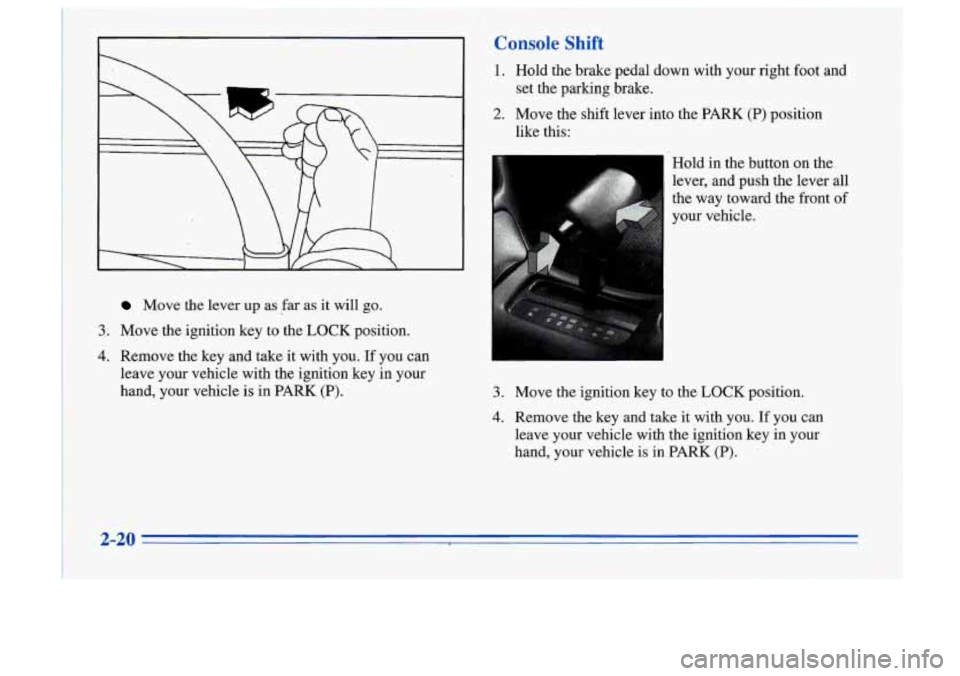
Console Shift
1. Hold the brake pedal down with your right foot and
2. Move the shift lever into the PARK (P) position
set the parking brake.
like this: Hold in the button
on the
lever, and push the lever all
the way toward the front of
your vehicle.
3. Move the ignition key to the LOCK position.
4. Remove the key and take it with you. If you can
leave your vehicle with the ignition key in your
hand, your vehicle is in PARK
(P).
2-20
Page 82 of 356
Shifting Out of PARK (P)
Your Oldsmobile has a brake-transaxle shift interlock.
You
.must fully apply your regular brakes before you can
shift
from PARK (P) when the ignition is in the‘RUN
position. See “Automatic Transaxle Operation” in
the Index.
If you cannot shift out of PARK
(P), ease pressure on
the shift lever by pushing it all the way into PARK (P),
while keeping the brake pedal pushed down. Release the
shift
leyer button if you have a console shift. Then move
the shift lever out of PARK (P), being sure to press the
shift lever button if you have a console shift.
If you ever hold the brake pedal down but still can’t,
shift out of PARK
(P), try this:
1. Turn the key to the OFF position.
2. Apply and hold the brake until the end of Step 4.
3. Shift to NEUTRAL (N).
4. Start the engine and shift to the drive gear you want.
5. Have the vehicle fixed as soon as you can.
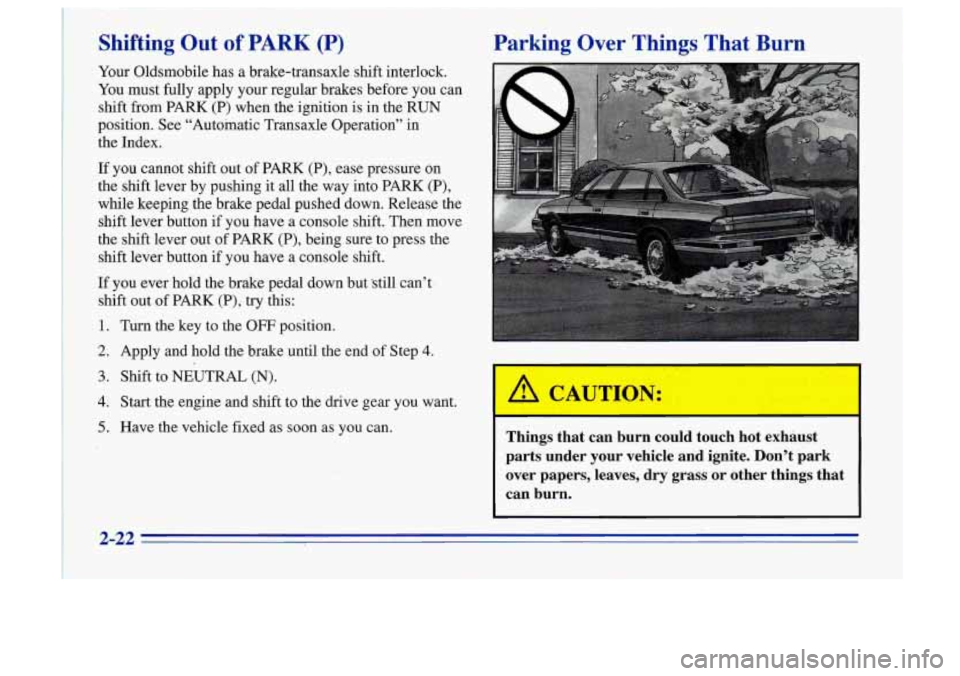
Parking Over Things That Burn
Things that can burn could touch hot exhaust
parts under your vehicle and ignite. Don’t park
over papers, leaves, dry grass
or other things that
can burn.
2-22
Page 97 of 356
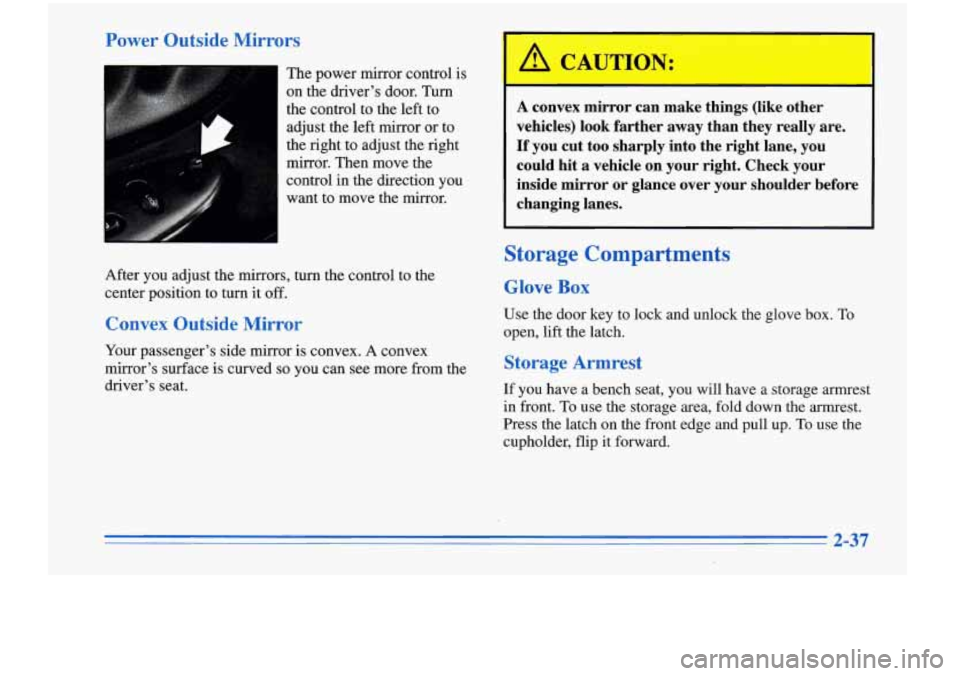
Power Outside Mirrors
The power mirror control is
on the driver's door. Turn
the control to the left to
adjust the left mirror or to
the right to adjust the right
mirror. Then move the
control in the direction you
want to move the mirror.
After
you adjust the mirrors, turn the control to the
center position to turn it
off.
Convex Outside Mirror
Your passenger's side mirror is convex. A convex
mirror's surface is curved
so you can see more from the
driver's seat.
A CAUTION:
A convex mirror can make things (like other
vehicles) look farther away than they really are. If you cut too sharply into the right lane, you
could hit
a vehicle on your right. Check your
inside mirror
or glance over your shoulder before
changing lanes.
Storage Compartments
Glove Box
Use the door key to lock and unlock the glove box. To
open, lift the latch.
Storage Armrest
If you have a bench seat, you will have a storage armrest
in front. To use the storage area, fold down the armrest.
Press the latch
on the front edge and pull up. To use the
cupholder, flip it forward.
2-37
Page 105 of 356
Warning Lights, Gages and Indicators
This part describes the warning lights and gages that
may be on your vehicle. The pictures will help you
locate them.
Warning lights and gages can signal that something
is
wrong before it becomes serious enough to cause an
expensive repair or replacement. Paying attention to
your warning lights and gages could also save you or
others from injury.
Warning lights come on when there may be or is a
problem with one of your vehicle’s functions. As you
will see in the details on the next few pages, some
warning lights come on briefly when you start the
engine just to let you know they’re working. If you are
familiar with this section, you should not be alarmed
when this happens.
Gages can indicate when there may be or is a problem
with one of your vehicle’s functions. Often gages and
warning lights work together to let you know when
there’s a problem with your vehicle. When
one of the warning lights comes on and stays on
when you
are driving, or when one of the gages shows
there may be a problem, check the section that tells you
what to do about it. Please follow this manual’s advice.
Waiting to do repairs can be costly
-- and even
dangerous.
So please get to know your warning lights
and gages. They’re a big help.
Safety Belt Reminder Light
When the key is turned to RUN or START, a chime will
come on for about eight seconds
to remind people to
fasten their safety belts, unless the driver’s safety belt is
already buckled.
The safety belt light will
also come on and stay
on until the driver’s belt
is buckled.
2-45
Page 107 of 356
Brake System Warning Light
Your Oldsmobile’s hydraulic brake system is divided
into two parts. If one part isn’t working, the other part
can still work and stop you. For good braking, though,
~ you need both parts workmg well.
If the warning light comes on, there could be
a brake
problem. Have your brake system inspected right away.
BRAKE
This light should come on
briefly when you turn the
ignition key to
RUN. If it
doesn’t come on then,
have
it fixed so it will be
ready to warn you if
there’s a problem.
If the light comes on while you
are driving, pull off the
road and stop carefully. You may notice that the pedal is
harder to push.
Or, the pedal may go closer to the floor.
It may take longer to stop. If the light is still on, or if the anti-lock brake system warning light
is flashing, have
the vehicle towed for service. (See “Anti-Lock Brake
System Warning Light” and “Towing Your Vehicle” in
the Index
.)
1 C.’ UTION:
Your brake system may not be working properly
if the brake system warning light is on. Driving
with the brake system warning light on can lead
to an accident. If the light is still on or if the
anti-lock brake system warning light is flashing
after you’ve pulled
off the road and stopped
carefully, have the vehicle towed for service.
When the ignition is on, the brake system warning light
will also come on when
you set your parking brake. The
light will stay on if your parking brake doesn’t release
fully. If it stays on after your parking brake is fully
released, it means you have a brake problem.
2-47
Page 108 of 356
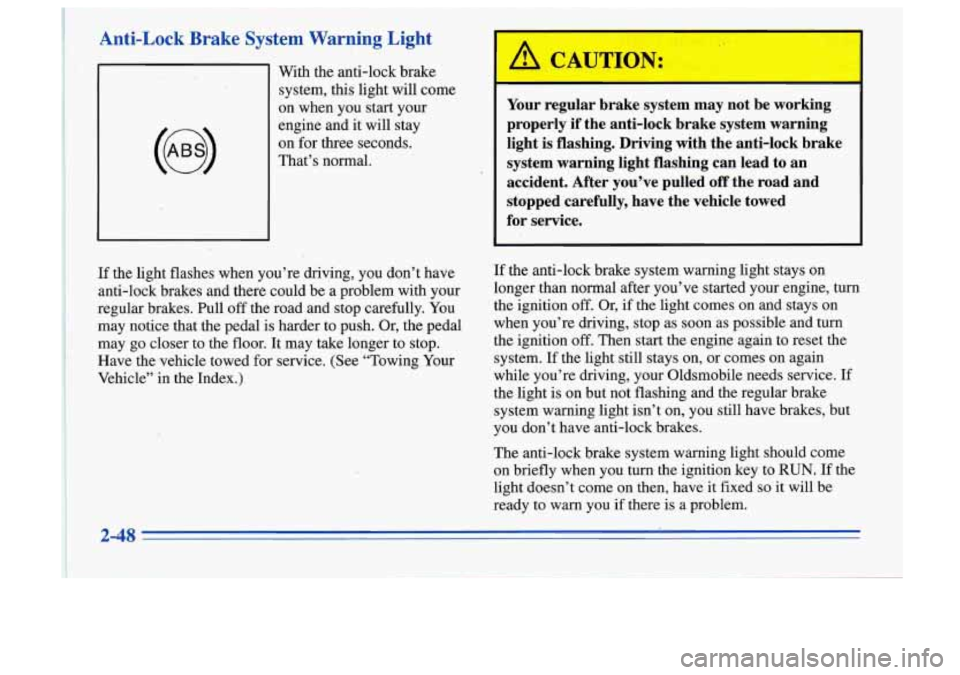
Anti-Lock Brake System Warning Light
With the anti-lock brake system, this light will come
on when you start your
engine and it will stay
on for three seconds.
That’s normal.
If the light flashes when you’re driving, you don’t have
anti-lock brakes and there could be
a problem with your
regular brakes. Pull
off the road and stop carefully. You
may notice that the pedal is harder to push. Or, the pedal
may go closer to the floor. It may take longer to stop.
Vehicle” in the Index.)
, Have the .vehicle towed for service. (See.“Towing Your
Your regular brake system may not be working
properly
if the anti-lock brake system warning
light is flashing. Driving with the anti-lock brake system warning light flashing can lead to an
accident. After you’ve pulled
off the road and
stopped carefully, have the vehicle towed
for service.
If the anti-lock brake system warning light stays on
longer than normal after you’ve started your engine, turn
the ignition
off. Or, if the light comes on and stays on
when you’re driving, stop as soon as possible and turn
the ignition
off. Then start the engine again to reset the
system. If the light still stays on, or comes on again
while you’re driving, your Oldsmobile needs service. If
the light is on but not flashing and the regular brake
system warning light isn’t on, you still have brakes, but
you don’t have anti-lock brakes.
The anti-lock brake system warning light should come
on briefly when you turn the ignition key to
RUN. If the
light doesn’t come on then, have it fixed
so it will be
ready
to warn you if there is a problem.
2-48
Page 109 of 356
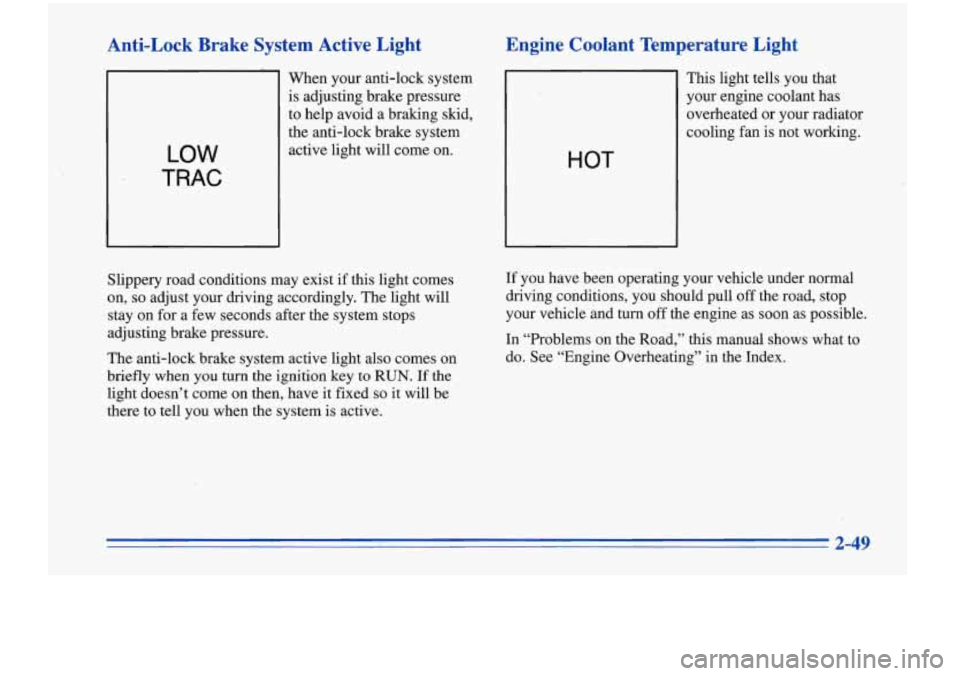
Anti-Lock Brake System Active Light
LOW
TRAC
When your anti-lock system
is adjusting brake pressure
to help avoid a braking skid,
the anti-lock brake system
active light will come
on.
Engine Coolant Temperature Light
HOT
This light tells you that
your engine coolant has
overheated or your radiator
cooling fan is not working.
Slippery road conditions may exist if this light comes
on,
so adjust your driving accordingly. The light will
stay on for a few seconds after the system stops
adjusting brake pressure.
The anti-lock brake system active light also comes on
briefly when you turn the ignition key to RUN. If the
light doesn’t come on then, have
it fixed so it will be
there to
tell you when the system is active. If you
have been operating your vehicle under normal
driving conditions, you should pull
off the road, stop
your vehicle and turn
off the engine as soon as possible.
In “Problems on the Road,” this manual shows what to
do. See “Engine Overheating” in the Index.
2-49