cooling Oldsmobile Cutlass Supreme 1996 Owner's Manuals
[x] Cancel search | Manufacturer: OLDSMOBILE, Model Year: 1996, Model line: Cutlass Supreme, Model: Oldsmobile Cutlass Supreme 1996Pages: 356, PDF Size: 18.48 MB
Page 66 of 356
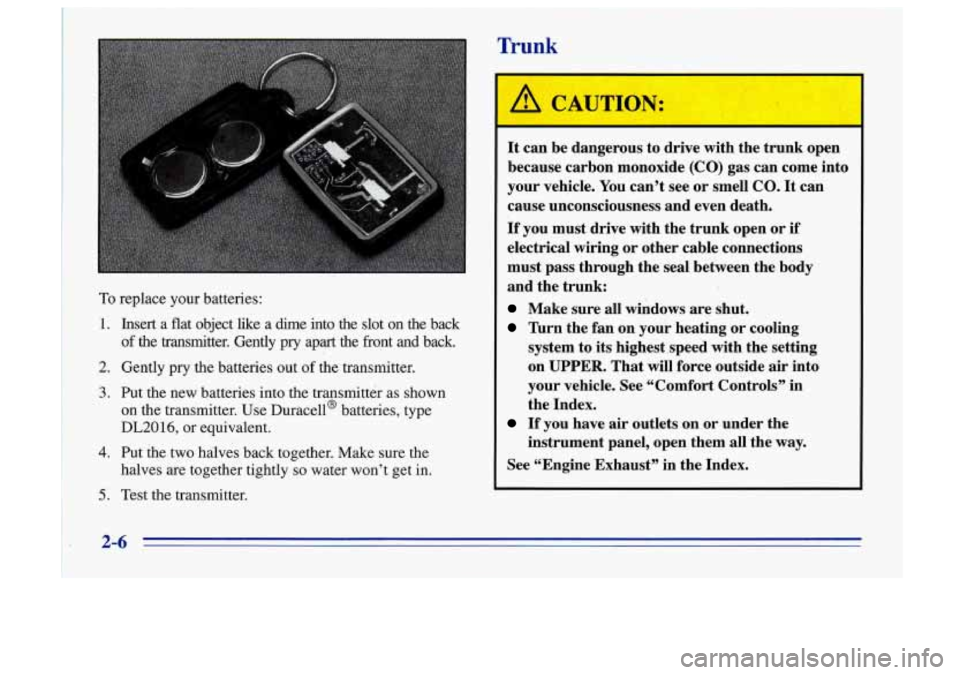
To replace your batteries:
1. . Insert a flat object like a dime into the slot on the back
of the transmitter. Gently pry apart the front and back.
2. Gently pry the batteries out of the transmitter.
3. Put the new batteries into the transmitter as shown
on the transmitter.
Use Duracell@ batteries, type
DL20 16, or equivalent.
4. Put the two halves back together. Make sure the
halves are together tightly
so water won’t get in.
5. Test the transmitter.
Trunk
It can be dangerous to drive with the trunk open
because carbon monoxide (CO) gas
can come into
your vehicle. You can’t see or smell CO.
It can
cause unconsciousness and even death.
If you must drive with the trunk open or if
electrical wiring or other cable connections
must pass through the seal between the body
and the trunk:
Make sure all windows are shut.
Turn the fan on your heating or cooling
system to its highest speed with the setting
on
UPPER. That will force outside air into
your vehicle. See “Comfort Controls” in
the Index.
instrument panel, open them all the way.
If you have air outlets on,or under the
See “Engine Exhaust” in the Index.
Page 109 of 356
Anti-Lock Brake System Active Light
LOW
TRAC
When your anti-lock system
is adjusting brake pressure
to help avoid a braking skid,
the anti-lock brake system
active light will come
on.
Engine Coolant Temperature Light
HOT
This light tells you that
your engine coolant has
overheated or your radiator
cooling fan is not working.
Slippery road conditions may exist if this light comes
on,
so adjust your driving accordingly. The light will
stay on for a few seconds after the system stops
adjusting brake pressure.
The anti-lock brake system active light also comes on
briefly when you turn the ignition key to RUN. If the
light doesn’t come on then, have
it fixed so it will be
there to
tell you when the system is active. If you
have been operating your vehicle under normal
driving conditions, you should pull
off the road, stop
your vehicle and turn
off the engine as soon as possible.
In “Problems on the Road,” this manual shows what to
do. See “Engine Overheating” in the Index.
2-49
Page 119 of 356
Section 3 Comfort Controls and Audio Systems
F- -- -I
In this section you’ll find out how to operate the comfort
control and audio systems offered with your Oldsmobile.
Be sure to read about
the particular systems supplied with
your vehicle.
Comfort Controls
Air Conditioning with Electronic Controls
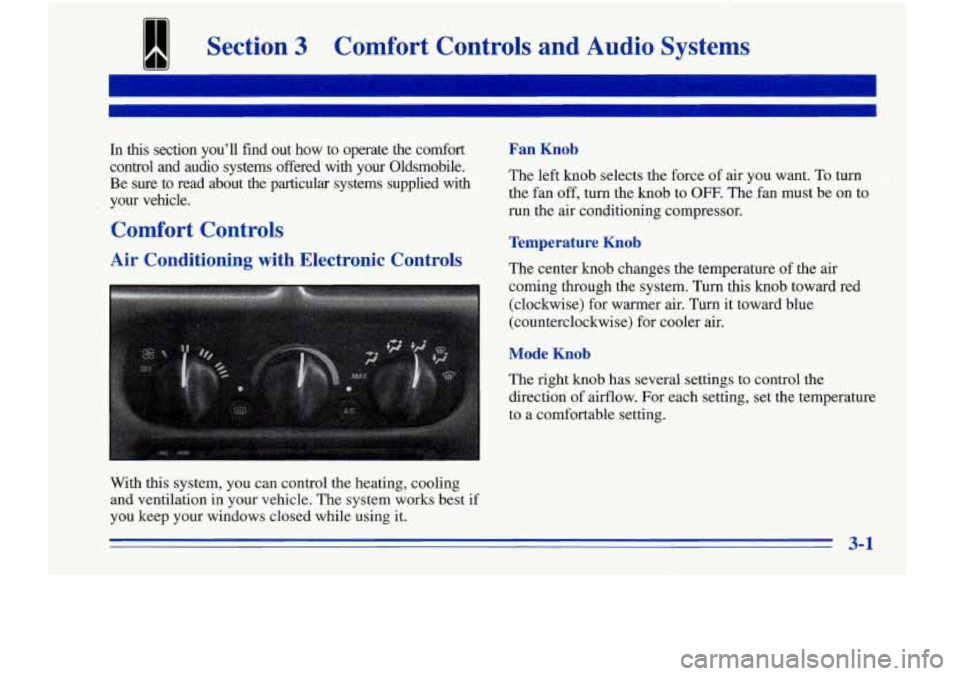
With this system, you can control the heating, cooling
and ventilation in your vehicle. The system works best
if
you keep your windows closed while using it.
Fan Knob
The left knob selects the force of air you want. To turn
the fan off, turn the knob to OFF. The fan must be on to
run the air conditioning compressor.
Temperature Knob
The center knob changes the temperature of the air
coming through the system. Turn this knob toward red (clockwise) for warmer air. Turn it toward blue
(counterclockwise) for cooler air.
Mode Knob
The right knob has several settings to control the
direction of airflow. For each setting, set the temperature
to a comfortable setting.
3-1
Page 121 of 356
Air Conditioning
On very hot days, open the windows long enough to’let
hot, inside air escape. This reduces the time the
compressor has to run, which should help fuel economy.
For quick cool-down on very hot days, use
MAX with
the temperature knob all
the way in the blue area. If this
setting is used for long periods of time, the air in your
vehicle may become too
dry.
For normal cooling on hot days, use VENT with the
temperature knob in the blue area and the A/C button
pushed in. The system will bring in outside air and
cool it.
On cool but sunny days, the sun may warm your upper
body, but your lower body may not be warm enough.
You can use BI-LEVEL with the temperature knob set
for comfort and the A/C button pushed in. The system
will bring in outside air and direct it to your upper body,
while sending slightly warmed air
to your lower body.
You may notice this temperature difference more at
some times than others.
Heating
On cold days, use FLOOR with the temperature knob all
the way in the red area. The system will bring in outside
air, heat it and send it to the floor ducts.
If your vehicle has an engine coolant heater, you can use
it to help your system provide warm air faster when it’s
cold outside (0°F (-18°C) or lower). An engine coolant
heater warms the coolant your engine and heating
system use to provide heat. See “Engine Coolant
Heater” in the Index.
Ventilation
For mild outside temperatures when little heating or
cooling is needed, use VENT to direct outside air
through your vehicle. Your vehicle also has the
flow-through ventilation system described later in
this section.
Defogging and Defrosting
Your system has two settings for clearing the front and
side windows. To defrost the windows quickly, use
DEFROST with the temperature knob all the way in the
red area. To warm passengers while keeping the
windows clean, use DEFOG.
3-3
Page 124 of 356
Manual Control
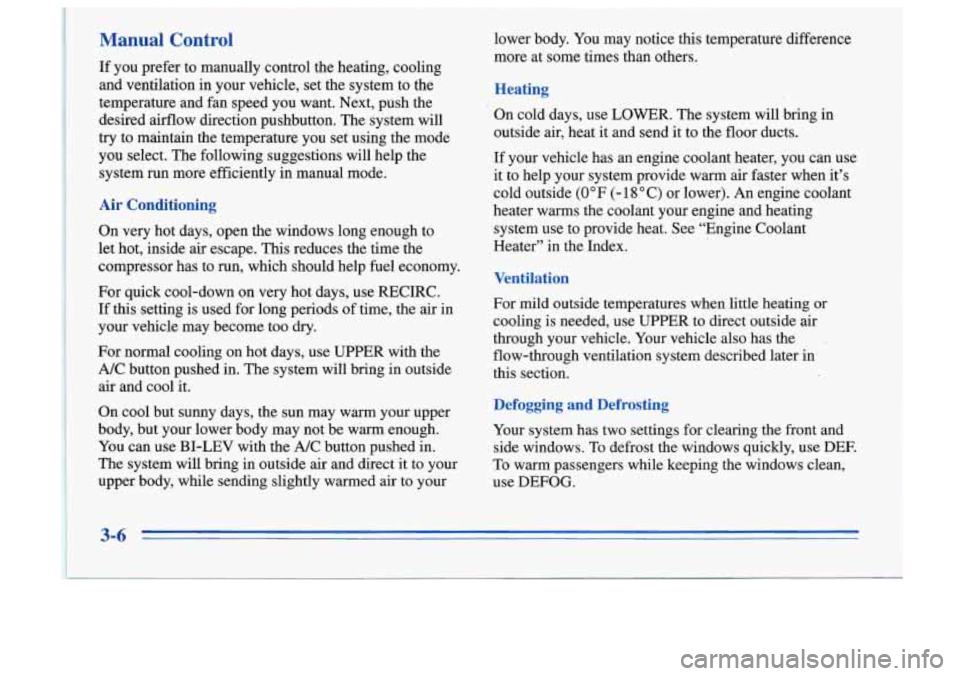
If you prefer to manually control the heating, cooling and ventilation in your vehicle, set the system to the
temperature and fan speed you want. Next, push the
desired airflow direction pushbutton. The system will
try to maintain the temperature you set using the mode
you select. The following suggestions will help the
system run more efficiently in manual mode.
Air Conditioning
On very hot days, open the windows long enough to
let hot, inside air escape. This reduces the time the
compressor has to run, which should help fuel economy.
For quick cool-down on very hot. days, use RECIRC.
If this setting is used for long periods of time, the air
in
your vehicle may become too dry.
For normal cooling on hot days, use UPPER with the
A/C button pushed in. The system will bring in outside
air and cool
it.
Heating
On cold days, use LOWER. The system will bring in
outside air, heat it and send it to the floor ducts.
If your vehicle has an engine coolant heater, you can use
it to help your system provide warm air faster when it’s
cold outside
(0°F (-18°C) or lower). An engine coolant
heater warms the coolant your engine and heating
system use to provide heat. See “Engine Coolant
Heater” in the Index.
Ventilation
For mild outside temperatures when little heating or
cooling is needed, use UPPER to direct outside air
through your vehicle. Your vehicle also has the
.
flow-through ventilation system, described later in
this section.
Defogging and Defrosting
Your system has two settings for clearing the front and
side windows.
To defrost the windows quickly, use DEF.
To warm passengers while keeping the windows clean,
use DEFOG.
On
cool but sunny days, the sun may warm your upper
body, but your lower body may not be warm enough.
You can use
BI-LEV with the A/C button pushed in.
I The system will bring in outside air and direct it to your
upper body, while sending slightly warmed air
to your
3-6
Page 183 of 356
When You Are Ready to Leave After
Parking on a Hill
1. Apply your regular brakes and hold the pedal down
while you:
Start your engine;
Shift into a gear; and
Release the parking brake.
2. Let up on the brake pedal.
3. Drive slowly until the trailer is clear of the chocks.
4. Stop and have someone pick up and store the chocks.
Maintenance When Trailer Towing
Your vehicle will need service more often when you’re
pulling a trailer. See the Maintenance Schedule
for more
on
this. Things that are especially important in trailer
operation are automatic transaxle fluid (don’t overfill),
engine oil, belt, cooling system and brake adjustment.
Each of these is covered in this manual, and the Index
will help you find them quickly. If you’re trailering, it’s
a good idea to review these sections before you start
your trip.
Check periodically to see that all hitch nuts and bolts
are tight.
4-35
Page 200 of 356
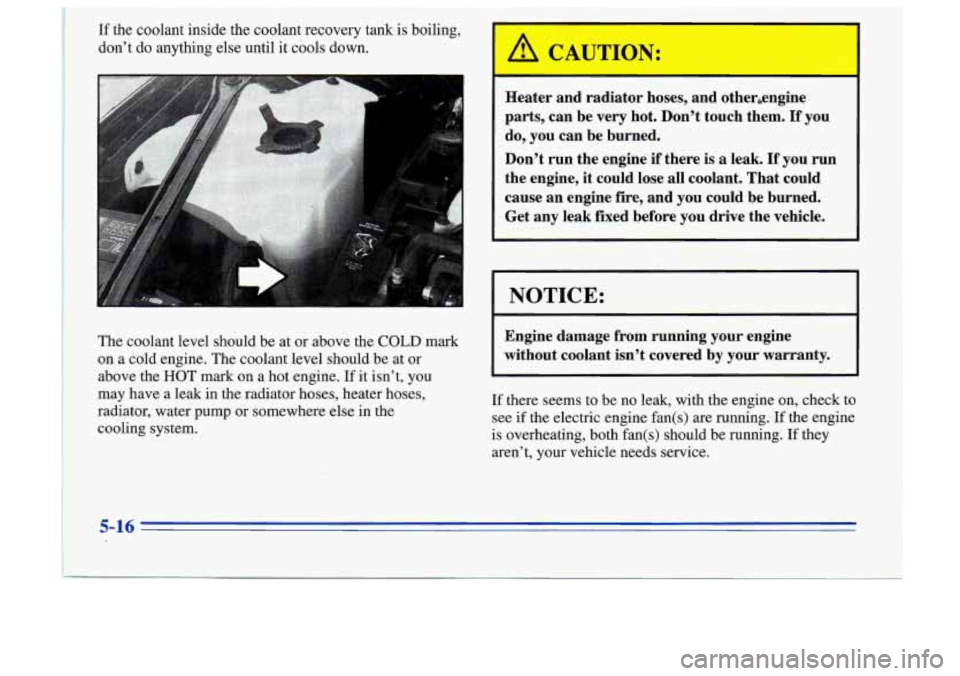
j If the coolant inside the coolant recovery tank is boiling,
don’t do anything
else until it cools down.
.. - ”r -+
Heater and radiator hoses, and otherengine
parts, can be very hot. Don’t touch them.
If you
do, you can be burned.
Don’t run the engine
if there is a leak. If you run
the engine,
it could lose all coolant. That could
cause an engine fiie,
and you could be burned.
Get any leak fixed before you drive the vehicle.
’
I NOTICE:
The coolant level should be at or above the COLD mark
on a cold engine. The coolant level should be at or
above the HOT mark on a hot engine. If it isn’t, you
may have a leak in the radiator hoses, heater hoses,
radiator, water pump or somewhere else in the cooling system.
r
Engine damage from running your engine
without coolant isn’t covered by your warranty.
If there seems to be no leak, with the engine on, check to
see if the electric engine fan(s) are running. If the engine
is overheating, both fan@) should be running; If they
aren’t, your vehicle needs service.
5-16
Page 201 of 356
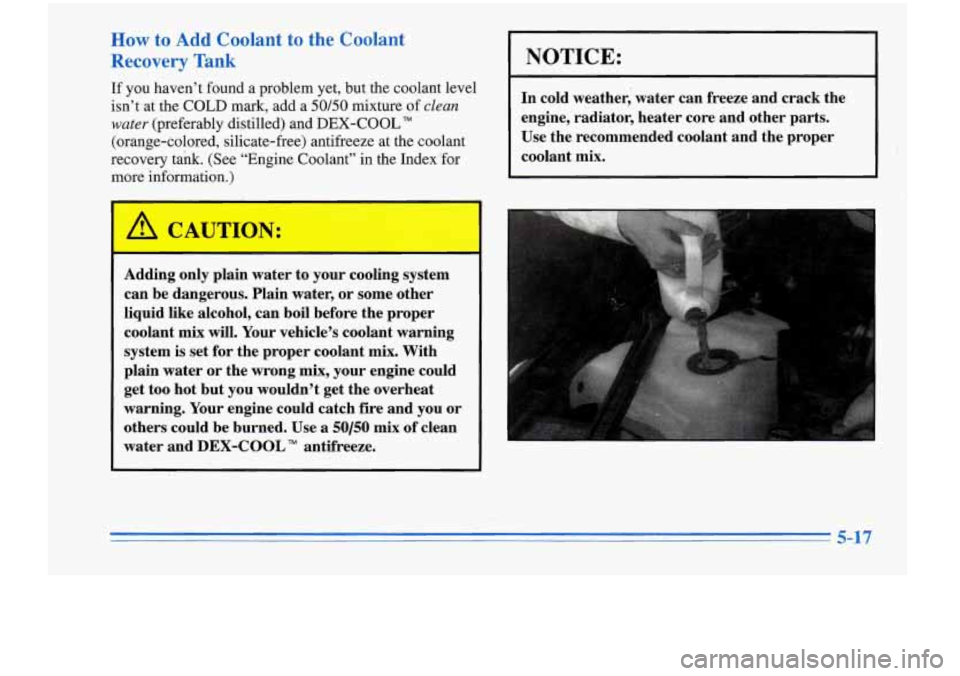
How to Add Coolant to the Coolant
Recovery Tank
If you haven’t found a problem yet, but the coolant level
isn’t at the COLD mark, add a
50/50 mixture of clean
water
(preferably distilled) and DEX-COOL
(orange-colored, silicate-free) antifreeze at the coolant
recovery
tad. (See “Engine Coolant” in the Index ’for
more information.)
I
A CAUTION:
- -
Adding only plain water to your cooling system
can be dangerous. Plain water, or some other
liquid like alcohol, can boil before the proper
coolant mix will. Your vehicle’s coolant warning
system
is set for the proper coolant mix. With
plain water or the wrong, mix, your engine could
get too hot but you wouldn’t get the overheat
warning. Your engine could catch fire and you
or
others could be burned. Use a 50/50 mix of clean
water and
DEX-COOL antifreeze.
NOTICE:
In cold weather, water can freeze and crack the
engine, radiator, heater core and other parts.
Use the recommended coolant and the proper
coolant mix.
5-17
Page 202 of 356
You can be burned if you spill coolant on hot
engine parts. Coolant contains ethylene glycol
and it will burn
if the engine parts are hot
enough. Don’t spill coolant on
a hot engine.
When the coolant
in the coolant recovery tank is at the
COLD mark, start your vehicle.
If the overheat warning continues, there’s one more
thing you can
try. You can add the proper coolant mix
directly to the radiator, but be sure the cooling system is
cool before you
do it.
I
I
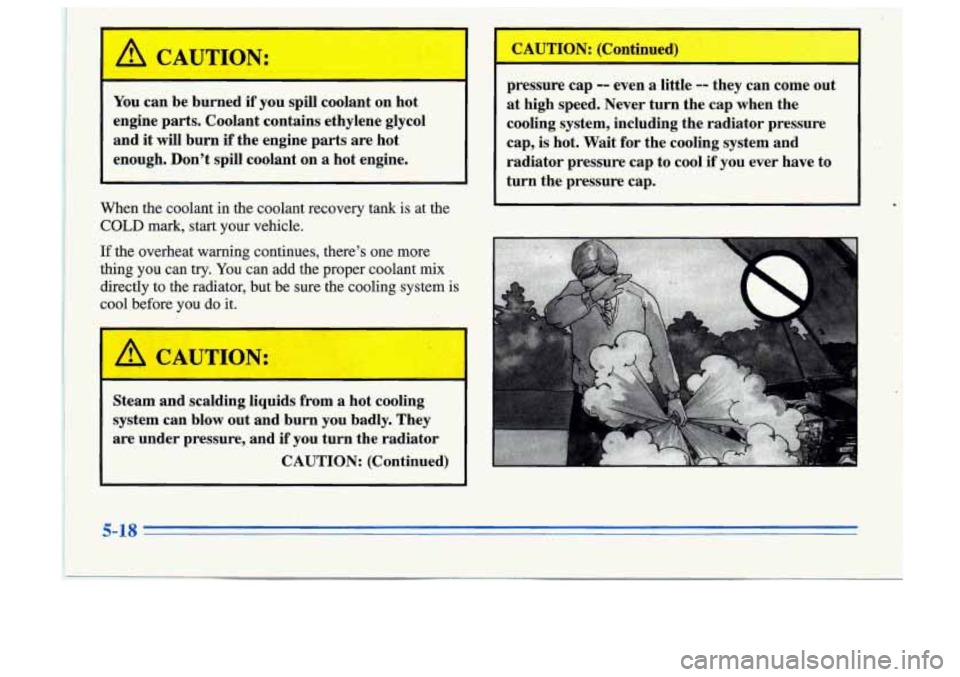
Steam and scalding liquids from a hot cooling
system can blow out and burn you badly. They
are under pressure, and if you turn the radiator
CAUTION: (Continued) pressure cap
-- even a little -- they can
come out
at high speed. Never turn the cap when the
cooling system, including the radiator pressure
cap, is hot. Wait for the cooling system and
radiator pressure cap to cool if you ever have to
turn the pressure cap.
5-18
i
Page 203 of 356
How to Add Coolant to the Radiator
I NOTICE:
Your engine has a specific radiator fill procedure.
Failure to follow this procedure could cause your
engine to overheat and be severely damaged.
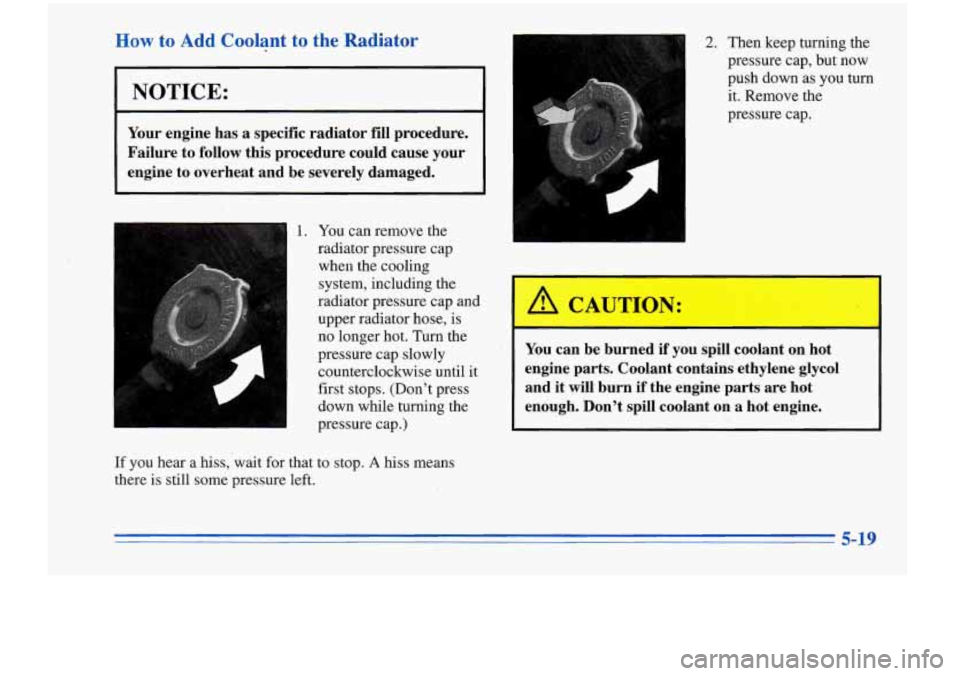
1. You can remove the
radiator pressure cap
when the cooling
system, including the
radiator pressure cap and
upper radiator hose, is
no longer hot. Turn the
pressure cap slowly
counterclockwise until it
first stops. (Don’t press
down while turning the
pressure cap.)
If you hear a hiss, wait for that to stop. A hiss means
there is still some pressure left.
2. Then keep turning the
pressure cap, but now
push down as you turn
it. Remove the
pressure cap.
1 CAUTIO
You can be burned if you spill coolant on hot
engine parts. Coolant contains ethylene glycol
and it
will burn if the engine parts are hot
enough. Don’t spill coolant on a hot engine.
5-19