engine oil Oldsmobile Cutlass Supreme 1996 Owner's Manuals
[x] Cancel search | Manufacturer: OLDSMOBILE, Model Year: 1996, Model line: Cutlass Supreme, Model: Oldsmobile Cutlass Supreme 1996Pages: 356, PDF Size: 18.48 MB
Page 7 of 356
J
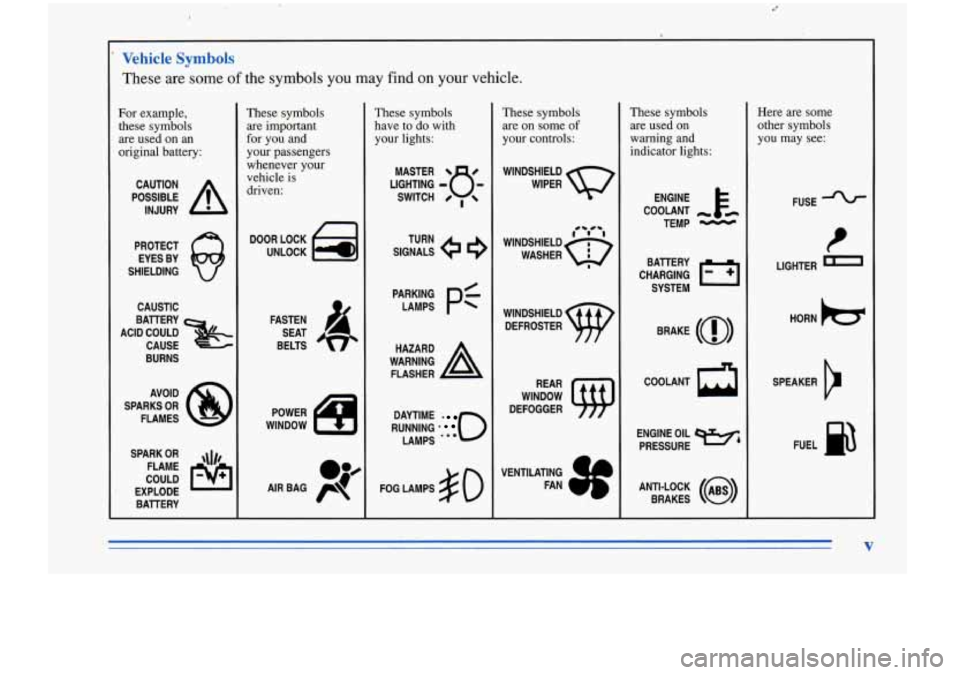
Vehicle Symbols
These are some of the symbols you may find on your vehicle.
For example, these symbols
are used on an
original battery:
POSSIBLE A
CAUTION
INJURY
PROTECT EYES BY
SHIELDING
Q
CAUSTIC
BURNS AVOID
SPARKS
OR
FLAMES
SPARK
OR ,\I/,
COULD FLAME
EXPLODE BAllERY
These symbols are important
for you and
your passengers
whenever your
vehicle is
driven:
UNLOCK w.
FASTEN
SEAT
BELTS
POWER
WINDOW
These symbols
have to do with
your lights:
SIGNALS e e3
TURN
RUNNING
* 0
DAYTIME
LAMPS
FOG LAMPS
# 0
These symbols
are on some
of
your controls:
WINDSHIELD
WIPER
WINDOW
DEFOGGER
These symbols are used on
warning and
indicator lights:
COOLANT
TEMP
-
CHARGING I-1
BAllERY
SYSTEM
BRAKE
(a)
COOLANT a
ENGINE OIL w,
PRESSURE
ANTI-LOCK
(@)
BRAKES
Here are some
other symbols
you may see:
FUSE
LIGHTER
m
HORN )tr
SPEAKER
I@
FUEL la
Page 73 of 356
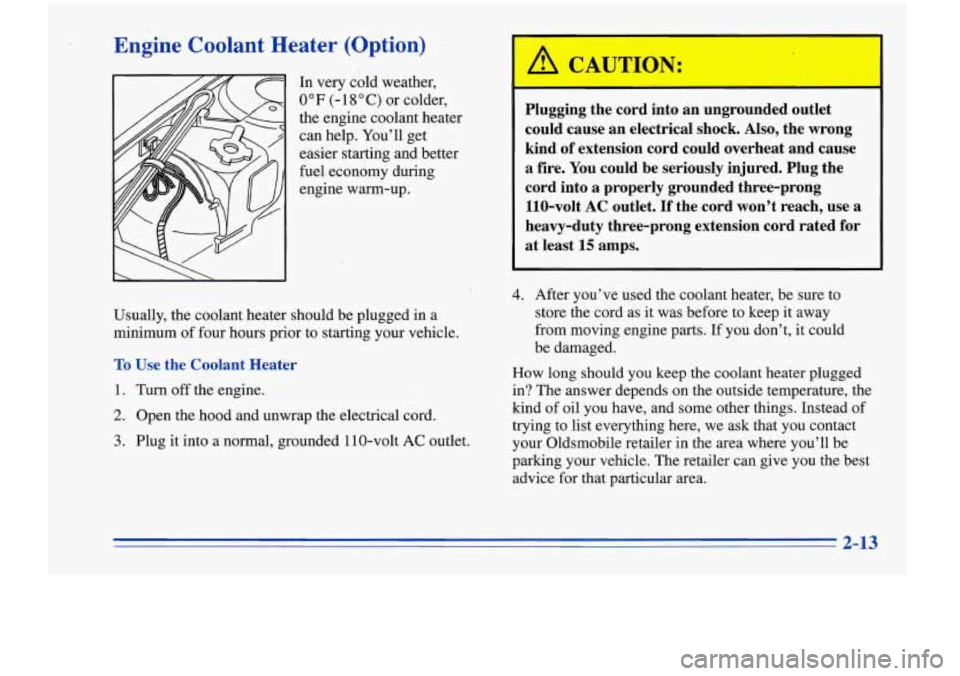
Yneine Coolant Heater (Option)
In very cold weather,
0°F (- 18 O C) or colder,
the engine coolant heater
can help. You’ll get
I
easier starting and better
fuel economy during
engine warm-up.
A CAUTION:
Plugging the
could cause an electrical shock. Also, the wrong
kind
of extension cord could overheat and cause
a fire.
You could be seriously injured. Plug the
cord into a properly grounded three-prong
110-volt AC outlet.
If the cord won’t reach, use a
heavy-duty three-prong extension cord rated for
at least 15 amps.
Usually, the coolant heater should be plugged in a
minimum of four hours prior to starting your vehicle.
To Use the Coolant Heater
1. Turn off the engine.
2. Open the hood and unwrap the electrical cord.
3. Plug it into a normal, grounded 110-volt AC outlet.
4. After you’ve used the coolant heater, be sure to
store the cord as it was before to keep it away
from moving engine parts.. If you don’t, it could
be damaged.
How long should you keep the coolant heater plugged
in? The answer depends on the outside temperature, the
kind of oil you have, and some other things. Instead of
trying
to list everything here, we ask that you contact
your Oldsmobile retailer in the area where you’ll be
parking your vehicle. The retailer can give you the best
advice for that particular area.
Page 113 of 356
Have you recently changed brands of fuel?
If so, be sure to fuel your vehicle with quality fuel (see
“Fuel” in the Index). Poor fuel quality will cause your
engine not to run as efficiently as designed. You may
notice this as stalling after start-up, stalling when you
put the vehicle into gear, misfiring, hesitation on
acceleration or stumbling on acceleration. (These
conditions may go away once the engine
is warmed up.)
This will be detected by the system and cause
the light
to turn on.
If you experience
this condition, change the fuel brand
you use.
It will require at least one full tank of the
proper fuel to turn the light
off.
If none of the above steps have made the light turn off,
have your retailer or qualified service center check the
vehicle. Your retailer has the proper test equipment and
diagnostic tools to fix any mechanical or electrical
problems that may have developed.
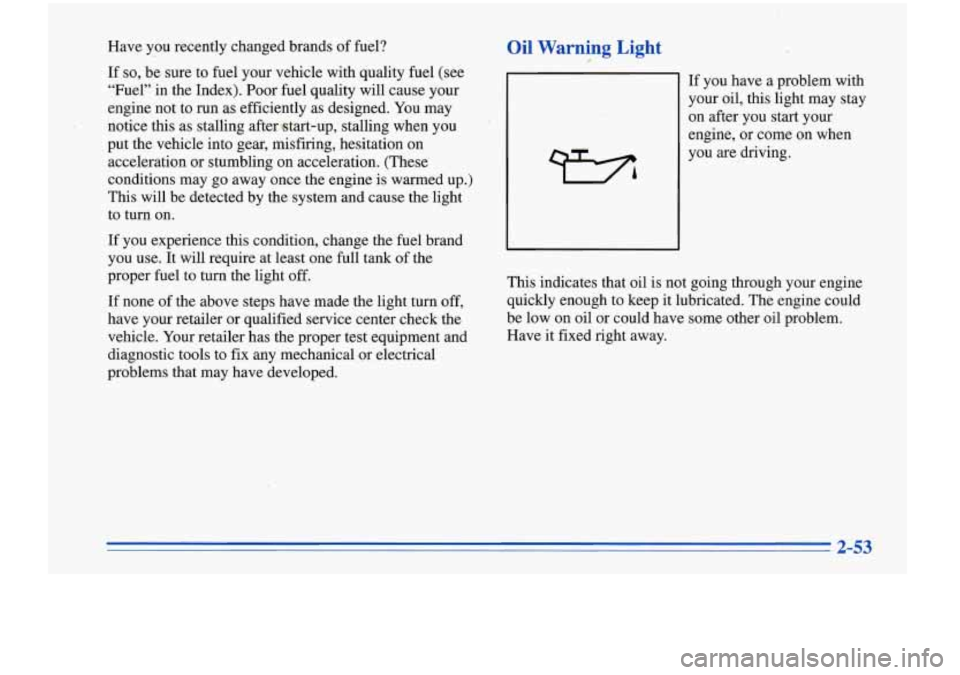
Oil Warning Light c
If you have a problem with
your oil, this light may stay
on after you start your
engine, or come on when
you are driving.
This indicates that oil is not going through your engine
quickly enough to keep it lubricated. The engine could
be low on oil or could have some other oil problem.
Have it fixed right away.
2-53
Page 114 of 356
I
0
0
When the ignition is on but the engine is not running,
the light will come on as a test to show you it is
working, but the light will go out when you turn the
ignition to
START. If it doesn’t come on with the
ignition on, you may have a problem with the fuse or
bulb. Have it fixed right away.
If you make a hard
stop, the light may come on for a
moment. This is normal.
A
I
Don’t keep driving if the oil pressure is low. If
you do, your engine can become so hot that it
catches fire.
You or others could be burned.
Check your oil as soon
as possible and have your
vehicle serviced.
I NOTICE:
Damage to your engine from neglected oil
problems can be costly and is not covered by
your warranty.
Page 115 of 356
-. In . .,>
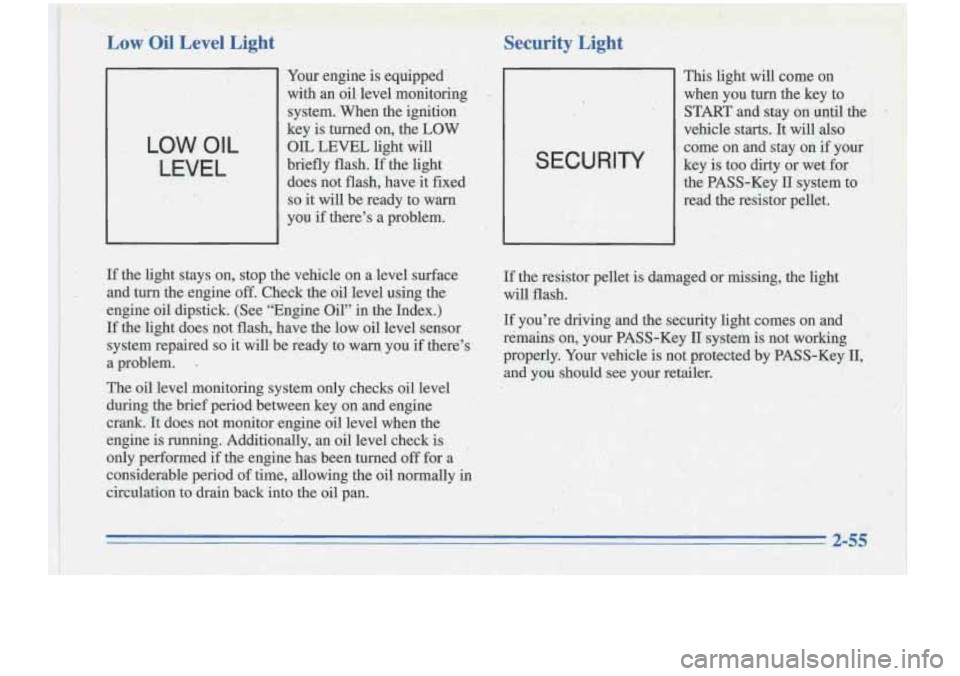
Low'Oil Level Eight
LOW OIL
LEVEL
Your engine is equipped
with an oil, level monitoring
system. When the i,gnition
key is turned on, the
LOW
OIL LEVEL light will
briefly flash.
If the light .
.does not flash, have it fixed
so it will be ready to warn
you if there's a problem.
.' only performed if the engine has been turned off for a '
, . considerable period of time, allowing the oil normally in .. circulation to drain back into-the oil pan.
,\' .. ,.
Security Light
SEC.URITY
1 i
I
This light will come on
when
you turn the key to i
START and st.ay on until the '. i
vehicle starts. .It will also I
come on and stay on if your i
key is too dirty or wet,.for
the PASS-Key
11 system to ~
I I
I I
read the resistor pellet.
I
If the resistor pellet is damaged or missing, the light
will 'flash.
If' you're driving and the security light comes on and
remains on; your PASS-Key
11 system is not working
properly. Your vehicle is not protected. by PASS-Key
11, ..
and you should see your retailer.
..
Page 168 of 356
Just before you leave the lane, glance quickly over your
shoulder to make sure there isn’t another vehicle in your
“blind” spot.
Once you are moving on the freeway, make certain you
allow a reasonable following distance. Expect to move
slightly slower at night.
When you want to leave the freeway, move to the proper
lane well in advance.
If you miss your exit, do not,
under any circumstances, stop and back up. Drive on to
the next exit.
The exit ramp can be curved, sometimes quite sharply.
The exit speed is usually posted.
Reduce your speed according to your speedometer, not
to your sense of motion. After driving for any distance
at higher speeds, you may tend to think you
are going
slower than you actually are.
I !
Before Leaving on a Long Trip
Make sure you’re ready. Try to be well rested. If you
must start when you’re not fresh
-- such as after a day’s
work
-- don’t plan to make too many miles that first part
of the journey. Wear comfortable clothing and shoes you
can easily drive in. Is
your vehicle ready for a long trip? If you keep it
serviced and maintained, it’s ready to
go. If it needs
service, have it done before starting out. Of course,
you’ll find experienced and able service experts in Oldsmobile retail facilities all across North America.
They’ll be ready and willing to help if you need it.
Here are some things you can check before
a trip:
0 Windshield Washer Fluid: Is the reservoir full? Are
all windows clean inside and outside?
Wiper Blades: Are they in good shape?
Fuel, Engine Oil, Other Fluids: Have you checked
all levels?
0 Lamps: Are they all working? Are the lenses clean?
0 Tires: They are vitally important to a safe,
trouble-free trip.
Is the tread good enough for
long-distance driving?
Are the tires all inflated to the
recommended pressure?
along your route? Should you delay your trip a short
time to avoid a major storm system?
0 Weather Forecasts: What’s the weather outlook
Maps: Do you have up-to-date maps?
4-20
Page 183 of 356
When You Are Ready to Leave After
Parking on a Hill
1. Apply your regular brakes and hold the pedal down
while you:
Start your engine;
Shift into a gear; and
Release the parking brake.
2. Let up on the brake pedal.
3. Drive slowly until the trailer is clear of the chocks.
4. Stop and have someone pick up and store the chocks.
Maintenance When Trailer Towing
Your vehicle will need service more often when you’re
pulling a trailer. See the Maintenance Schedule
for more
on
this. Things that are especially important in trailer
operation are automatic transaxle fluid (don’t overfill),
engine oil, belt, cooling system and brake adjustment.
Each of these is covered in this manual, and the Index
will help you find them quickly. If you’re trailering, it’s
a good idea to review these sections before you start
your trip.
Check periodically to see that all hitch nuts and bolts
are tight.
4-35
Page 200 of 356
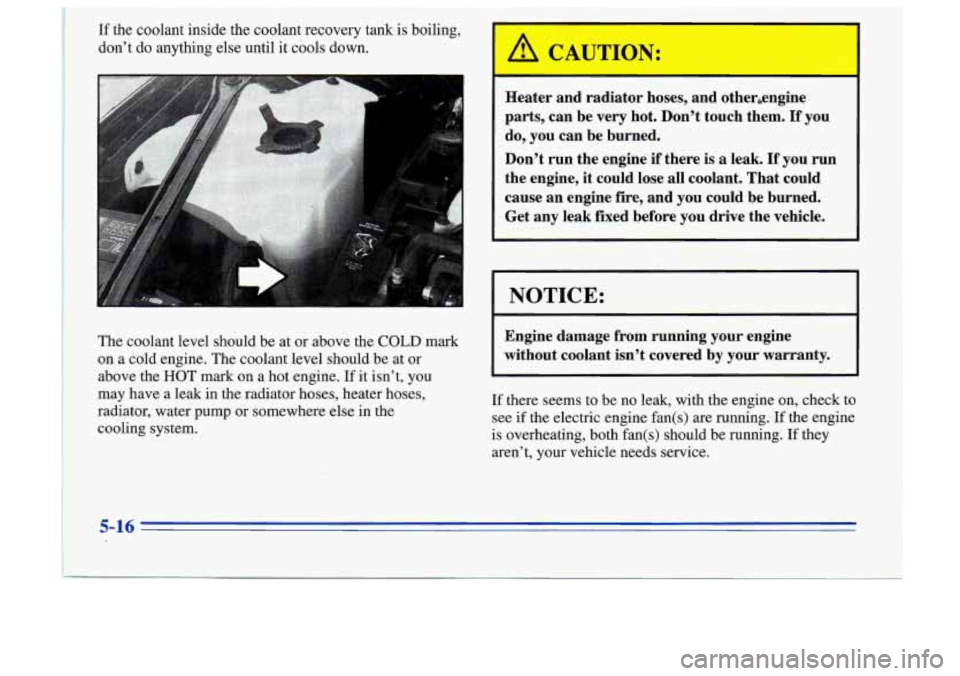
j If the coolant inside the coolant recovery tank is boiling,
don’t do anything
else until it cools down.
.. - ”r -+
Heater and radiator hoses, and otherengine
parts, can be very hot. Don’t touch them.
If you
do, you can be burned.
Don’t run the engine
if there is a leak. If you run
the engine,
it could lose all coolant. That could
cause an engine fiie,
and you could be burned.
Get any leak fixed before you drive the vehicle.
’
I NOTICE:
The coolant level should be at or above the COLD mark
on a cold engine. The coolant level should be at or
above the HOT mark on a hot engine. If it isn’t, you
may have a leak in the radiator hoses, heater hoses,
radiator, water pump or somewhere else in the cooling system.
r
Engine damage from running your engine
without coolant isn’t covered by your warranty.
If there seems to be no leak, with the engine on, check to
see if the electric engine fan(s) are running. If the engine
is overheating, both fan@) should be running; If they
aren’t, your vehicle needs service.
5-16
Page 201 of 356
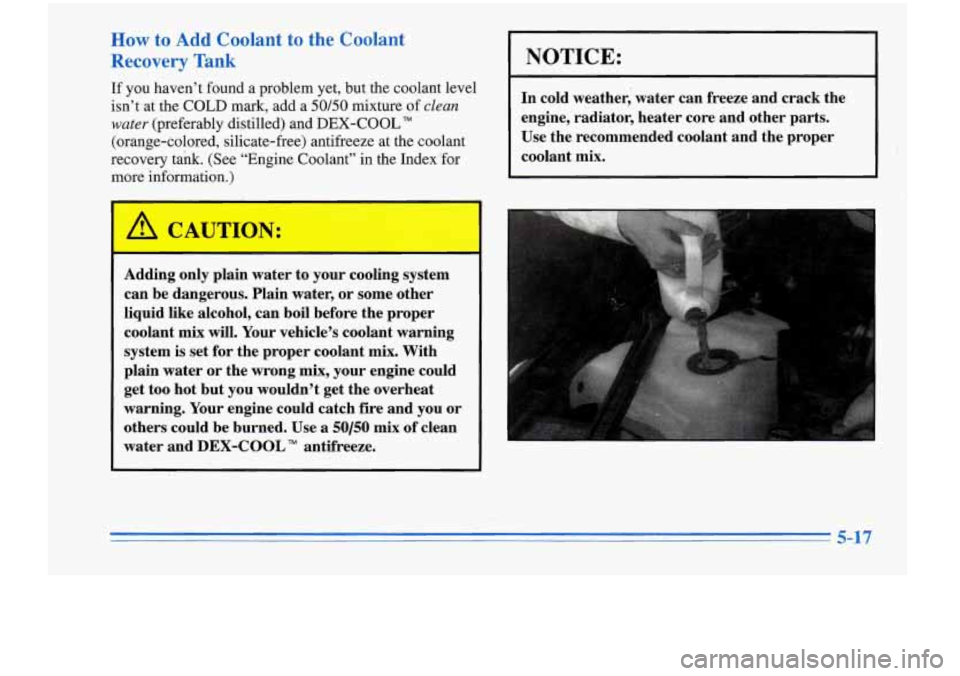
How to Add Coolant to the Coolant
Recovery Tank
If you haven’t found a problem yet, but the coolant level
isn’t at the COLD mark, add a
50/50 mixture of clean
water
(preferably distilled) and DEX-COOL
(orange-colored, silicate-free) antifreeze at the coolant
recovery
tad. (See “Engine Coolant” in the Index ’for
more information.)
I
A CAUTION:
- -
Adding only plain water to your cooling system
can be dangerous. Plain water, or some other
liquid like alcohol, can boil before the proper
coolant mix will. Your vehicle’s coolant warning
system
is set for the proper coolant mix. With
plain water or the wrong, mix, your engine could
get too hot but you wouldn’t get the overheat
warning. Your engine could catch fire and you
or
others could be burned. Use a 50/50 mix of clean
water and
DEX-COOL antifreeze.
NOTICE:
In cold weather, water can freeze and crack the
engine, radiator, heater core and other parts.
Use the recommended coolant and the proper
coolant mix.
5-17
Page 224 of 356
To provide cleaner air, all gasolines are now required to
contain additives that will help prevent deposits from
forming in your engine and fuel system, allowing your
emission control system to function properly. Therefore,
you should not have to add anything to the fuel. In
addition, gasolines containing oxygenates, such as
ethers and ethanol, and reformulated gasolines may
be available in your area to help clean the air. General
Motors recommends that you use these gasolines if they
comply with the specifications described earlier.
NOTICE: ~~
Your vehicle was not designed for fuel that
contains methanol. Don’t use it. It can corrode
metal parts in your fuel system and also damage
plastic and rubber parts. That damage wouldn’t
be covered under your warranty.
Fuels in Foreign Countries
If you plan on driving in another country outside the
United States or Canada, the proper fuel may be hard
to find. Never use leaded gasoline
or any other fuel not
recommended in the previous text on fuel. Costly repairs
caused by use of improper fuel wouldn’t be covered by
your warranty.
To check on fuel availability, ask an auto club, or
contact a major oil company that does business in the
country where you’ll be driving.
You can also write us at the following address for
advice. Just tell us where you’re going and give your
Vehicle Identification Number (VIN).
General Motors Overseas Distribution Corporation,
North American Export Sales (NAES)
1908 Colonel Sam Drive
Oshawa, Ontario
L1H 8P7
6-4