engine OLDSMOBILE SILHOUETTE 1993 User Guide
[x] Cancel search | Manufacturer: OLDSMOBILE, Model Year: 1993, Model line: SILHOUETTE, Model: OLDSMOBILE SILHOUETTE 1993Pages: 323, PDF Size: 17.13 MB
Page 67 of 323
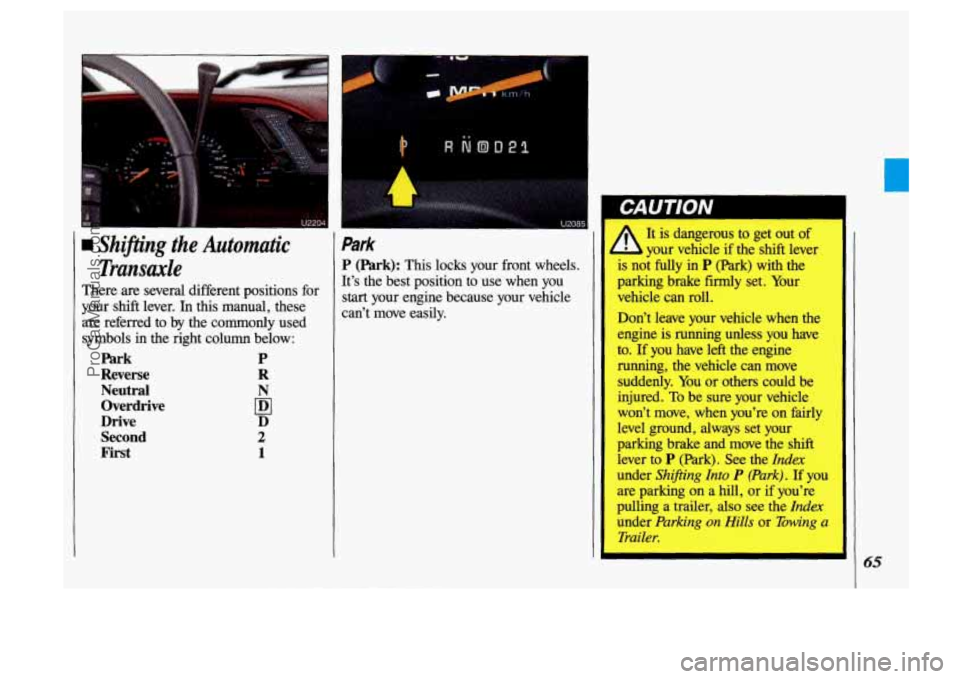
Sh#ting the Automatic
Tranm.de
There are several different positions for
your shift lever.
In this manual, these
are referred
to by the commonly used
symbols
in the right column below:
Park P
Reverse R
Neutral
Overdrive
&
Drive D
Second 2
First 1
Park
P (Park): This locks your front wheels.
It's the best position to use when you
start your engine because your vehicle
can't move easily. It
is dangerous to get out of
A your vehicle if the-shift lever
1s not fully in P (Park) with the
parking brake firmly set. Your
vehicle can roll.
Don't leave your vehicle when the
engine is running unless you have
to.
If you have left the engine
running, the vehicle can move suddenly. You or others could be
injured.
To be sure your vehicle
won't move, when you're on fairly
level ground, always set your
parking brake and move the shift lever to
P (Park). See the Index
under Shifting Into P (Park). If you
are parking
on a hill, or if you're
pulling a trailer, also see the
Index
under Parking on Hills or Towing a
Trailer.
ProCarManuals.com
Page 68 of 323
Features & Controls
66
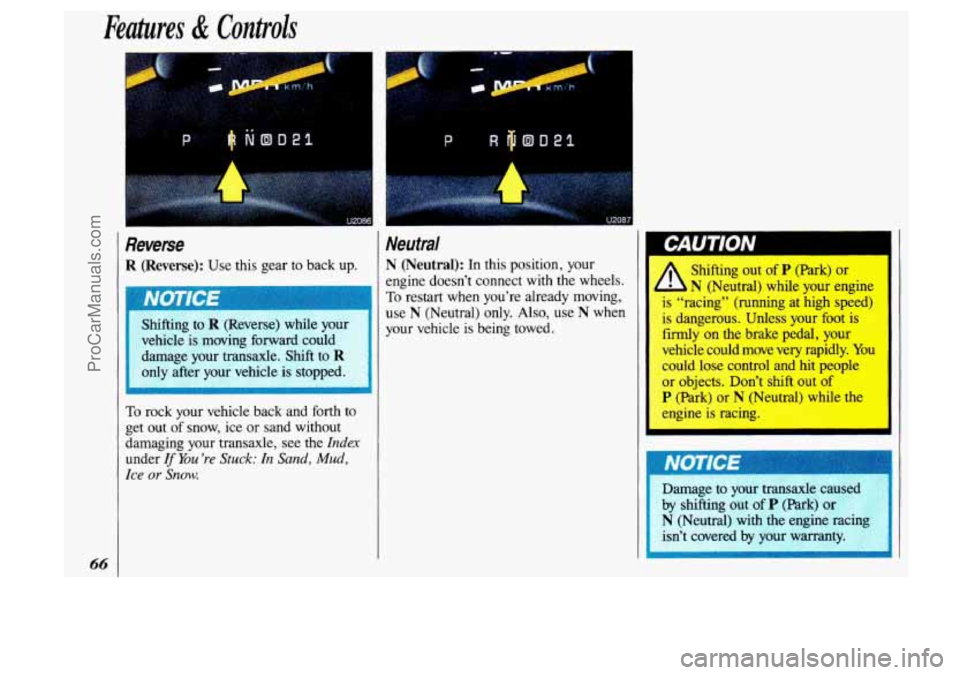
Reverse
R (Reverse): Use this gear to back up.
To rock your vehicle back and forth to
get out
of snow, ice or sand without
damaging your transaxle, see the
Index
under If You 're Stuck: In Sand, Mud,
Ice or Snow.
Neutral
N (Neutral): In this position, your
engine doesn't connect with the wheels.
To restart when you're already moving,
use
N (Neutral) only. Also, use N when
your vehicle
is being towed.
A
Shifting out of P (Park) or
N (Neutral) while your engine
is "racing" (running at high speed'
is dangerous. Unless your foot
is
firmly on the brake pedal, your
vehicle could move
very rapidly. You
could lose control and hit people
or objects. Don't shift out of
P (Park) or N (Neutral) while the
engine is racing.
~~
I;
: Damage to your transde.caused
by shifting out of P (Park) 0:
N (Neutral) with the engine racing
isn't covered
by your warranty.
ProCarManuals.com
Page 69 of 323
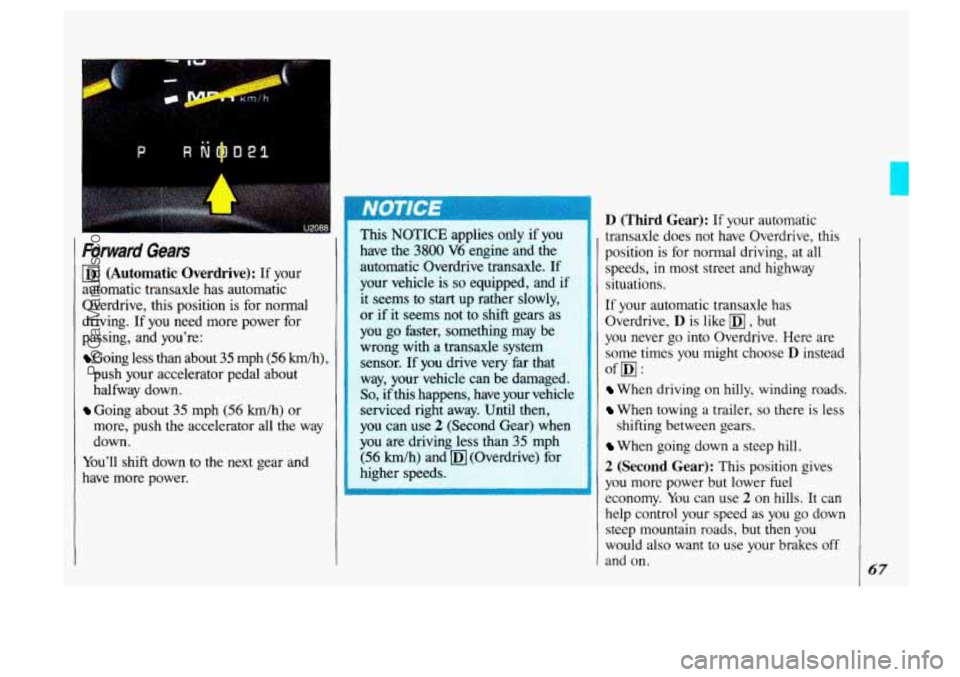
Fonvard Gears
(DI (Automatic Overdrive): If your
automatic transaxle has automatic
Overdrive, this position is for normal
driving.
If you need more power for
passing, and you’re:
Going less than about 35 mph (56 km/h),
push your accelerator pedal about
halfway down.
Going about 35 mph (56 km/h) or
more, push the accelerator all the way
down.
You’ll shift down to the next gear and
have more power. have
the
3.800 V6-engine and the
automatic Overdrive transaxle. If
your vehicle
is so equipped, and if
it seems to
start up rather slowly,
or if it seems not to shift gears as
you go faster, something may be
wrong with a transaxle system
sensor. If you drive very far that
way, your vehicle can be damaged.
So, if this happens, have your vehicle
serviced right away. Until then,
you can use
2 (Second Gear) when
you are driving less than
35 mph
(56 km/h) and (Overdrive) for
higher speeds? . --~ :~~~ - ~ , ~~. =-== ~~ ~=~ ~ .=- .~ ~..~ ..~... .~.= ~~ . .. .. .. ..
D (Third Gear): If your automatic
transaxle does not have Overdrive, this
position is for normal driving, at all
speeds, in most street and highway
situations.
If your automatic transaxle has
Overdrive,
D is like , but
you never go into Overdrive. Here are
some times you might choose
D instead
When driving on hilly, winding roads.
When towing a trailer, so there is less
When going down a steep hill.
2 (Second Gear): This position gives
you more power but lower fuel
economy. You can use
2 on hills. It can
help control your speed as you go down
steep mountain roads, but
then you
would also want to use your brakes off
and on.
ofH:
shifting between gears.
67
ProCarManuals.com
Page 70 of 323
Features & Controls
68
more than 5 miles (8 km), or at
speeds over
55 mph (88 km/h), or
you
can damage your transaxle. Use
: D (m or D if your vehicle has
Overdrive) as much
as possible.
Don’t shift into
2 unless you are
going slower than 65 mph
(105 km/h), or you can damage
your engine.
1 (First Gear): This position gives you
even more power (but lower fuel
economy) than
2. You can use it on very
steep hills, or in deep snow or mud.
If
the selector lever is put in 1, the
transaxle won’t shift into first gear until
the vehicle is going slowly enough.
If your front wheels can’t rotate,
don’t try
to drive. This might
happen if you were stuck in very
deep sand or mud or were up
against a solid object.
You could
damage your transaxle.
Also, if you stop when going
uphill, don’t hold your vehicle
there with only the accelerator
pedal. This could overheat and
damage the transaxle. Use your
brakes or shift into
P (Park) to
hold your vehicle
in position on a
hill.
Parking Brake
To Set the Parking Brake:
Hold the regular brake pedal down with
your right
foot. Push down the parking
brake pedal with your left foot.
If the
ignition is on, the brake system warning
light will come on. See the
Index under
Brake System Warning Light.
ProCarManuals.com
Page 71 of 323
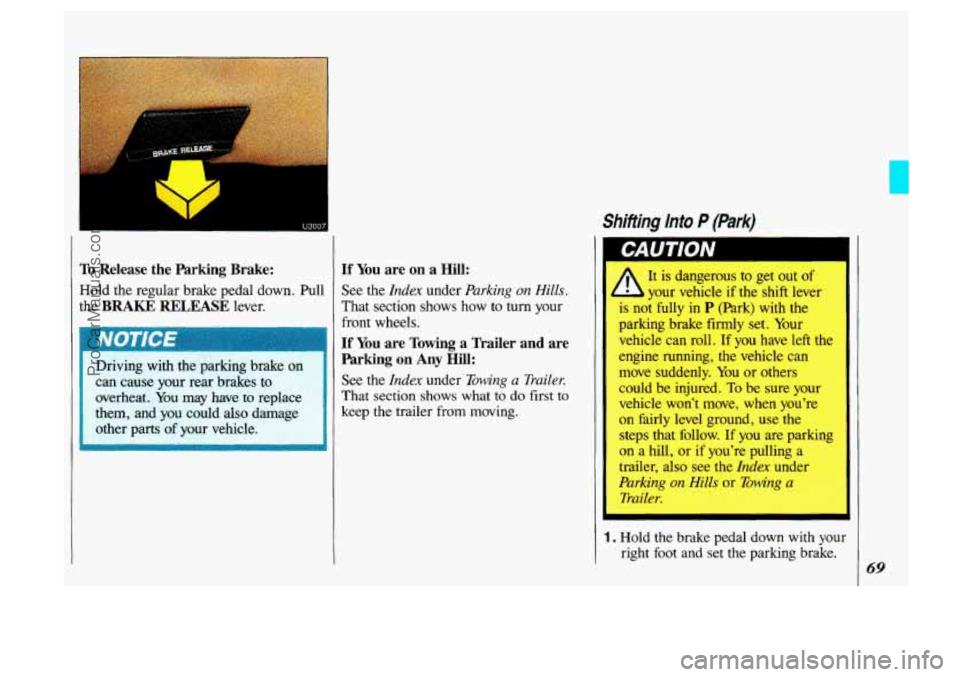
To Release the Parking Brake:
Hold the regular brake pedal down. Pull
the BRAKE RELEASE lever.
Driving with the parking brake
on
can cause your rear brakes to
overheat. You may have to replace
them, and you could also damage
i other parts of your vehicle. .. , m
If You are on a Hill:
See the Index under Parking on Hills.
That section shows how to turn your
front wheels.
If You are Towing a Trailer and are
Parking on Any Hill:
See the Index under Towing a Trailer.
That section shows what to do first to
keep the trailer
from moving.
Shiithg Into P (Park)
1
A
It is dangerous to get out 01
your vehicle if the shift lever
is not fully in
P (Park) with the
parking brake
firmly set. Your
vehicle can roll. If you have left
engine running, the vehicle can
move suddenly. You or others
could be injured.
To be sure your
vehicle won't move, when you're
on fairly level ground, use the
steps that follow.
If you are parking
on a hill,
or if you're pulling a
trailer, also see the Index under
Parking on Hills or Towing a
Trailer.
I
1. Hold the brake pedal down with your
right
foot and set the parhng brake.
69
ProCarManuals.com
Page 72 of 323
Features & Controls
I
Shifting Info P (Park) (CONI)
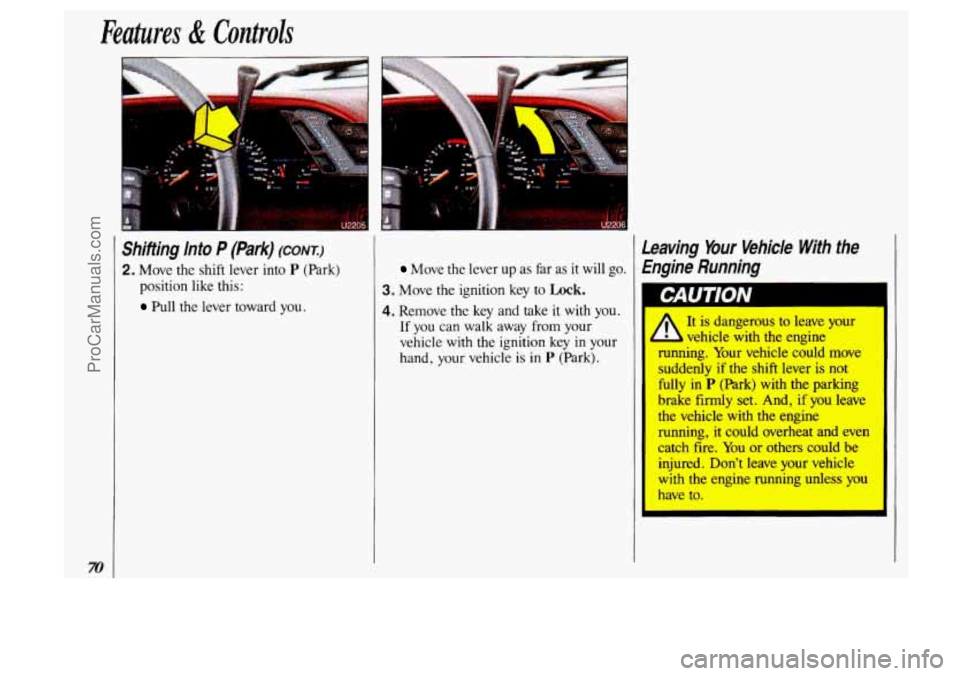
2. Move the shift lever into P (Park)
position like this:
Pull the lever toward you.
Leaving Your Vehicle With the
Move the lever up as far as it will go. Engine Running
3. Move the ignition key to Lock.
4. Remove the key and take it with you. I
If you can walk away from your
vehicle with the ignition key in yc
hand, your vehicle
is in P (Park).
1 CAUTION
ProCarManuals.com
Page 73 of 323
Engine Exhaust
If you have to leave your vehicle with
the engine
running, be sure your vehicle
is
in P (Park) and your parking brake is
firmly set before you leave it. After
you've moved the
shift lever into the P
(Park) position, hold the regular brake
pedal down. Then, see
if you can move
the shift lever away from
P (Park)
without first pulling
it toward you.
If you can, it means that the shift lever
wasn't fully locked into
P (Park).
I /.<*-- -+--,sa
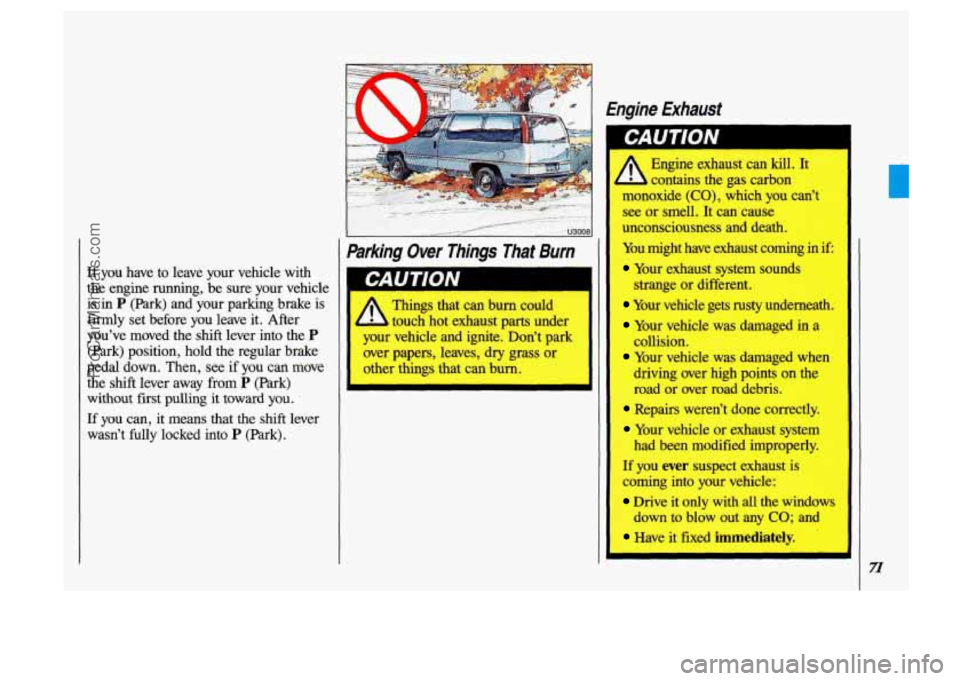
Parking Over Things That Burn
Things that can burn could
touch hot exhaust
parts under I
A
Engine exhaust can kill. It
contains the gas carbon
monoxide
(CO), which you can't
see or smell. It can cause
unconsciousness and death.
You might have exhaust coming
in if
Your exhaust system sounds
strange or different.
1 I Your vehicle gets rusty underneath.
, Your vehicle was damaged in a
your vehicle and ignite: Don't park collision.
over
papers, leaves, dry grass or Your vehicle was damaged when
other things that can burn. driving over high points on the
Repairs weren't done correctly.
Your vehicle or exhaust system
had been modified improperly.
road
or over road debris.
If
you ever suspect exhaust is
coming into your vehicle:
Drive it only with all the windows
down to blow out any CO; and
Have it fixed immediately.
n
ProCarManuals.com
Page 74 of 323
Features & Controls
n
Running bur Engine While You’re Parked
It’s better not to park with the engine running. But if you ever have to, here are
some things to know.
LAU I IUlV
A
Idling the engine with the air system control off could allow dangerous
exhaust into your vehicle (see the earlier CAUTION under
Engine
Exhaust).
Also, idling in a closed-in place can let deadly carbon monoxide (CO) into
your vehicle even if the fan switch
is at the highest setting. One place this can
happen is a garage. Exhaust-with CO-can come in easily.
Never park in a
garage with the engine running.
Another closed-in place can be a blizzard. (See the
Index under Blizzard.)
It can be dangerous to get out of your vehicle if the shift lever is not fully in
P (Park) with the parking brake firmly set. Your vehicle can roll. Don’t leave
your vehicle when the engine is running unless you have to.
If you’ve left the
engine running, the vehicle can move suddenly. You or others could be
injured.
To be sure your vehicle won’t move, even when you’re on fairly level
ground, always set your parking brake and move the shift lever to
P (Park).
Follow the proper steps to be sure your vehicle won’t move. See the
Index
under Shifing Into P (Park).
If you are parking on a hill, or if you’re pulling a trailer, also see the Index
under Parking on Hills or Towing a Trailer.
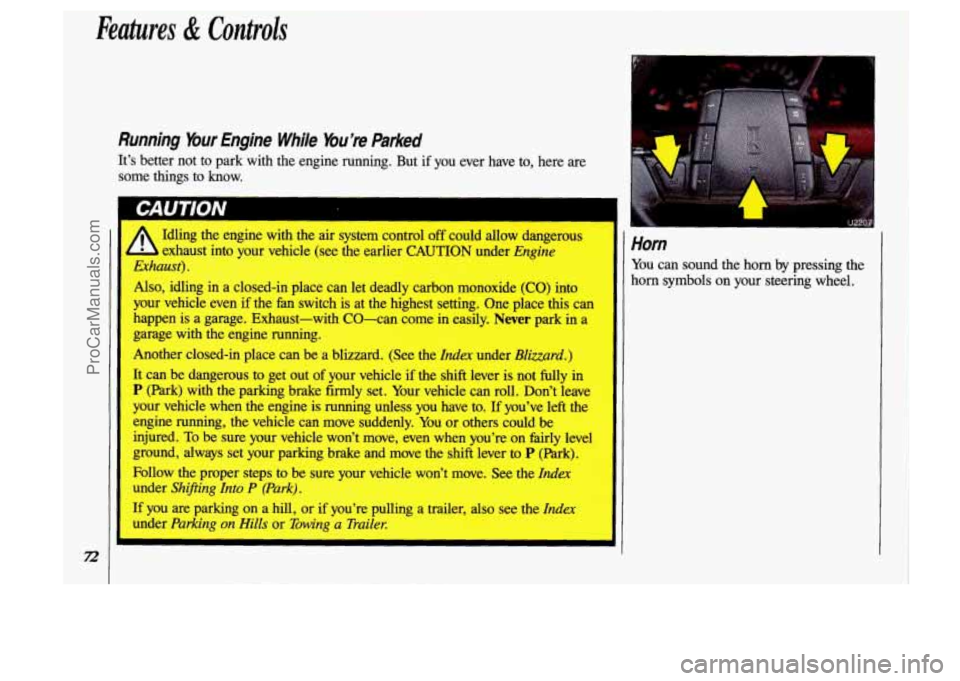
Horn
You can sound the horn by pressing the
horn symbols on your steering wheel.
ProCarManuals.com
Page 79 of 323
I To Resume a Set Speed
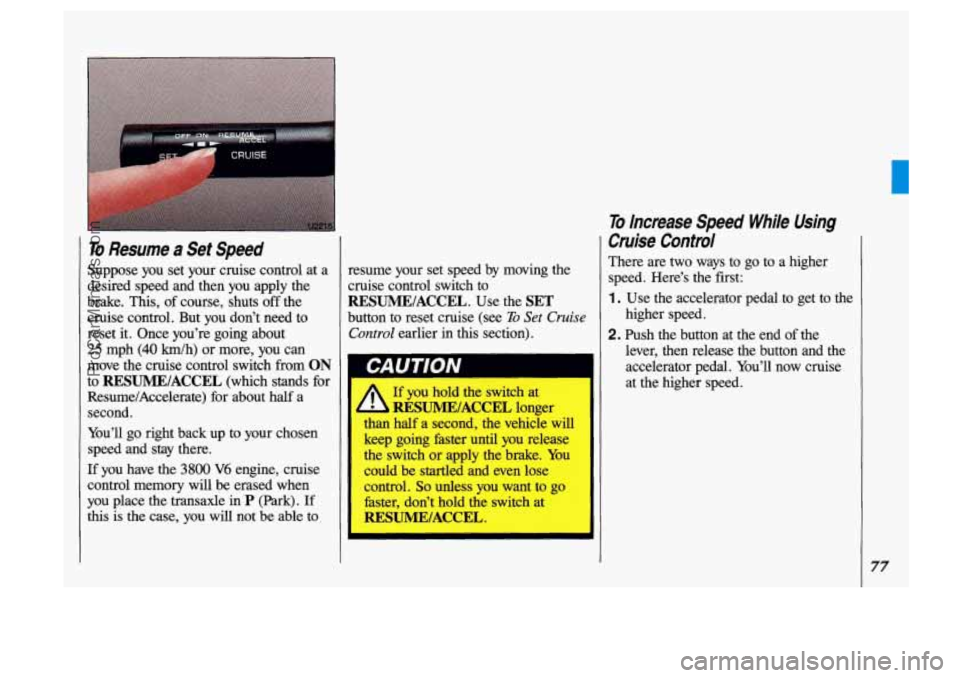
Suppose you set your cruise control at a
desired speed and then you apply the
brake. This,
of course, shuts off the
cruise control. But you don’t need to
reset it. Once you’re going about
25 mph (40 Wh) or more, you can
move the cruise control switch
from ON
to RESUME/ACCEL (which stands for
Resume/Accelerate) for about half a
second.
You’ll go right back up to your chosen
speed and stay there.
If you have the 3800 V6 engine, cruise
control memory
will be erased when
you place the transaxle
in P (Park). If
this is the case, you will not be able to resume your set speed
by moving the
cruise control switch to
RESUME/ACCEL. Use the SET
button to reset cruise (see To Set Cruise
Control earlier in this section).
If you hold the switch
at
than half a second, the vehicle will
keep going faster until you release
the switch or apply the brake. You
could be startled and even lose
control.
So unless you want to go
faster, don’t hold the switch at
RESUME/ACCEL.
I. RESUMEIACCEL longer
To Increase Speed Whl’le Using
Cruise Control
There are two ways to go to a higher
speed. Here’s the first:
1 . Use the accelerator pedal to get to the
2. Push the button at the end of the
higher speed.
lever, then release the button and the accelerator pedal. You’ll now cruise
at the higher speed.
77
ProCarManuals.com
Page 80 of 323
c
Features di Controls
To Increase Speed While Using
Cruise Control
(CONI)
Here’s the second way to go to a higher
speed:
Move the cruise switch from ON to
RESUME/ACCEL. Hold it there
until you get up to the speed you want,
and then release the switch.
amounts, move the switch to
RESUME/ACCEL for less than half a
second and then release it. Each time
you do this, your vehicle will go about
1 rnph (1.6 km/h) faster.
To increase your speed in very small
If you have the
3800 V6 engine, the
accelerate feature will only work after
you have set the initial cruise control
speed by pushing the
SET button. If you
have the
3.E V6 engine, the accelerate
feature will work whether or not you
have set an initial cruise control speed.
To Reduce Speed While Using
Cruise Control
Push in the button at the end of the
lever until you reach the lower speed
you want, then release it.
To slow down in very small amounts,
push the button for less than half a second. Each time
you do this, you’ll
go
1 mph (1.6 Wh) slower.
Passing Another Vehicle While
Using Cruise Control
Use the accelerator pedal to increase
your speed. When you take your foot off
the pedal, your vehicle
will slow down
to the cruise control speed you set
earlier.
Using Cruise Control on Hills
How well your cruise control will work
on
hills depends upon your speed, load,
and the steepness of the hills. When
going up steep hills, you may have to
step on the accelerator pedal to maintain
your speed. When going downhill, you
may have to brake or shift to a lower
gear to keep your speed down. Of course, applying the brake takes you out
of cruise control. Many drivers find this
to be too much trouble and don’t use
cruise control on steep hills.
ProCarManuals.com