engine OLDSMOBILE SILHOUETTE 1993 Workshop Manual
[x] Cancel search | Manufacturer: OLDSMOBILE, Model Year: 1993, Model line: SILHOUETTE, Model: OLDSMOBILE SILHOUETTE 1993Pages: 323, PDF Size: 17.13 MB
Page 197 of 323
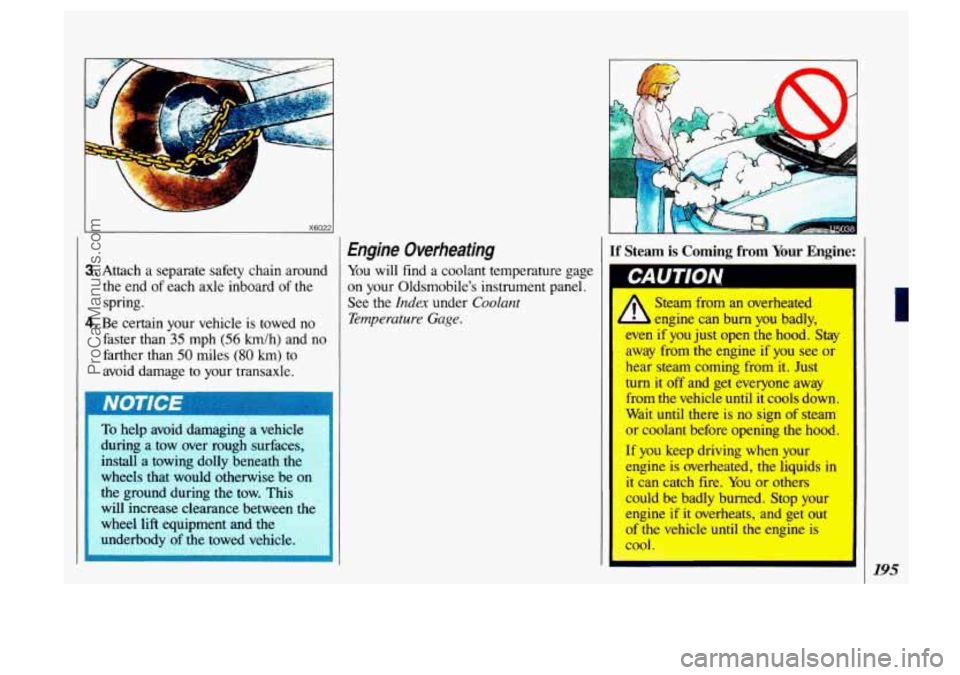
3. Attach a separate safety chain around
the end of each axle inboard of the
spring.
4. Be certain your vehicle is towed no
faster than
35 mph (56 km/h) and no
farther than
50 miles (80 km) to
avoid damage to your transaxle.
damaging a vehicle
luring a tow over rough surfaces,
Install a towing dolly beneath the
wheels that would otherwise be on
the ground during the tow. This
will increase clearance between
the
wheel lift equipment and the
underbody of the towed vehicle.
Engine Overheating If Steam is Coming from Your Engine
You will find a coolant temperature gage
on your Oldsmobile's instrument panel.
See the
Index under Coolant
Temperature
Gage.
A Steam from an overheated
r - n engine can bum you badly,
even
if you just open the hood. Stay
away from
the engine if you see or
hear steam coming from it. Just
turn
it off and get everyone away
from
the vehicle until it cools down.
Wait
until there is no sign of steam
or coolant before opening the hood.
If you keep driving when your
engine
is overheated, the liquids in
it can catch fire. You or others
could
be badly burned. Stop your
engine
if it overheats, and get out
of the vehicle
until the engine is
cool.
I
195
ProCarManuals.com
Page 198 of 323
Problems on the Road
I Enaine overheating (CONT:)
you keep driving with no coolant
your vehicle can be badly
damaged. The costly repairs wou
not be covered bv vour warrantv.
If No Steam is Coming from Your
Engine:
If you get the overheat warning but see
or hear no steam, the problem may not
be too serious. Sometimes the engine
can get a little
too hot when you:
Climb a long hill on a hot day.
Stop after high speed driving.
Idle for long periods in traffic.
Tow a trailer. If you get
the overheat warning with no
sign of steam,
try this for a minute or so:
1 . Turn off your air conditioner.
2. Turn on your heater to full hot at the
highest fan speed and open the
window as necessary.
3. Try to keep your engine under load
(in a drive gear where the engine
runs slower).
If you no longer have the overheat
warning, you can drive. Just
to be safe,
drive slower for about ten minutes.
If
the warning doesn’t come back on, you
can drive normally.
If the warning continues, pull over, stop,
and park your vehicle right away.
ProCarManuals.com
Page 199 of 323
If there’s still no sign of steam, you can
idle the engine for two or three minutes
while you’re parked, to see if the
warning stops. But then, if you still have
the warning, TURN OFF THE
ENGINE AND
GET EVERYONE
OUT OF THE VEHICLE until it cools
down.
You may decide not to lift the hood but
to get service help right away.
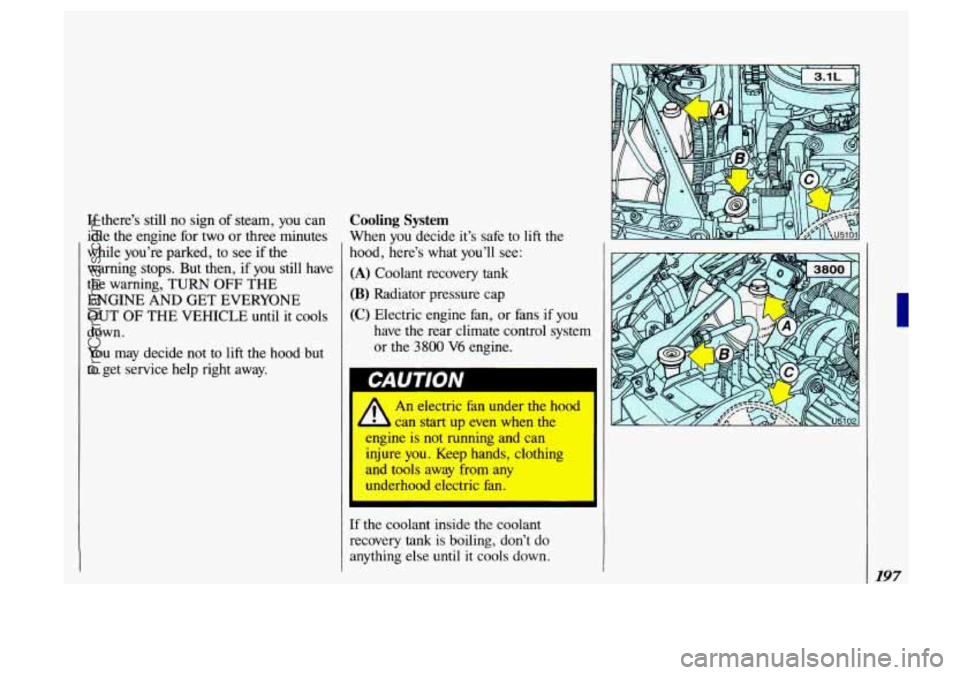
Cooling System
When you decide it’s safe to lift the
hood, here’s what you’ll see:
(A) Coolant recovery tank
(B) Radiator pressure cap
(C) Electric engine fan, or fans if you
have the rear climate control system
or the
3800 V6 engine.
I A An electric fan under the hod
L can start up even when the
engine is not running and can
injure
you. Keep hands, clothing
and‘tools away from any
underhood electric fan.
If the coolant inside the coolant
recovery
tank is boiling, don’t do
anything else
until it cools down.
197
ProCarManuals.com
Page 200 of 323
Engine Overheating (CONTI)
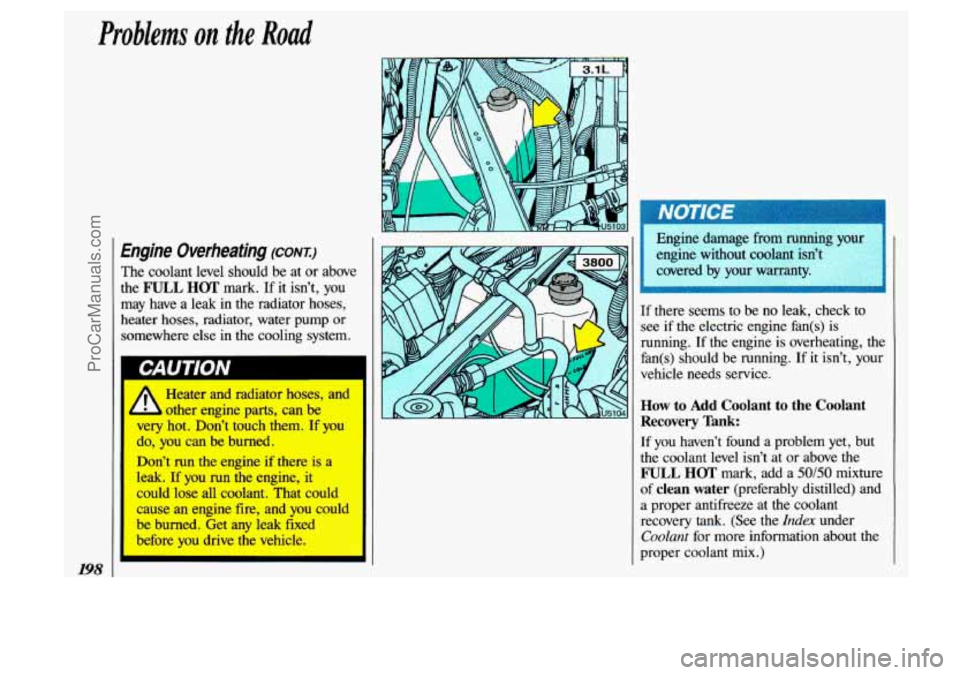
The coolant level should be at or above
the
FULL HOT mark. If it isn’t, you
may have a leak in the radiator hoses,
heater hoses, radiator, water pump or
somewhere else in the cooling system.
I, rn Heater and radiator hoses, and
b other engine parts, can be
VGI~ hot. Don’t touch them. If you
do, you can be
burned.
Don’t run the engine if there is a
leak. If you
run the engine, it
could lose all coolant. That could
cause an engine fire, and you
cou
be burned. Get any leak fix
before you drive the vehicle Engine damage from running your
: engine without coolant isn’t
i.: covered
by your warranty.
If there seems to be no leak, check to
see if the electric engine fan(s) is
running. If the engine is overheating, the
fan(s) should be running. If it isn’t, your
vehicle needs service.
How to Add Coolant to the Coolant
Recovery
Tank:
If you haven’t found a problem yet, but
the coolant level isn’t at or above the
FULL HOT mark, add a 50/50 mixture
of
clean water (preferably distilled) and
a proper antifreeze at the coolant
recovery
tank. (See the Index under
Coolant for more information about the
proper coolant mix.)
ProCarManuals.com
Page 201 of 323
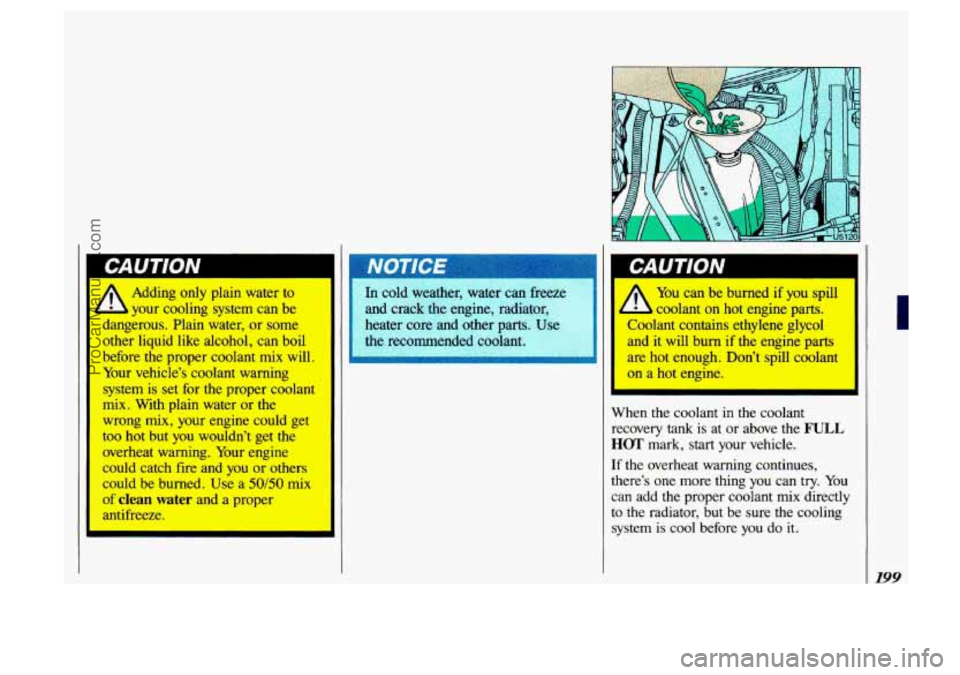
A
Adding only plain water to
your cooling system can be
dangerous. Plain water, or some
other liquid like alcohol, can boil
before the proper coolant mix will.
Your vehicle’s coolant warning
system is set for the proper coolant
mix. With plain water or the
wrong
mix, your engine could get
too hot but
you wouldn’t get the
overheat warning. Your engine
could catch fire and you or others
could be burned. Use a
50/50 mix
of clean water and a proper
antifreeze.
I
In cold- weatl , w r can .
and crack the engine, radial
heater core
and other parts. ‘,A
You can be burned if you spill
coolant on hot engine parts.
Coolant contains ethylene glycol
and it will burn
if the engine parts
are hot enough. Don’t spill coolant
on a hot engine.
I
When the coolant in the coolant
recovery
tank is at or above the FULL
HOT mark, start your vehicle.
If the overheat warning continues,
there’s one more thing you can try. You
can add the proper coolant
mix directly
to the radiator, but be sure the cooling
system is cool before
you do it.
199
ProCarManuals.com
Page 202 of 323
Problems on the Road
Engine Overheating (CONX)
I A Steam and scalding liquids I
I from a hot cooling system can
blow out and bum you badly. They
I
are under pressure, and if you turn
the radiator pressure cap-even a
little-they can come out at high
speed. Never
turn the cap when
the cooling system, including the
radiator pressure cap, is hot Wait
for the cooling system and radiator
pressure cap to cool if you ever
have to turn the pressure cap.
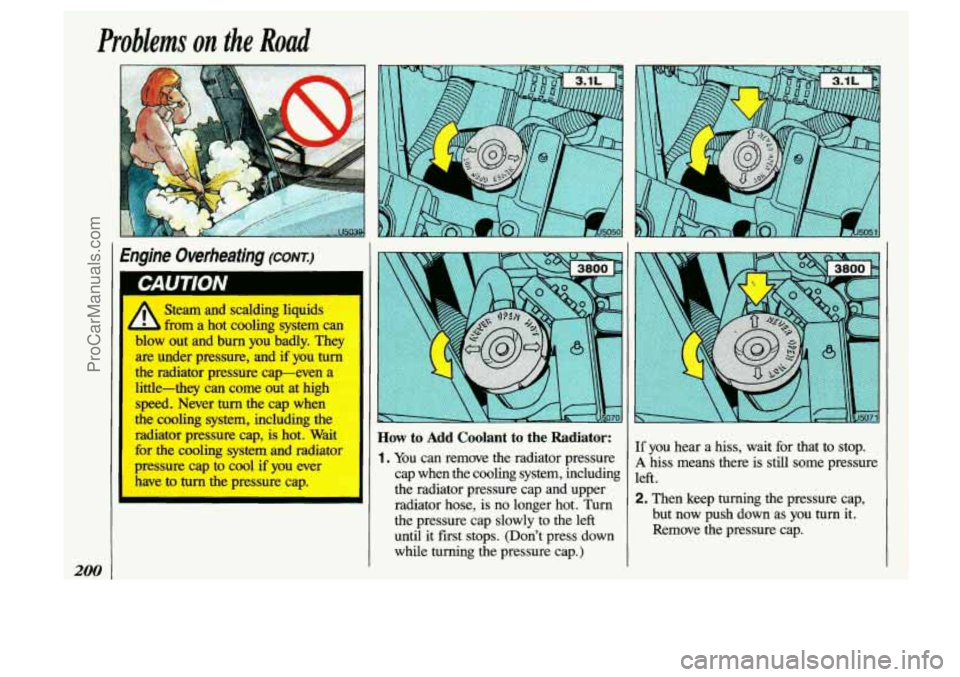
~ I Vow to Add Coolant to the Radiator:
I. You can remove the radiator pressure
cap when the cooling system, including
the radiator pressure cap and upper radiator hose, is no longer hot.
Turn
the pressure cap slowly to the left
until it first stops. (Don’t press down
while turning the pressure cap.)
If you hear a hiss, wait for that to stop.
A hiss means there is still some pressure
left.
2. Then keep turning the pressure cap,
but now push down as you turn it.
Remove the pressure cap.
~ 200
ProCarManuals.com
Page 204 of 323
Problems on the Road
202
P
Engine Overheating (CONI)
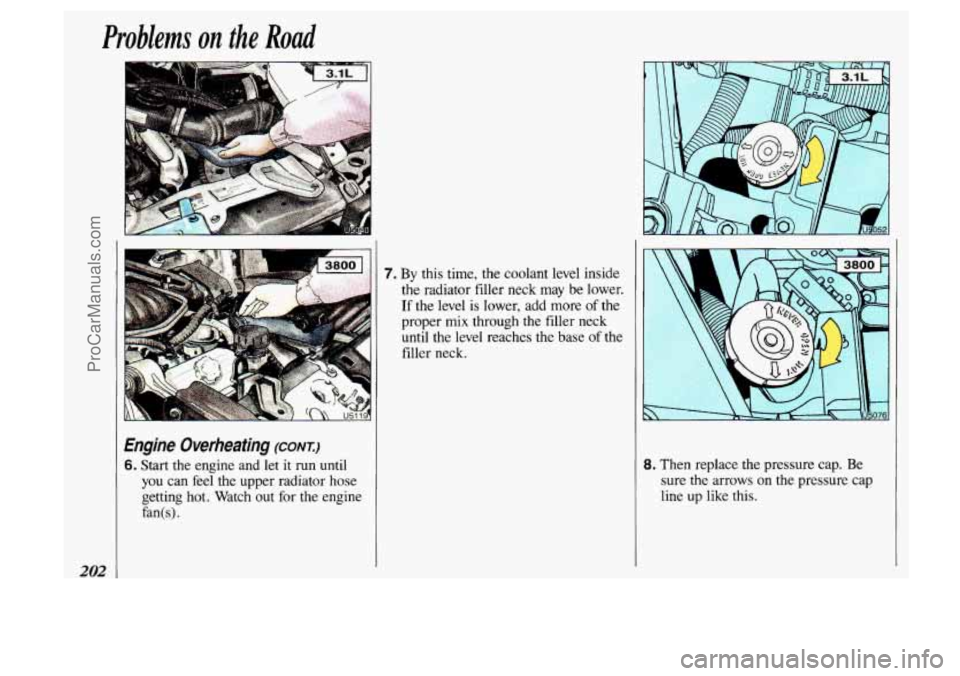
6. Start the engine and let it run until
you can feel the upper radiator hose
getting
hot. Watch out for the engine
fan(
s) .
7. By this time, the coolant level inside
the radiator filler neck may be lower.
If
the level is lower, add more of the
proper
mix through the filler neck
until the level reaches the base
of the
filler neck.
8. Then replace the pressure cap. Be
sure the arrows
on the pressure cap
line up like this.
ProCarManuals.com
Page 215 of 323
If You’re Stuck: In Sand, Mud,
Ice or Snow
What you don’t want to do when your
vehicle is stuck is to spin your wheels.
The method known as “rocking” can
help you get out when you’re stuck, but
you must use caution.
‘ If you let your tires spin at
high speed, they can explode
and
you or others could be injured.
And, the transaxle or other parts of
the vehicle can overheat. That could
cause an engine compartment fire
or other damage. When you’re
stuck, spin the wheels as little as
possible. Don’t spin
the wheels
above
35 mph (56 km/h) as shown
on the speedometer.
.~.. .. . .
$ back and forth, you can desi
F$ your transaxle.
Rocking Your Vehicle to Get it Out:
First, turn your steering wheel left and
right. That will clear the area around
your front wheels. Then shift back and
forth between
R (Reverse) and a
forward gear, spinning the wheels as
little as possible. Release the accelerator
pedal while
you shift, and press lightly
on
the accelerator pedal when the
transaxle is
in gear. If that doesn’t get
you out after a few tries, you may need
to be towed out. If you do need to be
towed out, see the
Index- under Towing
Your Oldsmobile.
213
ProCarManuals.com
Page 217 of 323
Here you will find information about
the care of your Oldsmobile
. This
part begins with service and fuel
information. and then it shows how to
check important fluid and lubricant levels
. There is also technical
information about your vehicle. and a section devoted to its appearance care
.
Part 6
Service di Appearance Care
Service ......................................................... 216
Fuel ........................................................... 217
HoodRelease
.................................................... 221
Engineoil
...................................................... 225
Aircleaner
..................................................... 230
TransaxleFluid
.................................................. 232
Enginecoolant
.................................................. 235
Power Steering Fluid
.............................................. 238
Windshield Washer Fluid
........................................... 239
Brakes
......................................................... 240
Battery
......................................................... 242
Bulb Replacement
................................................ 243
Windshield Wiper Blade Replacement
................................. 245
Loading Your Vehicle
............................................. 245
Tires
.......................................................... 247
Appearancecare ................................................. 254
Vehicle Identification Number (VIN)
................................. 262
Add-on Electrical Equipment
....................................... 263
Fuses
& Circuit Breakers ........................................... 264
Capacities
& Specifications ......................................... 269
Normal Maintenance Replacement Parts
............................... 271
Fluids
& Lubricants ............................................... 272
ReplacementBulbs
................................................ 273
215
ProCarManuals.com
Page 219 of 323
Fuel
Use regular unleaded gasoline rated at
87 octane or higher. It should meet
specifications
ASTM D4814 in the U.S.
and
CGSB 3.5-92 in Canada. These
fuels should have the proper additives,
so you should not have to add anything
to the fuel.
In the U.S. and Canada, it’s easy to be
sure you get the right kind of gasoline
(unleaded). You’ll see
“UNLEADED”
right on the pump. And only unleaded
nozzles will fit into your vehicle’s filler
neck.
Be sure the posted octane
is at least 87.
If the octane is less than 87, you may get
a heavy knocking noise when you drive.
If it’s bad enough, it can damage your
engine.
If you’re using fuel rated at 87 octane or
higher and you still hear heavy
knocking, your engine needs service.
But don’t worry
if you hear a little
pinging noise when you’re accelerating or driving up
a hill. That’s normal, and
you don’t have to buy a higher octane
fuel to get rid of pinging. It’s the heavy,
constant knock that means you have a
problem.
What about gasoline with blending
materials that contain oxygen, such
as
MTBE or alcohol?
MTBE is “methyl tertiary-butyl
ether:’ Fuel that is no more than
15 %
MTBE is fine for your vehicle.
Ethanol is ethyl or grain alcohol.
Properly-blended fuel that
is no more
than
10% ethanol is fine for your
vehicle.
Methanol is methyl or wood alcohol.
Fuel Capacity: 20 U.S. Gallons (76L).
Use unleaded fuel only.
227
ProCarManuals.com