lights OLDSMOBILE SILHOUETTE 1993 Owner's Manual
[x] Cancel search | Manufacturer: OLDSMOBILE, Model Year: 1993, Model line: SILHOUETTE, Model: OLDSMOBILE SILHOUETTE 1993Pages: 323, PDF Size: 17.13 MB
Page 106 of 323
Features & Controls
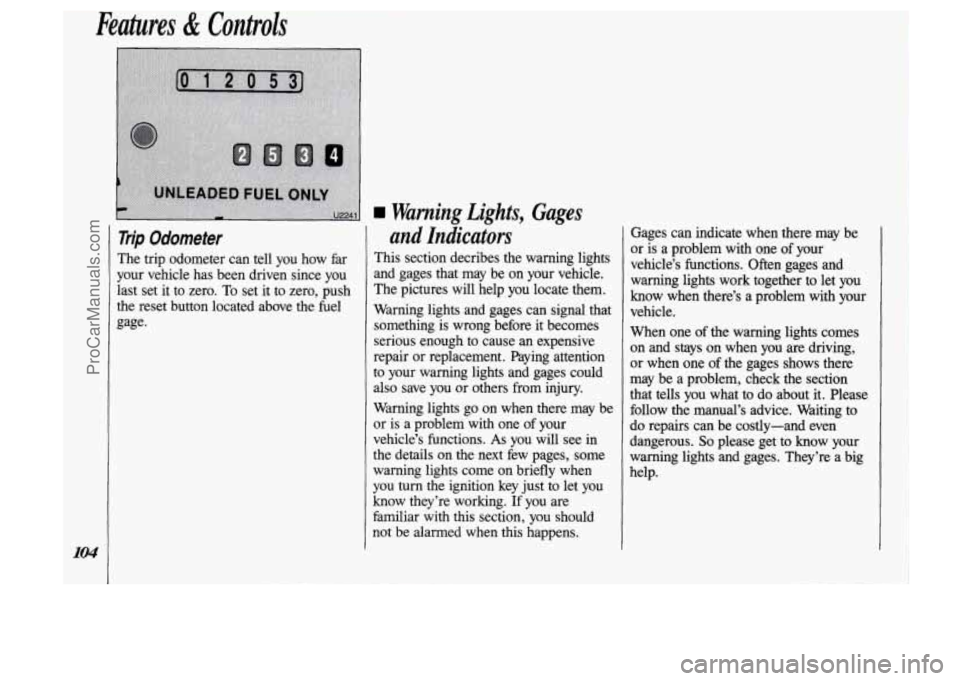
Trip Odometer
The trip odometer can tell you how far
your vehicle has been driven since you
last set it to zero. To set it to zero, push
the reset button located above the fuel
gage.
and Indicators
This section decribes the warning lights
and gages that may be on your vehicle.
The pictures will help you locate them.
Warning lights and gages can signal that something is wrong before it becomes
serious enough to cause an expensive
repair or replacement. Paying attention
to your warning lights and gages could also save you or others from injury.
Warning lights go on when there may be
or is a problem with one
of your
vehicle’s functions.
As you will see in
the details on the next few pages, some warning lights come on briefly when
you turn the ignition key just to let you
know they’re working.
If you are
familiar with
this section, you should
not be alarmed when this happens. bages
can indicate when there may be
or is a problem with one of your
vehicle’s functions. Often gages and
warning lights work together to
let you
know when there’s a problem with your
vehicle.
When one of the warning lights comes
on and stays on when you are driving,
or when one
of the gages shows there
may be a problem, check the section
that tells you what to do about it. Please
follow the manual’s advice. Waiting to
do repairs can be costly-and even
dangerous.
So please get to know your
warning lights and gages. They’re a big
help.
ProCarManuals.com
Page 144 of 323
142
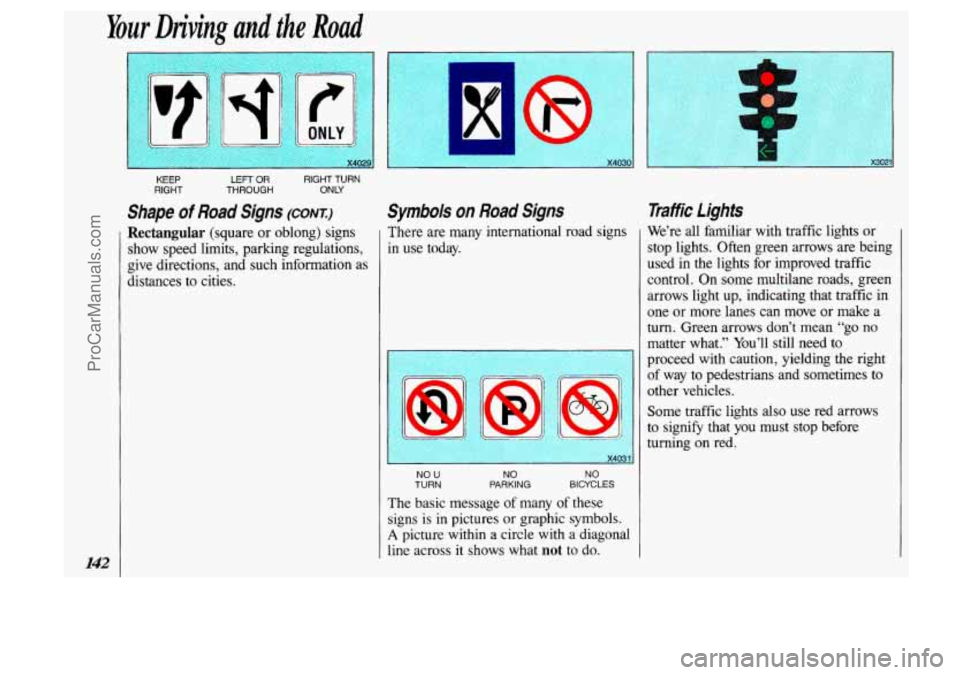
KEEP
RIGHT LEFT OR THROUGH RIGHT TURN ONLY
Shape of Road Signs (CONT.)
Rectangular (square or oblong) signs
show speed limits, parking regulations,
give directions, and such information as
distances to cities.
Symbols on Road Signs
There are many international road signs
in use today.
NO U TURN NO NO
PARKING BICYCLES
The basic message of many of these
signs is
in pictures or graphic symbols.
A picture within a circle with a diagonal
line across it shows what
not to do.
Trait2 Lights
We’re all familiar with traffic lights or
stop lights. Often green arrows are being
used in the lights for improved traffic
control. On some multilane roads, green
arrows light up, indicating that traffic in
one
or more lanes can move or make a
turn. Green arrows don’t mean
“go no
matter what.” You’ll still need to
proceed with caution, yielding the right
of way to pedestrians and sometimes to
other vehicles.
Some traffic lights also use red arrows
to signify that you must stop before
turning on red.
ProCarManuals.com
Page 145 of 323
m%p&:*g%
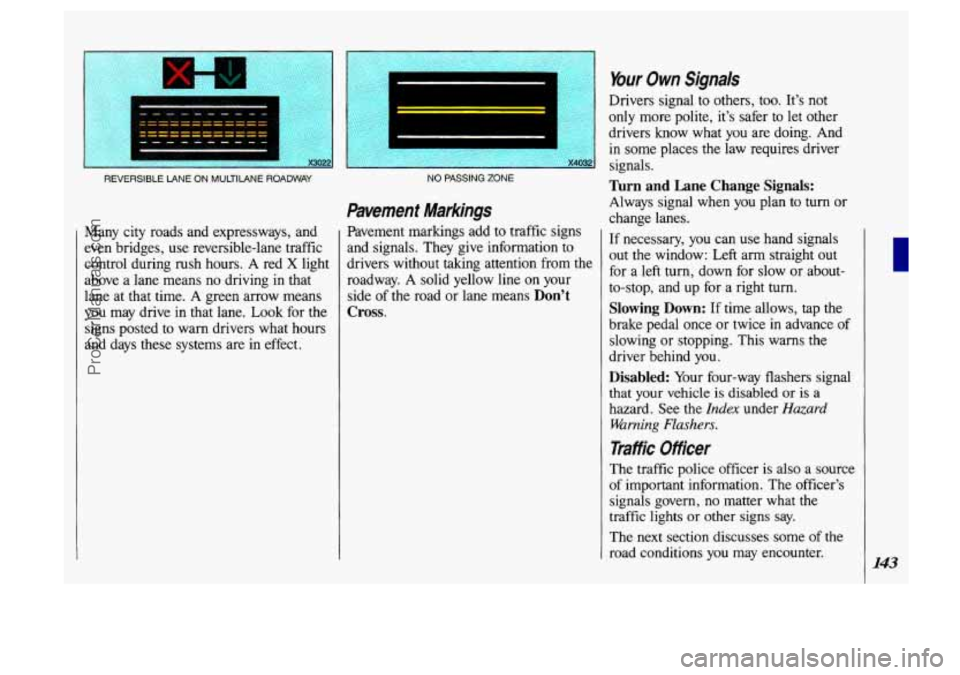
REVERSIBLE LANE ON MULTILANE ROADWAY
Many city roads and expressways, and
even bridges, use reversible-lane traffic
control during rush hours.
A red X light
above a lane means no driving in that
lane at that time. A green arrow means
you may drive in that lane.
Look for the
signs posted to warn drivers what hours
and days these systems are in effect.
~ ~~~
NO PASSING ZONE
Pavement Markings
Pavement markings add to traffic signs
and signals. They give information to
drivers without taking attention from the
roadway.
A solid yellow line on your
side of the road or lane means
Don’t
Cross.
Your Own Signals
Drivers signal to others, too. It’s not
only more polite, it’s safer
to let other
drivers know what
you are doing. And
in some places the law requires driver
signals.
Turn and Lane Change Signals:
Always signal when you plan to turn or
change lanes.
If necessary, you can use hand signals
out the window: Left arm straight out
for a left turn, down for slow or about-
to-stop, and up for a right turn.
Slowing Down: If time allows, tap the
brake pedal once or twice in advance of
slowing or stopping. This warns the
driver behind you.
Disabled: Your four-way flashers signal
that your vehicle is disabled or
is a
hazard. See the
Index under Hazard
Warning Flashers.
Traffic Officer
The traffic police officer is also a source
of important information. The officer’s
signals govern, no matter what the
traffic lights
or other signs say.
The next section discusses some
of the
road conditions you may encounter.
143
ProCarManuals.com
Page 156 of 323
Your Driving and the Road
Steering Tips-Driving on Curves
It’s important to take curves at a
reasonable speed.
A lot of the “driver lost control’’
accidents mentioned on the news happen
on curves. Here’s why:
Experienced driver or beginner, each of
us is subject to the same laws of physics
when driving
on curves. The traction of
the tires against the road surface makes
it possible for the vehicle to change its
path when you turn the front wheels.
If
there’s no traction, inertia will keep the
vehicle going in the same direction.
If
you’ve ever tried to steer a vehicle on
wet ice, you’ll understand this.
The traction you can get in a curve
depends
on the condition of your tires
and the road surface, the angle at which the curve
is banked, and your
speed.
While you’re in a curve, speed is the
one factor you can control.
Suppose you’re steering through a sharp
curve. Then
you suddenly accelerate.
Those two control systems-steering
and acceleration-can overwhelm those
places where
the tires meet the road and
make you lose control.
What should you do if this ever
happens? Let up on the accelerator
pedal, steer the vehicle the way you
want it to go, and slow down.
Speed limit signs near curves warn that
you should adjust your speed. Of
course, the posted speeds are based on
good weather and road conditions.
Under less favorable conditions you’ll
want to go slower. If you need to
reduce your speed as you
approach a curve, do it before you enter
the curve, while your front wheels are
straight ahead.
Try to adjust your speed
so you can
“drive” through
the curve. Maintain a
reasonable, steady speed. Wait to
accelerate until you are out of the curve,
and then accelerate gently into the
straightaway.
When you drive into a curve at night,
it’s harder to see the road ahead
of you
because it bends away from the straight
beams of your lights. This is one good
reason
to drive slower.
ProCarManuals.com
Page 159 of 323
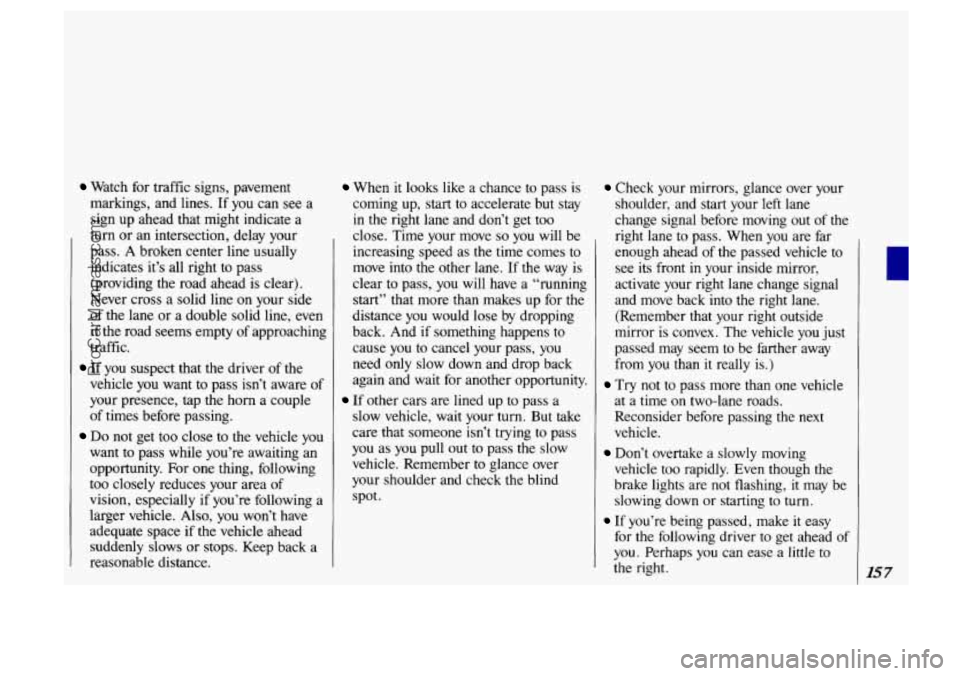
Watch for traffic signs, pavement
markings, and lines.
If you can see a
sign up ahead that might indicate a
turn or an intersection, delay your
pass.
A broken center line usually
indicates it’s all right to pass
(providing the road ahead is clear).
Never cross a solid line on your side
of the lane or a double solid line, even
if the road seems empty
of approaching
traffic.
vehicle you want to pass isn’t aware of
your presence, tap the horn a couple
of times before passing.
Do not get too close to the vehicle you
want to pass while you’re awaiting an
opportunity. For one thing, following
too closely reduces your area of
vision, especially if you’re following a
larger vehicle. Also, you won’t have
adequate space if the vehicle ahead
suddenly slows or stops. Keep back a
reasonable distance.
If you suspect that the driver of the
When it looks like a chance to pass is
coming up, start to accelerate but stay
in the right lane and don’t get too
close. Time your move
so you will be
increasing speed as
the time comes to
move into the other lane. If the way is
clear to pass,
you will have a “running
start” that more than makes up for the
distance you would lose by dropping
back. And
if something happens to
cause you
to cancel your pass, you
need only slow down and drop back
again and wait for another opportunity.
slow vehicle, wait your turn. But take
care that someone isn’t trying to pass
you as you pull out
to pass the slow
vehicle. Remember
to glance over
your shoulder and check the blind
spot.
If other cars are lined up to pass a
Check your mirrors, glance over your
shoulder, and start your left lane
change signal before moving out of the
right lane to pass. When you are far
enough ahead of the passed vehicle to
see its front in your inside mirror,
activate your right lane change signal
and move back into the right lane.
(Remember that your right outside
mirror
is convex. The vehicle you just
passed may seem to be farther away
from you than it really is.)
Try not to pass more than one vehicle
at a time on two-lane roads.
Reconsider before passing the
next
vehicle.
vehicle too rapidly. Even though the
brake lights are not flashing,
it may be
slowing down or starting to turn.
If you’re being passed, make it easy
for the following driver to get ahead
of
you. Perhaps you can ease a little to
the right.
Don’t overtake a slowly moving
157
ProCarManuals.com
Page 161 of 323
a lower gear). Any sudden changes
could cause the tires to slide. You may
not realize the surface is slippery until
your vehicle is skidding. Learn
to
recognize warning clues-such as
enough water, ice or packed snow on
the road to make a “mirrored
surface”-and slow down when
you
have any doubt.
Remember: Any anti-lock braking
system
(ABS) helps avoid only the
braking skid. Steer the way you want to
go.
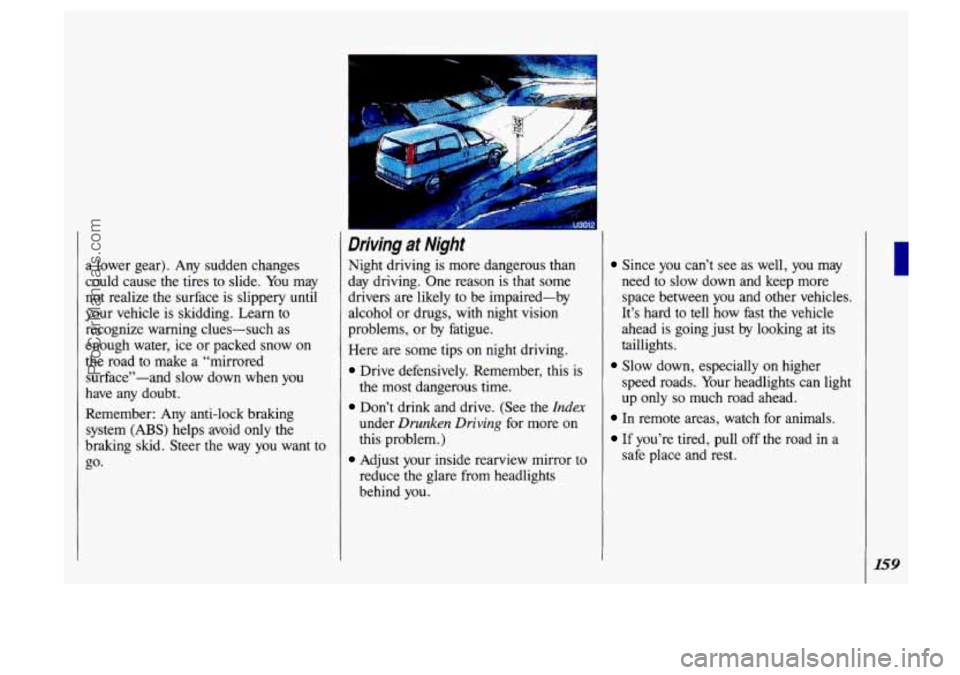
Driving at Night
Night driving is more dangerous than
day driving. One reason
is that some
drivers are likely to be impaired-by
alcohol or drugs, with night vision
problems, or by fatigue.
Here are some tips on night driving.
Drive defensively. Remember, this is
the most dangerous time.
Don’t drink and drive. (See the Index
under Drunken Driving for more on
this problem.)
Adjust your inside rearview mirror to
reduce the glare from headlights
behind you.
Since you can’t see as well, you may
need to slow down and keep more
space between
you and other vehicles.
It’s hard to tell how fast the vehicle
ahead is going just by looking at its
taillights.
speed roads. Your headlights can light
up only
so much road ahead.
Slow down, especially on higher
In remote areas, watch for animals.
If you’re tired, pull off the road in a
safe place and rest.
159
ProCarManuals.com
Page 162 of 323
Night Vision
No one can see as well at night as in the
daytime. But as we get older these
differences increase.
A 50-year-old
driver may require at least twice as
much light
to see the same thing at night
as a 20-year-old.
What you do in the daytime can also
affect your night vision. For example,
if
you spend the day in bright sunshine you
are wise to wear sunglasses. Your eyes
will have less trouble adjusting to night.
But if you're driving, don't wear
sunglasses at night. They may cut down
on glare from headlights, but they also
make a lot of things invisible that should
remain visible-such as parked cars,
obstacles, pedestrians, or even trains
blocking railway crossings. You may
want to put on your sunglasses after you
have pulled into a brightly-lighted
service or refreshment area. Eyes shielded from that glare
may adjust
more quickly to darkness back on the
road. But be sure to remove your
sunglasses before you leave the service
area.
You can be temporarily blinded by
approaching lights. It can take a second
or two, or even several seconds, for your
eyes to readjust to the dark. When you
are faced with severe glare (as
from a
driver who doesn't lower the high
beams, or a vehicle with misaimed
headlights), slow down a little. Avoid
staring directly into the approaching
lights. If there is a line of opposing
traffic, make occasional glances over the
line of headlights to make certain that
one of the vehicles isn't starting to move
into your lane. Once you are past the
bright lights, give your eyes the to
readjust before resuming speed.
High Beams
If the vehicle approaching you has its
high beams on, signal by flicking yours
to
high and then back to low beam. This
is the usual signal to lower the headlight
beams. If the other driver still doesn't
lower the beams, resist the temptation to
put your high beams on. This only
makes two half-blinded drivers.
On a freeway, use your high beams only
in remote areas where you won't impair
approaching drivers.
In some places,
like cities, using high beams is illegal.
When you follow another vehicle on a
freeway or highway, use low beams.
True, most vehicles now have day-night
mirrors that enable the driver to reduce
glare. But outside mirrors are not
of this
type and high beams from behind can
bother the driver ahead.
ProCarManuals.com
Page 163 of 323
A kw More Night Driving
Suggestions
Keep your windshield and all the glass
on your vehicle clean-inside and out.
Glare at night is made much worse by
dirt
on the glass. Even the inside of the
glass can build up a film caused by dust.
Tobacco smoke also makes inside glass
surfaces very filmy and can be a vision
hazard
if it’s left there.
Dirty glass makes lights dazzle and
flash more than clean glass would,
making the pupils of your eyes contract
repeatedly. You might
even want to keep
a cloth and some glass cleaner in your
vehicle if
you need to clean your glass
frequently. Remember that your headlights light up
far less of a roadway when you are in a
turn or curve.
Keep your eyes moving; that way, it’s
easier to pick out dimly lighted objects.
Just as your headlights should be
checked regularly for proper aim,
so
should your eyes be examined regularly.
Some drivers suffer from night
blindness-the inability to see in dim
light-and aren’t even aware of
it.
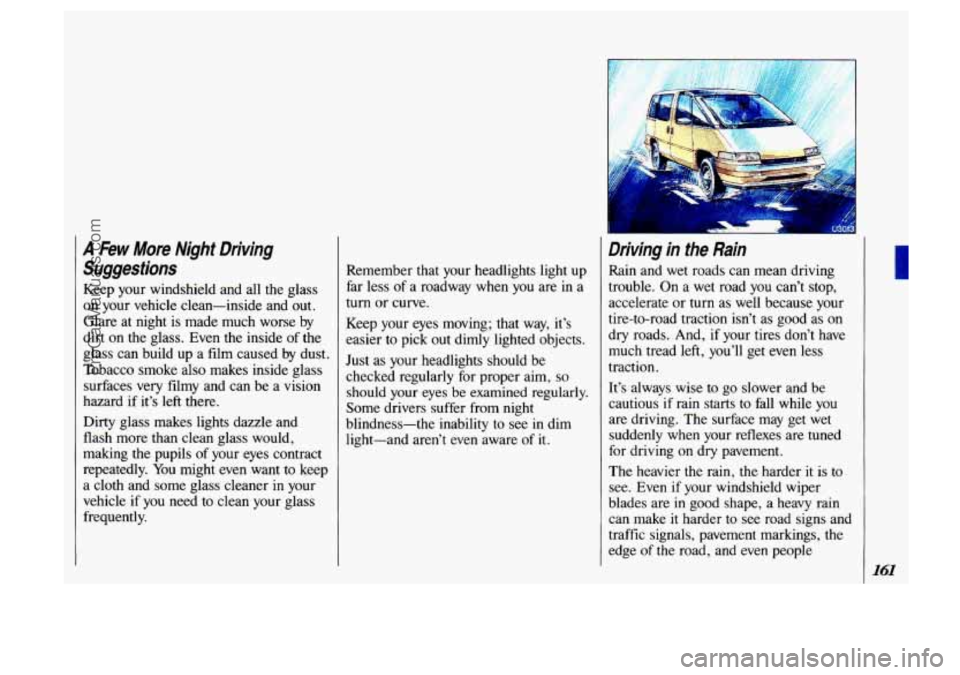
Driving in tne Rain
Rain and wet roads can mean driving
trouble. On a wet road you can’t stop,
accelerate or turn as well because your
tire-to-road traction isn’t as good as on
dry roads. And,
if your tires don’t have
much tread left, you’ll get even less
traction.
It’s always wise to
go slower and be
cautious if rain starts
to fall while you
are driving. The surface may get wet
suddenly when your reflexes are tuned
for driving on dry pavement.
The heavier the rain, the harder it is to
see. Even if your windshield wiper
blades are in good shape, a heavy rain
can make
it harder to see road signs and
traffic signals, pavement markings, the
edge
of the road, and even people
ProCarManuals.com
Page 165 of 323
I Hydroplaning
Hydroplaning is dangerous. So much
water can build up under your tires that
they can actually ride on the water. This
can happen if the road is wet enough
and you’re going fast enough. When
your vehicle is hydroplaning, it has little
or no contact with
the road.
You might not be aware
of hydroplaning.
You could drive along for some time
without realizing your tires aren’t in
constant contact with the road. You
could find out the hard way: when
you
have to slow, turn, move out to pass-or
if you get hit by a gust
of wind. You could
suddenly find yourself
out of control. Hydroplaning doesn’t happen often. But
it can if your tires haven’t much tread or
if the pressure
in one or more is low. It
can happen if a lot
of water is standing
on the road. If you can see reflections
from trees, telephone poles,
or other
vehicles, and raindrops “dimple” the
water’s surface, there could be
hydroplaning.
Hydroplaning usually happens at higher
speeds. There just isn’t a hard and fast
rule about hydroplaning. The best
advice is
to slow down when it is
raining, and be careful.
Some Other Rainy Weather Tips
Turn on your headlights-not just your
parking lights-to help make you more
visible to others.
Look for hard-to-see vehicles coming
from behind. You may want to use
your headlights even in daytime
if it’s
raining hard.
Besides slowing down, allow some
extra following distance. And be
especially careful when you pass
another vehicle. Allow yourself more
clear room ahead, and be prepared to
have your view restricted by road
spray. If the road spray is
so heavy you
are actually blinded, drop back. Don’t
pass until conditions improve. Going
more slowly is better than having an
accident.
Use your defogger if it helps.
Have good tires with proper tread
depth. (See the
Index under Tires.) 163
ProCarManuals.com
Page 166 of 323
Your Diving and the Road
Driving in Fog, Mist and Haze
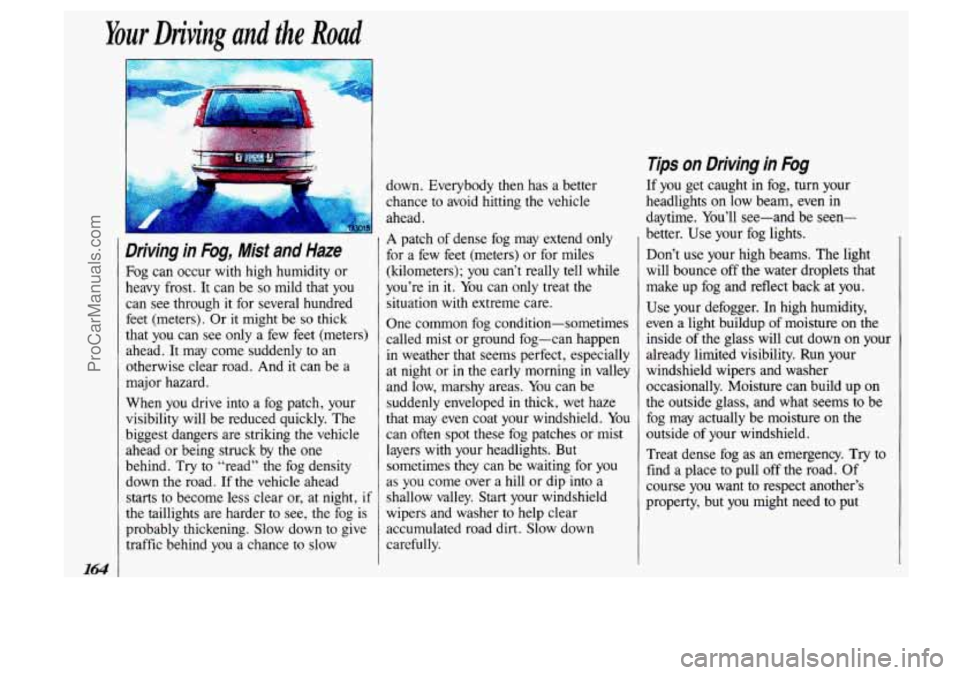
Fog can occur with high humidity or
heavy frost. It can be
so mild that you
can see through
it for several hundred
feet (meters). Or
it might be so thick
that you can see only a few feet (meters)
ahead. It may come suddenly
to an
otherwise clear road. And it can be a
major hazard.
When you drive into a fog patch, your
visibility will be reduced quickly. The
biggest dangers are striking the vehicle
ahead or being struck by the one
behind. Try to “read” the fog density
down the road.
If the vehicle ahead
starts to become less clear or, at night,
if
the taillights are harder to see, the fog is
probably thickening. Slow down
to give
traffic behind you a chance to slow down. Everybody then has a better
chance to avoid hitting the vehicle
ahead.
A patch of dense fog may extend only
for a few feet (meters) or for miles
(kilometers); you can’t really tell while
you’re
in it. You can only treat the
situation
with extreme care.
One common fog condition-sometimes
called mist or ground fog-can happen
in weather that seems perfect, especially
at night
or in the early morning in valley
and low, marshy areas. You can be
suddenly enveloped in thick, wet haze
that may even coat your windshield. You
can often spot these fog patches or mist
layers with your headlights. But sometimes they can be waiting for you
as you come over a hill or dip into a
shallow valley. Start your windshield
wipers and washer to help clear
accumulated road dirt. Slow down
carefully.
lips on Driving in Fog
If you get caught in fog, turn your
headlights
on low beam, even in
daytime. You’ll see-and be seen-
better. Use your fog lights.
Don’t use your high beams. The light
will bounce off the water droplets that
make up fog and reflect back at you.
Use your defogger. In high humidity,
even a light buildup of moisture on the
inside
of the glass will cut down on your
already limited visibility. Run your
windshield wipers and washer
occasionally. Moisture can build up on
the outside glass, and what seems to be
fog may actually be moisture on the
outside
of your windshield.
Treat dense fog as an emergency. Try to
find a place to pull off the road. Of
course you want to respect another’s
property, but you might need to put
ProCarManuals.com