warning light OLDSMOBILE SILHOUETTE 1993 Owner's Manual
[x] Cancel search | Manufacturer: OLDSMOBILE, Model Year: 1993, Model line: SILHOUETTE, Model: OLDSMOBILE SILHOUETTE 1993Pages: 323, PDF Size: 17.13 MB
Page 167 of 323
something between you and moving
vehicles-space, trees, telephone poles,
a private driveway, anything that
removes you from other traffic.
If visibility is near zero and you must
stop but are unsure whether you are
away from the road, turn your lights on,
start your hazard warning flashers, and
sound your horn at intervals or when
you hear approaching traffic.
Pass other vehicles in fog only if you
can
see far enough ahead to pass safely.
Even then, be prepared to delay your
pass if you suspect the fog is worse up
ahead. If other vehicles
try to pass you,
make it easy for them.
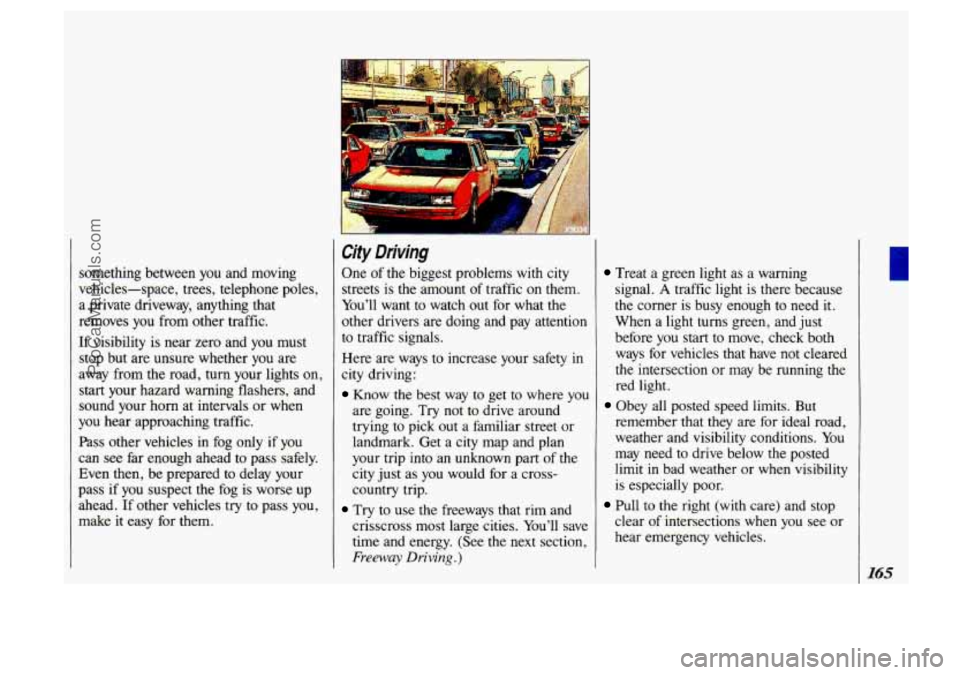
City Driving
One of the biggest problems with city
streets is the amount of traffic on them.
You’ll want to watch out for what the
other drivers are doing and pay attention
to traffic signals.
Here are ways to increase your safety
in
city driving:
Know the best way to get to where you
are going. Try not to drive around
trying
to pick out a familiar street or
landmark. Get a city map and plan
your trip into an unknown part of
the
city just as you would for a cross-
country trip.
Try to use the freeways that rim and
crisscross most large cities. You’ll save
time and energy. (See the next section,
Freeway Driving.)
Treat a green light as a warning
signal.
A traffic light is there because
the corner is busy enough to need it.
When a light turns green, and just
before you
start to move, check both
ways for vehicles that have not cleared
the intersection or may be running the
red light.
remember that
they are for ideal road,
weather and visibility conditions. You
may need
to drive below the posted
limit in bad weather or when visibility
is especially poor.
clear of intersections when you see
or
hear emergency vehicles.
Obey all posted speed limits. But
Pull to the right (with care) and stop
165
ProCarManuals.com
Page 169 of 323
If you are moving from an outside to a
center lane on a freeway having more
than two lanes, make sure another
vehicle isn’t about to move into the same spot. Look at the vehicles two lanes
over and watch for telltale signs:
turn
signals flashing, an increase in speed, or
moving toward the edge of the lane. Be
prepared
to delay your move.
Once you are moving on the freeway,
make certain you allow a reasonable
following distance. Expect
to move
slightly slower at night.
Leaving the Fkeeway
When you want to leave the freeway,
move to the proper lane well
in advance.
Dashing across lanes at the last minute
is dangerous.
If you miss your exit do
not, under any circumstances, stop and
back up. Drive on
to the next exit.
At each exit point is a deceleration lane.
Ideally it should be long enough for
you
to enter it at freeway speed (after
signaling, of course) and then do your
braking before moving onto the exit
ramp. Unfortunately, not
all deceleration
lanes are long enough-some are too
short for all the braking. Decide when
to start braking.
If you must brake on
the through lane, and if there is traffic
close behind you, you can allow a little extra time and flash your brake lights (in
addition to your
turn signal) as extra
warning that you are about
to slow
down and exit.
The exit ramp can be curved, sometimes
quite sharply. The exit speed is usually
posted. Reduce your speed according to your speedometer, not
to your sense of
motion. After driving for any distance at
higher speeds, you may tend to
think
you are going slower than you actually
are. For example,
40 mph (65 km/h)
might seem like only 20 mph (30 km/h).
Obviously, this could lead to serious
trouble on a ramp designed for
20 mph
(30 Mh)!
I67
ProCarManuals.com
Page 175 of 323
Torque Lock
If you are parking on a hill and you
don’t shift your transaxle into
P (Park)
properly, the weight of the vehicle may
put too much force on the parking pawl
in the transaxle. You may find it difficult
to pull the shift lever out of
P (Park).
This is called “torque lock.” To prevent
torque lock, always be sure
to shift into
P (Park) properly before you leave the
driver’s seat. To find out how, see the
Index under Shifting Into P (Park).
When you are ready to drive, move the
shift lever out of P (Park) before you
release the parking brake.
If torque lock does occur, you may need
to have another vehicle push yours a
little uphill to take some of the pressure
from the transaxle,
so you can pull the
shift lever out of
P (Park).
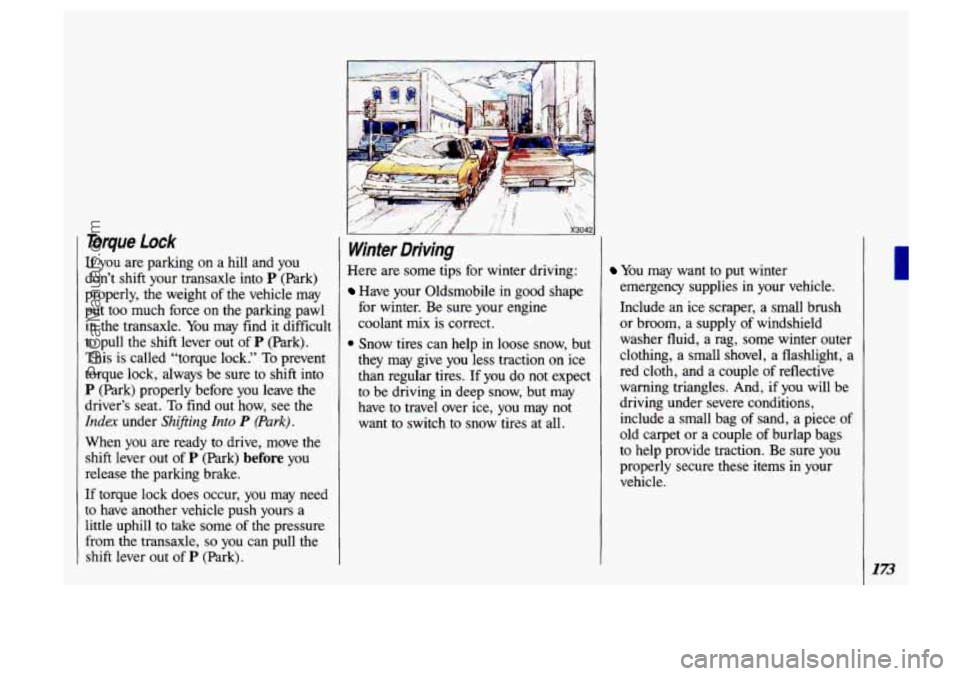
Winter Driving
Here are some tips for winter driving:
Have your Oldsmobile in good shape
for winter. Be sure your engine
coolant
mix is correct.
* Snow tires can help in loose snow, but
they may give you less traction on ice
than regular tires.
If you do not expect
to be driving in deep snow, but may
have to travel over ice, you may not
want
to switch to snow tires at all.
You may want to put winter
emergency supplies in your vehicle.
Include
an ice scraper, a small brush
or broom,
a supply of windshield
washer fluid, a rag,
some winter outer
clothing, a small shovel, a flashlight,
a
red cloth, and a couple of reflective
warning triangles. And,
if you will be
driving under severe conditions,
include a small bag
of sand, a piece of
old carpet or a couple of burlap bags
to help provide traction. Be sure you
properly secure these items
in your
vehicle.
173
ProCarManuals.com
Page 188 of 323
Problems on the Road
I
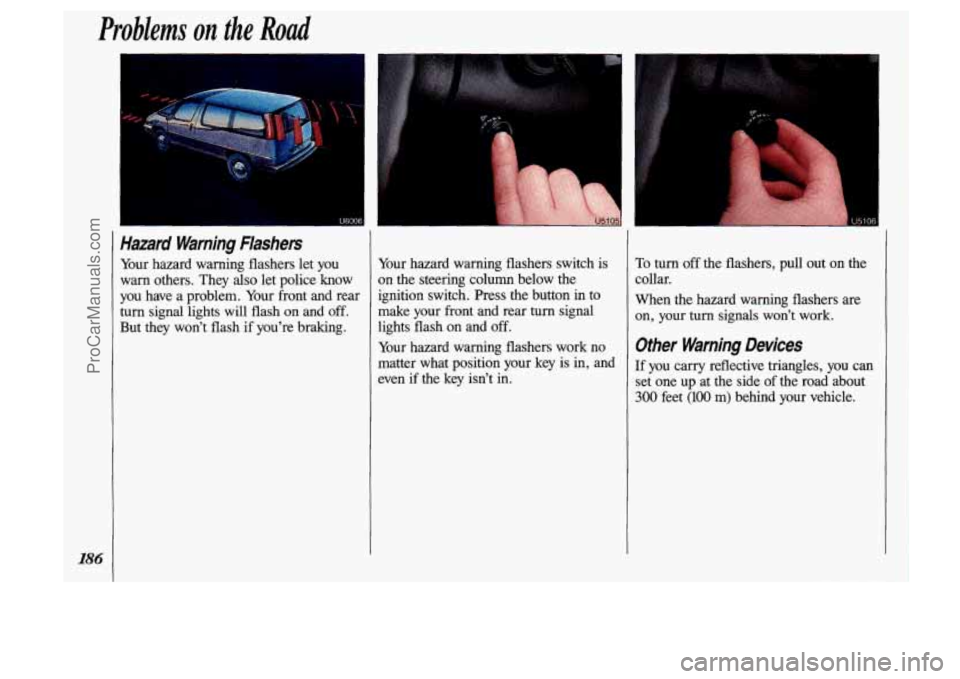
Hazard Warning Flashers
Your hazard warning flashers let you
warn others. They
also let police know
you have a problem. Your front and rear
turn signal lights will flash on and off.
But they won’t flash if you’re braking. Your
hazard warning flashers switch is
on the steering column below the
ignition switch. Press the button in to
make your front and rear turn signal
lights flash on and off.
Your hazard warning flashers work no
matter what position your key is in, and
even if the key isn’t in.
L
To turn off the flashers, pull out on the
collar.
When the hazard warning flashers are
on, your turn signals won’t work.
Other Warning Devices
If you carry reflective triangles, you can
set one up at the side of the road about
300 feet (100 m) behind your vehicle.
ProCarManuals.com
Page 214 of 323
Problems on the Road
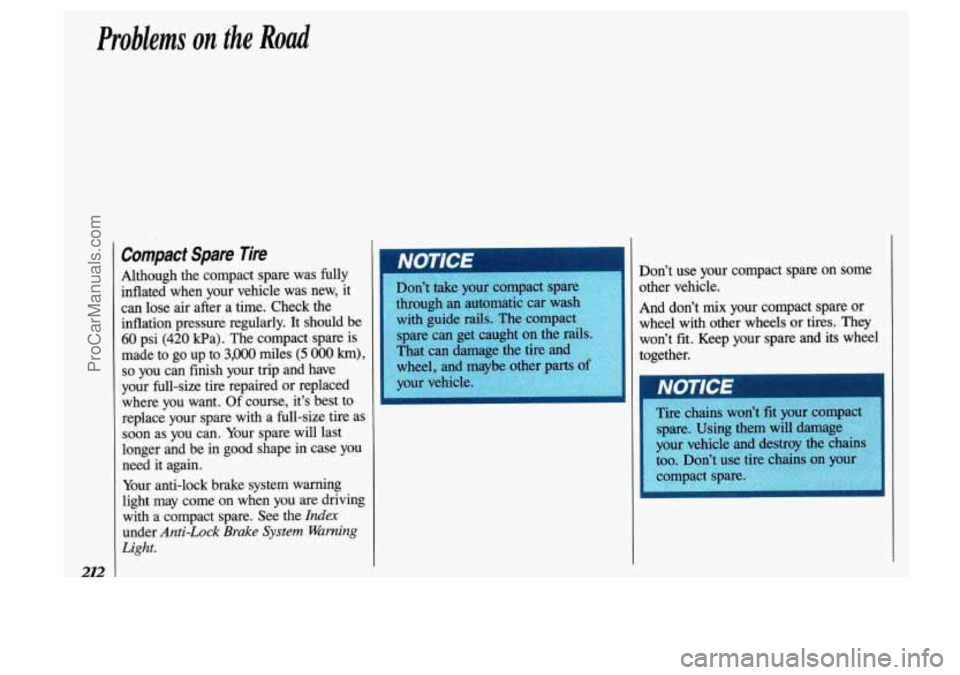
Compact Spare Tire
Although the compact spare was fully
inflated when your vehicle was new, it
can lose air after a time. Check the
inflation pressure regularly. It should
be
60 psi (420 Pa). The compact spare is
made to go up to
3,000 miles (5 000 km),
so you can finish your trip and have
your full-size tire repaired or replaced
where you want.
Of course, it’s best to
replace your spare with a full-size tire as
soon as you can. Your spare will last
longer and be
in good shape in case you
need it again.
Your anti-lock brake system warning
light may come on when you are driving
with a compact spare. See the
Index
under Anti-Lock Brake System Warning
Light.
Don’t use your compact spare on some
Don’t take your compact spare other vehicle.
through an automatic car wash
with guide rails. The compact
spare can get caught on the rails.
That can damage the tire and
wheel, and maybe other parts
of
your vehicle. And don’t
mix your compact
spare or
wheel with other wheels
or tires. They
won’t fit. Keep your spare
and its wheel
together.
ProCarManuals.com
Page 237 of 323
3
F
3
1
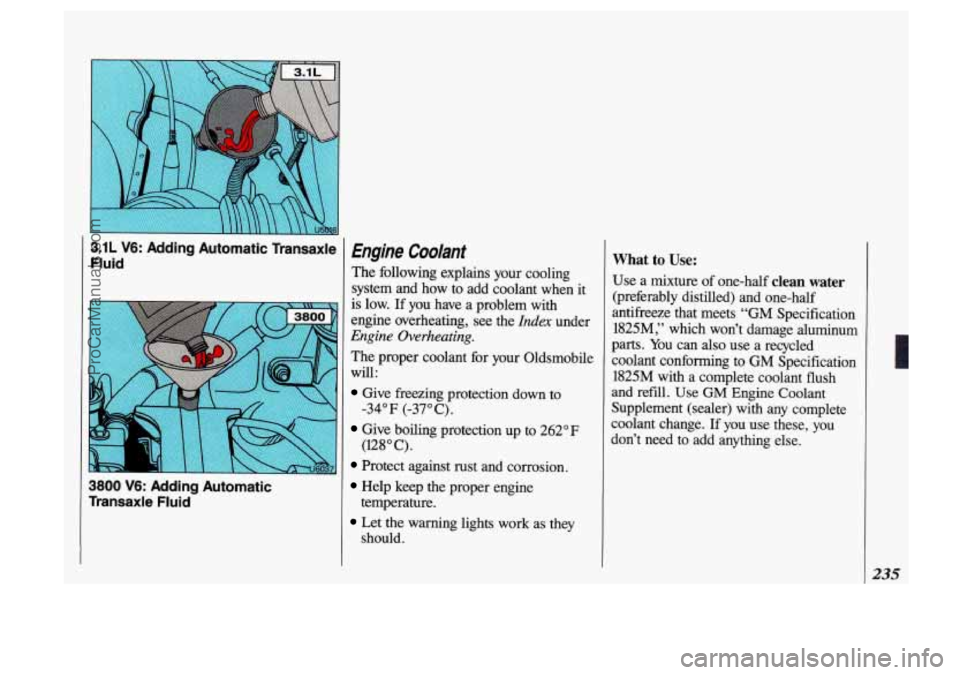
;.1L V6: Adding Automatic Transaxle
Wid
_I
1800 V6: Adding Automatic
Pansaxle Fluid
Engine Coolant
The following explains your cooling
system and how to add coolant when it
is low.
If you have a problem with
engine overheating, see the
Index under
Engine Overheating.
The proper coolant for your Oldsmobile
will:
Give freezing protection down to
Give boiling protection up to 262°F
Protect against rust and corrosion.
Help keep the proper engine
Let the warning lights work as they
-34°F (-37°C).
(128” C).
temperature.
should.
What to Use:
Use a mixture of one-half clean water
(preferably distilled) and one-half
antifreeze that meets “GM Specification
1825M,” which won’t damage aluminum
parts. You can also use a recycled
coolant conforming to GM Specification 1825M with a complete coolant flush
and refdl. Use
GM Engine Coolant
Supplement (sealer) with any complete
coolant change. If you use these, you
don’t need to add anything else.
235
ProCarManuals.com
Page 243 of 323
A
If you have too much brake
fluid, it can spill on the
engine. The fluid will burn if the
engine is hot enough. You OT
others could be burned, and your
vehicle could be damaged. Add
brake fluid only when work is
done on the brake hydraulic
system.
When your brake fluid falls to a low
level, your brake warning light will
come on. See the
Index under Brake
System Warning Light.
What to Add:
When you do need brake fluid, use only
DOT-3 brake fluid-such as Delco
Supreme
ll@ (GM Part No. 1052535).
Use new brake fluid from a sealed
container
only.
I
image your vehicle. Don’t use it
wrong kind of fluid.
FOI
Don’t let someone put in the
xample, just a few drops
c
mineral-based oil, such as en€
oil,
in your brake system can
damage brake system parts
so
badly that they’ll have to be replaced.
be careful not to spill
hr fluid-:
Brake fluid can damage -int,
ProCarManuals.com
Page 292 of 323
Maintenance Schedule
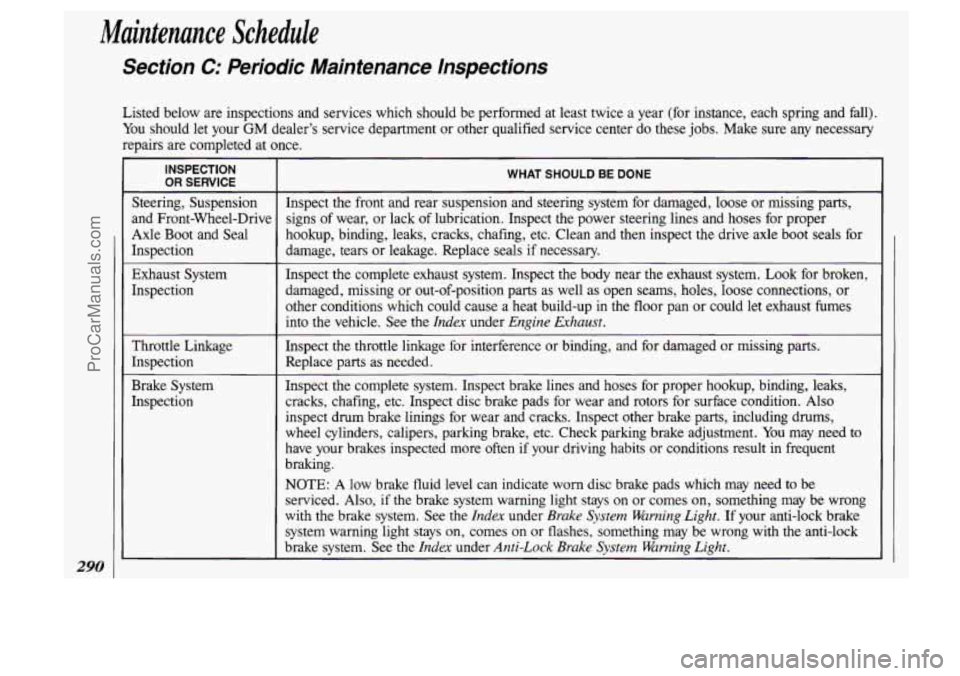
Section C: Periodic Maintenance lnspections
Listed below are inspections and services which should be performed at least twice a year (for instance, each spring and fall).
You should let your GM dealer’s service department or other qualified service center do these jobs. Make sure any necessary
repairs are completed at once.
290
INSPECTION
OR SERVICE
Steering, Suspension
and Front-Wheel-Drive
Axle Boot and Seal
Inspection
Exhaust System
Inspection
Throttle Linkage
Inspection
Brake System
Inspection
WHAT SHOULD BE DONE
Inspect the front and rear suspension and steering system for damaged, loose or missing parts,
signs of wear, or lack of lubrication. Inspect the power steering lines and hoses for proper
hookup, binding, leaks, cracks, chafing, etc. Clean and then in\
spect the drive axle boot seals for
damage, tears or leakage. Replace seals if necessary.
Inspect the complete exhaust system. Inspect the body near the exhaust system. Look for broken,
damaged, missing or out-of-position parts as well as open seams, holes, loose connections, or
other conditions which could cause a heat build-up in the floor pan or could let exhaust fumes
into the vehicle. See the
Index under Engine Exhaust.
Inspect the throttle linkage for interference or binding, and for damaged or missing parts.
Replace parts as needed.
Inspect the complete system. Inspect brake lines and hoses for \
proper hookup, binding, leaks,
cracks, chafing, etc. Inspect disc brake pads for wear and rotors for surface condition. Also
inspect drum brake linings for wear and cracks. Inspect other brake parts, including drums,
wheel cylinders, calipers, parking brake, etc. Check parking brake adjustment.
You may need to
have your brakes inspected more often
if your driving habits or conditions result in frequent
braking.
NOTE: A low brake fluid level can indicate worn disc brake pads which may need to be
serviced. Also, if the brake system warning light stays on or comes on, something may be wrong
with the brake system.
See the Index under Brake System Warning Light. If your anti-lock brake
system warning light stays on, comes on or flashes, something may be wrong with the anti-lock
brake system. See the
Index under Anti-Lock Brake System Warning Light.
ProCarManuals.com
Page 313 of 323
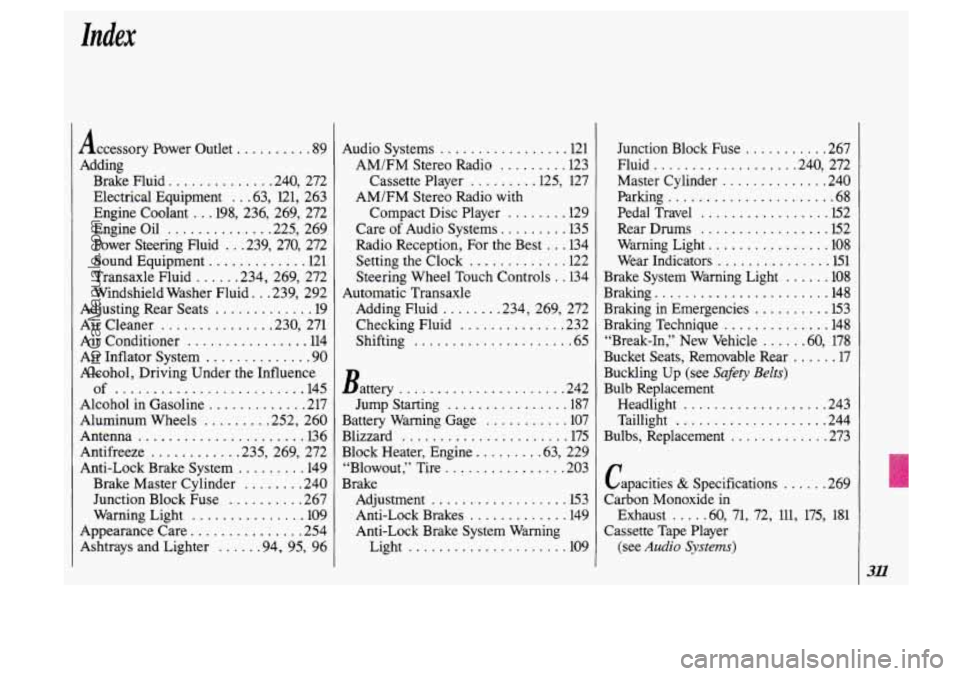
Index
Accessory Power Outlet .......... 89
Adding Brake Fluid
............. .240. 272
Engine Coolant
.. .198. 236. 269. 272
Engine Oil
............. .225. 269
Power Steering Fluid
.. .239. 270. 272
Sound Equipment
............. 121
Transaxle Fluid
..... .234. 269. 272
Adjusting Rear Seats
............. 19
Air Cleaner
.............. .230. 271
Air Conditioner
................ 114
Air Inflator System
.............. 90
Alcohol. Driving Under the Influence
of ......................... 145
Alcohol in Gasoline
............. 217
Aluminum Wheels
........ .252. 260
Antenna
...................... 136
Antifreeze
........... .235. 269. 272
Anti-Lock Brake System
......... 149
Brake Master Cylinder
........ 240
Junction Block Fuse
.......... 267
Warning Light
............... 109
Appearance Care ............... 254
Ashtrays and Lighter
..... .94. 95. 96
Electrical Equipment
.. .63.
121. 263
Windshield Washer Fluid
.. .239. 292 Audio Systems
................. 121
AM/FM Stereo Radio
......... 123
Cassette Player
........ .125. 127
AM/FM Stereo Radio with
Compact Disc Player
........ 129
Care of Audio Systems
......... 135
Radio Reception. For the Best
... 134
Setting the Clock
............. 122
Steering Wheel Touch Controls
. . 134
Adding Fluid
....... .234. 269. 272
Checking Fluid
.............. 232
Shifting
..................... 65
Automatic Transaxle
Battery
...................... 242
Jump Starting
................ 187
Battery Warning Gage
........... 107
Blizzard
...................... 175
Block Heater. Engine ........ .63. 229
“Blowout
,” Tire ................ 203
Brake Adjustment
.................. 153
Anti-Lock Brakes
............. 149
Anti-Lock Brake System Warning Light
..................... 109 Junction Block
Fuse
........... 267
Fluid
.................. .240. 272
Master Cylinder
.............. 240
Parking
..................... -68
Pedal Travel
................. 152
Rear Drums
................. 152
Warning Light
................ 108
Wear Indicators
............... 151
Brake System Warning Light
...... 108
Braking
....................... 148
Braking in Emergencies
.......... 153
Braking Technique .............. 148
“Break-In,” New Vehicle
..... .60, 178
Bucket Seats, Removable Rear
...... 17
Buckling Up (see Safety Belts)
Bulb Replacement
Headlight
................... 243
Taillight
.................... 244
Bulbs, Replacement
............. 273
Capacities
& Specifications ...... 269
Carbon Monoxide in
Cassette Tape Player Exhaust
.... .60, 71, 72,
111, 175, 181
(see
Audio Systems)
311
ProCarManuals.com
Page 314 of 323
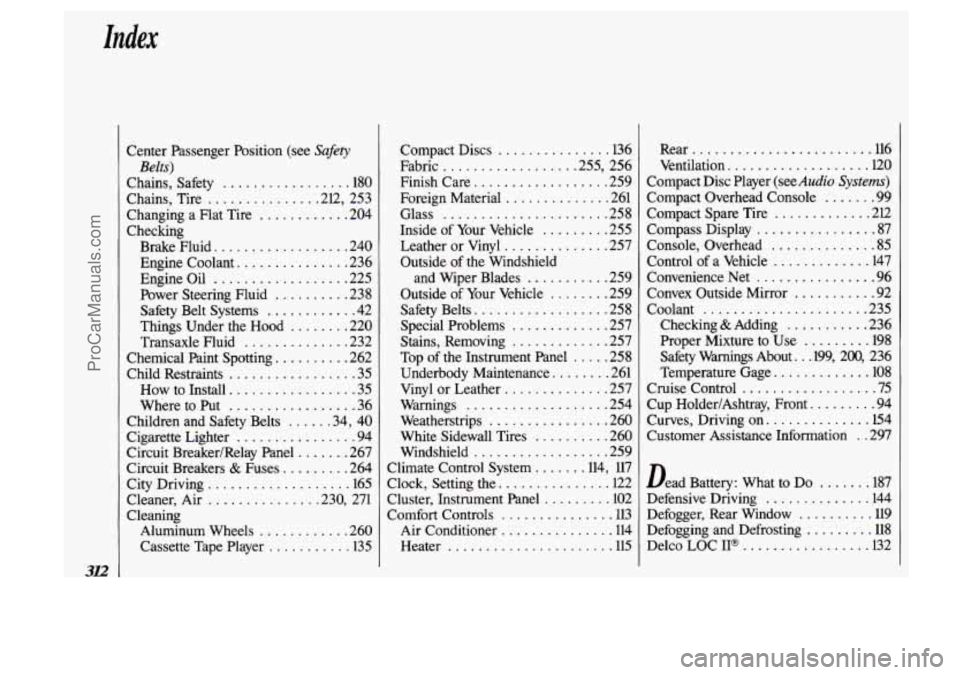
312
Center Passenger Position (see Safety
Chains. Safety ................. 180
Chains. Tire
.............. .2l2. 253
Changing a Flat Tire
............ 204
Checking Brake Fluid
.................. 240
Engine Coolant
............... 236
Engine Oil
.................. 225
Power Steering Fluid
.......... 238
Things Under the Hood
........ 220
Transaxle Fluid
.............. 232
Child Restraints
................. 35
How to Install ................. 35
Where to Put
................. 36
Children and Safety Belts
..... .34, 40
Cigarette Lighter ................ 94
Circuit BreakerIRelay Panel
....... 267
Circuit Breakers
& Fuses ......... 264
City Driving
................... 165
Cleaner. Air
.............. .230. 271
Cleaning Aluminum Wheels
............ 260
Cassette Tape Player
........... 135
Belts)
Safety Belt Systems ............ 42
Chemical Paint Spotting
.......... 262 Compact Discs
............... 136
Finish Care
.................. 259
Foreign Material
.............. 261
Glass
...................... 258
Inside of Your Vehicle
......... 255
Leather or Vinyl
.............. 257
Outside of the Windshield
and Wiper Blades
........... 259
Outside
of Your Vehicle ....... -259
Safety Belts
.................. 258
Special Problems
............. 257
Stains. Removing
............. 257
Top of the Instrument Panel
..... 258
Underbody Maintenance
........ 261
Vinyl or Leather
.............. 257
Warnings
................... 254
Weatherstrips
................ 260
White Sidewall Tires
.......... 260
Windshield
.................. 259
Climate Control System
...... .114, 117
Clock, Setting the
............... 122
Cluster, Instrument Panel
......... 102
Comfort Controls
............... 113
Air Conditioner
............... 114
Heater
...................... 115
Fabric .................. .255. 256 Rear
........................ 116
Ventilation
................... 120
Compact Disc Player (seeAudio Systems)
Compact Overhead Console ....... 99
Compact Spare Tire
............. 212
Compass Display
................ 87
Console, Overhead
.............. 85
Control of a Vehicle
............ -147
Convenience Net
................ 96
Convex Outside Mirror
........... 92
Coolant
...................... 235
Checking
& Adding ........... 236
Proper Mixture to Use
......... 198
Safety Warnings About
.. .199. 200, 236
Temperature Gage
............. 108
Cruise Control
.................. 75
Cup HoldedAshtray, Front ......... 94
Curves. Driving on
.............. 154
Customer Assistance Information
. . 297
Dead Battery: What
to Do ....... 187
Defensive Driving
.............. 144
Defogger. Rear Window
.......... 119
Defogging and Defrosting
......... 118
Delco LOC
II@ ................. 132
ProCarManuals.com