brake OLDSMOBILE SILHOUETTE 1993 Service Manual
[x] Cancel search | Manufacturer: OLDSMOBILE, Model Year: 1993, Model line: SILHOUETTE, Model: OLDSMOBILE SILHOUETTE 1993Pages: 323, PDF Size: 17.13 MB
Page 184 of 323
Your Driving and the Road
Driving with a Trailer (CONT.)
Backing Up
Hold the bottom of the steering wheel
with one hand. Then, to move the trailer
to the left, just move that hand
to the
left. To move the trailer to the right,
move your hand to the right. Always
back up slowly and, if possible, have
someone guide you.
Making Turns
When you’re turning with a trailer,
make wider
turns than normal. Do this
so your trailer won’t strike soft
shoulders, curbs, road signs, trees, or
other objects. Avoid jerky or sudden
maneuvers. Signal well in advance.
Turn Signals When Towing a Trailer
When you tow a trailer, your vehicle has
to have a different
turn signal flasher
and extra wiring. The green arrows on
your instrument panel will flash
whenever you signal
a turn or lane
change. Properly hooked up, the trailer
lights will also flash, telling other
drivers you’re about to
turn, change
lanes or stop.
When towing a trailer, the green arrows
on your instrument panel will flash for
turns even if the bulbs on the trailer are
burned out. Thus, you may think drivers
behind you are seeing your signal when
they are not. It’s important to check
occasionally to be sure the trailer bulbs
are still working.
Driving On Grades
Reduce speed and shift to a lower gear
before you start down a long or steep
downgrade.
If you don’t shift down, you
might have to use your brakes
so much
that they would get hot and no longer
work well.
On a long uphill grade,
shift down and
reduce your speed to around
45 mph
(70 Wh) to reduce the possibility of
engine and transaxle overheating. If
your vehicle has a 3800 V6 engine, you
should also drive in
D instead of
Overdrive when towing a trailer on
fairly level roads. This will help your
engine and transaxle run cooler in
this
condition, too.
If you are towing a trailer that weighs
more
than 1,000 pounds (454 kg), and
you have an automatic transaxle with Overdrive, you may prefer to drive in
D
instead of Overdrive (or, as you need to,
a lower gear).
ProCarManuals.com
Page 185 of 323
Parking on Hills
You really should not park your vehicle,
with a trailer attached, on a hill. If
something goes wrong, your rig could
start to move. People can be injured,
and both your vehicle and the trailer can
be damaged.
But if you ever have to park your rig on
a hill, here’s how to do it:
1 . Apply your regular brakes, but don’t
shift into
P (Park) yet.
2. Have someone place chocks under
the trailer wheels.
3. When the wheel chocks are in place,
release the regular brakes until the
chocks absorb the load.
apply your parking brake, and then shift to
P (Park).
4. Reapply the regular brakes. Then
5. Release the regular brakes.
When You Are Ready to Leave After
Parking on a Hill
1. Apply your regular brakes and hold
the pedal down while you:
Start your engine;
Shift into a gear; and
Release the parking brake.
2. Let up on the brake pedal.
3. Drive slowly until the trailer is clear
4. Stop and have someone pick up and
of the chocks.
store the chocks.
Maintenance When Trailer
Towing
Your vehicle will need service more
often when you’re pulling a trailer. See
the Maintenance Schedule for more on
this. Things that are especially
important in trailer operation are
automatic transaxle fluid (don’t overfill)
engine oil, belts, cooling system, and
brake adjustment. Each
of these is
covered in this manual, and the
Index
will help you find them quickly. If
you’re trailering, it’s a good idea to
review these sections before you
start
your trip.
Check periodically
to see that all hitch
nuts and bolts are tight.
183
ProCarManuals.com
Page 190 of 323
Problems on the Road
i
I
I
I
I88
Jump Starting (CONT.)
2. Get the vehicles close enough so the
jumper cables can reach, but be sure
the vehicles aren’t touching each other.
If they are, it could cause a
ground connection you don’t want.
You wouldn’t be able to start your
Oldsmobile, and the bad grounding
could damage the electrical systems.
You could be injured
if the
L vehicles roll. Set the parking
brake
firmly on each vehicle. Put
an automatic transaxle in
P (Park)
or a manual transaxle
in N (Neutral).
3. Turn off the ignition on both
vehicles.
Turn off all lights that aren’t
needed, and radios.
This will avoid
sparks and help save both batteries.
And it could save your radio!
4. Open the hoods and locate the
batteries.
r An electric fan can start up
even when the engine is not
I
I uming and can injure you. Keep
hands, clothing and tools away
from any underhood electric fan.
Find the positive
(+) and negative
(-) terminals on each battery.
ProCarManuals.com
Page 194 of 323
Problems on the Road
192
Towing Your Oldsmobile (CONT.:)
When you call, tell the towing service:
That your vehicle cannot be towed
from the front with sling-type
equipment.
drive.
vehicle. lever.
damaged.
That your vehicle has front-wheel
The make, model, and year of your
Whether you can still move the shift
If there was an accident, what was
When the towing service arrives, let the
tow operator know that this manual
contains detailed towing instructions and
illustrations. The operator may want to
see them.
1 X6016
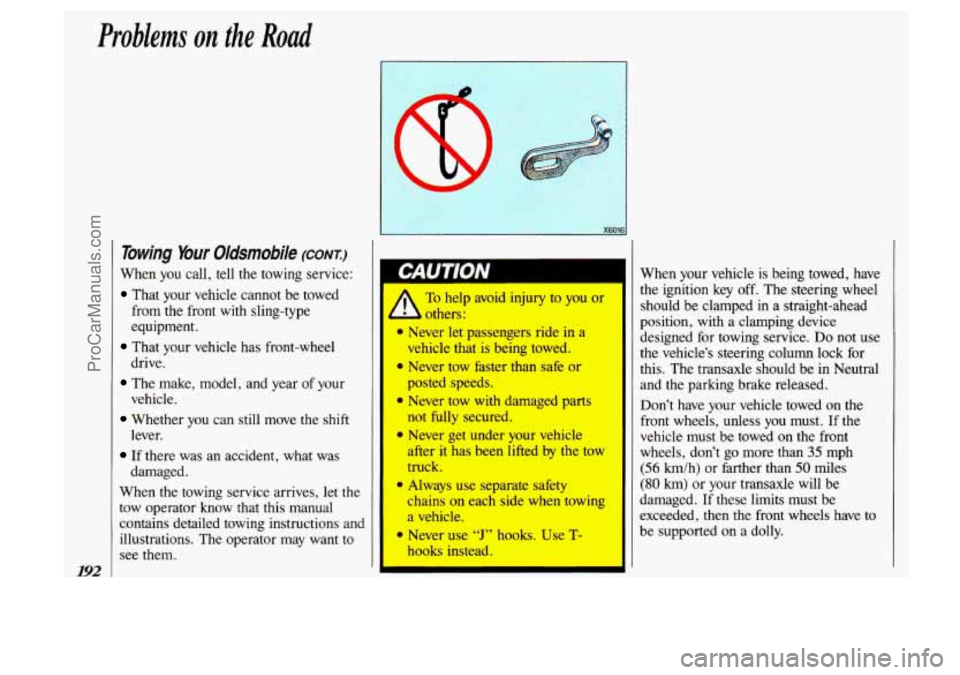
m,. ,
L ‘~‘n help avoid injury to you or
0 Never let passengers ride in a
vehicle that is
being towed.
* Never tow faster than safe or
0 Never tow with damaged parts
0 Never get under your vehicle
posted speeds.
not fully secured.
after it has been lifted by the tow
truck.
chains on each side when towing
a vehicle.
Never use “J” hooks. Use T-
hooks instead.
* Always use separate safety When your vehicle is being towed, have
the
ignition key
off. The steering wheel
should be clamped in a straight-ahead
position, with
a clamping device
designed for towing service. Do not use
the vehicle’s steering column lock for
this. The transaxle should be
in Neutral
and the parking brake released.
Don’t have your vehicle towed on
the
front wheels, unless you must. If the
vehicle must be towed on the front
wheels, don’t
go more than 35 mph
(56 km/h) or farther than 50 miles
(80 km) or your transaxle will be
damaged. If these limits must be
exceeded,
then the front wheels have to
be supported on a dolly.
ProCarManuals.com
Page 205 of 323
Ifa Tire Goes Hat
It’s unusual for a tire to “blow out”
while you’re driving, especially if
you
maintain your tires properly. If air goes
out of a tire, it’s much more likely to
leak out slowly. But if you should ever
have a “blowout:’ here are a few tips
about what
to expect and what to do:
If a front tire
fails, the flat tire will
create a drag that pulls
the vehicle
toward that side. Take your foot off the
accelerator pedal and grip the steering
wheel
firmly. Steer to maintain lane
position, then gently brake to a stop well
out of the traffic lane.
A rear blowout, particularly on a curve,
acts much like a skid and may require
the same correction you’d use in a skid.
In any rear blowout, remove your foot
from the accelerator pedal. Get
the
vehicle under control by steering the
way you want the vehicle to go.
It may
be very bumpy and noisy, but you can still steer. Gently brake to a stop, well
off the road if possible.
If your tire goes flat, the next section
shows how
to use your jacking
equipment to change a flat tire safely.
Air Inflator
Your vehicle may have an air inflator for
use
in bringing tires up to the proper
pressure.
To learn about it, see the Index
under Air Inflator System.
Inflating something too much
can make it explode, and
you
or others could be injured. Be sure
to read the inflator instructions and
inflate any object only to
its
recommended pressure.
I
203
ProCarManuals.com
Page 214 of 323
Problems on the Road
Compact Spare Tire
Although the compact spare was fully
inflated when your vehicle was new, it
can lose air after a time. Check the
inflation pressure regularly. It should
be
60 psi (420 Pa). The compact spare is
made to go up to
3,000 miles (5 000 km),
so you can finish your trip and have
your full-size tire repaired or replaced
where you want.
Of course, it’s best to
replace your spare with a full-size tire as
soon as you can. Your spare will last
longer and be
in good shape in case you
need it again.
Your anti-lock brake system warning
light may come on when you are driving
with a compact spare. See the
Index
under Anti-Lock Brake System Warning
Light.
Don’t use your compact spare on some
Don’t take your compact spare other vehicle.
through an automatic car wash
with guide rails. The compact
spare can get caught on the rails.
That can damage the tire and
wheel, and maybe other parts
of
your vehicle. And don’t
mix your compact
spare or
wheel with other wheels
or tires. They
won’t fit. Keep your spare
and its wheel
together.
ProCarManuals.com
Page 217 of 323
Here you will find information about
the care of your Oldsmobile
. This
part begins with service and fuel
information. and then it shows how to
check important fluid and lubricant levels
. There is also technical
information about your vehicle. and a section devoted to its appearance care
.
Part 6
Service di Appearance Care
Service ......................................................... 216
Fuel ........................................................... 217
HoodRelease
.................................................... 221
Engineoil
...................................................... 225
Aircleaner
..................................................... 230
TransaxleFluid
.................................................. 232
Enginecoolant
.................................................. 235
Power Steering Fluid
.............................................. 238
Windshield Washer Fluid
........................................... 239
Brakes
......................................................... 240
Battery
......................................................... 242
Bulb Replacement
................................................ 243
Windshield Wiper Blade Replacement
................................. 245
Loading Your Vehicle
............................................. 245
Tires
.......................................................... 247
Appearancecare ................................................. 254
Vehicle Identification Number (VIN)
................................. 262
Add-on Electrical Equipment
....................................... 263
Fuses
& Circuit Breakers ........................................... 264
Capacities
& Specifications ......................................... 269
Normal Maintenance Replacement Parts
............................... 271
Fluids
& Lubricants ............................................... 272
ReplacementBulbs
................................................ 273
215
ProCarManuals.com
Page 224 of 323
Service & Appearance Care
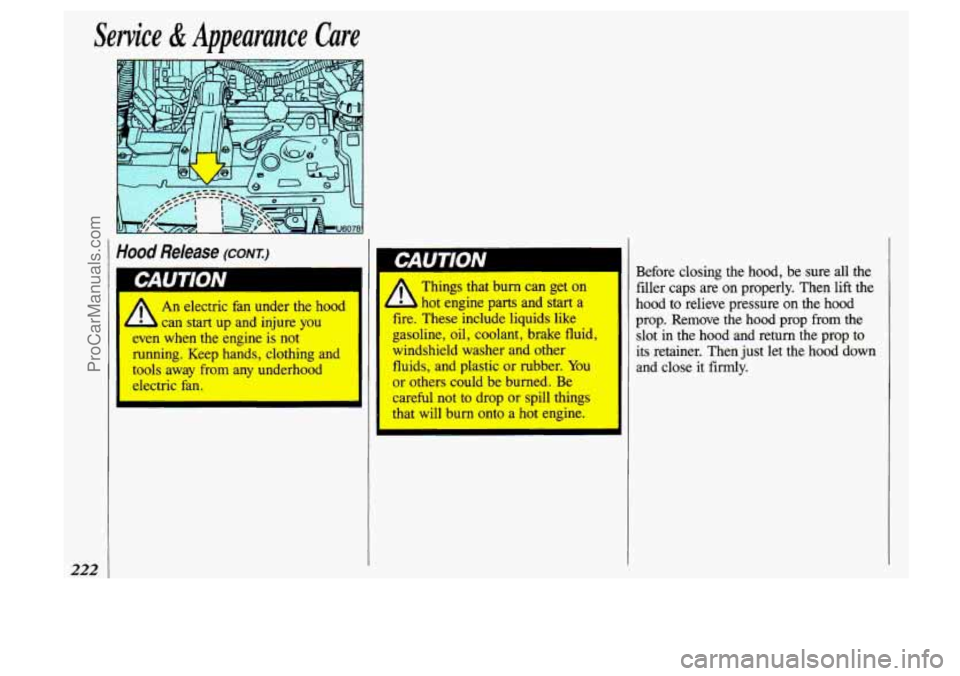
1 Hood Release (CONT.) I
I. CAUT'aN
An electric fan under the hood
can
start up and injure you
even when the engine is not
running. Keep hands, clothing and
tools away from any underhood
electric fan.
Things that burn can get on
hot engine parts and start a
~e. These include liquids like
gasoline, oil, coolant, brake fluid,
windshield washer and other
fluids, and plastic or rubber. You
or others could be burned. Be
cmh1 nut to drop or spill things
that wiU burn onto a hot engine.
Before closing the hood, be sure all the
filler caps are
on properly. Then lift the
hood
to relieve pressure on the hood
prop. Remove the hood prop from the
slot
in the hood and return the prop to
its retainer. Then just let the hood down
and close
it firmly.
*** I -- I
ProCarManuals.com
Page 225 of 323
P P
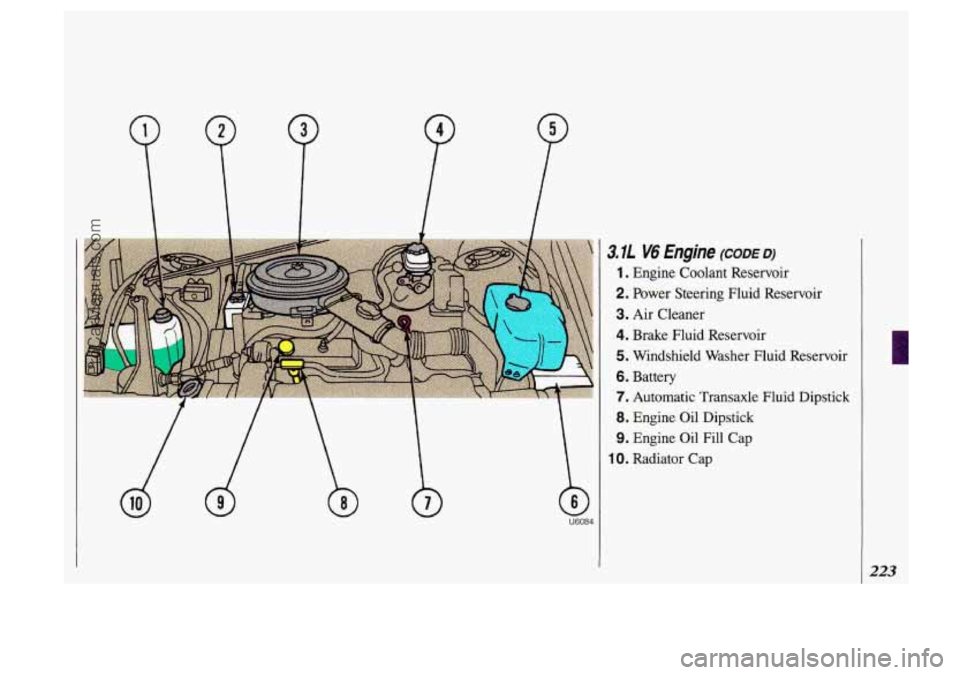
3,lL V6 Engine (CODE D)
1. Engine Coolant Reservoir
2. Power Steering Fluid Reservoir
3. Air Cleaner
4. Brake Fluid Reservoir
5. Windshield Washer Fluid Reservoir
6. Battery
7. Automatic Transaxle Fluid Dipstick
8. Engine Oil Dipstick
9. Engine Oil Fill Can
1 0. Radiator Cap
@ U6084
223
ProCarManuals.com
Page 226 of 323
Service & Appearance Cure
224
P P
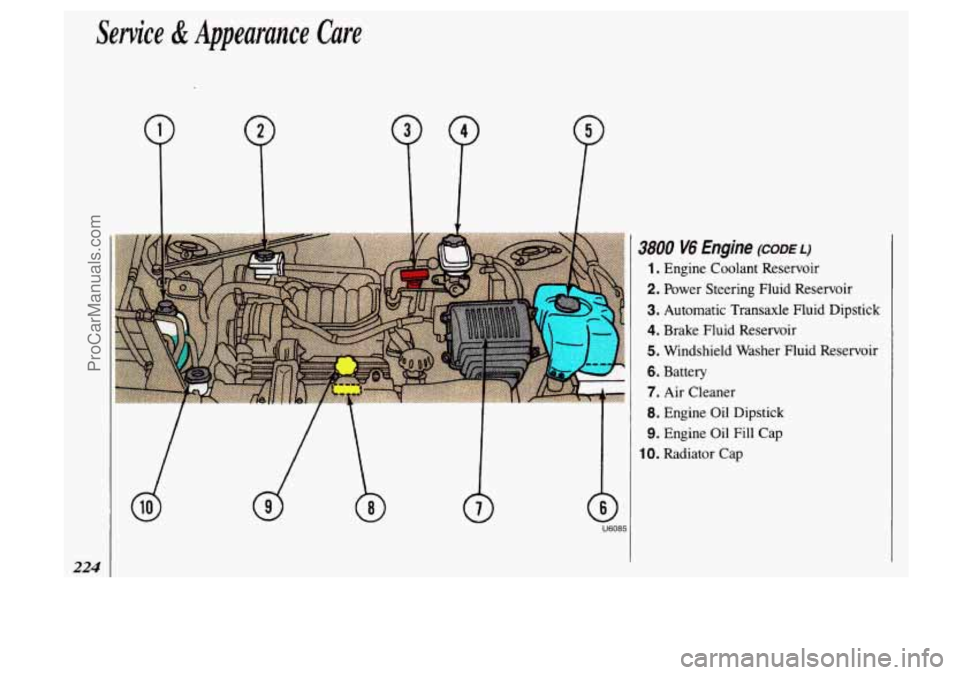
3800 V6 Engine (CODE L)
1 . Engine Coolant Reservoir
2. Power Steering Fluid Reservoir
3. Automatic Transaxle Fluid Dipstick
4. Brake Fluid Reservoir
5. Windshield Washer Fluid Reservoir
6. Battery
7. Air Cleaner
8. Engine Oil Dipstick
9. Engine Oil Fill Cap
10. Radiator Cap
(3 U6085
ProCarManuals.com