instrument panel OLDSMOBILE SILHOUETTE 1994 Owner's Manual
[x] Cancel search | Manufacturer: OLDSMOBILE, Model Year: 1994, Model line: SILHOUETTE, Model: OLDSMOBILE SILHOUETTE 1994Pages: 276, PDF Size: 15.82 MB
Page 117 of 276
Defogging and Defrosting
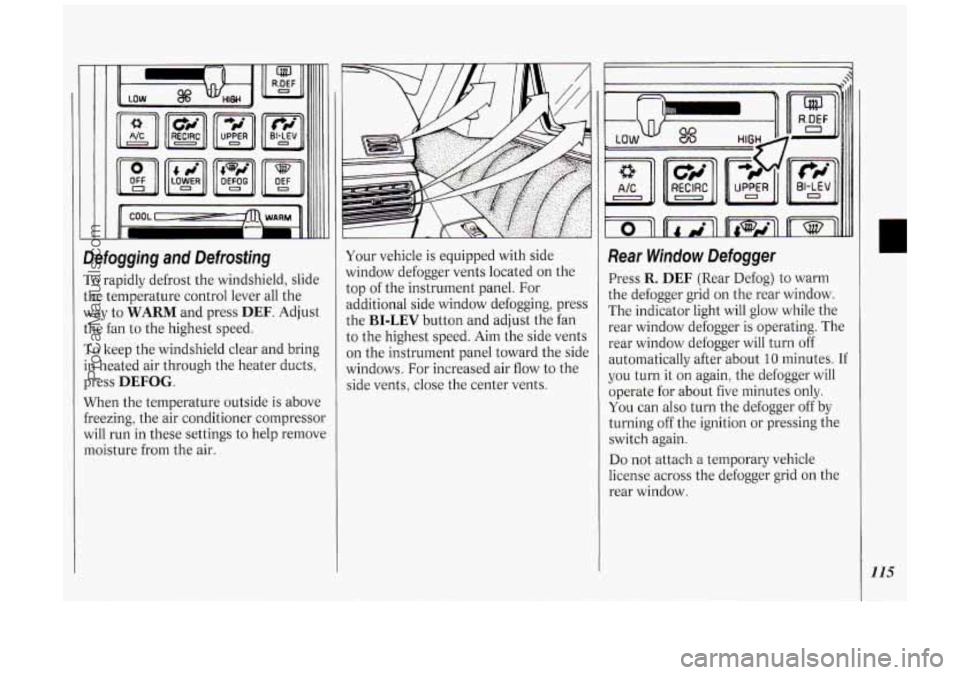
To rapidly defrost the windshield, slide
the temperature control lever all the
way to
WARM and press DEF. Adjust
the fan to the highest speed.
To keep the windshield clear and bring
in heated air through the heater ducts,
press
DEFOG.
When the temperature outside is above
freezing, the air conditioner compressor
will run in these settings to help remove
moisture from the air. Your vehicle
is equipped with side
window defogger vents located on the
top of the instrument panel. For
additional side window defogging, press
the
BI-LEV button and adjust the fan
to the highest speed. Aim the side vents
on the instrument panel toward the side
windows. For increased air flow to the
side vents, close the center vents.
Rear Window Defogger
Press R. DEF (Rear Defog) to warm
the defogger grid on the rear window.
The indicator light will glow while the
rear window defogger is operating. The
rear window defogger will turn off
automatically after about
10 minutes. If
you turn it on again, the defogger will
operate for about five minutes only.
You can also turn the defogger off by
turning off the ignition or pressing the
switch again.
Do not attach a temporary vehicle
license across the defogger grid on the
rear window.
115
ProCarManuals.com
Page 118 of 276
116
Comfort Controh di Audio Systems
NOTICE:
Don’t use a razor blade or
something else sharp on the inside
of the rear window. If you do, you
could cut or damage the warming
grid, and the repairs wouldn’t be
covered by your warranty.
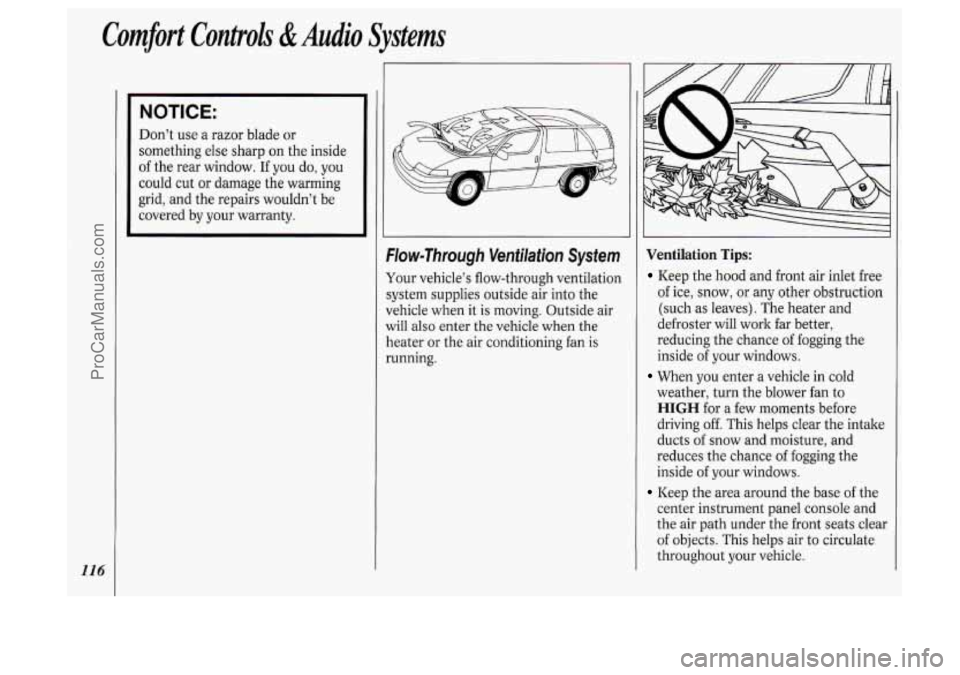
elow-Through Ventilation System
four vehicle’s flow-through ventilation
;ystem supplies outside air into the
{ehicle when
it is moving. Outside air
will also enter the vehicle when the
leater or the air conditioning fan is
sunning.
I I
Ventilation Tips:
Keep the hood and front air inlet free
of ice, snow, or any other obstruction
(such as leaves). The heater and
defroster will work far better,
reducing the chance of fogging the
inside of your windows.
When you enter a vehicle in cold
weather, turn the blower fan to
HIGH for a few moments before
driving off. This helps clear the intake
ducts of snow and moisture, and
reduces the chance of fogging the
inside of your windows.
Keep the area around the base of the
center instrument panel console and
the air path under the front seats clear
of objects. This helps air to circulate
throughout your vehicle.
ProCarManuals.com
Page 138 of 276
Your Driving and the Road
* x1000
136
i‘his light on the instrument panel will
go on when you start your vehicle.
When you start your vehicle, or when
jou begin to drive away, you may hear a
nomentary motor or clicking noise.
4nd you may even notice that your
)rake pedal moves
a little while this is
going on. This is the
ABS system
:esting itself.
(You may also hear a
:licking noise if you leave the ignition in
.he
Run position for about four seconds
Iefore starting the vehicle.) If there’s a
Jroblem with the anti-lock brake
iystem, the anti-lock brake system
Yarning light will stay on or flash.
See
Anti-Lock Brake System Warning
2ight
in the Index.
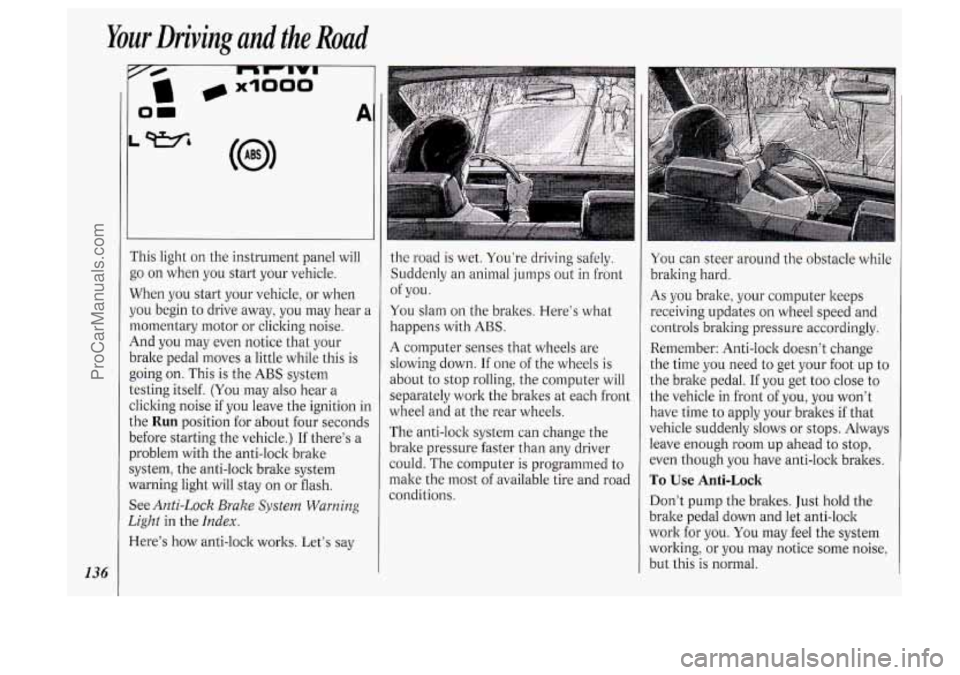
lere’s how anti-lock works. Let’s say
1
the road is wet. You’re driving safely.
Suddenly an animal jumps out
in front
You slam on the brakes. Here’s what
happens with
ABS.
A computer senses that wheels are
slowing down.
If one of the wheels is
about to stop rolling, the computer will
separately work the brakes at each front
wheel and at the rear wheels.
The anti-lock system can change the
brake pressure faster than any driver
could. The computer is programmed to
make the most of available tire and road
conditions. of
you.
You can steer around the obstacle while
braking hard.
As you brake, your computer keeps
receiving updates on wheel speed and
controls braking pressure accordingly.
Remember: Anti-lock doesn’t change
the time you need
to get your foot up to
the brake pedal.
If you get too close to
the vehicle in front of you, you won’t
have time to apply your brakes if that
vehicle suddenly slows or stops. Always
leave enough room up ahead to stop,
even though you have anti-lock brakes.
To Use Anti-Lock
Don’t pump the brakes. Just hold the
brake pedal down and let anti-lock
work for you. You may feel the system
working, or you may notice some noise,
but this is normal.
ProCarManuals.com
Page 140 of 276

Your Driving and the Road
138
I’he traction control system
mtomatically comes
on whenever you
start your vehicle.
To limit wheel spin, especially in
slippery road conditions, you should
dways leave the system on. But you can
:urn the traction control system off if
IOU ever need to. (You should turn the
;ystem off
if your vehicle ever gets stuck
n sand, mud, ice or snow. See Rocking
Your Vehicle in the Index.)
To turn the system off, press the switch
ocated on the center instrument panel
:onsole.
The light on the switch will go
off. If the
Lraction control system is limiting wheel
;pin when you press the switch, the
;ystem won’t turn
off right away. It will wait until
there’s
no longer a current
need to limit wheel spin.
You can turn the system back on at any
time by pressing the switch again. The
light
on the switch should come on.
Braking in Emergencies
Use your anti-lock braking system when
you need to. With anti-lock, you can
steer and brake at the same time.
In
many emergencies, steering can help
you more than even the very best
braking.
Steering
Power Steering
If you lose power steering assist
because the engine stops or the system
is not functioning, you can steer but it
will take much more effort.
Steering Tips
Driving on Curves
It’s important to take curves at a
reasonable speed.
A lot of the “driver lost control”
accidents mentioned on the news
happen
on curves. Here’s why:
Experienced driver or beginner, each of
us is subject to the same laws of physics
when driving
on curves. The traction of
the tires against the road surface makes
it possible for the vehicle to change its
path when you turn the front wheels. If
there’s
no traction, inertia will keep the
vehicle going in the same direction.
If
you’ve ever tried to steer a vehicle on
wet ice, you’ll understand this.
The traction you can get in a curve
depends
on the condition of your tires
and the road surface, the angle at which
the curve is banked, and your speed.
While you’re in a curve, speed
is the one
factor you can control.
Suppose you’re steering through a
sharp curve. Then you suddenly
accelerate. Both control systems
-
steering and acceleration - have to do
their work where the tires meet the
road. Unless you have traction control
and the system is on, adding the sudden
acceleration can demand too much
of
those places. You can lose control.
ProCarManuals.com
Page 157 of 276
During your trip, check occasionally to
be sure that the load is secure, and that
the lights and
any trailer brakes are still
working.
Following Distance
Stay at least twice as far behind the
vehicle ahead as you would when
driving your vehicle without a trailer.
This can help you avoid situations that
require heavy braking and sudden
turns.
Passing
You’ll need more passing distance up
ahead when you’re towing a trailer.
And, because you’re a good deal longer,
you’ll need to go much farther beyond
the passed vehicle before you can return
to your lane.
Backing Up
Hold the bottom of the steering wheel
with one hand. Then, to move the
trailer to the left, just move that hand to
the left.
To move the trailer to the right,
move your hand to the right. Always back up
slowly and, if possible, have
someone guide you.
Making Turns
When you’re turning with a trailer,
make wider turns than normal. Do this
so your trailer won’t strike soft
shoulders, curbs, road signs, trees, or
other objects. Avoid jerky or sudden
maneuvers. Signal well in advance.
Turn Signals When Towing a
Trailer
When you tow a trailer, your vehicle has
to have a different turn signal flasher
and extra wiring. The green arrows on
your instrument panel will flash
whenever you signal a turn or lane
change. Properly hooked up, the trailer
lights will
also flash, telling other
drivers you’re about to turn, change
lanes or stop.
When towing a trailer, the green arrows
on your instrument panel will flash for
turns even
if the bulbs on the trailer are
burned out. Thus, you may think
drivers behind you are seeing your signal
when they are not.
It’s important
to check occasionally to be sure the
trailer bulbs are still working.
Driving On Grades
Reduce speed and shift to a lower gear
before you start down a long or steep
downgrade. If you don’t
shift down, you
might have to use your brakes
so much
that they would get hot and
no longer
work well.
On a long uphill grade, shift down and
reduce your speed to around
45 mph
(70 lwh) to reduce the possibility of
engine and transaxle overheating.
If you are towing a trailer that weighs
more than
1,000 pounds (454 kg), and
you have an automatic transaxle with
Overdrive, you may prefer to drive in
D
instead of Overdrive (or, as you need to,
a lower gear). This will minimize heat
build-up and extend the life of your
transaxle.
n
ProCarManuals.com
Page 167 of 276
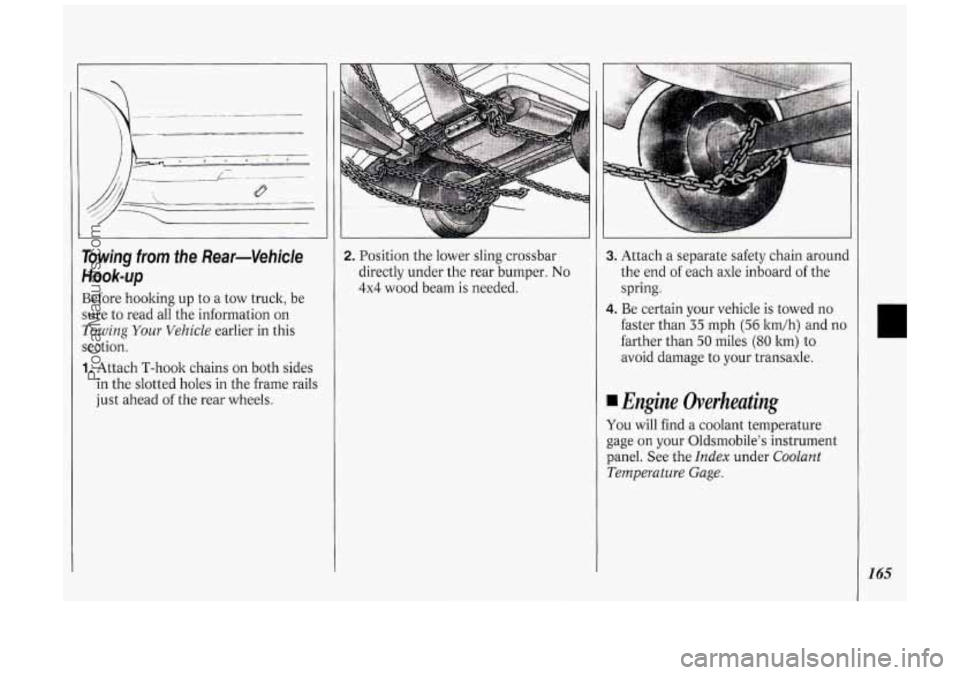
Towing from fhe Rear-Vehicle
HOOk-Up
Before hooking up to a tow truck, be
sure to read all the information
on
Towing Your Vehicle earlier in this
section.
1. Attach T-hook chains on both sides
in the slotted holes in the frame rails
just ahead
of the rear wheels.
I
2. Position the lower sling crossbar
directly under the rear bumper. No
4x4 wood beam is needed.
3. Attach a separate safety chain around
the end of each axle inboard
of the
spring.
4. Be certain your vehicle is towed no
faster than
35 rnph (56 ltm/h) and no
farther than
50 miles (80 ltm) to
avoid damage to your transaxle.
Engine Overheating
You will find a coolant temperature
gage on your Oldsmobile's instrument
panel. See the
Index under Coolant
Temperature Gage.
1
165
ProCarManuals.com
Page 216 of 276
Service & Appearance Care
I If a stain remains, follow the foam-
type instructions described earlier.
If an odor lingers after cleaning vomit
or urine, treat the area with a
waterbaking soda solution:
1
teaspoon (5 ml) of baking soda to 1
cup (250 ml) of lukewarm water.
If needed, clean lightly with solvent-
type cleaner.
Combination Stains
Such as candy, ice cream, mayonnaise,
chili sauce and unknown stains.
9 Carefully scrape off excess stain, then
clean with cool water and allow to
dry.
solvent-type cleaner.
If a stain remains, clean it with
Cleaning Vinyl
Use warn1 water and a clean cloth.
Rub with a clean, damp cloth to
remove dirt.
You may have to do it
more than once.
polish will stain if you don’t get them
Things like tar, asphalt and shoe
214
off quickly. Use a clean cloth and a
solvent-type vinyl cleaner.
Cleaning Leather
Use a soft cloth with lukewarm water
and a mild soap or saddle soap.
For stubborn stains, use a mild
solution of
10% isopropyl alcohol
(rubbing alcohol) and
90% water.
Never use oils, varnishes, solvent-
based or abrasive cleaners, furniture
polish or shoe polish on leather.
Soiled leather should be cleaned
immediately.
If dirt is allowed to work
into finish, it can harm the leather.
Cleaning the Top of the
Instrument Panel
Use only mild soap and water to clean
the top surfaces
of the instrument
panel. Sprays containing silicones
or
waxes may cause annoying reflections
in the windshield and even make it
difficult to see through the windshield
under certain conditions. Vacuum
the carpeted area as needed,
and clean as you would any other
carpet.
Care of Safety Belts
Keep belts clean and dry.
I
I
ProCarManuals.com
Page 220 of 276
Service & Appearance Care
218
Yehicle Identijication
Number
(VIN)
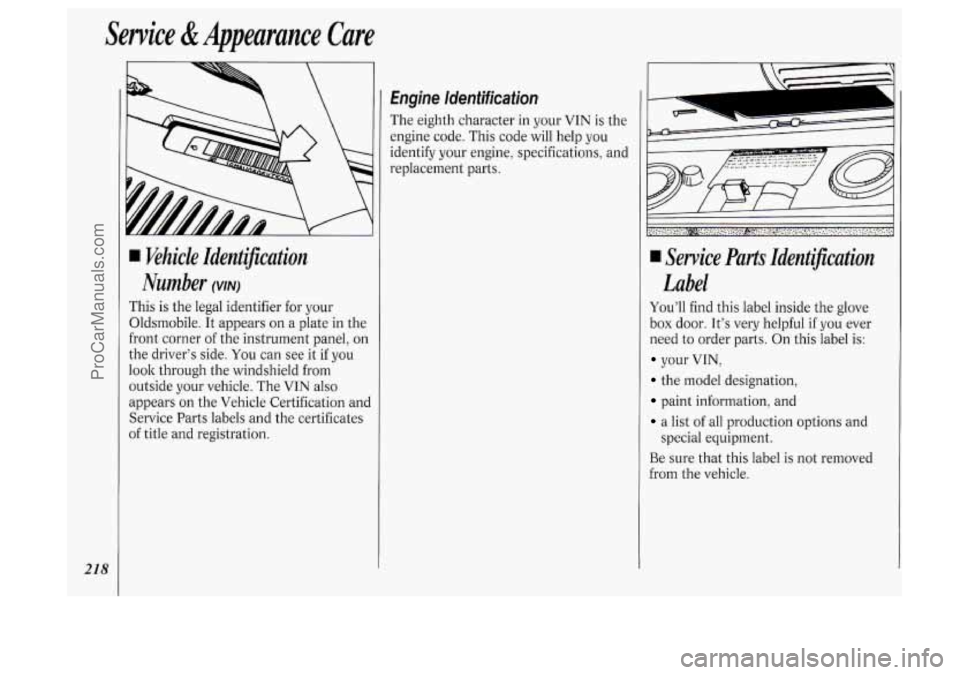
This is the legal identifier for your
Oldsmobile. It appears on a plate in the
front corner of the instrument panel, on
the driver’s side.
You can see it if you
look through the windshield from
outside your vehicle. The
VIN also
appears on the Vehicle Certification and
Service Parts labels and the certificates
of title and registration.
Engine ldenfificafion
The eighth character in your VIN is the
engine code. This code will help you
identify your engine, specifications, and
replacement parts.
1
._. _. .- .. .. .-
~.:~:~.~~~:~~~~:;~~~~~:~;.’:~,‘~~~.~~~~.~:~~~~;~:~,~~~;~~.~~,~;.~~\
~,~~~:~;:~~~::~~~:::.~,~~.’.~:. . . . . . . , . . .
Service Parts Identz!jication
Label
You’ll find this label inside the glove
box door. It’s very helpful if you ever
need to order parts. On this label is:
your VIN,
the model designation,
paint information, and
a list of all production options and
Be sure that this label is not removed
from the vehicle.
special equipment.
ProCarManuals.com
Page 252 of 276
Customer Assistance Infomation
250
I Customer Satiflaction
Procedure
four satisfaction and goodwill are
.mportant to your dealer and
3ldsmobile. Normally, any concern
with the sales transaction or the
)peration of your vehicle will be
Sesolved by your dealer’s Sales or
Service Departments. Sometimes,
lowever, despite the best intentions of
dl concerned, misunderstandings can
jccur. If your concern has not been
Sesolved to your satisfaction, the
:allowing steps should be taken:
STEP ONE - Discuss your concern
vith a member
of dealership
nanagement. Complaints can often be
picltly resolved at that level. If the matter has
already been reviewed with
the Sales, Service, or Parts Manager,
contact the owner of the dealership or
the General Manager.
STEP TWO - If after contacting a
member of dealership management, it
appears your concern cannot be
resolved by the dealership without
further help, contact the Oldsmobile
Customer Assistance Network by
calling 1-800-442-6537. In Canada,
contact GM of Canada Customer
Assistance Center in Oshawa by calling
1-800-263-3777 (English) or
1-800-263-7854 (French).
In Mexico, call
(525) 254-3777. In
Puerto Rico or
U.S. Virgin Islands, call
1-809-763-1315. In all other overseas
locations, contact GM North American
Export Sales in Canada by calling
For prompt assistance, please have the
following information available to give
the Customer Assistance
Representative:
Your name, address, telephone
1-416-644-4112.
number
Vehicle Identification Number (This
is available from the vehicle
registration or title, or the plate at the
left top of the instrument panel and
visible through the windshield.)
Dealership name and location
Vehicle delivery date and present
Nature of concern
We encourage you to call the toll free
number listed previously in order to
give your inquiry prompt attention.
However, if you wish to write
Oldsmobile, write to
United States
Customer Assistance Representative
Oldsmobile Central Office
920 Townsend Street
P.O.
Box 30095
Lansing,
MI 48909
Canada
General Motors of Canada Limited
Customer Assistance Center 1908 Colonel Sam Drive
Oshawa, Ontario
L1H 8P7
mileage
ProCarManuals.com
Page 266 of 276
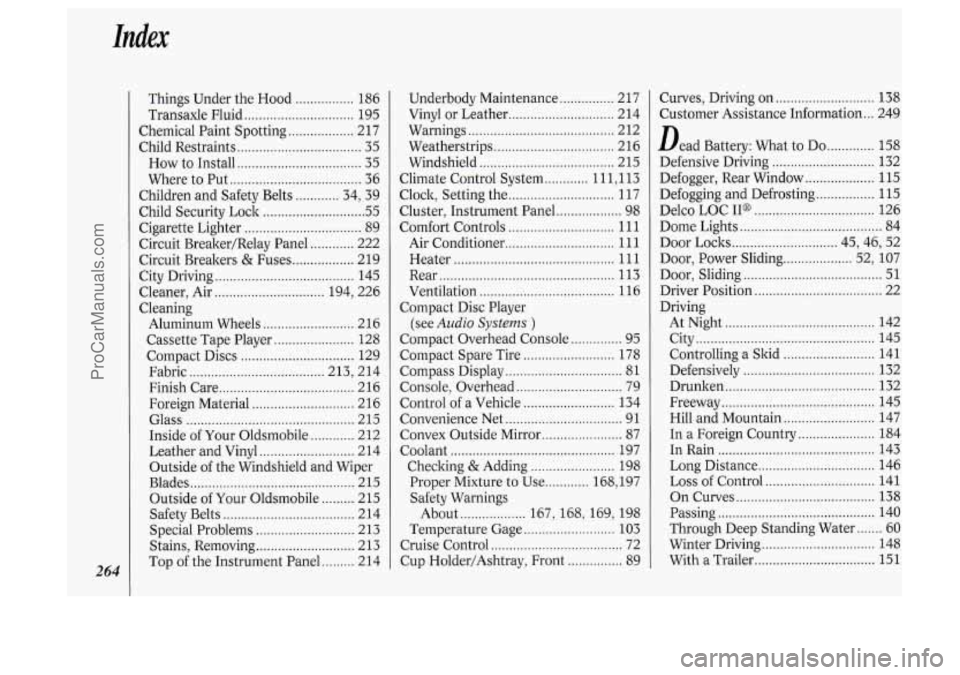
264
Things Under the Hood ................ 186
Transaxle Fluid
.............................. 195
Chemical Paint Spotting
.................. 217
Child Restraints
.................................. 35
How to Install
.................................. 35
Where to Put
.................................... 36
Children and Safety Belts
............ 34. 39
Child Security Lock
............................ 55
Circuit BrealtedRelay Panel ............ 222
Circuit Breakers
& Fuses ................. 219
City Driving
...................................... 145
Cleaner, Air
.............................. 194, 226
Cleaning Aluminum Wheels
......................... 216
Compact Discs
............................... 129
Fabric
..................................... 213, 214
Finish Care
..................................... 216
Foreign Material
............................ 2 16
Glass
.............................................. 215
Inside of Your Oldsmobile
............ 212
Leather and Vinyl
.......................... 214
Outside
of the Windshield and Wiper
Blades
............................................. 215
Outside
of Your Oldsmobile ......... 215
Safety Belts
.................................... 214
Special Problems
........................... 213
Stains. Removing
........................... 213
Cigarette Lighter
................................ 89
Cassette Tape Player
...................... 128
Top of the Instrument Panel
......... 214 Underbody
Maintenance
............... 217
Vinyl or Leather
............................. 214
Warnings
........................................ 2 12
Weatherstrips
................................. 216
Windshield
..................................... 215
Climate Control System
............ 11 1. 113
Clock. Setting the
............................. 117
Cluster. Instrument Panel .................. 98
Comfort Controls
............................. 11 1
Air Conditioner .............................. 11 1
Heater ............................................ 111
Rear ................................................ 113
Ventilation ..................................... 1 16
(see
Audio Systems )
Compact Disc Player
Compact Overhead Console
.............. 95
Compact Spare Tire
......................... 178
Compass Display
................................ 81
Console, Overhead ............................. 79
Control
of a Vehicle ......................... 134
Convenience Net
................................ 91
Convex Outside Mirror
...................... 87
Coolant ............................................. 197
Checking
& Adding ....................... 198
Proper Mixture to Use
............ 168, 197
Safety Warnings About
.................. 167, 168, 169, 198
Temperature Gage
......................... 103
Cruise Control
.................................... 72
Cup Holder/Ashtray, Front
............... 89 Curves. Driving
on
........................... 138
Customer Assistance Information
... 249
Dead Battery: What to
Do ............. 158
Defensive Driving
............................ 132
Defogger. Rear Window
................... 115
Defogging and Defrosting
................ 115
Delco LOC II@
................................. 126
Dome Lights
....................................... 84
Door Locks
............................. 45. 46. 52
Door. Power Sliding ................... 52. 107
Door. Sliding
...................................... 51
Driver Position
................................... 22
Driving At Night
......................................... 142
City
................................................. 145
Controlling a Skid
......................... 141
Defensively
.................................... 132
Drunlten
......................................... 132
Freeway
.......................................... 145
Hill and Mountain
......................... 147
In a Foreign Country ..................... 184
In Rain
........................................... 143
Long Distance
................................ 146
Loss
of Control .............................. 141
On Curves
...................................... 138
Passing ........................................... 140
Through Deep Standing Water
....... 60
Winter Driving
............................... 148
With a Trailer
................................. 151
ProCarManuals.com