lock OLDSMOBILE SILHOUETTE 1994 Workshop Manual
[x] Cancel search | Manufacturer: OLDSMOBILE, Model Year: 1994, Model line: SILHOUETTE, Model: OLDSMOBILE SILHOUETTE 1994Pages: 276, PDF Size: 15.82 MB
Page 151 of 276
Whatever the condition - smooth ice,
packed, blowing or loose snow
- drive
with caution.
If you have the traction control system,
keep the system on. It will improve your
ability to accelerate when driving on a
slippery road. Even though your vehicle
has a traction control system, you’ll
want to slow down and adjust your
driving to the road conditions. See
Traction Control System in the Index.
If you don’t have the traction control
system, accelerate gently. Try not to
break the fragile traction. If you
accelerate too fast, the drive wheels will
spin and polish the surface under the
tires even more.
Your anti-lock brakes improve your
ability to make a hard stop
on a slippery
road. Even though you have an anti-
lock braking system, you’ll want to
begin stopping sooner than you would
on dry pavement. See
Anti-lock in the
Index.
Allow greater following distance on
any slippery road.
Watch for slippery spots. The road
might be fine until you hit a spot that’s
covered with ice.
On an
otherwise clear road, ice patches may
appear in shaded areas where the
sun
can’t reach: around clumps of trees,
behind buildings, or under bridges.
Sometimes the surface of a curve or
an overpass may remain icy when the
surrounding roads are clear. If you see
a patch of ice ahead of you, brake
before you are
on it. Try not to brake
while you’re actually on the ice, and
avoid sudden steering maneuvers.
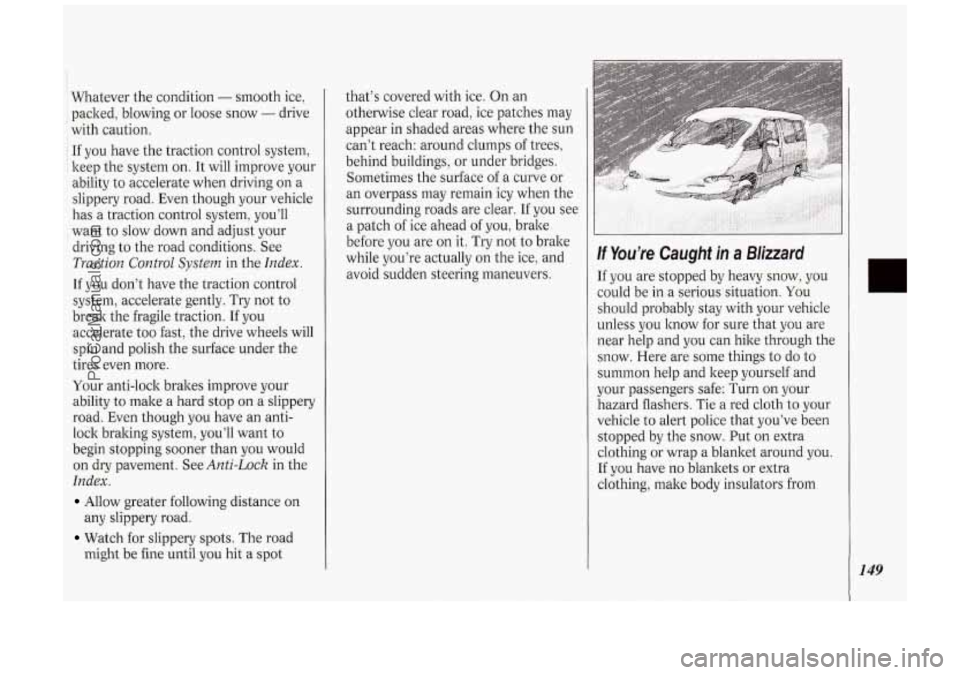
If You’re Caught in a Blizzard
If you are stopped by heavy snow, you
could be in a serious situation.
You
should probably stay with your vehicle
unless you know for sure that you are
near help and you can hike through the
snow. Here are some things to do to
summon help and keep yourself and
your passengers safe: Turn on your
hazard flashers. Tie a red cloth to your
vehicle
to alert police that you’ve been
stopped by the snow. Put on extra
clothing or wrap a blanket around you.
If you have no blankets or extra
clothing, make body insulators from
149
ProCarManuals.com
Page 156 of 276
Your Driving and the Road
154
hitches to them. Use only a frame-
mounted hitch that does not attach to
the bumper.
Safety Chains
You should always attach chains
between
your vehicle and your trailer.
Cross the safety chains under the
tongue of the trailer
so that the tongue
will not drop to the road if it becomes
separated from the hitch. Instructions
about safety chains may be provided by
the hitch manufacturer
or by the trailer
manufacturer. Follow the
manufacturer’s recommendation for
attaching safety chains. Always leave
just enough slack
so you can turn with
your rig. And, never allow safety chains
to drag on the ground.
Trailer Brakes
If your trailer weighs more than 1,000
pounds (450 kg) loaded, then it needs
its own brakes
- and they must be
adequate. Be sure to read and follow
the instructions for the trailer brakes
so
you’ll be able to install, adjust and
maintain them properly. Because
you have anti-lock brakes, do
not try to tap into your vehicle‘s brake
system. If you do, both brake systems
won’t work well, or at all.
Driving with a Trailer
Towing a trailer requires a certain
amount of experience. Before setting
out for the open road,
you’ll want to get
to know your rig. Acquaint yourself
with the feel of handling and braking
with the added weight of the trailer.
And always keep in mind that the
vehicle you are driving is now a good
deal longer and not nearly
so responsive
as your vehicle is by itself.
Before you start, check the trailer hitch
and platform, safety chains, electrical
connector, lights, tires and mirror
adjustment. If the trailer has electric
brakes, start your vehicle and trailer
moving and then apply the trailer brake
controller by hand to be sure the brakes
are working. This lets you check your
electrical connection at the same time.
ProCarManuals.com
Page 165 of 276

When you call, tell the towing service:
That your vehicle cannot be towed
from the front with sling-type
equipment.
drive.
vehicle.
lever. damaged.
That your vehicle has front-wheel
The make, model, and year of your
Whether you can still move the shift
If there W~S an accident, what was
When the towing service arrives, let the
tow operator know that this manual
contains detailed towing instructions
and illustrations. The operator may
want to see them.
I should be clamped in a straight-ahead
When your vehicle
is being towed, have
the ignition key
off. The steering wheel designed for towing service.
Do not
use
the vehicle’s steering column lock for
this. The transaxle should be in Neutral
and the parking brake released.
Don’t have your vehicle towed on the
front wheels, unless
you must. If the
vehicle must be towed on the front
wheels, don’t go more than
35 mph (56
l
If these
limits must be exceeded, then the front
wheels have to be supported on a dolly.
1 63
ProCarManuals.com
Page 176 of 276
Problems on the Road
I 74
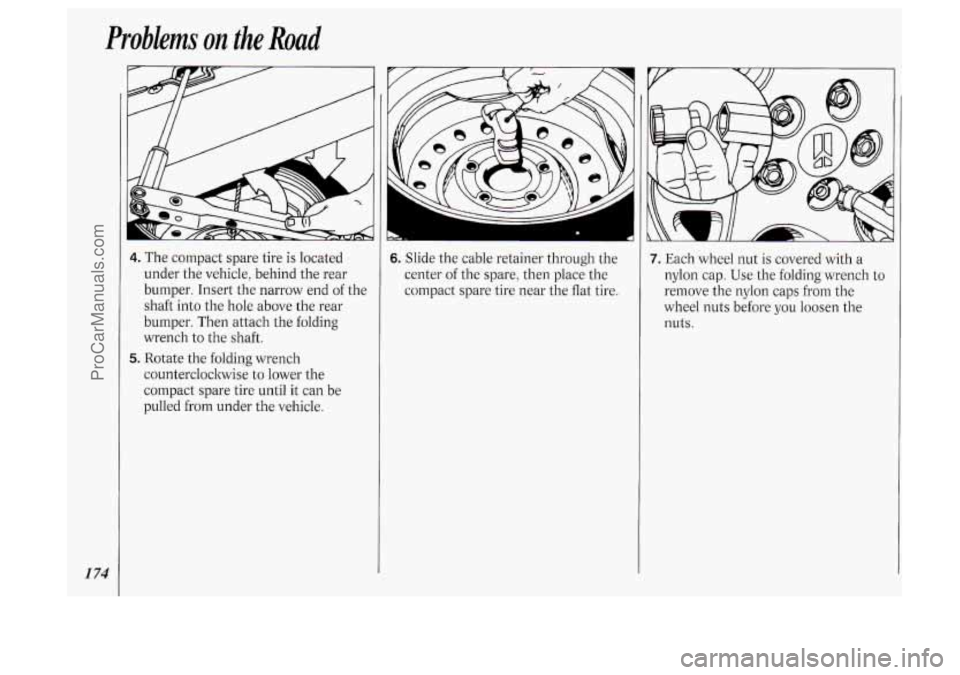
4. The compact spare tire is located
under the vehicle, behind the rear
bumper. Insert the narrow end of the
shaft into the hole above the rear
bumper. Then attach the folding
wrench to the shaft.
counterclockwise to lower the
compact spare tire until
it can be
pulled from under the vehicle.
5. Rotate the folding wrench
I
6. Slide the cable retainer through the
center of the spare, then place the
compact spare tire near the flat tire.
I
7. Each wheel nut is covered with a
nylon cap. Use the folding wrench to
remove the nylon caps from the
wheel nuts before
you loosen the
nuts.
ProCarManuals.com
Page 178 of 276
Problems on the Road
1 76
NOTICE:
Raising your vehicle with the jack
improperly positioned will damage
the vehicle or may allow the vehicle
to fall off the jack. Be sure to fit the
jack lift head into the proper
location before raising your vehicle.
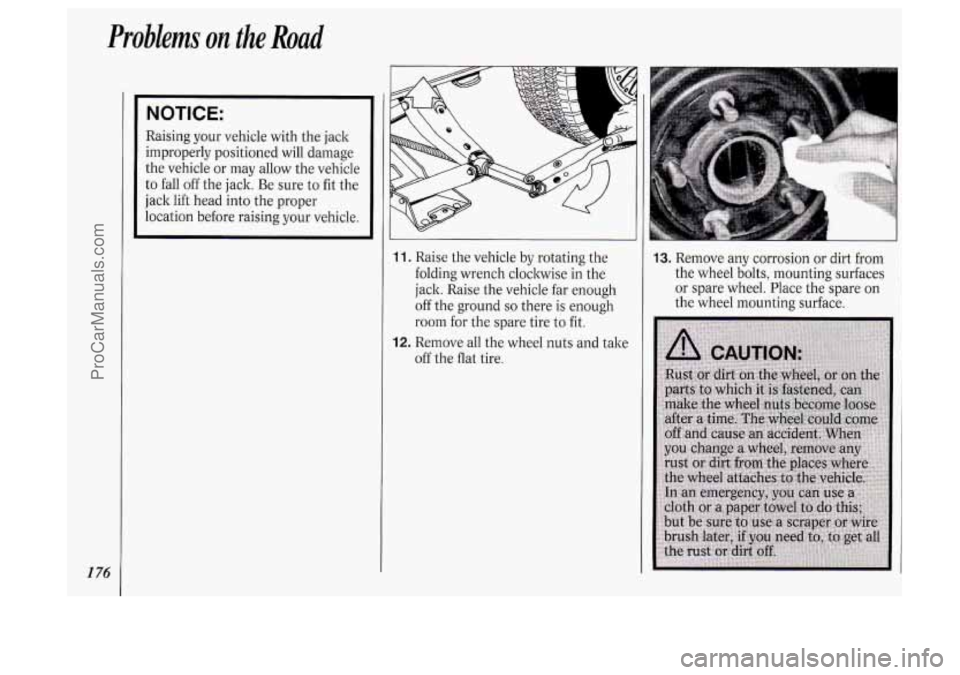
11. Raise the vehicle by rotating the
folding wrench clockwise in the
jack. Raise the vehicle far enough
off the ground
so there is enough
room for the spare tire to fit.
12. Remove all the wheel nuts and take
off the
flat tire.
3. Remove any corrosion or dirt from
the wheel bolts, mounting surfaces
or spare wheel. Place the spare on
the wheel mounting surface.
ProCarManuals.com
Page 179 of 276
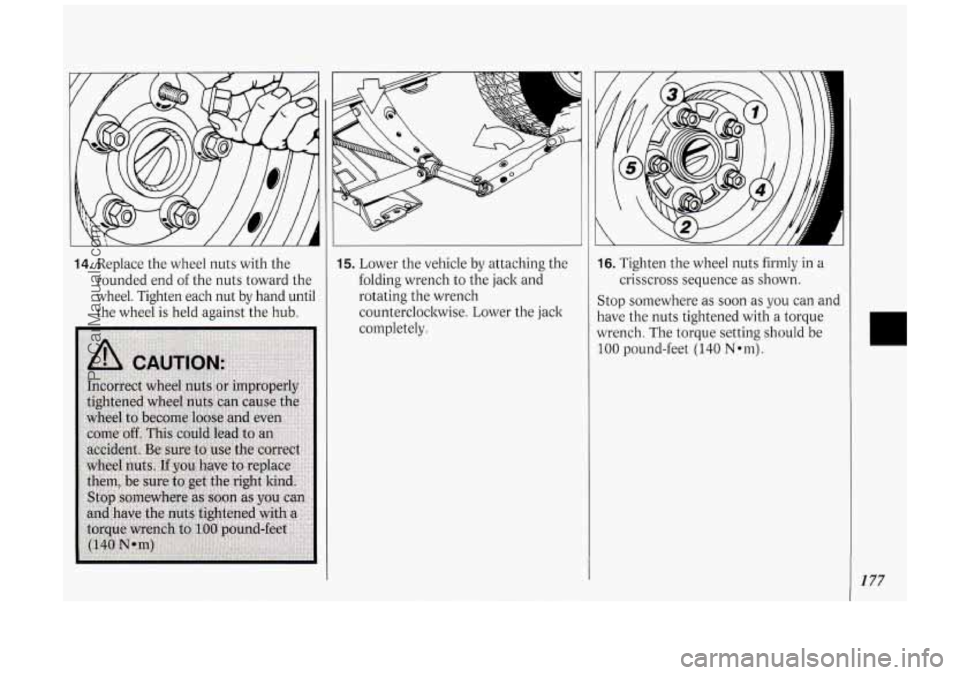
14. Replace the wheel nuts with the
rounded end of the nuts toward the
wheel. Tighten each nut by hand until
the wheel is held against the hub.
I
15. Lower the vehicle by attaching the
folding wrench to the jack and
rotating the wrench
counterclockwise. Lower the jack
completely.
I
16. Tighten the wheel nuts firmly in a
crisscross sequence as shown.
Stop somewhere as soon as you can and
have the nuts tightened with a torque
wrench. The torque setting should be
100 pound-feet (140 Nmm).
177
ProCarManuals.com
Page 195 of 276
As shown in the chart, SAE 5W-30 is
best for your vehicle. However, you can
use SAE 1OW-30 if it’s going
to be 0°F
(-18°C) or above. These numbers on an
oil container show
its viscosity, or
thickness.
Do not use other viscosity oils,
such as SAE 1OW-40 or SAE 20W-50.
If you cannot find oils with the new
“starburst” symbol on the front of the
container, you should look for and use
oils containing the following three things:
SH or SG
“SH’ or “SG’ must be on the oil container,
either by itself or combined with other
quality designations, such as “SHKD,”
“SH,SG,CD,” “SG/CD,” etc. These
letters show American Petroleum
Institute (API) levels of quality.
SAE 1OW-30 (3800 engine)
SAE 5W-30 (3100 engine)
Energy Conserving I1
Oils with these words on the
container will help you save fuel.
These three things are usually included
in a doughnut shaped logo (symbol) on
most containers.
If you cannot find oils
with the “starburst” symbol,
you should
look for oils with the doughnut shaped
symbol, containing the three things
noted above. If
you use oils that do not have
either the “starburst” symbol or an
API SH or
SG designation, you can
cause engine damage not covered
by your warranty.
GM Goodwrench@ oil (in Canada, GM
Engine Oil) meets all the requirements
for your vehicle.
Engine Oil Additives
Don’t add anything to your oil. Your
Oldsmobile dealer is ready to advise if
you think something should be added.
When to Change Engine Oil
See if any one of these is true for you:
Most trips are less than 4 miles (6 ltm).
It’s below freezing outside and most
trips are less than
10 miles (16 ltm).
The engine is at low speed most of the
time
(as in door-to-door delivery, or in
stop-and-go traffic).
You tow a trailer often.
Most trips are through dusty places.
If any one of these is true for your vehicle,
then you need to change your
oil and
filter every 3,000 miles (5 000 ltm) or 3
months - whichever comes first.
If none
of them is true, change the oil
every
7,500 miles (12 500 ltm) or 12
months -whichever comes first.
Change the filter at the first oil change
and at every other oil change after that.
Engine Coolant Heater (Engine
Block Heater)
An engine coolant heater can be a big
help if you have to park outside in very
cold weather,
0°F (-18°C) or colder. If
your vehicle has this option, see
Engine
Coolant Heater in the Index. 193
ProCarManuals.com
Page 206 of 276
Service &Appearance Care
204
Headlight Bulb Replacement
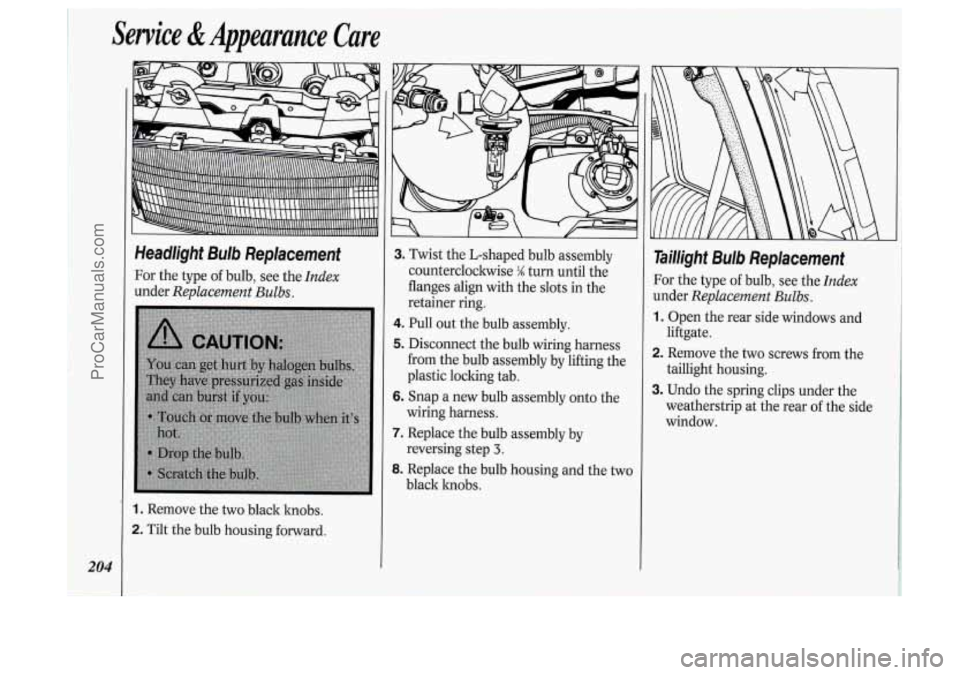
For the type of bulb, see the Index
under Replacement Bulbs.
1. Remove the two black knobs.
2. Tilt the bulb housing forward.
3. Twist the L-shaped bulb assembly
counterclockwise
M turn until the
flanges align with the slots in the
retainer ring.
4. Pull out the bulb assembly.
5. Disconnect the bulb wiring harness
from the bulb assembly by lifting the
plastic locking tab.
6. Snap a new bulb assembly onto the
7. Replace the bulb assembly by
8. Replace the bulb housing and the two
wiring harness.
reversing step
3.
black knobs.
Taillight Bulb Replacement
For the type of bulb, see the Index
under Replacement Bulbs.
1. Open the rear side windows and
2. Remove the two screws from the
3. Undo the spring clips under the
liftgate.
taillight housing.
weatherstrip at the rear of the side
window.
ProCarManuals.com
Page 207 of 276
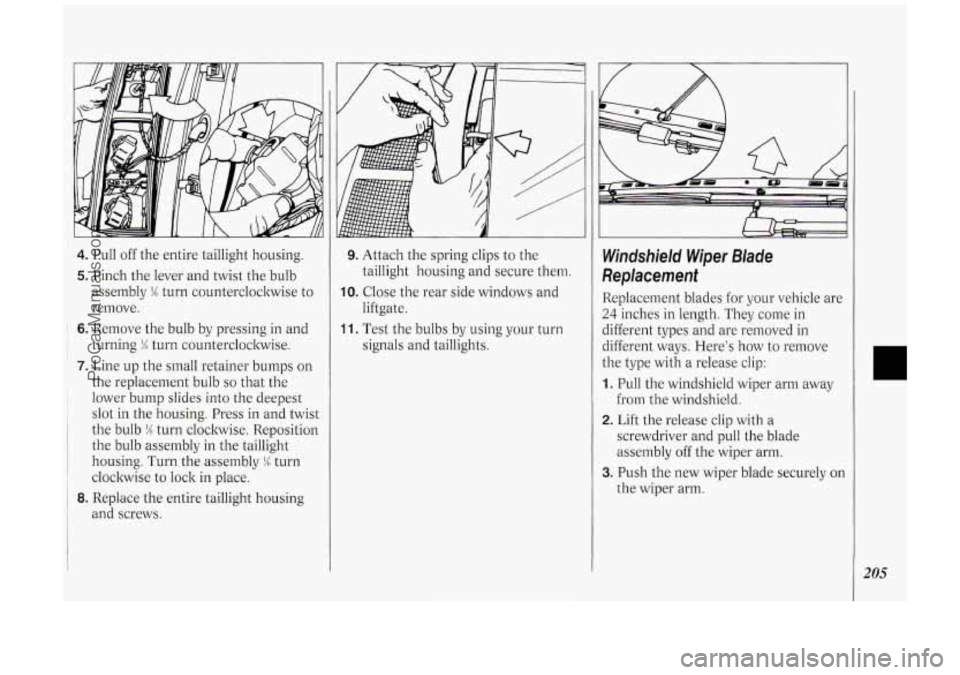
4. Pull off the entire taillight housing.
5. Pinch the lever and twist the bulb
assembly
M turn countercloclwise to
remove.
~ 6. Remove the bulb by pressing in and
1 turning % turn counterclockwise.
7. Line up the small retainer bumps on
the replacement bulb
so that the
1 lower bump slides into the deepest
' slot in the housing. Press in and twist
the bulb
!4 turn clockwise. Reposition
the bulb assembly in the taillight
housing. Turn the assembly
M turn
clockwise to lock in place.
' 8. Replace the entire taillight housing
and screws.
9. Attach the spring clips to the
taillight housing and secure them.
liftgate.
signals and taillights.
IO. Close the rear side windows and
11. Test the bulbs by using your turn
Windshield Wiper Blade
Replacement
Replacement blades for your vehicle are
24 inches in length. They come in
different types and are removed in
different ways. Here's how to remove
the type with a release clip:
1. Pull the windshield wiper arm away
from the windshield.
2. Lift the release clip with a
screwdriver and pull the blade
assembly off the wiper arm.
the wiper arm.
3. Push the new wiper blade securely on
205
ProCarManuals.com
Page 222 of 276
![OLDSMOBILE SILHOUETTE 1994 Workshop Manual Service &Appeurunce Cure
220
+I
r=J
HORN
prpl
m
STOP-HA2 F-PUMP
m3 AUX
r?]
.pg
TURN BIU
GAGE
prpl LPS
(31 ABS
RDO 2
pTo4
ca
rn
ca
R-WIPER F-WIPER
rfpl IGN
HTR-A/C R-BLWR
Posi](/img/31/58207/w960_58207-221.png "OLDSMOBILE SILHOUETTE 1994 Workshop Manual Service &Appeurunce Cure
220
+I
r=J
HORN
prpl
m
STOP-HA2 F-PUMP
m3 AUX
r?]
.pg
TURN BIU
GAGE
prpl LPS
(31 ABS
RDO 2
pTo4
ca
rn
ca
R-WIPER F-WIPER
rfpl IGN
HTR-A/C R-BLWR
Posi")
Service &Appeurunce Cure
220
+I
r=J
HORN
prpl
m
STOP-HA2 F-PUMP
m3 AUX
r?]
.pg
TURN BIU
GAGE
prpl LPS
(31 ABS
RDO 2
pTo4
ca
rn
ca
R-WIPER F-WIPER
rfpl IGN
HTR-A/C R-BLWR
Position Rating (AMP.)
CTSY
ELC
HORN STOP HAZ
F PUMP
AUX
TAIL
ECM
TURN B/U
GAGE
LPS
ABS RD02
WIPER
FflIPER
IGN
HTR A/C
R BLWR 15
20
15
15
10
20
15
10
15
7.5
7.5
3
15
20
25 15
25
25
Circuitry
Dome Lamps, Courtesy Lamps, Power Door Lock Switches, Glove
Box Lamp, Power Mirrors, Power Sliding Delay Lock Module
Auto Level Control, Underhood Lamp
Horns, Horn Relay, Safety Belt Buzzer
Front/Rear Turn Lamps, Front Side Marker Lamps, Rear Stop Lamps,
Instrument Cluster Turn Indicator Lamps, Cruise Brake Switch
Fuel Pump, Oil Pressure Sender/Fuel Pump Switch
Radio, Front Cigar Lighter, Accessory Power Outlet
Front Park Lamps, Rear Tail Lamps, Front Side Marker Lamps,
License Plate Lamp, Radio, Heat/Vent/AC Control Head, Power
Sliding Door
Throttle Body Fuel Injection, Fuel Pump Relay, Elec. Vac. Reg. Valve,
Elec. Control Module, Elec. Spark Control Module
Front/Rear Turn Lamps, Front Side Marker Lamps, Cluster Turn
Telltale, Back-up Lamps, Fog Lamps
Cluster, Anti-Lock Brake System Lamp Module, Elec. Level Control Sensor
Cluster, Radio, Wiper Switch, Headlamp Switch? Rear Blower Switch,
Heat/Vent/AC Control Head, Door Switch Illumination, Front/Rear
Ashtray Illumination Bulbs
Anti-Lock Brake System Radio
Rear WiperNasher Motors; Overhead Console Compass
Front Wiperflasher Motor
A/C Compressor, A/C Solenoid Box, Compressor Relay, Temp.
Door
Motor, Low Blower Relay; Heat/Vent/AC Control Head; Cruise
Module; Cooling Fan Relay; Rear Defogger Relay; Key Chime; Vehicle
Speed Sensor Buffer and Generator Charge Discrete, Transaxle
Converter Clutch Switch
Front/Rear Blower Motors, High Blower Relay
Rear Blower, Rear Heat/Vent/AC
ProCarManuals.com