brakes OLDSMOBILE SILHOUETTE 1996 Owner's Manual
[x] Cancel search | Manufacturer: OLDSMOBILE, Model Year: 1996, Model line: SILHOUETTE, Model: OLDSMOBILE SILHOUETTE 1996Pages: 372, PDF Size: 19.39 MB
Page 208 of 372

Driving with a Trailer
A -CAUTION:
I
If you have a rear-most window open and you
pull
a trailer with your vehicle, carbon monoxide
(CO) could come into your vehicle. You can’t see
or smell CO. It can cause unconsciousness or
death. (See “Engine Exhaust” in the Index.)
To
maximize your safety when towing a trailer:
Have your exhaust system inspected for
leaks, and make necessary repairs before
starting
on your trip.
0 Keep the rear-most windows closed.
0 If exhaust does come into your vehicle
through a window in the rear or another
opening, drive with your front, main
heating or cooling system on and with the
fan on any speed. This will bring fresh,
outside air into your vehicle.
Do not use
RECIRC because it only recirculates the
air inside your vehicle. (See “Comfort
Controls” in the Index.)
Towing a trailer requires a certain amount of experience.
Before setting out for the open road, you’ll want to get
to know your rig. Acquaint yourself with the feel of
handling and braking with the added weight
of the
trailer. And always keep in mind that the vehicle you are
driving
is now a good deal longer and not nearly as
responsive as your vehicle is by itself.
Before
you start, check the trailer hitch and platform
(and attachments), safety chains, electrical connector,
lamps, tires and mirror adjustment.
If the trailer has
electric brakes, start your vehicle and trailer moving and
then apply the trailer brake controller by hand to be sure
the brakes are working. This lets you check your
electrical connection
at the same time.
During your trip, check occasionally to be sure that the
load is secure, and that the lamps and any trailer brakes
are still working.
Following Distance
Stay at least twice as far behind the vehicle ahead as you
would when driving your vehicle without
a trailer. This
can help you avoid situations that require heavy braking
and sudden turns.
ProCarManuals.com
Page 210 of 372
Driving On Grades Parking on Hills
Reduce speed and shift to a lower gear before you start
down a long or steep downgrade. If you don’t shift
down, you might have
to use your brakes so much that
they would get hot and no longer work well.
On
a long uphill grade, shift down and reduce your
speed to around 45 mph
(70 km/h) to reduce the
possibility of engine and transaxle overheating.
If you are towing a trailer that weighs more than
1,000 lbs. (454 kg), and you have an automatic transaxle
with AUTOMATIC OVERDRIVE
(@), you may prefer
to drive in THIRD (D) instead of AUTOMATIC
OVERDRIVE
(@) (or, as you need to, a lower gear).
This will minimize heat build-up and extend the life
of
your transaxle.
You really should not park your vehicle, with a trailer
attached,
on a hill. If something goes wrong, your rig
could start to move. People can be injured, and both
your vehicle and the trailer can be damaged.
But
if you ever have to park your rig on a hill, here’s
how to do
it:
1. Apply your regular brakes, but don’t shift into
PARK (P) yet.
2. Have someone place chocks under the trailer wheels.
3. When the wheel chocks are in place, release the
regular brakes until the chocks absorb the load.
4. Reapply the regular brakes. Then apply your parking
brake, and then shift to PARK
(P).
5. Release the regular brakes.
4-36
ProCarManuals.com
Page 211 of 372

When You Are Ready to Leave After
Parking on a Hill
1. Apply your regular brakes and hold the pedal down
while you:
Start your engine;
0 Shift into a gear; and
Release the parking brake.
2. Let up on the brake pedal.
3. Drive slowly until the trailer is clear of the chocks.
4. Stop and have someone pick up and store the chocks.
Maintenance When Trailer Towing
Your vehicle will need service more often when you’re
pulling
a trailer. See the Maintenance Schedule for more
on this. Things that are especially important
in trailer
operation are automatic transaxle fluid (don’t overfill),
engine oil, belts, cooling system and brake adjustment.
Each
of these is covered in this manual, and the Index
will help you find them quickly.
If you’re trailering, it’s
a good idea to review these sections before you start
your trip.
Check periodically to see that all hitch nuts and bolts
are tight.
4-37
ProCarManuals.com
Page 271 of 372
ra
rkes
IF id
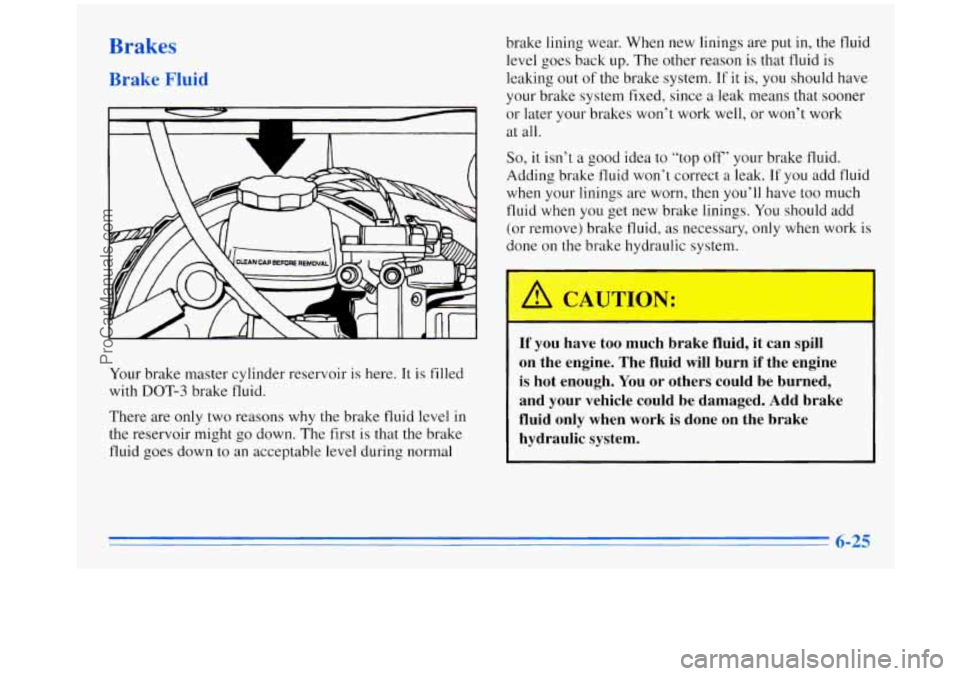
rour brake master cylinder reservoir is here. It is filled
with DOT-3 brake fluid.
There are only two reasons why the brake fluid level in
the reservoir might
go down. The first is that the brake
fluid
goes down to an acceptable level during normal brake lining
wear. When new linings are put
in, the fluid
level goes back up. The other reason is that fluid is
leaking out
of the brake system. If it is, you should have
your brake system fixed, since
a leak means that sooner
or later your brakes won’t work well, or won’t work
at all.
So, it isn’t a good idea to “top off’ your brake fluid.
Adding brake fluid won’t correct
a leak. If you add fluid
when your linings are worn, then you’ll have
too much
fluid when you get new brake linings. You should add
(or remove) brake fluid,
as necessary, only when work is
done
on the brake hydraulic system.
If you have too much brake fluid, it can spill
on the engine. The fluid will burn if the engine
is hot enough. You or others could be burned,
and your vehicle could be damaged. Add brake
fluid only when work is done on the brake hydraulic system.
ProCarManuals.com
Page 272 of 372
When your brake fluid falls
to
a low level, your brake
warning light
will come on.
See “Brake System Warning
I BRAKE I
What to Add
When you do need brake fluid, use only DOT-3 brake
fluid
-- such as Delco Supreme 11 @ (GM Part
No. 1052535). Use new brake fluid from a sealed
container only, and always clean the brake fluid
reservoir cap before removing
it.
r
With the wrong kind of fluid in your brake
system, your brakes may not work well, or they
may not even work
at all. This could cause a
crash. Always use the proper brake fluid.
NOTICE:
a
0
Using the wrong fluid can badly damage
brake system parts. For example, just
a few
drops of mineral-based oil, such as engine
oil, in your brake system can damage brake
system parts
so badly that they’ll have to be
replaced. Don’t let someone put in the
wrong kind of fluid.
If you spill brake fluid on your vehicle’s
painted surfaces, the paint finish can be
damaged. Be careful not to spill brake fluid
on your vehicle. If you do, wash it
off
immediately. See “Appearance Care” in
the Index.
6-26
ProCarManuals.com
Page 273 of 372
Brake Wear
Your Oldsmobile has front disc brakes and rear
drum brakes.
Disc brake pads have built-in wear indicators that
make a high-pitched warning sound when the brake
pads are
worn and new pads are needed. The sound may
come and go or be heard all the time your vehicle is
moving (except when you
are pushing on the brake
pedal firmly).
The brake wear warning sound means that
sooner or later your brakes won’t work well.
That could lead to an accident. When
you hear
the brake wear warning sound, have your
vehicle serviced.
NOTICE:
Continuing to drive with worn-out brake pads
could result in costly brake repair.
Some driving conditions or climates may cause a brake
squeal when the brakes
are first applied or lightly
applied. This does not mean something is wrong with
your brakes.
Free movement of brake calipers and properly torqued
wheel nuts are necessary to help prevent brake
pulsation. When tires are rotated, inspect brake calipers
for movement, brake pads
for wear, and evenly torque
wheel nuts in the proper sequence to
GM specifications.
Your rear drum brakes don’t have wear indicators, but
if
you
ever hear a rear brake rubbing noise, have the rear
brake linings inspected. Also, the rear brake drums
should be removed and inspected each time the tires
are removed for rotation or changing. When you
have the front brakes replaced, have the rear brakes
inspected, too.
Brake linings should always be replaced
as complete
axle sets.
6-27
ProCarManuals.com
Page 274 of 372
Brake Pedal Travel Battery
See your retailer if the brake pedal does not return to
normal height, or if there is a rapid increase
in pedal
travel. This could be
a sign of brake trouble.
Brake Adjustment
Every time you apply the brakes, with or without the
vehicle moving, your brakes adjust for wear.
Replacing Brake System Parts
The braking system on a modern vehicle is complex.
Its many parts have to be of
top quality and work well
together
if the vehicle is to have really good braking.
Vehicles we design and test have top-quality
GM brake
parts
in them, as your Oldsmobile does when it is new.
When you replace parts of your braking system
-- for
example, when your brake linings wear down and you
have to have new ones
put in -- be sure you get new
genuine
GM replacement parts. If you don’t, your
brakes may no longer work properly. For example, if
someone puts
in brake linings that are wrong for your
vehicle, the balance between your front and rear brakes
can change
-- for the worse. The braking performance
you’ve come to expect can change in many other ways
if
someone puts in the wrong replacement brake parts. Every
new Oldsmobile has
a Delco Freedom@ battery.
You never have to add water to one of these. When it’s
time for
a new battery, we recommend a Delco Freedom
battery. Get one that has the replacement number shown
on the original battery’s label.
Vehicle Storage
If you’re not going to drive your vehicle for 25 days or more,
take
off the black, negative (-) cable from the battery. lhs
will help keep your battery from running down.
I
/II CAUTIPV:
Batteries have acid that can burn you and gas
that can explode. You can be badly hurt if you
aren’t careful. See “Jump Starting” in the Index
for tips on working around a battery without
getting hurt.
Contact your retailer to learn how to prepare your
vehicle for longer storage periods.
Also, for your audio system, see “Theft-Deterrent
Feature” in the Index.
6-28
ProCarManuals.com
Page 343 of 372

Steering Column Lock Check
While parked, and with the parking brake set, try to turn
the key to LOCK in each shift lever position.
0 The key should turn to LOCK only when the shft
0 The key should come out only in LOCK.
lever
is in
PARK (P).
Parking Brake and Automatic Transaxle PARK (P)
lism Check Park
on a fairly steep
hill, with the vehicle facing
downhill. Keeping your foot on the regular brake,
set the parking brake.
To check the parking brake: With the engine running
and transaxle in NEUTRAL
(N), slowly remove foot
pressure from the regular brake pedal.
Do this until
the vehicle
is held by the parking brake only.
To check the PARK (P) mechanism’s holding ability:
With the engine running, shift to PARK
(P). Then
release all brakes.
Underbody Flushing Service At least every spring, use plain water to flush any
corrosive materials from the underbody. Take care to
clean thoroughly any areas where mud and other debris
can collect.
When
you
are doing this check, your vehicle
could begin to move. You or others could be
injured and property could be damaged. Make
sure there is room
in front of your vehicle in case
it begins to roll. Be ready to apply the regular
brake at once should the vehicle begin
to move.
7-37
ProCarManuals.com
Page 344 of 372

Part C: Periodic Maintenance
Inspections
Listed below are inspections and services which should
be performed at least twice a year (for instance, each
spring and fall).
You should let your GM retailer’s
service department or other qualified service center do
these jobs. Make sure any necessary repairs are
completed at once.
Proper procedures to perform these services may be
found
in an Oldsmobile Service Manual. See “Service
and Owner Publications’’ in the Index.
Steering, Suspension and Front-Wheel-Drive
Axle Boot and Seal Inspection
Inspect the front and rear suspension and steering system
for damaged, loose or missing parts, signs of wear or lack
of lubrication. Inspect the power steering lines and hoses
for proper hook-up, binding, leaks, cracks, chafing, etc.
Clean and then inspect the drive axle boot seals for
damage, tears or leakage. Replace seals if necessary.
Exhaust System Inspection
Inspect the complete exhaust system. Inspect the body
near the exhaust system. Look for broken, damaged,
missing or out-of-position parts as well as open seams, holes, loose connections
or other conditions which could
cause a heat build-up in the floor pan or could
let
exhaust fumes into the vehicle. See “Engine Exhaust’’ in
the Index.
Radiator anc d Heater Hose Inspection
Inspect the hoses and have them replaced if they are
cracked, swollen or deteriorated. Inspect all pipes,
fittings and clamps; replace as needed.
Throttle Linkage Inspect!. :
Inspect the throttle linkage for interrerence or binding,
and for damage or missing parts. Replace parts as
needed. Replace any cables that have high effort or
excessive wear.
Do not lubricate accelerator and cruise
control cables.
Brake System Inspection
Inspect the complete system. Inspect brake lines and
hoses for proper hook-up, binding, leaks, cracks, chafing, etc. Inspect disc brake pads for wear and rotors
for surface condition.
Also inspect drum brake linings
for wear and cracks. Inspect other brake parts, including
drums, wheel cylinders, calipers, parking brake, etc.
Check parking brake adjustment. You may need to have
your brakes inspected more often
if your driving habits
or conditions result
in frequent braking.
ProCarManuals.com
Page 359 of 372
I Section 9 Index
I ..
Accessory Power Outlet ......................... 2-66
Adjusting Rear Seats
............................ 1-10
How Does it Restrain .......................... 1-28
How it Works
................................ 1-27
Location
.................................... 1-27
Readiness Light
......................... 1.26. 2.73
Servicing
................................... 1-30
What Makes it Inflate
........................... 1-28
What Will
You See After it Inflates ............... 1-29
When Should it Inflate
.... : .................... 1-28
Aircleaner
.................................... 6-14
Air Cleaner. Checking or Replacing
................ 6- 15
Air Conditioning
................................ 3-3
Air Conditioning Refrigerants
..................... 6-59
Airhflator
.................................... 2-66
Alignment and Balance. Tire
...................... 6-40
Aluminum Wheels. Cleaning
...................... 6-48
AMAX ....................................... 3-17
Antenna. Integrated Roof
......................... 3-25
Antifreeze
..................................... 6-18
AirBag
....................................... 1-25
I
.
Anti-Lock
Brake System Warning Light
................ 2.75. 4.6
Brakes
...................................... 4-6
Appearance Care
............................... 6-42
Appearance Care Materials
....................... 6-50
Ashtrays ................................. 2.58. 2.59
Audio Equipment. Adding
........................ 3-23
Audio Systems
.................................. '3-9
Automatic
Door Locks ............................ 2-6
Customizing
.................................. 2-6
Overriding Lock Delay ......................... 2-6
Automatic Overdrive
............................ 2-29
Automatic Transaxle Check
....................... 7-35
Automatic Transaxle Fluid
........................ 6-15
Checking the Level
........................... 6-16
Howtocheck
................................. 6-16
Automatic Transaxle Operation
.................... 2-27
Automatic Transaxle Park Mechanism Check
......... 7-37
Anti-Lock Brake System Block Fuse
................ 657
Audio Controls. Steering Wheel Touch Control
....... 3-22
HowtoAdd
................................. 6-18
9-1
ProCarManuals.com