heating OLDSMOBILE SILHOUETTE 1997 User Guide
[x] Cancel search | Manufacturer: OLDSMOBILE, Model Year: 1997, Model line: SILHOUETTE, Model: OLDSMOBILE SILHOUETTE 1997Pages: 436, PDF Size: 21.87 MB
Page 276 of 436
Engine Overheating
You will find a coolant temperature gage on your
Oldsmobile’s instrument panel. See “Engine Coolant
Temperature Gage”
in the Index. You also have a low
coolant level light on your instrument panel. See “Low
Coolant Light” in the Index.
Overheated Engine Protection
Operating Mode
Should a low coolant condition exist, an overheat
protection mode which alternates firing groups of three
cylinders helps prevent engine damage. In this mode,
you will notice
a significant loss in power and engine
performance. The low coolant light may come on and
the temperature gage will indicate an overheat condition
exists. This emergency operating mode
allows your
vehicle to be driven to
a safe place in an emergency.
Towing
a trailer in the overheat protection mode should
be avoided.
I NOTICE:
After driving in the overheated engine protection
operating mode, to avoid engine damage, allow
the engine to cool before attempting any repair.
The engine oil
will be severely degraded. Repair
the cause of coolant loss and change the oil. See
“Engine Oil, When to Change” in the Index.
5-12
ProCarManuals.com
Page 280 of 436
He r an ra-engine
~
-m
parts, can be very hot. Don’t touch them. If you
do, you can be burned.
Don’t run the engine if there is a leak.
If you run
the engine, it could lose all coolant. That could
cause an engine fire, and you could be burned.
Get any leak fixed before you drive the vehicle.
NOTICE:
Engine damage from running your engine
without coolant isn’t covered by your warranty.
If there seems to be no leak, with
the engine on, check to
see if the electric engine fans are running.
If the engine
is overheating, both fans should be running. If they
aren’t, your vehicle needs service.
How to Add Coolant to the Coolant
--overy Tank
lr you haven’t found a problem yet, but the coolant
level isn’t at or above the
FULL HOT mark, add a
50/50 mixture of clean water (preferably distilled) and
DEX-COOL TM (silicate-free) antifreeze at the coolant
recovery tank. (See “Engine Coolant”
in the Index for
more information.)
Adding only plain water to your cooling system
can be dangerous. Plain water, or some other
liquid like alcohol, can boil before the proper
coolant mix will. Your vehicle’s coolant warning
system is set for the proper coolant mix. With
plain water or the wrong mix, your engine could
get too hot but you wouldn’t get the overheat
warning. Your engine could catch fire and you or
others could be burned. Use a
50/50 mix of clean
water and
DEX-COOL TM antifreeze.
5-16
ProCarManuals.com
Page 318 of 436
How to Add Fluid Engine Coolant
Refer to the Maintenance Schedule to determine what
kind
of transaxle fluid to use. See “Recommended
Fluids and Lubricants” in
the Index.
If the fluid level is low, add only enough of the proper
fluid to bring
the level into the cross-hatched area on
the dipstick.
1. Pull out the dipstick.
2. Using a long-neck funnel, add enough fluid at the
dipstick hole
to bring it to the proper level.
It doesn’t take much fluid, generally less than one pint
(0.5 L). Don% overfill. We recommend you use only
fluid labeled DEXRON@-111, because fluid with that label
is made especially for your automatic transaxle.
Damage caused by fluid other than DEXRON-111
is
not covered by your new vehicle warranty.
3. After adding fluid, recheck the fluid level as described under “How to Check.”
4. When the correct fluid level is obtained, push the
dipstick back in all the way. The cooling
system in your vehicle is filled with new
DEX-COOL
TM (silicate-free) engine coolant. This
coolant
is designed to remain in your vehicle for 5 years
or 150,000 miles
(240 000 km), whichever occurs first.
The following explains your cooling system and how to
add coolant when it is low. If you have a problem with
engine overheating, see “Engine Overheating” in
the Index.
A 50/50 mixture of water and the proper coolant for
your Oldsmobile will:
Give freezing protection down to -34°F (-37°C).
0 Give boiling protection up to 265°F (129°C).
Protect against rust and corrosion.
0 Help keep the proper engine temperature.
Let the warning lights and gages work as they should.
6-20
ProCarManuals.com
Page 322 of 436
Radiator Pressure Cap Power Steering Fluid
NOTICE:
Your
radiator cap is a 15 psi (105 kPa)
pressure-type cap and must be tightly installed to
prevent coolant
loss and possible engine damage
from overheating. Be sure the arrows on the cap
line up with the overflow tube on the radiator
filler neck.
When you replace your radiator pressure cap, an AC@
cap is recommended.
Thermostat
Engine coolant temperature is controlled by a thermostat
in the engine coolant system. The thermostat stops the
flow
of coolant through the radiator until the coolant
reaches a preset temperature.
When you replace your thermostat, an
AC@ thermostat
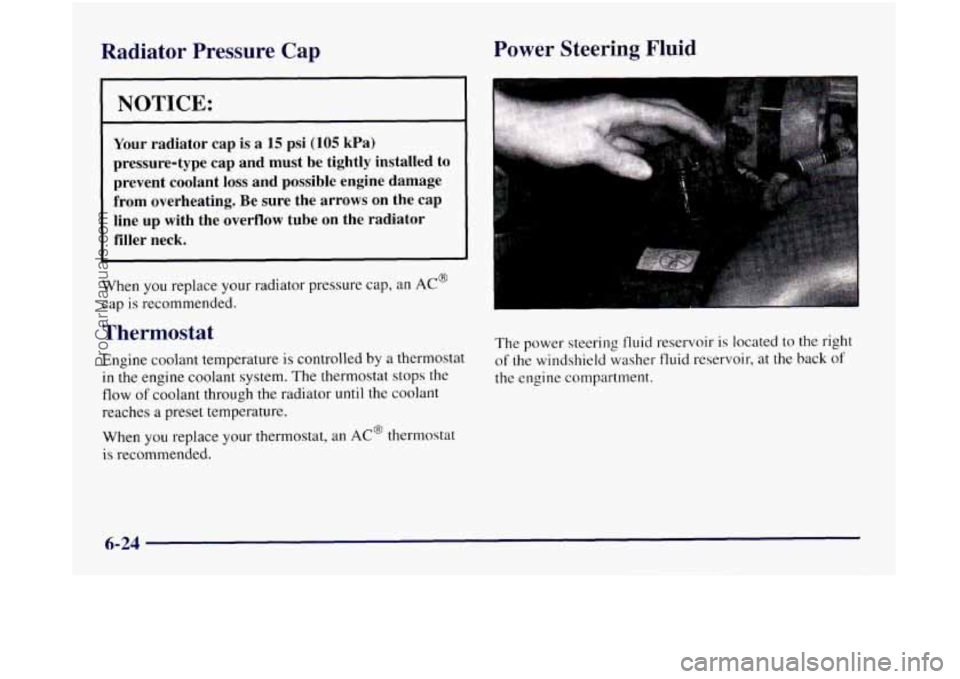
is recommended. The power steering fluid reservoir
is located
to the right
of the windshield washer fluid reservoir, at the back of
the engine compartment.
ProCarManuals.com
Page 337 of 436
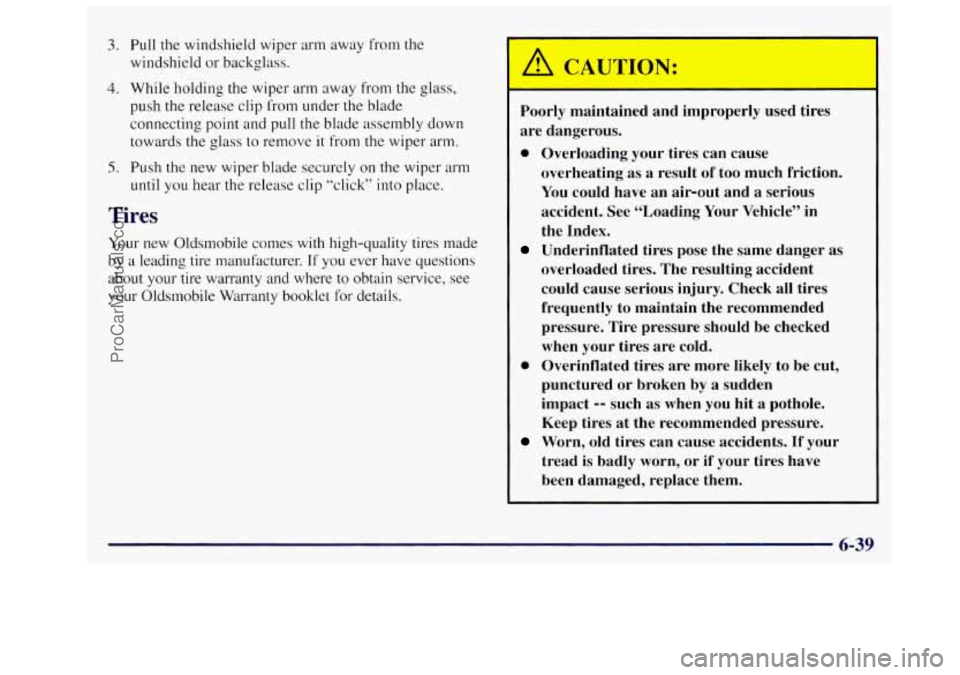
3. Pull the windshield wiper arm away from the
windshield or backglass.
4. While holding the wiper arm away from the glass,
push the release clip from under the blade
connecting point and pull the blade assembly down
towards the glass to remove it from the wiper arm.
5. Push the new wiper blade securely on the wiper arm
until you hear the release clip “click” into place.
Tires
Your new Oldsmobile comes with high-quality tires made
by a leading tire manufacturer.
If you ever have questions
about your tire warranty and where to obtain service, see
your Oldsmobile Warranty booklet for details. Poorly maintained and improperly used tires
are dangerous.
0 Overloading your tires can cause
overheating as a result
of too much friction.
You could have an air-out and
a serious
accident. See “Loading Your Vehicle” in
the Index.
Underinflated tires pose the same danger as
overloaded tires. The resulting accident
could cause serious injury. Check all tires
frequently to maintain the recommended pressure. Tire pressure should be checked
when your tires are cold.
0 Overinflated tires are more likely to be cut,
punctured
or broken by a sudden
impact
-- such as when you hit a pothole.
Keep tires at the recommended pressure.
Worn, old tires can cause accidents. If your
tread is badly worn, or if your tires have
been damaged, replace them.
6-39
ProCarManuals.com
Page 424 of 436
Driver’s Four-Way Manual Seat .................... 1-2
Driving City
........................................ 4-20
Defensive
.................................... 4-2
Drunken
..................................... 4-3
Freeway
.................................... 4-21
InaBlizzard
................................. 4-27
In Foreign Countries
........................... 6-4
IntheRain
.................................. 4-17
Night
...................................... 4-16
OnCurves
.................................. 4-11
On Grades While Towing a Trailer ............... 4-37
On Hill and Mountain Roads .................... 4-23
On Snow and Ice
............................. 4-25
WetRoads
.................................. 4-17
Winter
...................................... 4-25
With a Trailer
................................ 4-35
Dump and Stow Feature
........................... 1-7
Throughwater
............................... 4-19
Drunken Driving
................................ 4-3
Electrical Equipment. Adding
.................... 2-29
Electrical System
............................... 6-56
Electronic Level Control
......................... 4-29
Engine
........................................ 6-9
Coolant
..................................... 6-20
Coolant Heater
............................... 2-29
Coolant Level Check
.......................... 7-37 Coolant Tenlperature Gage
..................... 2-98
Cooling System
.............................. 6-62
Exhaust
..................................... 2-39
Identification
................................ 6-55
OilLevelCheck
.............................. 7-37
Overheated Protection Operating Mode
........... 5-12
Running While Parked
......................... 2-40
Specifications
................................ 6-63
Starting Your
................................ 2-28
Engine Oil
.............................. 2- 102. 6-10
Additives ................................... 6-14
Checking
................................... 6-11
Used ....................................... 6-14
What
Kind to Use ............................. 6-12
WhentoAdd
................................ 6-11
When
to Change .............................. 6-14
Engine Temperature Warning Light ................. 2-99
Equipment, Adding to the Outside
Of Your Vehicle ..... 6-3
Exhaust, Engine
................................ 2-39
Exit Lighting
.................................. 2-63
Overheating
................................. 5-12
Fabric Cleaning
............................... 6-47
Fan Knob. Climate Control System
.................. 3-2
Filling Your Tank
................................ 6-5
Filter. Air
..................................... 6-15
Filter. Pollen ................................... 6-16
Finishcare
.................................... 6-51
9-4
ProCarManuals.com
Page 425 of 436
Finish Damage ................................. 6-52
FirstGear
..................................... 2-34
Flashers. Hazard Warning
......................... 5-2
Flat Tire. Changing
............................. 5-22
Fluid Capacities
................................ 6-62
Fluids and Lubricants
............................ 7-43
FogLamps
.................................... 2-60
Folding Driver's Seatback
......................... 1-3
Foreign Countries. Fuel ........................... 6-4
FrontDoor
..................................... 2-4
Front Parking/Turn Signal Lamp Bulb Replacement
.... 6-34
Front Seat Storage Bin
........................... 2-75
Front Seat Storage Net
........................... 2-76
Front Sidemarker Lamp Bulb Replacement
........... 6-36
FrontTowing
.................................. 5-10
Fuel .......................................... 6-3
Filling Your Tank
.............................. 6-5
Gage ...................................... 2-105
In Foreign Countries ........................... 6-4
Fuses and Circuit Breakers ....................... 6-57
Gages Engine Coolant Temperature
.................... 2-98
Fuel
...................................... 2-105
Speedometer ................................. 2-9 1
Tachometer .................................. 2-92
Garage Door Opener Compartment
................. 2-69
Gear Positions. Automatic Transaxle
................ 2-3 I
GAWR ....................................... 4-29 GloveBox
.................................... 2-68
Gross Axle Weight Rating
........................ 4-29
Gross Vehicle Weight Rating
...................... 4-29
GVWR
....................................... 4-29
Halogen Bulbs
................................ 6-31
Hazard Warning Flashers
.......................... 5-2
Head Restraints ................................. 1-6
Headlamps
.................................... 2-59
Bulb Replacement ............................ 6-31
High/Low Beam Changer
...................... 2-53
OnReminder
................................ 2-59
Wiring
..................................... 6-56
Hearing Impaired, Customer Assistance
.............. 8-4
Heating
........................................ 3-4
High-Beam Headlamps
.......................... 2-53
Highway Hypnosis
.............................. 4-22
Hill and Mountain Roads ......................... 4-23
Hitches, Trailer
................................. 4-34
Hood
Checking Things Under ......................... 6-7
Prop
........................................ 6-8
Release ...................................... 6-8
Horn ......................................... 2-51
Hydroplaning
.................................. 4-19
Ignition Positions
.............................. 2-26
Illuminated Entry
............................... 2-62
9-5
__ . .- ~
ProCarManuals.com
Page 428 of 436
Net. ~onvenimzrrce ............................. -2-76
New Vehicle "Break-In" ......................... 2-24
Night Vision ................................... 4-16
Nt~@af ....................................... 2-32
Odometer .................................... 2-9 1
Odometer. Trip
................................. 2-91
Off-RoadRecovery
............................. 4-13
Oil. Engine
.............................. 2.102. 6.10
Oil Pressure Light
............................. 2-102
Overhead Console
.............................. 2-69
Driver Information Center
...................... 2-7 1
Garage Door Opener Compartment
............... 2-69
Sunglasses Compartment
....................... 2-7 1
Overhead Console Switchbank
.................... 2- 12
Overheated Engine Protection
..................... 5- 12
Overheating Engine
............................. 5- 12
Owner Checks and Services
....................... 7-37
Owner Publications. Ordering
..................... 8- 10
Paint Spotting. Chemical ........................ 6-53
Park Automatic Transaxle
.......................... 2-3 1
Shifting Into
................................. 2-36
Shifting Out of
............................... 2-38
AtNight
.................................... 2-25
Brake
...................................... 2-35
Parking Brake Mechanism Check
....................... 7-40
Over Things That
Bum ........................ 2-39
With a Trailer
................................ 4-37
Passing
....................................... 4-13
Periodic Maintenance Inspections
.................. 7-41
Pollen Filter
................................... 6-16
Power Accessory Outlet
............................. 2-84
DoorLocks
................................... 2-5
Option Fuses
................................ 6-56
Rear Quarter Windows
......................... 2-51
Remote Control Mirror
........................ 2-66
Seat
......................................... 1-3
Steering
.................................... 4-11
Sunroof
..................................... 2-85
Windows
................................... 2-50
Power Steering Fluid
............................ 6-24
Howtocheck
............................... 6-25
Whattouse
................................. 6-25
Whentocheck
............................... 6-25
Pregnancy. Use
of Safety Belts .................... 1-42
Problems on the Road
............................ 5-1
Publications. Service and Owner
................... 8-10
Lots
....................................... 2-25
Passenger Position
.............................. 1-43
Radiator
..................................... 5-19
Radiator Pressure Cap
........................... 6-24
Radio Reception
................................ 3-27
9-8
ProCarManuals.com