reset OLDSMOBILE SILHOUETTE 1997 User Guide
[x] Cancel search | Manufacturer: OLDSMOBILE, Model Year: 1997, Model line: SILHOUETTE, Model: OLDSMOBILE SILHOUETTE 1997Pages: 436, PDF Size: 21.87 MB
Page 214 of 436
SCAN: Press one of the SEEK arrows for two seconds,
and SCAN will appear on the display. Use SCAN to
listen to stations for
a few seconds. The radio will go to
a station, stop for a few seconds, then go on to the next
station. Press
SEEK again to stop scanning. The sound
will
mute while scanning.
PUSHBUTTONS: The six numbered pushbuttons let
you return to your favorite stations. You can set up to
18
stations (six AM, six FMI and six FM2). Just:
1. Press AM-FM to select the band.
2. Tune in the desired station.
3. Press AUTO TONE to select the equalization that
best suits the type of station selected.
4. Press and hold one of the six numbered buttons. The
sound will mute. When it returns, release the button.
Whenever you press that numbered button, the
station you set will return and the AUTO TONE
equalization that you selected will also be
automatically selected for that button.
5. Repeat the steps for each pushbutton.
If you manually tune or use SEEK or SCAN to find
a
frequency stored in a preset, the AUTO TONE
equalization stored for that frequency
will be recalled. Always check the display first
to make sure you have
the correct band.
P SCAN: Press this button to listen to each of your
favorite stations stored on your pushbuttons for a few
seconds. The radio will scan through each of the stations
stored
on your pushbuttons, except those stations with
weak reception. The AUTO TONE setting stored for that
pushbutton
will be automatically chosen. Press P SCAN
or one of the pushbuttons again
to stop scanning.
P SCAN will be displayed whenever the tuner is
in the
P SCAN mode. The channel number (Pl-P6) will appear
momentarily just before the frequency is displayed.
Setting the Tone
BASS: Press this knob lightly so it extends. Turn the
knob clockwise to increase bass and counterclockwise to
decrease bass. When you use this control, the radio’s
AUTO TONE setting will switch to manual.
TREB: Press this knob lightly so it extends. Turn the
knob clockwise to increase treble and counterclockwise
to decrease treble. When
you use this control, the radio’s
AUTO TONE setting will switch to manual.
If a station
is weak or noisy, you
may want to decrease the treble.
Push these knobs back
into their stored positions when
you’re not using them.
3-20
ProCarManuals.com
Page 215 of 436
AUTO TONE: This feature allows you to choose preset
bass and treble equalization settings designed for classical, news, rock, pop, country/western and jazz
stations.
C/W will appear on the display when you first
press AUTO TONE. Each time you press it, another
setting will appear on the display. Press it again after
JAZZ appears and the AUTO TONE display will go
blank. Tone control will return to the BASS and TREB knobs. Also, if you use the BASS and TREB
knobs,
control will return to them and the AUTO TONE
display will go blank.
Adjusting the Speakers
BAL: Press this knob lightly so it extends. Turn the
knob clockwise for right speakers and counterclockwise
for left speakers. The middle position balances the
sound between the speakers.
FADE: Press hs knob lightly so it extends. Turn the
knob clockwise to adjust the sound to the front speakers
and counterclockwise for the rear speakers. The middle
position balances the sound between the speakers.
Push these knobs back into their stored positions when
you’re not using them.
Playing a Compact Disc
Insert a disc partway into the slot, label side up. The
player will pull it in.
The disc should begin playing. The
display will show
CD and the CD symbol.
If you’re driving on a very rough road or if it’s very hot,
the disc may not play and ERR (error) may appear on
the display. Press
RECALL to take ERR off the display.
When things get back to normal, the disc should play. If
the disc comes out, it could be that:
0 The disc is upside down.
0 It is dirty, scratched or wet.
0 It is very humid. (If so, wait about an hour and
PREV (1): Press this button or the left SEEK arrow
to the start of a current track. If you hold the button
or press it more than once, the player will continue
moving back through the disc. The sound will mute
while seeking. try
again.)
RDM (2): Press this button to hear the tracks in random,
rather than sequential, order. RANDOM will show on
the display. Press RDM again to turn off random play.
RDM is reset to off when the disc is ejected.
3-21
ProCarManuals.com
Page 218 of 436
SCAN: Press and hold SEEK until the radio goes into
SCAN mode. SCAN allows you to listen to stations
for a few seconds. The receiver will continue to scan
and momentarily stop at each station
until you press
SEEK again.
P.SET PROG: The front passengers must be listening to
something different for each of these functions to work:
Press this button to seek through your preset radio
stations set
on your primary radio pushbuttons.
When a cassette tape is playing, press this button to
go to the other side
of the tape.
TAPE CD: With a cassette tape in the player and the
radio playing, press this button to play a cassette tape.
Press TAPE CD to switch between the tape
and compact
disc if both are loaded. Press
AM-FM to return to the
radio when a cassette tape or compact disc
is playing.
The inactive tape or
CD will remain safely inside the
radio for future listening.
Theft-Deterrent Feature
THEFTLOCK" is designed to discourage theft of your
radio. It works by using a secret code to disable
all radio
functions whenever battery power
is removed.
The THEFTLOCK feature for the radio may be used or
ignored. If ignored, the system plays normally and the
radio is not protected by
the feature. If THEFTLOCK is
activated, your radio will not operate if stolen.
When THEFTLOCK is activated, the radio will display
LOC to indicate a locked condition anytime battery
power is removed. If your battery loses power for any
reason, you must unlock the radio with the secret code
before it will operate.
Activating the Theft-Deterrent Feature
The instructions which follow, explain how to enter your
secret code to activate the THEFTLOCK system. It is
recommended that you read through all nine steps
before starting
the procedure.
NOTE: If you allow more than
15 seconds to elapse
between any steps, the radio automatically reverts to
time and
you must start the procedure over at Step 4.
1. Write down any three or four-digit number from
000 to 1999 and keep it in a safe place separate
from the vehicle.
2. Turn the ignition to ACCESSORY or RUN.
3-24
ProCarManuals.com
Page 221 of 436
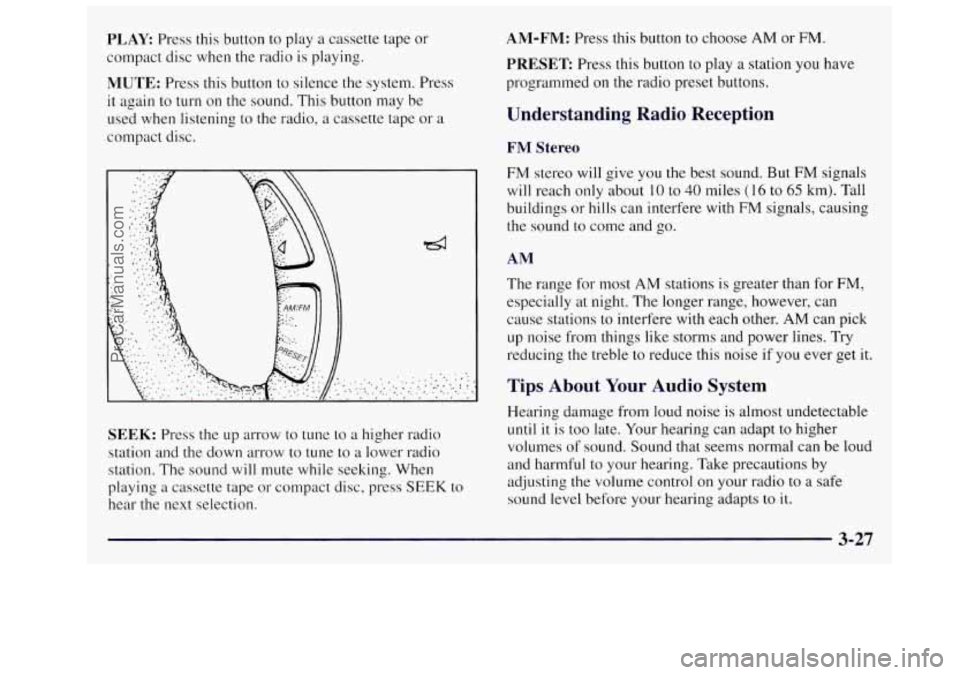
PLAY Press this button to play a cassette tape or
compact disc when the radio is playing.
MUTE: Press this button to silence the system. Press
it again to turn on the sound. This button may be
used when listening to the radio, a cassette tape or
a
compact disc.
SEEK: Press the up arrow to tune to a higher radio
station and the down arrow to tune to
a lower radio
station. The sound
will mute while seeking. When
playing a cassette tape or compact disc, press
SEEK to
hear the next selection.
AM-FM: Press this button to choose AM or FM.
PRESET Press this button to play a station you have
programmed on the radio preset buttons.
Understanding Radio Reception
FM Stereo
FM stereo will give you the best sound. But FM signals
will reach only about
10 to 40 miles (16 to 65 km). Tall
buildings or hills can interfere with
FM signals, causing
the sound to come and go.
AM
The range for most AM stations is greater than for FM,
especially at night. The longer range, however, can
cause stations to interfere with each other.
AM can pick
up noise from things like storms and power lines. Try
reducing the treble
to reduce this noise if you ever get it.
Tips About Your Audio System
Hearing damage from loud noise is almost undetectable
until it is too late. Your hearing can adapt to higher
volumes
of sound. Sound that seems normal can be loud
and harmful to your hearing. Take precautions by
adjusting
the volume control on your radio to a safe
sound level before your hearing adapts to
it.
3-27
ProCarManuals.com
Page 222 of 436
To help avoid hearing loss or damage:
Adjust the volume control to the lowest setting.
Increase volume slowly until you hear comfortably
and clearly.
NOTICE:
r
Before you add any sound equipment to your
vehicle
-- like a tape player, CB radio, mobile
telephone or two-way radio
-- be sure you can add
what you want.
If you can, it’s very important to
do it properly. Added sound equipment may
interfere with the operation of your vehicle’s
engine, Delco radio or other systems, and even
damage them. Your vehicle’s systems may
interfere with the operation of sound equipment
that has been added improperly.
So, before adding sound equipment, check with
your retailer and be sure to check Federal rules
covering mobile radio and telephone units.
Care of Your Cassette Tape Player
A tape player that is not cleaned regularly can cause
reduced sound quality, ruined cassettes or a damaged
mechanism. Cassette tapes should be stored in their
cases away from contaminants, direct sunlight and
extreme heat. If they aren’t, they may not operate
properly or may cause failure of the tape player.
Your tape player should be cleaned regularly after every
50 hours of use. Your radio may display CLN to indicate
that you have used your tape player for
50 hours without
resetting the tape clean timer. If this message appears
on the display, your cassette tape player needs to be
cleaned.
It will still play tapes, but you should clean it
as soon as possible to prevent damage to your tapes and
player. If you notice a reduction in sound quality, try a
known good cassette
to see if it is the tape or the tape
player at fault. If this other cassette has no improvement
in sound quality, clean the tape player.
3-28
ProCarManuals.com
Page 223 of 436
Cleaning may be done with a scrubbing action,
non-abrasive cleaning cassette with pads which scrub
the tape head as the hubs of the cleaner cassette turn. It
is normal for
the cassette to eject while cleaning because
your unit is equipped with a cut tape feature. To
temporarily override this feature for vehicles with
Automatic Tone Control (for one insertion), turn on the
ignition and turn the radio off. Press and hold TAPE
AUX until the tape symbol flashes
on the display, and
insert the cassette again. For vehicles without Automatic
Tone Control, press both
SEEK arrows within five
seconds of inserting the cassette with the ignition and
radio off. Insert the cassette at least three times to ensure
thorough cleaning.
A scrubbing action cleaning cassette
is available through your Oldsmobile retail facility.
You may also choose a non-scrubbing action, wet-type
cleaner which uses a cassette with a fabric belt to clean
the tape head. This type
of cleaning cassette will not
eject. It may not clean as thoroughly as the scrubbing
type cleaner. The cassette
tape player
is able to detect a broken tape.
Some cleaning cassettes may appear as a broken tape. If
the cleaning cassette is ejected immediately from the
tape player, follow these steps:
1. Turn the radio off.
2. Turn the ignition on.
3. Press and hold the TAPE-AUX button until the tape
symbol flashes.
4. Insert the cleaning cassette and the radio will turn on
in cassette mode.
5. Eject the tape after the tape player has been cleaned.
When
the cleaning cassette has been ejected, the broken
tape detection feature is active again.
After you clean the player, press and hold EJECT for
five seconds to reset the CLN indicator. The radio will
display
--- to show the indicator was reset.
Cassettes are subject to wear and the sound quality
may degrade over time. Always make sure the cassette
tape is
in good condition before you have your tape
player serviced.
3-29
ProCarManuals.com
Page 322 of 436
Radiator Pressure Cap Power Steering Fluid
NOTICE:
Your
radiator cap is a 15 psi (105 kPa)
pressure-type cap and must be tightly installed to
prevent coolant
loss and possible engine damage
from overheating. Be sure the arrows on the cap
line up with the overflow tube on the radiator
filler neck.
When you replace your radiator pressure cap, an AC@
cap is recommended.
Thermostat
Engine coolant temperature is controlled by a thermostat
in the engine coolant system. The thermostat stops the
flow
of coolant through the radiator until the coolant
reaches a preset temperature.
When you replace your thermostat, an
AC@ thermostat
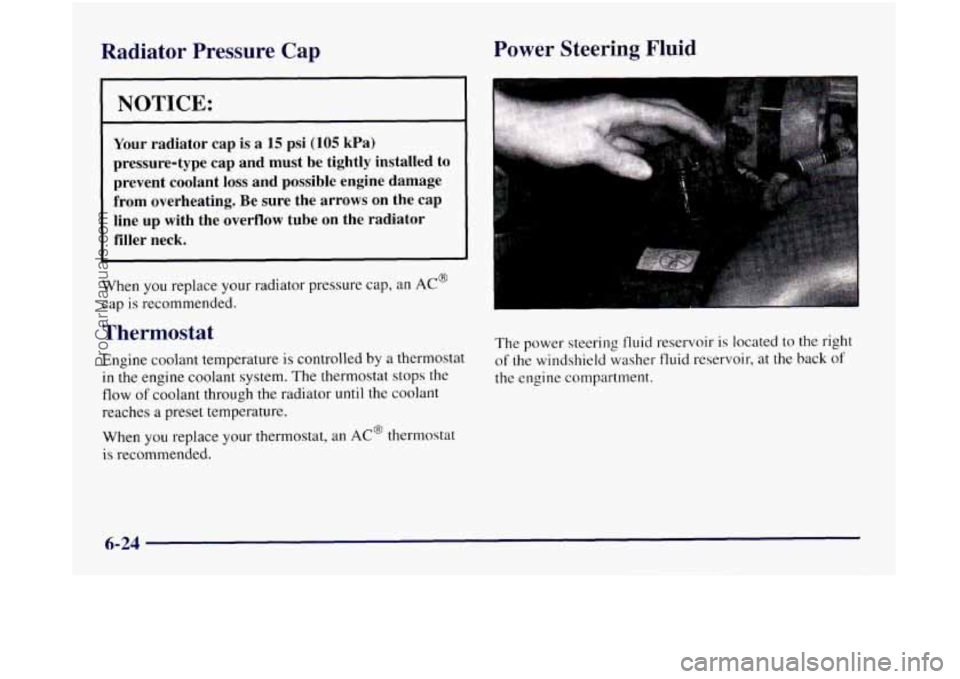
is recommended. The power steering fluid reservoir
is located
to the right
of the windshield washer fluid reservoir, at the back of
the engine compartment.
ProCarManuals.com
Page 342 of 436
Traction -- A, B, C
The traction grades, from highest to lowest, are A, B, and
C, and they represent the tire’s ability to stop on wet
pavement as measured under controlled conditions on specified government test surfaces of asphalt and concrete.
A tire marked C may have poor traction performance.
Warning: The traction grade assigned to this tire is based
on braking (straightahead) traction tests and does not
include cornering (turning) traction.
Temperature -- A, B, C
The temperature grades are A (the highest), B, and C,
representing the tire’s resistance to the generation of
heat and its ability
to dissipate heat when tested under
controlled conditions on
a specified indoor laboratory
test wheel. Sustained high temperature can cause the
material of the tire to degenerate and reduce tire life,
and excessive temperature can lead to sudden tire
failure. The grade
C corresponds to a level of
performance which all passenger car tires must meet
under the Federal Motor Vehicle Safety Standard
No.
109. Grades B and A represent higher levels of
performance on the laboratory test wheel than the
minimum required by
law.
Warning: The temperature grade for this tire is
established for a tire that is properly inflated and not
overloaded. Excessive speed, underinflation, or
excessive loading, either separately or in combination,
can cause heat buildup and possible tire failure.
Wheel Alignment and Tire Balance
The wheels on your vehicle were aligned and balanced
carefully at the factory to give you the longest tire life
and best overall performance.
Scheduled wheel alignment and wheel balancing are not
needed. However, if
you notice unusual tire wear or
your vehicle pulling one way or the other, the alignment
may need to be reset. If you notice your vehicle
vibrating when driving on a smooth road, your wheels
may need to be rebalanced.
Wheel Replacement
Replace any wheel that is bent, cracked, or badly rusted
or corroded.
If wheel nuts keep coming loose, the wheel,
wheel bolts and wheel nuts should be replaced.
If the
wheel leaks air, replace it (except some aluminum
wheels, which can sometimes be repaired). See your
Oldsmobile retailer
if any of these conditions exist.
Your retailer will know the kind
of wheel you need.
6-44
ProCarManuals.com
Page 429 of 436
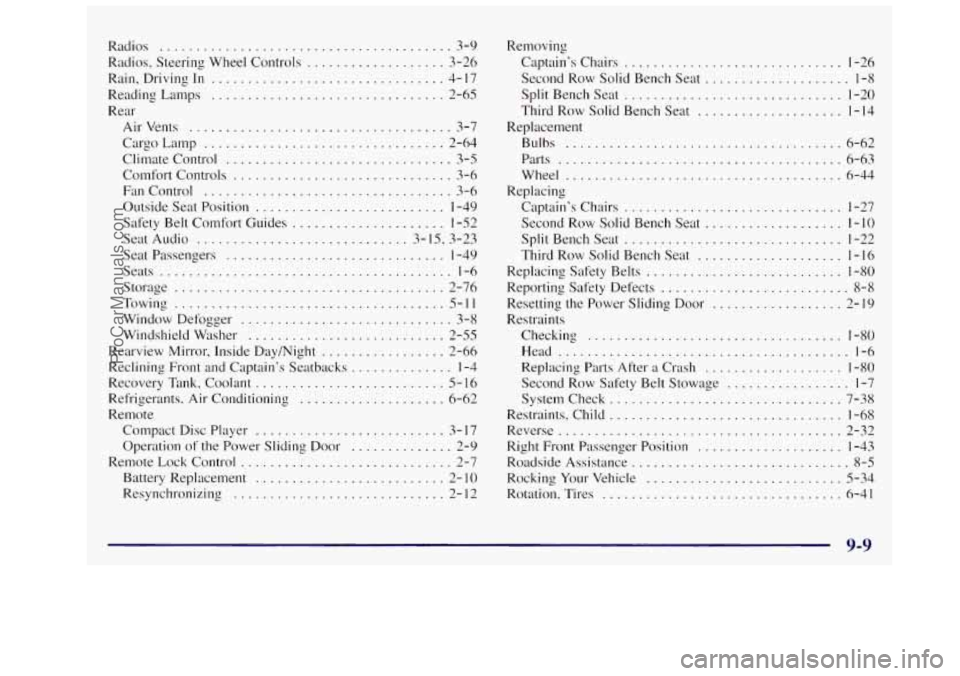
Radios ........................................ 3-9
Radios. Steering Wheel Controls
................... 3-26
Rain. Driving In
................................ 4- I7
Reading Lamps
................................ 2-65
Cargo Lamp
................................. 2-64
Rear
AirVents
.................................... 3-7
Climate Control
............................... 3-5
Comfort Controls
.............................. 3-6
Fan Control
.................................. 3-6
Outside Seat Position .......................... 1-49
Safety
Belt Comfort Guides ..................... 1-52
Seat Audio
............................. 3- 15. 3-23
Seat Passengers
.............................. 1-49
Seats
........................................ 1-6
Storage
..................................... 2-76
Towing
..................................... 5-11
Window Defogger
............................. 3-8
Windshield Washer
........................... 2-55
Rearview Mirror, Inside Day/Night
................. 2-66
Reclining Front and Captain’s Seatbacks
.............. 1-4
Recovery Tank, Coolant .......................... 5- 16
Refrigerants,
Air Conditioning .................... 6-62
Remote Compact Disc Player
.......................... 3- I7
Operation of the Power Sliding Door .............. 2-9
Battery Replacement
.......................... 2- IO
Resynchronizing ............................. 2- I2
Remote Lock
Control
............................. 2-7 Removing
Captain’s Chairs
.............................. 1-26
Second Row Solid Bench Seat
.................... 1-8
Split Bench Seat
.............................. 1-20
Third Row Solid Bench Seat .................... 1-14
Replacement BLIlbs
...................................... 6-62
Parts
....................................... 6-63
Wheel
...................................... 6-44
Replacing Captain’s Chairs
.............................. 1-27
Second Row Solid Bench Seat
................... 1 . IO
Split Bench Seat .............................. 1-22
Third Row Solid Bench Seat
.................... 1 . 16
Replacing Safety Belts ........................... 1-80
Reporting Safety Defects
.......................... 8-8
Resetting the Power Sliding Door
.................. 2-19
Restraints Checking
................................... 1-80
Head
........................................ 1-6
Replacing Parts After a Crash
................... 1-80
Second Row Safety Belt Stowage
................. 1-7
System Check ................................ 7-38
Restraints. Child
................................ 1-68
Reverse
....................................... 2-32
Right Front Passenger Position
.................... 1-43
Roadside Assistance
.............................. 8-5
Rocking Your Vehicle
........................... 5-34
Rotation
. Tires ................................. 6-41
ProCarManuals.com