stop start OLDSMOBILE SILHOUETTE 1997 User Guide
[x] Cancel search | Manufacturer: OLDSMOBILE, Model Year: 1997, Model line: SILHOUETTE, Model: OLDSMOBILE SILHOUETTE 1997Pages: 436, PDF Size: 21.87 MB
Page 216 of 436
NEXT (3): Press this button or the right SEEK arrow
to go to the next track. If you hold the button or press
it more than once, the player will continue moving
forward through the disc. The sound will mute
while seeking.
REV (4): Press and hold this button to quickly reverse
within a track. Release it to play the passage. You can
use the counter reading on the display to locate a
passage more easily.
FWD (6): Press and hold this button to advance quickly
within a track. Release
it to resume playing. You can
use the counter reading on
the display to locate a
passage easily.
RECALL: Press this button to see which track is
playing. Press
it again within five seconds to see how
long
it has been playing (elapsed time). The track
number also appears when you change the volume or
when a new track starts to play.
AM-FM: Press this button to play the radio when a disc
is
in the player. The letters CD will go off the display.
CD AUX: Press this button to change to the disc
function
when the radio is on. A CD icon will appear on
the display when
the disc is in the player, whether it is
active or not.
EJECT: Press this button to remove the disc. The radio
will play. The disc will start at the first track when you
reinsert
it.
If you turn off the ignition or radio with a disc in the
player,
it will stay in the player. When you turn on the
ignition or system,
the disc will start playing where it
was stopped. If you press EJECT but don’t remove the
disc,
the player will pull the disc back in to protect it
after about one minute.
3-22
ProCarManuals.com
Page 218 of 436
SCAN: Press and hold SEEK until the radio goes into
SCAN mode. SCAN allows you to listen to stations
for a few seconds. The receiver will continue to scan
and momentarily stop at each station
until you press
SEEK again.
P.SET PROG: The front passengers must be listening to
something different for each of these functions to work:
Press this button to seek through your preset radio
stations set
on your primary radio pushbuttons.
When a cassette tape is playing, press this button to
go to the other side
of the tape.
TAPE CD: With a cassette tape in the player and the
radio playing, press this button to play a cassette tape.
Press TAPE CD to switch between the tape
and compact
disc if both are loaded. Press
AM-FM to return to the
radio when a cassette tape or compact disc
is playing.
The inactive tape or
CD will remain safely inside the
radio for future listening.
Theft-Deterrent Feature
THEFTLOCK" is designed to discourage theft of your
radio. It works by using a secret code to disable
all radio
functions whenever battery power
is removed.
The THEFTLOCK feature for the radio may be used or
ignored. If ignored, the system plays normally and the
radio is not protected by
the feature. If THEFTLOCK is
activated, your radio will not operate if stolen.
When THEFTLOCK is activated, the radio will display
LOC to indicate a locked condition anytime battery
power is removed. If your battery loses power for any
reason, you must unlock the radio with the secret code
before it will operate.
Activating the Theft-Deterrent Feature
The instructions which follow, explain how to enter your
secret code to activate the THEFTLOCK system. It is
recommended that you read through all nine steps
before starting
the procedure.
NOTE: If you allow more than
15 seconds to elapse
between any steps, the radio automatically reverts to
time and
you must start the procedure over at Step 4.
1. Write down any three or four-digit number from
000 to 1999 and keep it in a safe place separate
from the vehicle.
2. Turn the ignition to ACCESSORY or RUN.
3-24
ProCarManuals.com
Page 233 of 436
Avoid needless heavy braking. Some people drive
in spurts
-- heavy acceleration followed by heavy
braking
-- rather than keeping pace with traffic. This
is a mistake. Your brakes may not have time to cool
between hard stops. Your brakes will wear out much
faster if you do a lot
of heavy braking. If you keep pace
with the traffic and allow realistic following distances,
you will eliminate a lot of unnecessary braking. That
means better braking and longer brake life.
If your engine ever stops while you’re driving, brake
normally but don’t pump your brakes. If you do, the
pedal may get harder to push down.
If your engine
stops, you will still have some power brake assist. But
you will use it when you brake. Once the power assist is
used up,
it may take longer to stop and the brake pedal
will be harder
to push.
Anti-Lock Brakes (ABS)
Your vehicle has anti-lock brakes (ABS). ABS is an
advanced electronic braking system that will help
prevent a braking skid.
When you start your engine, or when you begin to drive
away, your anti-lock brake system
will check itself.
You may hear a momentary motor or clicking noise
while this test is going on, and you may even notice
that your brake pedal moves
a little. (You may also hear
a clicking noise
if you leave the ignition in the RUN
position for about four seconds before starting the
vehicle.) This is normal.
If there’s a problem with the
anti-lock brake system, this
warning light will stay on or
flash. See “Anti-Lock
Brake System Warning
Light” in the Index.
ProCarManuals.com
Page 240 of 436
0
0
0
Do not get too close to the vehicle you want to
pass while you’re awaiting an opportunity. For one
thing, following too closely reduces your area
of
vision, especially if you’re following a larger
vehicle. Also, you won’t have adequate space
if
the vehicle ahead suddenly slows or stops. Keep
back a reasonable distance.
When it looks like a chance
to pass is coming up,
start to accelerate but stay in the right lane and don’t
get too close. Time your move
so you will be
increasing speed as the time comes to move into the
other lane. If the way is clear to pass, you will have a
“running start” that more than makes
up for the
distance you would lose by dropping back. And
if
something happens to cause you to cancel your pass,
you need only slow down and drop back again and
wait for another opportunity.
If other cars are lined up
to pass a slow vehicle, wait
your turn. But take care that someone isn’t trying to
pass
you as you pull out to pass the slow vehicle.
Remember to glance over your shoulder and check
the blind spot.
Check your mirrors, glance over your shoulder and
start your left lane change signal before moving out
of the right lane to pass. When you are far enough
ahead of the passed vehicle to see its front in your
inside mirror, activate your right lane change signal
and move back into the right lane. (Remember that
your right outside mirror
is convex. The vehicle you
just passed may seem to be farther away from you
than it really is.)
Try not to pass more than one vehicle at a time
on two-lane roads. Reconsider before passing the
next vehicle.
0 Don’t overtake a slowly moving vehicle too rapidly.
Even though the brake lamps are not flashing,
it may
be slowing down or starting to turn.
If you’re being passed, make it easy for the
following driver to get ahead of you. Perhaps you
can ease a little to the right.
4-14
ProCarManuals.com
Page 241 of 436
Loss of Control
Let’s review what driving experts say about what
happens when the
three control systems (brakes, steering
and acceleration) don’t have enough friction where the
tires meet the road to do what the driver has asked.
In any emergency, don’t give up. Keep trying to steer and
constantly seek
an escape route or area of less danger.
Skidding
In a skid, a driver can lose control of the vehicle.
Defensive drivers avoid most skids by taking reasonable
care suited
to existing conditions, and by not “overdriving”
those conditions. But skids
are always possible.
The three types of skids correspond to your
Oldsmobile’s
three control systems. In the bralung skid,
your wheels aren’t rolling. In the steering or cornering
skid, too much speed or steering in a curve causes tires
to slip and lose cornering force. And in the acceleration
slud, too much throttle causes the driving wheels to spin.
A cornering skid and an acceleration skid are best
handled by easing your foot off the accelerator pedal.
If your vehicle starts to slide, ease your foot off the
accelerator pedal and quickly steer the way you want the
vehicle to go.
If you start steering quickly enough, your
vehicle may straighten out. Always be ready for a
second skid
if it occurs.
Of course, traction is reduced when water, snow, ice,
gravel or other material is on
the road. For safety, you’ll
want to slow down and adjust your driving to these conditions. It is important to slow down on slippery
surfaces because stopping distance will be longer and
vehicle control more limited.
While driving on a surface with reduced traction, try
your best to avoid sudden steering, acceleration or
braking (including engine braking by shifting to a lower
gear). Any sudden changes could cause
the tires to slide.
You may not realize the surface is slippery until your
vehicle is sludding. Learn to recognize warning
clues
-- such as enough water, ice or packed snow on
the road to make a “mirrored surface”
-- and slow down
when you have any doubt.
Remember: Any anti-lock brake system (ABS) helps
avoid only the braking skid.
4-15
- --
ProCarManuals.com
Page 243 of 436
You can be temporarily blinded by approaching
headlamps. It can take a second or two, or even several
seconds, for your eyes to readjust to the dark. When you
are faced with severe glare (as from a driver who
doesn’t lower the high beams, or a vehicle with
misaimed headlamps), slow down a little. Avoid staring
directly into the approaching headlamps.
Keep your windshield and all the glass on your vehicle
clean
-- inside and out. Glare at night is made much
worse by dirt on the glass. Even the inside of the glass
can build up a film caused by dust. Dirty glass makes
lights dazzle and flash more than clean glass would,
making the pupils of your eyes contract repeatedly.
Remember that your headlamps light up far less
of a
roadway when you are in a turn or curve. Keep your
eyes moving; that way, it’s easier to pick out dimly
lighted objects. Just as your headlamps should be
checked regularly for proper aim,
so should your eyes
be examined regularly. Some drivers suffer from night
blindness
-- the inability to see in dim light -- and aren’t
even aware
of it.
Driving in Rain and on Wet Roads
1 V A
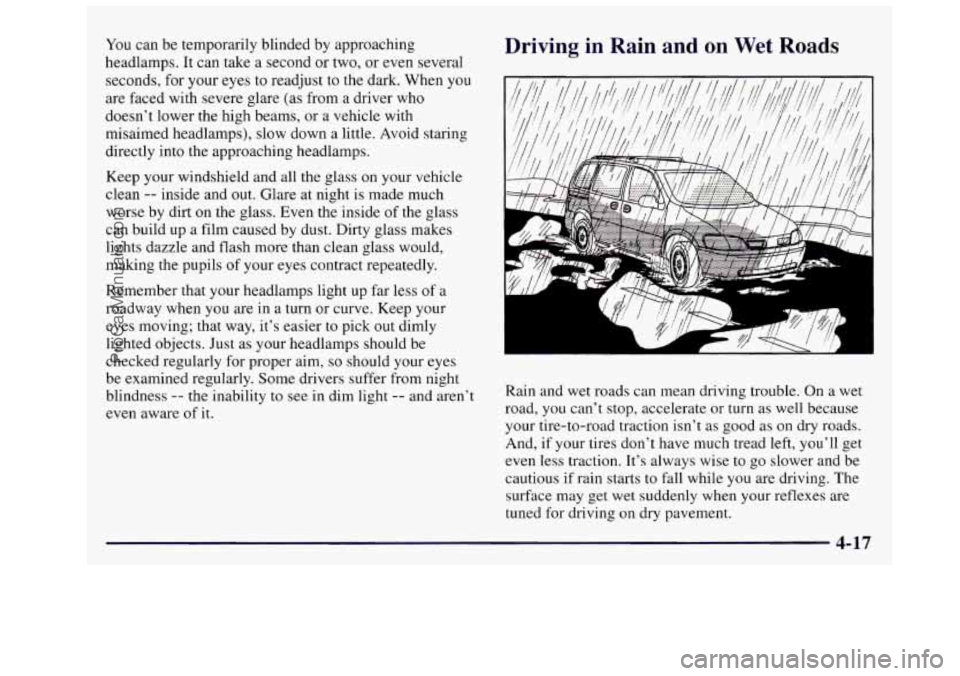
Rain and wet roads can mean driving trouble. On a wet
road, you can’t stop, accelerate or turn as well because
your tire-to-road traction isn’t as good as on dry roads.
And, if your tires don’t have much tread left, you’ll get
even less traction. It’s always wise to
go slower and be
cautious if rain starts to fall while
you are driving. The
surface may get wet suddenly when your reflexes are
tuned for driving
on dry pavement.
ProCarManuals.com
Page 244 of 436
The heavier the rain, the harder it is to see. Even if your
windshield wiper blades are in good shape,
a heavy rain
can make
it harder to see road signs and traffic signals,
pavement markings, the edge
of the road and even
people walking.
It's wise
to keep your wiping equipment in good shape
and keep your windshield washer tank filled with
washer fluid. Replace your windshield wiper inserts
when they show signs of streaking or missing areas on
the windshield, or when strips
of rubber start to separate
from the inserts. Driving
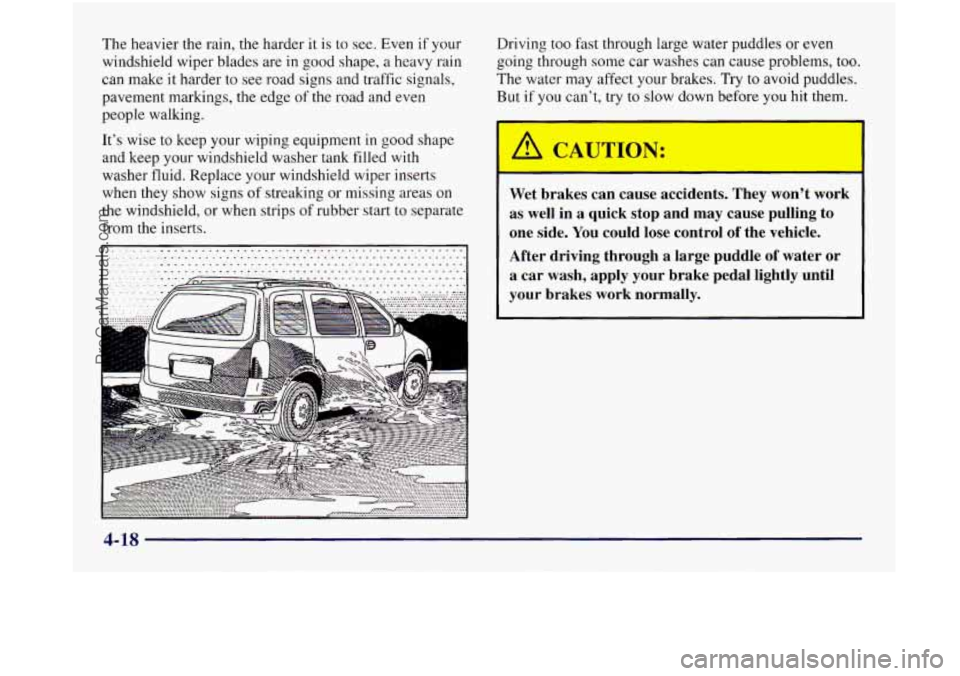
too fast through large water puddles or
even
going through some car washes can cause problems, too.
The water may affect your brakes. Try to avoid puddles.
But
if you can't, try to slow down before you hit them.
Wet brakes can cause accidents. They won't work
as well in
a quick stop and may cause pulling to
one side. You could lose control of the vehicle.
After driving through
a large puddle of water or
a car wash, apply your brake pedal lightly until
your brakes work pormally.
4-18
ProCarManuals.com
Page 263 of 436
Turn Signals When Towing a Trailer
When you tow a trailer, your vehicle has to have extra
wiring and a different turn signal flasher.
The arrows on your instrument panel will flash
whenever you signal a turn or lane change. Properly
hooked up, the trailer lamps will also flash, telling other
drivers you’re about to turn, change lanes or stop.
When towing a trailer, the arrows on your instrument
panel will flash for turns even if
the bulbs on the trailer
are burned out. Thus, you may think drivers behind you
are seeing your signal when
they are not. It’s important
to check occasionally to be sure the trailer bulbs are
still working.
Driving On Grades
Reduce speed and shift to a lower gear befure you start
down a long or steep downgrade.
If you don’t shift
down, you might have to use your brakes
so much that
they would get hot and
no longer work well.
On a long uphill grade, shift down and reduce your
speed to around
45 mph (70 km/h) to reduce the
possibility of engine and transaxle overheating.
If you are towing a trailer that weighs more than
1,000 lbs.
(454 kg), you may prefer to drive in
THIRD
(3) instead of AUTOMATIC OVERDRIVE (D)
(or, as
you need to, a lower gear). This will minimize
heat build-up and extend the life of your transaxle.
Parking on Hills
You really should not park your vehicle, with a trailer
attached, on a
hill. If something goes wrong, your rig
could start to move. People can be injured, and both
your vehicle and the trailer can be damaged.
But
if you ever have to park your rig on a hill, here’s
how to do it:
1.
2.
3.
4.
5.
Apply your regular brakes, but don’t shift into
PARK
(P) yet.
Have someone place chocks under
the trailer wheels.
When
the wheel chocks are in place, release the
regular brakes
until the chocks absorb the load.
Reapply the regular brakes. Then apply your parking
brake, and then shift
to PARK (P).
Release the regular brakes.
4-37
ProCarManuals.com
Page 264 of 436
When You Are Ready to Leave After
Parking on
a Hill
1. Apply your regular brakes and hold the pedal down
while you:
Start your engine;
Shift into a gear; and
Release the parking brake.
2. Let up on the brake pedal.
3. Drive slowly until the trailer is clear of the chocks.
4. Stop and have someone pick up and store the chocks
Maintenance When Trailer Towing
Your vehicle will need service more often when you’re
pulling a trailer. See the Maintenance Schedule
for more
on this. Things that are especially important
in trailer
operation are automatic transaxle fluid (don’t overfill),
engine oil, belts, cooling system and brake adjustment.
Each
of these is covered in this manual, and the Index
will help you find them quickly. If you’re trailering, it’s
a good idea to review these sections before you start
your trip.
Check periodically to
see that all hitch nuts and bolts
are tight.
4-38
ProCarManuals.com
Page 295 of 436
NOTICE:
Improperly tightened wheel nuts can lead to brake pulsation and rotor damage.
To avoid
expensive brake repairs, evenly tighten the wheel
nuts in the proper sequence and to the proper
torque specification.
11. Don’t try to put
a wheel cover on the compact spare
tire. It won’t fit. Store
the wheel cover securely in
the rear of the vehicle until you have the flat tire
repaired or replaced.
1 NOTICE:
Wheel covers won’t fit on your compact spare. If
you try to put a wheel cover on your compact
spare, you could damage the cover or the spare.
Storing a Flat or Spare Tire and Tools
Storing a jack, a tire or other equlpment in the
passenger compartment
of the vehicle could
cause injury. In
a sudden stop or collision, loose
equipment could strike someone. Store
all these
in the proper place.
Lay the tire near the rear of the vehicle with the valve
stem down. Slide the cable retainer through the center
of the wheel and start to raise the tire. When the tire is
almost in
the stored position, turn the tire so the valve is
towards the rear of the vehicle. This will help when you
check and maintain tire pressure
in the spare.
Keep raising the wheel
until you hear the hoist
mechanism click twice. This means the wheel is
firmly stored against the underside of the vehicle. Push
against the wheel to be sure it does
not move and is
stored securely.
ProCarManuals.com