oil temperature OLDSMOBILE SILHOUETTE 1997 Owners Manual
[x] Cancel search | Manufacturer: OLDSMOBILE, Model Year: 1997, Model line: SILHOUETTE, Model: OLDSMOBILE SILHOUETTE 1997Pages: 436, PDF Size: 21.87 MB
Page 118 of 436
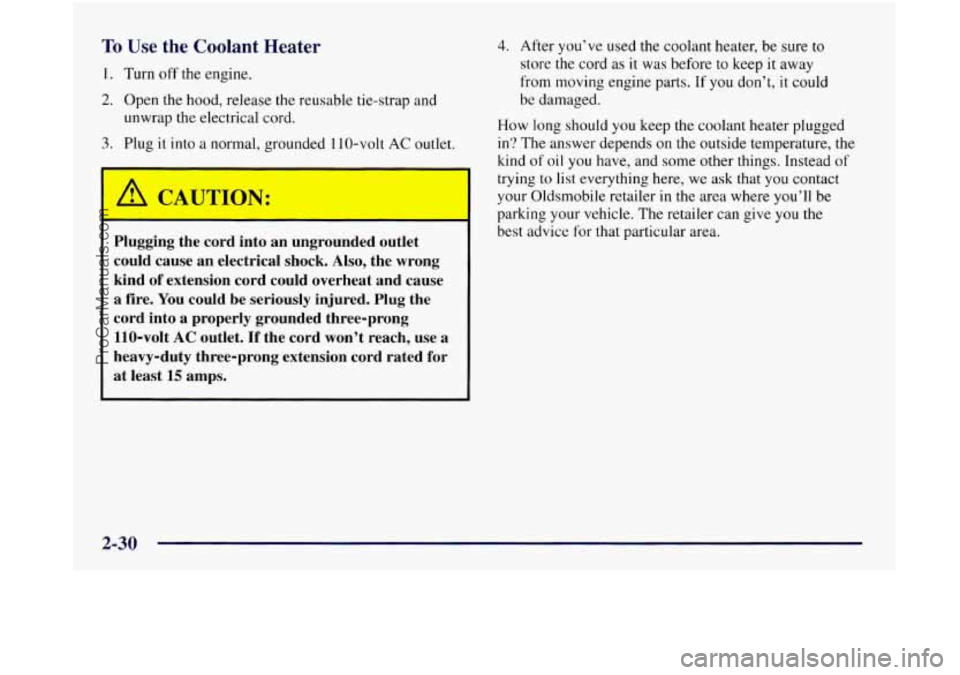
To Use the Coolant Heater
1. Turn off the engine.
2. Open the hood, release the reusable tie-strap and
3. Plug it into a normal, grounded 11 0-volt AC outlet.
unwrap the electrical cord.
ON:
I - - I
Plugging
the cord into an ungrounded outlet
could cause an electrical shock. Also, the wrong
kind
of extension cord could overheat and cause
a fire. You could be seriously injured. Plug the
cord into
a properly grounded three-prong
110-volt AC outlet. If the cord won’t reach, use a
heavy-duty three-prong extension cord rated for
at least
15 amps.
4. After you’ve used the coolant heater, be sure to
store the cord as it was before to keep it away
from moving engine parts. If you don’t, it could
be damaged.
How long should you keep the coolant heater plugged
in?
The answer depends on the outside temperature, the
kind of oil you have, and some other things. Instead of
trying to list everything here, we ask that you contact
your Oldsmobile retailer
in the area where you’ll be
parking your vehicle. The retailer can give you the
best advice
for that particular area.
2-30
ProCarManuals.com
Page 276 of 436
Engine Overheating
You will find a coolant temperature gage on your
Oldsmobile’s instrument panel. See “Engine Coolant
Temperature Gage”
in the Index. You also have a low
coolant level light on your instrument panel. See “Low
Coolant Light” in the Index.
Overheated Engine Protection
Operating Mode
Should a low coolant condition exist, an overheat
protection mode which alternates firing groups of three
cylinders helps prevent engine damage. In this mode,
you will notice
a significant loss in power and engine
performance. The low coolant light may come on and
the temperature gage will indicate an overheat condition
exists. This emergency operating mode
allows your
vehicle to be driven to
a safe place in an emergency.
Towing
a trailer in the overheat protection mode should
be avoided.
I NOTICE:
After driving in the overheated engine protection
operating mode, to avoid engine damage, allow
the engine to cool before attempting any repair.
The engine oil
will be severely degraded. Repair
the cause of coolant loss and change the oil. See
“Engine Oil, When to Change” in the Index.
5-12
ProCarManuals.com
Page 311 of 436
RECOMMENDED SAE VISCOSITY 6RADE ENGINE OILS
FOR BEST FUEL ECONOMY AND COLD STARTING, SELECT THE LOWEST
SAL
VISCOSITY GRADE OIL FOR THE EXPECTED TEMPERATURE RANGE.
HOT
WEATHER -
“F
1100-
+EO-
+60 -
+40-
+ 20 -
0-
-
“C
+ 38
+ 27
+ 16
+4
-7
- 18
WOK
FOR THIS
SYMBOL
L
COLD
WEATHER
DO NOT USE SAE 2OW-50 OR ANY OTHER GRADE OIL NOT RECOMMENDED
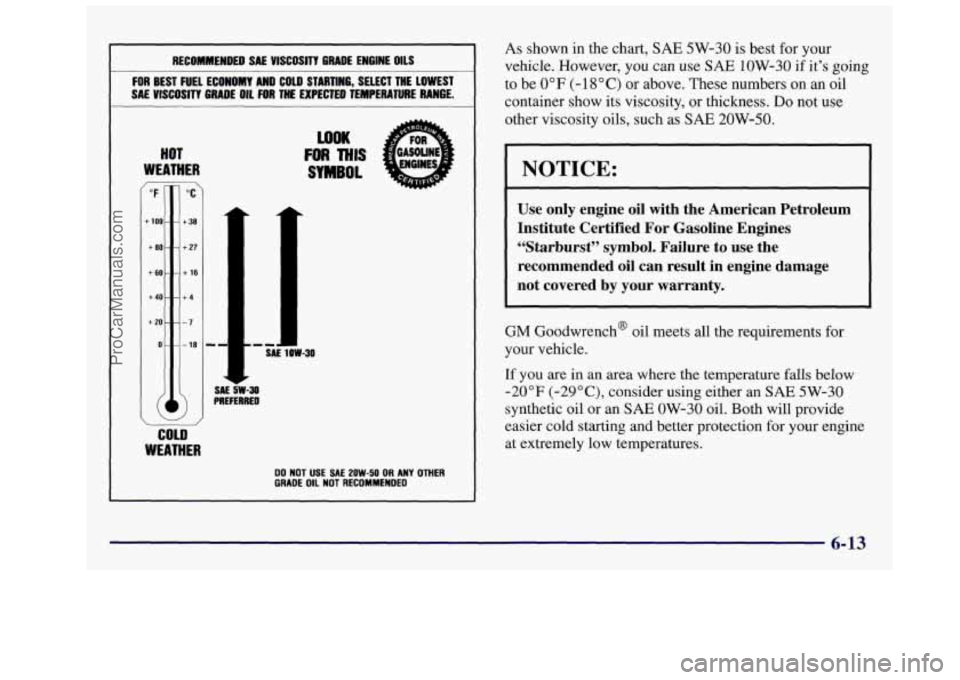
As shown in the chart, SAE 5W-30 is best for your
vehicle. However, you can use
SAE 1OW-30 if it’s going
to be
0°F (- 18 ” C) or above. These numbers on an oil
container show its viscosity, or thickness.
Do not use
other viscosity oils, such as
SAE 20W-50.
NOTICE:
Use only engine oil with the American Petroleum
Institute Certified For Gasoline Engines
“Starburst” symbol. Failure
to use the
recommended oil can result in engine damage
not covered
by your warranty.
GM Goodwrench@ oil meets all the requirements for
your vehicle.
If you are in an area where the temperature falls below
-20°F (-29”C), consider using either an SAE 5W-30
synthetic oil or an SAE OW-30 oil. Both will provide
easier cold starting and better protection for your engine
at extremely low temperatures.
6-13
ProCarManuals.com
Page 312 of 436

Engine Oil Additives
Don’t add anything to your oil. Your Oldsmobile retailer is \
ready to advise if
you think something should be added.
When to Change Engine Oil
If any one of these is true for you, use the short tripkity
maintenance schedule:
Most trips are less than 5 to IO miles (8 to 16 km).
This is particularly important when outside
temperatures are below freezing.
Most trips include extensive idling (such as frequent
driving
in stop-and-go traffic).
Most trips are through dusty areas.
You frequently tow a trailer or use a carrier on top of
your vehicle.
The vehicle is used for delivery service, police, taxi
or other commercial application.
Driving under these conditions causes engine oil to
break down sooner. If any one of these is true for your
vehicle, then you need to change your
oil and filter
every
3,000 miles (5 000 km) or 3 months -- whichever
occurs first. If
none
of them is true, use the long triphighway
maintenance schedule. Change the oil and filter every
7,500 miles (1 2 500 km) or I2 months -- whichever
occurs first. Driving
a vehicle with a fully warmed
engine under highway conditions causes engine oil to
break down slower.
What to Do with Used Oil
Did you know that used engine oil contains certain
elements that may be unhealthy for your skin and could
even cause cancer? Don’t let used oil stay on your skin
for very long. Clean your skin and nails with soap and
water, or
a good hand cleaner. Wash or properly throw
away clothing or rags containing used engine oil. (See
the manufacturer’s warnings about
the use and disposal
of oil products.)
Used oil can be a real threat to the environment. If you
change your own
oil, be sure to drain all free-flowing oil
from the filter before disposal. Don’t
ever dispose of oil
by putting
it in the trash, pouring it on the ground, into
sewers, or into streams or bodies of water. Instead,
recycle
it by taking it to a place that collects used oil. If
you have a problem properly disposing of your used oil,
ask your retailer,
a service station or a local recycling
center for help.
6-14
ProCarManuals.com
Page 315 of 436
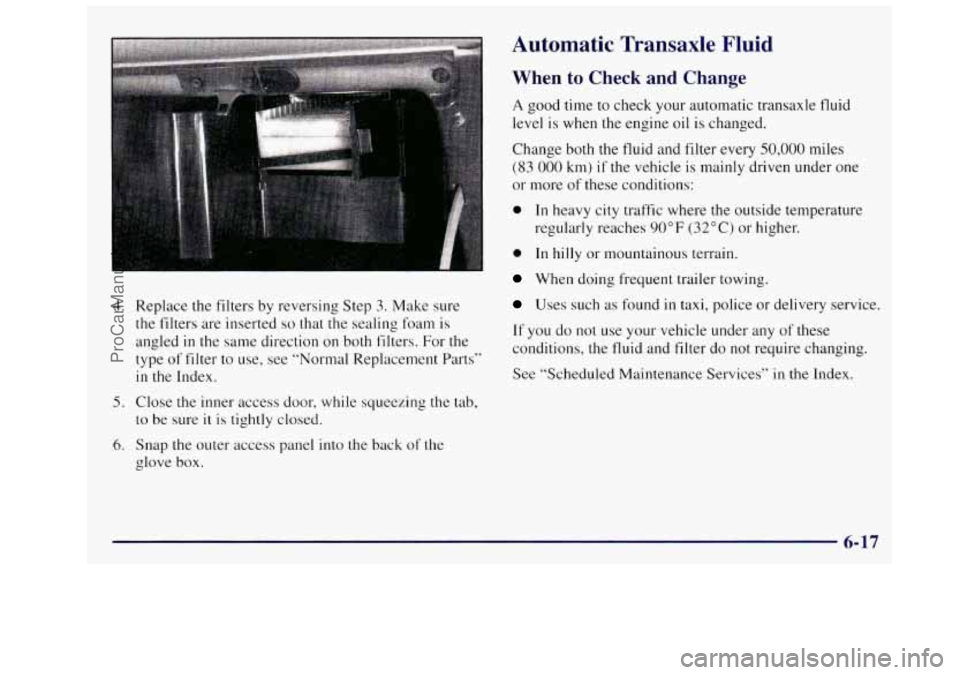
4.
5.
6.
Replace the filters by reversing Step 3. Make sure
the filters are inserted
so that the sealing foam is
angled
in the same direction on both filters. For the
type of filter to use,
see “Normal Replacement Parts”
in the Index.
Close the inner access door, while squeezing the tab,
to be sure
it is tightly closed.
Snap the outer access panel
into the back of the
glove box.
Automatic Transaxle Fluid
When to Check and Change
A good time to check your automatic transaxle fluid
level
is when the engine oil is changed.
Change both the fluid and filter every 50,000 miles
(83 000 km) if the vehicle is mainly driven under one
or more
of these conditions:
0 In heavy city traffic where the outside temperature
regularly reaches
90°F (32°C) or higher.
0 In hilly or mountainous terrain.
When doing frequent trailer towing.
Uses such as found in taxi, police or delivery service
If you do not use your vehicle under any of these
conditions, the fluid and filter do not require changing.
See “Scheduled Maintenance Services”
in the Index.
6-17
ProCarManuals.com
Page 318 of 436
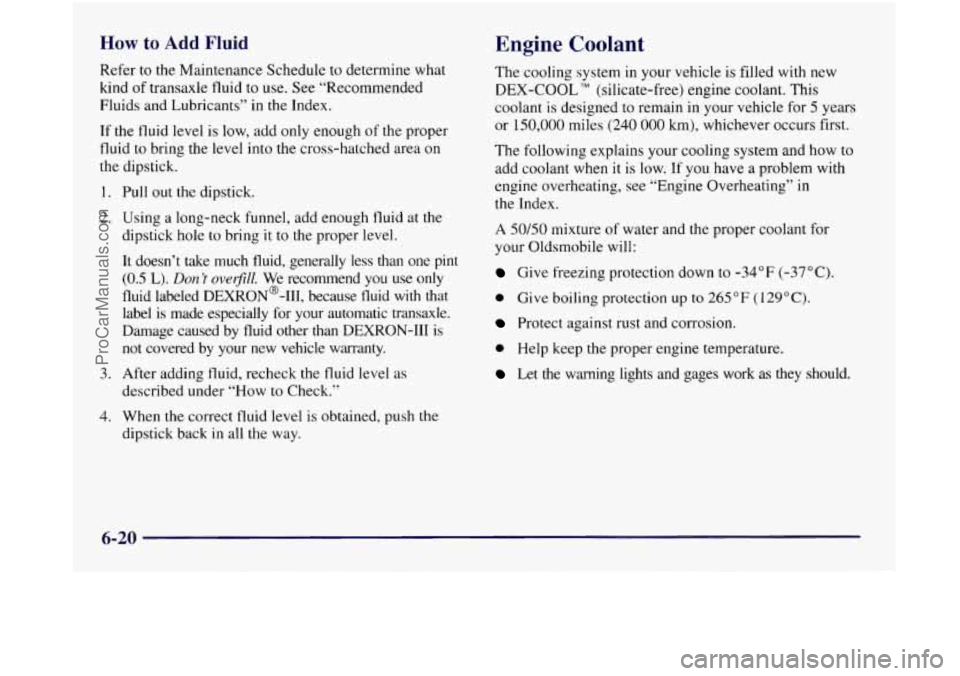
How to Add Fluid Engine Coolant
Refer to the Maintenance Schedule to determine what
kind
of transaxle fluid to use. See “Recommended
Fluids and Lubricants” in
the Index.
If the fluid level is low, add only enough of the proper
fluid to bring
the level into the cross-hatched area on
the dipstick.
1. Pull out the dipstick.
2. Using a long-neck funnel, add enough fluid at the
dipstick hole
to bring it to the proper level.
It doesn’t take much fluid, generally less than one pint
(0.5 L). Don% overfill. We recommend you use only
fluid labeled DEXRON@-111, because fluid with that label
is made especially for your automatic transaxle.
Damage caused by fluid other than DEXRON-111
is
not covered by your new vehicle warranty.
3. After adding fluid, recheck the fluid level as described under “How to Check.”
4. When the correct fluid level is obtained, push the
dipstick back in all the way. The cooling
system in your vehicle is filled with new
DEX-COOL
TM (silicate-free) engine coolant. This
coolant
is designed to remain in your vehicle for 5 years
or 150,000 miles
(240 000 km), whichever occurs first.
The following explains your cooling system and how to
add coolant when it is low. If you have a problem with
engine overheating, see “Engine Overheating” in
the Index.
A 50/50 mixture of water and the proper coolant for
your Oldsmobile will:
Give freezing protection down to -34°F (-37°C).
0 Give boiling protection up to 265°F (129°C).
Protect against rust and corrosion.
0 Help keep the proper engine temperature.
Let the warning lights and gages work as they should.
6-20
ProCarManuals.com
Page 361 of 436

Engine Specifications
Engine VTN Code ........................... E
EngineType .............................. V6
Firing Order
...................... 1-2-3-4-5-6
Horsepower
............................. I85
Thermostat Temperature
Specification
................... 195°F (91 “C)
Vehicle Dimensions - Long Wheel Base
Length ...................... 201.3” (51 1.5 cm)
Width
........................ 72.0” (1 83.0 cm)
Height
........................ 68.1’’ (1 73.1 cm)
Wheelbase
.................... 120” (304.7 cm)
Front Tread Width
............. 6 1.5” ( 1 56.2 cm)
Rear Tread Width
............. 63.3” ( 160.8 cm)
Vehicle Dimensions - Short Wheel Base
Length ...................... 187.4” (475.9 cm)
Width
........................ 72.0” (1 83.0 cm)
Height
........................ 67.4” (171.2 cm)
Wheelbase
.................... 1 12” (284.5 cm)
Front Tread Width
............. 6 1 Sf‘ ( 156.2 cm)
Rear Tread Width ............. 63.3” ( 160.8 cm)
Normal Maintenance Replacement Parts
Air Cleaner Filter .............. AC Type A-974C
Pollen Filter
(2) ..................... 52470574
Engine
Oil Filter ........................ PF47
Spark Plugs
................... AC Type 41-940
Gap: 0.060 ” (1.52 mm)
Windshield Wiper Blades Length
........................ 24” (600 mm)
Type ......................... Shepard’s Hook
Length ........................ 16” (406 mm)
Type
......................... Shepard’s Hook
Backglass Wiper
Blade
6-63
ProCarManuals.com
Page 367 of 436
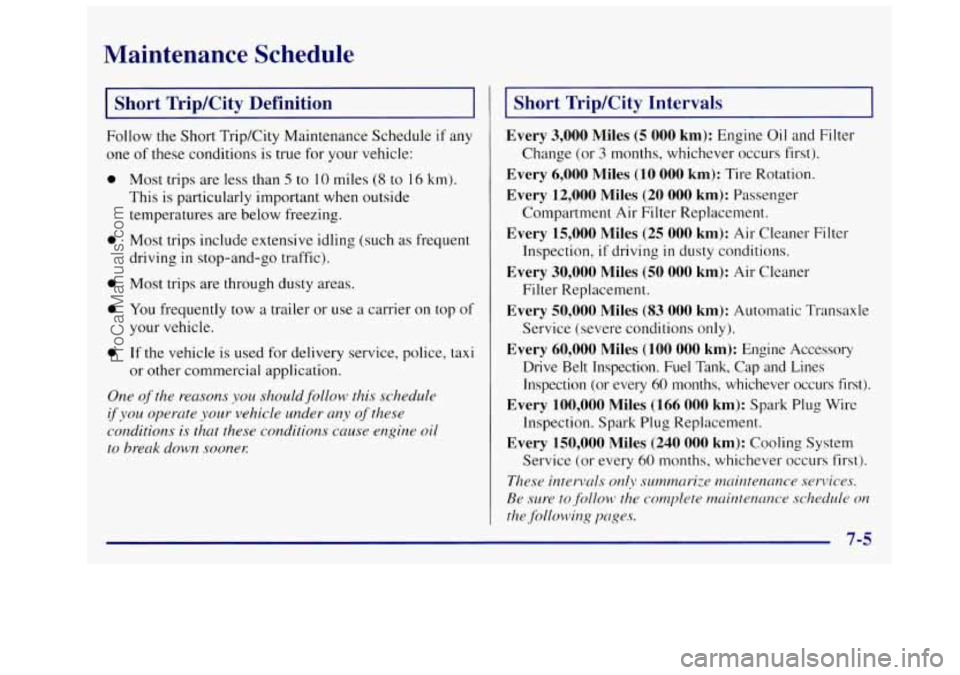
Maintenance Schedule
I Short Trip/City Definition I
Follow the Short Trip/City Maintenance Schedule if any
one of these conditions is true for your vehicle:
0
0
0
0
0
Most trips are less than 5 to 10 miles (8 to 16 km).
This is particularly important when outside
temperatures are below freezing.
Most trips include extensive idling (such as frequent
driving
in stop-and-go traffic).
Most trips are through dusty areas.
You frequently tow a trailer or use a carrier on top of
your vehicle.
If the vehicle is used for delivery service, police, taxi
or other commercial application.
One of the reasons you should follow this schedule
ifyo~1 operate your vehicle under any
sf these
conditions is that these conditions cause engine oil
to break down sooney:
Short Trip/City Intervals
Every 3,000 Miles (5 000 km): Engine Oil and Filter
Change (or
3 months, whichever occurs first).
Every 6,000 Miles (10 000 km): Tire Rotation.
Every 12,000 Miles (20 000 km): Passenger
Compartment Air Filter Replacement.
Every 15,000 Miles (25 000 km): Air Cleaner Filter
Inspection,
if driving in dusty conditions.
Every 30,000 Miles (50 000 km): Air Cleaner
Filter Replacement.
Every 50,000 Miles (83 000 km): Automatic Transaxle
Service (severe conditions only).
Every 60,000 Miles (100 000 km): Engine Accessory
Drive
Belt Inspection. Fuel Tmk, Cap and Lines
Inspection
(or every 60 months, whichever occurs first).
Every 100,000 Miles (166 000 km): Spark Plug Wire
Inspection. Spark Plug Replacement.
Every 150,000 Miles (240 000 km): Cooling System
Service (or every
60 months, whichever occurs first).
These intervals only sLlrnrnarize maintenance services.
Be sure to follow the complefe rnuintenance schedule on
the following pages.
ProCarManuals.com
Page 377 of 436
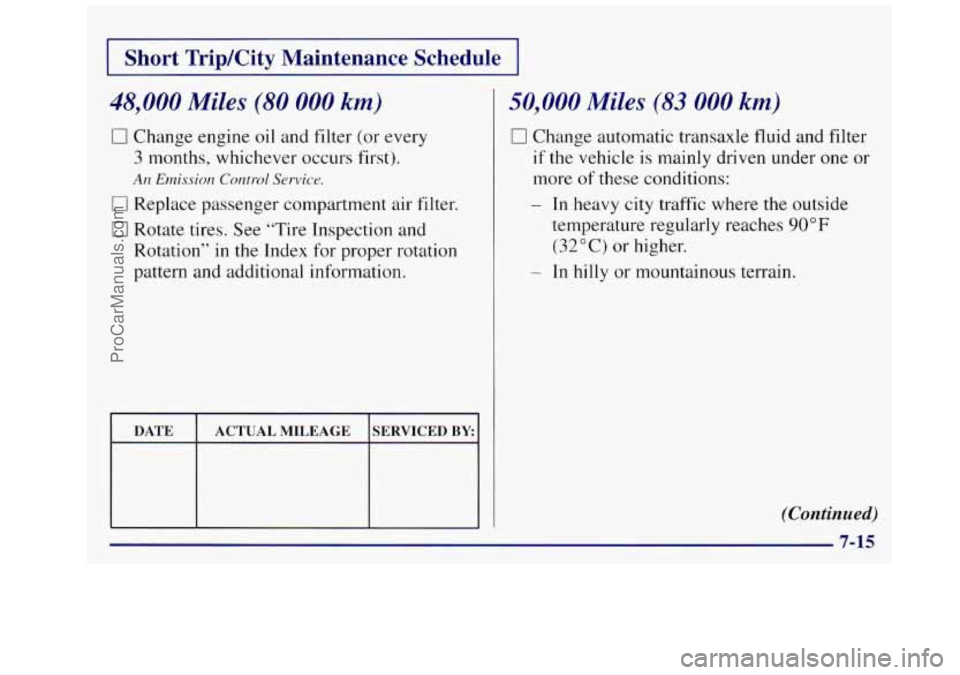
Short TripKity Maintenance Schedule
48,000 Miles (80 000 kmj
0 Change engine oil and filter (or every
3 months, whichever occurs first).
An Emission Control Service.
0 Replace passenger compartment air filter.
0 Rotate tires. See “Tire Inspection and
Rotation”
in the Index for proper rotation
pattern and additional information.
DATE ACTUAL MILEAGE
SERVICED BY
50,000 Miles (83 000 km)
0 Change automatic transaxle fluid and filter
if the vehicle is mainly driven under one or
more of these conditions:
- In heavy city traffic where the outside
temperature regularly reaches
90°F
(32°C) or higher.
- In hilly or mountainous terrain.
(Continued)
-1-
ProCarManuals.com
Page 387 of 436

I Short Trip/City Maintenance Schedule I
99,000 Miles (1 65 000 km)
0 Change engine oil and filter (or every
3 months, whichever occurs first).
An Emission Control Service.
DATE SERVICED BY ACTUAL MILEAGE
100,000 Miles (166 000 km)
0 Inspect spark plug wires.
An Emission Control Service.
Replace spark plugs.
0 Change automatic transa
An Emission Control Service.
.xle fl .uid and filter
if the vehicle is mainly driven under one
or
more of these conditions:
- In heavy city traffic where the outside
temperature regularly reaches
90 OF
(32°C) or higher.
- In hilly or mountainous terrain.
(Continued)
ProCarManuals.com