ignition OLDSMOBILE SILHOUETTE 1998 User Guide
[x] Cancel search | Manufacturer: OLDSMOBILE, Model Year: 1998, Model line: SILHOUETTE, Model: OLDSMOBILE SILHOUETTE 1998Pages: 444, PDF Size: 23.2 MB
Page 126 of 444
Arming with the Remote Lock
Control Transmitter
Your alarm system will arm when you use your remote
lock control transmitter to lock the doors, if the key is
not in the ignition. The security light will turn on to let
you know the system is arming. After all doors and
the
liftgate are closed and locked, the security light will
begin flashing at a very slow rate to let you know the
system is armed.
Arming with Your Key
Your alarm system will arm when you use your key to
lock the doors. The security light will turn on to let you
know the system is arming. After all doors and the
liftgate are closed and locked, the security light will
begin flashing at a very slow rate to let you know the
system is armed. If you would like your key not
to arm
the system, see “Locks and Lighting Choices” in
the Index.
Arming Confirmation
If remote unlock confirmation is on (see “Locks and
Lighting Choices”
in the Index), your parking lamps
will flash briefly to let you know when your alarm
system has armed.
Disarming with the Remote Lock
Control Transmitter
Your alarm system will disarm when you use your
remote lock control transmitter to unlock the doors. The
security light will stop flashing to let you know the
system is no longer armed.
Disarming with Your Key
Your alarm system will disarm when you use your key
to unlock the doors. The security light will stop flashing
to let you know the system is no longer armed. If you
would like your key not to disarm the alarm system, see
“Locks and Lighting Choices” in the Index.
2-24
ProCarManuals.com
Page 128 of 444
Ignition Positions
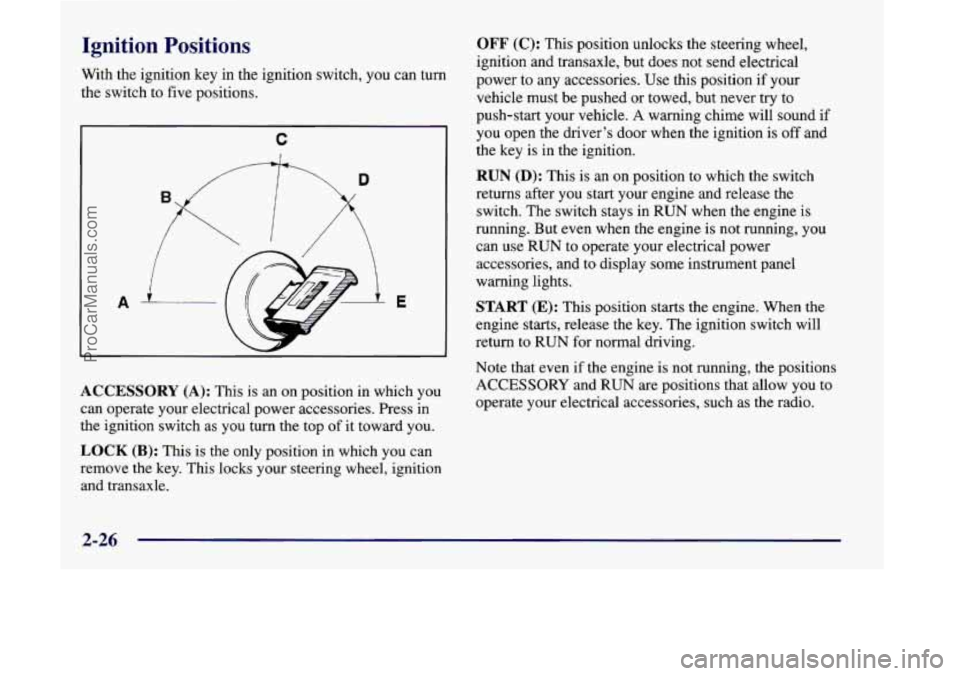
With the ignition key in the ignition switch, you can turn
the switch to five positions.
C
ACCESSORY (A): This is an on position in which you
can operate your electrical power accessories. Press in
the ignition switch as you turn the top
of it toward you.
LOCK (B): This is the only position in which you can
remove the key. This locks your steering wheel, ignition
and transaxle.
OFF (C): This position unlocks the steering wheel,
ignition and transaxle, but does not send electrical
power to any accessories. Use this position if your
vehicle must be pushed or towed, but never try to
push-start your vehicle.
A warning chime will sound if
you open the driver’s door when the ignition is off and
the key is in the ignition.
RUN (D): This is an on position to which the switch
returns after you start your engine and release the
switch.
The switch stays in RUN when the engine is
running. But
even when the engine is not running, you
can use RUN to operate your electrical power
accessories, and to display some instrument panel
warning lights.
START (E): This position starts the engine. When the
engine starts, release the key. The ignition switch will
return to RUN for normal driving.
Note that even
if the engine is not running, the positions
ACCESSORY and RUN are positions that allow you to
operate your electrical accessories, such as the radio.
2-26
ProCarManuals.com
Page 129 of 444

NOTICE:
If your key seems stuck in LOCK and you can’t
turn it, be sure you are using the correct key; if
so, is it all the way in? If it is, then turn the
steering wheel left and right while you turn the
key hard. But turn the key only with your hand.
Using
a tool to force it could break the key or the
ignition switch.
If none of this works, then your
vehicle needs service.
Starting Your Engine
Move your shift lever to PARK (P) or NEUTRAL (N).
Your engine won’t start in any other position
-- that’s a
safety feature. To restart when you’re already moving,
use NEUTRAL
(N) only.
NOTICE:
Don’t try to shift to PARK (P) if your Oldsmobile
is moving.
If you do, you could damage the
transaxle. Shift to
PARK (P) only when your
vehicle is stopped.
1. Without pushing the accelerator pedal, turn your
ignition key to START. When the engine starts, let
go of the key. The idle speed will go down as your
engine gets warm.
I NOTICE:
Holding your key in START for longer than
15 seconds at a time will cause your battery to be
drained much sooner. And the excessive heat can
damage your starter motor.
2-27
ProCarManuals.com
Page 132 of 444
Automatic Transaxle Operation
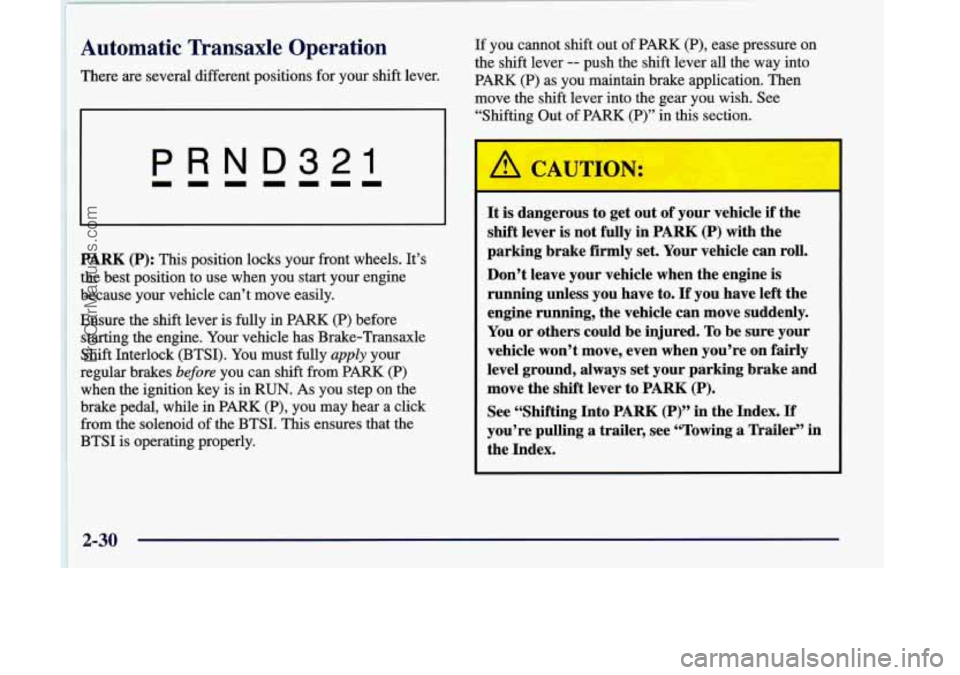
There are several different positions for your shift lever.
PRND321
PARK (P): This position locks your front wheels. It’s
the best position to use when you start your engine
because your vehicle can’t move easily.
Ensure the shift lever is fully in PARK (P) before
starting the engine.
Your vehicle has Brake-Transaxle
Shift Interlock (BTSI). You must fully
apply your
regular brakes
before you can shift from PARK (P)
when the ignition key is in RUN.
As you step on the
brake pedal, while in PARK (P), you may hear a click
from the solenoid of the BTSI.
This ensures that the
BTSI is operating properly.
I
If you cannot shift out of PARK (P), ease pressure on
the shift lever
-- push the shift lever all the way into
PARK (P) as you maintain brake application. Then
move the shift lever into the gear you wish. See
“Shifting Out of PARK (P)” in this section.
It is dangerous to get out of your vehicle if the
shift lever is not fully in PARK
(P) with the
parking brake firmly set. Your vehicle can roll.
Don’t leave your vehicle when the engine
is
running unless you have to. If you have left the
engine running, the vehicle can move suddenly.
You or others could be injured. To be sure your
vehicle won’t move, even when you’re on
fairly
level ground, always set your parking brake and
move the
shift lever to PARK (P).
See “Shifting Into PARK (P)” in the Index. If
you’re pulling a trailer, see “Towing a Trailer” in
the Index.
ProCarManuals.com
Page 136 of 444
Parking Brake
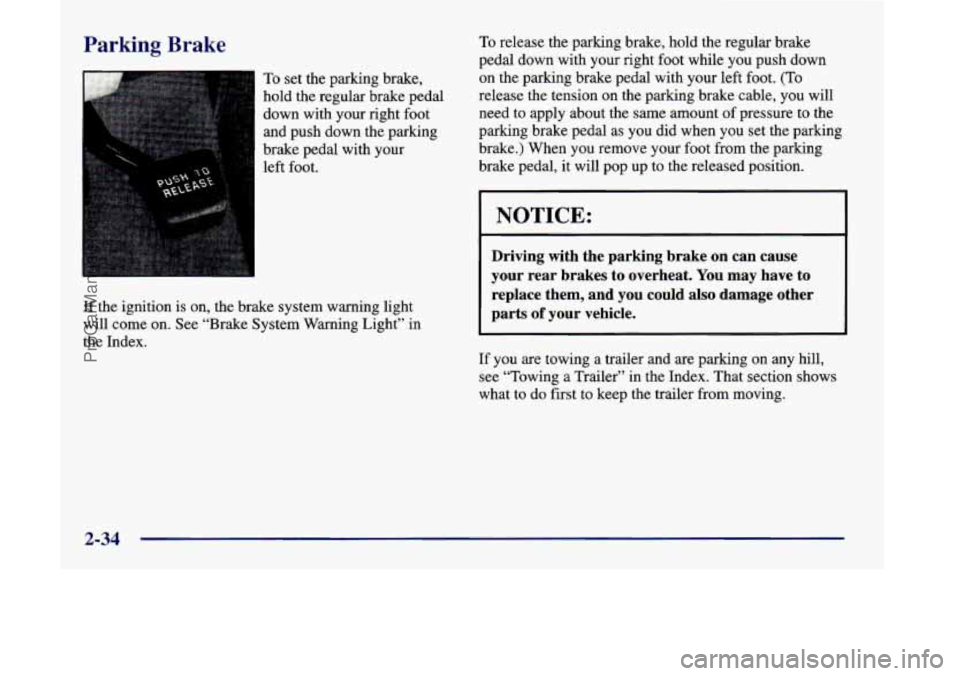
To set the parking brake,
hold the regular brake pedal
down with your right foot
and push down the parking
brake pedal with your
left foot.
If the ignition is on, the brake system warning light
will come on. See “Brake System Warning Light” in
the Index.
To release the parking brake, hold the regular brake
pedal down with your right foot while you push down
on the parking brake pedal with your left foot.
(To
release the tension on the parking brake cable, you will
need to apply about the same amount of pressure to the
parking brake pedal as you did when you set the parking
brake.) When you remove your foot from the parking
brake pedal,
it will pop up to the released position.
NOTICE:
Driving with the parking brake on can cause
your rear brakes to overheat. You may have to
replace them, and you could also damage other
parts
of your vehicle.
If you are towing a trailer and are parking on any hill,
see “Towing a Trailer” in the Index. That section shows
what to do first to keep the trailer from moving.
2-34
ProCarManuals.com
Page 138 of 444

0 Move the lever up as far as it will go.
3. Move the ignition key to LOCK.
~ 4. Remove the key and take it with you. If you can
leave your vehicle with the ignition key
in your
hand,
your vehicle is in PARK (P).
Leaving Your Vehicle With the
,g
It can be dangerous to leave your vehicle with the
engine running. Your vehicle could move
suddenly
if the shift lever is not fully in PARK (P)
with the parking brake firmly set. And, if you
leave the vehicle with the engine running,
it could
overheat and even catch fire. You or others could
be injured. Don’t leave your vehicle with the
engine running unless you have to.
If you have to leave your vehicle with the engine
running, be sure your vehicle is in PARK (P) and
your
parking brake is fdy set before you leave it. After
you’ve moved the shift lever into PARK (P), hold the
regular brake pedal down. Then, see
if you can move the
shift lever away from PARK (P) without first pulling it
toward you.
If you can, it means that the shift lever
wasn’t fully locked into PARK
(P).
ProCarManuals.com
Page 139 of 444

Torque Lock
If you are parking on a hill and you don’t shift your
transaxle into PARK
(P) properly, the weight of the
vehicle may put too much force on the parking pawl in
the transaxle. You may find it difficult to pull the shift
lever out of PARK (P). This is called “torque lock.” To
prevent torque lock, set the parking brake and then shift
into PARK (P) properly before you leave the driver’s
seat. To find out how, see “Shifting Into PARK (P)” in
the Index.
When you are ready to drive, move the shift lever out of
PARK (P)
before you release the parking brake.
If torque lock does occur, you may need to have another
vehicle push yours a little uphill to take some of the
pressure from the parking pawl in the transaxle,
so you
can pull the shift lever out of PARK (P).
Shifting Out of PARK (P)
Your vehicle has Brake-Transaxle Shift Interlock
(BTSI). You have to fully
apply your regular brakes
before you can shift from PARK (P), when the ignition
is
in RUN.
As you step on the brake pedal, while in PARK
(P), you
may hear a click from the solenoid
of the BTSI. This
ensures that the BTSI
is operating properly. See
“Automatic Transaxle Operation” in the Index.
If you cannot shift out of PARK (P), ease pressure on
the shift lever
-- push the shift lever all the way into
PARK
(P) as you maintain brake application. Then
move the shift lever into the gear you want. If you ever
hold the brake pedal down but still can’t shift out of
PARK (P), try this:
1.
2.
3.
4.
5.
Turn the ignition key to OFF.
Apply and hold the brake until the end of Step 4.
Shift to NEUTRAL (N).
Start the vehicle and then shift to the drive gear
you want.
Have the vehicle fixed as soon as you can.
2-37
ProCarManuals.com
Page 143 of 444

Entering Programming Mode
To program features, your vehicle must be in the
programming mode. Follow these steps:
1.
2.
3.
4.
5.
The Content Theft-Deterrent system (if equipped)
must be disarmed. See “Content Theft-Deterrent
System” in this section.
Remove the BCM PRGRM fuse from the instrument
panel fuse block, located to the right
of the glove
box. (See “Fuses and Circuit Breakers” in the Index.)
Close the driver’s door.
Turn the ignition switch towards you to
ACCESSORY.
Count the number of chimes you hear.
You will hear
two
to four chimes depending on the features your
vehicle is equipped with. Refer to the chart
shown previously.
You can now program your choices.
10 exit the programming mode, follow the steps
listed under “Exiting Programming Mode” later in
this section.
Delayed Illumination and Exit Lighting
With Delayed Illumination, the interior lamps will stay
on for about
25 seconds after all the doors and the
liftgate are closed.
With Exiting Lighting, the interior lamps will come on
and stay on for about
25 seconds whenever you remove
the key from the ignition.
To customize these features to your preference, see
“Programmable Modes” following.
Programmable Modes
Your vehicle can be programmed to one of the
following modes.
Mode 1: Both Features Off (The interior lamps will turn on
or
off at the same instant that a door is opened or closed.)
Mode 2: Delayed Illumination Only (The interior lamps
will stay
on for about 25 seconds after all the doors and
liftgate are closed, or until you lock the doors.)
2-41
ProCarManuals.com
Page 144 of 444

Mode 3: Exit Lighting Only (The interior lamps will
come on whenever you remove the key from the ignition
and stay on for about
25 seconds, or until you lock
the doors.)
Mode 4: Both Features On (This combines Modes 2
and 3.)
Vehicles are delivered programmed in Mode 4.
To change the mode:
1. Follow the instructions for “Entering Programming
Mode” listed previously.
2. Turn the interior lamps dial all the way to the right
and then back slightly to the left.
3. Count the number of chimes you hear. The number
of chimes tells you which mode your vehicle is in.
You can change the mode by turning the interior
lamps dial all the way
to the right and then back
slightly to the
left.
4. Repeat Step 2 until you hear the number of chimes
that matches the mode you want.
The mode you selected is now set. You can either exit
the programming mode by following the instructions
later in this section or program the next feature available
on your vehicle.
Automatic Door Locks
With Automatic Door Locks, all doors will
automatically lock when you shift out of PARK
(P) and
automatically unlock when the ignition is turned to
OFF.
To customize these features to your preference, see
“Programmable Modes” following.
Programmable Modes
Your vehicle can be programmed to one of the
following modes.
Mode 1: Both Features Off (Automatic door locking
and unlocking is disabled. You will always need to
lock your doors manually before driving to increase
occupant safety.)
Mode 2: Automatic Door Locking Only
0 The automatic door unlock feature is turned off.
Shift out of PARK (P) with the ignition on and the
driver’s door closed;
all doors will lock automatically.
Mode 3: Automatic Unlocking with the Ignition Off
Turn off the ignition with the transaxle in PARK (P);
all doors will unlock automatically.
Shift out of PARK (P) with the ignition on and the
driver’s door closed;
all doors will lock automatically.
2-42
ProCarManuals.com
Page 145 of 444

Mode 4: Automatic Unlocking with Transaxle in
PARK (P)
0 Shift into PARK (P) with the ignition on; all doors
will unlock automatically.
0 Shift out of PARK (P) with the ignition on and the
driver’s door closed; all doors will lock automatically.
Vehicles are delivered programmed
in Mode 3.
To change the mode:
1. Follow the instructions for “Entering Programming
Mode” listed previously.
2. Press LOCK on the power door lock switch.
3. Count the number of chimes you hear. The number
of chimes tells you which mode your vehicle is in.
You can change the mode by pressing LOCK again.
4. Repeat Step 2 until you hear the number of chimes
that
matches the mode you want.
The mode you selected is now set. You can either exit
the programming mode by following the instructions
later in this section or program the next feature available
on your vehicle.
Last Door Closed Locking and
Lockout Prevention
With the Last Door Closed Locking and Lockout
Prevention features, your vehicle will do the following:
If you leave your key in the ignition and leave the
driver’s door open, you won’t be able to lock the
doors using the power door lock switch.
When you press LOCK on the power door lock
switch or remote lock control transmitter (if
equipped) while any door
or the liftgate is open, the
doors will not lock. Instead you will hear three
chimes which let you know that the Last Door
Closed Locking feature is
in operation. Five seconds
after all the doors and the liftgate are closed, all the
doors and the liftgate will automatically lock.
To customize these features to your preference, see
“Programmable Modes” following.
2-43
ProCarManuals.com