wheel size OLDSMOBILE SILHOUETTE 1998 Owners Manual
[x] Cancel search | Manufacturer: OLDSMOBILE, Model Year: 1998, Model line: SILHOUETTE, Model: OLDSMOBILE SILHOUETTE 1998Pages: 444, PDF Size: 23.2 MB
Page 308 of 444

NOTE: INSTALL BOlTOM OF BAG FIRST
TOOL STORAGE
’ BAG & TOOLS
Replace all jacking tools as they were stored in the jack
storage compartment and replace the compartment
cover.
To replace the cover, line up the tabs on the right
of the cover with the slots in the cover opening. Push the
cover
in place and push down the tab so that it rests in
the groove. This secures the cover in place. Unless
you have the plastic “bolt-on” wheel covers, be
sure to also store the center cap. When you replace the
compact spare with a full-size tire, replace the bolt-on
wheel covers and the center cap. Tighten them “hand
tight’’ over the wheel nuts, using the folding wrench.
Compact Spare Tire
Although the compact spare tire was fully inflated when
your vehicle was new, it can lose air after a time. Check
the inflation pressure regularly. It should be
60 psi
(420 kPa).
After installing the compact spare on your vehicle, you
should stop as soon as possible and make sure your
spare tire is correctly inflated. The compact spare
is
made to perform well at speeds up to 65 mph
(105 km/h) for distances up to 3,000 miles (5 000 km),
so you can finish your trip and have your full-size tire
repaired or replaced where you want. Of course, it’s best
to replace your spare with a full-size tire as soon as
you
can. Your spare will last longer and be in good shape in
case
you need it again.
5-34
ProCarManuals.com
Page 353 of 444

CAUTION:
Mixing tires could cause you to lose control while
driving.
If you mix tires of different sizes or types
(radial and bias-belted tires), the vehicle may not
handle properly, and you could have a crash.
Using tires of different sizes may also cause
damage to your vehicle. Be sure to use the same
size and type tires on all wheels.
It’s all right to drive with your compact spare,
though. It was developed for use on your vehicle.
i A CAUTION: I
I If you use bias-ply tires on your vehicle, the
wheel rim flanges could develop cracks after
many miles of driving.
A tire and/or wheel could
fail suddenly, causing a crash. Use only radial-ply
tires with the wheels
on your vehicle.
Uniform Tire Quality Grading
The following information relates to the system
developed by the United States National Highway
Traffic Safety Administration, which grades tires by
treadwear, traction and temperature performance. (This
applies only to vehicles sold in the United States.) The
grades are molded on the sidewalls
of most passenger
car tires. The Uniform Tire Quality Grading system
does not apply to deep tread, winter-type snow tires,
space-saver or temporary use spare tires, tires with
nominal rim diameters of
10 to 12 inches (25 to 30 cm),
or to some limited-production tires.
While the tires available on General Motors passenger
cars and light trucks may vary with respect to these
grades, they must also conform to Federal safety
requirements and additional General Motors Tire
Performance Criteria
(TPC) standards.
6-43
ProCarManuals.com
Page 356 of 444
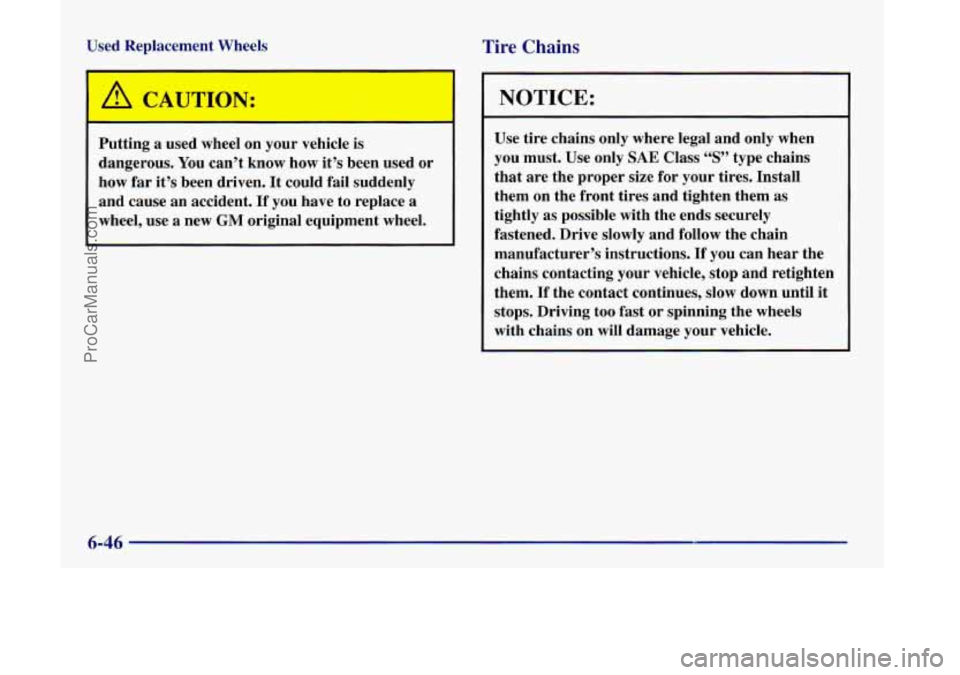
Used Replacement Wheels
I * I
1
Putting a used wheel on your vehicle is
dangerous. You can’t know how it’s been used or
how far it’s been driven. It could fail suddenly
and cause an accident. If you have to replace a
wheel, use
a new GM original equipment wheel.
Tire Chains
NOTICE:
Use tire chains only where legal and only when
you must. Use only
SAE Class “S” type chains
that are the proper size for your tires. Install
them on the front tires and tighten them as
tightly as possible with the ends securely
fastened. Drive slowly and follow the chain
manufacturer’s instructions. If you can hear the
chains contacting your vehicle, stop and retighten
them.
If the contact continues, slow down until it
stops. Driving too fast or spinning the wheels
with chains on will damage your vehicle.
6-46
ProCarManuals.com
Page 374 of 444
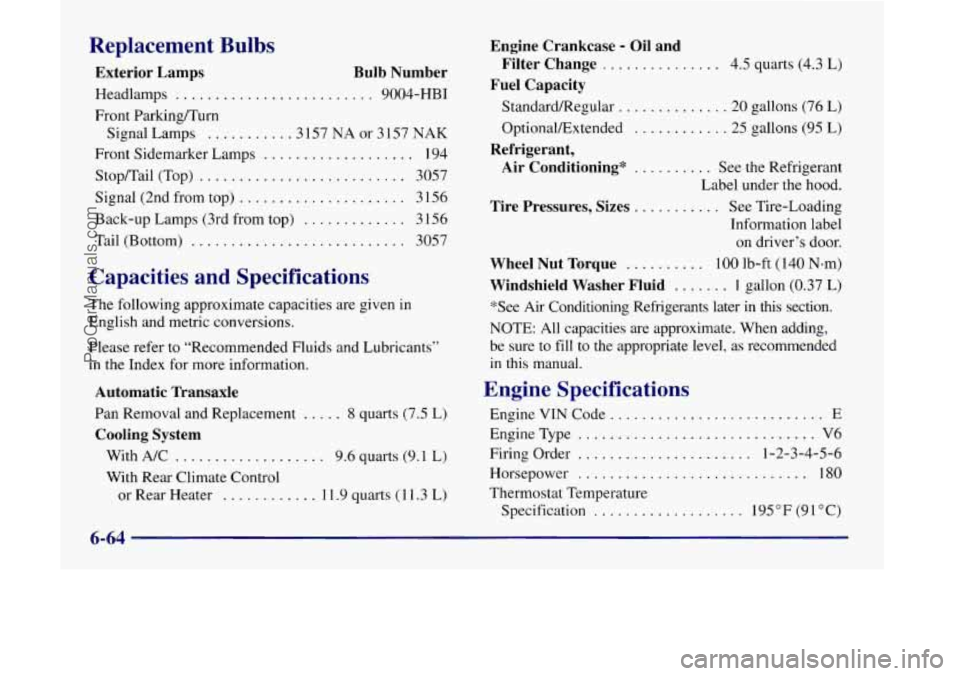
Replacement Bulbs
Exterior Lamps Bulb Number
Headlamps ......................... 9004-HBI
Signal Lamps
.......... .3 157 NA or 3 157 NAK
Front Sidemarker Lamps ................... 194
Stop/Tail (Top)
.......................... 3057
Signal (2nd from top)
..................... 3 156
Tail (Bottom) ........................... 3057
Front Parking/Turn
Back-up Lamps (3rd from top)
............. 3156
Capacities and Specifications
The following approximate
capacities are given in
English and metric conversions.
Please refer to “Recommended Fluids and Lubricants’’
in the Index for more information.
Automatic Transaxle
Pan Removal and Replacement ..... 8 quarts (7.5 L)
With A/C
................... 9.6 quarts (9.1 L)
Cooling System
With Rear Climate Control
or Rear Heater
............ 1 1.9 quarts (1 1.3 L)
Engine Crankcase - Oil and
Fuel Capacity Filter Change
............... 4.5 quarts (4.3 L)
Standard/Regular .............. 20 gallons (76 L)
OptionalExtended
............ 25 gallons (95 L)
Refrigerant,
Air Conditioning*
.......... See the Refrigerant
Label under the hood.
Tire Pressures, Sizes ........... See Tire-Loading
Information label
on driver’s door.
Wheel Nut Torque .......... 100 lb-ft (140 N-m)
Windshield Washer Fluid ....... 1 gallon (0.37 L)
*See Air Conditioning Refrigerants later in this section.
NOTE: All capacities are approximate. When adding,
be sure to fill to the appropriate level, as recommended
in this manual.
Engine Specifications
Engine VIN Code ........................... E
Firing Order
...................... 1-2-3-4-5-6
EngineType
.............................. V6
Horsepower
............................. 180
Thermostat Temperature Specification
................... 195°F (91°C)
6-64
ProCarManuals.com