seats Oldsmobile Silhouette 2001 s User Guide
[x] Cancel search | Manufacturer: OLDSMOBILE, Model Year: 2001, Model line: Silhouette, Model: Oldsmobile Silhouette 2001Pages: 436, PDF Size: 2.95 MB
Page 27 of 436
1-15
CAUTION:
If the seatback isn't locked, it could move forward
in a sudden stop or crash. That could cause injury
to the person sitting there. Always press rearward
on the seatback to be sure it is locked.
CAUTION:
A safety belt that is improperly routed, not
properly attached, or twisted won't provide the
protection needed in a crash. The person wearing
the belt could be seriously injured. After installing
the seat, always check to be sure that the safety
belts are properly routed and attached, and are
not twisted.
Captain's Chairs
The captain's chairs seatbacks can be folded forward or
reclined and the seats can be removed.
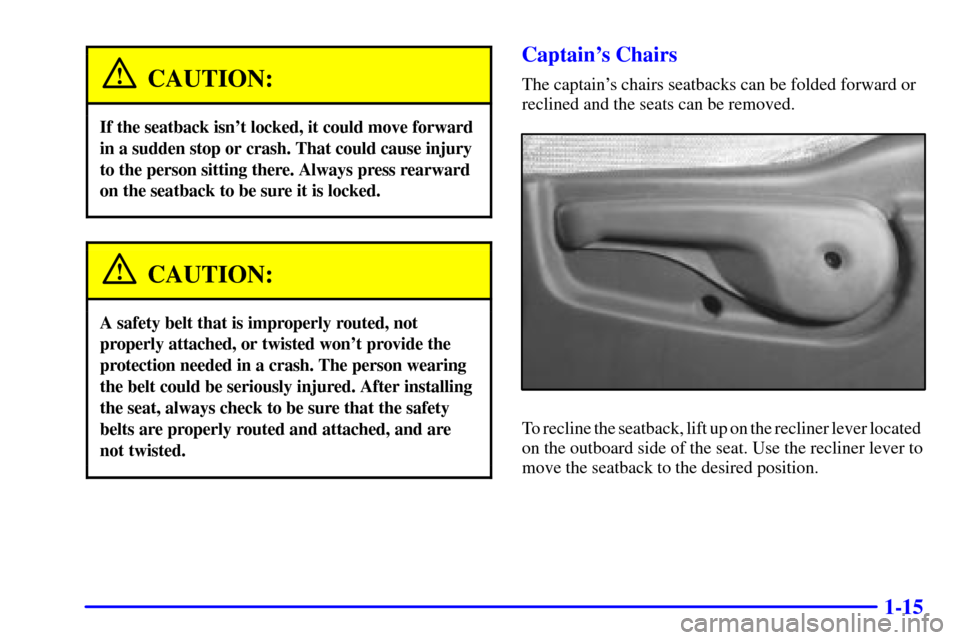
To recline the seatback, lift up on the recliner lever located
on the outboard side of the seat. Use the recliner lever to
move the seatback to the desired position.
Page 28 of 436
1-16
It is easier to raise or lower the seatback if you lean
forward, taking the weight off the seatback.
The armrests can be lowered or raised for entering or
exiting the vehicle.
The seatbacks on the second row captain's chairs also
fold forward to put items behind the left and right seats.
Lift up on the recliner lever and fold the seatback
forward. The seatback will lock into place when you
push it back to the upright position.
CAUTION:
If the seatback isn't locked, it could move forward
in a sudden stop or crash. That could cause injury
to the person sitting there. Always press rearward
on the seatback to be sure it is locked.
Adjusting the Captain's Chairs (Second Row)
The second row captain's chairs can be adjusted forward
or rearward.
There are two adjustment levers on each seat to adjust
the seat forward or rearward. One is located below the
center, in front of the seat. The other is located across
the rear of the seat.
Lift up either lever to slide the seat forward or rearward.
Release the lever. Push and pull on the seat to make sure
it is locked into place.
Page 30 of 436
1-18
Replacing the Captain's Chairs
The left chair second row goes in the A and C sets of
floor pins.
The right chair second row goes in the D and F sets
of floor pins.
The left chair third row goes in the G and H sets of
floor pins.
The right chair third row goes in the I and J sets of
floor pins.
See ªRear Seatsº in the beginning of this section for
more details. The seat must be placed in the proper
location for the legs to attach correctly.
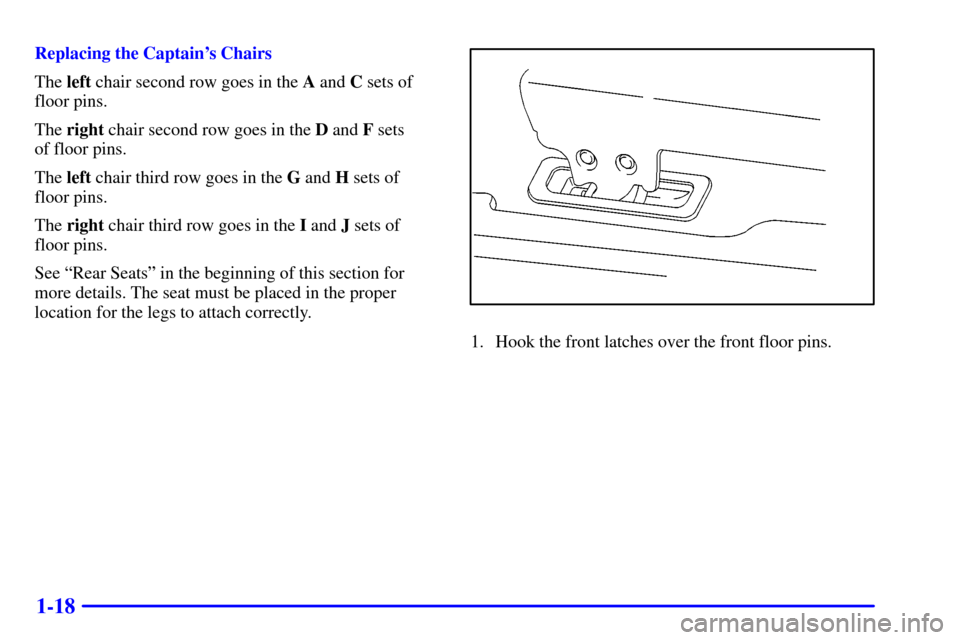
1. Hook the front latches over the front floor pins.
Page 34 of 436
1-22
Replacing the Stowable Seat
Do not put the stowable seat in facing rearward because
it will not latch that way. The stowable seat has to go
in before the convenience center. See ªConvenience
Centerº in the Index for more information.
The stowable seat has seat position labels, located on
the back of the seat, showing where the seat must go.
Follow the floor pin diagram. Use the front floor pins
of the front floor cups and the rear floor cups in the
third row.
Use the G, H, I, and J sets of floor cups.
See ªRear Seatsº in the beginning of this section for
more information. The seat must be placed in the proper
location for the legs to attach correctly.Make sure the seat is in its upright position before
beginning this procedure.
1. Place the front hooks of the seat onto the front floor
pins in the third row. To do this, the seat will need to
be angled so the front hooks clear the floor pins.
If the front legs are not attached correctly, the rear
legs will not attach to the rear set of floor pins.
2. Firmly push the rear hooks into the rear floor pins
by pushing down on the rear of the seat.
3. Try to raise the seat to make sure that it is
locked down.
4. Push and pull on the seatback to make sure that
it is locked into place.
Page 36 of 436
1-24
CAUTION:
It is extremely dangerous to ride in a cargo area,
inside or outside of a vehicle. In a collision,
people riding in these areas are more likely to be
seriously injured or killed. Do not allow people
to ride in any area of your vehicle that is not
equipped with seats and safety belts. Be sure
everyone in your vehicle is in a seat and using
a safety belt properly.
Your vehicle has a light
that comes on as a reminder
to buckle up. See ªSafety
Belt Reminder Lightº in
the Index.In most states and Canadian provinces, the law says to
wear safety belts. Here's why: They work.
You never know if you'll be in a crash. If you do have
a crash, you don't know if it will be a bad one.
A few crashes are mild, and some crashes can be so
serious that even buckled up a person wouldn't survive.
But most crashes are in between. In many of them,
people who buckle up can survive and sometimes walk
away. Without belts they could have been badly hurt
or killed.
After more than 30 years of safety belts in vehicles,
the facts are clear. In most crashes buckling up does
matter ... a lot!
Page 41 of 436
1-29
How to Wear Safety Belts Properly
Adults
This part is only for people of adult size.
Be aware that there are special things to know about
safety belts and children. And there are different
rules for smaller children and babies. If a child
will be riding in your vehicle, see the part of this
manual called ªChildren.º Follow those rules for
everyone's protection.
First, you'll want to know which restraint systems
your vehicle has.
We'll start with the driver position.
Driver Position
This part describes the driver's restraint system.
Lap-Shoulder Belt
The driver has a lap-shoulder belt. Here's how to
wear it properly.
1. Close and lock the door.
2. Adjust the seat so you can sit up straight.
To see how, see ªSeatsº in the Index.
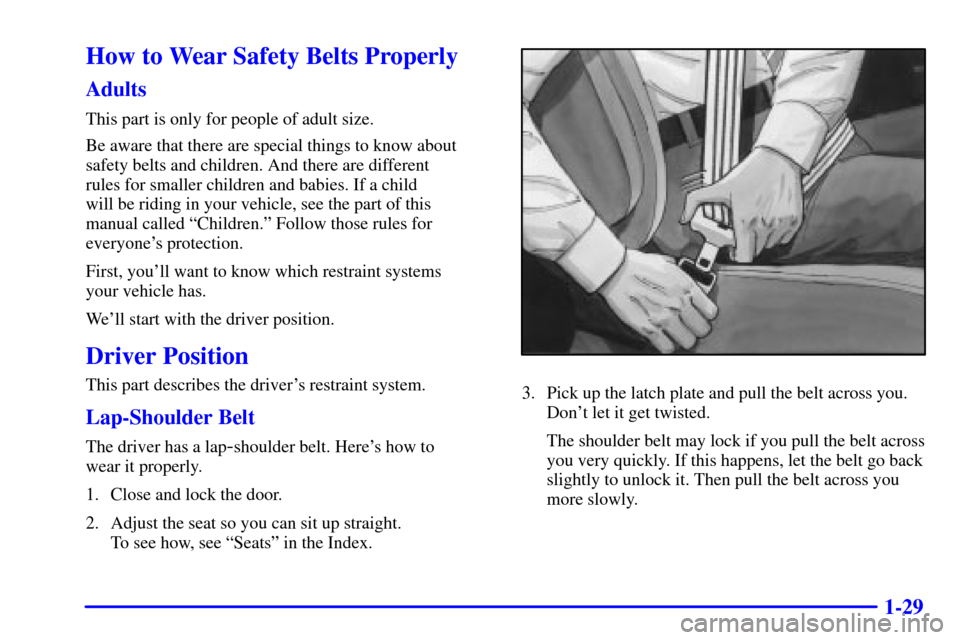
3. Pick up the latch plate and pull the belt across you.
Don't let it get twisted.
The shoulder belt may lock if you pull the belt across
you very quickly. If this happens, let the belt go back
slightly to unlock it. Then pull the belt across you
more slowly.
Page 62 of 436
1-50
CAUTION:
You can be seriously hurt if your shoulder belt is
too loose. In a crash, you would move forward too
much, which could increase injury. The shoulder
belt should fit against your body.
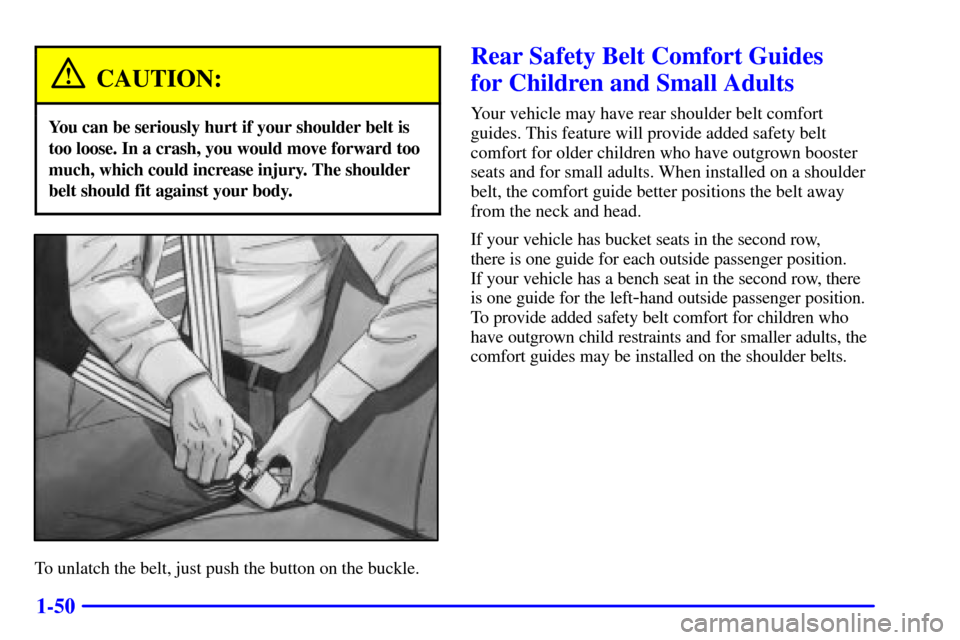
To unlatch the belt, just push the button on the buckle.
Rear Safety Belt Comfort Guides
for Children and Small Adults
Your vehicle may have rear shoulder belt comfort
guides. This feature will provide added safety belt
comfort for older children who have outgrown booster
seats and for small adults. When installed on a shoulder
belt, the comfort guide better positions the belt away
from the neck and head.
If your vehicle has bucket seats in the second row,
there is one guide for each outside passenger position.
If your vehicle has a bench seat in the second row, there
is one guide for the left
-hand outside passenger position.
To provide added safety belt comfort for children who
have outgrown child restraints and for smaller adults, the
comfort guides may be installed on the shoulder belts.
Page 71 of 436
1-59
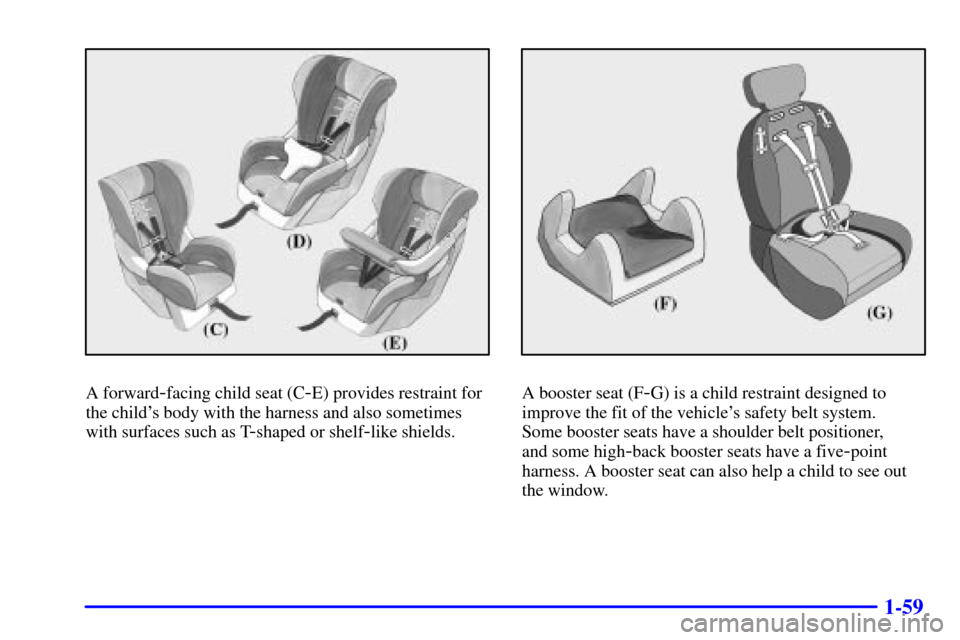
A forward-facing child seat (C-E) provides restraint for
the child's body with the harness and also sometimes
with surfaces such as T
-shaped or shelf-like shields.
A booster seat (F-G) is a child restraint designed to
improve the fit of the vehicle's safety belt system.
Some booster seats have a shoulder belt positioner,
and some high
-back booster seats have a five-point
harness. A booster seat can also help a child to see out
the window.
Page 72 of 436

1-60
Q:How do child restraints work?
A:A child restraint system is any device designed for
use in a motor vehicle to restrain, seat, or position
children. A built
-in child restraint system is a
permanent part of the motor vehicle. An add
-on
child restraint system is a portable one, which is
purchased by the vehicle's owner.
For many years, add
-on child restraints have
used the adult belt system in the vehicle. To help
reduce the chance of injury, the child also has to
be secured within the restraint. The vehicle's belt
system secures the add
-on child restraint in the
vehicle, and the add
-on child restraint's harness
system holds the child in place within the restraint.
One system, the three
-point harness, has straps
that come down over each of the infant's shoulders
and buckle together at the crotch. The five
-point
harness system has two shoulder straps, two hip
straps and a crotch strap. A shield may take the
place of hip straps. A T
-shaped shield has shoulder
straps that are attached to a flat pad which rests low
against the child's body. A shelf
- or armrest-type
shield has straps that are attached to a wide,
shelf
-like shield that swings up or to the side.When choosing a child restraint, be sure the child
restraint is designed to be used in a vehicle. If it is,
it will have a label saying that it meets federal motor
vehicle safety standards.
Then follow the instructions for the restraint. You may
find these instructions on the restraint itself or in a
booklet, or both. These restraints use the belt system in
your vehicle, but the child also has to be secured within
the restraint to help reduce the chance of personal injury.
When securing an add
-on child restraint, refer to the
instructions that come with the restraint which may be
on the restraint itself or in a booklet, or both, and to this
manual. The child restraint instructions are important,
so if they are not available, obtain a replacement copy
from the manufacturer.
Q:When securing an aftermarket child seat in a
bucket seat, I am unable to get the seat fastened
in snugly enough. What should I do?
A:With some child seats, it may be difficult to tighten
the vehicle belts so that there is less side
-to-side
or front
-to-back movement of the child seat.
A replacement buckle, which makes it easier to
secure your child seat, is available from your dealer
at no charge to you.
Page 85 of 436
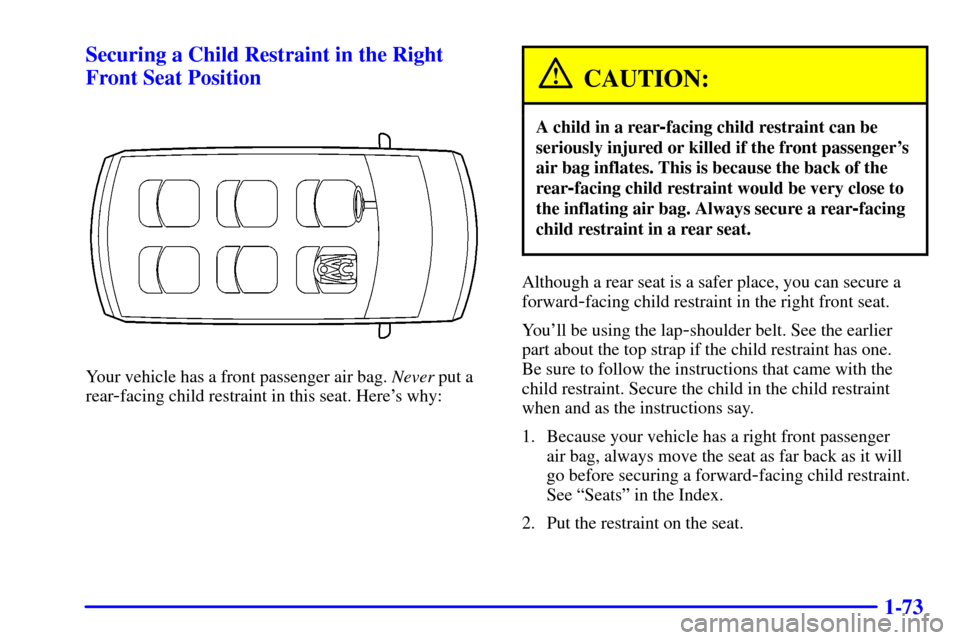
1-73 Securing a Child Restraint in the Right
Front Seat Position
Your vehicle has a front passenger air bag. Never put a
rear
-facing child restraint in this seat. Here's why:
CAUTION:
A child in a rear-facing child restraint can be
seriously injured or killed if the front passenger's
air bag inflates. This is because the back of the
rear
-facing child restraint would be very close to
the inflating air bag. Always secure a rear
-facing
child restraint in a rear seat.
Although a rear seat is a safer place, you can secure a
forward
-facing child restraint in the right front seat.
You'll be using the lap
-shoulder belt. See the earlier
part about the top strap if the child restraint has one.
Be sure to follow the instructions that came with the
child restraint. Secure the child in the child restraint
when and as the instructions say.
1. Because your vehicle has a right front passenger
air bag, always move the seat as far back as it will
go before securing a forward
-facing child restraint.
See ªSeatsº in the Index.
2. Put the restraint on the seat.