brake light OLDSMOBILE SILHOUETTE 2003 User Guide
[x] Cancel search | Manufacturer: OLDSMOBILE, Model Year: 2003, Model line: SILHOUETTE, Model: OLDSMOBILE SILHOUETTE 2003Pages: 466, PDF Size: 21.55 MB
Page 272 of 466
Remember: Anti-lock doesn’t change the time you need
to get your foot up to the brake pedal or always
decrease stopping distance.
If you get too close to the
vehicle in front of you, you won’t have time to apply
your brakes
if that vehicle suddenly slows or stops.
Always leave enough room up ahead to stop, even
though you have anti-lock brakes.
Using Anti-Lock
Don’t pump the brakes. Just hold the brake pedal down
firmly and let anti-lock work for you. You may feel a
slight brake pedal pulsation or notice some noise,
but this is normal.
Braking in Emergencies
At some time, nearly every driver gets into a situation
that requires hard braking.
If you have anti-lock, you can steer and brake at the
same time. However,
if you don’t have anti-lock,
your first reaction
- to hit the brake pedal hard
and hold it down
- mav be the wronq thina to do. Your
wheels can stop rolling. Once they do, the vehicle
can’t respond to your steering. Momentum will carry
it in whatever direction it was headed when the wheels
stopped rolling. That could be off the road, into the
very thing you were trying to avoid, or into traffic.
If you don’t have anti-lock, use a “squeeze” braking
technique. This will give you maximum braking while
maintaining steering control. You can do this by pushing
on the brake pedal with steadily increasing pressure.
In an emergency, you will probably want to squeeze
the brakes hard without locking the wheels. If you hear
or feel the wheels sliding, ease
off the brake pedal.
This will help you retain steering control.
If you do have
anti-lock, it’s different. See “Anti-Lock Brakes.”
In many emergencies, steering can help you more than
even the very best braking.
4-9
Page 273 of 466
Traction Control System (TCS)
Your vehicle may have a traction control system that
limits wheel spin. This is especially useful
in slippery
road conditions. The system operates only
if it senses
that one or both of the front wheels are spinning or
beginning to lose traction. When this happens,
the system works the front brakes and reduces engine
power to limit wheel spin.
The TRACTION ACTIVE message will come on when
the traction control system is limiting wheel spin.
See
Traction Active Message on page 3-53. You may
feel or hear the system working, but this is normal.
If your vehicle is in cruise control when the traction
control system begins to limit wheel spin, the cruise
control will automatically disengage. When road
conditions allow you to safely use it again, you may
reengage the cruise control. See “Cruise Control’’ under
Turn SignaVMultifunction Lever on page 3-7.
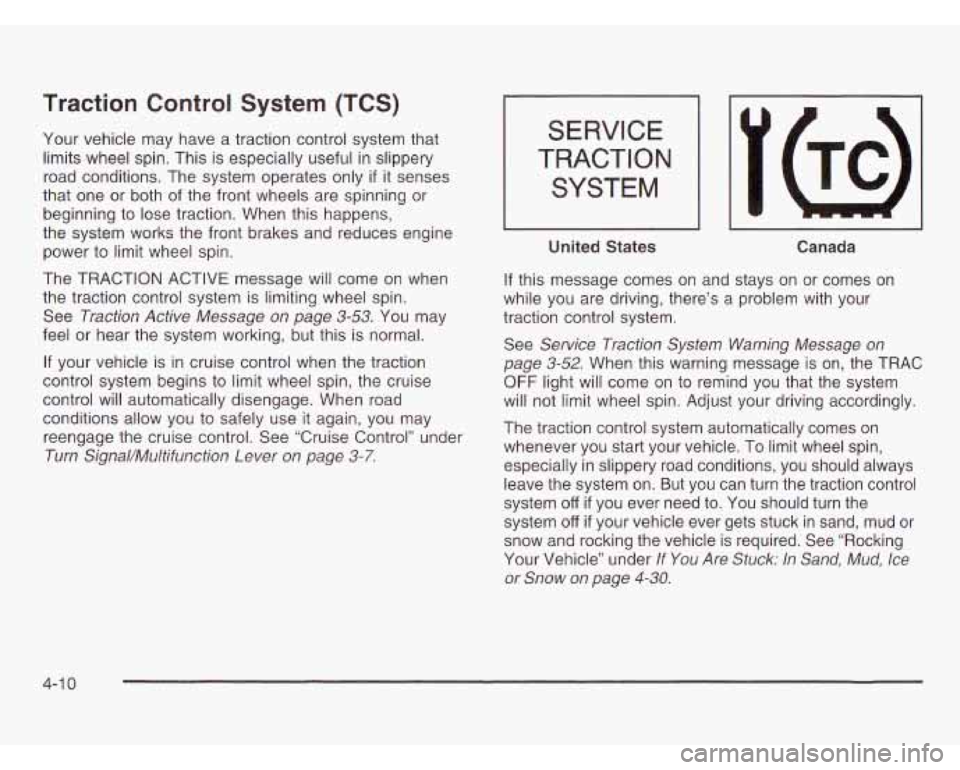
SERVICE
TRACTION
SYSTEM
United States
Canada
If this message comes on and stays on or comes on
while you are driving, there’s
a problem with your
traction control system.
See
Service Traction System Warning Message on
page
3-52. When this warning message is on, the TRAC
OFF light will come on to remind you that the system
will not limit wheel spin. Adjust your driving accordingly.
The traction control system automatically comes on
whenever you start your vehicle.
To limit wheel spin,
especially in slippery road conditions, you should always
leave the system on. But you can turn the traction control
system
off if you ever need to. You should turn the
system
off if your vehicle ever gets stuck in sand, mud or
snow and rocking the vehicle is required. See “Rocking
Your Vehicle” under
If You Are Stuck: In Sand, Mud, Ice
or Snow on page
4-30.
4-1 0
Page 282 of 466
The heavier the rain, the harder it is to see. Even if your
windshield wiper blades are in good shape, a heavy
rain can make it harder to see road signs and traffic
signals, pavement markings, the edge
of the road and
even people walking.
It’s wise to keep your wiping equipment in good shape
and keep your windshield washer tank filled with washer
fluid. Replace your windshield wiper inserts when
they show signs of streaking or missing areas on the
windshield, or when strips of rubber start to separate
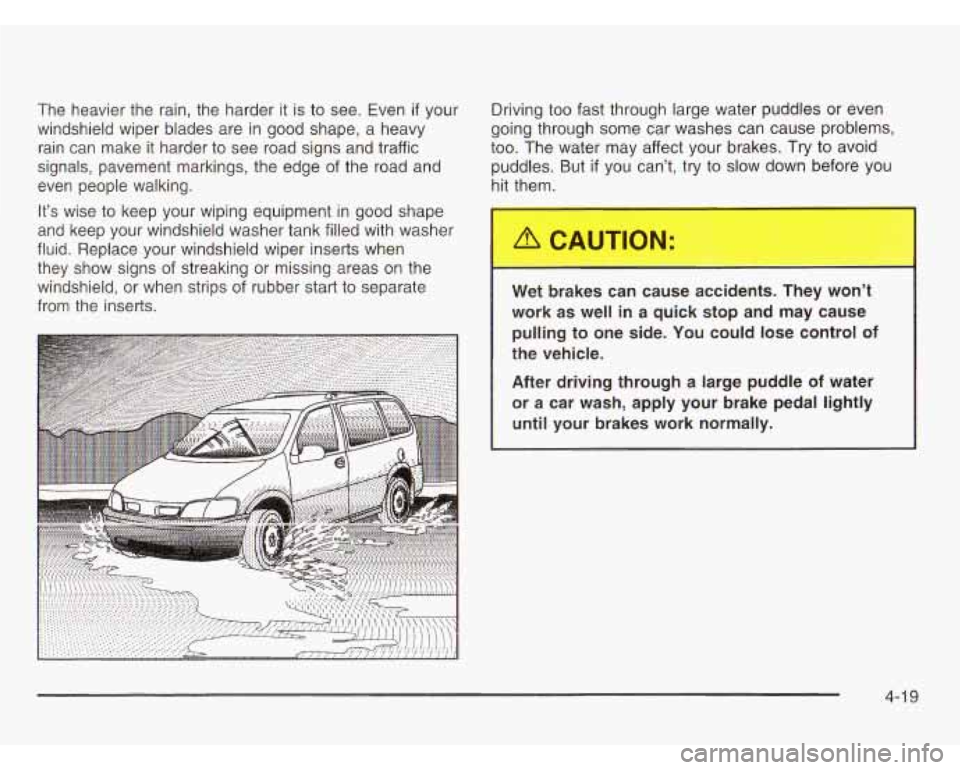
from the inserts. Driving too fast through large
water puddles or even
going through some car washes can cause problems,
too. The water may affect your brakes. Try to avoid
puddles. But if you can’t, try to slow down before you
hit them.
Wet brakes can cause accidents. They won’t
work as well
in a quick stop and may cause
pulling to one side. You could lose control of
the vehicle.
After driving through a large puddle of water
or a car wash, apply your brake pedal lightly
until your brakes work normally.
4-1 9
Page 347 of 466
There are only two reasons why the brake fluid level
in the reservoir might go down. The first is that the brake
fluid goes down to an acceptable level during normal
brake lining wear. When new linings are put
in, the fluid
level goes back up. The other reason is that fluid
is
leaking out of the brake system. If it is, you should have
your brake system fixed, since a leak means that
sooner or later your brakes won’t work well, or won’t
work at all.
So, it isn’t a good idea to “top off your brake fluid.
Adding brake fluid won’t correct a leak.
If you add fluid
when your linings are worn, then you’ll have too much
fluid when you get new brake linings.
You should add
(or remove) brake fluid, as necessary, only when work
is done on the brake hydraulic system.
1. ,’- have too much brake fLJ, it can spi.. an
the engine. The fluid will burn
if the engine is
hot enough. You or others could be burned,
and your vehicle could be damaged. Add brake
fluid only when work is done on the brake
hydraulic system. See “Checking Brake Fluid”
in this section.
BRAKE
When your brake fluid falls to a low level, your brake
warning light will come on. See
Brake System Warning
Light on page
3-44.
What to Add
When you do need brake fluid, use only DOT-3 brake
fluid. Use new brake fluid from a sealed container
only. See
Part D: Recommended Fluids and Lubricants
on page 6- 16.
Always clean the brake fluid reservoir cap and the
area around the cap before removing it. This
will help
keep dirt from entering the reservoir.
5-40
Page 348 of 466
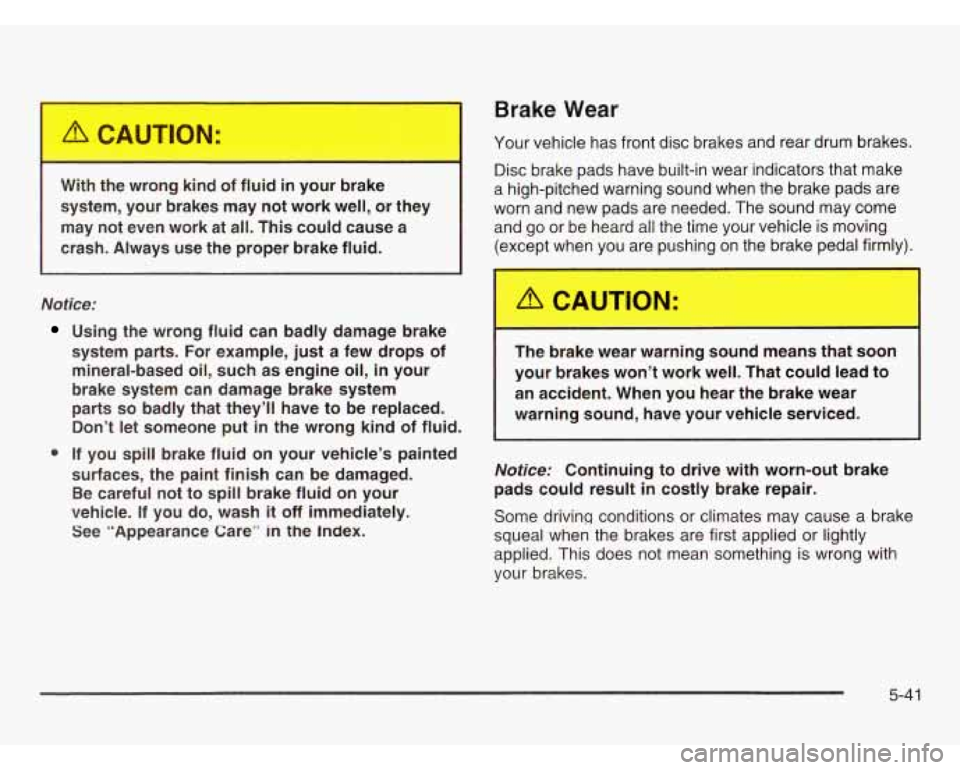
h the wrong kind of fluid in ur brake
system, your brakes may not work well, or they
may not even work at all. This could cause a
crash. Always use the proper brake fluid.
Notice:
Using the wrong fluid can badly damage brake
system parts. For example, just a few drops of
mineral-based oil, such as engine oil,
in your
brake system can damage brake system
parts
so badly that they’ll have to be replaced.
Don’t let someone
put in the wrong kind of fluid.
0 If you spill brake fluid on your vehicle’s painted
surfaces, the paint finish can be damaged.
Be careful not to spill brake fluid on your
vehicle. If you do, wash
it off immediately.
See “Appearance Care” in the Index.
Brake Wear
Your vehicle has front disc brakes and rear drum brakes.
Disc brake pads have built-in wear indicators that make
a high-pitched warning sound when the brake pads are
worn and new pads are needed. The sound may come
and
go or be heard all the time your vehicle is moving
(except when you are pushing on the brake pedal firmly).
The brake wear warning sound means that soon
your brakes won’t work well. That could lead
to
an accident. When you hear the brake wear
warning sound, have your vehicle serviced.
Notice: Continuing to drive with worn-out brake
pads could result
in costly brake repair.
Some driving conditions or climates may cause a brake
squeal when the brakes are first applied or lightly
applied. This does not mean something is wrong with
your brakes.
5-41
Page 376 of 466
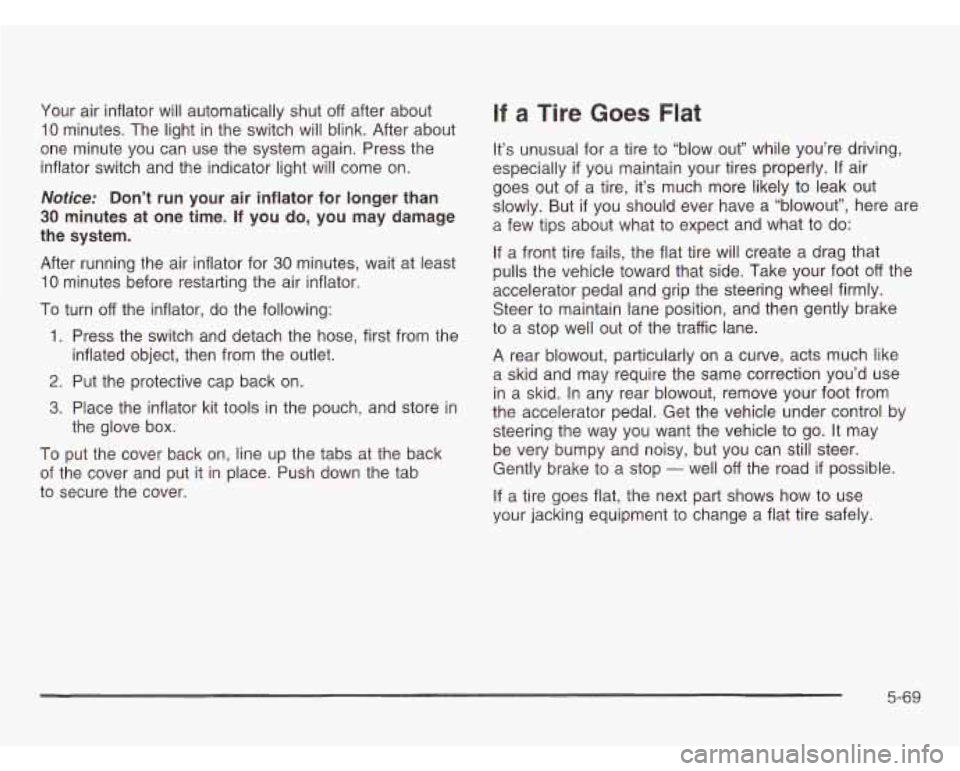
Your air inflator will automatically shut off after about
10 minutes. The light in the switch will blink. After about
one minute you can use the system again. Press the
inflator switch and the indicator light will come on.
Notice: Don’t run your air inflator for longer than
30 minutes at one time. If you do, you may damage
the system.
After running the air inflator for
30 minutes, wait at least
10 minutes before restarting the air inflator.
To turn off the inflator, do the following:
1. Press the switch and detach the hose, first from the
2. Put the protective cap back on.
3. Place the inflator kit tools in the pouch, and store in
inflated
object, then from the outlet.
the glove box.
To put the cover back on, line up the tabs at the back
of the cover and put it in place. Push down the tab
to secure the cover.
If a Tire Goes Flat
It’s unusual for a tire to “blow out” while you’re driving,
especially
if you maintain your tires properly. If air
goes out of a tire, it’s much more likely to leak out
slowly. But if you should ever have a “blowout”, here are
a few tips about what to expect and what to do:
If a front tire fails, the flat tire will create a drag that
pulls the vehicle toward that side. Take your foot
off the
accelerator pedal and grip the steering wheel firmly.
Steer to maintain lane position, and then gently brake
to a stop well out of the traffic lane.
A rear blowout, particularly on a curve, acts much like
a skid and may require the same correction you’d use
in a skid. In any rear blowout, remove your foot from
the accelerator pedal. Get the vehicle under control by
steering the way you want the vehicle to go. It may
be very bumpy and noisy, but you can still steer.
Gently brake to a stop
- well off the road if possible.
If a tire goes flat, the next part shows how to use
your jacking equipment to change a flat tire safely.
5-69
Page 405 of 466
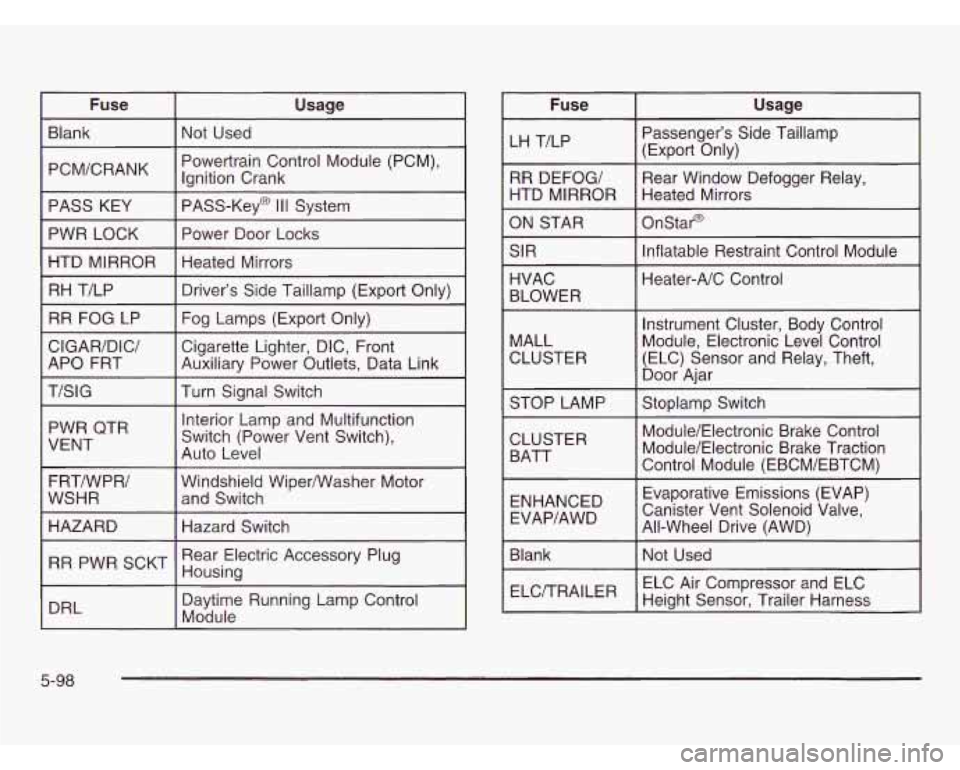
I Fuse I Usage I
Blank I Not Used
I PCM/CRANK I Powertrain Control Module (PCM),
Ignition Crank
I PASS KEY I PASS-Key@ Ill System I
I PWR LOCK I Power Door Locks I
I HTD MIRROR I Heated Mirrors I
I
RH T/LP I Driver’s Side Taillamp (Export Only) I
I
RR FOG LP I Fog Lamps (Export Only) I
CIGAR/DIC/
Auxiliary Power Outlets, Data Link
APO FRT Cigarette
Lighter, DIC, Front
I T/SIG I Turn Signal Switch I
PWR QTR
VENT Interior Lamp
and Multifunction
Switch (Power Vent Switch),
Auto Level
Windshield WiperNVasher Motor
and Switch
I HAZARD I Hazard Switch I
I RR PWR SCKT I Rear Electric Accessory Plug
Housing
I DRL Daytime Running
Lamp Control
Module Fuse
I Usage
LH T/LP
I
Passenger’s Side Taillamp
(Export Only)
RR DEFOG/ Rear Window Defogger Relay,
HTD MIRROR Heated Mirrors
ON STAR onstar@
SIR Inflatable Restraint Control Module HVAC
I Heater-A/C Control
BLOWER
MALL
CLUSTER Instrument Cluster, Body Control
Module, Electronic Level Control
(ELC) Sensor and Relay, Theft,
Door Ajar
STOP LAMP
I Stoplamp Switch
CLUSTER BATT Module/Electronic Brake Control
Module/Electronic Brake Traction
Control Module (EBCM/EBTCM)
Evaporative Emissions (EVAP)
Canister Vent Solenoid Valve,
All-Wheel Drive (AWD)
ENHANCED
Blank Not Used
ELC Air Compressor and ELC
Heiaht Sensor. Trailer Harness
5-98
Page 446 of 466
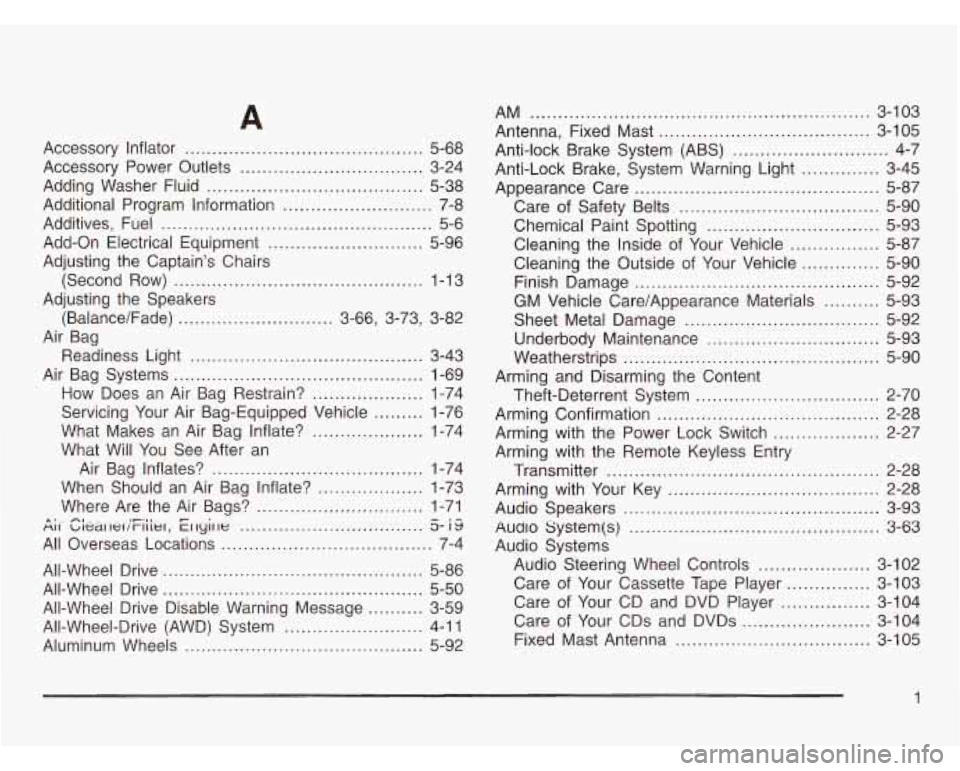
Accessory Inflator ........................................... 5-68
Accessory Power Outlets
................................. 3-24
Adding Washer Fluid
....................................... 5-38
Additional Program Information
........................... 7-8
Additives, Fuel
..................... ,... . ......... 5-6
Add-on Electrical Equipment
................. ... 5-96
Adjusting the Captain's Chairs
(Second Row)
............................................. 1-13
Adjusting the Speakers (Balance/Fade)
............................ 3-66, 3-73, 3-82
Air Bag Readiness Light
.......................................... 3-43
Air Bag Systems
............................................. 1-69
Servicing Your Air Bag-Equipped Vehicle
......... 1-76
What Will You See After an
How Does
ari Air Bag Restrain? .................... 1-74
What Makes an Air Bag Inflate?
.................... 1-74
Air Bag Inflates?
...................................... 1-74
When Should an Air Bag Inflate?
................... 1-73
Where Are the Air Bags?
.............................. 1-71
~II 'clttmIw/t-lller, Eflyirle ................................. 5- IS
All Overseas Locations ....... ........................ 7-4
A: . nr- ~ . . I~.ER
All-Wheel Drive ............................................... 5-86
All-Wheel Drive
............................................... 5-50
All-Wheel Drive Disable Warning Message .......... 3-59
All-Wheel-Drive (AWD) System
......................... 4-1 1
Aluminum Wheels ........................................... 5-92 AM
............................................................. 3-103
Antenna, Fixed Mast
...................................... 3-105
Anti-lock Brake System (ABS)
............................ 4-7
Anti-Lock Brake, System Warning Light
.............. 3-45
Appearance Care
............................................ 5-87
Care
of Safety Belts .................................... 5-90
Cleaning the Inside of Your Vehicle
................ 5-87
Cleaning the Outside of Your Vehicle
.............. 5-90
Finish Damage
............................................ 5-92
Chemical Paint Spotting
............................... 5-93
GM Vehicle Care/Appearance Materials
.......... 5-93
Sheet Metal Damage
................................... 5-92
Underbody Maintenance
............................... 5-93
Weatherstrips
.............................................. 5-90
Theft-Deterrent System
............. ......... 2-70
Arming and Disarming the Content
Arming Confirmation
.................... ............ 2-28
Arming with the Power Lock Switch
... ......... 2-27
Arming with the Remote Keyless Entry
Transmitter
................................................. 2-28
Arming with Your Key
...................................... 2-28
Audio Speakers
.............................................. 3-93
hdl0 System(s) ............................................. 3-63
Audio Systems
Audio Steering Wheel Controls
.................... 3-102
Care of Your Cassette Tape Player
............... 3-103
Care of Your CD and DVD Player
................ 3-104
Care
of Your CDs and DVDs ....................... 3-104
Fixed Mast Antenna
................. ... 3-105
Page 447 of 466
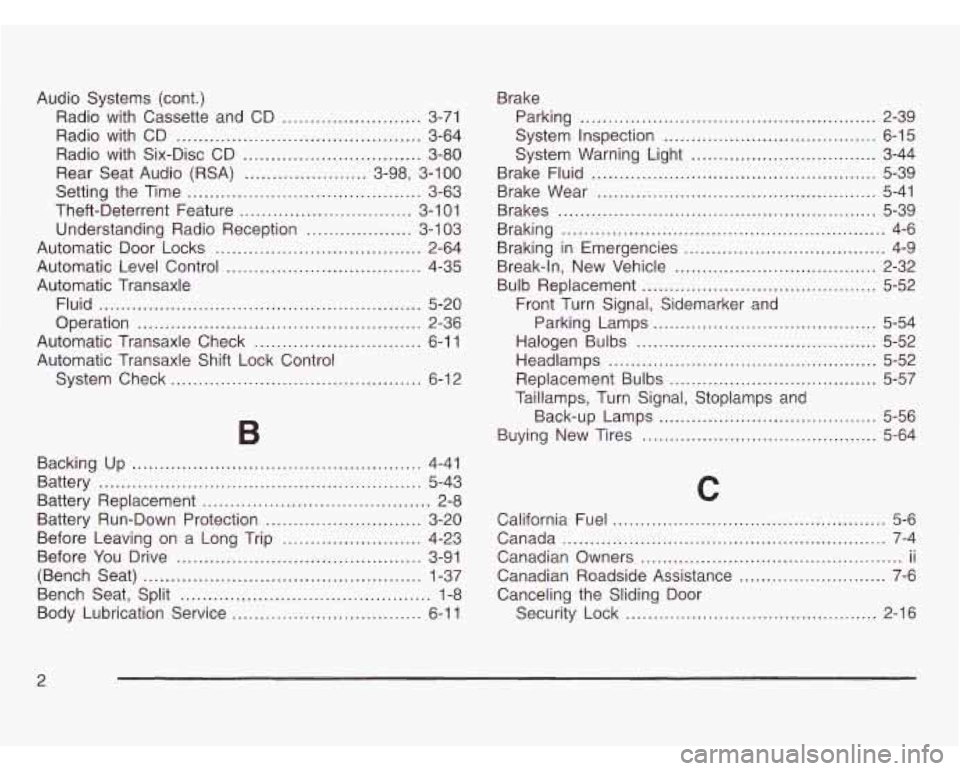
Audio Systems (cont.) Radio with Cassette and CD
......................... 3-71
Radio with CD
............................................ 3-64
Radio with Six-Disc CD
................................ 3-80
Rear Seat Audio (RSA)
...................... 3-98, 3-1 00
Setting the Time .......................................... 3-63
Theft-Deterrent Feature
............................... 3-1 01
Understanding Radio Reception
................... 3-1 03
Automatic Door Locks
..................................... 2-64
Automatic Level Control
................................... 4-35
Automatic Transaxle
Fluid
....................................................... 5-20
Automatic Transaxle Check
.............................. 6-1 1
Automatic Transaxle Shift Lock Control
System Check
................................... ... 6-12
Operation
................................................... 2-36
B
Backing
Up .................................................... 4-41
Battery
.......................................................... 5-43
Battery Replacement
......................................... 2-8
Battery Run-Down Protection
............................ 3-20
Before Leaving on a Long Trip
......................... 4-23
Before You Drive
............................................ 3-91
(Bench Seat)
.................................................. 1-37
Bench Seat, Split
............................................. 1-8
Body Lubrication Service
.................................. 6-1 1 Brake
Parking
.................................. .... 2-39
System Inspection
....................... ........ 6-15
System Warning Light
...................... .... 3-44
Brake Fluid
.................................................... 5-39
Brake Wear
................................................... 5-41
Brakes
.......................................................... 5-39
Braking
........................................................... 4-6
Braking in Emergencies
..................................... 4-9
Break-In, New Vehicle
..................................... 2-32
Bulb Replacement
........................................... 5-52
Halogen Bulbs
............................................ 5-52
Headlamps
................................................. 5-52
Front Turn Signal,
Sidemarker and
Parking Lamps
......................................... 5-54
Replacement Bulbs
...................................... 5-57
Taillamps, Turn Signal, Stoplamps and
Back-up Lamps
........................................ 5-56
Buying New Tires
........................................... 5-64
C
California Fuel .......................................... 5-6
Canada
..................................... .......... 7-4
Canadian Owners
....................... ................. II
Canadian Roadside Assistance ........................... 7-6
Canceling the Sliding Door
Security Lock
.............................................. 2-16
Page 453 of 466
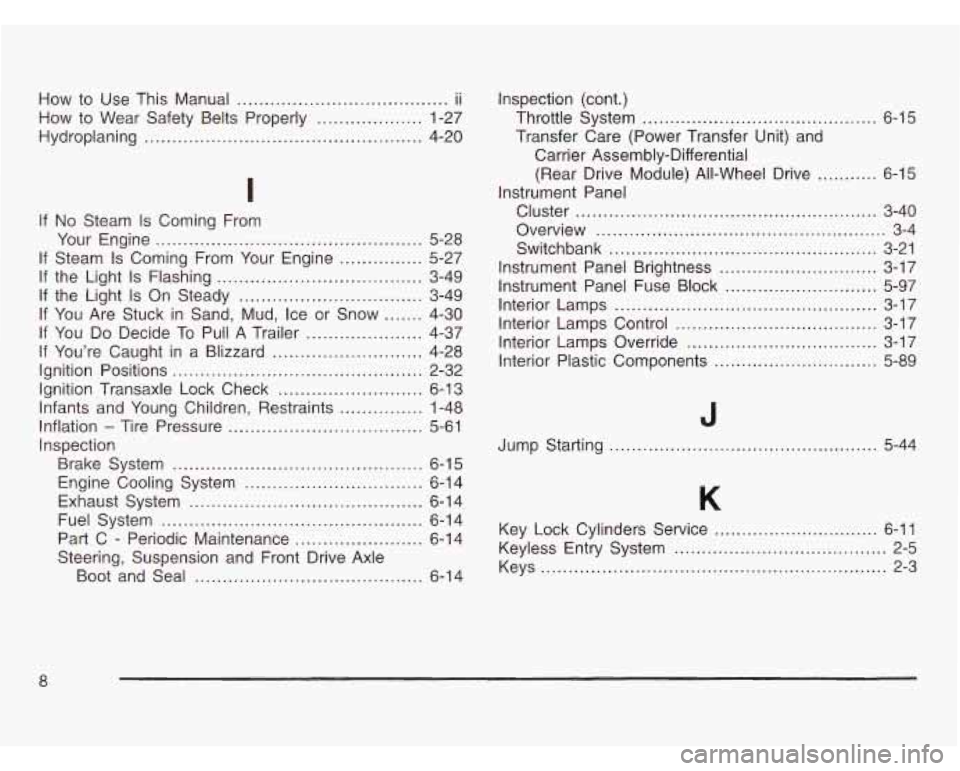
How to Use This Manual ................... .... ii
How to Wear Safety Belts Properly ............... 1-27
Hydroplaning
.................................................. 4-20
I
If No Steam Is Coming From
If Steam Is Coming From Your Engine ............... 5-27
If the Light Is Flashing ..................................... 3-49
If the Light Is On Steady ................................. 3-49
If You Are Stuck in Sand. Mud. Ice or Snow
....... 4-30
If You Do Decide To Pull A Trailer ..................... 4-37
Your
Engine
................................................ 5-28
If You’re Caught in a Blizzard ........................... 4-28
Ignition Positions
............................................. 2-32
Ignition Transaxle Lock Check
.......................... 6-13
Infants and Young Children, Restraints
............... 1-48
Inflation
- Tire Pressure ................................... 5-61
Inspection Brake System
............................................. 6-15
Engine Cooling System
................................ 6-14
Exhaust System
.......................................... 6-14
Fuel System
............................................... 6-14
Part C - Periodic Maintenance ....................... 6-14
Steering, Suspension and Front Drive Axle
Boot and Seal
..................................... 6-14 Inspection
(cont.)
Throttle System
........................................... 6-15
Transfer Care (Power Transfer Unit) and
Carrier Assembly-Differential
(Rear Drive Module) All-Wheel Drive
........... 6-15
Instrument Panel Cluster
..........................................
Overview ......................................
Switchbank ....................................
Instrument Panel Brightness ................
Instrument Panel Fuse Block ...............
Interior Lamps ...................................
Interior Lamps Control ........................
Interior Lamps Override ......................
Interior Plastic Components .................
....
.......... 3-40
........... 3-4
.......... 3-21
.......... 3-17
.......... 5-97
.......... 3-17
.......... 3-17
.......... 3-17
.......... 5-89
Jump Starting
......................... . 5-44
Key Lock Cylinders Service
................. .... .......... 6-11
Keyless Entry System
....................................... 2-5
Keys
............................................................... 2-3