light OLDSMOBILE SILHOUETTE 2003 User Guide
[x] Cancel search | Manufacturer: OLDSMOBILE, Model Year: 2003, Model line: SILHOUETTE, Model: OLDSMOBILE SILHOUETTE 2003Pages: 466, PDF Size: 21.55 MB
Page 87 of 466
Section 2 Features and Controls
Storage Areas ................................................ 2.54
Glove
Box ................................................... 2.54
Cupholder(s)
................................................ 2.54
Compact Overhead Console
........................ 2.54
Overhead Console
................. ................ 2.55
Front Seat Storage Net
...... ................... 2.55
Luggage Carrier
........................................... 2.56
Rear Storage Area
........................................ 2.58
Convenience Net
.......................................... 2.59
Convenience Center
...................................... 2.60 Vehicle Personalization
.................................
Entering
Programming Mode ........................
Delayed Illumination and
Exit Lighting
...........................................
Automatic Door Locks .................................
Last Door Locking and Lockout Deterrent .......
Remote Driver Unlock Control ......................
Remote Lock and Unlock Confirmation ...........
Content Theft-Deterrent System ....................
Arming and Disarming the Content
Theft-Deterrent System
.............................
Memory Seat .............................................
Exiting Programming Mode ...........................
. 2.62
. 2.63
. 2.63
. 2.64
. 2.65
. 2.66
. 2.67
. 2.69
. 2.70
. 2.71
. 2.72
2-2
Page 107 of 466

Liftgate
To unlock the liftgate from the outside, turn the key in
the cylinder clockwise or use the remote keyless
entry transmitter.
To lock the liftgate using the key,
turn the key counterclockwise.
Open the liftgate using the handle located above the
license plate. Once slightly opened, the liftgate will rise
by itself. Lamps
in the rear of the vehicle will come
on, illuminating the rear cargo area. See
lnterior Lamps
on page 3-17.
Notice: Be sure there are no overhead
obstructions, such as a garage door, before you
open the liftgate. You could slam the liftgate
into something and break the
glass.
It can be dangerous to drive w ~~~ the liftgate
open because carbon monoxide
(CO) gas can
come into your vehicle. You can’t see or smell
CO.
It can cause unconsciousness and even
death. If you must drive with the liftgate open
or if electrical wiring or other cable
connections must pass through the seal between the body and the liftgate:
Make sure all other windows are shut.
Turn the fan on your heating or cooling
system to
its highest speed and select the
control setting that will force outside air into your vehicle. See “Comfort Controls”
in the Index.
If you have air outlets on or under the
instrument panel, open them all
the way.
See “Engine Exhaust”
in the Index.
2-22
Page 108 of 466

To close the liftgate, pull down on the handle, then
firmly shut the liftgate. Don’t drive with the liftgate open,
even slightly. See
Engine Exhaust on page 2-43.
A message in your instrument panel cluster will warn
you
if the liftgate is not completely closed. See
Rear Hatch Ajar Warning Message on page 3-58.
2-23
Page 111 of 466
Power Rear Quarter Windows
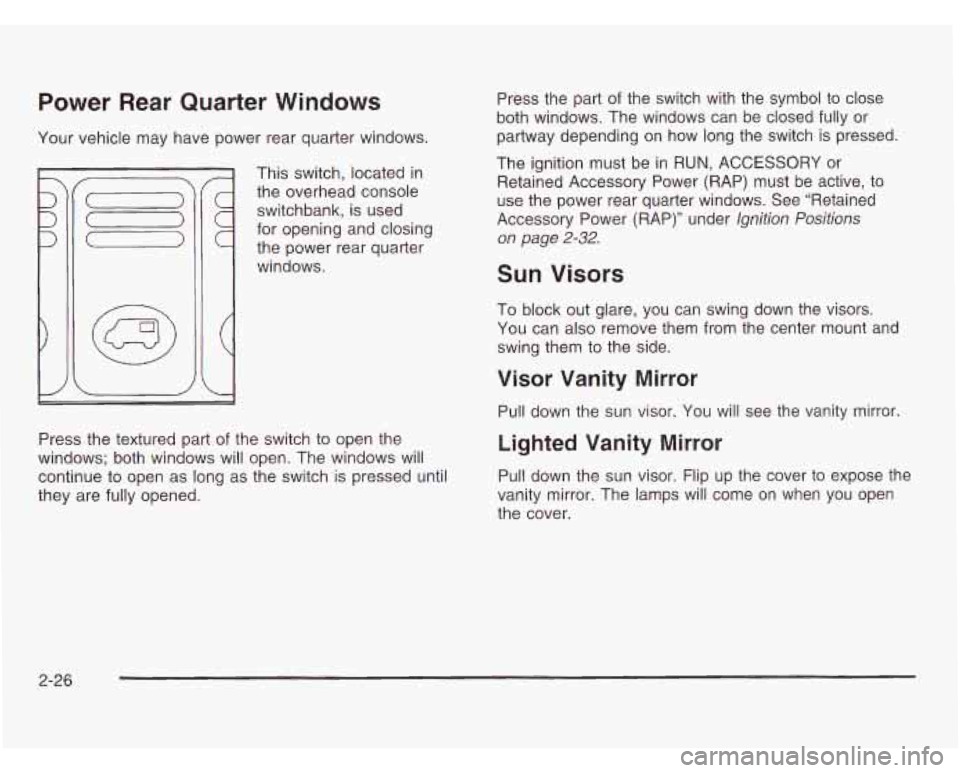
Your vehicle may have power rear quarter windows.
the overhead console
switchbank, is used
for opening and closing
the power rear quarter
windows.
Press the textured part of the switch to open the
windows; both windows will open. The windows will
continue to open as long as the switch is pressed until
they are fully opened. Press
the part of the switch with the symbol to close
both windows. The windows can be closed fully or
partway depending on how long the switch is pressed.
The ignition must be in RUN, ACCESSORY or
Retained Accessory Power (RAP) must be active, to
use the power rear quarter windows. See “Retained
Accessory Power (RAP)” under
lgnition Positions
on page 2-32.
Sun Visors
To block out glare, you can swing down the visors.
You can also remove them from the center mount and
swing them to the side.
Visor Vanity Mirror
Pull down the sun visor. You will see the vanity mirror.
Lighted Vanity Mirror
Pull down the sun visor. Flip up the cover to expose the
vanity mirror. The lamps will come on when you open
the cover.
2-26
Page 112 of 466
Theft-Deterrent Systems While armed, the doors will not unlock with the power
door lock switch.
Vehicle theft is big business, especially in some cities.
Although your vehicle has a number of theft-deterrent Once
armed, the alarm will go
off if someone tries to
enter the vehicle (without using the remote keyless entry
features, we know that nothing we put on it can make it
transmitter or a key) or turns the ignition to ON. The
impossible to steal. horn will sound and the parking lamps will flash for up to
Content Theft-Deterrent
Your vehicle may have a theft-deterrent alarm system. two minutes.
When
the alarm is armed, the liftgate may be opened
with the remote keyless entry transmitter or with a key.
Arming with the Power Lock Switch
Your alarm system will arm when you use either power
door lock switch to lock the doors while any door or the
liftgate is open and the key is removed from the ignition.
If you would like to turn on power door lock switch arming,
see
Vehicle Personalization on page 2-62.
When the security light flashes quickly the system is
ready to arm with the power door lock switches.
Then the security light will stop flashing and stay on
when you press the rear of the power door lock switch,
and the liftgate are closed and locked, the security light
will begin flashing at a very slow rate to let you know
the system is armed.
tc ]et ;‘cs k~s;~i the syste~ is srm.jnn 3- ‘ Aftnr .‘--. E!! &mrs
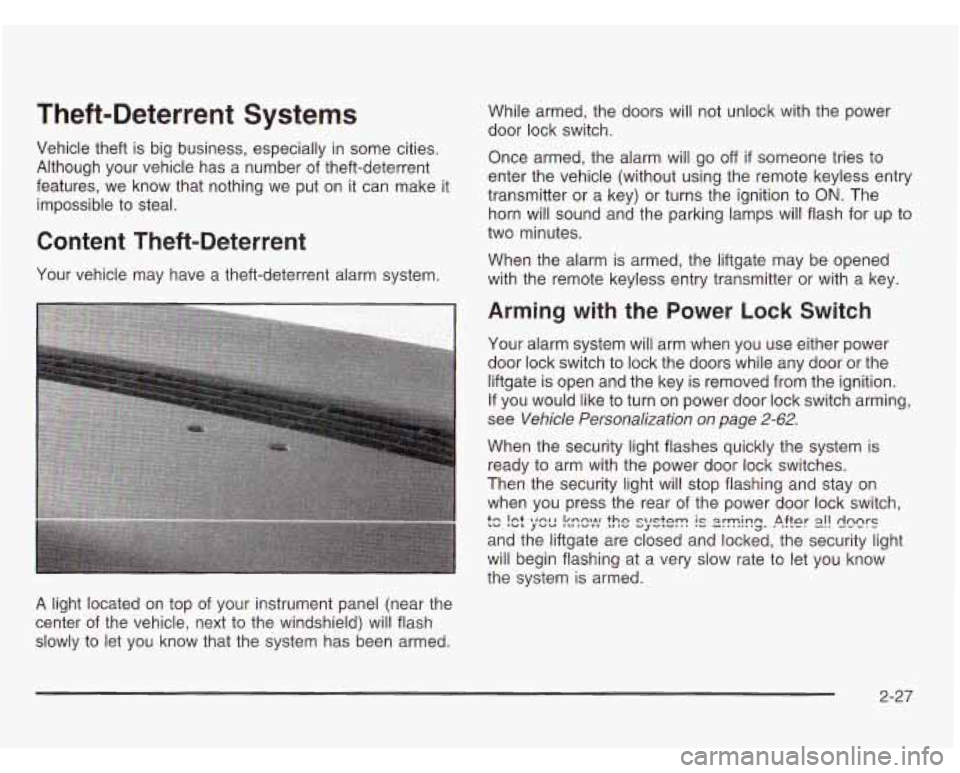
A light located on top of your instrument panel (near the
center of the vehicle, next to the windshield) will flash
slowly to let you know that the system has been armed.
2-27
Page 113 of 466
Arming with the Remote Keyless Entry
Transmitter
Your alarm system will arm when you use your remote
keyless entry transmitter
to lock the doors, if the key
is not in the ignition. The security light will turn on to let
you know the system is arming. After all doors and
the liftgate are closed and locked, the security light will
begin flashing at a very slow rate
to let you know
the system is armed.
Arming with Your Key
Your alarm system will arm when you use your key to
lock the doors. The security light will turn on to let
you know the system is arming. After all doors and the
liftgate are closed and locked, the security light will
begin flashing at a very slow rate
to let you know the
system is armed. If you would like your key not
to
arm the system, see Vehicle Personalization on
page 2-62.
Arming Confirmation
If remote unlock confirmation is on, your parking lamps
will flash briefly
to let you know when your alarm system
has disarmed. If you would not like the parking lamps
to
flash, see Vehicle Personalization on page 2-62.
Disarming with the Remote Keyless
Entry Transmitter
Your alarm system will disarm when you use your
remote keyless entry transmitter to unlock the doors.
The security light will stop flashing
to let you know the
system is no longer armed.
Disarming with Your Key
Your alarm system will disarm when you use your key to
unlock the doors. The security light will stop flashing to let
you know the system is no longer armed. If you would like
your key not
to disarm the alarm system, see Vehicle
Personalization on page 2-62.
2-28
Page 118 of 466

B (LOCK): This is the only position from which you
can remove the key. This position locks your ignition,
steering wheel and transaxle.
Notice: If your key seems stuck in LOCK and you
can’t turn
it, be sure you are using the correct key;
if
so, is it all the way in? If it is, then turn the
steering wheel left and right while you turn the key hard. Turn the key only with your hand. Using a
tool to force
it could break the key or the ignition
switch. If none
of these works, then your vehicle
needs service.
C (OFF): This position unlocks the ignition, steering
wheel and transaxle but, does not send power to
any accessories. Use this position
if your vehicle
must be pushed or towed, but never try
to push-start
your vehicle.
D (RUN): This is the position to which the switch returns
after you start your engine and release the ignition key.
This is the position for driving. Even when the engine is
not running, you can use RUN to operate your electrical
accessories and
to display some instrument panel
warning lights.
E (START): This position starts the engine. When the
engine starts, release the ignition key. The switch
will return to RUN for normal driving.
If the engine is not running, ACCESSORY and RUN
are positions that allow you to operate your electrical
accessories, such as the radio.
Retained Accessory Power (RAP)
With RAP, the power windows, power rear quarter
windows, audio system and the automatic level control
will continue to work up to
10 minutes after the
ignition key is turned to
OFF and none of the doors
are opened.
2-33
Page 124 of 466
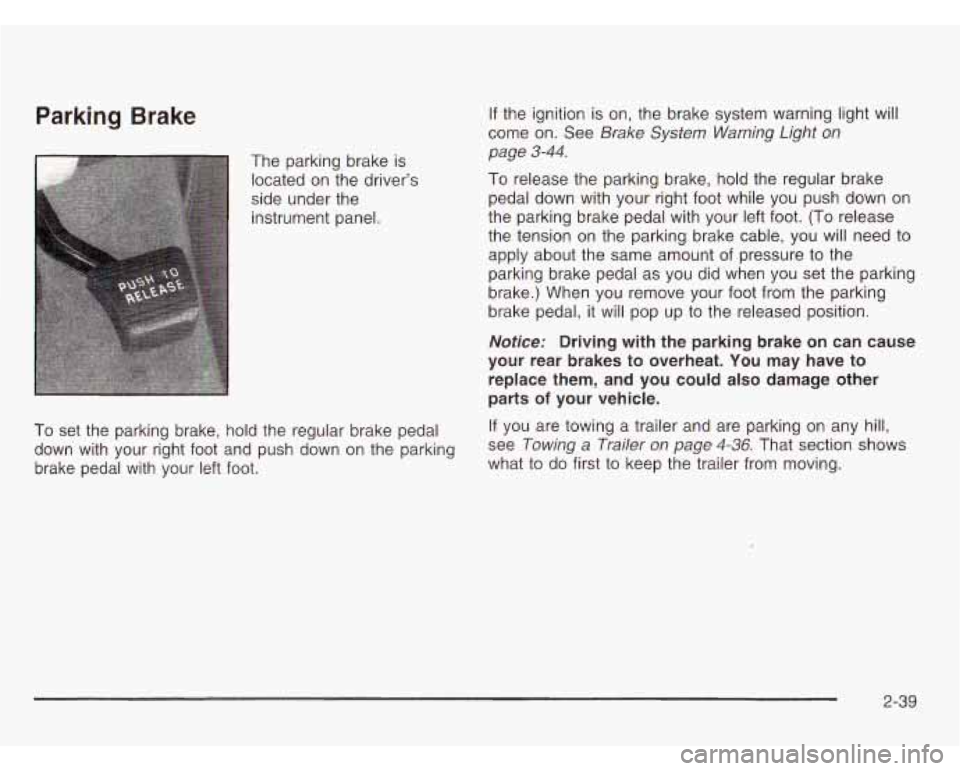
Parking Brake
The parking brake is
located on the driver’s
side under the
instrument panel.
If the ignition is on, the brake system warning light will
come on. See
Brake System Warning Light on
page 3-44.
To release the parking brake, hold the regular brake
pedal down with your right foot while you push down on
the parking brake pedal with your left foot. (To release
the tension on the parking brake cable, you will need to
apply about the same amount of pressure to the
parking brake pedal as you did when you set the parking
brake.) When you remove your foot from the parking
brake pedal,
it will pop up to the released position.
Notice: Driving with the parking brake on can cause
your rear brakes to overheat. You may have to
replace them, and you could also damage other
parts
of your vehicle.
To set the parking brake, hold the regular brake pedal If
you are towing a trailer and are parking on any
hill,
brake pedal with your left foot. what
to do first to keep the trailer from moving.
down with your right foot
and push down on the parking see
Towing a Trailer on page 4-36, That section shows
2-39
Page 130 of 466
Mirrors
Manual Rearview Mirror
To reduce glare from lights behind you, pull the lever
toward you (to the night position). To return the mirror to
the day position, push the lever away from you.
Outside Power Mirrors
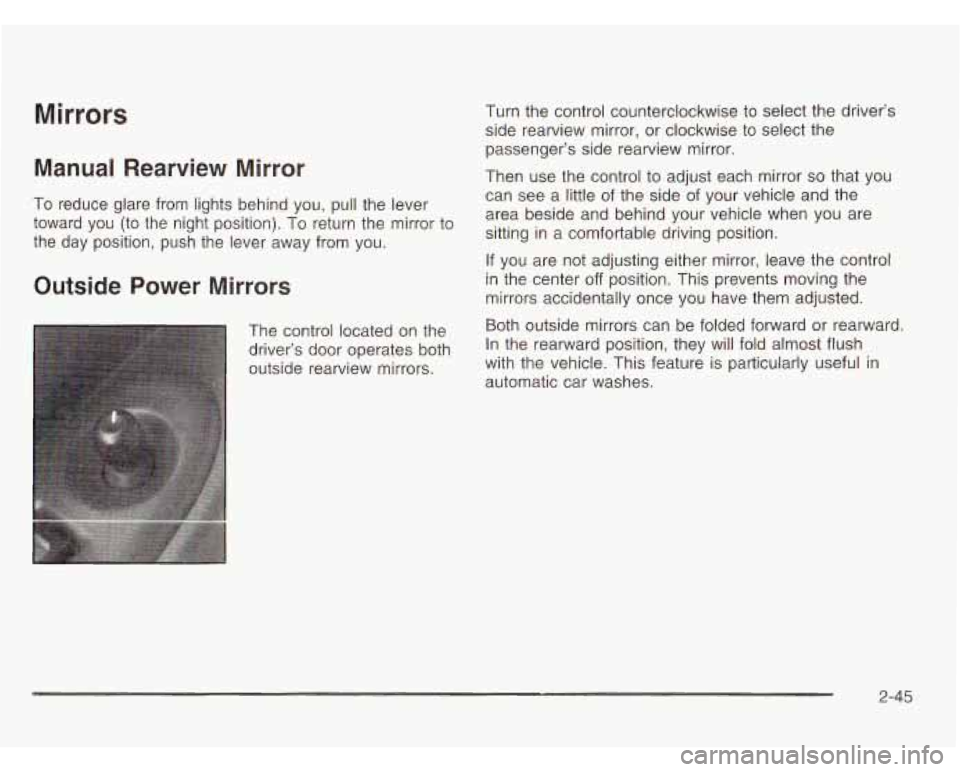
The control located on the
driver’s door operates both
outside rearview mirrors. Turn
the control counterclockwise to select the driver’s
side rearview mirror, or clockwise to select the
passenger’s side rearview mirror.
Then use the control to adjust each mirror
so that you
can see a little
of the side of your vehicle and the
area beside and behind your vehicle when you are
sitting in a comfortable driving position.
If you are not adjusting either mirror, leave the control
in the center
off position. This prevents moving the
mirrors accidentally once you have them adjusted.
Both outside mirrors can be folded forward or rearward.
In the rearward position, they will fold almost flush
with the vehicle. This feature
is particularly useful in
automatic car washes.
2-45
Page 134 of 466
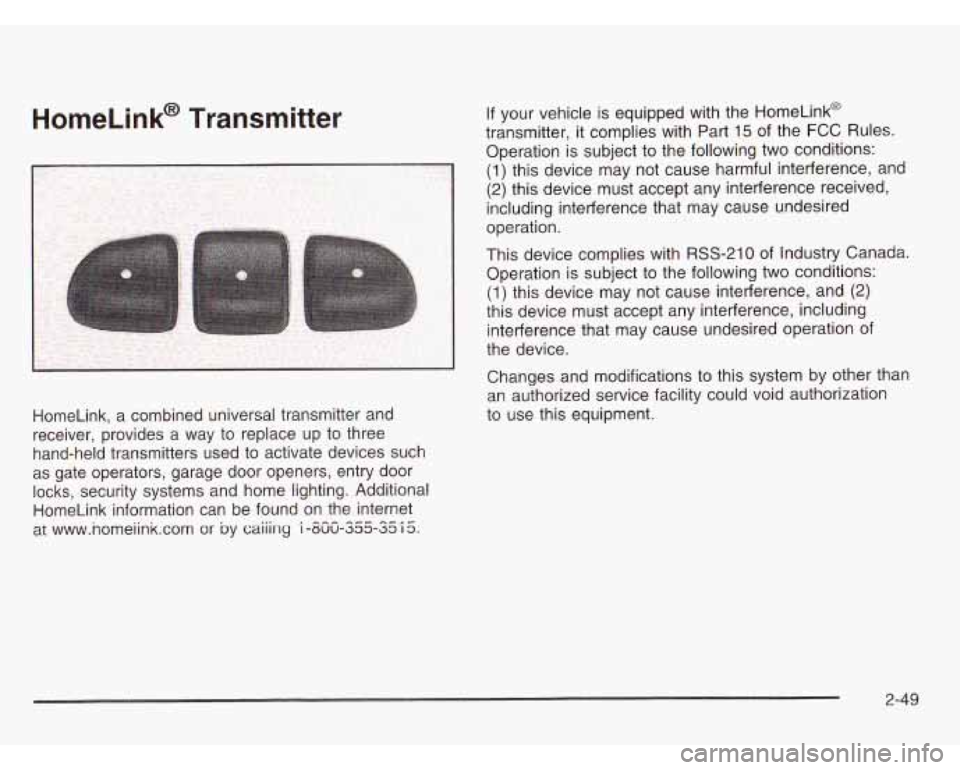
HomeLink, a combined universal transmitter and
receiver, provides a way to replace up to three
hand-held transmitters used to activate devices such
as gate operators, garage door openers, entry door
locks, security systems and home lighting. Additional
HomeLink information can be found on the internet
at www.nomeiink.com
or by caiiing i -uuu-333-~3 I 3. --- --A-
an authorized service facility could void authorization
to use this equipment.
2-49