belt OPEL 1900 1973 User Guide
[x] Cancel search | Manufacturer: OPEL, Model Year: 1973, Model line: 1900, Model: OPEL 1900 1973Pages: 625, PDF Size: 17.22 MB
Page 127 of 625

fabric to dry thoroughly; then rub lightly with a
clean cloth dipped in a volatile cleaner. This is the
only further treatment recommended.
Soap and water are not recommended since they will
probably set the stain and cause a permanent dis-
coloration. Drying the fabric by means of heat (such
as the use of an iron) is not recommended.
6. Grease and 02 If grease has been spilled on the
material, as much as possible should be remove by
scraping with a dull knife or spatula before further
treatment is attempted.
Grease and oil stains may be removed by rubbing
lightly with a clean cloth saturated with a volatile
cleaner. Be sure all motions are toward the center of
the stained area to decrease the possibility of spread-
ing the stain.
7. Ice Cream. The same procedure is recommended
for the removal of ice cream stains as that used in
removing fruit stains.
If the stain is persistent, rubbing the spot with a cloth
wet with soap suds (mild neutral soap) may be used
to some advantage after the initial treatment with hot
water. This soap treatment should be followed with
a rinsing, by rubbing with a clean cloth wet with cold
water. After this dries, rubbing lightly with a cloth
wet with volatile cleaner will clear up the last of the
stain, by removing fatty or oily matter.
8.Vomit. Sponge with a clean cloth, dipped in clear
cold water. After most of the stain has been removed
in this way wash lightly with soap (mild neutral),
using a clean cloth and lukewarm water. Then rub
with another clean cloth dipped in cold water. If any
of the stain remains after this treatment, gently rub
clean with a cloth moistened with a volatile cleaner.
SPECIFICATIONS
BOLT TORQUE SPECIFICATIONSLocation
DoorStriker toPillarPostr .^ ...r.ZA- 41973 OPEL SERVICE MANUAL
9. Shoe Polish and Dressings. On types of shoe
dressing which contain starch or dextrine or some
water soluble vehicle, allow the polish to dry; then
brush the spot vigorously with a brush. This will
probably be all the treatment that is necessary. If
further treatment is required moisten the spot with
cold water and after it has dried, repeat the brushing
operation.
Paste or wax type shoe polishes may require using a
volatile cleaner. Rub the stain gently with a cloth wet
with a volatile cleaner until the polish is removed.
Use
;a clean portion of the cloth for each rubbing
operation and rub the stained area from outside to
center.
10. Tar. Moisten the spot lightly with a volatile
cleaner, and then remove as much of the tar as possi-
ble with a dull knife. Follow this operation by rub-
bing the spot lightly with a cloth wet with the cleaner
until the stain is removed.
II. .X&e. Sponge the stain with a clean cloth satu-
rated with soap suds (mild neutral soap) and rinse
well by rubbing the stain with a clean cloth dipped
in cold water. Then saturate a clean cloth with a
solution of one part household ammonia water and
five parts water. Apply the cloth to the stain and
allow solution to remain on affected area for one
minute; then rinse by rubbing with a clean wet cloth.
I,?.
L,ipslick. The compositions of different brands of
lipsticks vary, making the stains very
diff%cult to
remove. In some instances a volatile cleaner may
remove the stain. If some stain remains after re-
peated applications of the volatile cleaner, it is best
to leave it rather thari try other measures.
Torque
Lb.Ft.
wont saar twacnment to war........................................Seat andShoulderBelt Anchor Attachment
................StationwagonTailgate
HingetoBody............................StationwagonTailgate
HingetoDoor............................Stationwagon Striker Plate on
Body................................Stationwagon
LatchHookonBody..................................Stationwagon Latch on Door
............................................14.18
_^ _^13-1036-46
13-16
13-16
3-4
13-16
3-4
Page 134 of 625

WINDOWS AND WINDOW MOLDINGS2c-118. With a sealer gun, apply window sealing com-
pound between outside of windshield and rubber
channel. See Figure
2C-8.Figure 2C-8 Applying Sealing Compound Outside of
Windshield
REMOVAL AND INSTALLATION OF FRONT DOOR
SASH WINDOW
1. Remove and install door trim pad.
2. Remove and install lock knob.
Figure 2C-9 Removing’Glass3. Remove and install door inside handle.
4. Remove and install door belt reveal molding.
5. Scribe position of window lifter guide rail screws.
6. For unscrewing window lifter guide rail, block
sash window or support it with the hand.:;CJ.;t window and take it out of door. See Figure
REMOVAL AND INSTALLATION OF ORNAMENTAL
BAR AT THE REAR QUARTER WINDOW
Removal1. Unscrew chromed molding and remove rear quar-
ter window. See Figure
2C-10.Figure
2C-10 Removing Chromed Molding
2. In the area of the rear quarter window, pull wea-
therstrip out of metal profile and remove sealing
strip.
3. Unscrew metal profile and remove ornamental
bar.
Installation1. Install ornamental bar and fasten metal profile.
2. Install sealing strip and weatherstrip into metal
profile.
Page 138 of 625

dOORS2D-15
3. Unhook con&cting rod out of old support and
hook into new support and door lock.
the water deflector foil is inserted in lower door slot.See Figure
2D-6. Reverse procedure for installation.2D-i-
Figure
2D-7 Removing Support
4. Screw support onto door inner panel so that it canbe shifted in both holes. Adjust remote control so
that the connecting rod has a clearance at the door
lock of
.02 inch (0.5 mm).
5. Tighten support to door inner panel.
b. Install door trim pad
REMOVAL AND INSTALLATION OF FRONT
DOOR
BELT REVEAL MOLDING
1. Bend up ends of molding.2. With a wooden wedge, pry off molding towards
the top. See Figure
2D-8.Figure
2D-6 Installing Water Deflector
REMOVAL AND INSTALLATION OF FRONT
DOOR
INSIDEHANDLE WITH SUPPORT
1. Remove door trim pad.
2. Unscrew support and unhook connecting rod out
of door lock. See Figure
2D-7.Figure
2D-6 Removing Molding
3. Check retaining clamps in outer door panel for
proper position and tight seat. Push new molding
onto retaining clamps and bend both ends inwards.
REMOVAL AND INSTALLATION OF FRONT
DOOR
WINDOW LIFTER
Removal1. Remove door trim pad.
Page 142 of 625
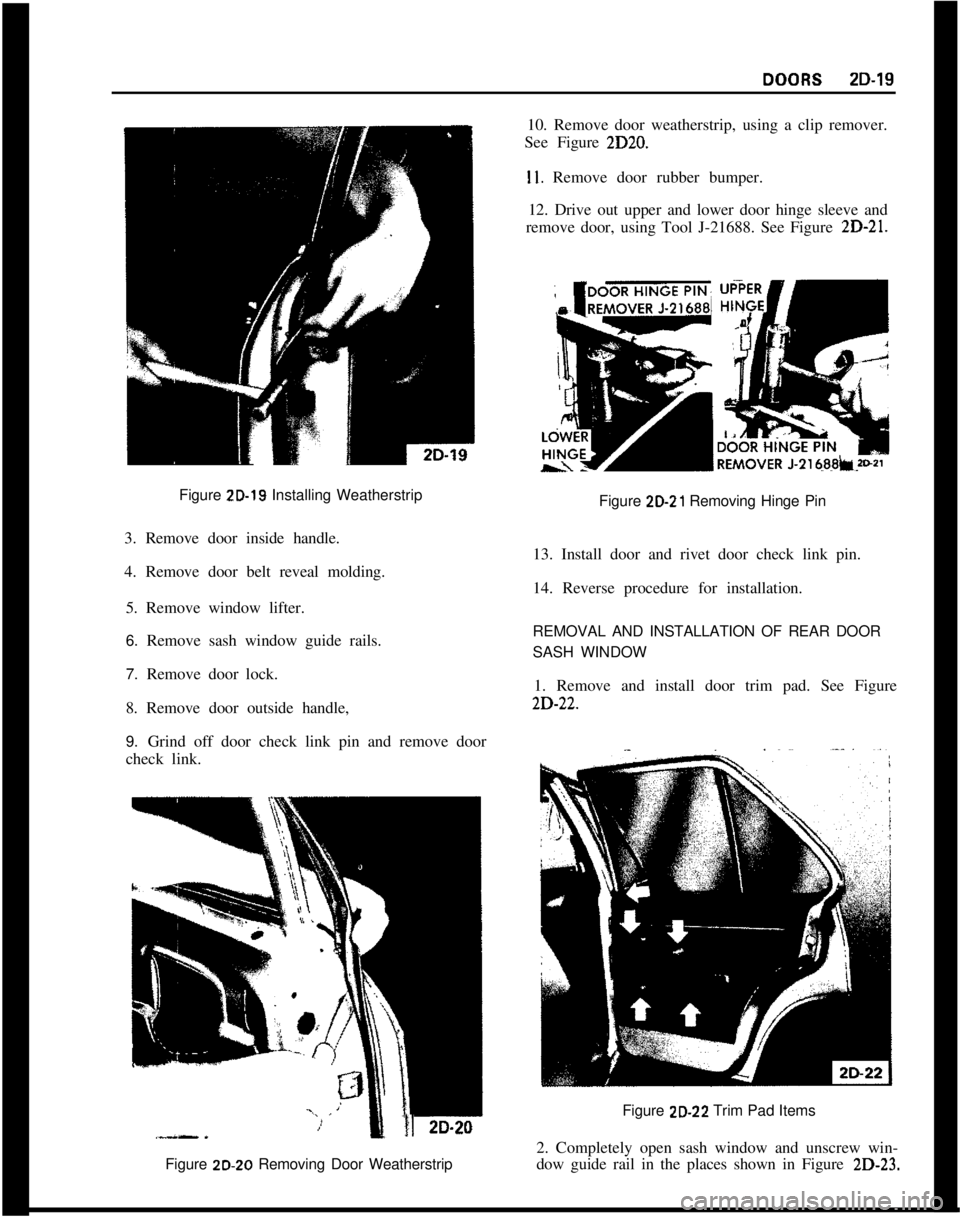
Figure ZD-19 Installing Weatherstrip
3. Remove door inside handle.
4. Remove door belt reveal molding.
5. Remove window lifter.
6. Remove sash window guide rails.
7. Remove door lock.
8. Remove door outside handle,
9. Grind off door check link pin and remove door
check link./.-..&- _[I 2D-20
Figure ZD-20 Removing Door Weatherstrip10. Remove door weatherstrip, using a clip remover.
See Figure 2D20.
Il. Remove door rubber bumper.
12. Drive out upper and lower door hinge sleeve and
remove door, using Tool J-21688. See Figure
2D-21.Figure
ZD-21 Removing Hinge Pin
13. Install door and rivet door check link pin.
14. Reverse procedure for installation.
REMOVAL AND INSTALLATION OF REAR DOOR
SASH WINDOW
1. Remove and install door trim pad. See Figure
2D-22.Figure
ZD-22 Trim Pad Items
2. Completely open sash window and unscrew win-
dow guide rail in the places shown in Figure
2D-23.
Page 156 of 625
SEATS, INTERIOR TRIM AND HEADLINING26-33SEATS, INTERIOR TRIM AND HEADLINING
CONTENTS
SubjectPage No.
DESCRIPTION AND OPERATION: (Not Applicable)
DIAGNOSIS: (Not Applicable)
MAINTENANCE AND ADJUSTMENTS: (Not
Applicable)
MAJOR REPAIR:
Removal and Installation
FrontSeat
. . . . . . . . . . . . . . . . . . . . . . . . . . . . . . . . . . . . . . . . . . . . . . . . . . . . . . . . . . . . . . . . . . . . . . . .RearSeat
. . . . . . . . . . . . . . . . . . . . . . . . . . . . . . . . . . . . . . . . . . . . . . . . . . . . . . . . . . . . . . . . . . . . . . . . . .Glove Compartment Lock ..,.........................................
Front
SidePanelTrimPad. . . . . . . . . . . . . . . . . . . . . . . . . . . . . . . . . . . . . . . . . .Headlining
. . . . . . . . . . . . . . . . . . . . . . . . . . . . . . . . . . . . . . . . . . . . . . . . . . . . . . . . . . . . . . . . . . . . . . . .
RearSidePanelTrimPad. . . . . . . . . . . . . . . . . . . . . . . . . . . . . . . . . . . . . . . . . .SPECIFICATIONS: (Not Applicable)26-33
26-33
26-3426-34
26-3526-37
MAJOR REPAIRREMOVAL AND INSTALLATION OF FRONT SEAT
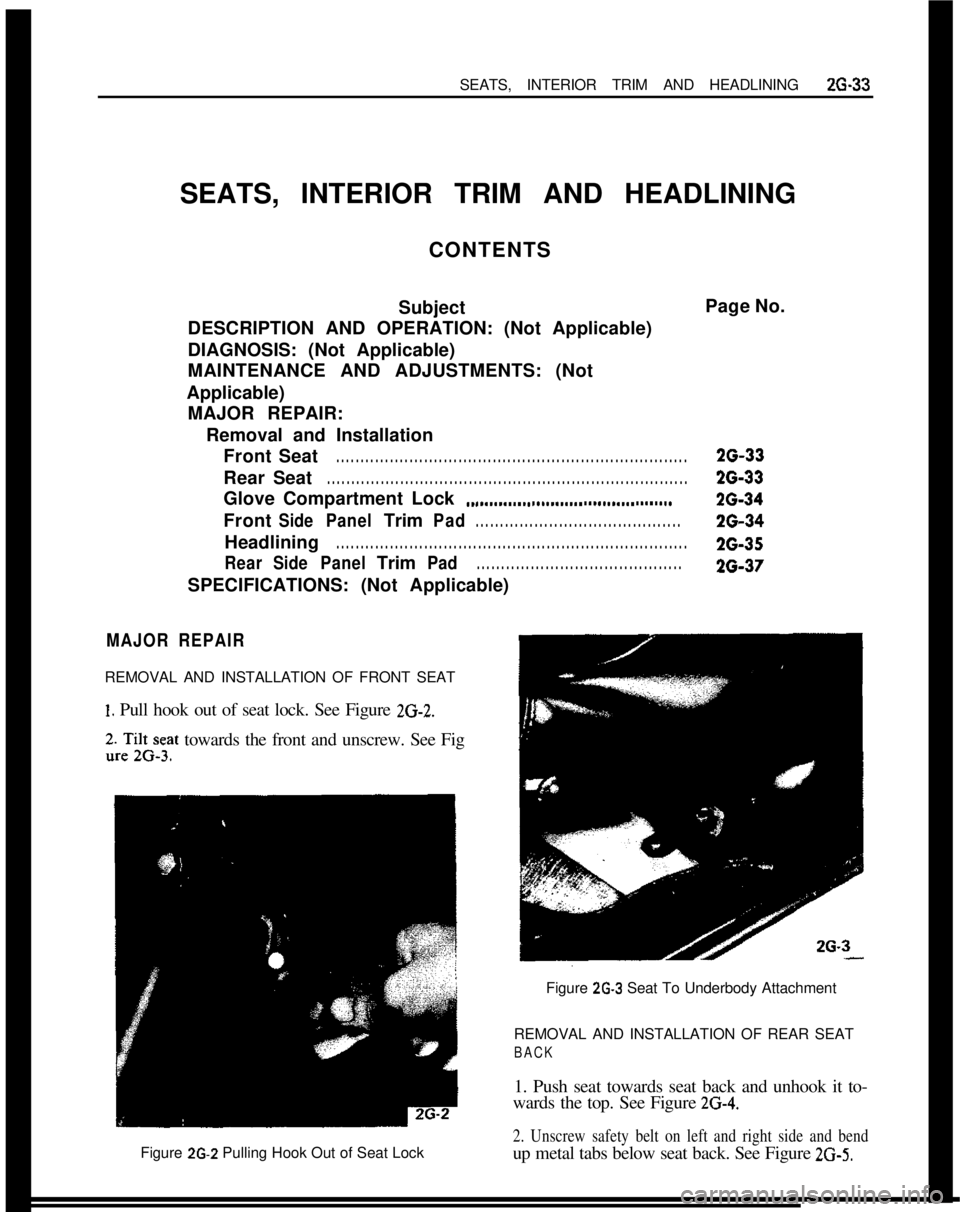
1. Pull hook out of seat lock. See Figure 2G-2.
2.TZ.Gy3at towards the front and unscrew. See Fig
Figure
2G-2 Pulling Hook Out of Seat LockFigure
2G-3 Seat To Underbody Attachment
REMOVAL AND INSTALLATION OF REAR SEAT
BACK1. Push seat towards seat back and unhook it to-
wards the top. See Figure
2G-4.
2. Unscrew safety belt on left and right side and bendup metal tabs below seat back. See Figure
2~3-5.
Page 314 of 625
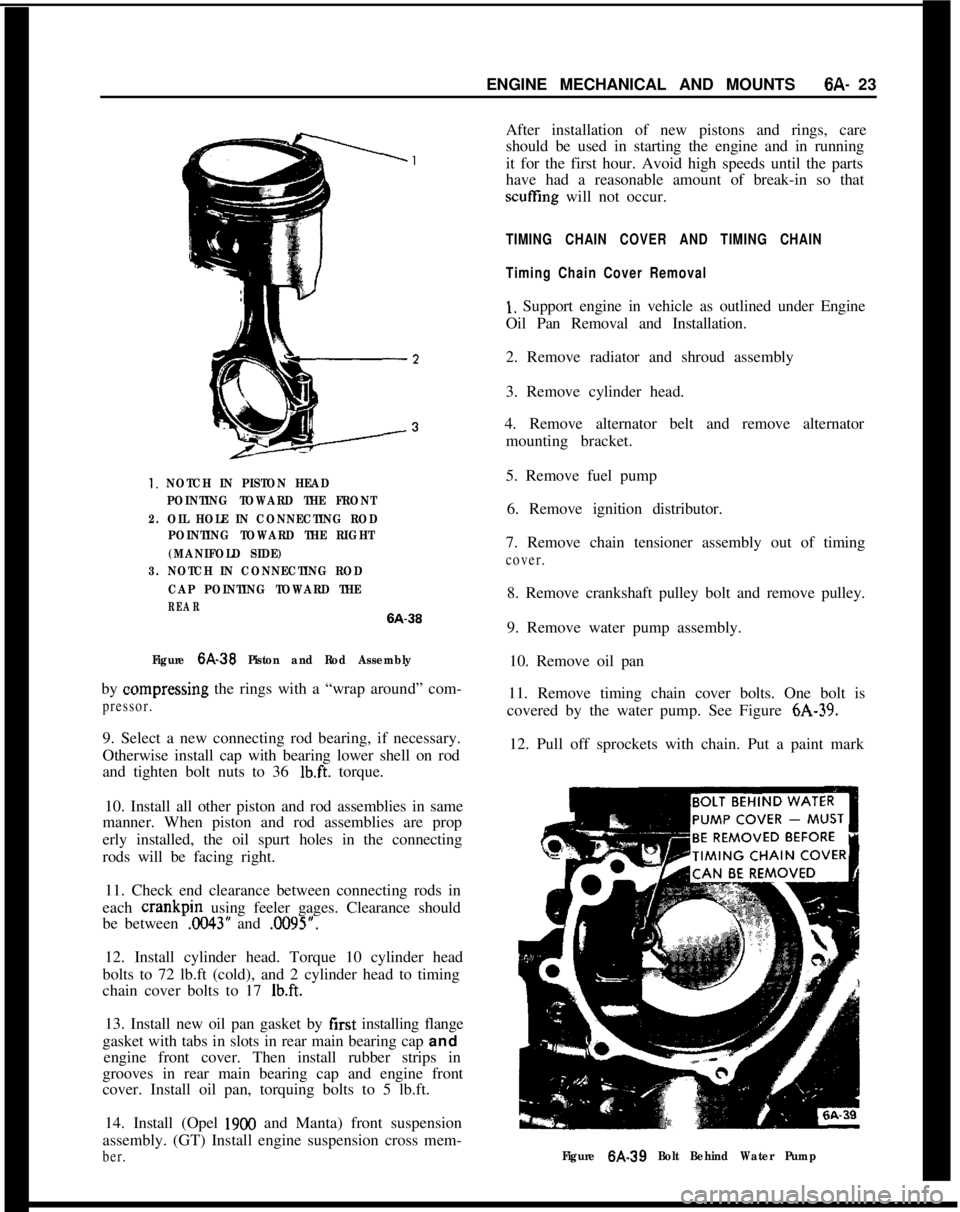
ENGINE MECHANICAL AND MOUNTS6A- 231. NOTCH IN PISTON HEAD
POINTING TOWARD THE FRONT
2. OIL HOLE IN CONNECTING ROD
POINTING TOWARD THE RIGHT
(MANIFOLD SIDE)
3. NOTCH IN CONNECTING ROD
CAP POINTING TOWARD THE
REAR6A-36
Figure
6A-39 Piston and Rod Assemblyby oompressing the rings with a “wrap around” com-
pressor.9. Select a new connecting rod bearing, if necessary.
Otherwise install cap with bearing lower shell on rod
and tighten bolt nuts to 36
lb.ft. torque.
10. Install all other piston and rod assemblies in same
manner. When piston and rod assemblies are prop
erly installed, the oil spurt holes in the connecting
rods will be facing right.
11. Check end clearance between connecting rods in
each crankpin using feeler gages. Clearance should
be between
.0043” and .0095”.
12. Install cylinder head. Torque 10 cylinder head
bolts to 72 lb.ft (cold), and 2 cylinder head to timing
chain cover bolts to 17
lb.ft.13. Install new oil pan gasket by first installing flange
gasket with tabs in slots in rear main bearing cap and
engine front cover. Then install rubber strips in
grooves in rear main bearing cap and engine front
cover. Install oil pan, torquing bolts to 5 lb.ft.
14. Install (Opel
1900 and Manta) front suspension
assembly. (GT) Install engine suspension cross mem-
ber.After installation of new pistons and rings, care
should be used in starting the engine and in running
it for the first hour. Avoid high speeds until the parts
have had a reasonable amount of break-in so that
scuffling will not occur.
TIMING CHAIN COVER AND TIMING CHAIN
Timing Chain Cover Removal
1, Support engine in vehicle as outlined under Engine
Oil Pan Removal and Installation.
2. Remove radiator and shroud assembly
3. Remove cylinder head.
4. Remove alternator belt and remove alternator
mounting bracket.
5. Remove fuel pump
6. Remove ignition distributor.
7. Remove chain tensioner assembly out of timing
cover.8. Remove crankshaft pulley bolt and remove pulley.
9. Remove water pump assembly.
10. Remove oil pan
11. Remove timing chain cover bolts. One bolt is
covered by the water pump. See Figure 6A-39.
12. Pull off sprockets with chain. Put a paint mark
Figure 6A-39 Bolt Behind Water Pump
Page 315 of 625
6A- 24 1973 OPEL SERVICE: MANUAL
on front side of timing chain to permit reinstallation
in original position.
Timing Chain Cover and Timing
Chain installation
Reinstall timing chain cover by reversing removal
procedures, pay particular attention to the following
points.
1. Clean all parts, check for wear and replace as
required. The Parts Department supplies either the two sprockets complete with chain or the chain
alone. It is not permissible to replace sprockets alone.
The chain tensioner is, with the, exception of the
tensioner body, only available as a complete unit.
2. Turn crankshaft so that key for sprocket is on top
and vertical. Assemble chain’, with camshaft
sprocket, then put chain on crankshaft sprocket al-
ready installed. Be sure paint dot
on chain is in front
so that chain moves in same direction as prior to
disassembly.
3. Make sure camshaft sprocket mark is in alignment
with mark on support and chain in parallel with
damper block.
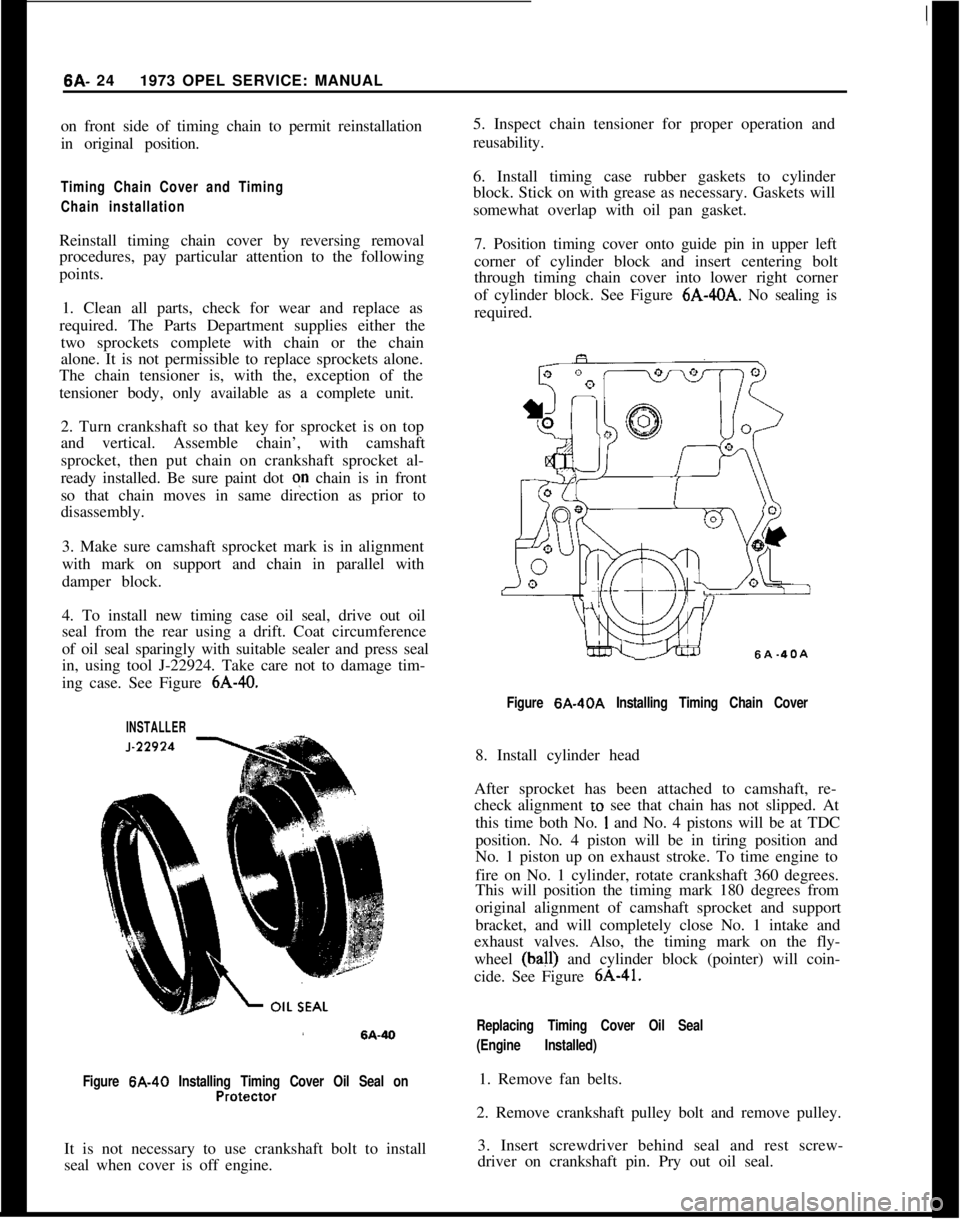
4. To install new timing case oil seal, drive out oil
seal from the rear using a drift. Coat circumference
of oil seal sparingly with suitable sealer and press seal
in, using tool J-22924. Take care not to damage tim-
ing case. See Figure
6A-40. 5. Inspect chain tensioner for proper operation and
reusability.
6. Install timing case rubber gaskets to cylinder
block. Stick on with grease as necessary. Gaskets will
somewhat overlap with oil pan gasket.
7. Position timing cover onto guide pin in upper left
corner of cylinder block and insert centering bolt
through timing chain cover into lower right corner
of cylinder block. See Figure
6A-40A. No sealing is
required.
SA-40.4
Figure 6A-40A Installing Timing Chain Cover
INSTALLER
Figure 6A-40 Installing Timing Cover Oil Seal onProtector
It is not necessary to use crankshaft bolt to install
seal when cover is off engine. 8. Install cylinder head
After sprocket has been attached to camshaft, re-
check alignment
LO see that chain has not slipped. At
this time both No.
1 and No. 4 pistons will be at TDC
position. No. 4 piston will be in tiring position and
No. 1 piston up on exhaust stroke. To time engine to
fire on No. 1 cylinder, rotate crankshaft 360 degrees.
This will position the timing mark 180 degrees from
original alignment of camshaft sprocket and support
bracket, and will completely close No. 1 intake and
exhaust valves. Also, the timing mark on the fly-
wheel
(ball) and cylinder block (pointer) will coin-
cide. See Figure
6A-41.
Replacing Timing Cover Oil Seal
(Engine Installed)
1. Remove fan belts.
2. Remove crankshaft pulley bolt and remove pulley. 3. Insert screwdriver behind seal and rest screw-
driver on crankshaft pin. Pry out oil seal.
Page 316 of 625
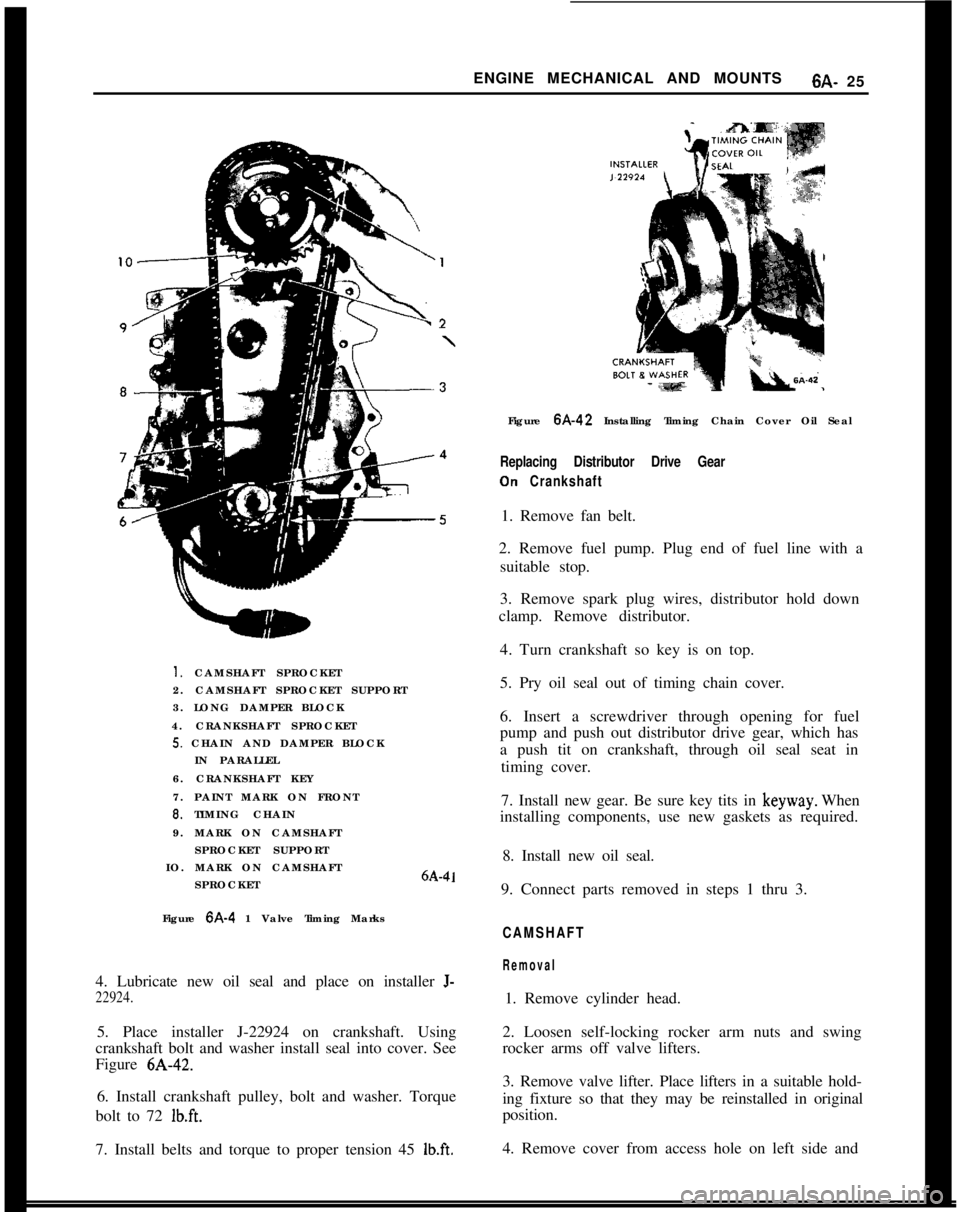
ENGINE MECHANICAL AND MOUNTS6A- 251, CAMSHAFT SPROCKET
2. CAMSHAFT SPROCKET SUPPORT
3. LONG DAMPER BLOCK
4. CRANKSHAFT SPROCKET
5. CHAIN AND DAMPER BLOCK
IN PARALLEL
6. CRANKSHAFT KEY
7. PAINT MARK ON FRONT
8. TIMING CHAIN
9. MARK ON CAMSHAFT
SPROCKET SUPPORT
IO. MARK ON CAMSHAFT
SPROCKET
6A-41Figure 6A-4 1 Valve Timing Marks
Removal4. Lubricate new oil seal and place on installer
J-
22924.1. Remove cylinder head.
5. Place installer J-22924 on crankshaft. Using
crankshaft bolt and washer install seal into cover. See
Figure 6A-42.2. Loosen self-locking rocker arm nuts and swing
rocker arms off valve lifters.
6. Install crankshaft pulley, bolt and washer. Torque
bolt to 72
Ib.ft.3. Remove valve lifter. Place lifters in a suitable hold-
ing fixture so that they may be reinstalled in original
position.
7. Install belts and torque to proper tension 45
lb.ft.4. Remove cover from access hole on left side andFigure 6A-42 Installing Timing Chain Cover Oil Seal
Replacing Distributor Drive Gear
On Crankshaft1. Remove fan belt.
2. Remove fuel pump. Plug end of fuel line with a
suitable stop.
3. Remove spark plug wires, distributor hold down
clamp. Remove distributor.
4. Turn crankshaft so key is on top.
5. Pry oil seal out of timing chain cover.
6. Insert a screwdriver through opening for fuel
pump and push out distributor drive gear, which has
a push tit on crankshaft, through oil seal seat in
timing cover.
7. Install new gear. Be sure key tits in
keyway. When
installing components, use new gaskets as required.
8. Install new oil seal.
9. Connect parts removed in steps 1 thru 3.
CAMSHAFT
Page 323 of 625
66.321973 OPEL SERVICE MANUAL
COOLING SYSTEM
CONTENTS
Subject
DESCRIPTION AND OPERATION:
Cooling System and Water Pump
. . . . . . . . . . . . . . . . . . . . . . . . . . . . . . . .DIAGNOSIS: (Not Applicable)
MAINTENANCE AND ADJUSTMENTS:
Checking and Filling Cooling System
. . . . . . . . . . . . . . . . . . . . . . . .Draining
andFlushingCoolingSystem. . . . . . . . . . . . . . . . . . . . . .Conditioning the Cooling System
. . . . . . . . . . . . . . . . . . . . . . . . . . . . . . . .Using and Testing Anti-Freeze Solutions
. . . . . . . . . . . . . . . . . .Fan Belt Adjustment or Replacement
. . . . . . . . . . . . . . . . . . . . . . . .Radiator Thermostat Inspection and Test
. . . . . . . . . . . . . . . .MAJOR REPAIR:
Water Pump Removal
. . . . . . . . . . . . . . . . . . . . . . . . . . . . . . . . . . . . . . . . . . . . . . . . . . . . .Radiator
Removal. . . . . . . . . . . . . . . . . . . . . . . . . . . . . . . . . . . . . . . . . . . . . . . . . . . . . . . . . . . . . .SPECIFICATIONS:
Cooling System Capacities
. . . . . . . . . . . . . . . . . . . . . . . . . . . . . . . . . . . . . . . . . . . .Page No.
68-32
6B-32
68-32
68-33
68-33
68-33
68-33
68-34
68-34
6B-35
DESCRIPTION AND OPERATION
COOLING SYSTEM AND WATER PUMPThe coiling system is of the conventional pressurized
type. A centrifugal pump arranged in timing case
serves to circulate the coolant.
When the thermostat is closed, the coolant will re-
turn to the pump via a by-pass for swift and uniform
warming up of the engine the coolant circulates
through the radiator, only when the engine has
reached normal operating temperature.
The heater system branches off the cooling system
ahead of thermostat in flow direction so that the
heater is in operation before engine has reached full
operating temperature.
MAINTENANCE AND ADJUSTMENTS
Checking and Filling Cooling SystemThe coolant level should be checked only when the
engine is cold and only enough coolant should be
added to bring the level halfway between core andtank top. It is unnecessary and undesirable to remove
the radiator cap and check the coolant level each
time the car stops at a filling station for gasoline or
oil, since the engine is usually hot at such times.
WARNING: Never remove the radiator cap quickly
when engine is HOT Sudden release of cooling
sys-
tern pressure may cause the coolant to boil and some
of it may be ejected from the radiator
filler neck,
resulting in
inl’ury to persons or damage to the car
finish.If it is necessary at any time to remove the radiator
cap when engine is hot, rotate the cap counterclock-
wise until first stop is reached. Leave cap in this
position until all pressure in cooling system has been
released, then turn cap past the first stop and remove
it.
Draining and Flushing
Cooling SystemThe cooling system should be completely drained
and the recommended coolant installed every two (2)
years.To drain the cooling system, remove radiator cap,
remove lower radiator hose from the lower tank and
Page 324 of 625
COOLING SYSTEM6B- 33
remove drain plug on right.side of cylinder block. Set
heater temperature control valve at full heat posi-
tion. After the cooling system is drained, and plugs
reinstalled, fill the system with clean water. Run the
engine long enough to open the thermostat for com-
plete circulation through the system, then com-
pletely drain the cooling system before sediment has
a chance to settle.
Conditioning the Cooling System
“Rust Inhibitor and Stop Leak”, or equivalent listed
under Group 8.800 is recommended for use in the
cooling system, particularly when preparing for in-
stallation of anti-freeze solution. This material stops
small seepage leaks, has rust preventive properties
and its soluble oil is effective in eliminating a squeal-
ing noise which sometimes develops at the water
pump seal washer. Instructions for its application are
printed on the conditioner bottle.
It is very important to make certain that the cooling
system is properly prepared before an anti-freeze so-
lution is installed, otherwise loss of solution through
leakage may occur or seepage may result in damage
to the engine. The cooling system should be drained
and flushed as described under Draining and Flush-
ing Cooling System. All joints should be checked for
leakage and corrected, and the conditioner described
above should be added with the anti-freeze solution.
Inspect the water pump, radiator core, heater and
defroster cores, water jacket plugs, and edge of cylin-
der head gaskets for evidence of water leaks. Tighten
all hose clamps in the cooling and heating systems
and replace any deteriorated hoses.
Using and Testing Anti-Freeze
Solutions
Inhibited year around (ethylene glycol type) engine
coolant solution which is formulated to withstand
two full calendar years of normal operation without
draining or adding inhibitors should be used at all
times. Freeze protection should be provided to pro-
tect against corrosion. When adding solution due to
loss of coolant for any reason or in areas where tem-
peratures lower than minus 20 degrees F. may be
encountered, a sufficient amount of any of the sev-
eral brands of year around coolant (Ethylene Glycol
base) compatible to GM Specification 1899-M avail-
able on the market should be used. Water or alcohol
base coolants are not recommended for this vehicle
at any time.
If for any reason water only is used as a coolant in
an emergency, it is extremely important that Buick
Heavy Duty Cooling System Protector and Water
Pump Lubricant or equivalent be added to the cool-
ing system as soon as possible. If any other cooling
System protector is used, be certain it is labeled toindicate that it meets General Motors Specification
GM 1894-M. It should be recognized that this is only
a temporary measure. The manufacture intends that
permanent type coolant solution be used year around
in the cooling system.
The cooling system should be completely drained
and the recommended coolant installed every two (2)years.It is advisable to test the anti-freeze solution at inter-
vals during the winter to make certain that the solu-
tion has not been weakened. Use only hydrometers
which are calibrated to read both the specific gravity
and the temperature, and have a table or other means
of converting the freezing point at various tempera-
tures of solution. Disregarding the temperature of
the solution when making the test may cause an error
as large as 30 degrees F. Care must be exercised to
use the correct float or table for the particular type
of anti-freeze being tested.
Fan Belt Adjustment or Replacement
A tight fan belt will cause rapid wear of the alterna-
tor and water pump bearings. A loose belt will slip
and wear excessively and will cause noise, engine
over-heating, and unsteady alternator output. A fan
belt which is cracked or frayed, or which is worn so
that it bottoms in the pulleys should be replaced. The
fan belt may be replaced by loosening the alternator
brace at alternator, slightly loosening the alternator
mounting bolts and moving alternator inward to pro-
vide maximum slack in the belt.
The alternator must be moved outward to adjust the
fan belt. After the generator brace and mounting
bolts are securely tightened, the fan belt tension
should be 45 lb. using Tensioner J-23600.
WARNING: Zfa
fan blade is bent or damaged in any
way, no attempt should be made to repair and reuse
the damaged part. A bent or damaged fan assembly
should always be replaced with a new
fal. assembly.
It is essential that fan assemblies remain in proper
balance and proper balance cannot be assured once
a fan assembly has been bent or damaged. A fan
assembly that is not in proper balance could fail and
fly apart during subsequent
we creating an ex-
tremely dangerous condition.
Radiator Thermostat Inspection and Test
A sticking radiator thermostat will prevent the cool-
ing system from functioning properly. If the thermo-
stat sticks in the open position, the engine will warm
up very slowly. If the thermostat sticks in the closed
position, the engine will overheat.
The thermostat may be removed for inspection and