belt OPEL 1900 1973 Owner's Manual
[x] Cancel search | Manufacturer: OPEL, Model Year: 1973, Model line: 1900, Model: OPEL 1900 1973Pages: 625, PDF Size: 17.22 MB
Page 325 of 625
6B- 341973 OPEL SERVICE MANUAL
test by partially draining the cooling system and dis-
connecting the water outlet housing from the ther-
mostat housing which is mounted on the right front
side of cylinder head.
The standard thermostat valve should start to open
at 189 degrees F and fully open at approximately 212
degrees F. If thermostat does not operate at specified
temperatures, it should be replaced as it cannot be
repaired.MAJOR REPAIR
WATER PUMP REPAIRSThe water pump bearing outer race is shrunk fit into
the water pump cover. For this reason the cover,
shaft bearing, and hub are not repairable.
Water Pump RemovalOpel radiators do not have a drain plug. Drain radia-
tor by first, loosening radiator cap, then remove
lower hose from lower radiator tank.
1. Drain coolant into a clean container. Remove
radiator and shroud.
2. Remove fan belt.
3. Remove fan blade and pulley on water pump shaft.
4. Disconnect inlet hose and heater hose from water
pump. Remove bolts, pump assembly and gasket
from timing chain cover.
5. Check pump shaft bearing for end play or rough-
ness in operation. If bearings are not in serviceable
condition, the assembly must be replaced.
Water Pump Installation1. Make sure the gasket surfaces on pump and timing
chain covers are clean. Install pump assembly with
new gasket. Bolts must be tightened uniformly.
Torque to 11 lb. ft.
2. Install radiator and shroud. Connect radiator hose
to pump inlet and heater hose to nipple.
3. Install fan pulley and fan blade, tighten attaching
bolts securely. Install belts and adjust for proper
tension.4. Fill cooling system and check
,for leaks at pump
and hose joints.
RADIATOR REMOVAL AND INSTALLATION
RemovalI. Loosen radiator cap, then remove lower radiator
hose and drain radiator coolant into suitable con-
tainer.
2. On vehicles with automatic transmission, unscrew
oil lines from connectors on lower radiator tank and
plug lines. On GT models with automatic transmis-
sion the lines have to be disconnected at the coupling
before removing from the tank. It is essential that no
dirt enters the oil lines. When unscrewing oil lines,
hold connectors on lower radiator tank with pliers to
avoid leakages. Ensure that no dirt enters oil cooler.
3. Remove lower attaching nut and slide radiator
upward and out of engine compartment.
Installation1. Install radiat,or into engine compartment and se-
cure lower attaching nut.
2. On vehicles with automatic transmissions, fasten
oil cooler lines to lower radiator tank. It is essential
that no dirt enters the oil lines. When tightening oil
lines, hold connectors on lower radiator tank with
pliers to avoid leakages. Ensure that no dirt enters oil
cooler. Torque to 1 I-15
lbs.ft.3. Install lower radiator hose and add collected coo-
lant.
All Opels are provided with a radiator initial fill of
an antifreeze solution containing corrosion inhibitor.
The antifreeze has either a glycol or glycerin base
and protects the engine against freezing, down to
minus 22 degrees F. (minus 30 degrees C.). Before
the start of the cold season, coolant must be checked
with a hydrometer and if necessary, brought to the
necessary specific gravity by adding anti-freeze with
a glycol or glycerin base. As the specific gravities of
all anti- freeze solutions having a glycol or glycerin
base are practically the same, the hydrometer can be
used for all these types. Because of the tolerances of
the hydrometer, or slight differences in specific
gravity, variations of plus or minus 5 degrees can be
expected. Coolant must be checked at a temperature
of plus 68 degrees F. (plus 20 degrees C.)
Page 358 of 625
2. If inspection of contact points indicates excessive
burning, pitting or wear, check condenser and re-
place if necessary.
3. Inspect all connections and wires in the primary
ignition circuit. Correct any abnormal conditions
found.Carburetor1. Clean fuel strainer in fuel pump. To prevent fuel
leakage in pump, disconnect “IN” line from pump
and raise end above fuel level. The in-line fuel filter
should be replaced every 12,000 miles or every 12
months.
2. Check for freedom of choke valve operation and
clean shaft if necessary, with suitable solvent.
3. Inspect throttle cable or linkage bracket and re-
turn spring for wear. With helper depressing acceler-
ator pedal to floor, check for wide open throttle.
Adjust accelerator pedal height so wide open throttle
is obtained when pedal is within
l/2 inch from floor.
Lubricate linkage pivot points with engine oil.
Air CleanerCheck paper element every 6,000 miles and replace
every
24,ooO miles. If a vehicle is operated in dusty
territory, check condition of air cleaner element
more frequently and replace if necessary.
Fan Belt1. Inspect belt for wear, cracks or frayed points.
Replace and/or adjust as necessary. Specified ten-
sion for belt using Gauge J-23600 is 45 lbs.
Cooling System1. Inspect the radiator, water pump, cylinder head
areas and all radiator and heater hose connections
for evidence of engine coolant leaks.
2. Inspect all hoses for deterioration from gas and oil
contact. Correct as required.
Inspection should be made with engine operating at
normal temperature, cooling system completely
filled, temperature control lever fully open and nor-
mal pressure in the system. Normal pressure should
be 13.2 to 15.2 psi.
Engine Lubrication SystemInspect engine for evidence of oil leakage. Correctany abnormal condition with sealastic or new seals
and gaskets.
Battery
1. Inspect battery, battery mount and cables and
check electrolyte level. Proper level should be just
above the cell plates.
CAUTION:Do not over fill.
2. Determine the serviceability of the battery by ap-
plying the 421 Battery Test.
Positive Crankcase VentilationClean crankcase ventilator metered orifice in the in-
take manifold fitting every 6,000 miles. Also all hoses
and fittings should be inspected, cleaned and re-
placed, if necessary.
To clean, remove rubber hose from metered orifice
and apply air pressure to orifice to remove any for-
eign particles that may be trapped.
Valve Lifter AdjustmentRefer to Engine Mechanical and Mounts section for
valve lifter adjustment procedure.
Engine Tune-Up Instrument ChecksThe following instrument checks and adjustments
serve as a final check on engine condition. These
checks may discover some new problems that may
not have been obvious before. The engine is also
given its final adjustments that will assure maximum
performance, reliability, and proper emission con-
trol.
Refer to Electrical Group for checking procedures of
the following:
Cranking Voltage Check
Ignition Timing
Distributor Advance
Ignition Output
Secondary Resistance
Current Output and Voltage Setting
Idle Speed and Mixture AdjustmentsRefer to carburetor section.
Page 542 of 625
REFRIGERANT COMPONENTS ALL MODELS99- 33
That the attraction of the drying material for mois-
ture is so powerful that if the receiver is left open,
moisture will be drawn in from the outside air.
That just one drop of water added to the refrigerantwill start chemical changes that can result in corro-
sion and eventual breakdown of the chemicals in the
system. Hydrochloric acid is the result of an R-12
mixture with water.
That the smallest amount of air in the refrigeration
system may start reactions that can cause malfunc-
tions.
That the drying agent in the receiver-dehydrator is
Activated Silica Alumina (silica-gel).
That
the inert gas in the expansion valve capillary
line is carbon dioxide.
DESCRIPTION OF AIR CONDITIONING
COMPONENTS
Compressor
The compressor is located in the engine compart-
ment. The purpose of the unit is to draw the low
pressure,gas from the evaporator and compress this
gas into a high temperature, high pressure gas. This
action will result in the refrigerant having a higher
temperature than the surrounding air.
The
cortipressor is of basic double action piston de-
sign. Three horizontal double acting pistons make up
a six cylinder compressor (See Figure
9B-162). The
pistons operate in
l-1/2 inch bore and have a l-1/8
inch stroke. A
wash plate keyed to the shaft drives
the pistons. The shaft is belt driven through a mag-
netic clutch and pulley arrangement. An oil pump
mounted at the rear of the compressor picks up oil
from the
botto’m of the compressor and lubricates the
bearings’and other internal parts of the compressor.
Reed type valves at each end of the compressor open
or close to control the flow of incoming and outgoing refrigerant. Two gas tight passages interconnect
chambers of the front and rear heads so that there is
one common suction port, and one common dis-
charge port. The internal parts of the compressor
function, as follows:
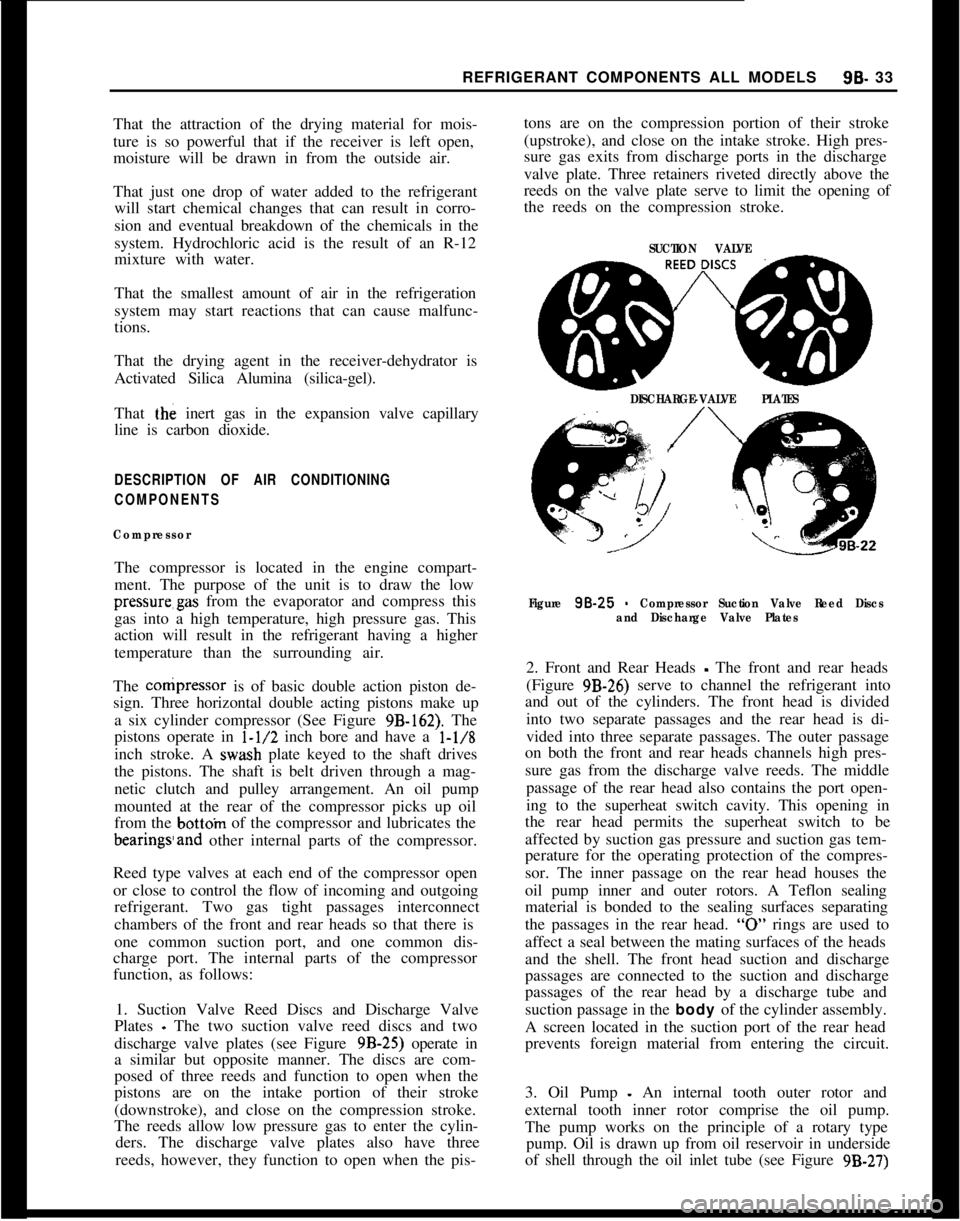
1. Suction Valve Reed Discs and Discharge Valve
Plates
_ The two suction valve reed discs and two
discharge valve plates (see Figure
9B-25) operate in
a similar but opposite manner. The discs are com-
posed of three reeds and function to open when the
pistons are on the intake portion of their stroke
(downstroke), and close on the compression stroke.
The reeds allow low pressure gas to enter the cylin- ders. The discharge valve plates also have three
reeds, however, they function to open when the pis- tons are on the compression portion of their stroke
(upstroke), and close on the intake stroke. High pres-
sure gas exits from discharge ports in the discharge
valve plate. Three retainers riveted directly above the
reeds on the valve plate serve to limit the opening of
the reeds on the compression stroke.
SUCTION VALVE
DISCHARGE-VALVE PLATES
Figure
98-25 - Compressor Suction Valve Reed Discs
and Discharge Valve Plates
2. Front and Rear Heads - The front and rear heads
(Figure
9B-26) serve to channel the refrigerant into
and out of the cylinders. The front head is divided
into two separate passages and the rear head is di-
vided into three separate passages. The outer passage
on both the front and rear heads channels high pres-
sure gas from the discharge valve reeds. The middle
passage of the rear head also contains the port open-
ing to the superheat switch cavity. This opening in
the rear head permits the superheat switch to be
affected by suction gas pressure and suction gas tem-
perature for the operating protection of the compres-
sor. The inner passage on the rear head houses the
oil pump inner and outer rotors. A Teflon sealing
material is bonded to the sealing surfaces separating
the passages in the rear head.
“0” rings are used to
affect a seal between the mating surfaces of the heads
and the shell. The front head suction and discharge
passages are connected to the suction and discharge
passages of the rear head by a discharge tube and
suction passage in the
body of the cylinder assembly.
A screen located in the suction port of the rear head
prevents foreign material from entering the circuit.
3. Oil Pump
- An internal tooth outer rotor and
external tooth inner rotor comprise the oil pump.
The pump works on the principle of a rotary type pump. Oil is drawn up from oil reservoir in underside
of shell through the oil inlet tube (see Figure
9B-27)
Page 549 of 625

98.40 1973 OPEL SERVICE MANUAL
2. Interconnect manifold and gage set (J-5725-01),
gage charging lines (J-5418) and gage adapters
(J-5420) to air conditioning system as shown in Figure
9B-40.3. Place transmission in “Park” for automatics and
in neutral for manuals. Apply hand brake.
4. Turn blower switch to the “Hi” position.
5. Turn temperature switch to “Max” position.
6. Run engine at 2000 RPM for ten (10) minutes with
car doors and windows closed and the hood up. Place
a high volume industrial type fan in front of radiator
if head pressure should exceed 250 psi and also at
high ambients to bring the pressures to within the
limits specified in the Functional Charts in Division
V.In the case of the Opel 1900 and the Manta, a ther-
mometer should be placed in a position to read the
temperature of the air discharging from the right-
hand A/C outlet. In case of the GT, a thermometer
should be placed in a position to read the tempera-
ture of the air discharging from the left-rear A/C
outlet.
HEATER-AIR CONDITIONER REFRIGERANT
CIRCUIT TROUBLE DIAGNOSIS GUIDE
Insufficient Cooling (Check Air Flow)
Normal Air Flow (Inspect system for visual defects.
Run functional tests.)
Discharge Air
- Normal Temp Check for air leaks
through dash, car body, windows, or from heater or
ventilators.
Discharge Air
- High Temp Check sight glass for
foaming and compressor clutch for engagement.
No Compressor Clutch Engagement Check connec-
tions at clutch switch, harness connectors, and check
clutch switch.
No Foaming Compare evaporator pressure to that
on functional test table.
Foaming System is probably low on refrigerant.
Check for leaks, repair, evacuate, and charge. If
foaming still occurs, check for restriction in refriger-
ant lines between condenser and receiver dehydrator.
Evaporator Pressure Normal Compare head pres-
sure to pressure on functional test table.
Evaporator Pressure Low Ice may be forming on
evaporator. Low volume of air discharging at A/C
outlet after system has been running above idle con-dition
,for approximately 15-30 min.utes. Discharging
air gradually elevating in temperature. Check expan-
sion valve. If valve isn’t permitting flow of liquid,
this will be indicated by a warm pipe out of the
evaporator. This may be caused by: 1) Clogged or
Plugged inlet screen in the expansion valve; 2)
Broken capillary line; or 3) Discharged temperature
bulb. If the valve is okay, the pipe out of the evapora-
tor will be cold.
Evaporator Pressure High Check the expansion
valve to determine if themobulb is making good con-
tact and is properly insulated. Operate engine at 2000
RPM with maximum air conditioning setting. If
evaporator pressure remains high, feel suction line.
If line feels frosty or extremely
(cold with relative
high ambient conditions, then partially cover the
condenser to obtain head pressures from 265 psi to
280 psi maximum. If evaporator pressure rises above
30 psi, change the expansion valve.
Also, check if compressor may be the cause due to
some internal or external mechanical trouble which
prevents reduction of pressure. Check for external
troubles, slipping belt, bad clutch and/or pulley, or
improper clutch engagement, before investigating
the compressor internally.
Head Pressure High Check for the following: Con-
denser air flow low, air in system, excessive refriger-
ant in system, restriction in condenser.Head.PressureLowRestriction in flow of refrigerant
to evaporator, or expansion valve plugged or defec-
tive.
Low Air Flow (Check blower operation and
evaporator. Check operation of controls.)
Ice BIocking Evaporator Run functional test. If
evaporator pressure is low, ice may form on evapora-
tor and reduce air flow.
Evaporator Pressure Low Ice may be forming on
evaporator. Low volume of air discharging at A/C
outlet after system has been running above idle con-
dition for approximately 15-30 minutes. Discharging
air gradually elevating in temperature. Check expan-
sion valve. If valve isn’t permitting flow of liquid,
this will be indicated by a warm pipe out of the
evaporator. This may be caused by: 1) Clogged or
plugged inlet screen in the expansion valve; 2)
Broken capillary line, or 3) Discharged temperature
bulb. If the valve is okay, the pipe out of the evapora-
tor will be cold.BlowerNot OperatingCheck for the following: Fuse
blown, blower switch defective, wire broken or loose
connection, poor ground connection, or blower mo-
tor defective.
Page 558 of 625
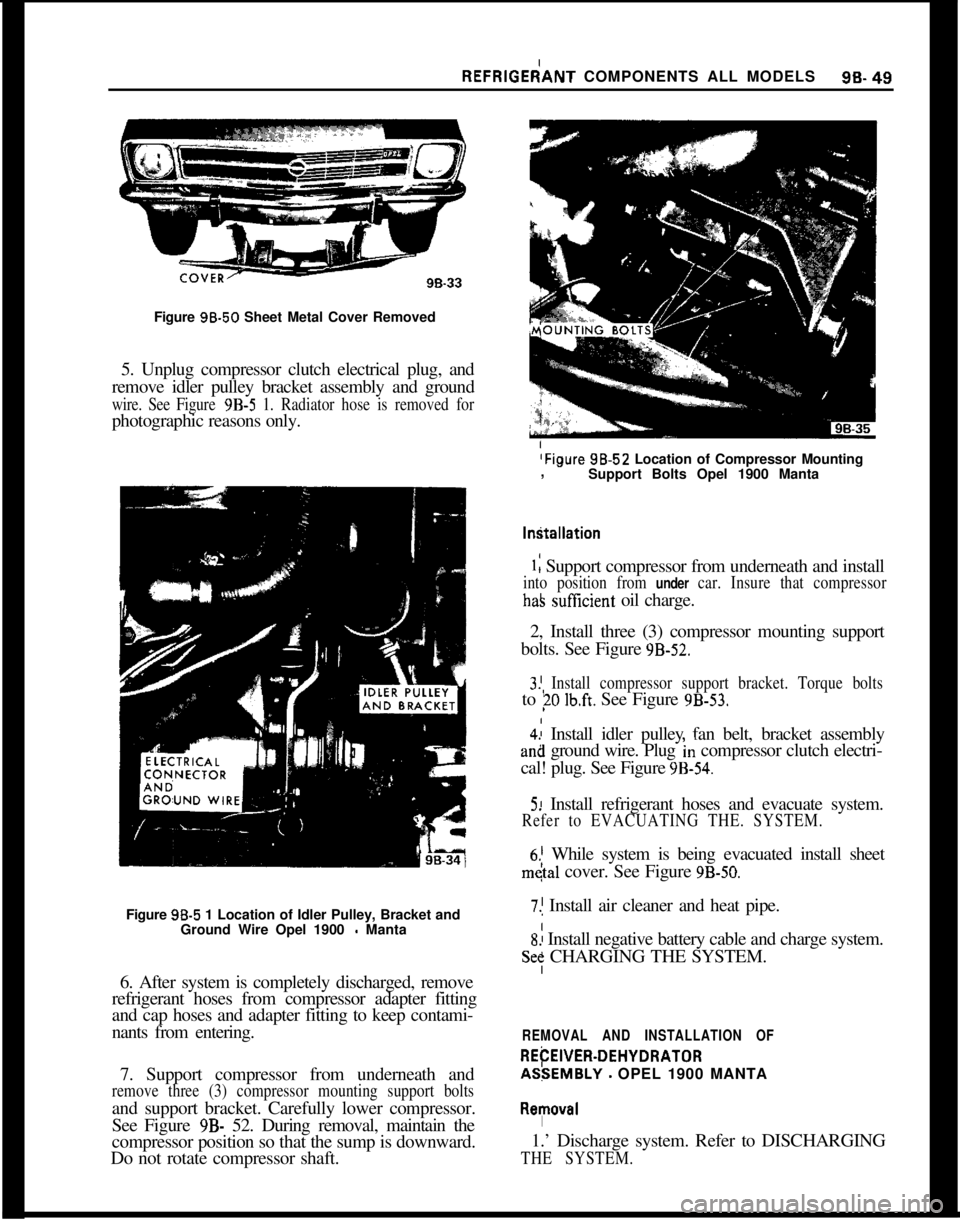
REFRlGEdANT COMPONENTS ALL MODELS96-49Figure 96.50 Sheet Metal Cover Removed
5. Unplug compressor clutch electrical plug, and
remove idler pulley bracket assembly and ground
wire. See Figure 9B-5 1. Radiator hose is removed forphotographic reasons only.
(Figure 98.52 Location of Compressor Mounting
,
Support Bolts Opel 1900 Manta
I
Figure 98-5 1 Location of Idler Pulley, Bracket and
Ground Wire Opel 1900
- Manta
6. After system is completely discharged, remove
refrigerant hoses from compressor adapter fitting
and cap hoses and adapter fitting to keep contami-
nants from entering.
7. Support compressor from underneath and
remove three (3) compressor mounting support boltsand support bracket. Carefully lower compressor.
See Figure
9B- 52. During removal, maintain the
compressor position so that the sump is downward.
Do not rotate compressor shaft.
1: Support compressor from underneath and install
into position from under car. Insure that compressor
haS sutXcient oil charge.
2, Install three (3) compressor mounting support
bolts. See Figure
9B-52.I
3! Install compressor support bracket. Torque boltsto
?O lb.ft. See Figure 9B-53.
4.: Install idler pulley fan belt, bracket assemblyan8 ground wire. Plug
‘In compressor clutch electri-
cal! plug. See Figure
9B-54.
5! Install refrigerant hoses and evacuate system.
Refer to EVACUATING THE. SYSTEM.
6.’ While system is being evacuated install sheet
m&l cover. See Figure 9B-50.
7.1 Install air cleaner and heat pipe.
S! Install negative battery cable and charge system.
Se: CHARGING THE SYSTEM.
REMOVAL AND INSTALLATION OF
REtiEWEFt-DEHYDRATORAS:EMBLY
- OPEL 1900 MANTA
I
R~l!lOV~lI1.’ Discharge system. Refer to DISCHARGING
THE SYSTEM.
Page 567 of 625
98-58 1973 OPEL SERVICE MANUAL
2. Discharge system. Refer to DISCHARGING
SYSTEM.
3. While system is discharging remove air cleaner
and loosen idler pulley and bracket assembly. See
Figure 98-80.
4. Remove bolt holding compressor adapter fitting
into rear head. Disengage from compressor and tape
closed openings in both lines and ports in rear head.
It is important to seal compressor ports to avoid a
loss of refrigeration oil and also to prevent foreign
material and moisture from entering compressor. See
Figure 9B-82.
5. Remove bolt and ground wire, unplug electrical
connector, and remove 2 rear compressor mounting
bolts. See Figure 98-82.
6. Remove 2 front compressor mounting bolts,
clutch drive belt, and lift out compressor. During
removal, maintain the compressor position so that
the sump is downward. Do not’rotate compressor
shaft. See Figure 9B-84.
Installation1. Install compressor into mounting brackets and
secure with 4 mounting bolts. See Figure
9B-84.2. Untape lines and ports, and install compressor
adapter fitting and bolt using new o-rings. See Figure
9B-82.3. Evacuate system. Refer to, EVACUATING
SYSTEM.
4. While system is being evacuated, install drive belt
and tighten idler pulley. See Figure
9B-80.5. Install bolt and ground wire and plug in electrical
connector. See Figure
9B-83.6. Install air cleaner and negative battery cable.
7. Charge system. Refer to, CHARGING SYS-
TEM.
REMOVAL AND INSTALLATION OF
RECEIVER.DEHYDRATOR
ASSEMBLY. GT
Removal1. Discharge system. Refer to DISCHARGING
SYSTEM.
2. Disconnect refrigerant lines to both ends of re-
ceiver-dehydrator and tape closed open ends of
re-
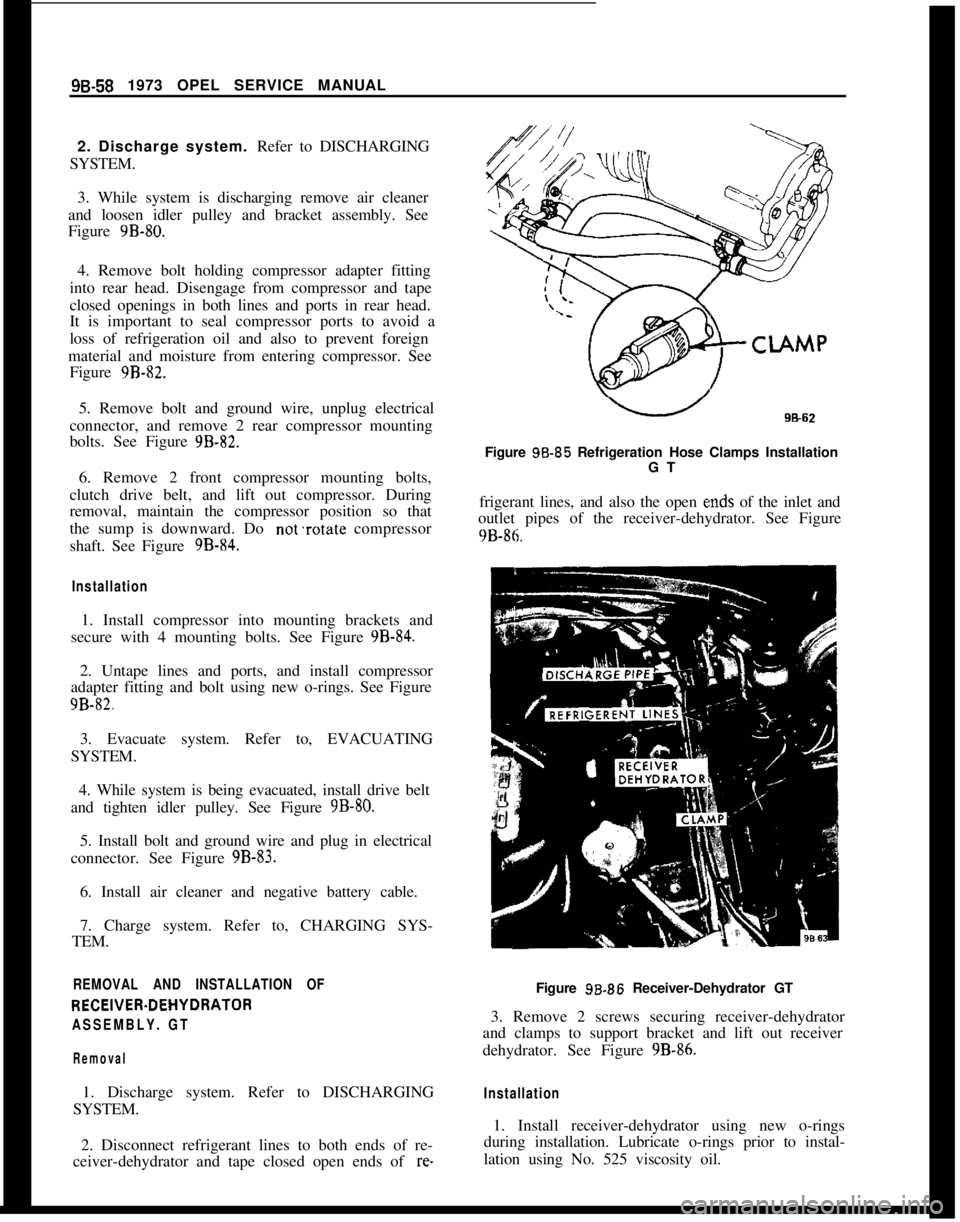
9862Figure 98.85 Refrigeration Hose Clamps Installation
GT
frigerant lines, and also the open
e:nds of the inlet and
outlet pipes of the receiver-dehydrator. See Figure
9B-86.Figure 98.86 Receiver-Dehydrator GT
3. Remove 2 screws securing receiver-dehydrator
and clamps to support bracket and lift out receiver
dehydrator. See Figure
9B-86.
Installation1. Install receiver-dehydrator using new o-rings
during installation. Lubricate o-rings prior to instal-
lation using No. 525 viscosity oil.
.
Page 591 of 625
r98-82 1973 OPEL SERVICE MANUAL
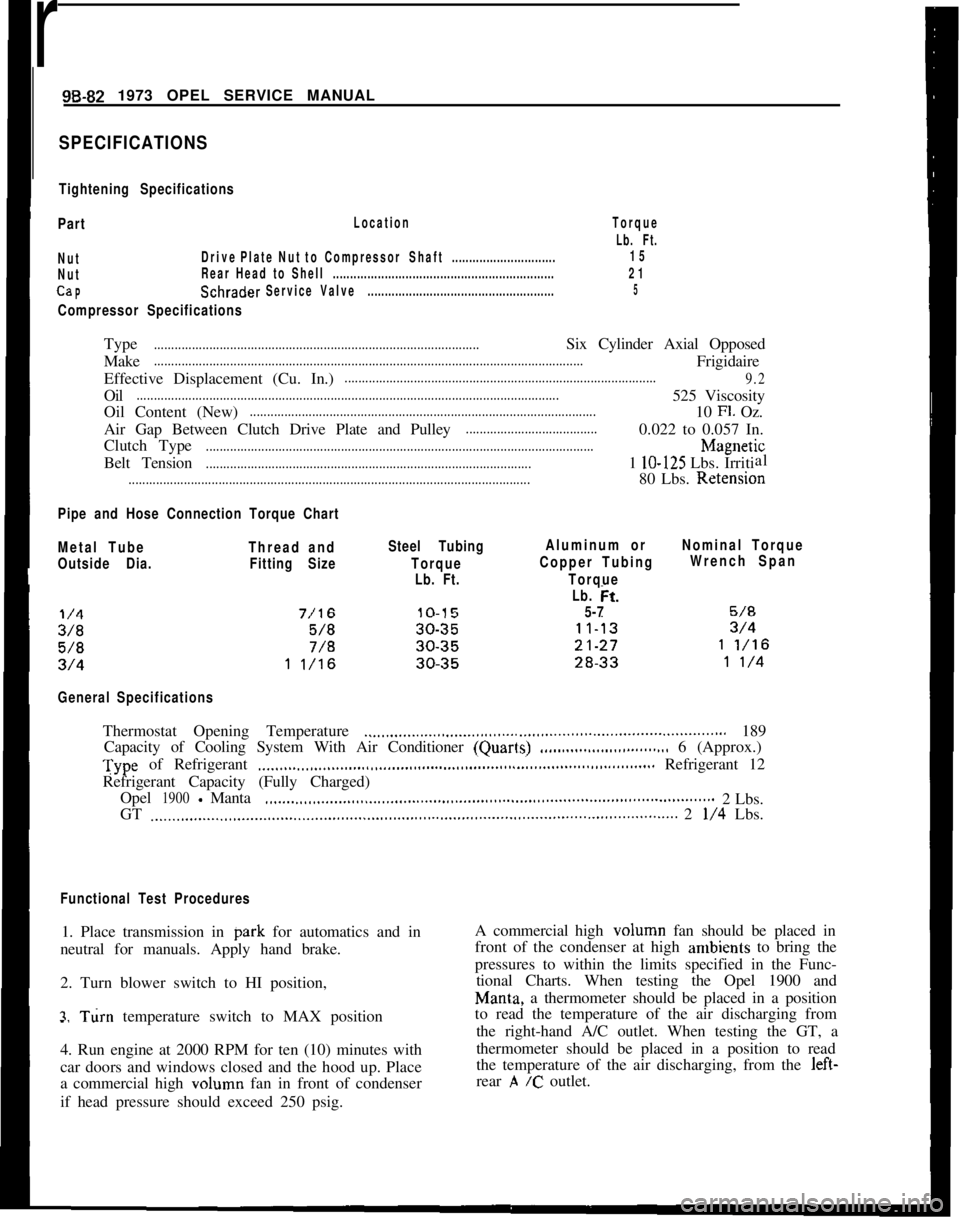
SPECIFICATIONS
Tightening Specifications
Part
Location
NutDrivePlateNut toCompressorShaft..............................
NutRear Head to Shell................................................................
CaPSchraderServiceValve......................................................
Compressor Specifications
Torque
Lb. Ft.
15
21
5Type
..............................................................................................Six Cylinder Axial Opposed
Make
............................................................................................................................Frigidaire
Effective Displacement (Cu. In.)
..........................................................................................
9.2Oil
..........................................................................................................................525 Viscosity
Oil Content (New)
....................................................................................................10 Fl. Oz.
Air Gap Between Clutch Drive Plate and Pulley
......................................0.022 to 0.057 In.
Clutch Type
................................................................................................................h4agnetic
Belt Tension
..............................................................................................1 lo-125 Lbs. Irritial
....................................................................................................................80 Lbs. Retension
Pipe and Hose Connection Torque Chart
Metal TubeThread andSteel TubingAluminum orNominal Torque
I
Outside Dia.Fitting SizeTorqueCopper TubingWrench Span
Lb. Ft.Torque
Lb. tit.
5-7
General SpecificationsThermostat Opening Temperature
.._.....,,,...__....,,.............................................................. 189
Capacity of Cooling System With Air Conditioner (Quarls)
.,,..___....___............... 6 (Approx.)Type of Refrigerant
.___,,,._...,.,,,.__.....,,,.......,,,,.......,,,...................,,,......,,,............ Refrigerant 12
Refrigerant Capacity (Fully Charged)
Opel
1900-Manta,,._....,,,,._...._.,,,,.......,,,........,,............................................................2 Lbs.
GT
,..__..,..,..__..,,,.......,,,,.......,,,........,,,.,......,,,,,......,,.,,........,,.......,,..........,,............... 2 l/4 Lbs.
Functional Test Procedures1. Place transmission in park for automatics and in
neutral for manuals. Apply hand brake.
2. Turn blower switch to HI position,
3. Turn temperature switch to MAX position-.
4. Run engine at 2000 RPM for ten (10) minutes with
car doors and windows closed and the hood up. Place
a commercial high volumn fan in front of condenser
if head pressure should exceed 250 psig.A commercial high volumn fan should be placed in
front of the condenser at high ambients to bring the
pressures to within the limits specified in the Func-
tional Charts. When testing the Opel 1900 and
Man& a thermometer should be placed in a position
to read the temperature of the air discharging from
the right-hand A/C outlet. When testing the GT, a
thermometer should be placed in a position to read
the temperature of the air discharging, from the left-
rear
,A /c outlet.
Page 597 of 625
AIR CONDITIONER SYSTEM -OPEL 1900 - MANTASB- 89
cJ 6084
J
14OVSJ
5428.03
,J 23390
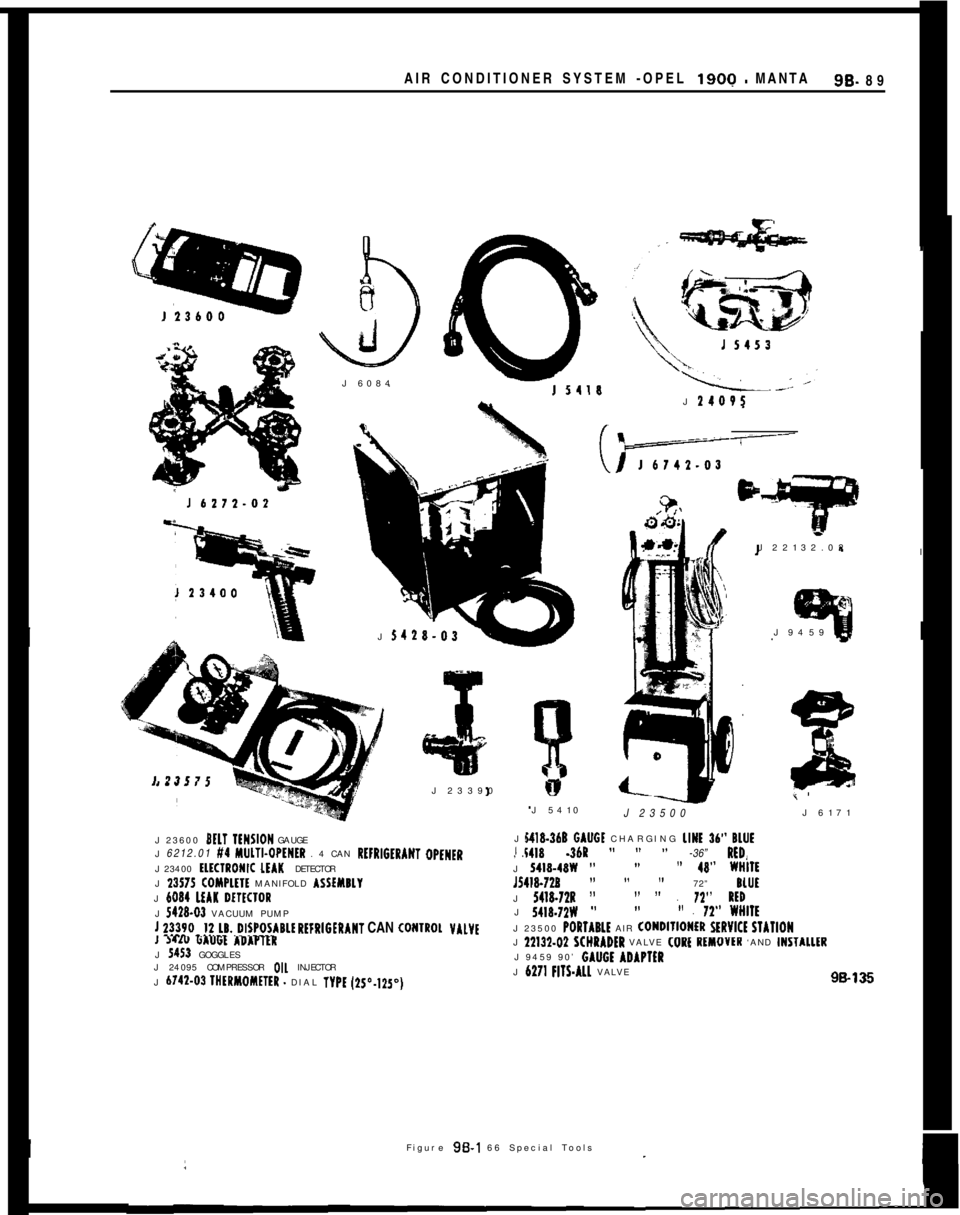
J 23600 BELT IENSION GAUGE
J 6212.01 #4 MlJLTI.OPtNtR . 4 CAN RtFRIGtRANT OPENER
J 23400
tlKlRONIC LEAK DETECTOR
J 23575 COMPLHE MANIFOLD ASSfYBLY
J 6034 LEAK WtClORJ 5418-03 VACUUM PUMP
! ?!!~O~!~~~..~I~poIIRL~ REFRIGERANT CAN CONIROL VALVEI WI" 6A"Gt ADAPTEK
J 5453 GOGGLES
J 24095 COMPRESSOR OIL INJECTOR
J 6742.03 IHtRMOMETER
- DIAL TYPE (2S”.lZ5~)J 22132.02
I
J 9459
1J 5410
J 23500J 6171
141%360 GAUGt CHARGING LINE 36” BLUEi418 -36R ” ” ” -36” RED, J!I I, .J 5418.48W ””” 48” WHIIEJ5418.728
” ” ” 72” BLUI
J 5418.72s ”” I’ . 11” RtD
J 5418.7ZW ””” . 72” WWllt
J 23500 PORlARLt AIR ~ONDIlIONtR SERVlCt STAllON
J 22132.D2 SCWRADER VALVE
J 6271 FIlS.ALL VALVE98136I
IFigure 96-l 66 Special Tools
Page 621 of 625
SubjectPage Number
Subject Page Number
A
Air Conditioning Refrigerant Components .................
98.17
Opel 1900
& Manta-In Car Components .....9B-90
GT.ln Car Components..................98-97
Alignment Opel 1900
& Manta .....................3C-22
GT-Opel ..............................
3C-22
Alternator Description ...........................
lD-28
Specifications. .........................1 D-35
Overhaul K-l..........................lD-30
Removal & Installation ..................lD-30
Testing...............................lD-29
Wiring Diagrams
Manta .............................
1 J-105
Opel 1900
..........................lJ-103
GT ................................
lJ-107
AM
Radio-GT............................9C-105
AM Radio-Opel 1900 &Manta ...............
9C-109
Antenna, Installation .......................
9C-111
Antenna Trimmer .........................
9C-110
Assembly of Transmission from Major Units Manual ...............................
78-23
3 Speed Automatic .....................
7C-103
Axle,
R&r, Disassembly ....................48~11
Bolt Torque Specifications
Engine ...............................
6A-27
Transmission. Manual ....................
78-33
3 Speed Automatic .....................
7C-136
Clutch ...............................
7A-7
Body ................................
2A-4
Brakes
Brake Drum, Shoes & Linings .............5C-28
Hydraulic Wheel Cylinder ................
5C-30
Hydraulic Master Cylinder ................
5A-2
Parking Brake Cables .....................
5C-33
Standard Brakes ........................
X-22
Disc Brakes...........................5B-10
Brake Booster and Vacuum
Coritrol Valve ....5A-5
Bumpers, Front and Rear ...................
ZH-33
C
B
Balance,,Wheel and Tire....................3G-62
Ball
J&tUpper .........................3A-7
Lower ...............................
3A-7
Battery
Specifications ..........................
lA-9
Testing...............................lA-6
Charging ..............................lA-9
Trouble Diagnosis ......................lA-4
Battery Test 421.........................l A-6
Belt Tensions ............................
68.33
Blower and Air Inlet Assembly, Removal and Installation
Owl 1900&Manta.....................9A-15
GT
.: ................................9A-5
Body Name Plate ............................
OA-1
Style’Numbers ......................... OA-2
Windows and Weatherstrips ...............
ZC-9
Doors ................................
ZD-13
Interior Trim and Headlining ..............
26-33
Seatsi................................26-33
Roof&d Sunroof-Opel 1900
& Manta ......2F.24 Camshaft,
1.9L
Engine .....................6A-25
Car Model Identification .......
.,............OA-1
Carburetor..............................6E-44
Trouble Diagnosis ......................
6E-49
Description ...........................
6E-44
Overhaul .............................
6E-53
Adjust ...............................
6E-50
Removal
& Installation ......,............6E-52
Specifications ..........................
6E-58
Charging
System
Description ..............
:............ 1 D-28
Specifications. ............
.,............lD-35
Testing..................:............lD-29
Wiring Diagrams
Manta .............................
lJ-105
Opel 1900 ..........................
lJ.103
GT ................................
lJ-107
Chart Lubrication ........................ OC-5
Chassis Springs, Front. ........
!............3A-15
Clutch, Second-Automatic Transmission .......
7C-103
Clutch Adjustment .........................
7A-4
Control Arm Front Upper ...................
:............3A-10
Lower ...............................
3A-11
Converter Checking Procedure ................
7C-125
Coolant Flow ............................
68-32
4 Speed Manual Transmission ...
!,...........7B-12
Cranking System. See Starting
SyStem
Crankshaft..............................6A-16
Cylinder Head ...............
:............6A-12
D
Description
3.Speed Automatic.....................7C-37