rod OPEL 1900 1973 User Guide
[x] Cancel search | Manufacturer: OPEL, Model Year: 1973, Model line: 1900, Model: OPEL 1900 1973Pages: 625, PDF Size: 17.22 MB
Page 42 of 625
IGNITION SYSTEMlC-214. Rota&distributor counterclockwise slightly until
contact pbints just start to open. This must be done
very carefully or engine will not start.
5. Install distributor cap. Make sure spark plug wires
are correctly installed in distributor cap, through clip
and on spark plugs.
Finish TimingIContact boint gap
(.016” at widest gap) or dwell 50
degrees plus or minus 3 degrees should always be
checked before adjusting ignition timing.
1. Connekt timing light to No. 1 spark plug.
2. Disconnect and plug vacuum advance unit and
retard u$it hoses.
3. Connect a tachometer from distributor side of coil
to
groun$l.4. Start dngine. Set idle speed to 900 RPM.
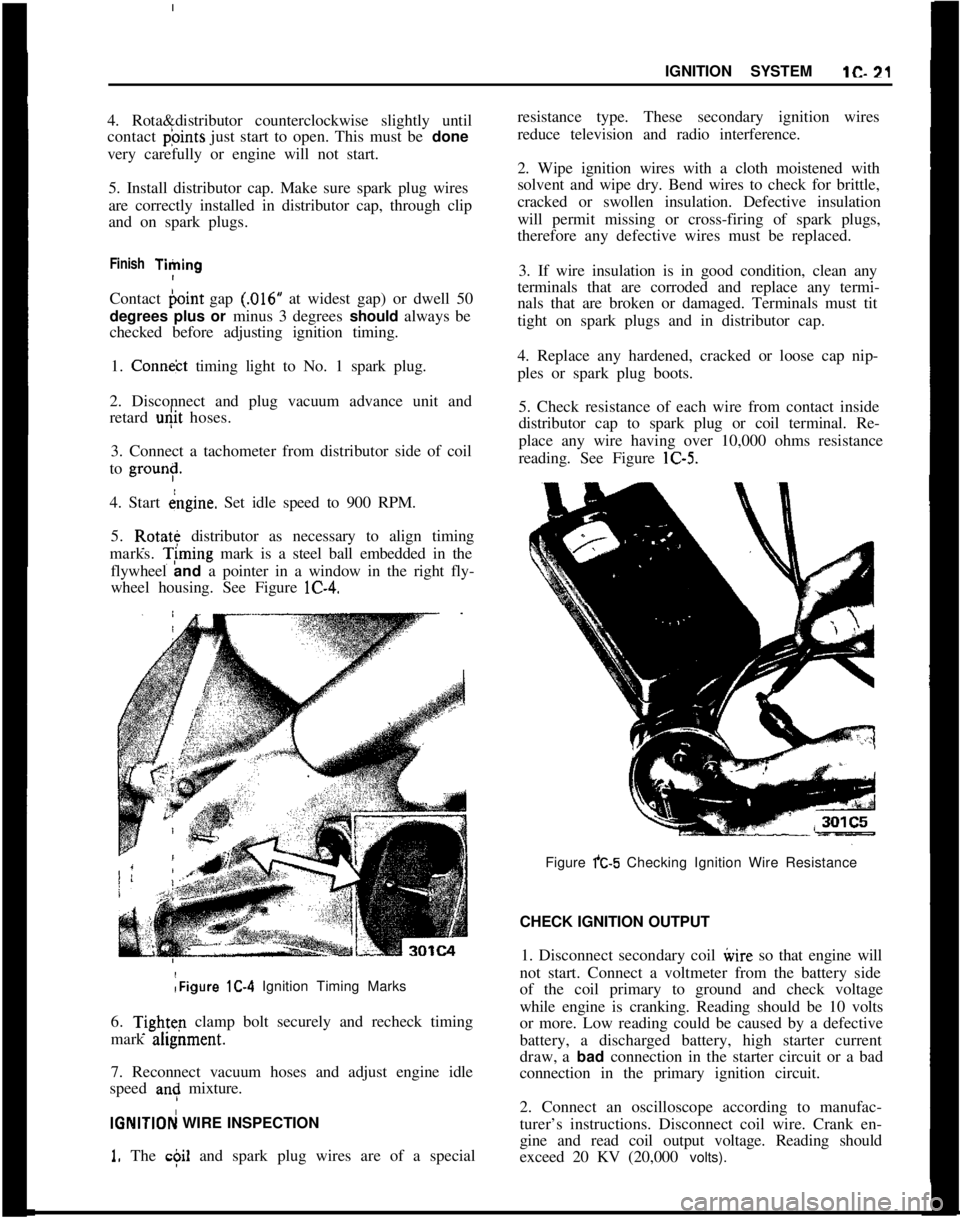
5. Rotate distributor as necessary to align timing
marks. T;ming mark is a steel ball embedded in the
flywheel and a pointer in a window in the right fly-
wheel housing. See Figure lC-4.:Figure lC-4 Ignition Timing Marks
6.
Tightq clamp bolt securely and recheck timing
mark ahgnment.
7. Reconnect vacuum hoses and adjust engine idle
speed
an: mixture.
IGNlTlOFj WIRE INSPECTION
1. The c$il and spark plug wires are of a specialresistance type. These secondary ignition wires
reduce television and radio interference.
2. Wipe ignition wires with a cloth moistened with
solvent and wipe dry. Bend wires to check for brittle,
cracked or swollen insulation. Defective insulation
will permit missing or cross-firing of spark plugs,
therefore any defective wires must be replaced.
3. If wire insulation is in good condition, clean any
terminals that are corroded and replace any termi-
nals that are broken or damaged. Terminals must tit
tight on spark plugs and in distributor cap.
4. Replace any hardened, cracked or loose cap nip-
ples or spark plug boots.
5. Check resistance of each wire from contact inside
distributor cap to spark plug or coil terminal. Re-
place any wire having over 10,000 ohms resistance
reading. See Figure lC-5.
Figure fC-5 Checking Ignition Wire Resistance
CHECK IGNITION OUTPUT
1. Disconnect secondary coil ivire so that engine will
not start. Connect a voltmeter from the battery side
of the coil primary to ground and check voltage
while engine is cranking. Reading should be 10 volts
or more. Low reading could be caused by a defective
battery, a discharged battery, high starter current
draw, a bad connection in the starter circuit or a bad
connection in the primary ignition circuit.
2. Connect an oscilloscope according to manufac-
turer’s instructions. Disconnect coil wire. Crank en-
gine and read coil output voltage. Reading should
exceed 20 KV (20,000 volts).
Page 43 of 625
lC- 22 1973 OPEL SERVICE MANUAL j
3. Start engine and disconnect a wire from a spark
plug. Read output voltage of disconnected spark
plug circuit. Reading should exceed 20 KV
(20,poO
volts).I
CHECK DISTRIBUTOR
!1. Clean distributor cap and inspect it for cracks or
tracking. Inspect inner segments for erosion and
outer sockets for corrosion.
2. Clean and inspect ignition wires. Make sure resist-
ance of each wire is less than 10,000 ohms. Replace
any defective spark plug boots or distributor
capnipples. See paragraph lC-12.
3. Inspect breaker points and replace if necessary.
Adjust breaker point gap to
,016 inch with rubbing
block on peak of cam lobe or check dwell and adjust
if not 50 degrees plus or minus 3 degrees. 4. Check
dwell variation by reading dwell at idle and at 3000
RPM. Dwell must not vary more than 3 degrees.
Excessive variation means distributor shaft, cam or
breaker plate are worn or damaged--overhaul dis-
tributor and replace defective parts.
5. Check distributor condenser for a minimum series
resistance and insulation leakage. Check for a
capacity between
.15 and .20 microfarads.
6. Check total advance (centrifugal and vacuum) at
2500 engine RPM using a timing light having a dial
for reading advance.
(a) The timing marks are aligned with both the
vacuum advance and the vacuum retard hoses dis-
connected and plugged.
Engine idle should be 900 RPM.
(b) Reconnect vacuum hoses. Run engine at
3600RPM and adjust knob until timing marks are
aligned. Read advance on dial. Maximum centrifugal
advance should be between 28-32 degrees.
7. If total advance is out of specifications, check
centrifugal advance only, at
2500 RPM. Discon+ectand plug all vacuum hoses. Maximum vacuum ad-
vance should be l-5 degrees at 4.5-5.0 in. hg.
8. Replace centrifugal or vacuum advance parts as
required to bring distributor total advance within
specifications.
9. Check operation of vacuum retard unit (rear unit)
by first making sure timing marks are aligned with
vacuum hoses disconnected and at slow idle (700
RPM). Then connect vacuum hose to vacuum retard
unit (rear unit). Timing ball should move in a retard
direction (upward).
CHEICK SPARK PLUGS1. Remove spark plugs. If electrodes are badly worn,
discard plugs. If inner or outer porcelain is cracked
or broken, discard plugs.
2. Note color and general appearance of inner end of
spark plug. Brown to grayish
- tan deposits and slight
electrode wear indicate correct spark plug heat
range. Plugs having this appearance may be cleaned,
regapped, tested and reinstalled.
3. Clean spark plugs in a sand blast type cleaner.
Clean only enough to remove deposits, not enough to
wear away porcelain. If deposits are too hard to
remove or if porcelain is glazed, discard plugs.
4. After cleaning spark plugs, clean tiring surfaces of
electrodes with a line file.
5. Test cleaned spark plugs on a pressure tester by
comparing spark of the used plugs with that of a new
plug. Install tested plugs, using new gaskets.
6. If removed spark plugs have excessive carbon foul-
ing and if the car will be driven mostly at low speeds
in city driving, it is advisable to replace plugs with
a hotter plug, AC43FS.
7. If removed plugs show rapid electrode wear or
inner porcelain breakage at low mileage. Check for
a vacuum leak such as a poor manifold to head fit.
8.
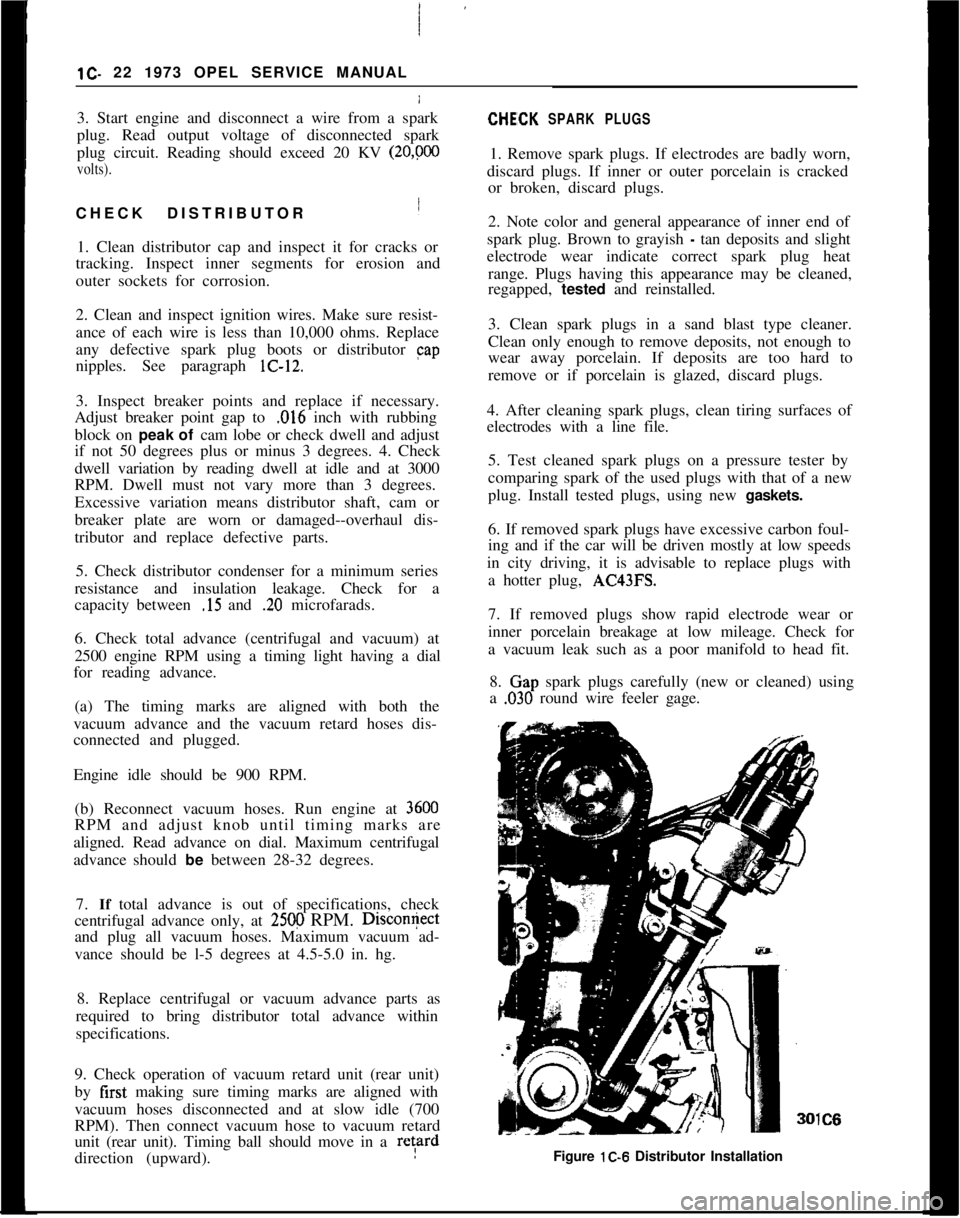
Clap spark plugs carefully (new or cleaned) using
a
,030 round wire feeler gage.IC6
Figure lC-6 Distributor Installation
Page 46 of 625
IGNITION SYSTEM1C. 25
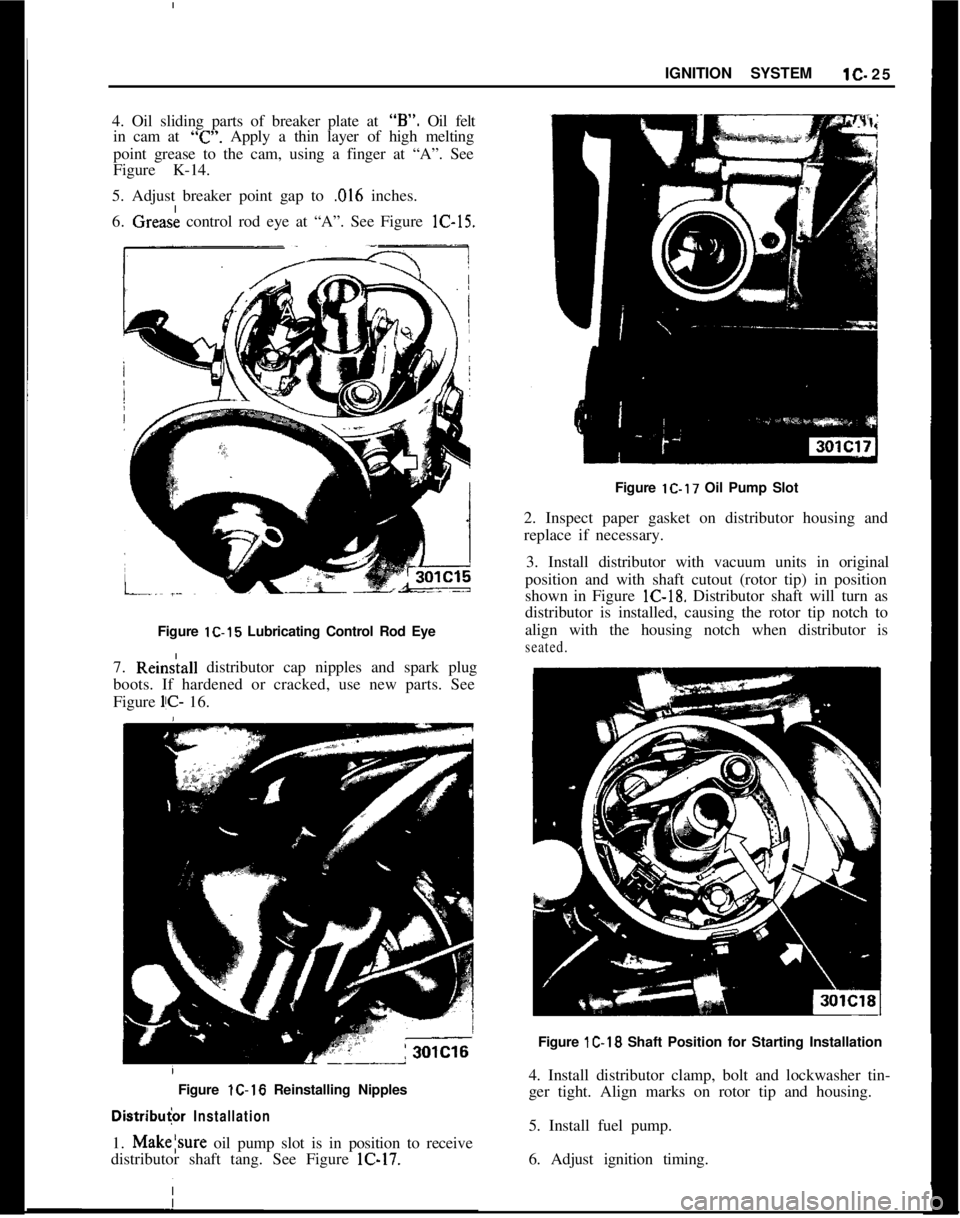
4. Oil sliding parts of breaker plate at “B”. Oil felt
in cam at
“c”. Apply a thin layer of high melting
point grease to the cam, using a finger at “A”. See
Figure K-14.
/
5. Adjust breaker point gap to
,016 inches.
6. Grease control rod eye at “A”. See Figure lC-15.
Figure lC-15 Lubricating Control Rod Eye
7. Rein&all distributor cap nipples and spark plug
boots. If hardened or cracked, use new parts. See
Figure
l!C- 16.
/ Figure lC-16 Reinstalling Nipples
Distribu
2. Inspect paper gasket on distributor housing and
replace if necessary.
3. Install distributor with vacuum units in original
position and with shaft cutout (rotor tip) in position
shown in Figure lC-18. Distributor shaft will turn as
distributor is installed, causing the rotor tip notch to
align with the housing notch when distributor is
seated.Figure
1C-18 Shaft Position for Starting Installation
4. Install distributor clamp, bolt and lockwasher tin-
ger tight. Align marks on rotor tip and housing.
5. Install fuel pump.
6. Adjust ignition timing.
Page 47 of 625
lC- 261973 OPEL SERVICE MANUAL /
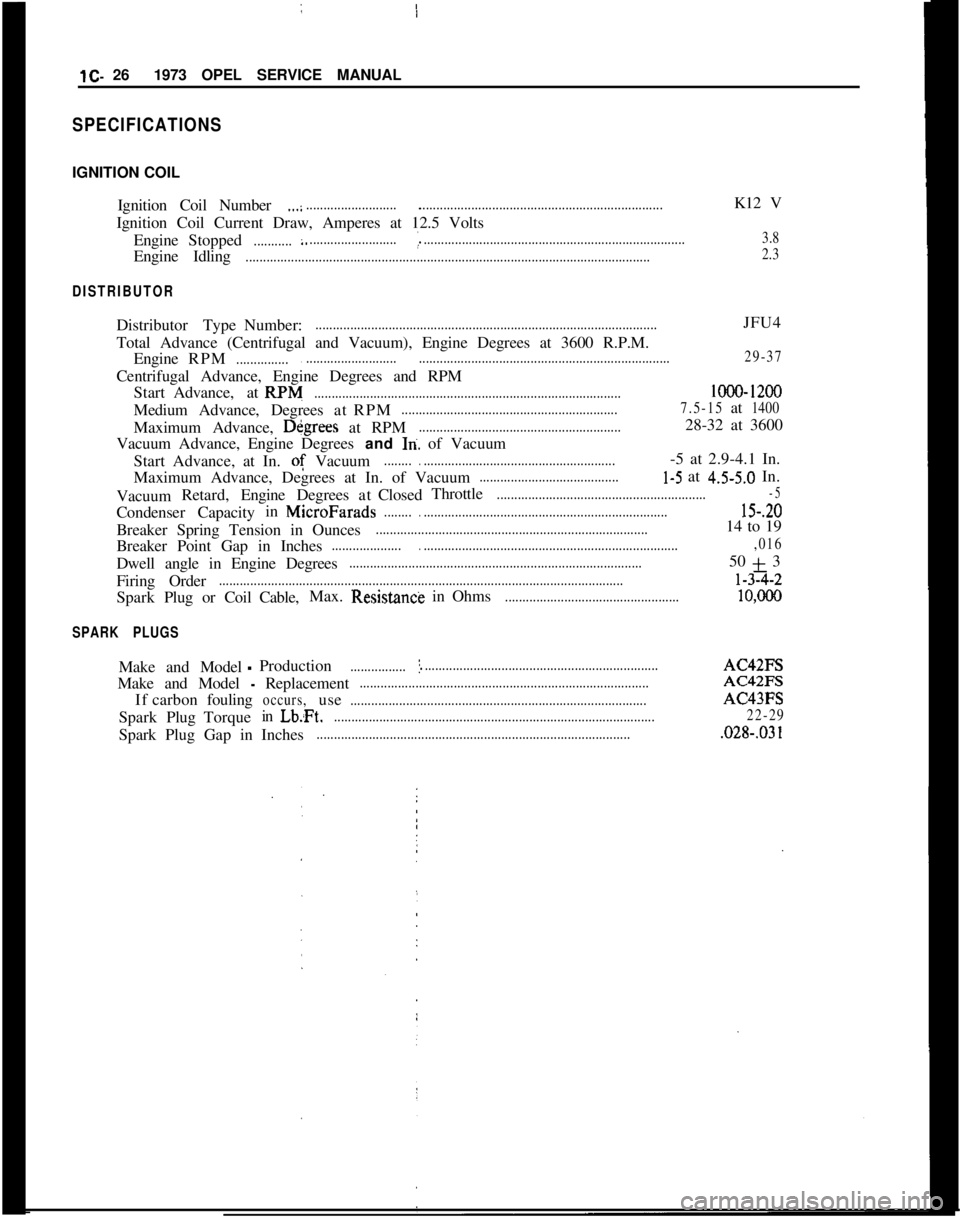
SPECIFICATIONSIGNITION COIL
Ignition Coil Number
.,.:.................................................................................................K12 V
Ignition Coil Current Draw, Amperes at 12.5 Volts
EngineStopped
...........:.........................._............................................................................3.8Engine Idling
....................................................................................................................2.3
DISTRIBUTORDistributor TypeNumber:
..................................................................................................JFU4
Total Advance (Centrifugal and Vacuum), Engine Degrees at 3600 R.P.M.
EngineRPM
..................................................................................................................29-37Centrifugal Advance, Engine Degrees and RPM
StartAdvance,atRPM
........................................................................................lOOO-1200MediumAdvance,DegreesatRPM
..............................................................7.5-15at1400Maximum Advance, Dkgrees at RPM
..........................................................28-32 at 3600
Vacuum Advance, Engine Degrees and
In. of Vacuum
Start Advance, at In. of Vacuum
................................................................-5 at 2.9-4.1 In.
Maximum Advance, Degrees at In. of Vacuum
........................................l-5 at 4.5-5.0 In.
VacuumRetard,EngineDegreesatClosedThrottle
............................................................-5CondenserCapacityinMicroFarads
...............................................................................15-.20Breaker Spring Tension in Ounces
..............................................................................14 to 19
Breaker Point Gap in Inches
..............................................................................................,016Dwell angle in Engine Degrees
....................................................................................50 + 3
Firing Order
....................................................................................................................l-32-2
SparkPlug or CoilCable,Max.Resistancti in Ohms
..................................................10,ooO
SPARK PLUGSMake and Model
-Production................I....................................................................AC42FS
Make and Model
- Replacement...................................................................................AC42FS
Ifcarbonfouling
occurs,use.....................................................................................AC43FS
SparkPlugTorqueinLb:Ft.
............................................................................................22-29Spark Plug Gap in Inches
...........................................................................................028-.03 1
Page 54 of 625

CHARGING SYSTEMlD- 33
Figure lD-17 Checking Rotor for Ground
Eigure lD-18 Checking Rotor for ShortFibwe 1 D-l 9 Checking Stator for Ground16. Check stator windings for a short, using a low
reading ohmmeter. Check two phases at a time by
holding ohmmeter prods alternately on winding
ends. Ohmmeter should read between
.26 and .29ohms. See Figure lD-20.
301 D20Figure 1 D-20 Checking Stator for Short
17. Clean slip rings with fine emery cloth and polish
them. To avoid generating flat surfaces on slip rings,
spin rotor on a lathe when cleaning and polishing.
Slip rings that are not concentric can be turned down
to a diameter of
l-1/4 inches. When doing this,
remove only enough material to just clean up the
worn surface, then polish slip rings and blow clean
with compressed air.
18. If alternator current output is low one or more
of the nine diodes may be defective. See Figure lD-3.
19. If a defective diode is suspected, test diodes.
Before testing diodes, disconnect them, otherwise it
is not possible to determine which diode is defective.
Use a test light supplied with a DC voltage of not
more than 24 volts.
20. To test a diode, place one test light prod on diode
connection and other on diode housing, then reverse
test light prods. Test light should light brightly in
,
CONNECTIONCONNECTION
I(ANODE)
(CATHODE)
IURRENTCURRENT ,I
CURREN’
FLOW+
+ HOUSING(CATHODE)HOUSING
(AN&E) 3lMD2Figure 1 D-2 1 Positive and Negative Diodes
Page 59 of 625

1 E- 381973 OPEL SERVICE MANUAL
4. Turn switch on to see if wiper niotor will function
with wiper linkage’detached. If wiper motor will ndt
run, disconnect connector at wiper motor and co?-
nect hot lead from battery to terminal No. 53 onwiper motor. If wiper motor runs, the wiper switch
is faulty or there is an break in the lead wire. If wiper
motor still will not run, remove and bench test.
MAJOR REPAIRWIPER TRANSMISSIONS
Removal (1900 and Manta)1. Remove wiper blade (2).
2. Remove the wiper transmission retaining nut,
washer, and rubber seal ring. See .Figure lE-1.
Figure lE-1 Crank Arm Retaining Nut3. Remove instrument cluster housing.
If only left wiper transmission is to be serviced, it can
be done without removing any ‘other instrument
panel components. If the right side, or both, trans-
missions are to be serviced, then
it will be necessary
for complete instrument panel removal. On the Ral-
lye models, the gauge carrier must also be remove&Qn all
1900 and Manta Models the defroster ducts
are secured to the instrument panel cover, by two (‘2)
spring clips, and should not be removed from
dayhcover. Remove cover and duct as, a unit.
4. Remove retaining clips from transmission co;-netting rod pins. Pull connecting rods off pins. See
Item “A”, Figure lE-2.
5. Remove the screws securing the wiper transmis-
sion to the inner side of the cowl (Items “B”, Figuie
13), and remove the transmission assemblies.I
Figure lE-2 Connecting Rod Retaining Clips
Installation1. Place wiper transmissions into position at cowl
and install holding screws.
2. Push connecting rods onto transmission cranking
arm pins and install retaining clips. See Figure lE-2,
Item “A”.
3. Reinstall dash and instrument cluster parts.
4.
1nst:all the rubber seal ring, washer, and transmis-
sion retaining nut. See Figure IE-1.
5. Install wiper blades and check the position of the
blades in the park position. See Figure lE-3.
Figure lE-3 Wiper Blades in Park Position
Removal and Installation of GT W/per Transmission1. Remove nuts and remove both wiper
arms. See
Figure lE-4.
2. Remove three (3) bolts from each windshield
Page 87 of 625

ll- 66 1973 OPEL SERVICE MANUALi
ConditionPossible CauseCorrection
Gas gauge does not read
full when tank tilled1. Tank unit misadjusted1. Install 40 ohm resistor
between connector and ground
I
(disconnect from unit). If
dash unit reads full within
one pointer width. Remove
/
Igas tank unit from tank, install
connector, ground unit and
adjust tab to obtairi full reading on
dash. Reinstall tank unit.
2. Defective’ voltage
stabilizer1. See corrective action above.
Gas gauge not operating1. Corroded tank unit
terminal I1. Check tank unit terminal, if
corroded clean, pack connector
with grease and reinstall
connector..
2. Loose dash gauge
!
1. Install 40 ohm resistor between
sending unit connector. and
ground (disconnect from tank
terminal). If dashgauge does
not read rull, check dash gauge
attaching nuts for secureness
and tighten if required.
(Requires removal of dash panel)
Momentarily touch dash gauge
attaching studs to 12 volt
source. If indicator moves,
reinstall panel; if not, replace
gauge. (Caution do not keep
studs connected to 12 volt
source for more than a few
seconds
- damage to gauge can
result)
3. Open
w&g1. Remove connector from sending
unit and ground (40 ohm
resistor may be used if
ohmmeter available. Remove
multiple connector from rear
of dash. Connect test light
to ground and touch other end
to connector socket with blue
and black wire, if it does not
light (40 ohm reading of ohm
meter used) repair open circuit.
4. Defective gas tank
sending unit1. Install 40 ohm resistor between
temperature sending unit and
ground (disconnect from unit)
if dash unit reads full scale.
Replace tank unit (check for
terminal corrosion before
replacing).
Page 88 of 625

I
GAUGES1 I- 67I
I Condition
Car
&s out of gas with
gauge indicating fuel in
tank. 1
I
I
I
I
IPossible Cause
1. Tank unit misadjusted
2. Defective voltage
stabilizer.Correction
1. Follow corrective action as
stated above (obtain empty
reading on dash)
1. See corrective action above.
Temperature gauge not1. Loose dash gauge1. See corrective action above.
Iattaching nut.
I
I
I2. Defective temperature1. Install 40 ohm resistor
Isending unitbetween temperature sneding
Iunit and ground (disconnect
I
from unit). If dash unit reads
I
full scale, replace temperature
Isending unit.
I
I
I3. Open wiring.1. Follow corrective action as
Istated above (connector socket
Iwith blue wire).Tempkrature gauge indicates
hot when engine temperature1. Incorrect temperature1. Check for correct sending unit
sending unit
normal.(white porcelain) replace if
incorrect.
2. i>efective temperaturesending unit.1. See corrective action above.
3. Dkfective voltage
stabilizer.
1. See Corrective action above.
GAS
GdUGE TROUBLE DIAGNOSIS - GT4. Disconnect the tank unit lead wire (light blue with
black tracer) from the tank unit.
An inoperative gas gauge reading can normally be
found to result from a poor grounding condition
within the circuit. Using the procedure as outlined
below may lead to the correction of the inoperative
reading without replacement of either the tank unit
or the
dph unit.5. Connect ihe stock tank unit; ground unit, and
operate manually.
6. If the dash unit shows a correct reading, then
replacement of the tank unit is required as the cor-
rection.
1. Makelcertain the gas tank (ground) strap is prop-
erly secured.A correct reading will be one which resembles the
movement of the manually-operated tank unit.
2. Make’certain the ground wire (brown in color) for
gasoline/ and temperature gauges is properly con-
nected tb the windshield wiper motor and is secured.
(This
gl?ound wire is also common for the heater
blower
etor.)7. If the dash unit does not show a correct reading,
then its replacement is necessary.
If the adove procedure does not produce a satisfac-
tory gaube reading, an attempt to isolate the defec-
tive
par<, i.e. tank or dash unit should be made.
3. Rem&e a tank unit from parts stock.MAJOR
AEPAIR
OPEL 1900. MANTA
Removing Voltage Stabilizer1. Remove instrument cluster housing assembly.
Page 131 of 625

28. B1973 OPEL SERVICE MANUAL
A
B
C
D
E
F
G
H
I
J
K-L
M
N
1 O-9/ 16”
14-9116”
71.7116”90-l/2”
S-3/16”
1 l-S/V
21-9/l 6”
30”
24-314”30-9/l 6”38-l/2”36-3/V
17-5116”Figure
28-3 Opel 1900 Manta Frame Details
1900
- MANTA 1900 - MANTA FRAME MEASUREMENTS
Mating surface of frame rail to horizontal line from center of front crossmember
to frame support bolt hole.
Centerline of front crossmember attaching bolt hole to centerline of front
crossmember to frame support bolt hole.
Centerline of front crossmember attaching bolt hole to center of lower control
arm to frame bolt hole.
Centerline of front crossmember attaching bolt hole to center of rear spring seat.
Rear spring seat to datum line.
Center of spring seat to center of track rod to body attaching bolt hole.
Centerline of front crossmember right attaching bolt hole to centerline of front
crossmember left attaching bolt hole.
Centerline of right front frame bolt hole to centerline of left front crossmember
to frame support bolt hole (inboard side of frame rail).
Distance between frame rails at front crossmember to frame support bolt holes.
Centerline to centerline of torque tube support to frame bolt holes.
Center qf spring seat to center of torque tube support to frame bolt hole
(inboard side of frame).
Centerline of right spring seat to centerline of left spring seat.
Centerline of car to centerline of track rod to body attaching bolt.
Page 138 of 625

dOORS2D-15
3. Unhook con&cting rod out of old support and
hook into new support and door lock.
the water deflector foil is inserted in lower door slot.See Figure
2D-6. Reverse procedure for installation.2D-i-
Figure
2D-7 Removing Support
4. Screw support onto door inner panel so that it canbe shifted in both holes. Adjust remote control so
that the connecting rod has a clearance at the door
lock of
.02 inch (0.5 mm).
5. Tighten support to door inner panel.
b. Install door trim pad
REMOVAL AND INSTALLATION OF FRONT
DOOR
BELT REVEAL MOLDING
1. Bend up ends of molding.2. With a wooden wedge, pry off molding towards
the top. See Figure
2D-8.Figure
2D-6 Installing Water Deflector
REMOVAL AND INSTALLATION OF FRONT
DOOR
INSIDEHANDLE WITH SUPPORT
1. Remove door trim pad.
2. Unscrew support and unhook connecting rod out
of door lock. See Figure
2D-7.Figure
2D-6 Removing Molding
3. Check retaining clamps in outer door panel for
proper position and tight seat. Push new molding
onto retaining clamps and bend both ends inwards.
REMOVAL AND INSTALLATION OF FRONT
DOOR
WINDOW LIFTER
Removal1. Remove door trim pad.