rod OPEL 1900 1973 Owner's Manual
[x] Cancel search | Manufacturer: OPEL, Model Year: 1973, Model line: 1900, Model: OPEL 1900 1973Pages: 625, PDF Size: 17.22 MB
Page 144 of 625
DOORSZD- 21
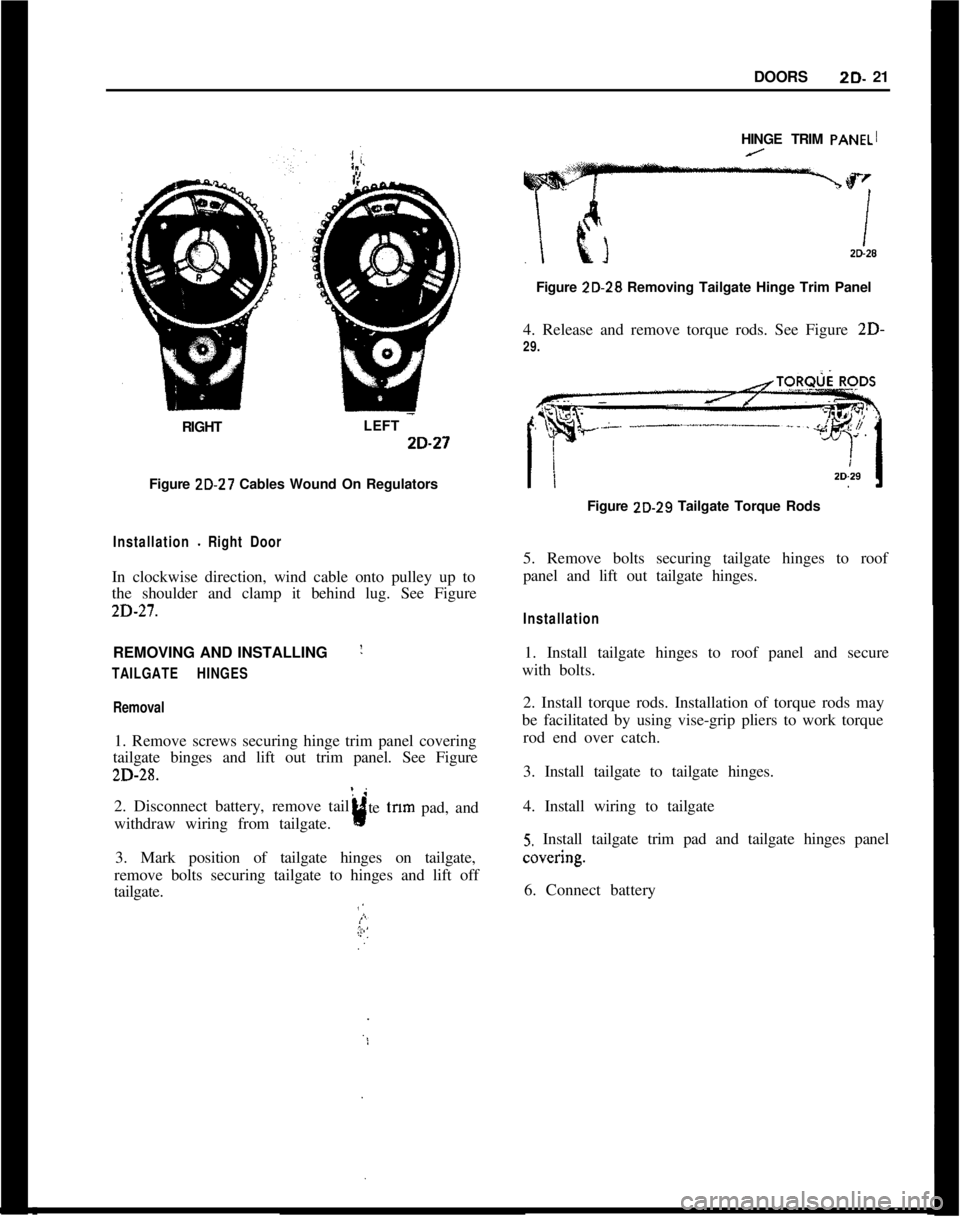
RIGHTLEFT ~-ZD-27
Figure ZD-27 Cables Wound On Regulators
Installation - Right DoorIn clockwise direction, wind cable onto pulley up to
the shoulder and clamp it behind lug. See Figure2D-27.
REMOVING AND INSTALLING
’
TAILGATE HINGES
Removal1. Remove screws securing hinge trim panel covering
tailgate binges and lift out trim panel. See Figure
2D-28.2. Disconnect battery, remove tail
te trun pad, and
withdraw wiring from tailgate.
u3. Mark position of tailgate hinges on tailgate,
remove bolts securing tailgate to hinges and lift off
tailgate.
,’HINGE TRIM
PANEL1IFigure ZD-28 Removing Tailgate Hinge Trim Panel
4. Release and remove torque rods. See Figure 2D-
29.Figure ZD-29 Tailgate Torque Rods
5. Remove bolts securing tailgate hinges to roof
panel and lift out tailgate hinges.
Installation1. Install tailgate hinges to roof panel and secure
with bolts.
2. Install torque rods. Installation of torque rods may
be facilitated by using vise-grip pliers to work torque
rod end over catch.
3. Install tailgate to tailgate hinges.
4. Install wiring to tailgate
5. Install tailgate trim pad and tailgate hinges panel
COVehg.6. Connect battery
Page 146 of 625
REAR COMPARTMENT LID2E- 23
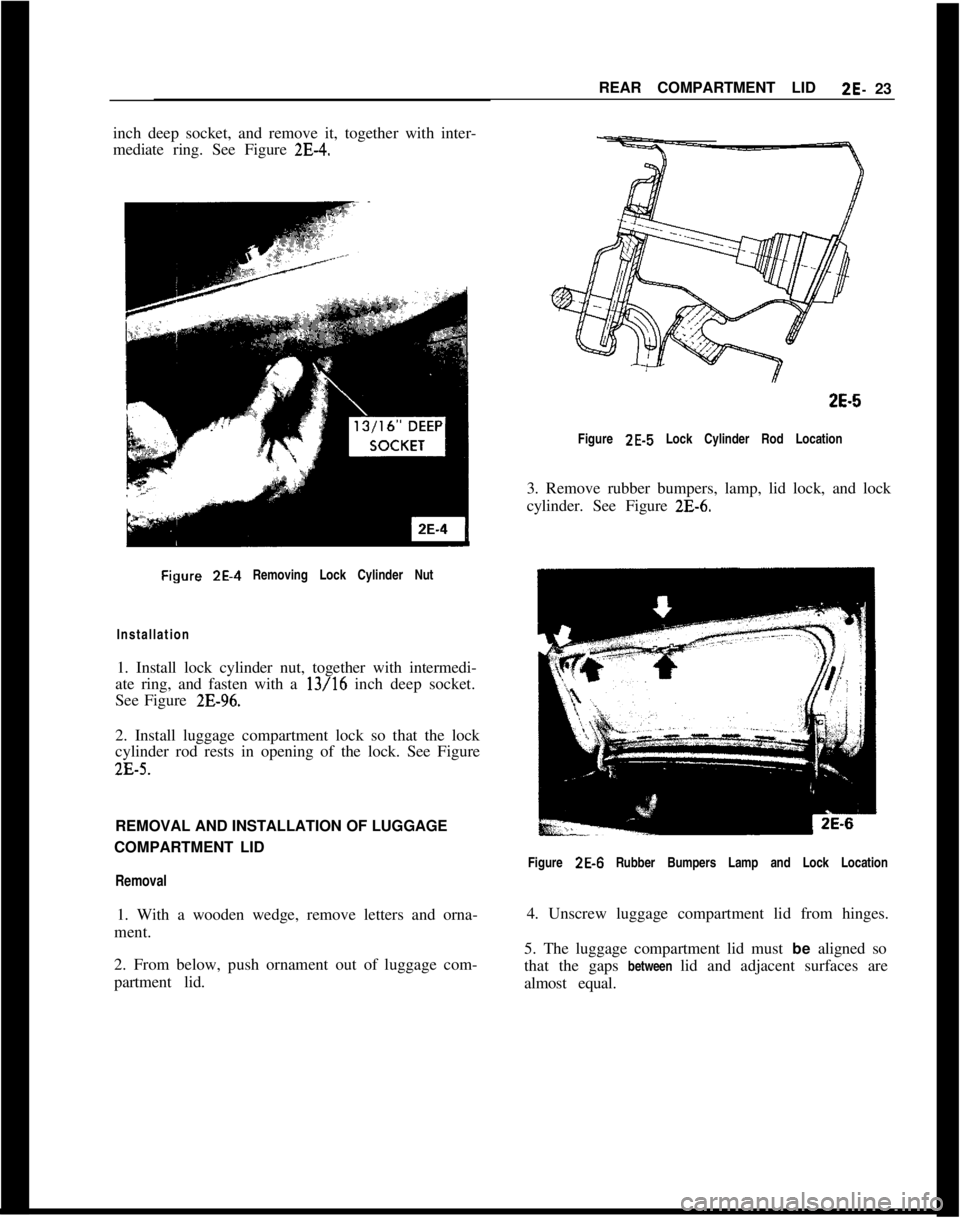
inch deep socket, and remove it, together with inter-
mediate ring. See Figure 2E-4.Fiyure
ZE-4 Removing Lock Cylinder Nut
Installation
1. Install lock cylinder nut, together with intermedi-
ate ring, and fasten with a 13/16 inch deep socket.
See Figure 2B96.
2. Install luggage compartment lock so that the lock
cylinder rod rests in opening of the lock. See Figure
2E-5.REMOVAL AND INSTALLATION OF LUGGAGE
COMPARTMENT LID
Removal1. With a wooden wedge, remove letters and orna-
ment.
2. From below, push ornament out of luggage com-
partment lid.2E-5
Figure
ZE-5 Lock Cylinder Rod Location
3. Remove rubber bumpers, lamp, lid lock, and lock
cylinder. See Figure
2E-6.Figure
2E-6 Rubber Bumpers Lamp and Lock Location
4. Unscrew luggage compartment lid from hinges.
5. The luggage compartment lid must be aligned so
that the gaps between lid and adjacent surfaces are
almost equal.
Page 177 of 625
3A- 101973 OPEL SERVICE MANUAL
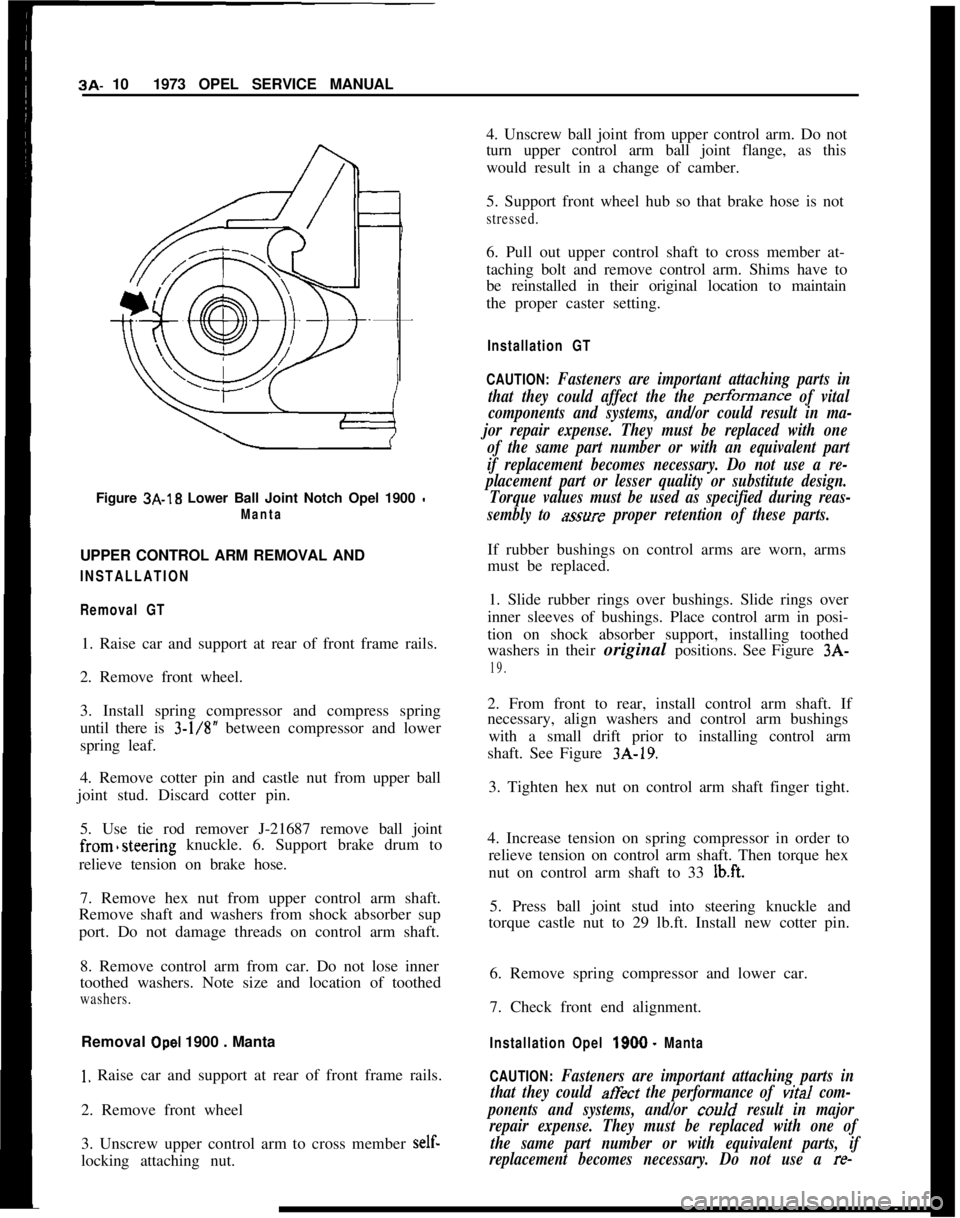
Figure 3A-18 Lower Ball Joint Notch Opel 1900 -
MantaUPPER CONTROL ARM REMOVAL AND
INSTALLATION
Removal GT1. Raise car and support at rear of front frame rails.
2. Remove front wheel.
3. Install spring compressor and compress spring
until there is 3-l/8” between compressor and lower
spring leaf.
4. Remove cotter pin and castle nut from upper ball
joint stud. Discard cotter pin.
5. Use tie rod remover J-21687 remove ball jointfrom.steering knuckle. 6. Support brake drum to
relieve tension on brake hose.
7. Remove hex nut from upper control arm shaft.
Remove shaft and washers from shock absorber sup
port. Do not damage threads on control arm shaft.
8. Remove control arm from car. Do not lose inner
toothed washers. Note size and location of toothed
washers.Removal
Opel 1900 . Manta
1, Raise car and support at rear of front frame rails.
2. Remove front wheel
3. Unscrew upper control arm to cross member
self-locking attaching nut.4. Unscrew ball joint from upper control arm. Do not
turn upper control arm ball joint flange, as this
would result in a change of camber.
5. Support front wheel hub so that brake hose is not
stressed.6. Pull out upper control shaft to cross member at-
taching bolt and remove control arm. Shims have to
be reinstalled in their original location to maintain
the proper caster setting.
Installation GT
CAUTION:
Fasteners are important attaching parts in
that they could affect the the
perfonmmce of vital
components and systems, and/or could result in ma-
jor repair expense. They must be replaced with one
of the same part number or with an equivalent part
if replacement becomes necessary. Do not use a re-
placement part or lesser quality or substitute design.
Torque values must be used as specified during reas-
sembly to
assure proper retention of these parts.If rubber bushings on control arms are worn, arms
must be replaced.
1. Slide rubber rings over bushings. Slide rings over
inner sleeves of bushings. Place control arm in posi-
tion on shock absorber support, installing toothed
washers in their original positions. See Figure 3A-
19.2. From front to rear, install control arm shaft. If
necessary, align washers and control arm bushings
with a small drift prior to installing control arm
shaft. See Figure
3A-19.3. Tighten hex nut on control arm shaft finger tight.
4. Increase tension on spring compressor in order to
relieve tension on control arm shaft. Then torque hex
nut on control arm shaft to 33
Ib.ft.5. Press ball joint stud into steering knuckle and
torque castle nut to 29 lb.ft. Install new cotter pin.
6. Remove spring compressor and lower car.
7. Check front end alignment.
Installation Opel 1900. Manta
CAUTION:
Fasteners are important attaching parts in
that they could at?&
the performance of vital com-
ponents and systems, and/or
coo/d result in major
repair expense. They must be replaced with one of
the same part number or with equivalent parts, if
replacement becomes necessary. Do not use a
re-
Page 180 of 625
FRONT SUSPENSION3A- 13
6. Reconnect shock absorber to lower control arm
and torque to 30
Ib.ft.7. Remove spring compressor.
8. Install front wheel, and lower the car.
9. Check front end alignment.
Installation Opel 1900 Manta
CAUTION: Fasteners are important attachingparts in
that they could aff&
the-performance of vitaI com-
ponents and systems, and/or could
resu/t in major
repair expenses. They must be
repraced with one of
the same part number or with an
equivaknt part, ifreplacement becomes necessary. Do not use a re-
placement part of ksser quality or substitute design.
Torque values must be used as specified
dmitig reas-
sembIy to assure proper retention of these parts.1. Loosely attach lower control arm to front cross
member.
2. Properly seat spring between lower control arm
and cross member.
3. Raise jack and place lower control into position.
4. Attach lower control ball joint to steering knuckle
and torque nut to 54
Ib.ft.5. Tighten lower control arm to cross member bolt
to 43
lb.ft.6. Attach stabilizer bar to lower control arm and
torque to 87
lb.ft.7. Attach stabilizer bar to cross member to body
support.
8. Install shock absorber and torque lower attaching
nut and bolt to 30
lb.ft.9. Install nuts on upper shock absorber attaching
studs. Tighten nuts until a distance from top of nut
to stud is approximately
l/2 inch.
10. Install front wheels and tighten nuts to 65
lb.ft.11. Remove stands and lower car.
STEERING KNUCKLE REMOVAL AND
INSTALLATION
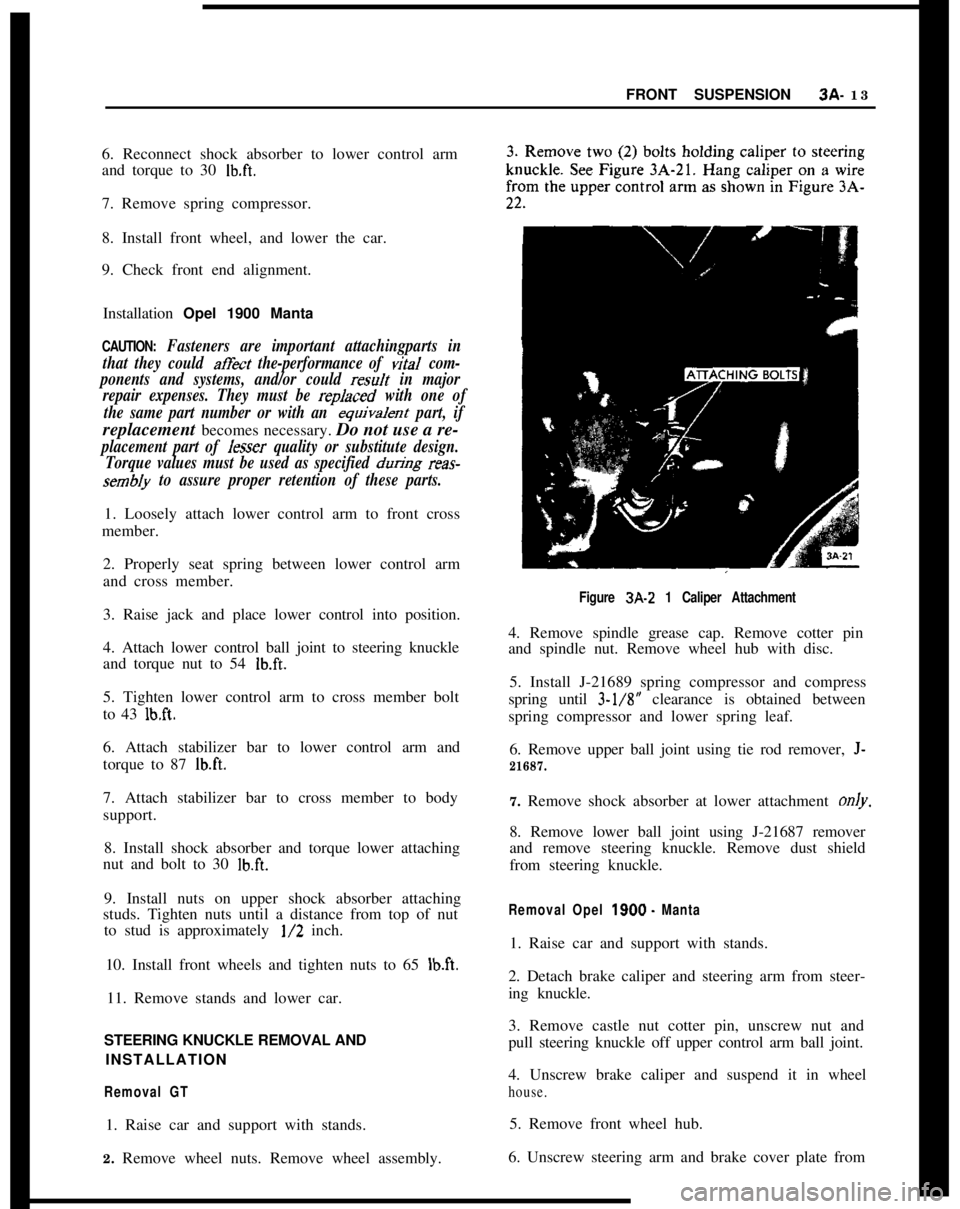
Removal GT1. Raise car and support with stands.
2. Remove wheel nuts. Remove wheel assembly.
Figure 3A-2 1 Caliper Attachment4. Remove spindle grease cap. Remove cotter pin
and spindle nut. Remove wheel hub with disc.
5. Install J-21689 spring compressor and compress
spring until 3-l/8” clearance is obtained between
spring compressor and lower spring leaf.
6. Remove upper ball joint using tie rod remover,
J-
21687.7. Remove shock absorber at lower attachment only.
8. Remove lower ball joint using J-21687 remover
and remove steering knuckle. Remove dust shield
from steering knuckle.
Removal Opel 1900. Manta1. Raise car and support with stands.
2. Detach brake caliper and steering arm from steer-
ing knuckle.
3. Remove castle nut cotter pin, unscrew nut and
pull steering knuckle off upper control arm ball joint.
4. Unscrew brake caliper and suspend it in wheel
house.5. Remove front wheel hub.
6. Unscrew steering arm and brake cover plate from
Page 181 of 625
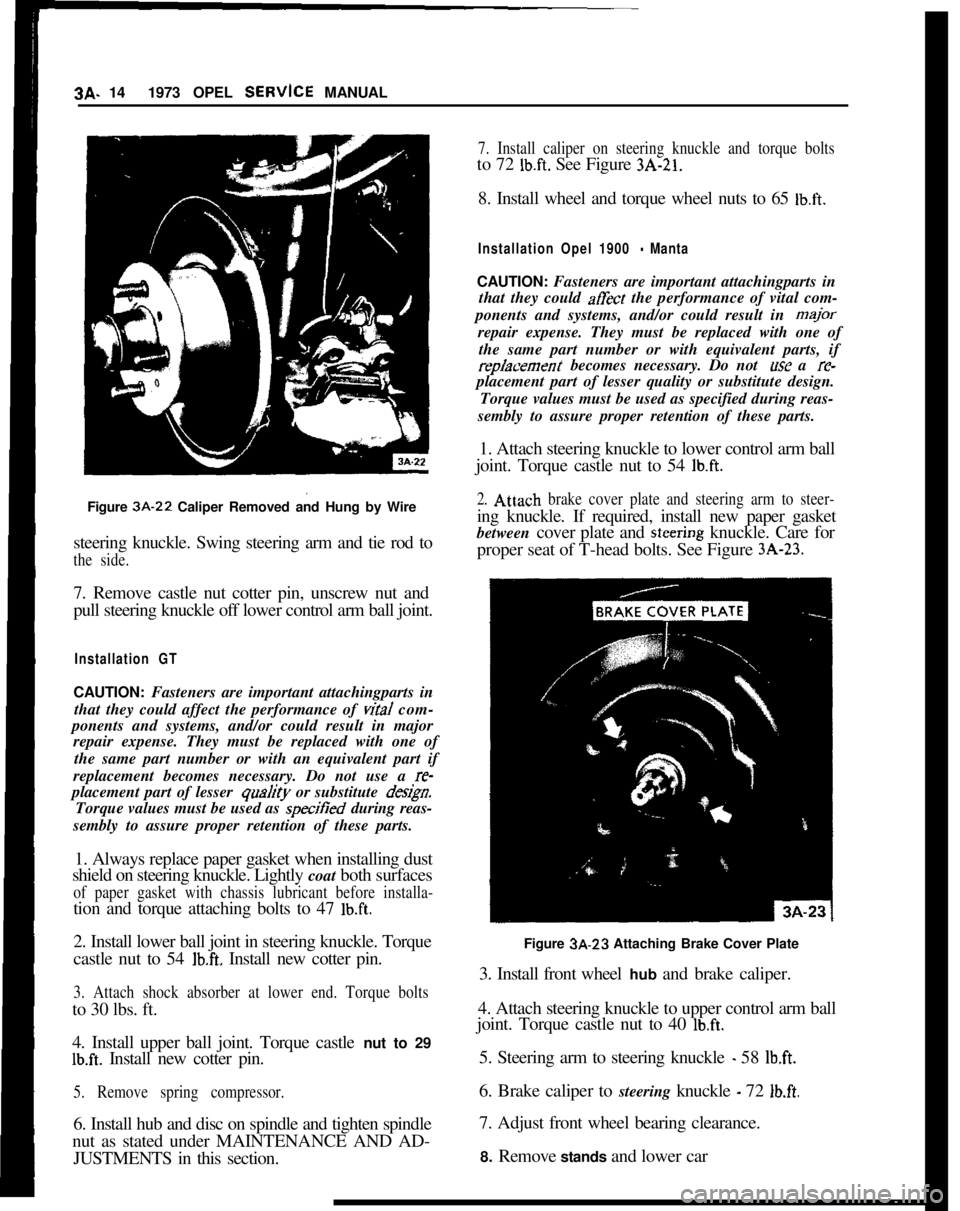
3A. 141973 OPEL SERVkE MANUAL
Figure 3A-22 Caliper Removed and Hung by Wire
steering knuckle. Swing steering arm and tie rod to
the side.7. Remove castle nut cotter pin, unscrew nut and
pull steering knuckle off lower control arm ball joint.
Installation GTCAUTION: Fasteners are important attachingparts in
that they could affect the performance of
viral com-
ponents and systems, and/or could result in major
repair expense. They must be replaced with one of
the same part number or with an equivalent part if
replacement becomes necessary. Do not use a re-
placement part of lesser quality or substitute
desig.Torque values must be used as specified during reas-
sembly to assure proper retention of these parts.
1. Always replace paper gasket when installing dust
shield on steering knuckle. Lightly coat both surfaces
of paper gasket with chassis lubricant before installa-tion and torque attaching bolts to 47
lb.ft.2. Install lower ball joint in steering knuckle. Torque
castle nut to 54
Ib.ft. Install new cotter pin.
3. Attach shock absorber at lower end. Torque boltsto 30 lbs. ft.
4. Install upper ball joint. Torque castle nut to 29
lb.ft. Install new cotter pin.
5. Remove spring compressor.6. Install hub and disc on spindle and tighten spindle
nut as stated under MAINTENANCE AND AD-
JUSTMENTS in this section.
7. Install caliper on steering knuckle and torque boltsto 72
lb.ft. See Figure 3A-21.8. Install wheel and torque wheel nuts to 65
lb.ft.
Installation Opel 1900
- MantaCAUTION: Fasteners are important attachingparts in
that they could
affit the performance of vital com-
ponents and systems, and/or could result in
ma&repair expense. They must be replaced with one of
the same part number or with equivalent parts, ifrepfacement becomes necessary. Do not use a re-
placement part of lesser quality or substitute design.
Torque values must be used as specified during reas-
sembly to assure proper retention of these parts.
1. Attach steering knuckle to lower control arm ball
joint. Torque castle nut to 54
lb.ft.
2.
Atl,ach brake cover plate and steering arm to steer-ing knuckle. If required, install new paper gasket
between cover plate and steering knuckle. Care for
proper seat of T-head bolts. See Figure
3A-23.Figure 3A-23 Attaching Brake Cover Plate
3. Install front wheel hub and brake caliper.
4. Attach steering knuckle to upper control arm ball
joint. Torque castle nut to 40
lb.ft.5. Steering arm to steering knuckle
_ 58 lb.ft.6. Brake caliper to steering knuckle
- 72 lb.ft.7. Adjust front wheel bearing clearance.
8. Remove stands and lower car
Page 185 of 625

3A- 161973 OPEL SERVICE MANUAL
SPECIFICATIONS
Torque Specifications
Use a reliable torque wrench to tighten all parts listed to insure proper
tightness without straining or distorting parts. These specifications are for
clean and lightly-lubricated threads only; dry or dirty threads produce in-
creased friction which prevents accurate maasurement of tightness.
LocationFront Suspension Crossmember to Front Frame
Clamp, Steering Mast to Steering Mast Flange
(GT)
........................................................................................
Clamp, Steering Mast to Steering Mast Flange(1900
-Manta)..................................................................
Clamp,UpperUniversalJoint(GT)..................................Clamp, Lower Universal Joint (GT)
..................................
WheelNuts............................................................................Lower Control Arm Shaft to Lower Control Arm
..........Lower Control Arm Ball Joint to Steering Knuckle
......Upper Control Arm Ball Joint to Steering Knuckle
(GT)........................................................................................Upper Control Arm Ball Joint to Steering Knuckle
(1 900 Manta)
..................................................................Upper Control Arm Ball Joint to Upper Control Arm
ShockAbsorbertoLowerControlArm..........................Steering Arm to Steering Knuckle (1900
- Manta)......
Brake Backing Plate or Brake Disc Shield andSteering Arm to Steering Knuckle
(GTJ
Hex Head Bolt M 10......Hex Head Bolt M 8
......
Brake Backing Plate to Steering Knuckle(1900 Manta)
..................................................................
Brake Caliper to Steering Knuckle.................................
Lower Control Arm to Front Spring Eye (GT)................
Brake Disc to Front Wheel Hub........................................Upper Control Arm to Crossmember (1900
- MantajLower Control Arm to Crossmember (1900
- Manta)
Steering Gear Housing to Front Suspension
Crossmember (GT)
............................................................
Steering Gear Housing to Front SuspensionCrossmember (1900
- Manta)........................................Stabilizer Bar to Lower Control Arm
(Opel 1900
- Manta)........................................................Tie Rod Clamp Bolts
(GTJ....................................................
CastleNut,TieRodtoSteeringArm..............................Upper Control Arm Shaft to Shock Absorber Support
and Upper Control Arm (GT)
..........................................
CrossMember to
BodySupport Attachment................
FrontSuspensionAssemblytoFrame............................Front End Alignment Specifications
Torque
Lb.Ft.36
1522
14
22
6540
5429
ii30
5847
18
58
72
1836
40
43
1830
87
:i33
58
47ModelCaster’
Camber”1900‘3
l/2-6 l/2GT
3+1-:%+*Permissible deviation from left to right wheel
- Max. 1’.
Toe-In”Min.-Max.
l/8-3/ 16
l/32-1/8Outer Wheel
When Inner
Wheel at 20
19
l/418
l/2
Page 186 of 625

STEERING LINKAGE38.19STEERING LINKAGE
CONTENTS
Subject
DESCRIPTION AND OPERATION:
Description
andOperationofTieRods. . . . . . . . . . . . . . . . . . . . . .DIAGNOSIS: (Not Applicable)
MAINTENANCE AND ADJUSTMENTS: (Not
Applicable)
MAJOR REPAIR:
RemovalandInstallationofTieRods. . . . . . . . . . . . . . . . . . . . . . . .Disassembly
andReassemblyofTieRods. . . . . . . . . . . . . . . .SPECIFICATIONS:
Tightening Specifications ..,.............................................Page No.
38-193B-1938-21jB-21
DESCRIPTION AND OPERATION2. Using remover J-21687, pull outer tie rod ball
studs out of steering arms. See Figure
3B-2.DESCRIPTION AND OPERATION OF TIE RODS
Tie rods on the GT are connected to both rack ends
by means of a ball joint. Two rubber bellows between
ball joint and steering gear housing protect rack and
ball joints against dirt, dust and mud. The ball joints
of the tie rods do not require service.
Tie rods on the Opel l&O and Manta are connected
to both rack ends by means of a axial joint. Two
rubber bellows between the axial joint and steering
gear housing protect the rack and axial joints against
dirt, dust, and mud. The ball joint of the tie rod ends
on the Opel 1900 and Manta are maintenance free
and must not be disassembled.
MAJOR REPAIRREMOVAL AND INSTALLATION OF TIE RODS
38-2
RemovalFigure
38-2 Removing Ball Stud
In order to avoid the possibility of dirt entering the
steering gear assembly via the rack, it is recom-
mended that rods and area immediately surrounding
the gear assembly be wiped free of loose dirt prior to
removal.3. Remove clamp securing one end of rubber bellows
to tie rods and slip bellows off tie rods to expose nut
or lock plates. See Figure
3B-3.1. Remove cotter pins securing nuts on tie rod ends
and remove nuts. Discard cotter pins.4. On the GT, bend up round edges of lock plate
from tie rod ball studs and unscrew ball studs From
rack. See Figure
3B-4.
Page 187 of 625

Figure 38-3 Bellows Removed From Tie Rod GT
5. On the Opel 1900 - Manta, unscrew tie rod from
axial joint. It is important that rack be held secure
with open end wrench to prevent damage to rack
teeth.
38. 201973 OPEL SERWCE MANUAL
Figure 38.4 Removing Tie Rods. GT
Installation . GT
CAUTION:
Fasteners are important attaching parts in
that they could affect the performance of vital com-
ponents and systems, and/or
coo/d result in major
repair expense. They must be replaced with one of
the same part number or with an equivalent part if
replacement becomes necessary. Do not use a
re-
placement part or lesser
quaJity or sub.Mute design.
Torque
vaJues must be used as specified during reas-
sembJy to assure proper retention of these parts.1. Install new lock plates onto tie rod ball studs and
screw ball studs into rack while holding bent tab of
lock plates against flat on rack. Torque ball studs 43lb.ft. See Figure
3B-5. It is important that rack be
held secure with open end wrench to prevent damage
to rack teeth.
Figure 38-5 Bending Lock Plate Over Ball Stud
- GT
2. Bend round edges of lock plate over
flat on ball
stud
‘to lock ball stud in position.
3. Position rubber bellows and hose clamps over tie
rods and adjust clamp so that wire ends are pointing
in same direction as adjusting screw. Check that bel-
lows are not twisted and will compress and expand
properly.
4. Connect outer tie rod ball stud to steering arm,
torque castle nut to 29
lb.ft., and lock in position
with new cotter pin.
Installation Opel 1900. Manta
CAUTION:
Fasteners are important attachingparts in
that they could ah% the performance of vital com-
ponents and systems, and/or
couJd reslllt in major
repair expense. They must be replaced with one of
the same part number or with an
equivalenr part if
repJacement becomes necessary. Do not use a re-
placement part of lesser quality or substitute design.
Torque valves must be used as specified during
reas-
sembfy to assure proper retention of these parts.1. Screw tie rod into axial joint.
2. Attach tie rod end to steering arm and torque nut
to 29 lb.ft. Install new cotter pin.
3. Adjust toe-in and then torque lock nut of both tie
rods to 47 lbft.
Page 188 of 625

STEERING LINKAGE38-21
4. Attach rubber bellows to axial joint using hoseClamp.DISASSEMBLY AND REASSEMBLY OF TIE RODS
The ball joint of the tie rod end on the Opel 1900
_Manta is maintenance free and must not be disassem-
bled.
Disassembly - GT
?. Loosen tie rod clamp bolt and unscrew outer tie
rod ball stud from tie rod. See Figure
3B-6.2. Remove retainer ring from outer ball stud of tie
rod and take off rubber sealing cap.
Reassembly GT1. Install rubber sealing cap and retainer ring onto
outer ball stud.
2. Screw outer tie rod ball stud into tie rod and
tighten clamp bolt.
CAUTION: Fasteners for tie rods are important
attaching parts in that they could affect the per-
formance of vital components and systems, and-
TIE ROD rCLAMPOUTERy BALL STUD
RETAINER RING
SEALING RINGFigure
38-6 Tie Rod and Outer Ball Stud
/or could result in major repair expense.They must
be replaced with one of the same part number or with
an equivalent part if replacement becomes necessary.
Do not use a replacement part or lesser quality or
substitute design. Torque values must be used as
specified during reassembly to assure proper reten-
tion of these parts.
SPECIFICATIONSTIGHTENING SPECIFICATIONS
Location
Ball Stud to Rack (GT)Ball Stud to Steering Arm (GT)
Tie Rod End to Steering Arm (1900 . Manta)
Tie Rod Lock Nut (1900
- Manta)
Torque
Lb.Ft.
4329
29
47
Page 191 of 625

3C-24 1973 OPEL SERVICE MANUAL
NOTE:
FRONT OF CAR
4Figure
3C-3 Upper Control Arm Shaft and Bushingsx.3
Figure
3C-4 Supporting Vehicle at Both Lower
Control Arms(B) (rear) between upper control arm and shock ab-
sorber support. See Figure
3C-5.5. One
.24” thick washer each is installed in produc-
tion on each car side. Consequently, only two adjust-
ments are possible by adding washers of different
thickness.
6. One
.12” in front and one .36” in the rear (caster
increase of 1 degree) or one
.36” in front and one. 12”
in the rear (caster decrease of 1 degree). Never addFRONT OF CAR
3G5
Figure
3C-5 Caster Adjustment Washer Location -Opel 1900 - Manta
several washers in one place. The washers B installed
in production have a larger outer diameter than the
washer A. For service, the Parts and Accessories
Department supplies only larger washers with an
outer diameter of 1.57”.
7. Insert control arm shaft from front towards the
rear into upper control arm and shock absorber
SUP-port. Observe that the crown of both plate washers
shows inwards. See Figure
3C-5.8. Torque hex nut of control arm shaft to 40 ft.lbs.
Always use new self-locking nut.
9. Torque wheel nuts to 75
ft.lbs.10. Recheck caster setting.