rod OPEL 1900 1973 Workshop Manual
[x] Cancel search | Manufacturer: OPEL, Model Year: 1973, Model line: 1900, Model: OPEL 1900 1973Pages: 625, PDF Size: 17.22 MB
Page 218 of 625
REAR SUSPENSION3F- 51
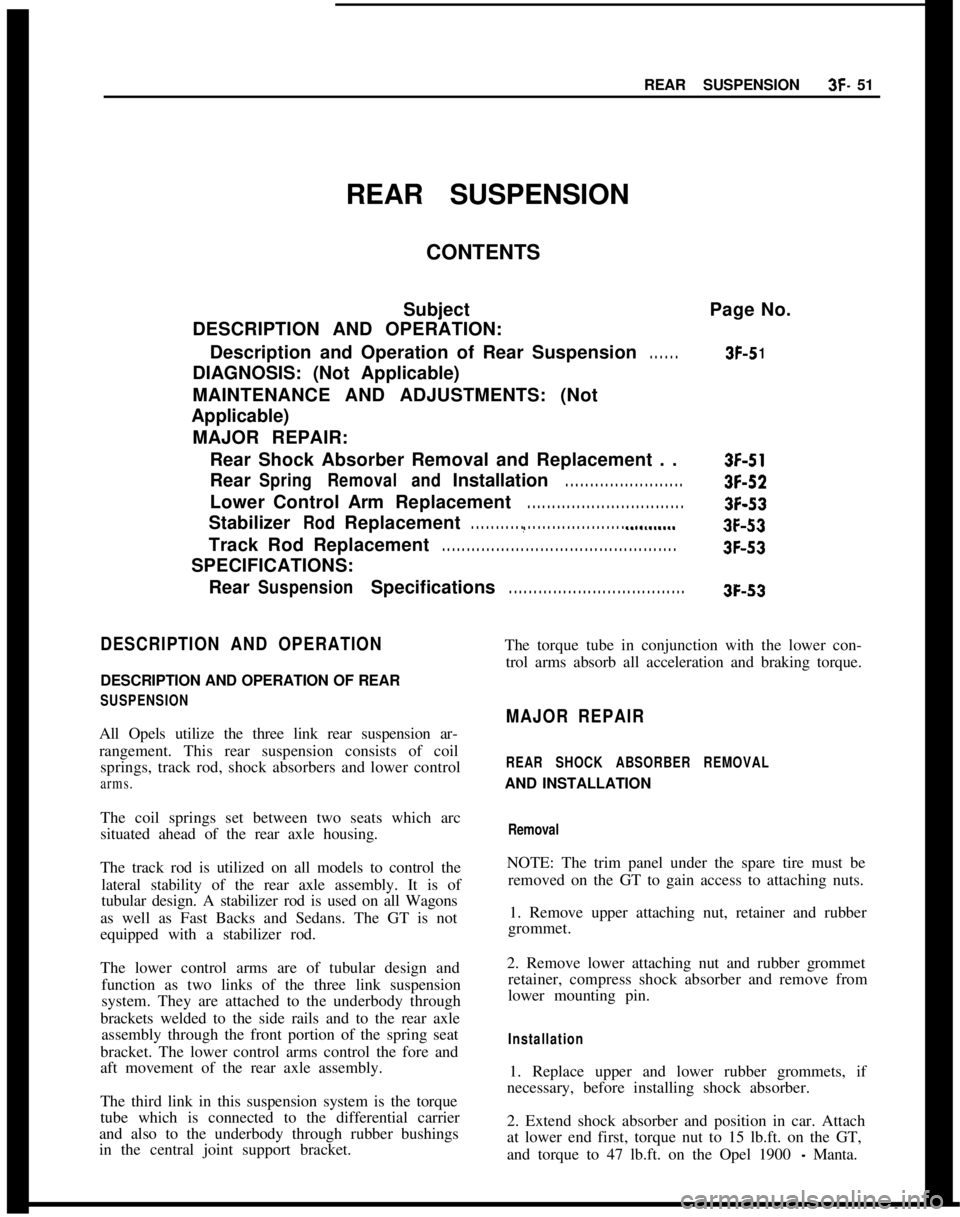
REAR SUSPENSION
CONTENTS
Subject
DESCRIPTION AND OPERATION:
Description and Operation of Rear Suspension. . . . . .DIAGNOSIS: (Not Applicable)
MAINTENANCE AND ADJUSTMENTS: (Not
Applicable)
MAJOR REPAIR:
Rear Shock Absorber Removal and Replacement . .
Rear
SpringRemovalandInstallation. . . . . . . . . . . . . . . . . . . . . . . .LowerControlArmReplacement
. . . . . . . . . . . . . . . . . . . . . . . . . . . . . . . .Stabilizer
RodReplacement. . . . . . . . . . . ~ . . . . . . . . . . . . . . . . . . . . . ..-....Track Rod Replacement
. . . . . . . . . . . . . . . . . . . . . . . . . . . . . . . . . . . . . . . . . . . . . . . .SPECIFICATIONS:
Rear
SuspensionSpecifications. . . . . . . . . . . . . . . . . . . . . . . . . . . . . . . . . . . .Page No.3F-5
13F-513F-523F-533F-533F-533F-53
DESCRIPTION AND OPERATIONDESCRIPTION AND OPERATION OF REAR
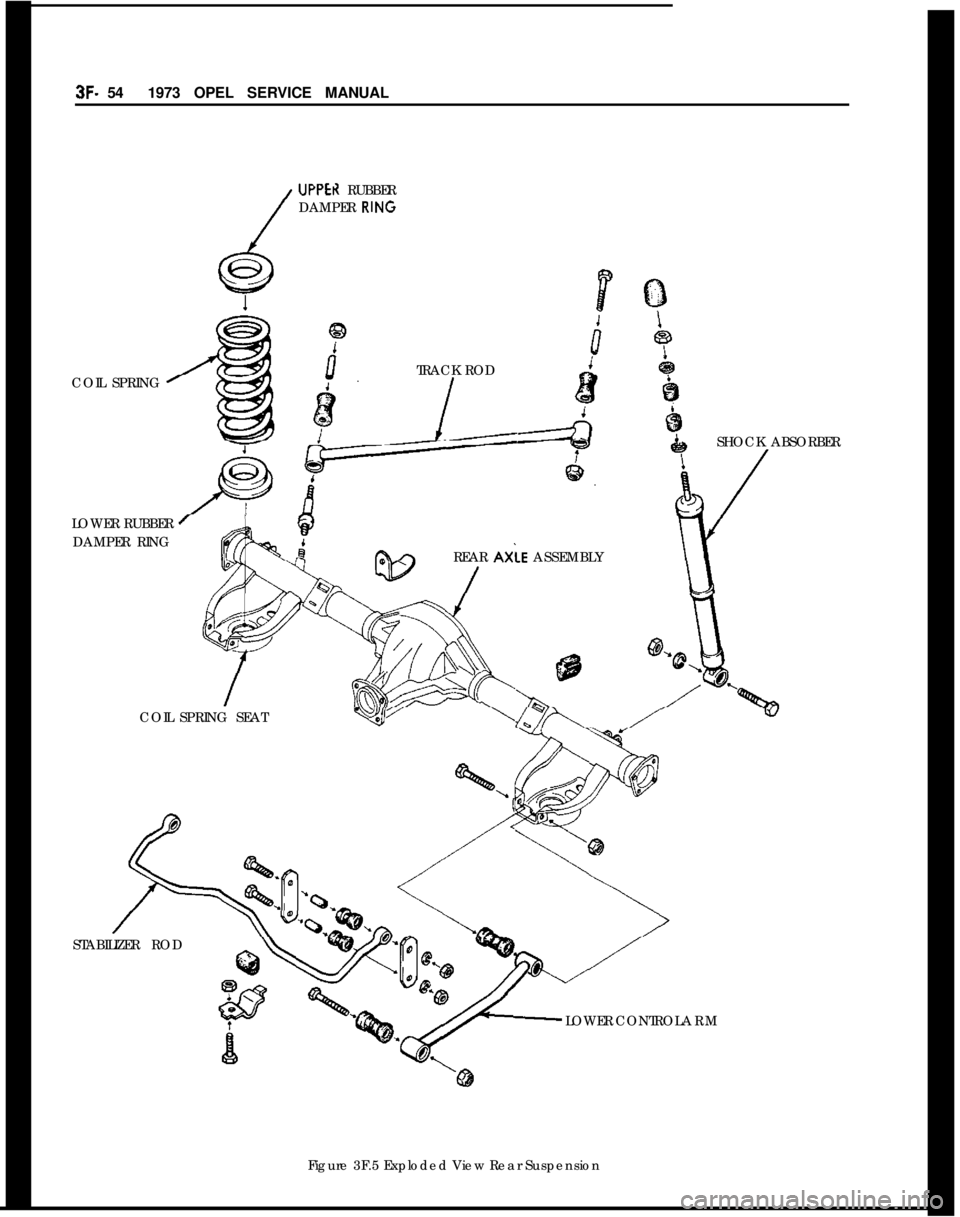
SUSPENSIONAll Opels utilize the three link rear suspension ar-
rangement. This rear suspension consists of coil
springs, track rod, shock absorbers and lower control
arms.The coil springs set between two seats which arc
situated ahead of the rear axle housing.
The track rod is utilized on all models to control the
lateral stability of the rear axle assembly. It is of
tubular design. A stabilizer rod is used on all Wagons
as well as Fast Backs and Sedans. The GT is not
equipped with a stabilizer rod.
The lower control arms are of tubular design and
function as two links of the three link suspension
system. They are attached to the underbody through
brackets welded to the side rails and to the rear axle
assembly through the front portion of the spring seat
bracket. The lower control arms control the fore and
aft movement of the rear axle assembly.
The third link in this suspension system is the torque
tube which is connected to the differential carrier
and also to the underbody through rubber bushings
in the central joint support bracket.The torque tube in conjunction with the lower con-
trol arms absorb all acceleration and braking torque.
MAJOR REPAIR
REAR SHOCK ABSORBER REMOVALAND INSTALLATION
RemovalNOTE: The trim panel under the spare tire must be
removed on the GT to gain access to attaching nuts.
1. Remove upper attaching nut, retainer and rubber
grommet.
2. Remove lower attaching nut and rubber grommet
retainer, compress shock absorber and remove from
lower mounting pin.
Installation1. Replace upper and lower rubber grommets, if
necessary, before installing shock absorber.
2. Extend shock absorber and position in car. Attach
at lower end first, torque nut to 15 lb.ft. on the GT,
and torque to 47 lb.ft. on the Opel 1900
- Manta.
Page 220 of 625

REAR SUSPENSION3F- 53
7. Remove jack stands.
LOWER CONTROL ARM REPLACEMENTRemovalThis operation can be performed with the vehicle
standing at curb height or elevated.
1. Disconnect parking brake cable from support
bracket on control arm.
2. Loosen and remove front and rear control arm
attaching bolts and remove control arm.
installation1. On
1900’s and Manta’s place a load of approxi-
mately 350 lbs. in luggage compartment or on the
GT, place a load of approximately 150
Ibs. on dri-
ver’s seat. Torque control arm attaching nut and
bolts to 18 lb.ft on
GT’s and 23 Ib.ft. on the 1900 -Manta.
2. Connect parking brake cable to support bracket on
control
ranI.
STABILIZER ROD REPLACEMENT
Removal1. Raise and support rear of vehicle.
2. Disconnect stabilizer rod to shackle bolts.
3. Disconnect stabilizer rod to underbody retainers
and work stabilizer rod out from under vehicle.
SPECIFICATIONS
REAR SUSPENSION SPECIFICATIONS
Tightening SpecificationsInstallation1. Work stabilizer rod into position and loosely at-
tach stabilizer to underbody retainers.
2. Connect stabilizer rod to shackles.
3. With the vehicle standing on its wheels or the rear
axle assembly lifted, tighten stabilizer rod to under-
body bracket bolts to 15 lb. ft.
4. Remove jack stands and lower vehicle.
TRACK ROD REPLACEMENT
Removal1. Lift rear of car and suitably support.
2. Disconnect track rod from rear axle and frame
side member.
Installation
1. Loosely connect track rod first to side member and
then to the rear axle.
2. On the
1900 - Manta, load luggage compartment
of vehicle with approximately 350 lbs. or on the GT,
place a load of approximately 150 lbs. on driver’s
seat and tighten track rod attaching bolts to specified
torque.
3. Remove supports (jack stands) and lower vehicle.
Use a reliable torque wrench. Specifications are for clean and lightly-oiled
threads.
Part
Nut
Nut
Nut
Bolt
Nut
Nut
Nut
BoltName
WheelNuts.
.._.._......._........................................................
Control Arm Attaching (GT) .._.._.,,,........,,.,,.......,,......,,,,......
Control Arm Attaching (1 900 - Manta) .,,...._...,,,,_.....,,.,...
Stabilizer Rod to Underbody Retainers ,....._.,.,,.,.....,,,....
Shock Absorber Lower Attachment (GT) . .._.....,._.._.,,,...
Shock Absorber Lower Attachment (1900 Manta) ,,.,
Shock Absorber Upper Attachment. .._.....................
Stabilizer Shackle to Axle Bracket .._._.._,...._..,,.,,.......,,,...
Torque
Lb.Ft.
65
16
23
15
1,5
47
1025
Page 221 of 625
3F- 541973 OPEL SERVICE MANUAL/UPPER RUBBER
DAMPER
RINGCOIL SPRINGTRACK ROD
LOWER RUBBER
’DAMPER RING
REAR AX;E ASSEMBLY
COIL SPRING SEAT
STABILIZER ROD
$3SHOCK ABSORBER
LOWER CONTROLARM
Figure 3F.5 Exploded View Rear Suspension
Page 222 of 625
WHEELS AND TIRES3G- 55
WHEELS AND TIRES
CONTENTS
Subject
DESCRIPTION AND OPERATION: (Not Applicable)
DIAGNOSIS:
Car
RoughnessandVibration. . . . . . . . . . . . . . . . . . . . . . . . . . . . . . . . . . . . . . . .AbnormalTireWear
. . . . . . . . . . . . . . . . . . . . . . . . . . . . . . . . . . . . . . . . . . . . . . . . . . . . . . . . . .MAINTENANCE AND ADJUSTMENTS:
Demounting and Mounting Tubeless Tires
. . . . . . . . . . . . . .Wheel
andTireBalance. . . . . . . . . . . . . . . . . . . . . . . . . . . . . . . . . . . . . . . . . . . . . . . . . .MAJOR REPAIR: (Not Applicable)
SPECIFICATIONS:
Specifications
. . . . . . . . . . . . . . . . . . . . . . . . . . . . . . . . . . . . . . . . . . . . . . . . . . . . . . . . . . . . . . . . . . . . . .Page No.
3G-55
3G-58
3G-6136-6236-62
DIAGNOSIS
CAR ROUGHNESS AND VIBRATIONinflation pressures and perform tire inspection, in-
cluding removal of any foreign material on tire tread
or wheel large enough to upset balance.
Possible Causes
To assist in the diagnosis and correction of some of
the more stubborn cases of tire vibration and rough-
ness conditions that may be encountered, the follow-
ing information is offered:Tire inflation pressure recommendations are very
important at all times and particularly so on all ride
complaints. Raising or lowering tire pressures to
“improve” mileage or traction should not be at-
tempted.
VIBRATION, or a quivering motion condition, no-
ticeable by feel through the steering column, steering
wheel, floor
p&n, or by hood and fender shake, usu-
ally originates from the front wheels and tires. Front
end vibration, when caused by unbalanced front
wheels, can be generally felt as steering wheel “nib-ble”.Next, road-test the car with the owner, if possible,
and have the owner explain the specific ride disturb-
ance.After road-testing, raise car on hoist and proceed to
isolate the offending tire/wheel assembly.
Reproducing the Disturbance
A vibration felt through the seats as a side-to-side
disturbance can usually be attributed to the rearIn an attempt to reproduce the disturbance ex-
wheels and tires.perienced in the ride, a wheel spinner can be used on
the front wheels of the car.
Both front and rear vibration can be noticed mainly
at highway speeds, usually over 60 mph.The rear wheels may be spun by placing car in
“Drive” with engine running.
ROUGHNESS, noticeable primarily at speeds be-
tween 40 and 65 mph, can be felt (and occasionally
heard), and is due to certain irregularities in the tire.
Roughness usually sets up a “trembling” feel or a
shuddering effect.When spinning rear wheels, never exceed a speedom-
eter speed of 35 mph with a standard rear axle assem-
bly, or 75 mph on one with a positive traction rear
axle. Excessive speeds may cause damage to the rear
axle assembly.
Road-Test With Owner
When a ride complaint is encountered, first checkJack up both rear wheels by placing the jack under
the differential housing. Spin one wheel and tire with
the opposite wheel held from rotating by holding the
Page 225 of 625
3G- 581873 OPEL SERVICE MANUALTire Wear IrregularitiesAn additional cause of vibrations may sometimes be
tire wear irregularities. These can also produce noise
disturbances, and can be generally corrected by
rotating the tires, Figure
3G-6. Before proceeding
further, locate and correct the cause of the irregular
tire wear. See Figure
3G-7.Use the criss-cross method of rotation of tires only
when all four tires are equally worn. In some in-
stances, it may be necessary to put the truest running
assemblies (those with the lowest tolerances) on the
front of the car.
Wheel Nut Torque end Tightening SpecificationsDuring all wheel installations, it is important to use
the correct procedures for installing wheel nuts and
torquing them uniformly and in proper sequence.
This is important in order to avoid possible distor-
tion of the brake drum or disc, and to minimize
damage to lug and nut threads and wheel stud holes.
To assure uniform tightening of wheel lug nuts, the
following procedure is recommended:
1. Install wheel lug nuts in a criss-cross pattern and
tighten just enough to seat wheel against hub. This
assures proper piloting of the wheel on its hub.
2. Tighten lug nuts uniformly to proper torque of 65
Ib.ft. using criss-cross pattern.
An impact wrench should not be used, as uniform
torque control cannot be maintained.
Summary of Diagnosis end Correction of Tire and
Wheel Vibration1. Inflate all tires to recommended pressure and
road-test car with owner to define problem.
2. Spin front tire/wheel assemblies with wheel driv-
ing equipment. Rear wheels may be spun with tires
off the ground and with one wheel held at a time. The
offending tire may cause vibration that may be felt
by touching the bumper or fender. By process of
elimination, determine offending tire/wheel assem-
bly.
3. Check for tire/wheel unbalance. Balance, if neces-
sary.4. Check each tire/wheel assembly on the car for
radial runout on the tire tread. Wheel and tire assem-
blies exceeding
.050 inches may be considered as
offending assemblies. Offending tire/wheel assemblyshould be deflated and the tire repositioned (indexed)
180 degrees from original location.
5. After repositioning, rebalance tire/wheel assembly
(static and dynamic preferred).
6. Test drive and evaluate correction.
The following procedure should be used to determine
cause of roughness or vibration with car in operation
at various speeds:
I. Jack up all wheels having jack support rear end of
car at center of rear axle housing.
2. With transmission in “Drive”, run engine at vari-
ous car speeds to note speeds at which vibration or
roughness occurs.
3. Remove rear wheels and run engine again at the
critical speeds noted in step 2. If roughness is gone,
the condition is caused by unbalanced wheel and tire
assemblies.
4. If roughness still exists with rear wheels removed,
remove rear brake drums and repeat the running
test. Elimination of the roughness indicates out of
balance brake drums.
5. If roughness still exists with brake drums
removed, run engine with transmission in “Neutral”.
Elimination of the roughness indicates that propeller
shaft is out of balance. Continued roughness indi-
cates an out-of- balance engine.
ABNORMAL TIRE WEAR
General Operating ConditionsAssuming that there is no misalignment condition to
cause abnormal wear, the life of tires depends largely
upon car operation conditions and driving habits.
Tires wear at a much faster rate in some localities
than in others because of road and operating condi-
tions. Some types of roads are much more abrasive
than others. Tire wear is also dependent upon the
number of hills and mountains which the car must
go up and down, the severity of grades, the number
of starts and stops, driging speeds, the amount of rain
and snow, and prevailing temperatures. Tire
wear
increases rapidly with speed, temperature, and loadon tire. Tires used at low speeds, in cool climates, or
with light loads will have longer life than tires used
for high-speed driving in hot climates with heavy
loads.
Driving habits have a very important hearing on tire
life. A careful driver may obtain much greater mile-
age from a set of tires than would be obtained by a
Page 227 of 625
36. 601973 OPEL SERVICE MANUAL
severe or careless driver. Rapid acceleration and de-celeration, severe application of brakes, taking turns
at excessive speed, high-speed driving, and striking
curbs or other obstructions which lead to misalign-
ment are driving habits which will shorten the life of
any tire.hiaintenance of proper inflation pressure and peri-
odic interchanging of tires to equalize wear are
within the control of the driver. Underinflation
raises the internal temperature of a tire greatly due
to the continual friction caused by the flexing of the
side walls. Tire squealing on turns is an indication of
underinflation or excessive speed on the turns. A
combination of underinflation, high road tempera-
tures, and high-speed driving will quickly ruin the
best tire made.
High speed on straight highways or expressways nor-
mally causes more rapid wear on the rear than on thefront tires, although cupping of front tires can result
if the tires are not periodically switched from wheel
to wheel. Driving turns and curves at too high a rate
of speed causes the front tires to wear much faster
than the rear tires.
An inspection of the tires, together with information
as to locality in which the car has been operated willusually indicate whether abnormal wear is due to the
operating conditions described above or to mechani-cal faults which should be corrected.
The various types of
abnormal tire wear and their
causes are described in the following paragraphs.
Shoulder or Underinflation Tread WearWhen a tire is underinflated, the side walls and
shoulders of the tread carry the load, while the centerof tread folds in or compresses due to the low inter-
nal air pressure. This action causes the shoulders to
take all of the driving and braking load, resulting in
much faster wear of shoulders than of the center of
tread. See Figure 3G-7. For maximum results in han-dling, riding and tire life, tire inflation pressures
should never be allowed to go below the specified
minimum pressure.
Continuous high-speed driving on curves, right and
left, may produce tread wear very similar to underin-flation wear and might very easily be mistaken for
such. Side thrust when rounding turns causes wear
on the sides of tire tread. In making a turn to the left,especially at high speeds, the outside shoulder of the
right tire and the inside shoulder of the left tire take
the side thrust and naturally receive the most wear.
The only possible correction is to advise slower
speeds on curves. Do not increase tire inflation pres-
sures beyond specified limits, as this will cause centeror over-inflation wear. See paragraph below.
Canter or Overinflation Tread Wear
Excessive wheel camber, either positive or negative,causes the tire to run at such an angle to the road
surface that one side of the tread wears much more
than the other. See Figure
3G-7.When tire inflation pressures are maintained within
the specified limits, the tire will make a full contact
across the entire width of tread, thereby distributing
the wear evenly over the total surface of the tread
area.
Cross or Toe Tread WearWhen the front wheels have an excessive amount of
either toe-in or toe-out, the tires are actually draggedsideways when they travel straight down the road
and cross wear or scraping action takes place rapidly
wearing away the tread of tires. This cross wear con-dition will usually produce a tapered or feathered
edge on the ribs of the tire tread. See Figure
3G-7.In most cases, this can be detected by rubbing the
hand across the tire tread.
If the tapered or feathered edges are on the inner
sides of the ribs on one of both sides, it indicates thatone or both tires have excessive toe-in, while the
same condition in the outer sides of ribs indicates
excessive toe-out. Usually, excessive toe-in causes
excessive tire wear on the outer edge of the right
front tire and toe-out causes tire wear on the inner
edge of the left front tire. See Section 3C for toe-in
correction.Cornering wear caused by high-speed driving on
curves (see following paragraph) sometimes has the
appearance of toe wear. Care must be used to distin-guish between these two types of wear so that the
proper corrective measures will be used.
Side or Camber WearExcessive wheel camber, either positive or negative,
causes the tire to run at such an angle to the road
surface that one side of the tread wears much more
than the other. See Figure
3G-7.The amount or angle of the camber wear will be
governed by the amount of positive or negative cam-ber. Tire tread wear very similar in appearance to
camber wear may be caused by driving on turns at
excessive speeds. This “cornering” tread wear (see
paragraph below) cannot be corrected by change of
camber angle.
Adjustments for specified camber are covered in Sec-
tion 3C.
Page 228 of 625
WHEELS AND TIRES3G- 61Cornering Tread WearThe modern independently-sprung automobile al-
lows the driver to negotiate turns at a high rate of
speed with a greater feeling of safety. This fact is
responsible for a comparatively new type of tread
wear that can easily be mistaken for toe or camber
wear.When a car is making a turn, the tires are supposed
to be rolling in a circle. When the turn is made at
high speed, however, centrifugal force acting on the
car causes the tires to be distorted sideways and to
slip or skid on the road surface. This produces a
diagonal cross type of wear, which in severe cases
will result in a fine or sharp edge on each rib of the
tire treads.
Cornering wear can be distinguished from toe or
camber wear by the rounding of the outside shoulder
of the tire and by the roughening of tread surface in
this section denoting severe abrasion. See Figure
3G-7.No alignment or tire pressure cahnge can be made
that will relieve cornering wear. Only the driver can
effect a cure and that is by slowing down on curves.
Heel and Toe Tread WearHeel and toe wear is a saw-tooth effect with one end
of each tread block worn more than the other.
The end which wears is the one that first grips the
road when the brakes are applied. High-speed driv-
ing and excessive “se of the brakes will cause this
type of irregular tire wear. This type of wear will
occur on any type of block tread design. See Figure3G-7.
Heel and toe wear is not so prevalent on the rear tires
because of the propelling action which creates a
counteracting force which wears the opposite end of
the tread block. These two stresses on the rear tires
wear the tread blocks in opposite directions and re-
sult in more even wear while on the front tires, the
braking stress is the only one which is effective. This
may be counteracted by interchanging tires.
A small amount of irregular wear, slightly
saw-toothed in appearance, at the outer segments of tires
is a normal condition and is due to the difference in
circumference between the center and the outer
edges of the tire tread. This saw-toothed appearance,
however, will be exaggerated by underinflation, im-
proper toe-in, or both.Cupped or Scalloped Type Tire Wear
Cupping or scalloping is associated with wear on acar driven mostly at highway speeds without recom-
mended tire rotation. Factors which promote cup-
ping include underinflation, incorrect toe-in setting
or camber setting, and steady highway speeds on
smooth, paved surfaces as opposed to gravel or
rough asphalt.
The following recommendations suggest action that
may be taken to help prevent cupping.
1. Rotate tires as recommended in Figure
3G-6.2. Frequently inspect front tires for irregular wear
due to underinflation, improper toe-in setting, or
camber setting. Regardless of the original cause of
cupped tread wear on either front tire, no alignment
or balance job, however perfect, can prevent future
excessive wear of the spots. Once a front tire acquires
flat or cupped spots, additional wear will continue at
a rapid rate. At the time of correction, however, the
cupped tire should be interchanged with a rear tire
on which the tread runs true. The cupped tire will,
to a certain degree, true itself on a rear wheel.
Although not normally the cause of cupping, the
following factors can contribute to the problem.
Looseness of parts in the suspension system, such as
worn steering knuckle ball joints, loose wheel bear-
ings, inoperative shock absorbers, and any excessive
looseness throughout the steering system all tend to
allow the front wheels to kick around and, if any of
the wheel alignment factors are incorrect, irregular
spotty tire tread wear of one type or another may
result.
Wobble or runout of a tire, either front or rear, due
to bent wheel or to tire being improperly mounted
will cause uneven wear.
MAINTENANCE AND ADJUSTMENTSDEMOUNTING AND MOUNTING
TUBELESS TIRESDue to “se of symmetrical rims, tires must be
mounted over the narrow rim shoulder i.e., over out-
side rim flange.
When demounting a tubeless tire “se care to avoid
damaging the rim-seal ridges on tire beads DO NOT
USE TIRE IRONS TO FORCE BEADS A WA Y
FROM WHEEL RIM FLANGES.
When tire is removed, inspect it carefully to deter-
mine whether loss of air was caused by puncture or
by improper
tit of beads against rim flanges. If im-
proper fit is indicated, check wheel as follows: Do
not reuse dented rims.
Page 234 of 625

PROPELLER SHAFT AND CENTRAL JOINT4A- 3MAJOR REPAIR
PROPELLER SHAFT REMOVAL AND
INSTALLATION
Removal
1. Raise rear of car and support on jack stands at rear
jack brackets.
2. Disconnect parking brake cable equalizer from
rod.3. On the Opel
1900 and Manta, unhook parking
brake cable from floor panel.
4. On the Opel 1900 and Manta, unhook exhaust
system and let it down.
5. Mark the mating parts of the U-joint and the drive
pinion extension shaft flange.
6. Loosen bolt locks and remove bolts or nuts.
7. Work propeller shaft slightly forward, lower rear
end of shaft and slide assembly rearward. Remove
thrust spring from front of propeller shaft.
S. Install plug in transmission extension housing to
prevent loss of lubricant.
installation
CAUTION:
Fasteners in the foJlowing steps are impor-
tant attaching parts in that they could affect the
performance of
vital components and systems, and-
/or could
result in major repair expense. They must
be replaced with one of the
samepart number or with
an equivalent part
ifreplacement becomes oecessary.
Do not use a replacement part of lesser quality or
substitute design. Torque values must be used as
specirid during reassembly to assure proper reten-
tion of these parts.1. Remove plug from rear of transmission.
2. Slide thrust spring onto transmission output shaft
and slide propeller shaft through the oil seal and onto
the transmission output shaft. Make certain trans-
mission rear seal is not damaged.
3. Align rear universal joint and pinion flange locat-
ing marks and secure with respective bolts and lock
plates. Torque bolts to 11
lb.ft. Bend lock plate tangs
to secure bolts or nuts.
4. Connect parking brake cable equalizer to brake
rod and adjust to specifications.
5. On the Opel 1900 and Manta connect parking
brake cable to floor panel.DISASSEMBLY AND ASSEMBLY OF THE
CENTRAL JOINT
Disassembly of Central Joint1. Raise and support rear of car under axle tubes.
2. Release brake line bracket from rear of torque
tube.3. Disconnect parking brake cable equalizer and re-
turn spring from brake rod.
4. On the Opel 1900 and Manta, unhook exhaust
system and let it down.
5. Mark universal joint and flange. Disconnect pro-
peller shaft from flange and support it out of the way.
6. Support torque tube with floor jack using mini-
mum pressure.
7. Remove the central joint bracket to underbody
attaching bolts.
8. Allow floor jack to lower the torque tube.
9. Disconnect torque tube from differential carrier by
removing the attaching bolts.
10. Install pinion flange holder J-8614 and remove
self-locking flange nut. See Figure 4A-2.
FLANGE HOLDER4A-2
Figure 4A-2 Removing Pinion Flange Nut
11. Pull pinion flange using J-8614 adapter. See Fig-
ure 4A-3.
12. Remove drive pinion extension shaft from torque
tube using a soft faced mallet. See Figure 4A- 4.
13. Removal ball bearing from cushion.
14. With torque tube placed in vise remove support
Page 236 of 625

PROPELLER SHAFT AND CENTRAL JOINT4A- 5
1. Check condition of support cushions. If new cush-
ions are installed, torque to 29 lb. ft. See Figure 4A-6.
2. Install ball bearing into rubber cushion with the
flange facing toward front of car. Pack area in front
of bearing with water resistant grease. See Figure4A-7.
GAP BETWEEN BALL BEARING
AND SHEET METAL CASING
FILLED WITH GREASE
RUBBER CUSHION
BALL BEARING
TRAL JOINT
SUPPORT
RQUE TUBEa.7
Figure 4A-7 Torque Tube Bearing Installed
3. Install support bracket onto torque tube in such a
manner that one cushion is in place, then pry the
other cushion into place with a screwdriver. Torque
attaching bolts to 15 lb. ft.
4. Install drive pinion extension shaft into torque
tube from the rear. Tap in place with soft face mallet.
5. Install flange. Tap-flange onto drive pinion exten-
sion shaft, with a soft face mallet, at least far enough
to install nut.
6. Assemble flange holder J-8614 to flange, install
new self-locking nut and torque to 87
lb.ft.7. Install torque tube assembly onto differential car-
rier using only three of the four bolts. The fourth bolt
will be used later to install the brake pipe bracket.Figure
4A-8 Installing Support Bracket on TorquelTube8. Position floor jack under torque tube and raise it
far enough to install central joint support to under-
body bolts finger tight. Remove jack.
9. Jounce rear of car so springs will assume normal
position and torque the central joint support to un-
derbody bolts to 36 lb. ft.
10. Align mating marks of universal joint and flange,
connect universal joint to flange with respective bolts
and lock plates. Torque nuts to 11 lb. ft. Bend lock .
plate tangs to retain bolts.
11. Assemble parking brake cable equalizer and re-
turn spring to brake rod and adjust to specifications.
12. Connect brake line bracket to torque tube.
13. Remove supports
f&n rear of car and lower to
the floor.
Page 238 of 625
REAR AXLE
CONTENTS
SubjectPage No.
DESCRIPTION AND OPERATION:
Rear Axle Description. . . . . . . . . . . . . . . . . . . . . . . . . . . . . . . . . . . . . . . . . . . . . . . . . . . . . .4B- 7
DIAGNOSIS:
RearAxleTroubleDiagnosis. . . . . . . . . . . . . . . . . . . . . . . . . . . . . . . . . . . . . . . . . .4B- 8
MAINTENANCE AND ADJUSTMENTS: (Not Applicale)
MAJOR REPAIR:
Removal and Installation of Rear Axle Assembly
Removal and Installation of Axle Shaft Assembly
Disassembly and Assembly of Differential
.* . . . . . . . . . . . .SPECIFICATIONS:
DifferentialSpecifications
. . . . . . . . . . . . . . . . . . . . . . . . . . . . . . . . . . . . . . . . . . . . . .4B- 94B-10
48-l 1
4B-22
DESCRIPTION AND OPERATION
REAR AXLE DESCRIPTIONThe Opel rear axle is a semi-floating type that carries
car weight through the axle shafts by way of ball
bearings which are located on the outer ends of each
axle shaft. The rear axle assembly is attached to the
under body by way of the shock absorbers, track rod,
central joint support, and lower control arms. A sta-
bilizer rod is used on all Wagons, as well as Fast
Backs and Sedans. The GT is not equipped with a
stabilizer rod. The rear springs have a progressive
spring rate which is attained by a gradual reduction
of coil thickness. The springs are arranged between
the spring seats welded onto the rear axle tubes and
the under body side members. The upper and lower
ends are seated in profiled rubber dampening rings.
The differential housing is a malleable iron casting
with tubular axle housings pressed into the sides to
form a complete assembly. An oil feed passage to the
pinion bearings and an oil return hole are provided
to allow lubricant to circulate. A removable steel
cover is bolted on the rear of the differential housing
to permit service of the differential without removing
the rear axle assembly from the vehicle. A breather
fitting is located on top of the right axle tube.Within the differential carrier, the differential case is
supported by two tapered roller side bearings. These
side bearings are preloaded by shims located between
the bearing inner races and differential case. During
installation, varying the shim thickness from side to
side also determines the ring gear to pinion backlash.
The differential case houses two side gears meshed
with two pinions. The pinions and side gears are
backed by thrust washers. The pinion gears are held
in place by a pinion shaft which is anchored in the
differential case by a lock pin.
The inner end of the axle shafts engage and extend
through the splines of the side gears with a floating
tit.
The axle shafts have an enlarged diameter from mid-
shaft to the flange end.
A ball bearing and oil seal are used on all models, and
are pressed onto the outer end of the axle shaft as an
assembly.The drive pinion is mounted in two roller bearings in
the rear axle housing. Pinion setting is established by
shims located between the differential carrier and therear’pinion bearing outer race.