oil OPEL 1900 1973 Service Manual
[x] Cancel search | Manufacturer: OPEL, Model Year: 1973, Model line: 1900, Model: OPEL 1900 1973Pages: 625, PDF Size: 17.22 MB
Page 586 of 625
REFRIGERANT COMPONENTS ALL MODELS99.77
In order to tit the piston onto the wash plate and
into the cylinder bore, the wash plate must be raised
approximately l/2 inch, the front needle thrust bear-
ing and races must be held up against the hub of thewash plate, and the service piston rings must be
squeezed together (see Figure
9B-147). Lubricate
cylinder bore, piston assembly and wash plate with
No. 525 viscosity oil to facilitate reassembly.
4. Repeat procedure in Steps 1 and 2 for installation
of No. 2 and No. 3 pistons.
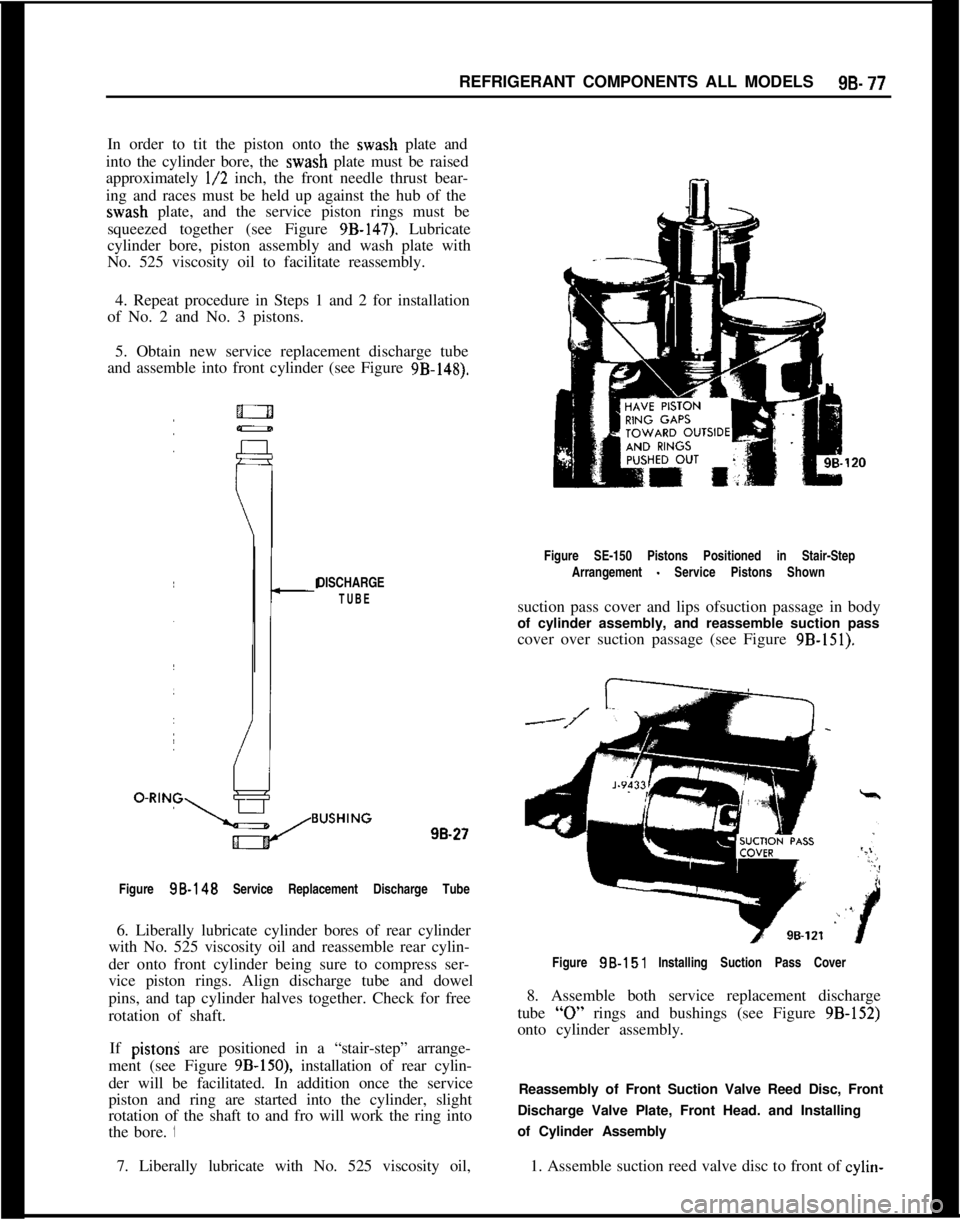
5. Obtain new service replacement discharge tube
and assemble into front cylinder (see Figure
9B-148).Figure SE-150 Pistons Positioned in Stair-Step
DISCHARGE
TUBEArrangement
- Service Pistons Shown
suction pass cover and lips ofsuction passage in body
of cylinder assembly, and reassemble suction pass
cover over suction passage (see Figure
9B-151).98.27
Figure
SB-148 Service Replacement Discharge Tube
6. Liberally lubricate cylinder bores of rear cylinder
with No. 525 viscosity oil and reassemble rear cylin-
der onto front cylinder being sure to compress ser-
vice piston rings. Align discharge tube and dowel
pins, and tap cylinder halves together. Check for free
rotation of shaft.
If pistoni are positioned in a “stair-step” arrange-
ment (see Figure
9B-150), installation of rear cylin-
der will be facilitated. In addition once the service
piston and ring are started into the cylinder, slight
rotation of the shaft to and fro will work the ring into
the bore. ‘IFigure
98.151 Installing Suction Pass Cover
8. Assemble both service replacement discharge
tube
“0” rings and bushings (see Figure 9B-152)
onto cylinder assembly.
Reassembly of Front Suction Valve Reed Disc, Front
Discharge Valve Plate, Front Head. and Installing
of Cylinder Assembly
7. Liberally lubricate with No. 525 viscosity oil,1. Assemble suction reed valve disc to front of cylin-
Page 587 of 625
98-78 1973 OPEL SERVICE MANUAL
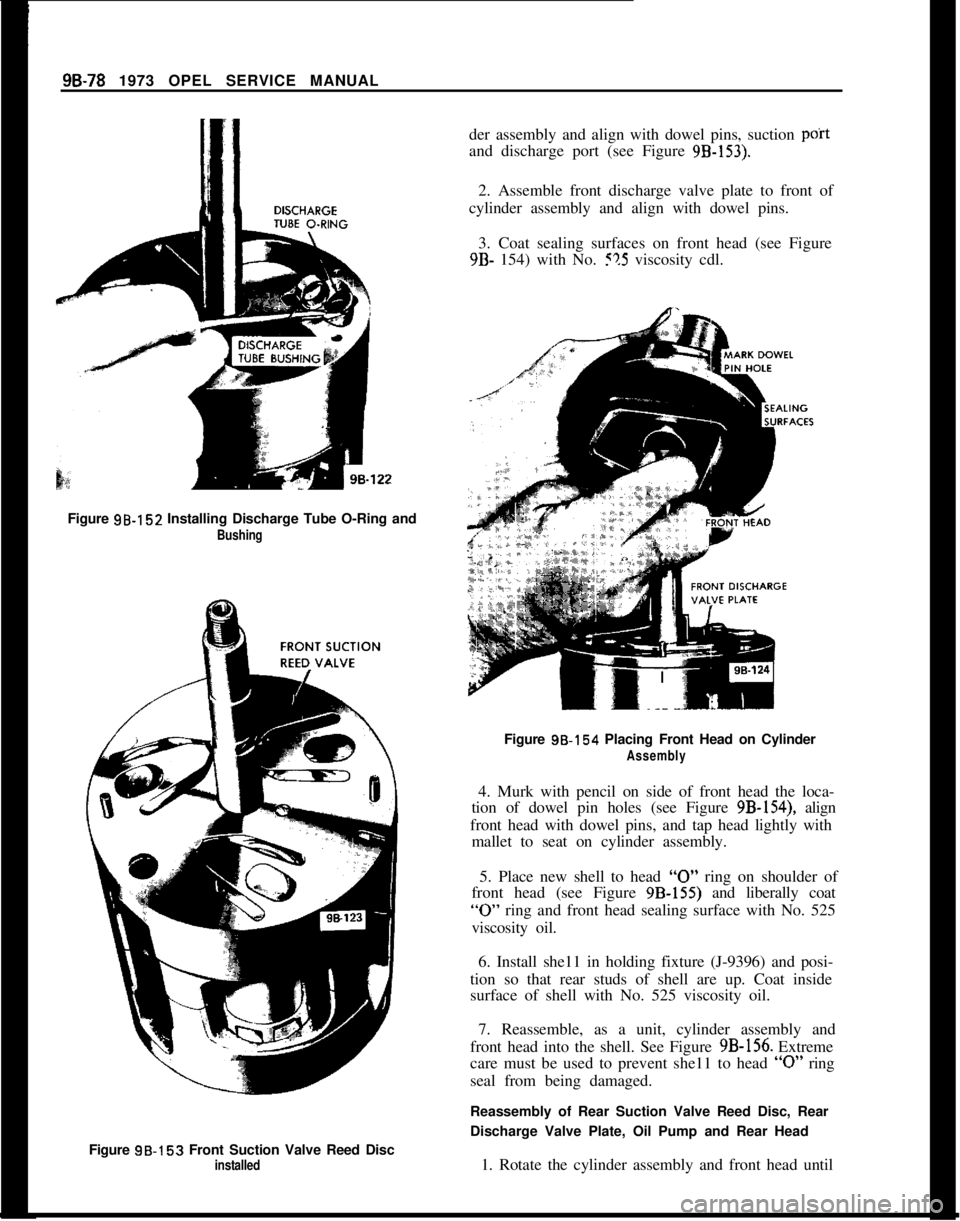
der assembly and align with dowel pins, suction poitand discharge port (see Figure
9B-153).2. Assemble front discharge valve plate to front of
cylinder assembly and align with dowel pins.
3. Coat sealing surfaces on front head (see Figure9B- 154) with No. !?5 viscosity cdl.
Figure 98.152 Installing Discharge Tube O-Ring and
BushingFigure 98.154 Placing Front Head on Cylinder
Assembly4. Murk with pencil on side of front head the loca-
tion of dowel pin holes (see Figure 9B-154), align
front head with dowel pins, and tap head lightly with
mallet to seat on cylinder assembly.
5. Place new shell to head
“0” ring on shoulder of
front head (see Figure 9B-155) and liberally coat
“0” ring and front head sealing surface with No. 525
viscosity oil.
6. Install she11 in holding fixture (J-9396) and posi-
tion so that rear studs of shell are up. Coat inside
surface of shell with No. 525 viscosity oil.
Figure 9B-153 Front Suction Valve Reed Disc
installed7. Reassemble, as a unit, cylinder assembly and
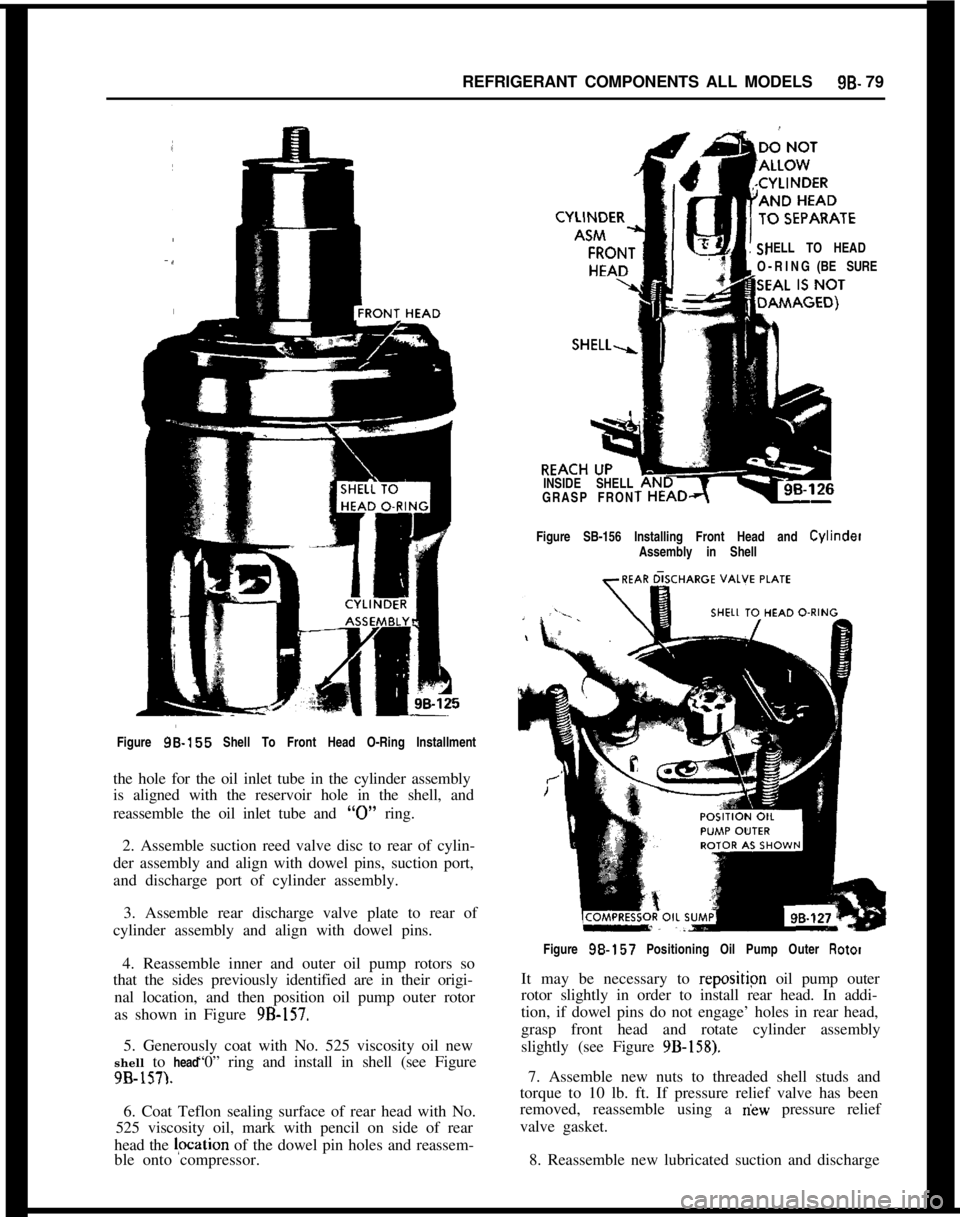
front head into the shell. See Figure 9B-156. Extreme
care must be used to prevent she11 to head
“0” ring
seal from being damaged.
Reassembly of Rear Suction Valve Reed Disc, Rear
Discharge Valve Plate, Oil Pump and Rear Head
1. Rotate the cylinder assembly and front head until
Page 588 of 625
REFRIGERANT COMPONENTS ALL MODELS9B- 79
HELL TO HEAD
O-RING(BE SURE
INSIDE SHELL
GRASP FRON
Figure SB-156 Installing Front Head and Cylinder
Assembly in Shell
Figure
96-155 Shell To Front Head O-Ring Installment
the hole for the oil inlet tube in the cylinder assembly
is aligned with the reservoir hole in the shell, and
reassemble the oil inlet tube and
“0” ring.
2. Assemble suction reed valve disc to rear of cylin-
der assembly and align with dowel pins, suction port,
and discharge port of cylinder assembly.
3. Assemble rear discharge valve plate to rear of
cylinder assembly and align with dowel pins.
4. Reassemble inner and outer oil pump rotors so
that the sides previously identified are in their origi-
nal location, and then position oil pump outer rotor
as shown in Figure
9B-157.5. Generously coat with No. 525 viscosity oil new
“0” ring and install in shell (see Figure shell to head
9B-157).6. Coat Teflon sealing surface of rear head with No.
525 viscosity oil, mark with pencil on side of rear
head the lpcation of the dowel pin holes and reassem-
ble onto compressor.Figure
98.157 Positioning Oil Pump Outer Rotor
It may be necessary to repositipn oil pump outer
rotor slightly in order to install rear head. In addi-
tion, if dowel pins do not engage’ holes in rear head,
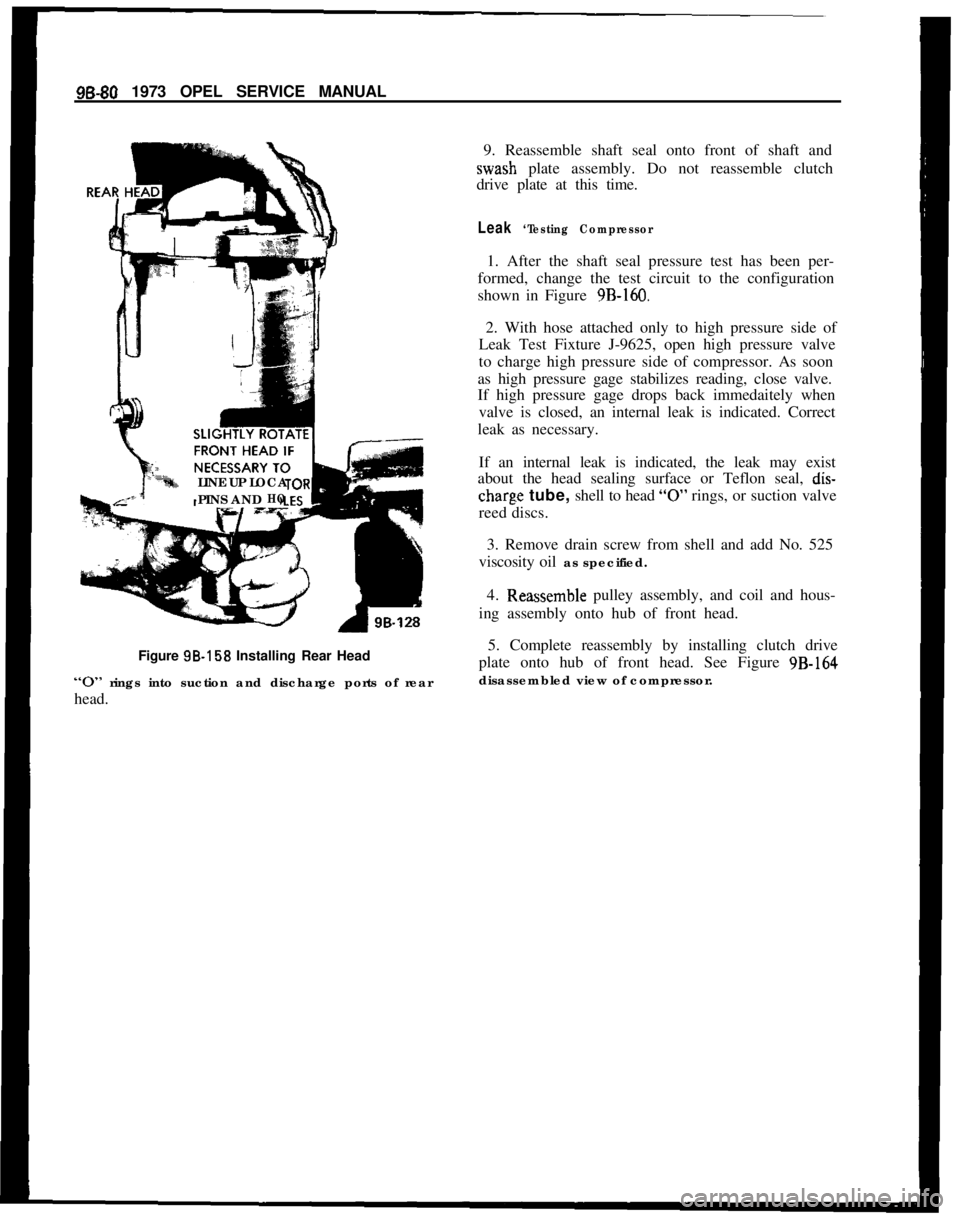
grasp front head and rotate cylinder assembly
slightly (see Figure
9B-158).7. Assemble new nuts to threaded shell studs and
torque to 10 lb. ft. If pressure relief valve has been
removed, reassemble using a
riew pressure relief
valve gasket.
8. Reassemble new lubricated suction and discharge
Page 589 of 625
96-80 1973 OPEL SERVICE MANUAL
LINE UP LOCA
PINS AND
HOFigure SB-158 Installing Rear Head
“0” rings into suction and discharge ports of rear
head.9. Reassemble shaft seal onto front of shaft andwash plate assembly. Do not reassemble clutch
drive plate at this time.
Leak ‘Testing Compressor1. After the shaft seal pressure test has been per-
formed, change the test circuit to the configuration
shown in Figure 9B-160.
2. With hose attached only to high pressure side of
Leak Test Fixture J-9625, open high pressure valve
to charge high pressure side of compressor. As soon
as high pressure gage stabilizes reading, close valve.
If high pressure gage drops back immedaitely when
valve is closed, an internal leak is indicated. Correct
leak as necessary.
If an internal leak is indicated, the leak may exist
about the head sealing surface or Teflon seal,
dis-
charg,e tube, shell to head “0” rings, or suction valve
reed discs.
3. Remove drain screw from shell and add No. 525
viscosity oil as specified.
4.
R~eassemble pulley assembly, and coil and hous-
ing assembly onto hub of front head.
5. Complete reassembly by installing clutch drive
plate onto hub of front head. See Figure 9B-164
disassembled view of compressor.
Page 591 of 625
r98-82 1973 OPEL SERVICE MANUAL
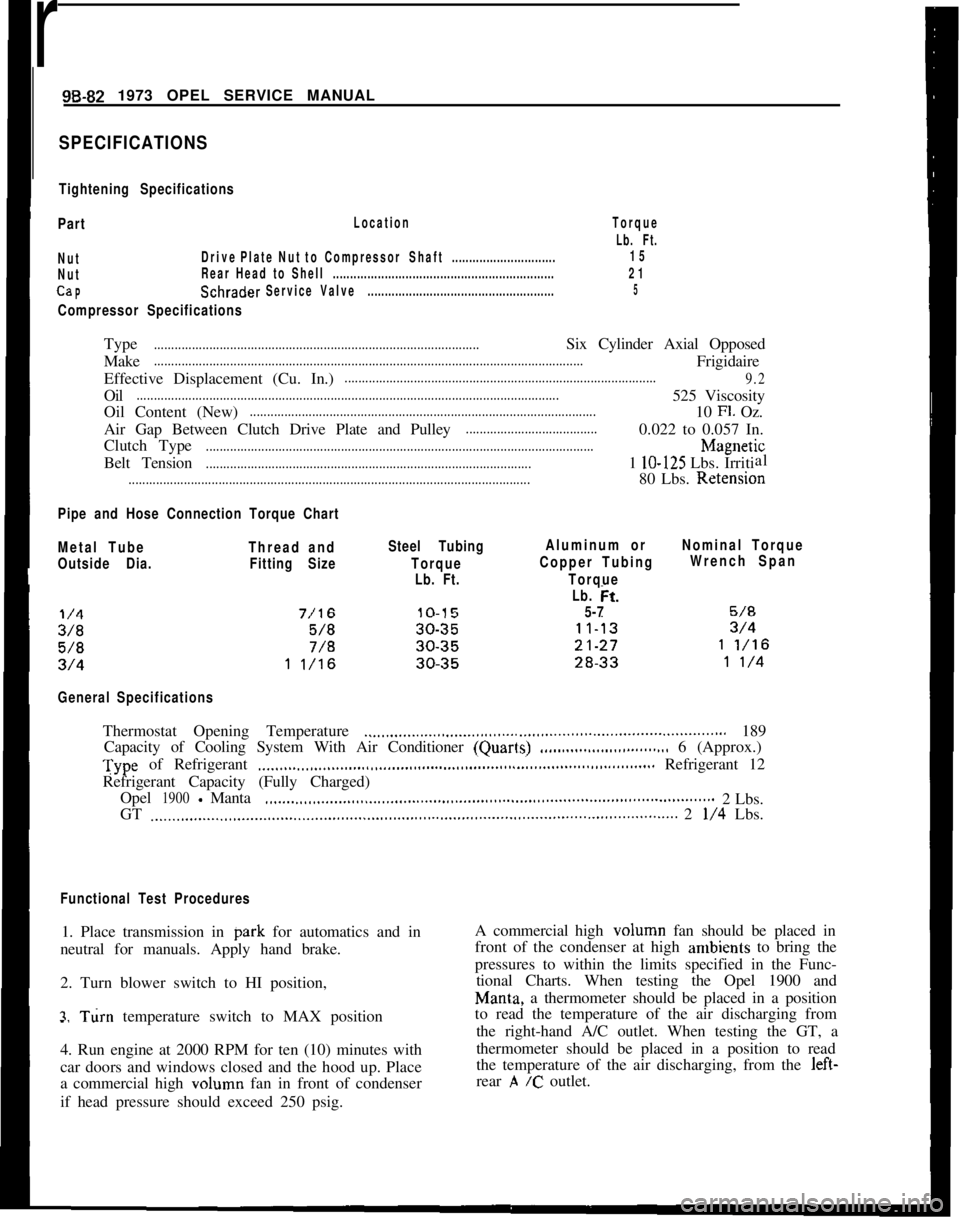
SPECIFICATIONS
Tightening Specifications
Part
Location
NutDrivePlateNut toCompressorShaft..............................
NutRear Head to Shell................................................................
CaPSchraderServiceValve......................................................
Compressor Specifications
Torque
Lb. Ft.
15
21
5Type
..............................................................................................Six Cylinder Axial Opposed
Make
............................................................................................................................Frigidaire
Effective Displacement (Cu. In.)
..........................................................................................
9.2Oil
..........................................................................................................................525 Viscosity
Oil Content (New)
....................................................................................................10 Fl. Oz.
Air Gap Between Clutch Drive Plate and Pulley
......................................0.022 to 0.057 In.
Clutch Type
................................................................................................................h4agnetic
Belt Tension
..............................................................................................1 lo-125 Lbs. Irritial
....................................................................................................................80 Lbs. Retension
Pipe and Hose Connection Torque Chart
Metal TubeThread andSteel TubingAluminum orNominal Torque
I
Outside Dia.Fitting SizeTorqueCopper TubingWrench Span
Lb. Ft.Torque
Lb. tit.
5-7
General SpecificationsThermostat Opening Temperature
.._.....,,,...__....,,.............................................................. 189
Capacity of Cooling System With Air Conditioner (Quarls)
.,,..___....___............... 6 (Approx.)Type of Refrigerant
.___,,,._...,.,,,.__.....,,,.......,,,,.......,,,...................,,,......,,,............ Refrigerant 12
Refrigerant Capacity (Fully Charged)
Opel
1900-Manta,,._....,,,,._...._.,,,,.......,,,........,,............................................................2 Lbs.
GT
,..__..,..,..__..,,,.......,,,,.......,,,........,,,.,......,,,,,......,,.,,........,,.......,,..........,,............... 2 l/4 Lbs.
Functional Test Procedures1. Place transmission in park for automatics and in
neutral for manuals. Apply hand brake.
2. Turn blower switch to HI position,
3. Turn temperature switch to MAX position-.
4. Run engine at 2000 RPM for ten (10) minutes with
car doors and windows closed and the hood up. Place
a commercial high volumn fan in front of condenser
if head pressure should exceed 250 psig.A commercial high volumn fan should be placed in
front of the condenser at high ambients to bring the
pressures to within the limits specified in the Func-
tional Charts. When testing the Opel 1900 and
Man& a thermometer should be placed in a position
to read the temperature of the air discharging from
the right-hand A/C outlet. When testing the GT, a
thermometer should be placed in a position to read
the temperature of the air discharging, from the left-
rear
,A /c outlet.
Page 594 of 625
REFRIGERANT COMPONENTS ALL MODELSSB- 85
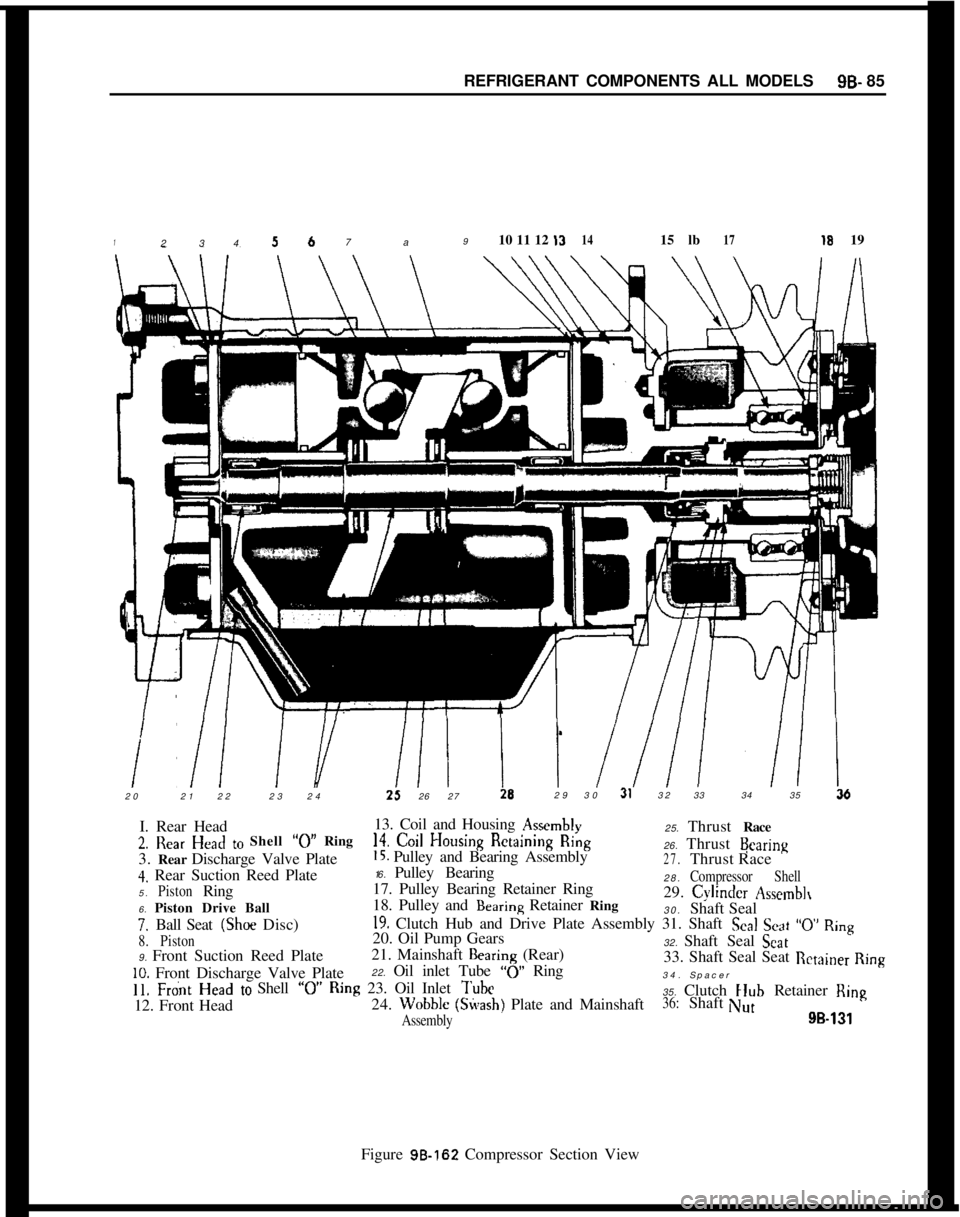
123 45 6 7a910 11 12 131415 lb1718 19
_202122232425 26 272a2930313233 34 35 3b
I. Rear Head13. Coil and Housing
Assemblv
2. Rear Head to Shell “0” Ring
3. Rear Discharge Valve Plate14. coil Housiq Retaining Ring25. Thrust Race
4. Rear Suction Reed Plate
15. Pulley and Bearing Assembly26. Thrust &zarin~27.16. Pulley BearingThrust Race
28.
5.
PistonRingCompressor Shell6. Piston Drive Ball17. Pulley Bearing Retainer Ring
18. Pulley and
Bearing Retainer Ring29. Cylinder Assembh30.Shaft Seal
7. Ball Seat (Shae Disc)
8. Piston
19. Clutch Hub and Drive Plate Assembly 31. Shaft Seal Seat “0” Rjn820. Oil Pump Gears
32. Shaft Seal sear
9. Front Suction Reed Plate
10. Front Discharge Valve Plate21. Mainshaft
Bearing (Rear)
22. Oil inlet Tube “0” Ring33. Shaft Seal Seat Rrrainer Ring
11. Fr&t Head to Shell “0” Rin8 23. Oil Inlet Tube34. Spacer
12. Front Head24. Wobble
(Skash) Plate and Mainshaft35. Clutch flub Retainer Ring36:Shaft Nut
Assembly98.131Figure 98.162 Compressor Section View
Page 597 of 625
AIR CONDITIONER SYSTEM -OPEL 1900 - MANTASB- 89
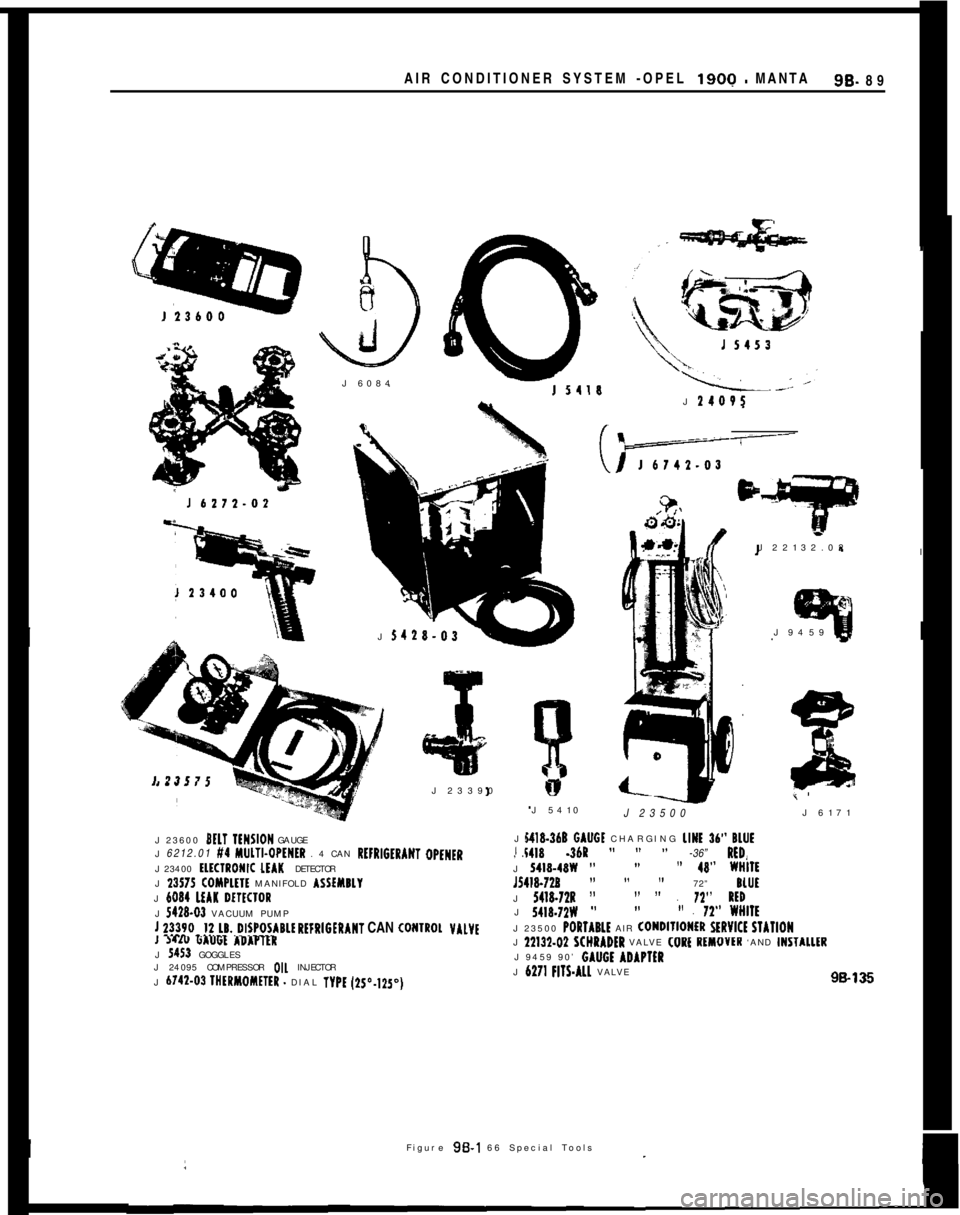
cJ 6084
J
14OVSJ
5428.03
,J 23390
J 23600 BELT IENSION GAUGE
J 6212.01 #4 MlJLTI.OPtNtR . 4 CAN RtFRIGtRANT OPENER
J 23400
tlKlRONIC LEAK DETECTOR
J 23575 COMPLHE MANIFOLD ASSfYBLY
J 6034 LEAK WtClORJ 5418-03 VACUUM PUMP
! ?!!~O~!~~~..~I~poIIRL~ REFRIGERANT CAN CONIROL VALVEI WI" 6A"Gt ADAPTEK
J 5453 GOGGLES
J 24095 COMPRESSOR OIL INJECTOR
J 6742.03 IHtRMOMETER
- DIAL TYPE (2S”.lZ5~)J 22132.02
I
J 9459
1J 5410
J 23500J 6171
141%360 GAUGt CHARGING LINE 36” BLUEi418 -36R ” ” ” -36” RED, J!I I, .J 5418.48W ””” 48” WHIIEJ5418.728
” ” ” 72” BLUI
J 5418.72s ”” I’ . 11” RtD
J 5418.7ZW ””” . 72” WWllt
J 23500 PORlARLt AIR ~ONDIlIONtR SERVlCt STAllON
J 22132.D2 SCWRADER VALVE
J 6271 FIlS.ALL VALVE98136I
IFigure 96-l 66 Special Tools
Page 614 of 625

9C-106 1973 OPEL SERVICE MANUAL
c. Adjust trimmer screw for maximum volume.
d. If antenna trimmer does not have a definite peak, check for defective antenna by substitution.
2. Check that the speaker connection is plugged in
SXUdY.
3. If the radio is still weak, remove the receiver and
speaker assembly for repair.
Radio Is Noisy
1. Radio is noisy all the time:
a. Check for defective antenna by striking antenna
with hand. If static is heard while tapping, replace
antenna.
b. If antenna is not defective, remove receiver and
speaker for repair.
2. Radio is noisy only when jarred:
a. Check antenna as in Step No. 1 above.
b. Check speaker connection. If speaker connection is not at fault, remove receiver and speaker for re-
pair.
3. Radio is noisy when engine is running:
a. Check noise suppressor by substituting on genera-
tor with known good one.
b. Check to see that antenna is mounted securely,
grounding the antenna base to the fender. The an-
tenna lead-in wire is shielded and the shield should
have good ground connection at the receiver and the
antenna base.
c. Check for other car wiring, passing too close to
radio receiver case.
d. If engine noise is still present, remove receiver and
speaker for repair.
4. Radio is noisy when car equipment is operated,
such as directional lights or brake lights:
Check for defective antenna lead-in wire or, loose
antenna mounting, as in Step No. 3b above.
MAINTENANCE AND ADJUSTMENTS
ANTENNA TRIMMER ADJUSTMENT
An antenna trimmer adjusment screw is provided for
matching of the antenna coil in the receiver to the car antenna. This adjustment must always be made after
installation of a receiver or an antenna, or after re-
pair to these units. This adjustment should also be
performed whenever radio reception is unsatisfac-
tory.
1. Position antenna to a height of 31 inches.
2. Tune receiver
tb a weak station at or near 1400
KHz that can barely be heard
with volume turned
fully up.
3. Insert a small-bladed screwdriver in antenna trim-
Figure 9C-1 Location of Access Trim Plug
Figure
9C-2 Removing Hex Head Screw
Page 618 of 625

9C-110 197j 6PEi SERVICE MANUAL
c. Adjust trimmei screw for maximum volume,
d. If antenna trir&ner does not have a definite peak,
check for defective ant&ma by substitution.
2. Check that the speaker connection is plugged in
securely.3. If the radio is still weak, remove the receiver and
speaker assembly for repair.
Radio Is Noisy1. Radio is noisy all the time:
a. Check for defective antenna by striking antenna
with hand. If static is heard while tapping, replace
antenna.
b. If antenna is not defective, remove receiver and
speaker for ripair.
2. Radio is noisy only when jarred:
a. Check antenna as in Step No. 1 above.
b. Check speaker connection. If speaker connection
is not at fault, remove receiver and speaker for re-
pair.
3. Radio is noisy when engine is running:
a. Check noise suppressor by substituting on genera-
tor with known good one.
b. Check to see that antenna is mounted securely,
grounding the antenna base to the fender. The an-
tenna lead-in wire is shielded and the shield should
have good ground corinection at the receiver and the
antenna base.
c. Check for other car wiring passing too close to
radio receiver case.
d. If engine noise is still present, remove receiver and
speaker for repair.
4. Radio is noisy when car equipment is operated,
such as directional lights or brake lights:
Check for defective antenna lead-in wire or loose
antenna mounting, as in Step No. 3b above.
5. Radio is noisy only on dry days when car is mov-
ing:
Wheel and tire static will occur only during dry
weather. To check to see if noise is wheel static or tire
static, drive car until noise is noticed. Touch the
brake. If noise disappears, it is wheel static. If noise
persists, it is tire static. Static may be eliminated in
two ways:a. Wheel static may be eliminated by installation of
static collectors in the front wheels. It is important
to make sure the button on the end of the spiral
collector rides evenly in the spindle. Grease and dirt
can cause poor contact between static collector and
the cap, which would result in wheel static, even with
the collectors installed.
b. Tire static is eliminated by injecting graphite tire
static powder in all
five (5) tires. Either a special gun
or a plastic squeeze bottle can be used to insert pow-
der.MAINTENANCE AND ADJUSTMENTS
ANTENNA TRIMMER ADJUSTMENTAn antenna trimmer adjustment screw is provided
for matching of the antenna coil in the receiver to the
car antenna. This adjustment must always be made
after installation of a receiver or an antenna, or after
repair to these units. This adjustment should also be
performed whenever radio reception is unsatisfac-
tory.1. Position antenna to a height of 31 inches.
2. Tune receiver to a weak station at or near 1400
KHz that can barely be heard with volume turned
fully up.
3. Insert a small-bladed screwdriver in antenna trim-
mer screw and rotate screw until maximum volume
is achieved.
Figure 9C-15 Radio Control Knobs
Page 622 of 625

Subject
Page NumbelSubjectPage Number4.Speed Manual I..
Clutch
Detent Cable Adjustment
:Differential
Directional Signal Switch
Repair Opel 1900 & Manta
Repair GT
:Disassembly of
4.Speed Manual Transmission
DistributorFunction of Valves and Hydraulic Control Units
Opel
3.Speed Automatic.................
74-21
Fuse Chart..............................lG-56
Fusible Link.............................
lA-8Specifications.
Point Replacement..
..,78-127A-
17c-9148-73E-393E-4878.23
1C-26
1 c-20
GEGas Tank See Fuel Tank
General Specifications
Engine...............................6A-28
Opel 3.Speed Automatic
.................7C-134
Transmission, Manual.,
..................78-33
Clutch...............................7A-7
Body................................ZA-4
Governor Drive Gear
Opel
3.Speed Automatic.................7C-103
Grille
Opel 1900 & Manta.....................8A-7
GT..................................8A-6 Electrically Heated Rear Window
Engine
General Description
Cooling System
Lubrication System
Trouble Diagnosis
Exhaust Manifold
Exhaust System
Removal and Installation
External Oil Leaks,
Opel 3 Speed Automatic
FFast Idle Adjustment
..................
Filter-Engine Oil
......................
Fluid Checking Procedure Transmission
Opel 3Speed Automatic.............
Frame-Opel 1900 & Manta.............
Frame
GT-Opel......................
SWVOOpel Xipeed Automatic...........
Front Suspension
Opel1900&Manta.................
GT..............................
Front Wheel Alignment................
Front Wheel Bearing Adjustment
All Series.........................
Fuel Gauge
Trouble Diagnosis
Opell$OO&Manta...............
GT............................
Fuel Pump Operation..................
Fuel System
Fuel Tank (Opel 1900 & Manta)
.......
Fuel Lines (Opel 1900 & Manta)
.......
Fuel Tank
(GT)....................
Fuel Gauge Tank Unit
(GT)...........
Fuel Lines
(GT)....................
Fuel Tank Removal and Installation....
Cleaning Tank.....................
lH-576A-268-326A-46A-66A-126D-427C-816E-51
oc-77C~Bl2B-826-77c-1003A-23A-23C-223A-4
HHazard Warning Flasher
....................lG-55
Headlamp Aiming
.........................1 F-46
Headlamp Switch
Opel 190.0 & Manta
.....................1 F-46
Headlamp Mechanism GT
..................8A-2
Heater System Opel 1900 &Manta
Trouble Diagnosis
......................9A-11
Description and Operation
................9A-10
Adjustments and Minor Service............9A-12
Removal and Installation
.................9A-12
Specifications..........................$A-16
Heater System GT
Trouble Diagnosis
......................9A-4
Description and Operation
................9A-2
Adjustments and Minor Service
............9A-4
Removal and Installation.................9A-5
Specifications..........................$A-9Horn
Operation.............................lG-54
Hydraulic Operation
Opel
3.Speed Automatic.................7C-64
IIdentification Number Vehicle...............
OA-1ldle.Adjustment
..........................6E-51
Inflation Pressures, Tires.
...................36-62
Ignition Coil
Specifications.
.........................
lC-26Identification, Engine
......................
OA-1Ignition System
Timing...............................
lC-20Instrument Panel Parts Removal