oil OPEL 1900 1973 Service Manual
[x] Cancel search | Manufacturer: OPEL, Model Year: 1973, Model line: 1900, Model: OPEL 1900 1973Pages: 625, PDF Size: 17.22 MB
Page 554 of 625

REFRIGERANT COMPONENTS ALL MODELS9t3- 45
B. If system is charged using J-6272-02, close the
valve of opener after all cans are empty. Release the locking lever and discard the three (3) empty cans.
If this tool will be used to complete the charge with
additional cans to provide the required refrigerant
charge, leave the empty cans in position, locate one
full can and lock the lever into place. These empty
cans balance the assembly and prevent the loss of
refrigerant through the open “series” passage. Align
the pierced hole in the empty can with the punch in
the cover of the tool.
If the J-6271 valve for single cans is available, com-
plete charging as explained in 4a above.
5. Close high side valve on manifold gauge set,
WARNING: Prior to starting up engine, the high side
valve on the charging manifold must be closed due
to excessive pressure
bui/d-up which can result in
bursting of the container(s) causing serious injury. If
you are inexperienced in the use of this procedure, seek professional assistance.
6. Operate engine at 2000 RPM with temperature
control knob at full cold position and blower speed
on Max Hi. If air inlet temperature at the condenser
is below 70 degrees F. when this check is made,
bubbles may appear, even though the proper amount
of refrigerant is in the system. Air inlet temperature
must be 70 degrees F. or above to make an accurate
check.
7. When refrigerant has been installed, continue to
operate system and test for proper operation as ou-
tlined
under “Operational Test”.
8. When satisfied that the air conditioning system
is operating properly, stop engine, remove gauge set
and replace protective caps on suction and discharge
fittings.
from thegauge fitting to prevent damage-or injury to
personnel.
9. Using a leak detector, check complete system for
leaks.
Charging Station Method
INSTALLING J-8393-02
-
1. Be ceitain compressor hand shut-off valves to
gauge fittings are closed (counterclockwise).
2. Be certain all valves on charging station are
closed.
3. Connect high pressure gauge line to compressor
high pressure gauge fitting.
4. Turn high pressure hand shut-off valve one turn
clockwise, and high pressure control one turn coun-
terclockwise (open). Crack open low pressure con-
trol and allow refrigerant gas to hiss from low
pressure gauge line for three seconds, then connect
low pressure gauge line to low pressure gauge fitting
on compressor adapter fitting. (Place J-9459 adapter
on hose, then attach adapter to gauge fitting.)
FILLING CHARGING CYLINDER
1. Open Control valve on refrigerant container.
2. Open valve on bottom of charging cylinder, al-
lowing refrigerant to enter cylinder.
3. Bleed charging cylinder to valve (behind control
panel) only as required to allow refrigerant to enter
cylinder. When refrigerant reaches desired charge
level, close valve at bottom of charging cylinder and
be certain cylinder bleed valve is closed securely.
While filling the cylinder, it will be necessary to close
the bleed valve periodically to allow boiling to sub-
side so that refrigerant level in the charging cylinder
can be accurately read.
CHARGING THE SYSTEM USING J-8393-02
1. With charging station connected, as previously
described, remove low pressure gauge line at com-
pressor adapter fitting.
2. Crack open high and low pressure control valves
on station and allow refrigerant gas to purge from
system. Purge slowly enough so, that oil does not
escape from system along with refrigerant.
3. When refrigerant flow nearly stops, connect low
pressure gauge line to
compress& adapter fitting.
4. Turn on vacuum pump and open vacuum control
valve.
5. With system purged as
abovk, run pump until
26-28 inches of vacuum is obtained Continue to run
pump for 15 minutes after the system reaches 26-28
inches vacuum.
In all evacuating procedures, the specification of
26.
28 inches of mercury vacuum is used. These figures
are only attainable at or near sea level. For each 1000
feet above sea level where this operation is being
performed, the specifications should be lowered by 1
inch. For example, at 5000 feet elevation, only 21 to
23 inches vacuum can normally be obtained.
6. If 26-28 inches vacuum (corrected to sea level)
cannot be obtained, close vacuum: control valve and
Page 555 of 625

98-46 1973 OPEL SERVICE MANUAL
shut off vacuum pump. Open refrigerant control
valve and allow some refrigerant to enter system.
Locate and repair all leaks.
7. After evacuating for 15 minutes, add l/2 lb. of
refrigerant to system. Purge this
l/2 lb. and reevacu-
ate for 15 minutes. This second evacuation is to be
certain that as much contamination is removed from
the system as possible.
8. Only after evacuating as above, system is ready
for charging. Note reading on sight glass of charging
cylinder. If it does not contain a sufficient amount
for a full charge, till to proper level.
9. Close low pressure valve on charging station.
Fully open station refrigerant control valve and al-
low all liquid refrigerant to enter system. When full
charge of refrigerant has entered system, turn off
refrigerant control valve and close both hand shut-
off valves.
10. If full charge of refrigerant will not enter system,
close high pressure control and refrigerant control
valves. Start engine and run at low idle with com-
pressor operating. Crack refrigerant control valve
and low pressure control on station. Watch low side
gauge and keep gauge below 50 psi by regulating
refrigerant control valve. Closing valve will lower
pressure. This is to prevent liquid refrigerant from
reaching the compressor while the compressor is op-
erating. When required charge has entered system,
close refrigerant control valve and close low pressure
control.
11. System is now charged and should be perform-
ance- tested before removing gauges.
Adding Refrigerant
The following procedure should be used in adding
small amounts of refrigerant that may have been lost
by leaks or while opening system for servicing the
compressor. Before adding refrigerent to replace that
lost by leaks, check for evidence of oil loss and add
oil if necessary.
This procedure will only apply if the air inlet temper-
ature is above 70 degrees F. at the condenser.
1. Remove caps from compressor gauge fittings.
Attach gauge set to gauge fittings, making sure
adapter (J- 5420) is between low pressure gauge hose
and suction gauge fitting, and J-9459 is between high
pressure gauge hose and discharge gauge fitting.
2. Start engine, turn air conditioning temperature
control knob to full cold position, blower switch to
Max Hi. Operate for ten
(IO) minutes at 2000 RPM
to stabilize system.
3. Observe the refrigerant through the sight glasscover of receiver-dehydrator with the system operat-
ing,
IO see if there are any bubbles evident.
a. If no bubbles are evident, then bleed system slowly
through the discharge valve until bubbles appear in
the receiver-dehydrator. Add 1 lb. of refrigerant as
explained under “Charging the
ISystem”.b. If bubbles are visible in the receiver-dehydrator
with the temperature control krlob in the full cold
position and the blower at MAX speed, it indicates
a partial or complete plug in a line, a shortage of
refrigerant, or both. Correct condition. Add refriger-
ant
u~ntil the sight glass clears, then add another 1 lb.
of refrigerant.
4. Attach flexible hose from center fitting of gauge
set loosely to refrigerant drum or on disposable can
valvxs. Open high and low pressure valves on the
gauge set slightly to purge pressure gauge lines of air.
Tighten fitting of refrigerant drum or can when satis-
fied ihat all air has been removed from gauge lines.
Close (clockwise) both hand shut-off valves or gauge
set.5. Partially charge system.
REFRIGERANT DRUM METHOD:
A. Place pail containing hot water that does not have
a temperature exceeding 125 degrees F. on scales,
place refrigerant drum in pa” containing water, note
weig,ht and only open low pressure valve on gauge
set.B. Start engine, turn temperature control knob to full
cold position and place blower switch in Max Hi.
Operate engine for 10 minutes at 2000 RPM to sta-
bilize system.
C. With compressor operating, slowly open valve on
refrigerant drum and allow refrigerant to flow into
system (through manifold gauge set) until liquid in-
dicator clears up and immediately shut off valve ai
gauge set or on refrigerant drum. Check weight of
refrigerant drum and pail of water. Then slowly open
valve on gauge set (or refrigerant drum) and add one
more lb. of refrigerant. Note total amount of refriger-
ant added.
DISPOSABLE CAN METHOD:
A. Make sure the outlet valve on the J-6271 valve is
fully clockwise and attach the J-6271 to a 1 lb. can
of refrigerant by backing off the valve from the top
of the retainer, slipping the valve onto the can and
turning the valve into the retainer until tight. DO
NOT accidentally open outlet valve during this oper-
ation, as turning the valve into the retainer punctures
the top of the can to make it ready for charging.
.
Page 556 of 625
REFRIGERANT COMPONENTS ALL MODELS9a- 47
B. Connect center flexible line of gauge set to the
fitting on the valve.
C. Start engine, turn temperature control knob to full
cold position, set blower switch to Max Hi. Operate
engine for 10 minutes at 2000 RPM to stabilize sys-tem.D. With compressor operating, slowly open valve on
refrigerant can and allow refrigerant to flow into
system (through manifold gauge set) until liquid in-
dicator clears up and immediately shut off valve at
gauge set and on refrigerant can. Check weight of
can and valve assembly and record.
E. Add an additional 1 lb. of refrigerant by adding
refrigerant from the can just weighed until can is
empty. Attach another can and add refrigerant until
can and valve assembly weigh the same as recorded.
6. Close valves at refrigerant drum or
can,7. Test for leaks and make operational check of
system.
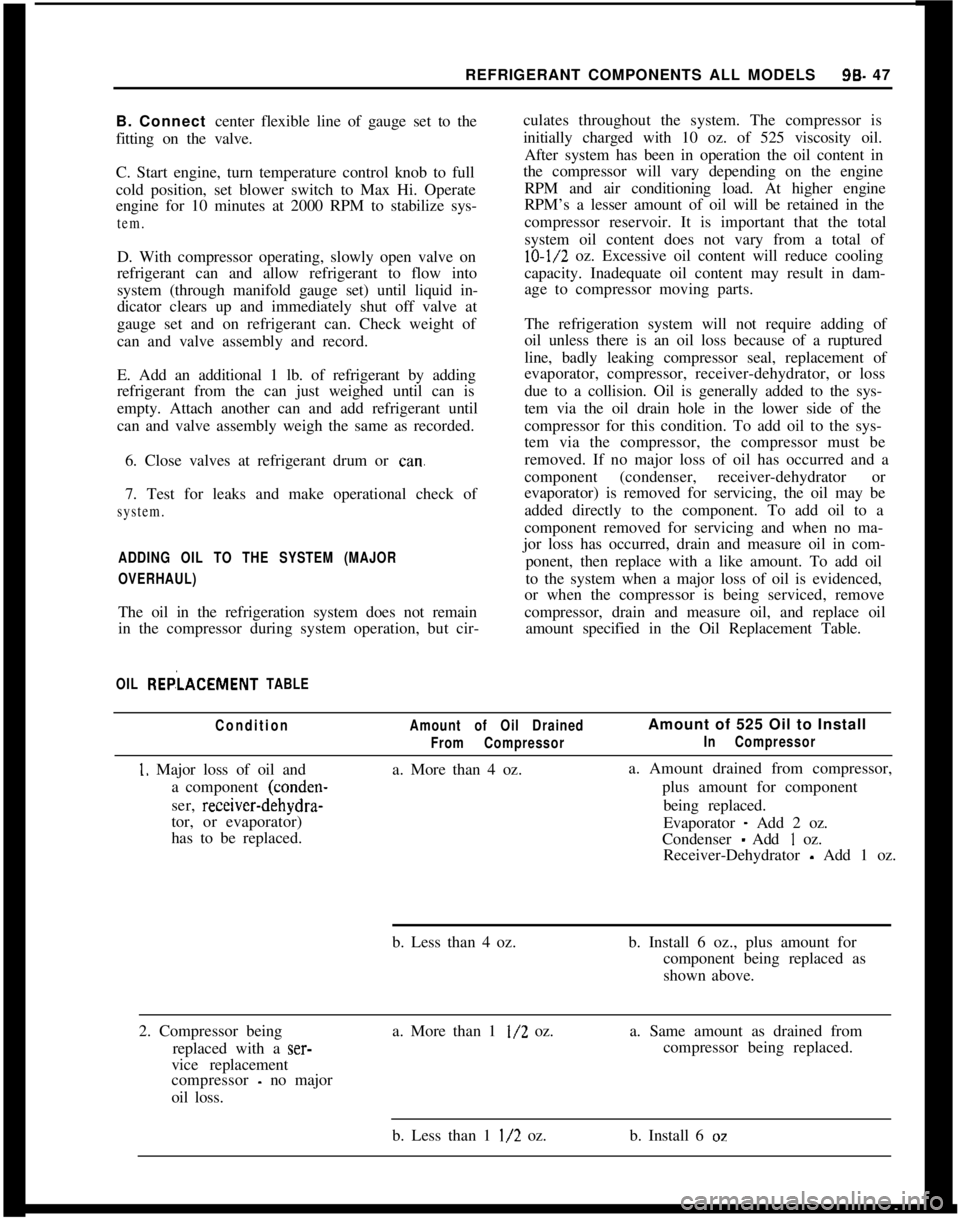
ADDING OIL TO THE SYSTEM (MAJOR
OVERHAUL)The oil in the refrigeration system does not remain
in the compressor during system operation, but cir-culates throughout the system. The compressor is
initially charged with 10 oz. of 525 viscosity oil.
After system has been in operation the oil content in
the compressor will vary depending on the engine
RPM and air conditioning load. At higher engine
RPM’s a lesser amount of oil will be retained in the
compressor reservoir. It is important that the total
system oil content does not vary from a total of10-l/2 oz. Excessive oil content will reduce cooling
capacity. Inadequate oil content may result in dam-
age to compressor moving parts.
The refrigeration system will not require adding of
oil unless there is an oil loss because of a ruptured
line, badly leaking compressor seal, replacement of
evaporator, compressor, receiver-dehydrator, or loss
due to a collision. Oil is generally added to the sys-
tem via the oil drain hole in the lower side of the
compressor for this condition. To add oil to the sys-
tem via the compressor, the compressor must be
removed. If no major loss of oil has occurred and a
component (condenser,receiver-dehydrator or
evaporator) is removed for servicing, the oil may be
added directly to the component. To add oil to a
component removed for servicing and when no ma-
jor loss has occurred, drain and measure oil in com-
ponent, then replace with a like amount. To add oil
to the system when a major loss of oil is evidenced,
or when the compressor is being serviced, remove
compressor, drain and measure oil, and replace oil
amount specified in the Oil Replacement Table.
OIL REP,‘LACEMENT TABLE
Condition
1. Major loss of oil and
a component (conden-
ser, receiver-dehydra-
tor, or evaporator)
has to be replaced.
Amount of Oil Drained
From Compressora. More than 4 oz.Amount of 525 Oil to Install
In Compressora. Amount drained from compressor,
plus amount for component
being replaced.
Evaporator
- Add 2 oz.
Condenser
- Add I oz.
Receiver-Dehydrator
- Add 1 oz.
b. Less than 4 oz.b. Install 6 oz., plus amount for
component being replaced as
shown above.
2. Compressor being
replaced with a
ser-vice replacement
compressor
- no major
oil loss.a. More than 1
l/2 oz.a. Same amount as drained from
compressor being replaced.
b. Less than 1
l/2 oz.b. Install 6 oz
Page 557 of 625
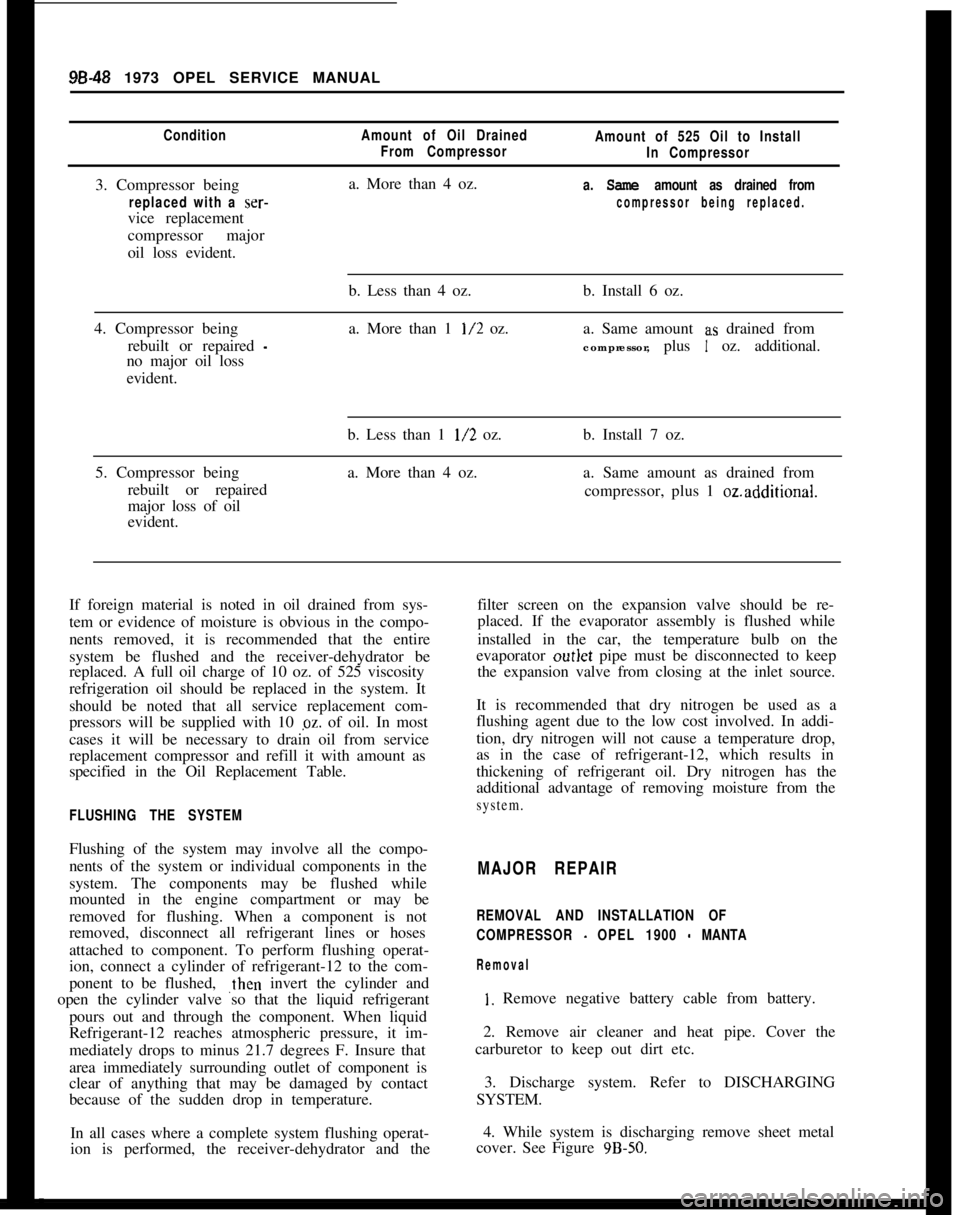
98-48 1973 OPEL SERVICE MANUALCondition3. Compressor being
replaced with a ser-vice replacement
compressor major
oil loss evident.
Amount of Oil Drained
From Compressora. More than 4 oz.Amount of 525 Oil to Install
In Compressor
a.
Same amount as drained from
compressor being replaced.4. Compressor being
rebuilt or repaired
-no major oil loss
evident.b. Less than 4 oz.
a. More than 1
l/2 oz.b. Install 6 oz.
a. Same amount a.s drained from
compressor, plus
1 oz. additional.
5. Compressor being
rebuilt or repaired
major loss of oil
evident.b. Less than 1
l/2 oz.
a. More than 4 oz.b. Install 7 oz.
a. Same amount as drained from
compressor, plus 1
ozadditional.If foreign material is noted in oil drained from sys-
tem or evidence of moisture is obvious in the compo-
nents removed, it is recommended that the entire
system be flushed and the receiver-dehydrator be
replaced. A full oil charge of 10 oz. of 525 viscosity
refrigeration oil should be replaced in the system. It
should be noted that all service replacement com-
pressors will be supplied with 10 pz. of oil. In most
cases it will be necessary to drain oil from service
replacement compressor and refill it with amount as
specified in the Oil Replacement Table.filter screen on the expansion valve should be re-
placed. If the evaporator assembly is flushed while
installed in the car, the temperature bulb on the
evaporator outlet pipe must be disconnected to keep
the expansion valve from closing at the inlet source.
FLUSHING THE SYSTEMIt is recommended that dry nitrogen be used as a
flushing agent due to the low cost involved. In addi-
tion, dry nitrogen will not cause a temperature drop,
as in the case of refrigerant-12, which results in
thickening of refrigerant oil. Dry nitrogen has the
additional advantage of removing moisture from thesystem.Flushing of the system may involve all the compo-
nents of the system or individual components in the
system. The components may be flushed while
mounted in the engine compartment or may be
removed for flushing. When a component is not
removed, disconnect all refrigerant lines or hoses
attached to component. To perform flushing operat-
ion, connect a cylinder of refrigerant-12 to the com-
ponent to be flushed, ,then invert the cylinder and
open the cylinder valve so that the liquid refrigerant
pours out and through the component. When liquid
Refrigerant-12 reaches atmospheric pressure, it im-
mediately drops to minus 21.7 degrees F. Insure that
area immediately surrounding outlet of component is
clear of anything that may be damaged by contact
because of the sudden drop in temperature.MAJOR REPAIR
REMOVAL AND INSTALLATION OF
COMPRESSOR
- OPEL 1900 - MANTA
Removal
I. Remove negative battery cable from battery.
2. Remove air cleaner and heat pipe. Cover the
carburetor to keep out dirt etc.
3. Discharge system. Refer to DISCHARGING
SYSTEM.
In all cases where a complete system flushing operat-4. While system is discharging remove sheet metal
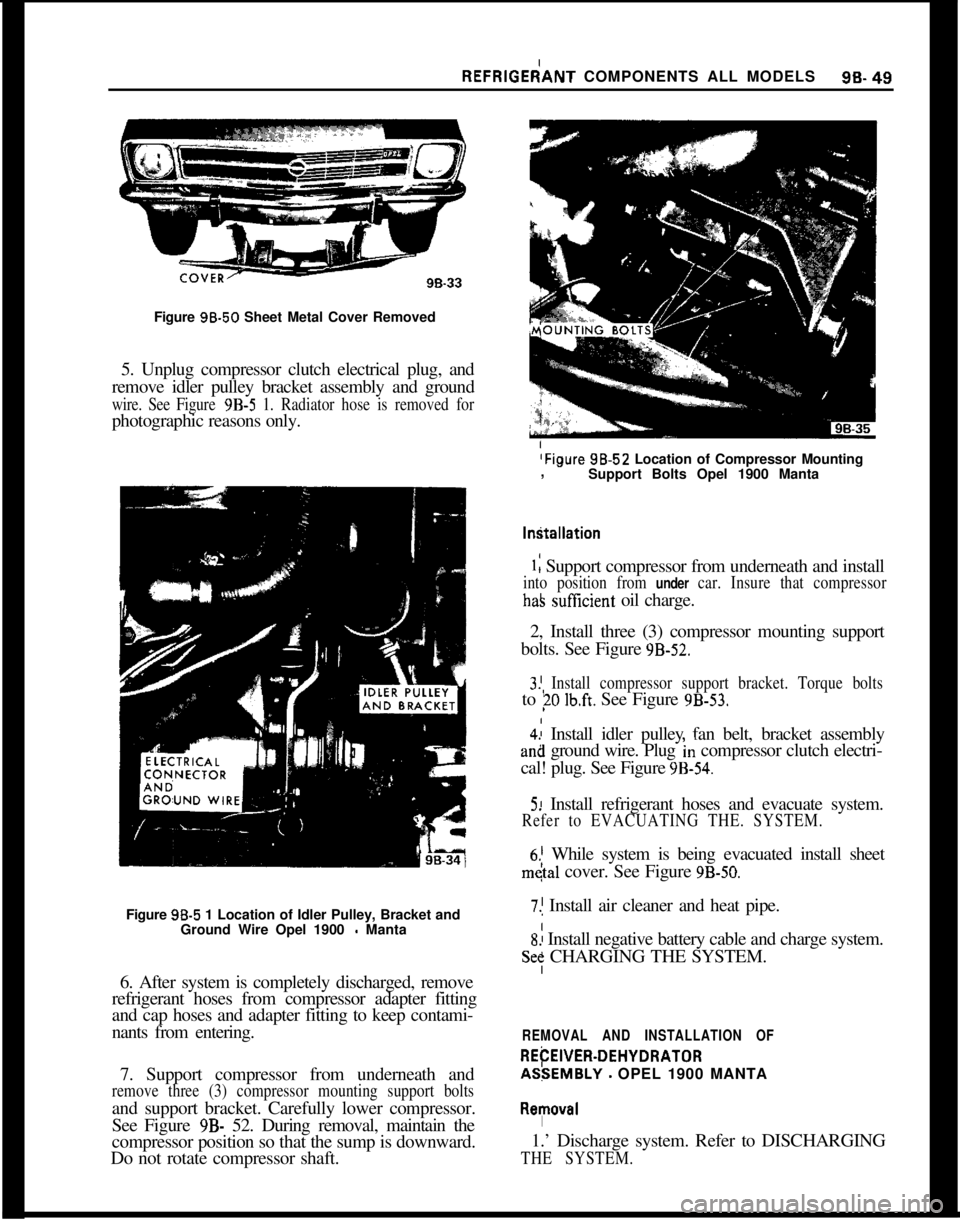
ion is performed, the receiver-dehydrator and thecover. See Figure
9B-50.
Page 558 of 625
REFRlGEdANT COMPONENTS ALL MODELS96-49Figure 96.50 Sheet Metal Cover Removed
5. Unplug compressor clutch electrical plug, and
remove idler pulley bracket assembly and ground
wire. See Figure 9B-5 1. Radiator hose is removed forphotographic reasons only.
(Figure 98.52 Location of Compressor Mounting
,
Support Bolts Opel 1900 Manta
I
Figure 98-5 1 Location of Idler Pulley, Bracket and
Ground Wire Opel 1900
- Manta
6. After system is completely discharged, remove
refrigerant hoses from compressor adapter fitting
and cap hoses and adapter fitting to keep contami-
nants from entering.
7. Support compressor from underneath and
remove three (3) compressor mounting support boltsand support bracket. Carefully lower compressor.
See Figure
9B- 52. During removal, maintain the
compressor position so that the sump is downward.
Do not rotate compressor shaft.
1: Support compressor from underneath and install
into position from under car. Insure that compressor
haS sutXcient oil charge.
2, Install three (3) compressor mounting support
bolts. See Figure
9B-52.I
3! Install compressor support bracket. Torque boltsto
?O lb.ft. See Figure 9B-53.
4.: Install idler pulley fan belt, bracket assemblyan8 ground wire. Plug
‘In compressor clutch electri-
cal! plug. See Figure
9B-54.
5! Install refrigerant hoses and evacuate system.
Refer to EVACUATING THE. SYSTEM.
6.’ While system is being evacuated install sheet
m&l cover. See Figure 9B-50.
7.1 Install air cleaner and heat pipe.
S! Install negative battery cable and charge system.
Se: CHARGING THE SYSTEM.
REMOVAL AND INSTALLATION OF
REtiEWEFt-DEHYDRATORAS:EMBLY
- OPEL 1900 MANTA
I
R~l!lOV~lI1.’ Discharge system. Refer to DISCHARGING
THE SYSTEM.
Page 560 of 625
REFRIGERANT COMPONENTS ALL MODELSSB- 51
3. Remove two (2) screws securing receiver-dehy-
drator within support bracket and lift out receiver-
dehydrator.
InstallationIf the receiver-dehydrator has been exposed to the
atmosphere for any amount of time, (more than five
(5) minutes), the receiver-dehydrator should be re-
placed, since the life of the dessicant is probably
expended.
1. Install receiver-dehydrator. Using new o-rings
during installation. Lubricate o-rings prior to instal-
lation using No. 525 viscosity oil.
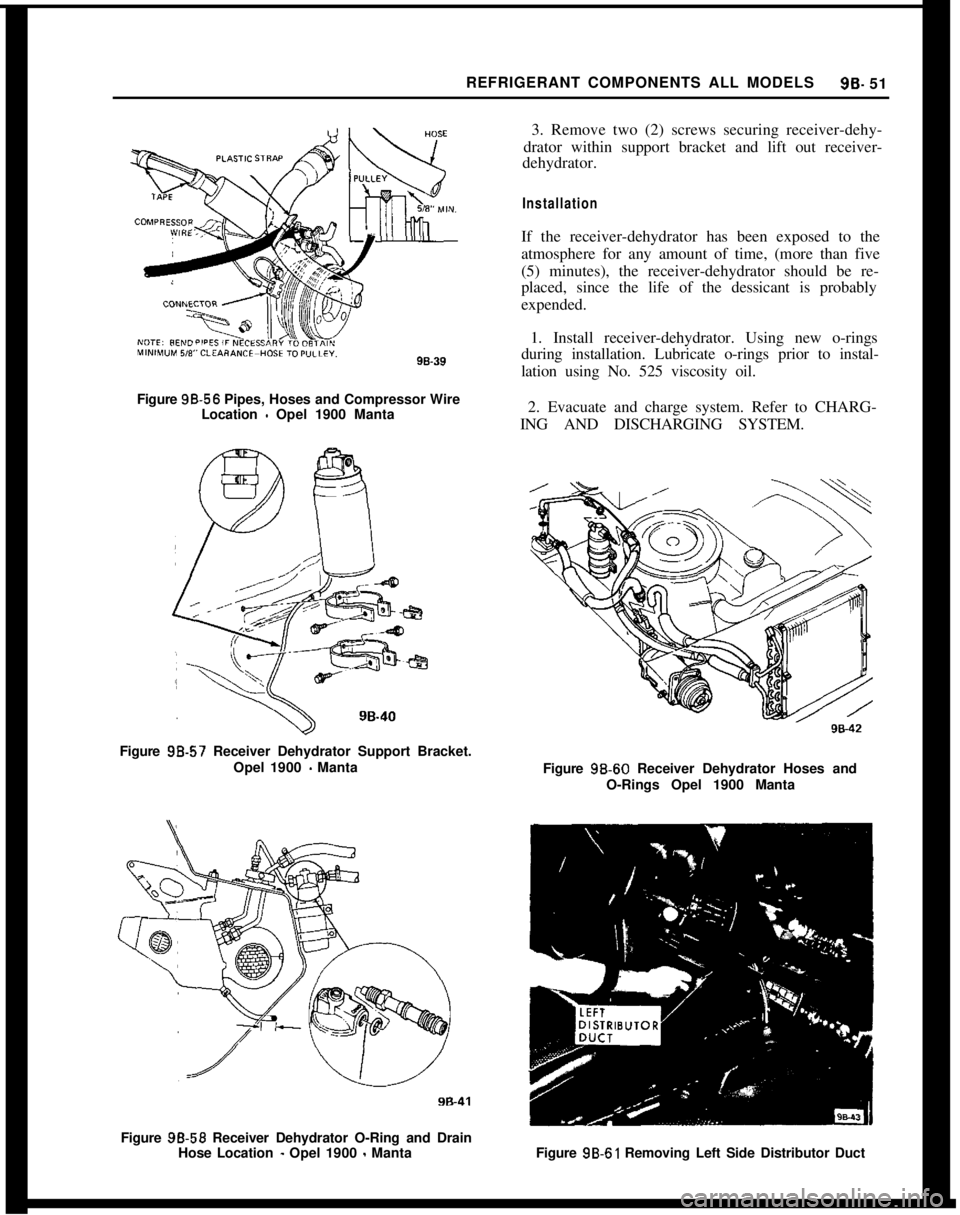
Figure 98.56 Pipes, Hoses and Compressor Wire
Location
- Opel 1900 Manta2. Evacuate and charge system. Refer to CHARG-
ING AND DISCHARGING SYSTEM.
Figure 98.57 Receiver Dehydrator Support Bracket.
Opel 1900
- Manta
Figure 98-59 Receiver Dehydrator O-Ring and Drain
Hose Location
- Opel 1900 - MantaFigure 9B-60 Receiver Dehydrator Hoses and
O-Rings Opel 1900 Manta
Figure 9B-61 Removing Left Side Distributor Duct
Page 563 of 625

96-54 1973 OPEL SERVICE MANUAL
valve. The filter screen at the inlet port may be re-
placed. Remove screen by threading a lo-32 NF
screw into old filter screen. With a washer and a nut
on the screw arranged to work as a puller screw, hold
the body of the screw and turn the nut. Insert the
new filter screen into the inlet port and lightly tap
screen only enough to seat.
1. Install expansion valve using new o-rings during
installation. Lubricate o-rings prior to installation
using No. 525 viscosity oil.
2. Install evaporator assembly and case attaching
screws. See Figure 9B-70.3. Install blower motor assembly into case and se-
cure with attaching screws. See Figure
9B-69.4. Install finger guard shields and fan housing case.
See Figure
9B-69.5. Install resistor assembly and electrical connector.
Install blower motor connector. See Figure
9B-69.6. Install assembly into car carefully guiding
evaporator pipes up through cowl opening. See Fig-
ure
9B-71.Figure 93-7 1 Inlet and Outlet Pipes and O-Rings
-Opel 1900 Manta
7. Install two (2) upper attaching evaporator at-
taching nuts. See Figures 9B-66 and
9B-67.8. Install two (2) attaching case mounting bracket
to instrument panel screws. See Figure
9B-67.9. Connect two (2) drain hoses underneath evapora-
tor.10. Install evaporator inlet and outlet pipes retainer
and rubber grommet. See Figure
9B-65.11. Connect vacuum cut-off switch and electrical
wiring, making sure the delay restrictor and checkvalve hoses are installed correctly. See Figures
9B-63and 64.
.gB-72 Delay Restrictor and Check Valve Hose.Assembly
12. Install refrigerant hoses and pipes using new
o-rings on line fittings and evacuate system. Refer to
EVACUATING SYSTEM.
13. While system is being evacuated, install in-line
fuse and left side of distributor duct. See Figure 9B-
61.14. Install glove box.
15. Install negative battery cable and charge system.
Refer to CHARGING SYSTEM.
REMOVAL AND INSTALLATION OF CONDENSER
ASSEMBLY -OPEL 1900. MANTA
Removal
1. Remove negative battery cable from battery.
2. Remove air cleaner.
3. Discharge system. Refer to DISCHARGING
SYSTEM.
4. While system is discharging, remove lower radia-
tor hose from radiator and drain coolant into a suita-
ble container.
5. Remove fan shroud.
6. On vehicles with automatic transmission, un-
screw oil lines from connectors on lower radiator
tank and plug lines. It is essential that no dirt enters
the oil lines. When unscrewing oil lines, hold connec-
tors on lower radiator tank with pliers to avoid leak-
ages. Ensure that no dirt enters oil cooler.
7. Remove upper radiator hose from radiator.
8. Remove lower attaching nut and slide radiator
upward and out of engine compartment.
9. Remove inlet and outlet hoses from condenser
Page 564 of 625
REFRIGERANT COMPONENTS ALL MODELS99.55pipes and tape closed the open ends of refrigerant
lines, and also the open ends of the inlet and outlet
pipes of the condenser.
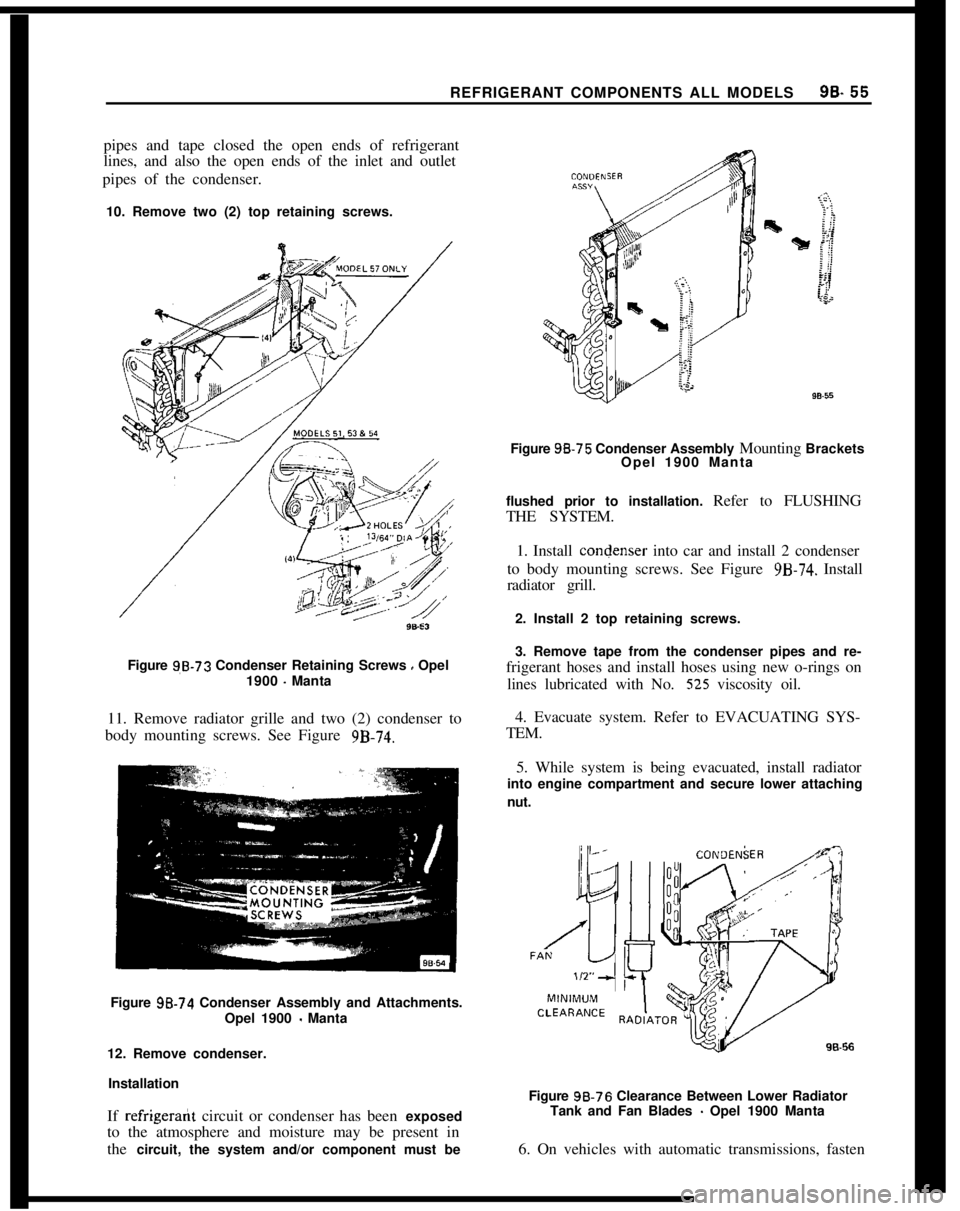
10. Remove two (2) top retaining screws.
Figure
9,S-73 Condenser Retaining Screws - Opel
1900
- Manta
11. Remove radiator grille and two (2) condenser to
body mounting screws. See Figure 98.74.
Figure 98-74 Condenser Assembly and Attachments.
Opel 1900
- Manta
12. Remove condenser.
Installation
If refrigerarit circuit or condenser has been exposed
to the atmosphere and moisture may be present in
the circuit, the system and/or component must beFigure 98-75 Condenser Assembly Mounting Brackets
Opel 1900 Manta
flushed prior to installation. Refer to FLUSHING
THE SYSTEM.
1. Install comjenser into car and install 2 condenser
to body mounting screws. See Figure 98-74. Install
radiator grill.
2. Install 2 top retaining screws.
3. Remove tape from the condenser pipes and re-
frigerant hoses and install hoses using new o-rings on
lines lubricated with No.
525 viscosity oil.
4. Evacuate system. Refer to EVACUATING SYS-
TEM.
5. While system is being evacuated, install radiator
into engine compartment and secure lower attaching
nut.
Figure 98.76 Clearance Between Lower Radiator
Tank and Fan Blades
- Opel 1900 Manta
6. On vehicles with automatic transmissions, fasten
Page 565 of 625

98-56 1973 OPEL SERVICE MANUAL
oil cooler lines to lower radiator tank. It is essential
that no dirt enters the oil lines. When tightening oil
lines hold connectors on lower radiator tank with
pliers to avoid leakages. Ensure that no dirt enters oil
cooler. Torque to 11-15 Ibs. ft.
7. Install fan shroud.
8. Install upper radiator hose.
9. Install lower radiator hose and add collected coo-
lant.
All Opel
1900’s and Manta’s are provided with a
radiator initial fill of an anti-freeze solution contain-
ing corrosion inhibitor. The anti-freeze has either a
glycol or glycerin base and protects the engine
against freezing, down to minus 22 degrees F. (minus
30 degrees C.). Before the start of the cold season,
coolant must be checked with a hydrometer and if
necessary, brought to the necessary specific gravity
by adding anti-freeze. Anti-freeze added, must have
a glycol or glycerin base. As the specific gravities of
all anti-freeze solutions having a glycol or glycerin
base are practically the same, the hydrometer can be
used for all these types. Because of the tolerances of
the hydrometer, or slight differences in specific
gravity, variations of plus or minus 5 degrees can be
expected. Coolant must be checked at a temperature
of plus 68 degrees F. (plus 20 degrees C.).
IO. Install negative battery cable and air cleaner.
11. Charge system. Refer to CHARGING SYS-
TEM.
Figure 99.80 Location of Idler Pulley and Bracket
Assembly
- GTFigure 99.81 Idler Pulley and Bracket Assembly and
Support Bracket GT
REMOVAL AND INSTALLATION OF
COMPRESSOR. GT
I. Removenegative battery cable from battery.
Figure 98-82 Compressor Adapter Fitting, Ground
Wire. and Front and Rear Mounting Bolts
- GT
Figure 99.83
Elecirical Connector and Ground Wire
GT
Page 567 of 625
98-58 1973 OPEL SERVICE MANUAL
2. Discharge system. Refer to DISCHARGING
SYSTEM.
3. While system is discharging remove air cleaner
and loosen idler pulley and bracket assembly. See
Figure 98-80.
4. Remove bolt holding compressor adapter fitting
into rear head. Disengage from compressor and tape
closed openings in both lines and ports in rear head.
It is important to seal compressor ports to avoid a
loss of refrigeration oil and also to prevent foreign
material and moisture from entering compressor. See
Figure 9B-82.
5. Remove bolt and ground wire, unplug electrical
connector, and remove 2 rear compressor mounting
bolts. See Figure 98-82.
6. Remove 2 front compressor mounting bolts,
clutch drive belt, and lift out compressor. During
removal, maintain the compressor position so that
the sump is downward. Do not’rotate compressor
shaft. See Figure 9B-84.
Installation1. Install compressor into mounting brackets and
secure with 4 mounting bolts. See Figure
9B-84.2. Untape lines and ports, and install compressor
adapter fitting and bolt using new o-rings. See Figure
9B-82.3. Evacuate system. Refer to, EVACUATING
SYSTEM.
4. While system is being evacuated, install drive belt
and tighten idler pulley. See Figure
9B-80.5. Install bolt and ground wire and plug in electrical
connector. See Figure
9B-83.6. Install air cleaner and negative battery cable.
7. Charge system. Refer to, CHARGING SYS-
TEM.
REMOVAL AND INSTALLATION OF
RECEIVER.DEHYDRATOR
ASSEMBLY. GT
Removal1. Discharge system. Refer to DISCHARGING
SYSTEM.
2. Disconnect refrigerant lines to both ends of re-
ceiver-dehydrator and tape closed open ends of
re-
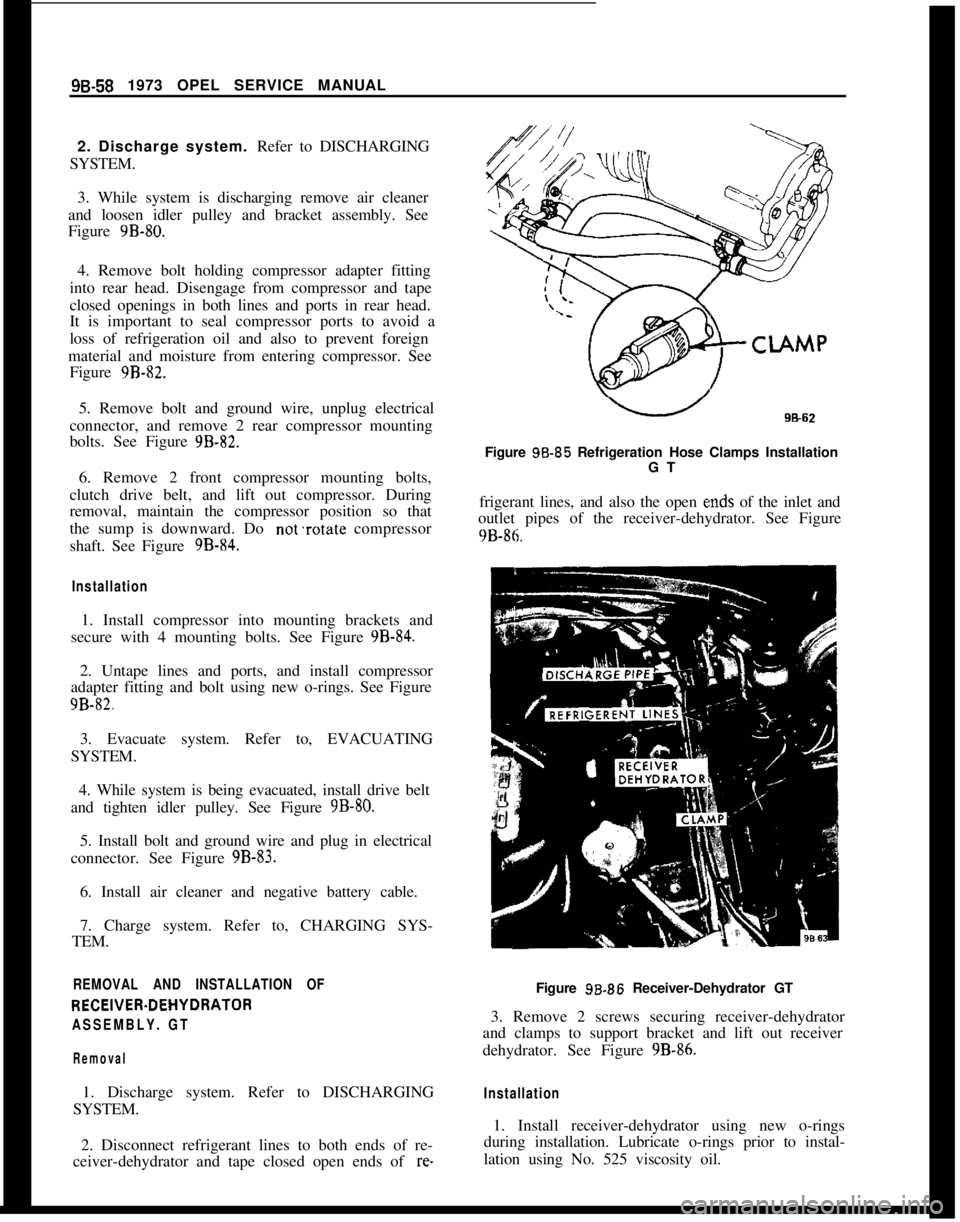
9862Figure 98.85 Refrigeration Hose Clamps Installation
GT
frigerant lines, and also the open
e:nds of the inlet and
outlet pipes of the receiver-dehydrator. See Figure
9B-86.Figure 98.86 Receiver-Dehydrator GT
3. Remove 2 screws securing receiver-dehydrator
and clamps to support bracket and lift out receiver
dehydrator. See Figure
9B-86.
Installation1. Install receiver-dehydrator using new o-rings
during installation. Lubricate o-rings prior to instal-
lation using No. 525 viscosity oil.
.