oil OPEL 1900 1973 Service Manual
[x] Cancel search | Manufacturer: OPEL, Model Year: 1973, Model line: 1900, Model: OPEL 1900 1973Pages: 625, PDF Size: 17.22 MB
Page 570 of 625
REFRIGERANT COMPONENTS ALL MODELS96.61
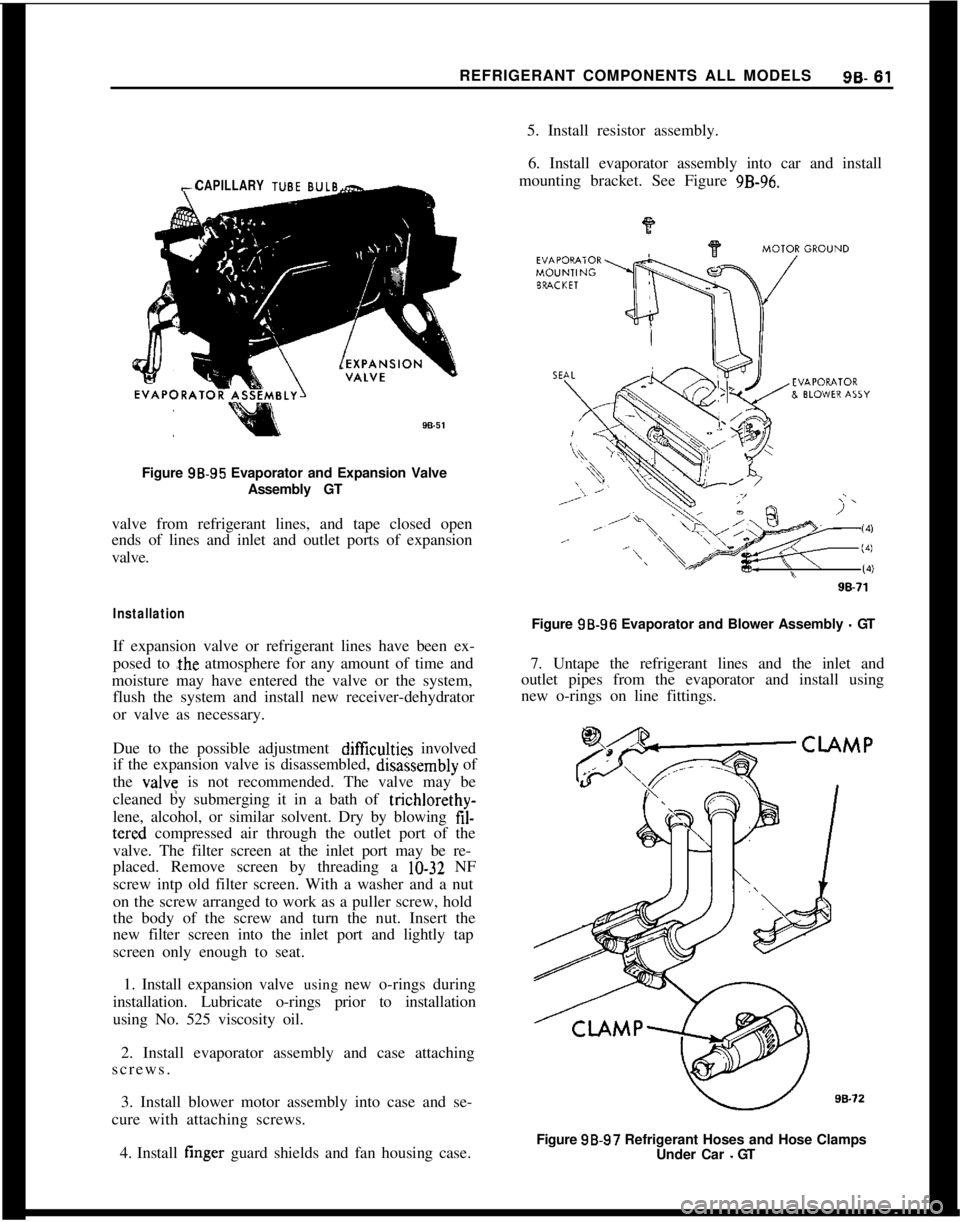
CAPILLARY T”BEFigure 98.95 Evaporator and Expansion Valve
Assembly GT
valve from refrigerant lines, and tape closed open
ends of lines and inlet and outlet ports of expansion
valve.
Installation5. Install resistor assembly.
6. Install evaporator assembly into car and install
mounting bracket. See Figure
9B-96.Figure 98.96 Evaporator and Blower Assembly
- GT
If expansion valve or refrigerant lines have been ex-
posed to
,the atmosphere for any amount of time and
moisture may have entered the valve or the system,
flush the system and install new receiver-dehydrator
or valve as necessary.7. Untape the refrigerant lines and the inlet and
outlet pipes from the evaporator and install using
new o-rings on line fittings.
Due to the possible adjustment difficulties involved
if the expansion valve is disassembled, disaisembly of
the valve is not recommended. The valve may be
cleaned by submerging it in a bath of trichlorethy-
lene, alcohol, or similar solvent. Dry by blowing iil-tered compressed air through the outlet port of the
valve. The filter screen at the inlet port may be re-
placed. Remove screen by threading a lo-32 NF
screw intp old filter screen. With a washer and a nut
on the screw arranged to work as a puller screw, hold
the body of the screw and turn the nut. Insert the
new filter screen into the inlet port and lightly tap
screen only enough to seat.
1. Install expansion valve using new o-rings during
installation. Lubricate o-rings prior to installation
using No. 525 viscosity oil.
2. Install evaporator assembly and case attaching
screws.
3. Install blower motor assembly into case and se-
cure with attaching screws.
4. Install finger guard shields and fan housing case.Figure 98-97 Refrigerant Hoses and Hose Clamps
Under Car
- GT
Page 572 of 625
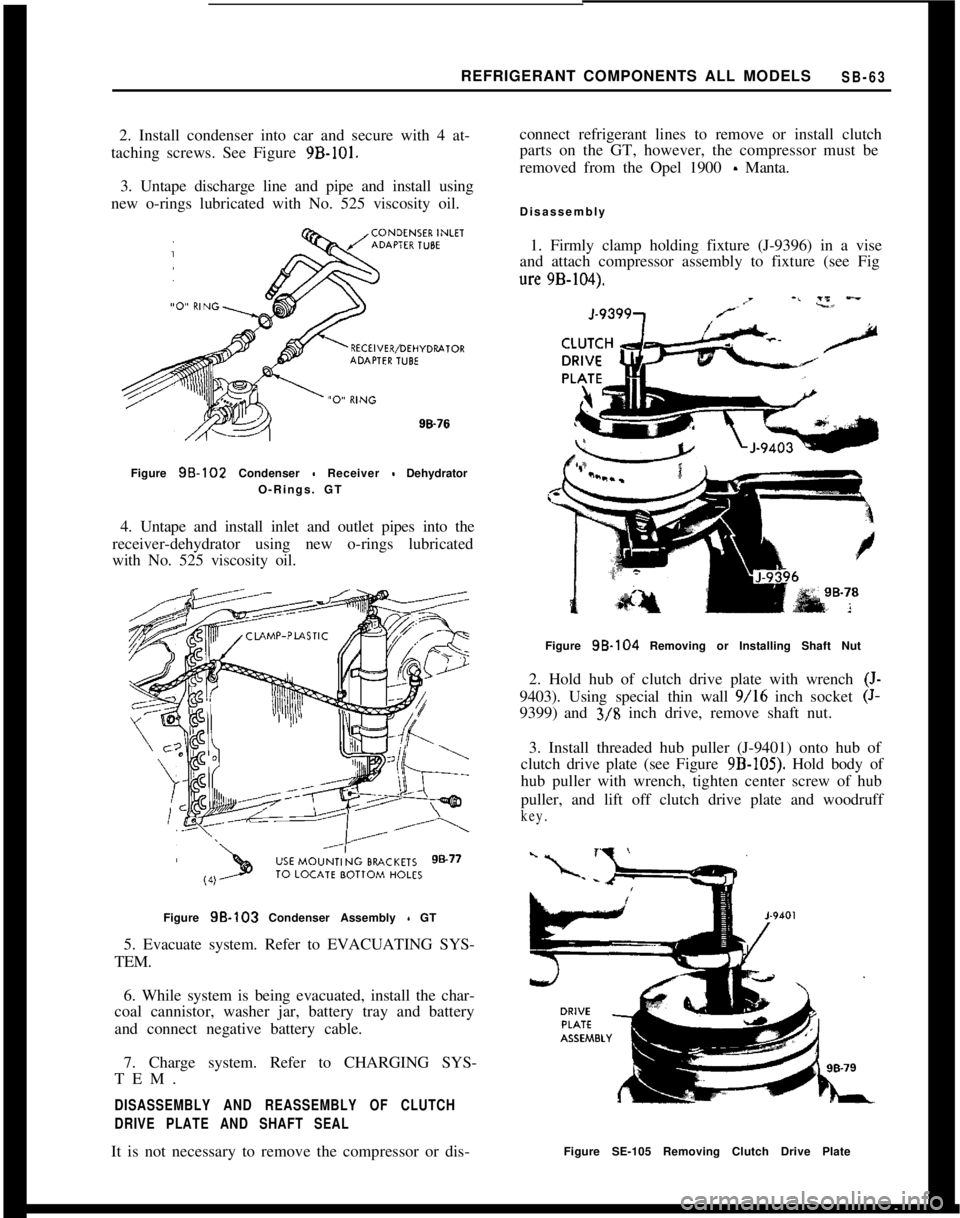
REFRIGERANT COMPONENTS ALL MODELSSB-632. Install condenser into car and secure with 4 at-
taching screws. See Figure
9B-101.3. Untape discharge line and pipe and install using
new o-rings lubricated with No. 525 viscosity oil.
Figure
99.102 Condenser - Receiver - Dehydrator
O-Rings. GT
4. Untape and install inlet and outlet pipes into the
receiver-dehydrator using new o-rings lubricated
with No. 525 viscosity oil.
Figure
98-103 Condenser Assembly - GT
5. Evacuate system. Refer to EVACUATING SYS-
TEM.
6. While system is being evacuated, install the char-
coal cannistor, washer jar, battery tray and battery
and connect negative battery cable.
7. Charge system. Refer to CHARGING SYS-
TEM.
DISASSEMBLY AND REASSEMBLY OF CLUTCH
DRIVE PLATE AND SHAFT SEALIt is not necessary to remove the compressor or dis-connect refrigerant lines to remove or install clutch
parts on the GT, however, the compressor must be
removed from the Opel 1900
- Manta.
Disassembly
1. Firmly clamp holding fixture (J-9396) in a vise
and attach compressor assembly to fixture (see Figwe
9B-104).
-_ .s -Figure SE-104 Removing or Installing Shaft Nut
2. Hold hub of clutch drive plate with wrench
(J-9403). Using special thin wall 9/16 inch socket
(J-9399) and 3/g inch drive, remove shaft nut.
3. Install threaded hub puller (J-9401) onto hub of
clutch drive plate (see Figure
9B-105). Hold body of
hub puller with wrench, tighten center screw of hub
puller, and lift off clutch drive plate and woodruff
key.Figure SE-105 Removing Clutch Drive Plate
Page 573 of 625
9B-64 1973 OPEL SERVICE MANUAL
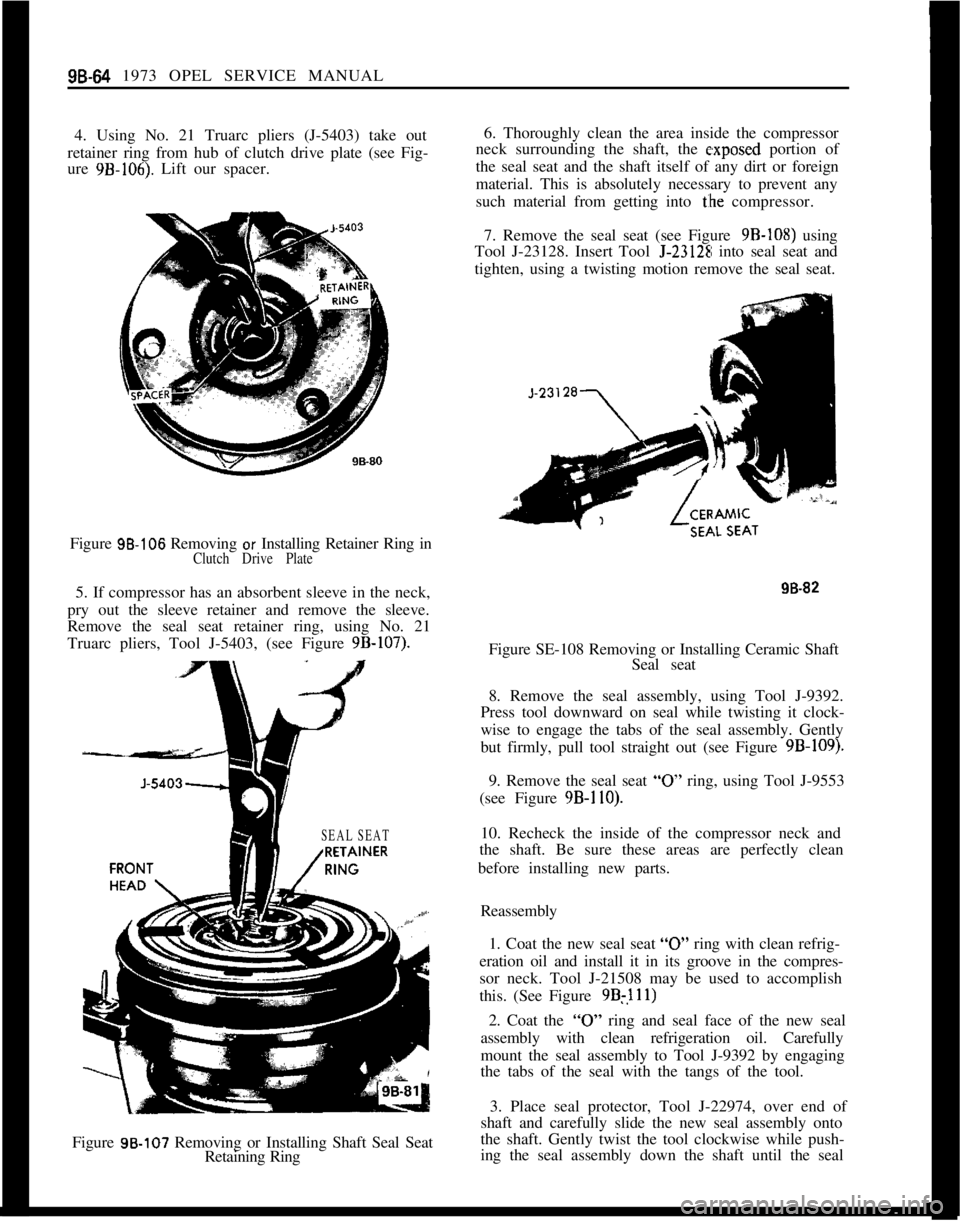
4. Using No. 21 Truarc pliers (J-5403) take out
retainer ring from hub of clutch drive plate (see Fig-
ure 9B-106). Lift our spacer.
Figure 95.106 Removing
or Installing Retainer Ring inClutch Drive Plate5. If compressor has an absorbent sleeve in the neck,
pry out the sleeve retainer and remove the sleeve.
Remove the seal seat retainer ring, using No. 21
Truarc pliers, Tool J-5403, (see Figure
9B-107).
SEAL SEATFigure 98.107 Removing or Installing Shaft Seal Seat
Retaining Ring6. Thoroughly clean the area inside the compressor
neck surrounding the shaft, the
ezxposed portion of
the seal seat and the shaft itself of any dirt or foreign
material. This is absolutely necessary to prevent any
such material from getting into
t:he compressor.
7. Remove the seal seat (see Figure 9B-108) using
Tool J-23128. Insert Tool
J-2312E; into seal seat and
tighten, using a twisting motion remove the seal seat.96-82
Figure SE-108 Removing or Installing Ceramic Shaft
Seal seat
8. Remove the seal assembly, using Tool J-9392.
Press tool downward on seal while twisting it clock-
wise to engage the tabs of the seal assembly. Gently
but firmly, pull tool straight out (see Figure
9B-109).9. Remove the seal seat
“0” ring, using Tool J-9553
(see Figure
9B-110).10. Recheck the inside of the compressor neck and
the shaft. Be sure these areas are perfectly clean
before installing new parts.
Reassembly
1. Coat the new seal seat
“0” ring with clean refrig-
eration oil and install it in its groove in the compres-
sor neck. Tool J-21508 may be used to accomplish
this. (See Figure
9B;,lll)2. Coat the
“0” ring and seal face of the new seal
assembly with clean refrigeration oil. Carefully
mount the seal assembly to Tool J-9392 by engaging
the tabs of the seal with the tangs of the tool.
3. Place seal protector, Tool J-22974, over end of
shaft and carefully slide the new seal assembly onto
the shaft. Gently twist the tool clockwise while push-
ing the seal assembly down the shaft until the seal
Page 574 of 625
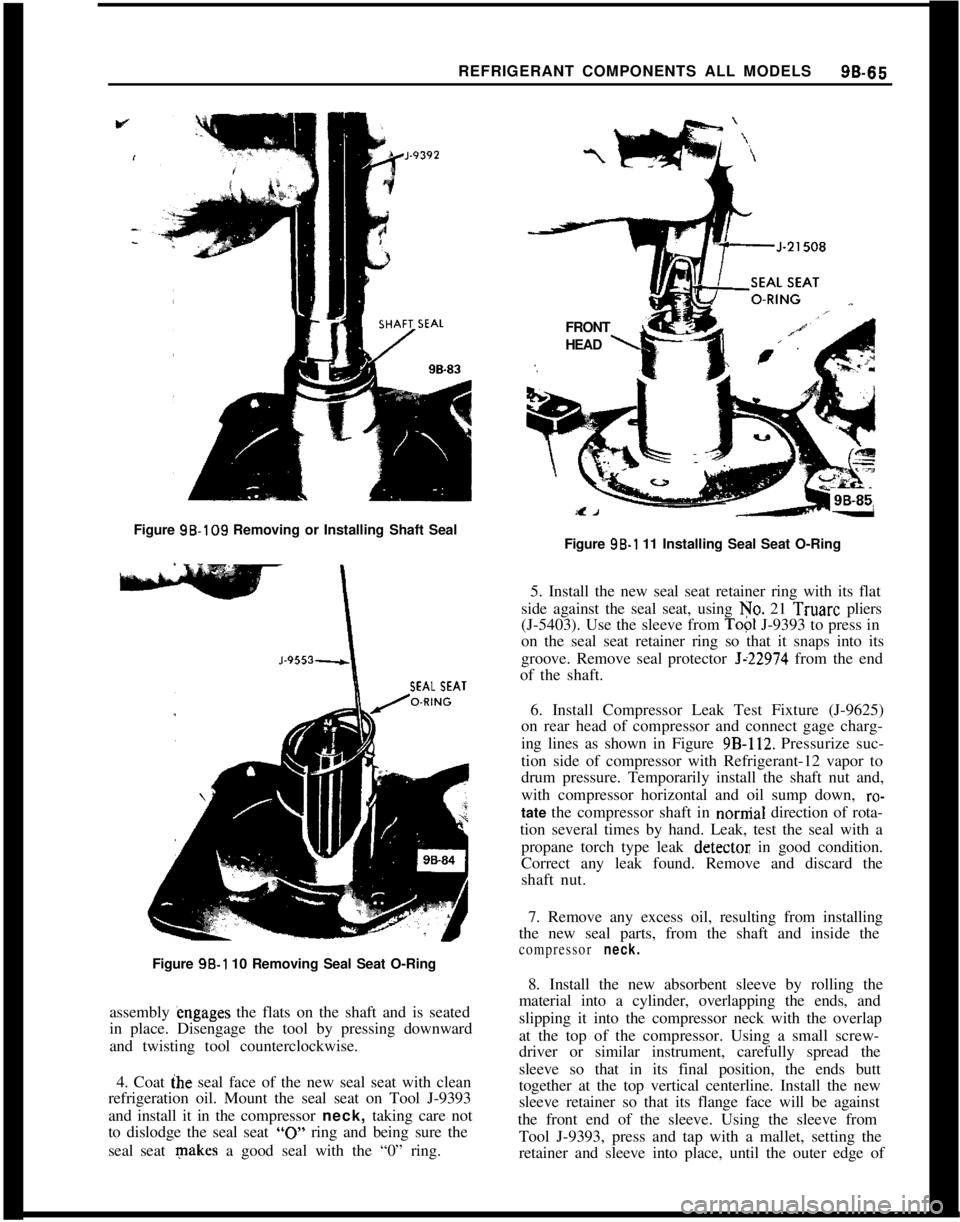
REFRIGERANT COMPONENTS ALL MODELS96-66Figure 98.109 Removing or Installing Shaft Seal
SEAL SEAT
-Figure 98-l 10 Removing Seal Seat O-Ring
assembly engages the flats on the shaft and is seated
in place. Disengage the tool by pressing downward
and twisting tool counterclockwise.
4. Coat ihe seal face of the new seal seat with clean
refrigeration oil. Mount the seal seat on Tool J-9393
and install it in the compressor neck, taking care not
to dislodge the seal seat
“0” ring and being sure the
seal seat makes a good seal with the “0” ring.FRONT
L’HEAD
\Figure 96-l 11 Installing Seal Seat O-Ring
5. Install the new seal seat retainer ring with its flat
side against the seal seat, using No. 21 Truarc pliers
(J-5403). Use the sleeve from
Top1 J-9393 to press in
on the seal seat retainer ring so that it snaps into its
groove. Remove seal protector
Jz22974 from the end
of the shaft.
6. Install Compressor Leak Test Fixture (J-9625)
on rear head of compressor and connect gage charg-
ing lines as shown in Figure
9B-112. Pressurize suc-
tion side of compressor with Refrigerant-12 vapor to
drum pressure. Temporarily install the shaft nut and,
with compressor horizontal and oil sump down,
ro-tate the compressor shaft in nornial direction of rota-
tion several times by hand. Leak, test the seal with a
propane torch type leak
detectot; in good condition.
Correct any leak found. Remove and discard the
shaft nut.
7. Remove any excess oil, resulting from installing
the new seal parts, from the shaft and inside the
compressor neck.8. Install the new absorbent sleeve by rolling the
material into a cylinder, overlapping the ends, and
slipping it into the compressor neck with the overlap
at the top of the compressor. Using a small screw-
driver or similar instrument, carefully spread the
sleeve so that in its final position, the ends butt
together at the top vertical centerline. Install the new
sleeve retainer so that its flange face will be against
the front end of the sleeve. Using the sleeve from
Tool J-9393, press and tap with a mallet, setting the
retainer and sleeve into place, until the outer edge of
Page 576 of 625
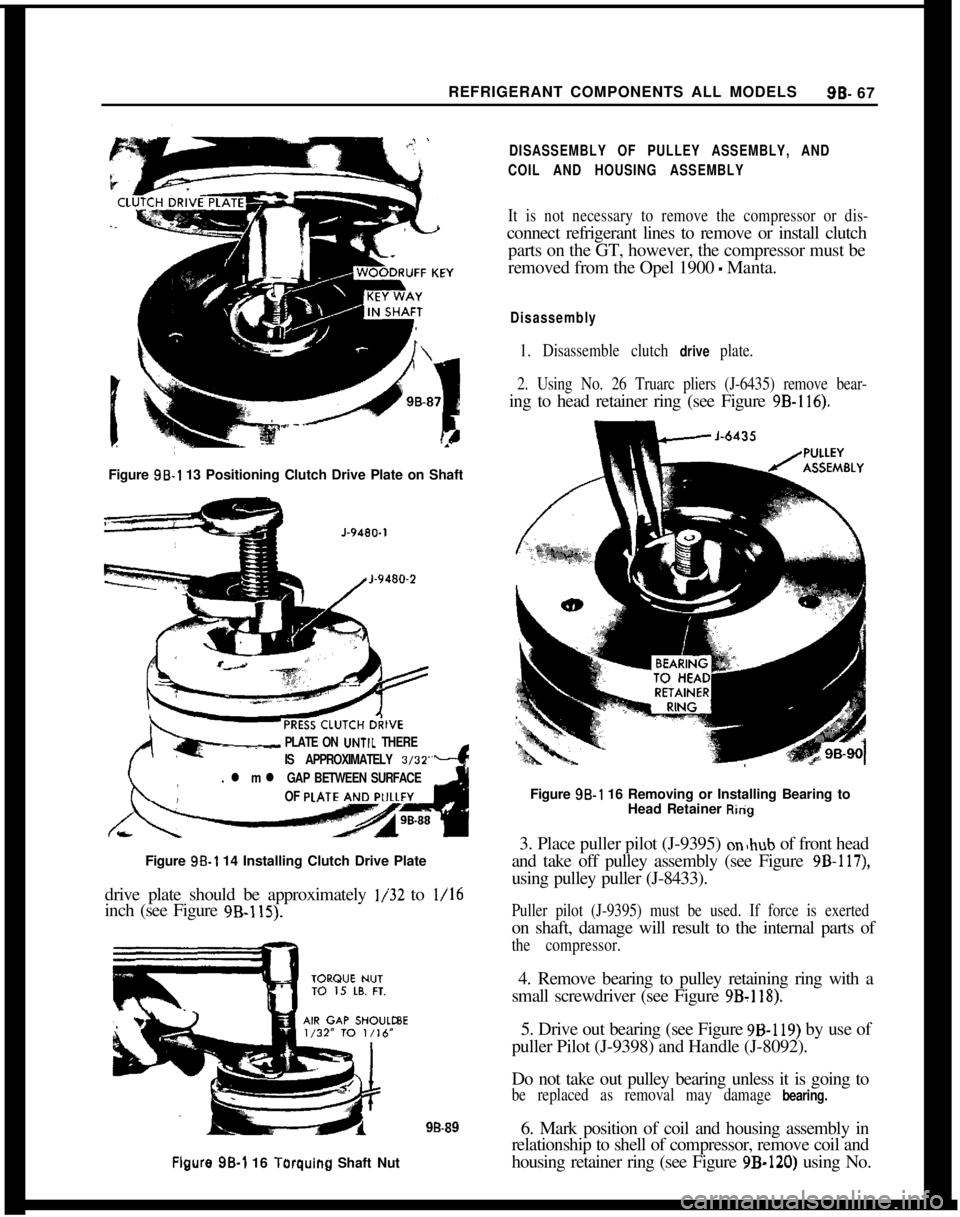
REFRIGERANT COMPONENTS ALL MODELS9B- 67
Figure 9B-1 13 Positioning Clutch Drive Plate on Shaft
PLATE ON UNTlL THERE
IS APPROXIMATELY
3/32”-
. l m l GAP BETWEEN SURFACE
OF
PLATFigure
98-1 14 Installing Clutch Drive Plate
drive plate should be approximately l/32 to l/16
inch (see Figure
9B-115).
Flgure 98-1 16 Torquing Shaft Nut
BE98.89
DISASSEMBLY OF PULLEY ASSEMBLY, AND
COIL AND HOUSING ASSEMBLY
It is not necessary to remove the compressor or dis-connect refrigerant lines to remove or install clutch
parts on the GT, however, the compressor must be
removed from the Opel 1900
- Manta.
Disassembly
1. Disassemble clutch drive plate.
2. Using No. 26 Truarc pliers (J-6435) remove bear-ing to head retainer ring (see Figure
9B-116).Figure
9B-1 16 Removing or Installing Bearing to
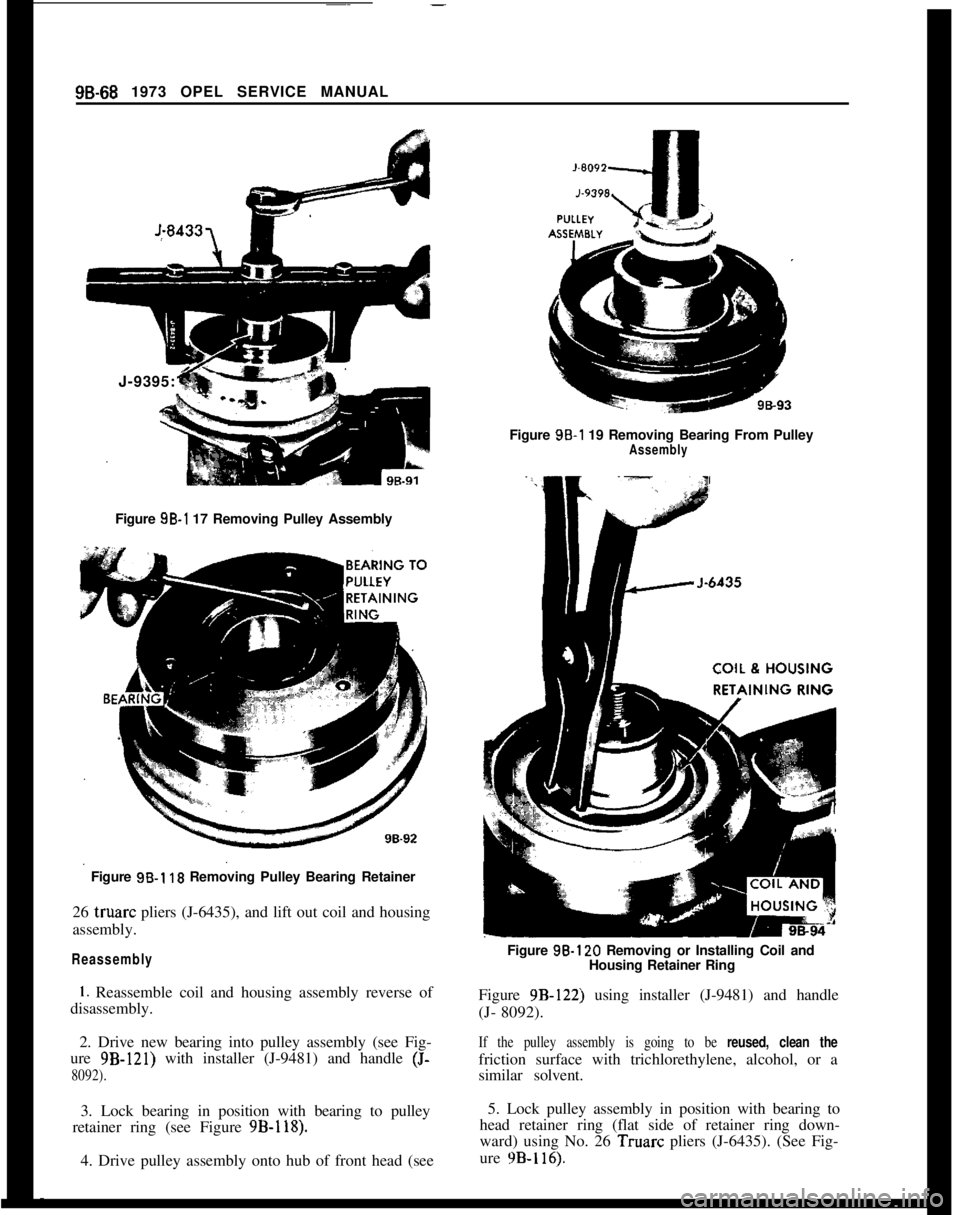
Head Retainer Ring3. Place puller pilot (J-9395) on,hub of front head
and take off pulley assembly (see Figure
9B-117),using pulley puller (J-8433).
Puller pilot (J-9395) must be used. If force is exertedon shaft, damage will result to the internal parts of
the compressor.4. Remove bearing to pulley retaining ring with a
small screwdriver (see Figure
9B-118).5. Drive out bearing (see Figure
9B-119) by use of
puller Pilot (J-9398) and Handle (J-8092).
Do not take out pulley bearing unless it is going to
be replaced as removal may damage bearing.6. Mark position of coil and housing assembly in
relationship to shell of compressor, remove coil and
housing retainer ring (see Figure
9B-120) using No.
Page 577 of 625
98-68 1973 OPEL SERVICE MANUAL
J-9395:
Figure 9B-1 17 Removing Pulley Assembly
Figure
9B-1 10 Removing Pulley Bearing Retainer
26 truarc pliers (J-6435), and lift out coil and housing
assembly.
Reassembly
1. Reassemble coil and housing assembly reverse of
disassembly.
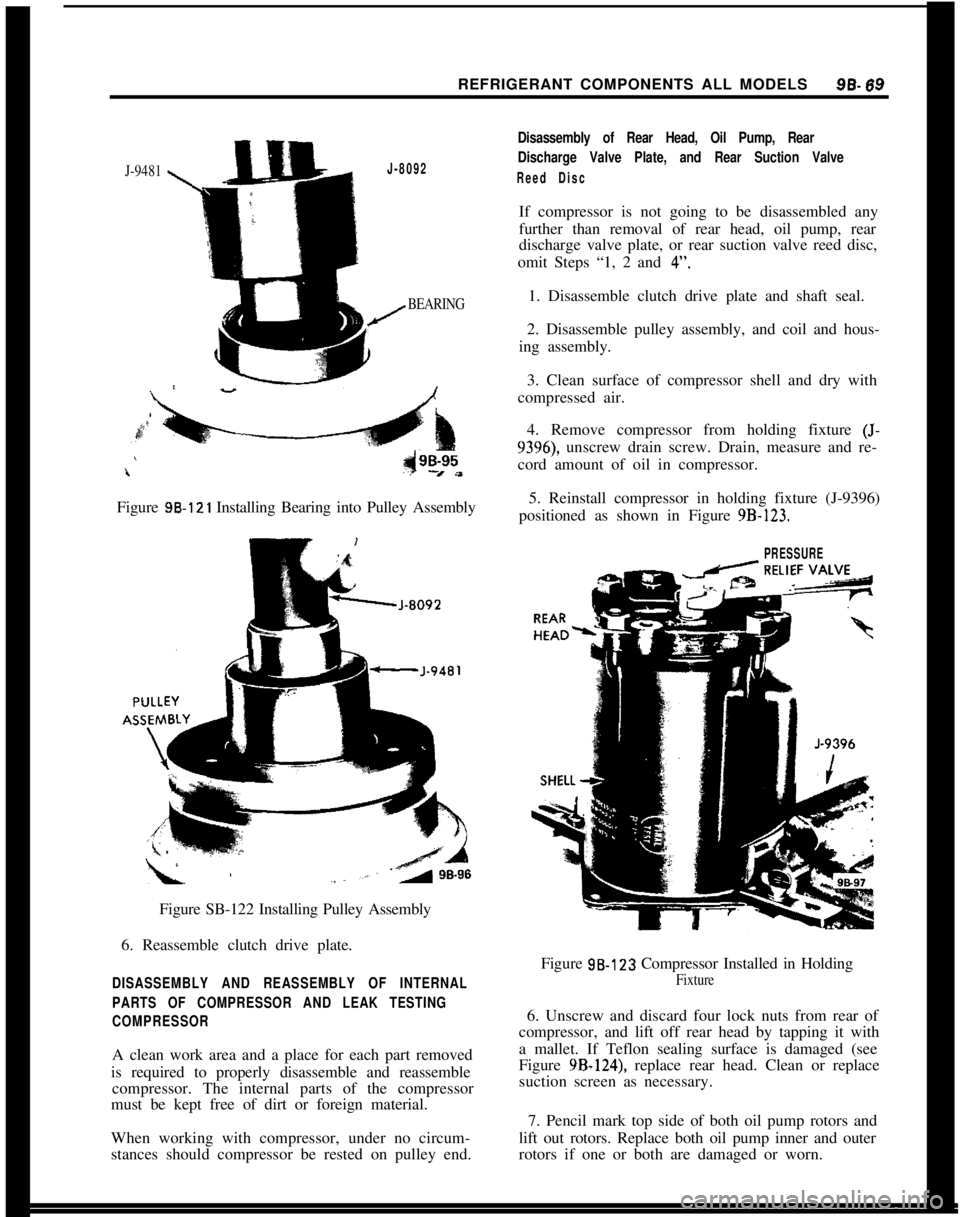
2. Drive new bearing into pulley assembly (see Fig-
ure 9B-121) with installer (J-9481) and handle
(J-
8092).3. Lock bearing in position with bearing to pulley
retainer ring (see Figure 9B-118).
4. Drive pulley assembly onto hub of front head (seeFigure 99-l 19 Removing Bearing From Pulley
AssemblyFigure 9B-120 Removing or Installing Coil and
Housing Retainer Ring
Figure 9B-122) using installer (J-9481) and handle
(J- 8092).
If the pulley assembly is going to be reused, clean thefriction surface with trichlorethylene, alcohol, or a
similar solvent.
5. Lock pulley assembly in position with bearing to
head retainer ring (flat side of retainer ring down-
ward) using No. 26 Truarc pliers (J-6435). (See Fig-
ure
9B-116).
Page 578 of 625
REFRIGERANT COMPONENTS ALL MODELS96.69
J-9481\J-8092
/BEARING
Disassembly of Rear Head, Oil Pump, Rear
Discharge Valve Plate, and Rear Suction Valve
Reed Disc
If compressor is not going to be disassembled any
further than removal of rear head, oil pump, rear
discharge valve plate, or rear suction valve reed disc,
omit Steps “1, 2 and
4”.
1. Disassemble clutch drive plate and shaft seal.
2. Disassemble pulley assembly, and coil and hous-
ing assembly.
3. Clean surface of compressor shell and dry with
compressed air.
4. Remove compressor from holding fixture
(J-
9396), unscrew drain screw. Drain, measure and re-
cord amount of oil in compressor.
Figure
98-121 Installing Bearing into Pulley Assembly 5. Reinstall compressor in holding fixture (J-9396)
positioned as shown in Figure 9B-123.
Figure SB-122 Installing Pulley Assembly
6. Reassemble clutch drive plate.
DISASSEMBLY AND REASSEMBLY OF INTERNAL
PARTS OF COMPRESSOR AND LEAK TESTING
COMPRESSOR
A clean work area and a place for each part removed
is required to properly disassemble and reassemble compressor. The internal parts of the compressor
must be kept free of dirt or foreign material.
When working with compressor, under no circum-
stances should compressor be rested on pulley end.
PRESSURE
Figure 96.123 Compressor Installed in Holding
Fixture
6. Unscrew and discard four lock nuts from rear of
compressor, and lift off rear head by tapping it with
a mallet. If Teflon sealing surface is damaged (see
Figure
9B-124), replace rear head. Clean or replace
suction screen as necessary.
7. Pencil mark top side of both oil pump rotors and
lift out rotors. Replace both oil pump inner and outer
rotors if one or both are damaged or worn.
Page 579 of 625
9B-70 1973 OPEL SERVICE MANUAL
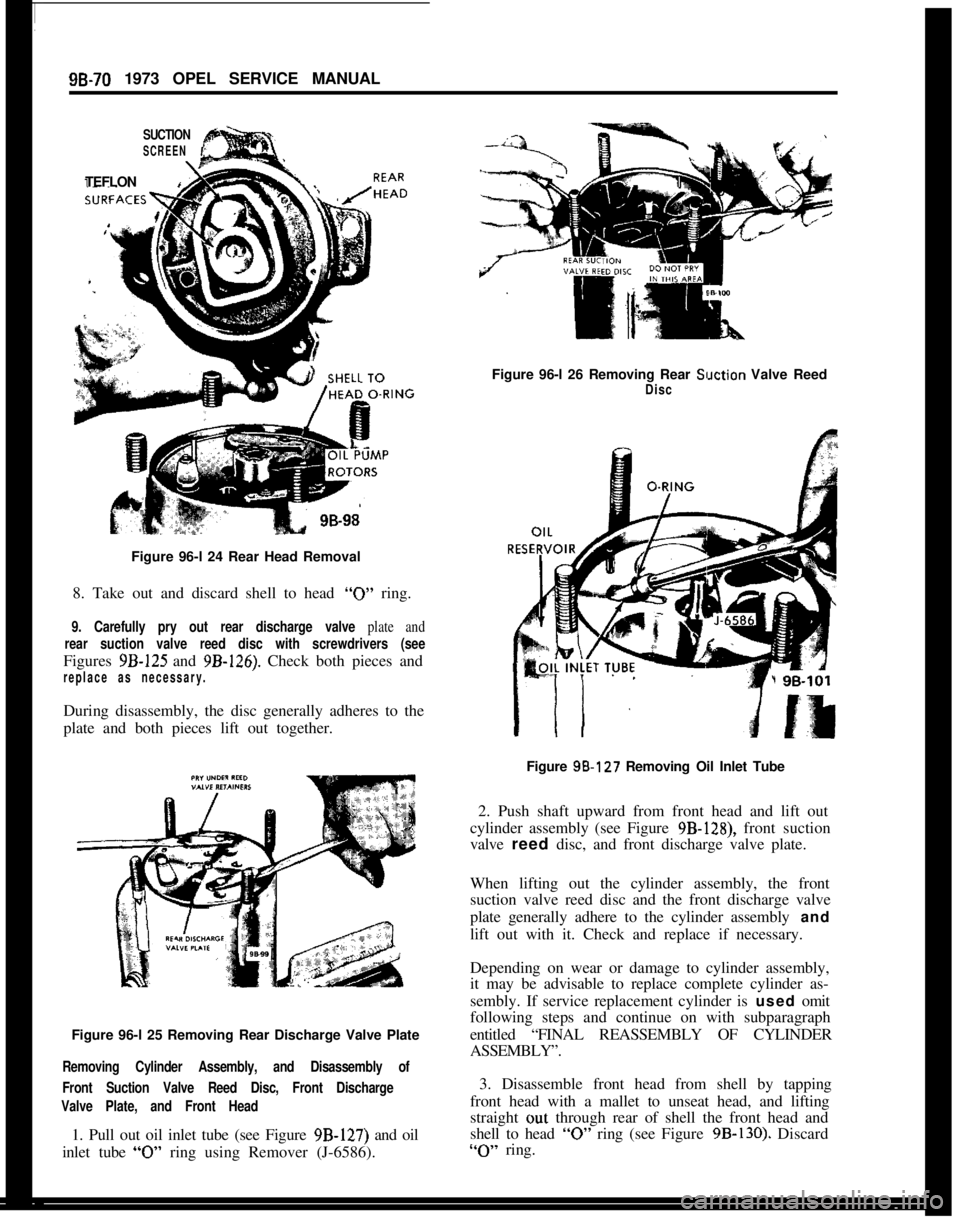
SUCTION
SCREENTEFLON Iut 98-98
Figure 96-l 24 Rear Head Removal
8. Take out and discard shell to head
“0” ring.
9. Carefully pry out rear discharge valve plate and
rear suction valve reed disc with screwdrivers (seeFigures 9B-125 and
9B-126). Check both pieces and
replace as necessary.During disassembly, the disc generally adheres to the
plate and both pieces lift out together.
Figure 96-l 25 Removing Rear Discharge Valve Plate
Removing Cylinder Assembly, and Disassembly of
Front Suction Valve Reed Disc, Front Discharge
Valve Plate, and Front Head1. Pull out oil inlet tube (see Figure 9B-127) and oil
inlet tube
“0” ring using Remover (J-6586).Figure 96-l 26 Removing Rear
SfJction Valve ReedDiscFigure 98-127 Removing Oil Inlet Tube
2. Push shaft upward from front head and lift out
cylinder assembly (see Figure 9B-128), front suction
valve reed disc, and front discharge valve plate.
When lifting out the cylinder assembly, the front
suction valve reed disc and the front discharge valve
plate generally adhere to the cylinder assembly and
lift out with it. Check and replace if necessary.
Depending on wear or damage to cylinder assembly,
it may be advisable to replace complete cylinder as-
sembly. If service replacement cylinder is used omit
following steps and continue on with subparagraph
entitled “FINAL REASSEMBLY OF CYLINDER
ASSEMBLY”.
3. Disassemble front head from shell by tapping
front head with a mallet to unseat head, and lifting
straight out through rear of shell the front head and
shell to head
“0” ring (see Figure 9B-130). Discard
“0” ring.
Page 583 of 625
98.74 1973 OPEL SERVICE MANUAL
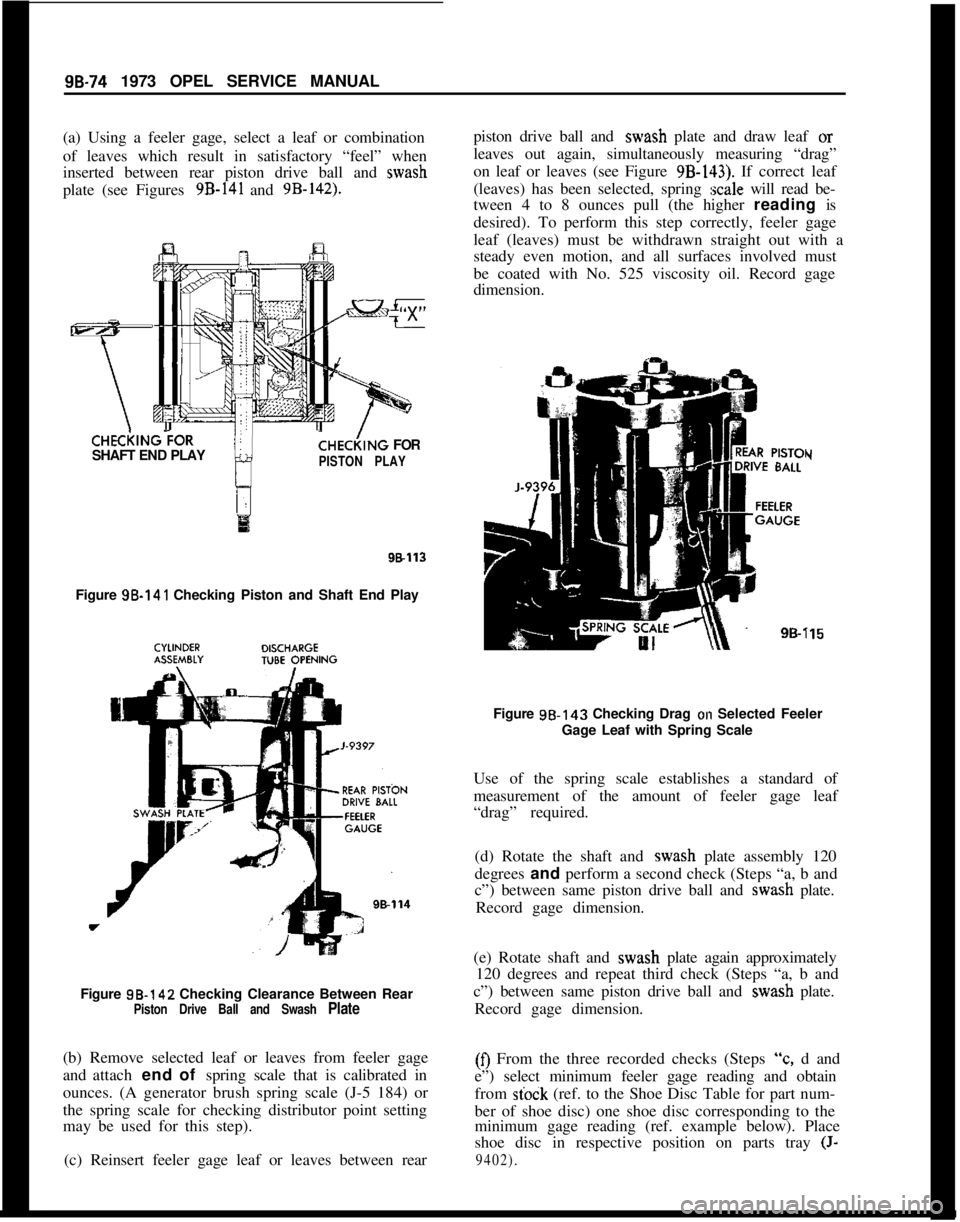
(a) Using a feeler gage, select a leaf or combination
of leaves which result in satisfactory “feel” when
inserted between rear piston drive ball and wash
plate (see Figures 9B-141 and 9B-142).CHECi(lNG?OR
SHAFT END PLAY
CHE&NG FOR
PISTON PLAY
98113Figure 98-141 Checking Piston and Shaft End Play
Figure 98-142 Checking Clearance Between Rear
Piston Drive Ball and Swash Plate(b) Remove selected leaf or leaves from feeler gage
and attach end of spring scale that is calibrated in
ounces. (A generator brush spring scale (J-5 184) or
the spring scale for checking distributor point setting
may be used for this step).
(c) Reinsert feeler gage leaf or leaves between rearpiston drive ball and wash plate and draw leaf or
leaves out again, simultaneously measuring “drag”
on leaf or leaves (see Figure
9B-143). If correct leaf
(leaves) has been selected, spring
:scale will read be-
tween 4 to 8 ounces pull (the higher reading is
desired). To perform this step correctly, feeler gage
leaf (leaves) must be withdrawn straight out with a
steady even motion, and all surfaces involved must
be coated with No. 525 viscosity oil. Record gage
dimension.
Y
i15Figure 98.143 Checking Drag
on Selected Feeler
Gage Leaf with Spring Scale
Use of the spring scale establishes a standard of
measurement of the amount of feeler gage leaf
“drag” required.
(d) Rotate the shaft and wash plate assembly 120
degrees and perform a second check (Steps “a, b and
c”) between same piston drive ball and wash plate.
Record gage dimension.
(e) Rotate shaft and wash plate again approximately
120 degrees and repeat third check (Steps “a, b and
c”) between same piston drive ball and wash plate.
Record gage dimension.(0 From the three recorded checks (Steps
“c, d and
e”) select minimum feeler gage reading and obtain
from
stock (ref. to the Shoe Disc Table for part num-
ber of shoe disc) one shoe disc corresponding to the
minimum gage reading (ref. example below). Place
shoe disc in respective position on parts tray
(J-
9402).
Page 584 of 625
REFRIGERANT COMPONENTS ALL MODELS9B- 75Shoe Disc TableSERVICEID. NO.
PART NO. STAMPED
6557000
6556175
6556180
65561856556190
65561956556200
65562056556210
65562156556220
EXAMPLESHOE
DISC
0
(“ZSXO”Shoe
Disc)
17
l/218%
1919
l/2202&2
2121
l/2
22
Piston’
1st2nd3rdNo.
CheckCheckCheck
1,019,020,019(Select
No.19 -ShoeDisc)
2,020,020,019(Select
No.19-ShoeDisc)
3
.021,020.021(Select
No.20ShoeDisc)
(g) Repeat Steps “c, d, e and f’ for other two pistons
and obtain two more selected shoe discs for other
two pistons. In the rebuilt cylinder assembly, each
piston will have one selected shoe disc and one
“zero” shoe disc.
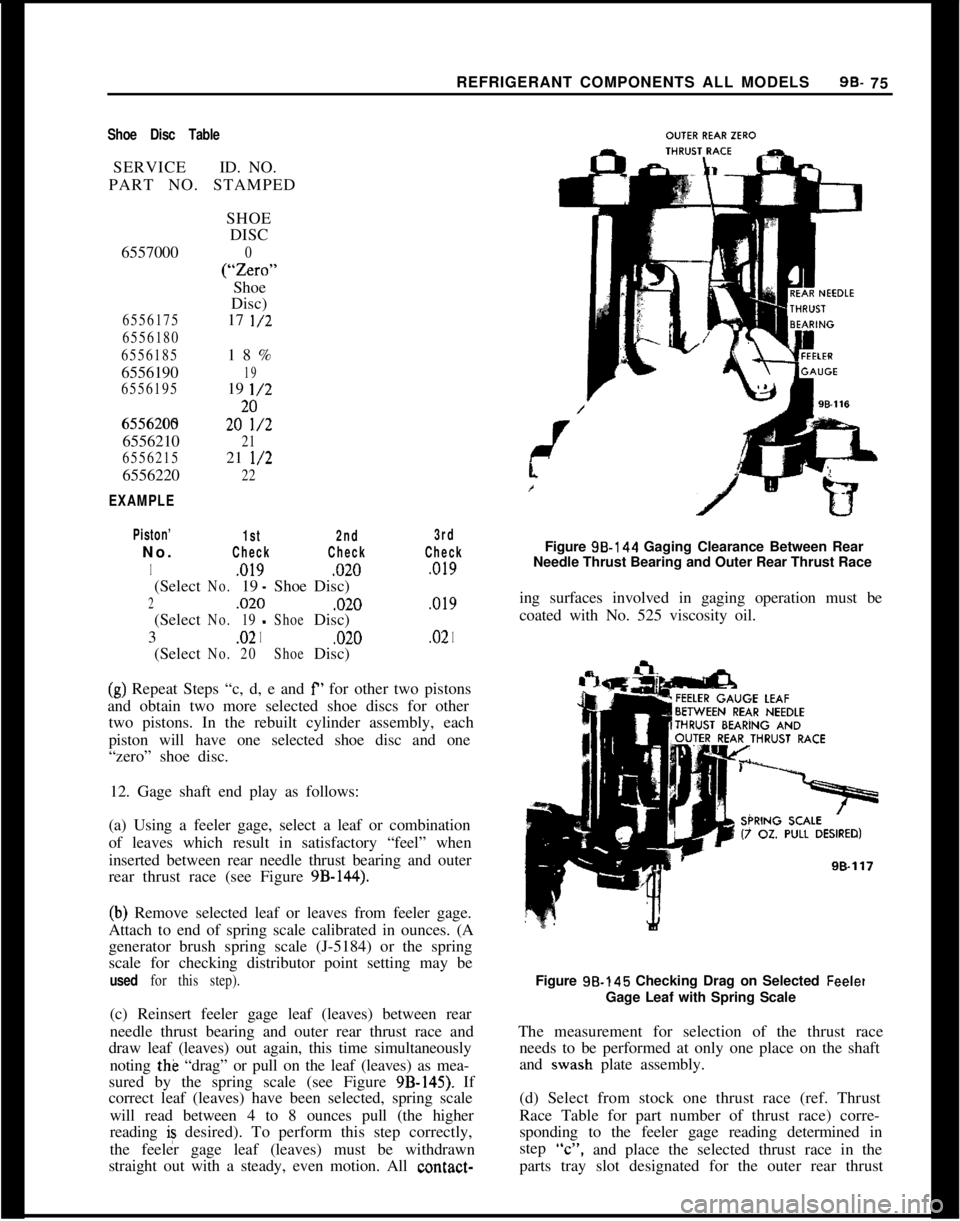
12. Gage shaft end play as follows:
(a) Using a feeler gage, select a leaf or combination
of leaves which result in satisfactory “feel” when
inserted between rear needle thrust bearing and outer
rear thrust race (see Figure
9B-144).
(b) Remove selected leaf or leaves from feeler gage.
Attach to end of spring scale calibrated in ounces. (A
generator brush spring scale (J-5184) or the spring
scale for checking distributor point setting may be
used for this step).(c) Reinsert feeler gage leaf (leaves) between rear
needle thrust bearing and outer rear thrust race and
draw leaf (leaves) out again, this time simultaneously
noting the “drag” or pull on the leaf (leaves) as mea-
sured by the spring scale (see Figure
9B-145). If
correct leaf (leaves) have been selected, spring scale
will read between 4 to 8 ounces pull (the higher
reading is desired). To perform this step correctly,
the feeler gage leaf (leaves) must be withdrawn
straight out with a steady, even motion. All contact-Figure 98.144 Gaging Clearance Between Rear
Needle Thrust Bearing and Outer Rear Thrust Race
ing surfaces involved in gaging operation must be
coated with No. 525 viscosity oil.
Figure 98.145 Checking Drag on Selected
FeeletGage Leaf with Spring Scale
The measurement for selection of the thrust race
needs to be performed at only one place on the shaft
and wash plate assembly.
(d) Select from stock one thrust race (ref. Thrust
Race Table for part number of thrust race) corre-
sponding to the feeler gage reading determined in
step
“C”,and place the selected thrust race in the
parts tray slot designated for the outer rear thrust