oil type OPEL 1900 1973 Owner's Guide
[x] Cancel search | Manufacturer: OPEL, Model Year: 1973, Model line: 1900, Model: OPEL 1900 1973Pages: 625, PDF Size: 17.22 MB
Page 542 of 625
REFRIGERANT COMPONENTS ALL MODELS99- 33
That the attraction of the drying material for mois-
ture is so powerful that if the receiver is left open,
moisture will be drawn in from the outside air.
That just one drop of water added to the refrigerantwill start chemical changes that can result in corro-
sion and eventual breakdown of the chemicals in the
system. Hydrochloric acid is the result of an R-12
mixture with water.
That the smallest amount of air in the refrigeration
system may start reactions that can cause malfunc-
tions.
That the drying agent in the receiver-dehydrator is
Activated Silica Alumina (silica-gel).
That
the inert gas in the expansion valve capillary
line is carbon dioxide.
DESCRIPTION OF AIR CONDITIONING
COMPONENTS
Compressor
The compressor is located in the engine compart-
ment. The purpose of the unit is to draw the low
pressure,gas from the evaporator and compress this
gas into a high temperature, high pressure gas. This
action will result in the refrigerant having a higher
temperature than the surrounding air.
The
cortipressor is of basic double action piston de-
sign. Three horizontal double acting pistons make up
a six cylinder compressor (See Figure
9B-162). The
pistons operate in
l-1/2 inch bore and have a l-1/8
inch stroke. A
wash plate keyed to the shaft drives
the pistons. The shaft is belt driven through a mag-
netic clutch and pulley arrangement. An oil pump
mounted at the rear of the compressor picks up oil
from the
botto’m of the compressor and lubricates the
bearings’and other internal parts of the compressor.
Reed type valves at each end of the compressor open
or close to control the flow of incoming and outgoing refrigerant. Two gas tight passages interconnect
chambers of the front and rear heads so that there is
one common suction port, and one common dis-
charge port. The internal parts of the compressor
function, as follows:
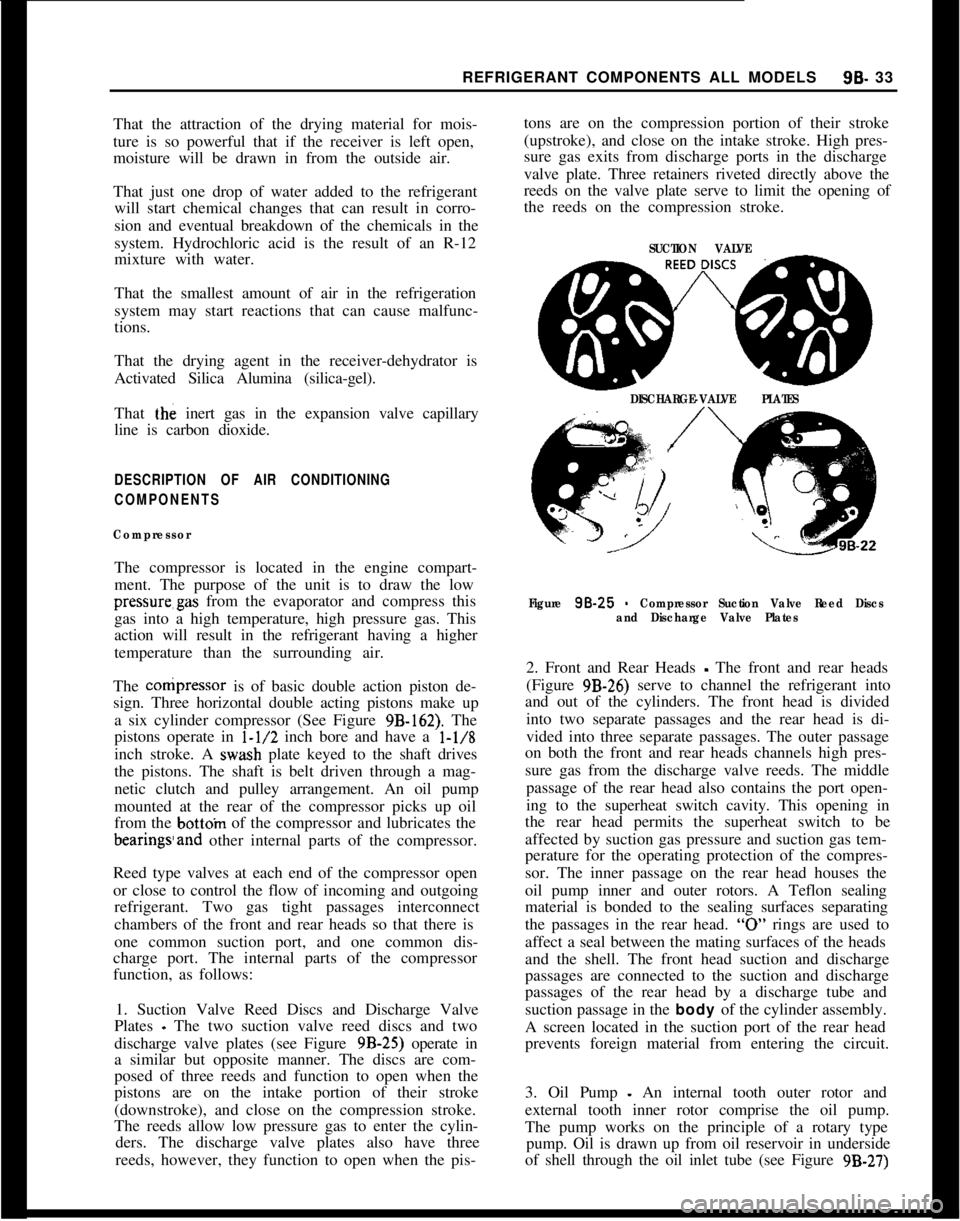
1. Suction Valve Reed Discs and Discharge Valve
Plates
_ The two suction valve reed discs and two
discharge valve plates (see Figure
9B-25) operate in
a similar but opposite manner. The discs are com-
posed of three reeds and function to open when the
pistons are on the intake portion of their stroke
(downstroke), and close on the compression stroke.
The reeds allow low pressure gas to enter the cylin- ders. The discharge valve plates also have three
reeds, however, they function to open when the pis- tons are on the compression portion of their stroke
(upstroke), and close on the intake stroke. High pres-
sure gas exits from discharge ports in the discharge
valve plate. Three retainers riveted directly above the
reeds on the valve plate serve to limit the opening of
the reeds on the compression stroke.
SUCTION VALVE
DISCHARGE-VALVE PLATES
Figure
98-25 - Compressor Suction Valve Reed Discs
and Discharge Valve Plates
2. Front and Rear Heads - The front and rear heads
(Figure
9B-26) serve to channel the refrigerant into
and out of the cylinders. The front head is divided
into two separate passages and the rear head is di-
vided into three separate passages. The outer passage
on both the front and rear heads channels high pres-
sure gas from the discharge valve reeds. The middle
passage of the rear head also contains the port open-
ing to the superheat switch cavity. This opening in
the rear head permits the superheat switch to be
affected by suction gas pressure and suction gas tem-
perature for the operating protection of the compres-
sor. The inner passage on the rear head houses the
oil pump inner and outer rotors. A Teflon sealing
material is bonded to the sealing surfaces separating
the passages in the rear head.
“0” rings are used to
affect a seal between the mating surfaces of the heads
and the shell. The front head suction and discharge
passages are connected to the suction and discharge
passages of the rear head by a discharge tube and
suction passage in the
body of the cylinder assembly.
A screen located in the suction port of the rear head
prevents foreign material from entering the circuit.
3. Oil Pump
- An internal tooth outer rotor and
external tooth inner rotor comprise the oil pump.
The pump works on the principle of a rotary type pump. Oil is drawn up from oil reservoir in underside
of shell through the oil inlet tube (see Figure
9B-27)
Page 547 of 625

9B-38 1973 OPEL SERVICE MANUAL
expand and return to the original gaseous state. To
accomplish this transformation it begins to boil.
The boiling action of the refrigerant demands heat.
To satisfy the demand for heat, the air passing over
the core gives up heat to the evaporator and is subse-
quently cooled.\
DIAGNOSIS
GENERAL INFORMATIONThe following is a brief description of the type of
sympton each refrigerant component will evidence if
a malfunction occurs:
Compressor malfunction will appear in one of four
ways: noise, seizure, leakage, or low discharge pres-
sure.Resonant compressor noises are not cause for alarm;
however, irregular noise or rattles may indicate
broken parts or excessive clearances due to wear. To
check seizure, de-energize the magnetic clutch and
check to see if drive plate can be rotated. If rotation
is impossible, compressor is seized. Low discharge
pressure may be due to a faulty internal seal of the
compressor, or a restriction in the compressor.
Low discharge pressure may also be due to an insuffi-
cient refrigerant charge or a restriction elsewhere in
the system. These possibilities should be checked
prior to servicing the compressor. If the compressor
is inoperative; but, is not seized, check to see if cur-
rent is being supplied to the magnetic clutch coil
terminals.
CondenserA condenser may malfunction in two ways: it may
leak, or it may be restricted. A condenser restriction
will result in excessive compressor discharge pres-
sure. If a partial restriction is present, sometimes ice
or frost will form immediately after the restriction as
the refrigerant expands after pas?ing through the re-
striction. If air flow through the condenser or radia-
tor is blocked, high discharge pressures will result.
During normal condenser operation, the outlet pipe
will be slightly cooler than the inlet pipe.
Receiver-DehydratorA receiver-dehydrator may fail due to a restriction
inside body of unit. A restriction at the inlet to the
receiver-dehydrator will cause high head pressures.
Outlet tube restrictions will be indicated by low headpressures. Outlet tube restrictions will be indicated
by
low head pressures and little or no cooling. An
excessively cold receiver-dehydrator outlet may be
indicative of a restriction.
Expansion ValveExpansion valve failures usually will be indicated by
low suction and discharge pressures, and insuff%ient
evaporator cooling. The failure is generally due to
malfunction of the power element and subsequent
closing of the valve. A less common cause of the
above symptom is a clogged inlet screen.
EvaporatorWhen the evaporator malfunctions, the trouble will
show up as inadequate supply of cool air. A partially
plugged core due to dirt or a faulty blower will gener-
ally be the cause.
Refrigerant Line Restrictions
Rest~rictions in the refrigerant lines will be indicated
as follows:
I. Suction Line - A restricted suction line will cause
low suction pressure at the compressor, low dis-
charge pressure and little or no cooling.
2. Discharge Line -A restriction in the discharge line
generally will cause the pressure relief valve to open.
3. Liquid Line
- A liquid line restriction will be evi-
denced by low discharge and suction pressure, and
insufficient cooling.
Use of Receiver-Dehydrator Sight Glass for
DiagnosisAt temperatures higher than 70 degrees F, the sight
glass may indicate whether the refrigerant charge is
sufficient. A shortage of liquid refrigerant is in-
dicated after about
five minutes of compressor oper-
ation by the appearance of slow-moving bubbles
(vapor) or a broken column of refrigerant under the
glass. Continuous bubbles may appear in a properly
charged system on a cool day. This is a normal situa-
tion. If the sight, glass is generally clear and perform-
ance is satisfactory, occasional bubbles do not
indicate refrigerant shortage.
If the sight glass consistently shows foaming or a
broken liquid column, it should be observed after
partially blocking the air to the condenser. If under
this condition the sight glass clears and the perform-
ance is otherwise satisfactory, the charge shall be
considered adequate.
Page 565 of 625

98-56 1973 OPEL SERVICE MANUAL
oil cooler lines to lower radiator tank. It is essential
that no dirt enters the oil lines. When tightening oil
lines hold connectors on lower radiator tank with
pliers to avoid leakages. Ensure that no dirt enters oil
cooler. Torque to 11-15 Ibs. ft.
7. Install fan shroud.
8. Install upper radiator hose.
9. Install lower radiator hose and add collected coo-
lant.
All Opel
1900’s and Manta’s are provided with a
radiator initial fill of an anti-freeze solution contain-
ing corrosion inhibitor. The anti-freeze has either a
glycol or glycerin base and protects the engine
against freezing, down to minus 22 degrees F. (minus
30 degrees C.). Before the start of the cold season,
coolant must be checked with a hydrometer and if
necessary, brought to the necessary specific gravity
by adding anti-freeze. Anti-freeze added, must have
a glycol or glycerin base. As the specific gravities of
all anti-freeze solutions having a glycol or glycerin
base are practically the same, the hydrometer can be
used for all these types. Because of the tolerances of
the hydrometer, or slight differences in specific
gravity, variations of plus or minus 5 degrees can be
expected. Coolant must be checked at a temperature
of plus 68 degrees F. (plus 20 degrees C.).
IO. Install negative battery cable and air cleaner.
11. Charge system. Refer to CHARGING SYS-
TEM.
Figure 99.80 Location of Idler Pulley and Bracket
Assembly
- GTFigure 99.81 Idler Pulley and Bracket Assembly and
Support Bracket GT
REMOVAL AND INSTALLATION OF
COMPRESSOR. GT
I. Removenegative battery cable from battery.
Figure 98-82 Compressor Adapter Fitting, Ground
Wire. and Front and Rear Mounting Bolts
- GT
Figure 99.83
Elecirical Connector and Ground Wire
GT
Page 574 of 625
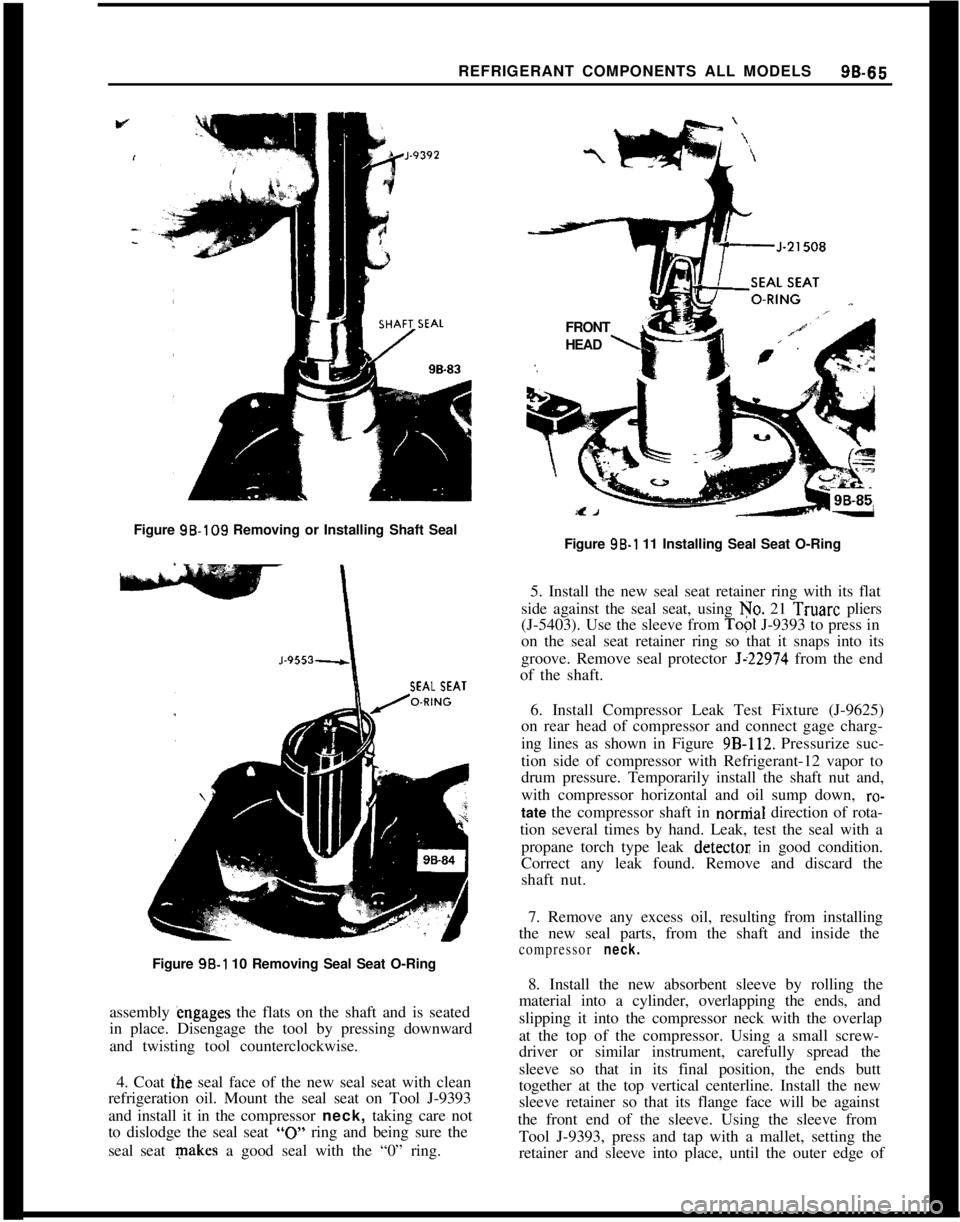
REFRIGERANT COMPONENTS ALL MODELS96-66Figure 98.109 Removing or Installing Shaft Seal
SEAL SEAT
-Figure 98-l 10 Removing Seal Seat O-Ring
assembly engages the flats on the shaft and is seated
in place. Disengage the tool by pressing downward
and twisting tool counterclockwise.
4. Coat ihe seal face of the new seal seat with clean
refrigeration oil. Mount the seal seat on Tool J-9393
and install it in the compressor neck, taking care not
to dislodge the seal seat
“0” ring and being sure the
seal seat makes a good seal with the “0” ring.FRONT
L’HEAD
\Figure 96-l 11 Installing Seal Seat O-Ring
5. Install the new seal seat retainer ring with its flat
side against the seal seat, using No. 21 Truarc pliers
(J-5403). Use the sleeve from
Top1 J-9393 to press in
on the seal seat retainer ring so that it snaps into its
groove. Remove seal protector
Jz22974 from the end
of the shaft.
6. Install Compressor Leak Test Fixture (J-9625)
on rear head of compressor and connect gage charg-
ing lines as shown in Figure
9B-112. Pressurize suc-
tion side of compressor with Refrigerant-12 vapor to
drum pressure. Temporarily install the shaft nut and,
with compressor horizontal and oil sump down,
ro-tate the compressor shaft in nornial direction of rota-
tion several times by hand. Leak, test the seal with a
propane torch type leak
detectot; in good condition.
Correct any leak found. Remove and discard the
shaft nut.
7. Remove any excess oil, resulting from installing
the new seal parts, from the shaft and inside the
compressor neck.8. Install the new absorbent sleeve by rolling the
material into a cylinder, overlapping the ends, and
slipping it into the compressor neck with the overlap
at the top of the compressor. Using a small screw-
driver or similar instrument, carefully spread the
sleeve so that in its final position, the ends butt
together at the top vertical centerline. Install the new
sleeve retainer so that its flange face will be against
the front end of the sleeve. Using the sleeve from
Tool J-9393, press and tap with a mallet, setting the
retainer and sleeve into place, until the outer edge of
Page 591 of 625
r98-82 1973 OPEL SERVICE MANUAL
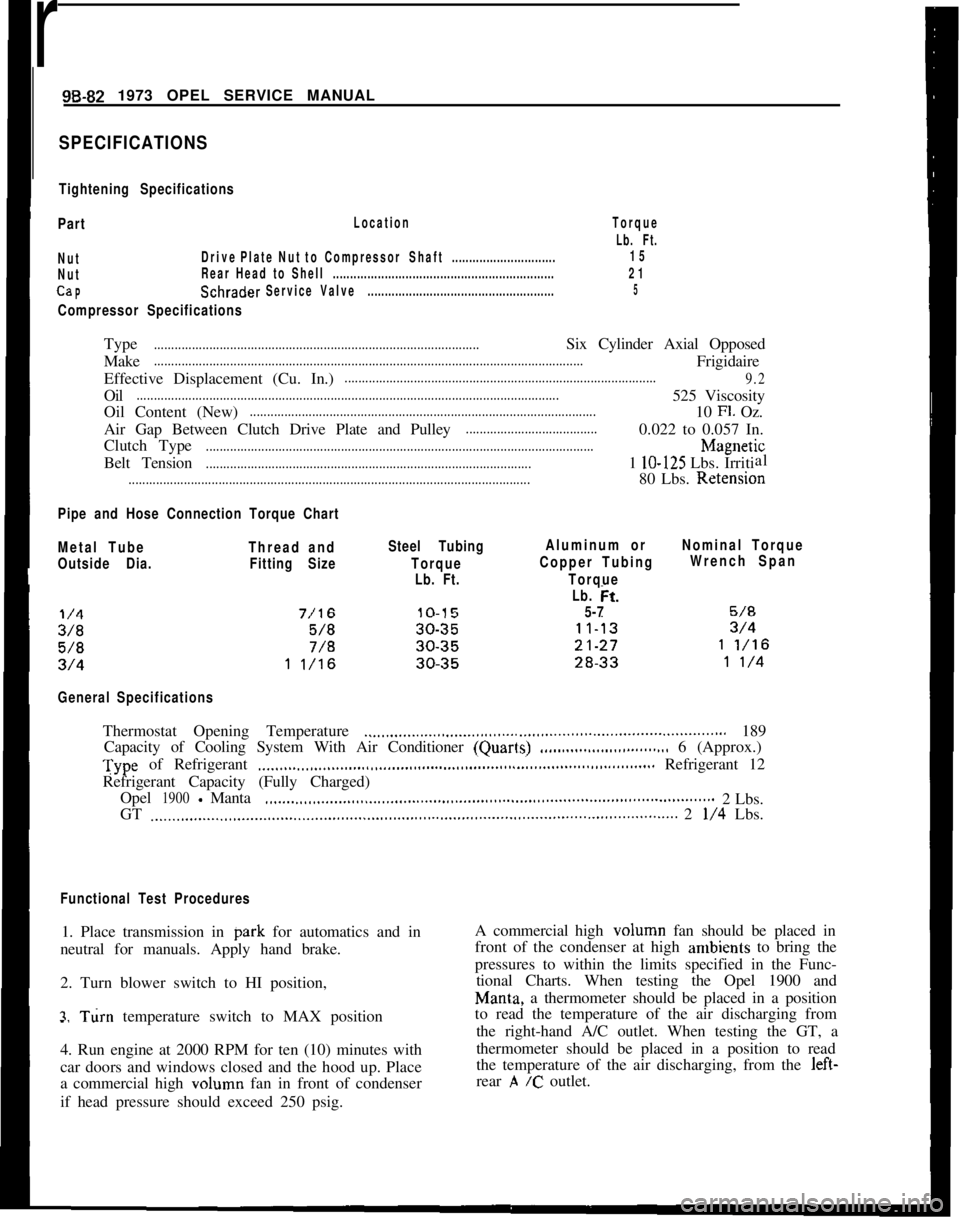
SPECIFICATIONS
Tightening Specifications
Part
Location
NutDrivePlateNut toCompressorShaft..............................
NutRear Head to Shell................................................................
CaPSchraderServiceValve......................................................
Compressor Specifications
Torque
Lb. Ft.
15
21
5Type
..............................................................................................Six Cylinder Axial Opposed
Make
............................................................................................................................Frigidaire
Effective Displacement (Cu. In.)
..........................................................................................
9.2Oil
..........................................................................................................................525 Viscosity
Oil Content (New)
....................................................................................................10 Fl. Oz.
Air Gap Between Clutch Drive Plate and Pulley
......................................0.022 to 0.057 In.
Clutch Type
................................................................................................................h4agnetic
Belt Tension
..............................................................................................1 lo-125 Lbs. Irritial
....................................................................................................................80 Lbs. Retension
Pipe and Hose Connection Torque Chart
Metal TubeThread andSteel TubingAluminum orNominal Torque
I
Outside Dia.Fitting SizeTorqueCopper TubingWrench Span
Lb. Ft.Torque
Lb. tit.
5-7
General SpecificationsThermostat Opening Temperature
.._.....,,,...__....,,.............................................................. 189
Capacity of Cooling System With Air Conditioner (Quarls)
.,,..___....___............... 6 (Approx.)Type of Refrigerant
.___,,,._...,.,,,.__.....,,,.......,,,,.......,,,...................,,,......,,,............ Refrigerant 12
Refrigerant Capacity (Fully Charged)
Opel
1900-Manta,,._....,,,,._...._.,,,,.......,,,........,,............................................................2 Lbs.
GT
,..__..,..,..__..,,,.......,,,,.......,,,........,,,.,......,,,,,......,,.,,........,,.......,,..........,,............... 2 l/4 Lbs.
Functional Test Procedures1. Place transmission in park for automatics and in
neutral for manuals. Apply hand brake.
2. Turn blower switch to HI position,
3. Turn temperature switch to MAX position-.
4. Run engine at 2000 RPM for ten (10) minutes with
car doors and windows closed and the hood up. Place
a commercial high volumn fan in front of condenser
if head pressure should exceed 250 psig.A commercial high volumn fan should be placed in
front of the condenser at high ambients to bring the
pressures to within the limits specified in the Func-
tional Charts. When testing the Opel 1900 and
Man& a thermometer should be placed in a position
to read the temperature of the air discharging from
the right-hand A/C outlet. When testing the GT, a
thermometer should be placed in a position to read
the temperature of the air discharging, from the left-
rear
,A /c outlet.
Page 597 of 625
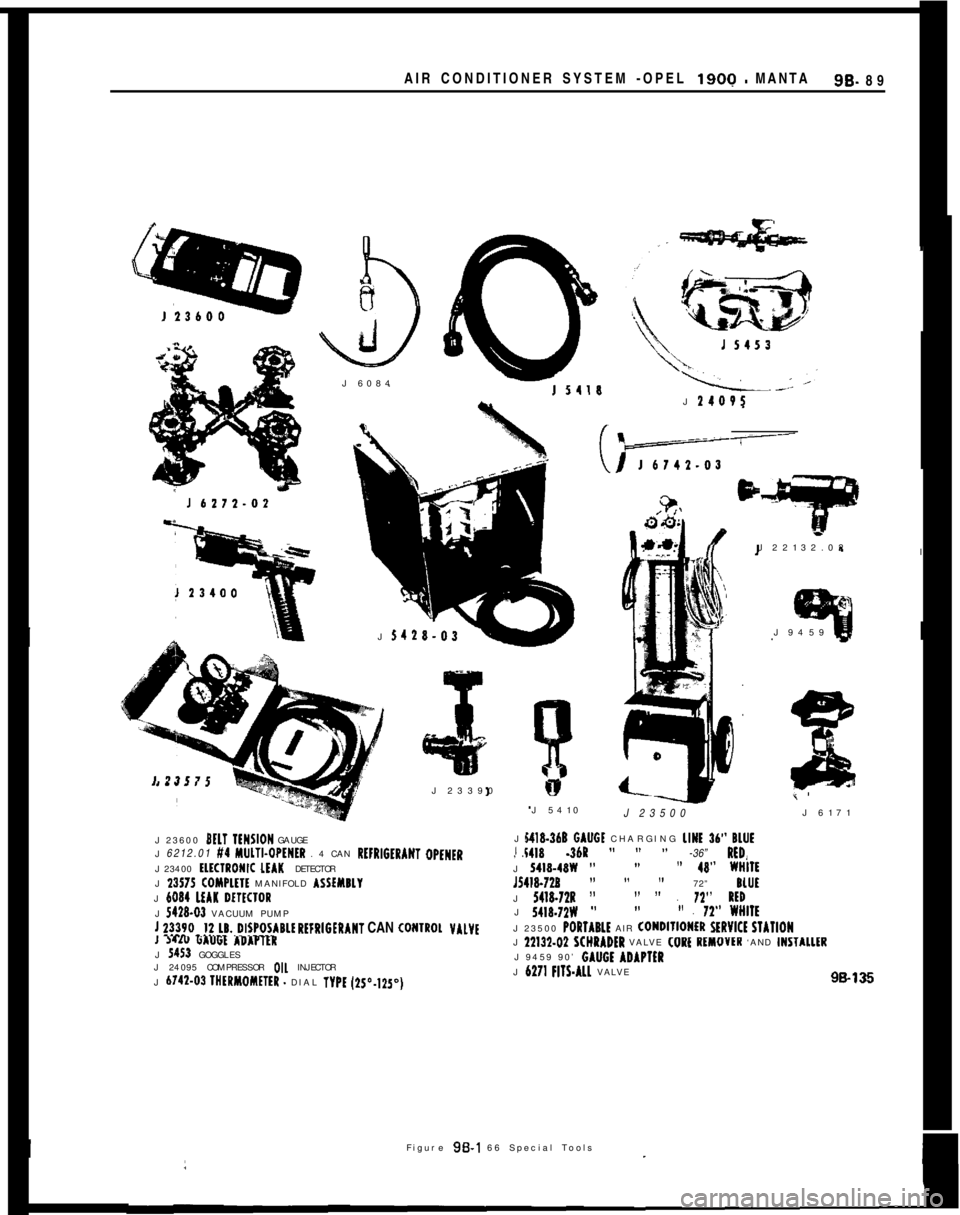
AIR CONDITIONER SYSTEM -OPEL 1900 - MANTASB- 89
cJ 6084
J
14OVSJ
5428.03
,J 23390
J 23600 BELT IENSION GAUGE
J 6212.01 #4 MlJLTI.OPtNtR . 4 CAN RtFRIGtRANT OPENER
J 23400
tlKlRONIC LEAK DETECTOR
J 23575 COMPLHE MANIFOLD ASSfYBLY
J 6034 LEAK WtClORJ 5418-03 VACUUM PUMP
! ?!!~O~!~~~..~I~poIIRL~ REFRIGERANT CAN CONIROL VALVEI WI" 6A"Gt ADAPTEK
J 5453 GOGGLES
J 24095 COMPRESSOR OIL INJECTOR
J 6742.03 IHtRMOMETER
- DIAL TYPE (2S”.lZ5~)J 22132.02
I
J 9459
1J 5410
J 23500J 6171
141%360 GAUGt CHARGING LINE 36” BLUEi418 -36R ” ” ” -36” RED, J!I I, .J 5418.48W ””” 48” WHIIEJ5418.728
” ” ” 72” BLUI
J 5418.72s ”” I’ . 11” RtD
J 5418.7ZW ””” . 72” WWllt
J 23500 PORlARLt AIR ~ONDIlIONtR SERVlCt STAllON
J 22132.D2 SCWRADER VALVE
J 6271 FIlS.ALL VALVE98136I
IFigure 96-l 66 Special Tools