engine OPEL ANTARA 2009 Owner's Manual
[x] Cancel search | Manufacturer: OPEL, Model Year: 2009, Model line: ANTARA, Model: OPEL ANTARA 2009Pages: 234, PDF Size: 3.01 MB
Page 95 of 234

Lighting95
Main beam, headlamp flash
To switch from dipped beam to main
beam, push lever forwards.
To switch back to dipped beam, pull lever
back towards steering wheel.
To activate the headlamp flash, pull lever
towards steering wheel. Main beam is
engaged for the duration of activation.
The blue control indicator P is illuminated
when main beam or headlamp flash is on.
Automatic dipped beam
activation 3
Light switch to AUTO; dipped beam comes
on automatically when the engine is
running, depending on outside light
conditions.
For reasons of safety, the light switch
should always remain in the AUTO
position.
To ensure automatic dipped beam
activation functions properly, do not cover
the light sensor on top of the instrument
panel.
Turn signal lamps
To activate, press lever up or down lightly.
When the steering wheel is turned back, the
lever automatically returns to its rest
position. This will not happen when making
a minor steering manoeuvre such as lane
changing.
Tap signal: briefly move lever to resistance
point. The turn signal then flashes three
times when changing lanes or the like.
Hold the lever if you want the turn signals
to flash for longer. When released, the lever
will spring back to rest position.
The volume of the turn signal lamps’
audible warning is dependent upon vehicle
speed.
Lever up = Right turn
Lever down = Left turn
Page 105 of 234
Climate control105
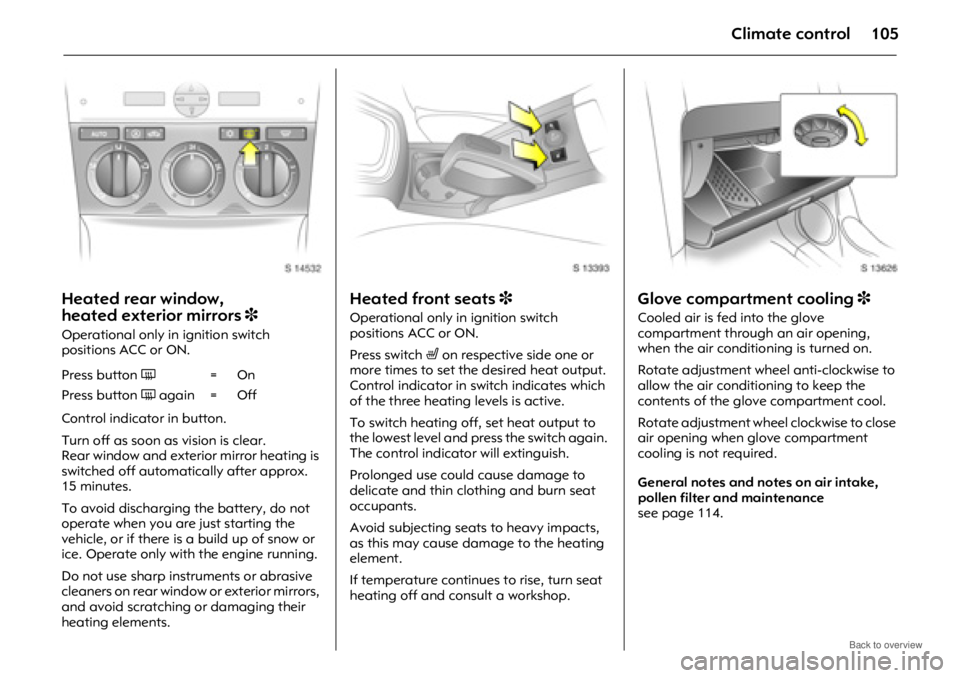
Heated rear window,
heated exterior mirrors 3
Operational only in ignition switch
positions ACC or ON.
Control indicator in button.
Turn off as soon as vision is clear.
Rear window and exterior mirror heating is
switched off automatically after approx.
15 minutes.
To avoid discharging the battery, do not
operate when you are just starting the
vehicle, or if there is a build up of snow or
ice. Operate only with the engine running.
Do not use sharp instruments or abrasive
cleaners on rear window or exterior mirrors,
and avoid scratching or damaging their
heating elements.
Heated front seats 3
Operational only in ignition switch
positions ACC or ON.
Press switch ß on respective side one or
more times to set the desired heat output.
Control indicator in switch indicates which
of the three heating levels is active.
To switch heating off, set heat output to
the lowest level and press the switch again.
The control indicato r will extinguish.
Prolonged use could cause damage to
delicate and thin clothing and burn seat
occupants.
Avoid subjecting seats to heavy impacts,
as this may cause damage to the heating
element.
If temperature continues to rise, turn seat
heating off and consult a workshop.
Glove compartment cooling 3
Cooled air is fed into the glove
compartment through an air opening,
when the air conditioning is turned on.
Rotate adjustment wheel anti-clockwise to
allow the air conditioning to keep the
contents of the glove compartment cool.
Rotate adjustment wheel clockwise to close
air opening when glove compartment
cooling is not required.
General notes and notes on air intake,
pollen filter and maintenance
see page 114.
Press button
Ü=On
Press button Ü again = Off
Page 107 of 234
Climate control107
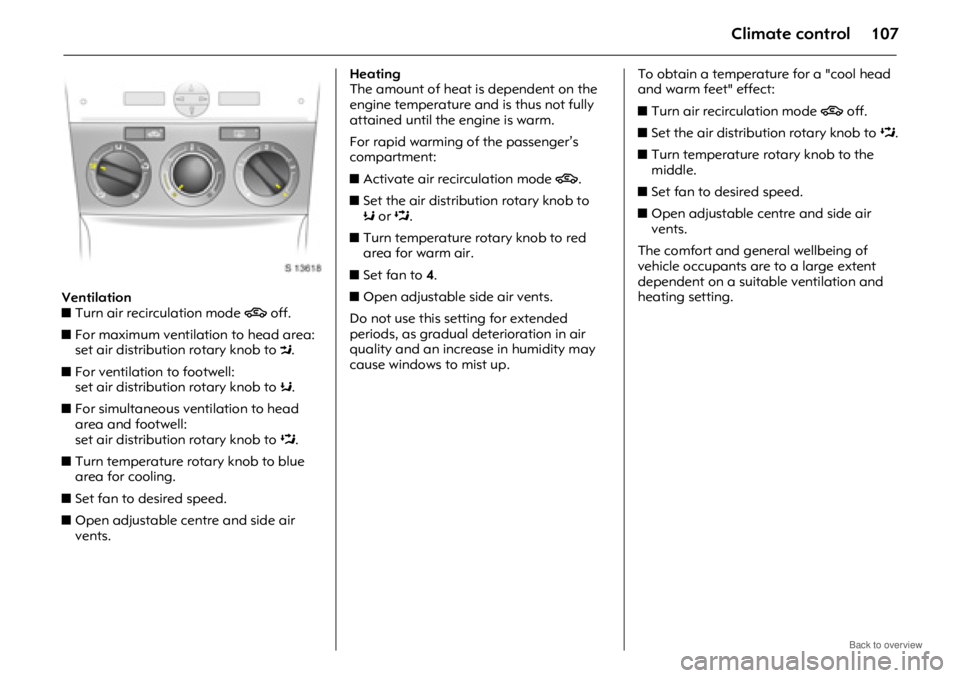
Ventilation
zTurn air recirculation mode 4 off.
z For maximum ventilation to head area:
set air distribution rotary knob to M.
z For ventilation to footwell:
set air distribution rotary knob to K.
z For simultaneous ventilation to head
area and footwell:
set air distribution rotary knob to L.
z Turn temperature rotary knob to blue
area for cooling.
z Set fan to desired speed.
z Open adjustable centre and side air
vents. Heating
The amount of heat is dependent on the
engine temperature and is thus not fully
attained until the engine is warm.
For rapid warming of the passenger’s
compartment:
z
Activate air recirculation mode 4.
z Set the air distribution rotary knob to
K or L .
z Turn temperature ro tary knob to red
area for warm air.
z Set fan to 4 .
z Open adjustable side air vents.
Do not use this setting for extended
periods, as gradual deterioration in air
quality and an increase in humidity may
cause windows to mist up. To obtain a temperat
ure for a "cool head
and warm feet" effect:
z Turn air recirculation mode 4 off.
z Set the air distribution rotary knob to L.
z Turn temperature rotary knob to the
middle.
z Set fan to desired speed.
z Open adjustable centre and side air
vents.
The comfort and general wellbeing of
vehicle occupants are to a large extent
dependent on a suitab le ventilation and
heating setting.
Page 110 of 234
Climate control110
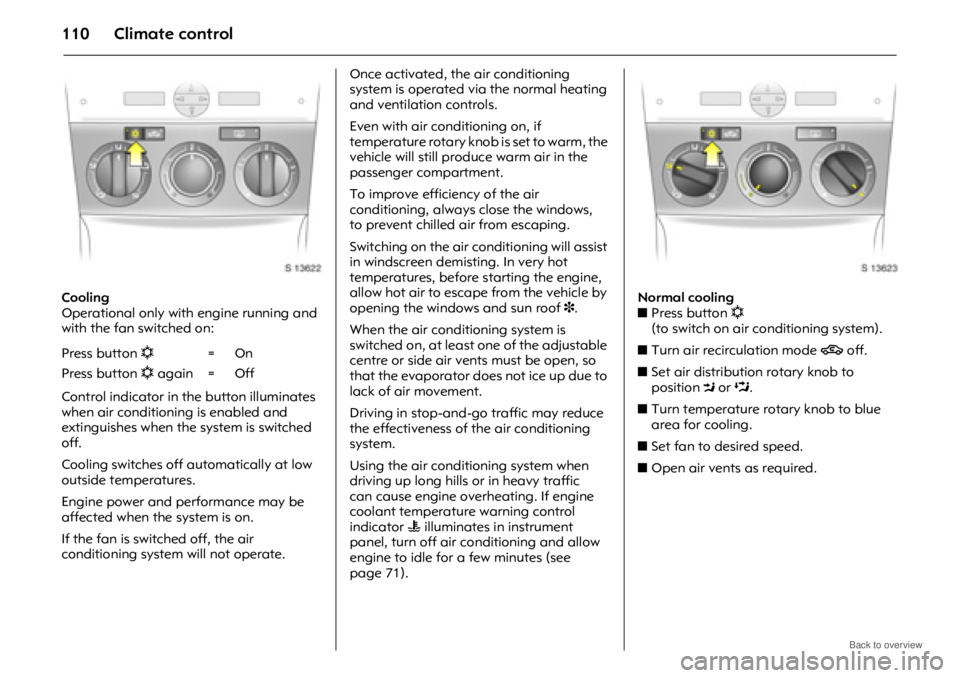
Cooling
Operational only with engine running and
with the fan switched on:
Control indicator in the button illuminates
when air conditioning is enabled and
extinguishes when the system is switched
off.
Cooling switches off automatically at low
outside temperatures.
Engine power and performance may be
affected when the system is on.
If the fan is switched off, the air
conditioning system will not operate. Once activated, the air conditioning
system is operated via the normal heating
and ventilation controls.
Even with air conditioning on, if
temperature rotary knob is set to warm, the
vehicle will still produce warm air in the
passenger compartment.
To improve efficiency of the air
conditioning, always close the windows,
to prevent chilled air from escaping.
Switching on the air conditioning will assist
in windscreen demisting. In very hot
temperatures, before starting the engine,
allow hot air to escape from the vehicle by
opening the windows and sun roof
3.
When the air conditioning system is
switched on, at least one of the adjustable
centre or side air vents must be open, so
that the evaporator does not ice up due to
lack of air movement.
Driving in stop-and-go traffic may reduce
the effectiveness of the air conditioning
system.
Using the air conditioning system when
driving up long hills or in heavy traffic
can cause engine overheating. If engine
coolant temperature warning control
indicator W illuminates in instrument
panel, turn off air co nditioning and allow
engine to idle for a few minutes (see
page 71). Normal cooling
z
Press button n
(to switch on air co nditioning system).
z Turn air recirculation mode 4 off.
z Set air distribution rotary knob to
position M or L.
z Turn temperature rotary knob to blue
area for cooling.
z Set fan to desired speed.
z Open air vents as required.
Press button
n=On
Press button n again = Off
Page 112 of 234

Climate control112
Automatic air recirculation
The automatic air recirculation system has
an air quality sensor to detect harmful
ambient gases, in which case it will switch
automatically to air recirculation mode.
Press automatic air recirculation button t;
the system provides the optimum settings
for almost all conditions. Control indicator
in the button illuminates when automatic
air recirculation is enabled.
Press button t again to turn automatic air
recirculation system off; control indicator in
the button extinguishes and outside air is
drawn into the vehicle.
The system is only operational when the
engine is running. Automatic mode
Basic setting for maximum comfort:
z
Press AUTO button.
z Open all air vents.
z Set temperature using central rotary
knob.
All air vents are actuated automatically in
automatic mode. The air vents should
therefore always be open - see page 104.
The control indicator in the AUTO button
illuminates when automatic mode has
been selected.
To switch the system off, set fan to x .Temperature preset
The central rotary knob can be used to set
the temperature; 22 °C, 24 °C and 26 °C
appear on the rotary
knob. Intermediate
settings are possible.
The selected temperature is maintained.
At the lowest or highest temperature
setting, the system works at maximum
cooling or heating.
Page 114 of 234

Climate control114
Air intake
The air intakes in front of the windscreen in
the engine compartment must be kept
clear to allow air intake. Remove any
leaves, dirt or snow.
Pollen filter
The pollen filter cleans dust, soot, pollen
and spores from the air entering from
outside. The active carbon layer 3
eliminates most odours and harmful
ambient gases from the air.
Replace the pollen filter at the intervals
given on pages 206 to 212.
Note
If the windscreen mists up in damp
weather, temporarily set the system as
described under "Window demisting and
defrosting" - see pages 108, 113.
Cooling is most efficient when the windows
are closed. If the interior is extremely hot
due to a long period in strong sunlight,
briefly open the windows and sun roof 3 to
allow hot air to escape quickly.
When cooling (air conditioning
compressor) is switched on, condensation
forms, which is expelled from the underside
of the vehicle.
When cooling is switched on, at least one of
the adjustable centre or side air vents must
be open so that the evaporator does not
ice up due to lack of air movement.
Cooling switches off automatically at low
outside temperatures.
Do not cover the interior temperature
sensor (located below the fan switch) or the
sunlight sensor (located in front of
windscreen defroster vents) as this could
cause the Electronic Climate Control (ECC)
system 3 to malfunction.
Maintenance
To ensure continuously efficient
performance and prolong the life of the air
conditioning system, it must be switched on
for a few minutes once a week, irrespective
of the weather and time of year.
Electronic Climate Control (ECC) 3 handles
this automatically while driving. Air
conditioning compressor operation is not
possible at low outside temperatures.
Malfunctions in the system must not be
rectified by the owner: consult a workshop.
Page 115 of 234

Driving and operation115
Driving and operationAutomatic transmission 3
The automatic transmission permits
manual gearshifting (manual mode) or
automatic gearshifting ( automatic mode)
with fully automatic clutch control.
The engine can only be started when the
selector lever is in position P or N. When
starting in P, turn key in ignition switch to
ACC or ON, depress foot brake and press
selector lever button before selecting a
gear.
Do not accelerate whilst gearshifting. If a
gear has been selected and the foot brake
is released without accelerating, the
vehicle will "creep".
Never operate the brake pedal and
accelerator simultaneously. Selecting
D puts the transmission in
automatic mode.
If the selector lever is moved to the left from
position D, manual mode is activated.
Forward gear changes only can then be
made manually by tipping the selector
lever towards + or -.
Automatic transmission
3................. 115
All Wheel Drive.................................... 121
Driving hints ........................................ 127
Save fuel, protect the environment ... 129
Fuels, refuelling ................................... 131
Catalytic converter, exhaust emissions........................................... 133
Drive control systems ......................... 136
Brake system ....................................... 145
Anti-lock Brake System (ABS) u....... 148
Wheels, tyres ....................................... 149
Roof racks 3........................................ 153
Flex-Fix system 3................................ 154
Towing equipment 3 .......................... 164
Towing ................................................. 1679 Warning
Disregard of these instructions may
cause damage to the vehicle and lead to
injuries or endanger life.
Page 116 of 234
Driving and operation116
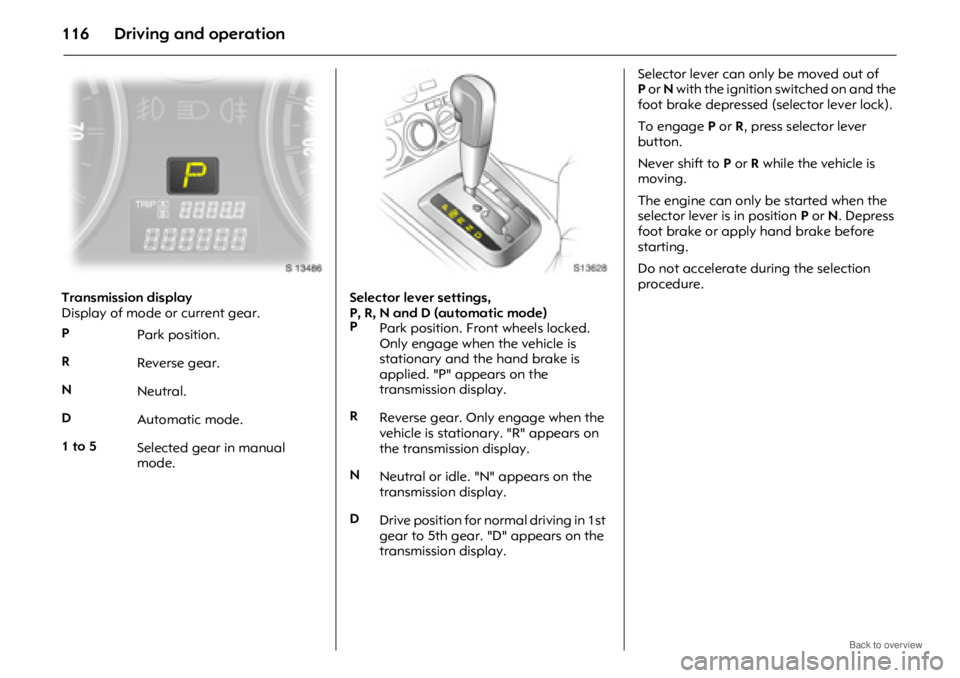
Transmission display
Display of mode or current gear.Selector lever settings,
P, R, N and D (automatic mode)Selector lever can only be moved out of
P
or N with the ignition switched on and the
foot brake depressed (selector lever lock).
To engage P or R, press selector lever
button.
Never shift to P or R while the vehicle is
moving.
The engine can only be started when the
selector lever is in position P or N. Depress
foot brake or apply hand brake before
starting.
Do not accelerate during the selection
procedure.
P Park position.
R Reverse gear.
N Neutral.
D Automatic mode.
1 to 5 Selected gear in manual
mode.
P
Park position. Front wheels locked.
Only engage when the vehicle is
stationary and the hand brake is
applied. "P" appears on the
transmission display.
R Reverse gear. Only engage when the
vehicle is stationary. "R" appears on
the transmission display.
N Neutral or idle. "N" appears on the
transmission display.
D Drive position for normal driving in 1st
gear to 5th gear. "D" appears on the
transmission display.
Page 117 of 234
Driving and operation117
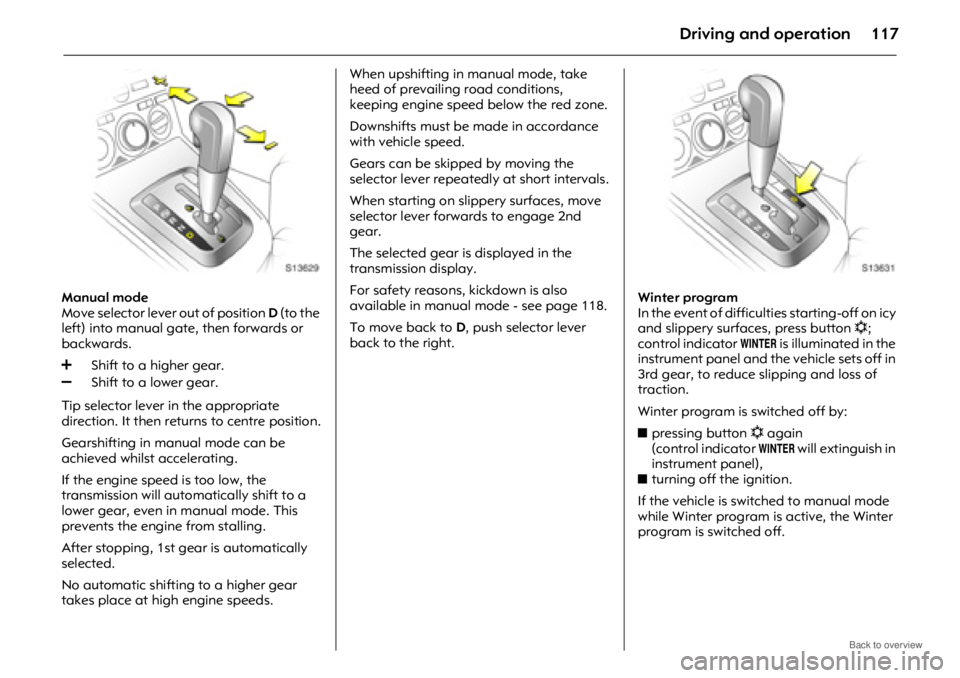
Manual mode
Move selector lever out of position D (to the
left) into manual gate, then forwards or
backwards.
Tip selector lever in the appropriate
direction. It then returns to centre position.
Gearshifting in manual mode can be
achieved whilst accelerating.
If the engine speed is too low, the
transmission will automatically shift to a
lower gear, even in manual mode. This
prevents the engine from stalling.
After stopping, 1st gear is automatically
selected.
No automatic shifting to a higher gear
takes place at high engine speeds. When upshifting in manual mode, take
heed of prevailing road conditions,
keeping engine speed below the red zone.
Downshifts must be made in accordance
with vehicle speed.
Gears can be skipped by moving the
selector lever repeated
ly at short intervals.
When starting on slippery surfaces, move
selector lever forwards to engage 2nd
gear.
The selected gear is displayed in the
transmission display.
For safety reasons, kickdown is also
available in manual mode - see page 118.
To move back to D, push selector lever
back to the right. Winter program
In the event of difficult
ies starting-off on icy
and slippery surfac es, press button n;
control indicator
0 is illuminated in the
instrument panel and the vehicle sets off in
3rd gear, to reduce slipping and loss of
traction.
Winter program is switched off by:
z pressing button n again
(control indicator
0 will extinguish in
instrument panel),
z turning off the ignition.
If the vehicle is switched to manual mode
while Winter program is active, the Winter
program is switched off.
Page 118 of 234
Driving and operation118
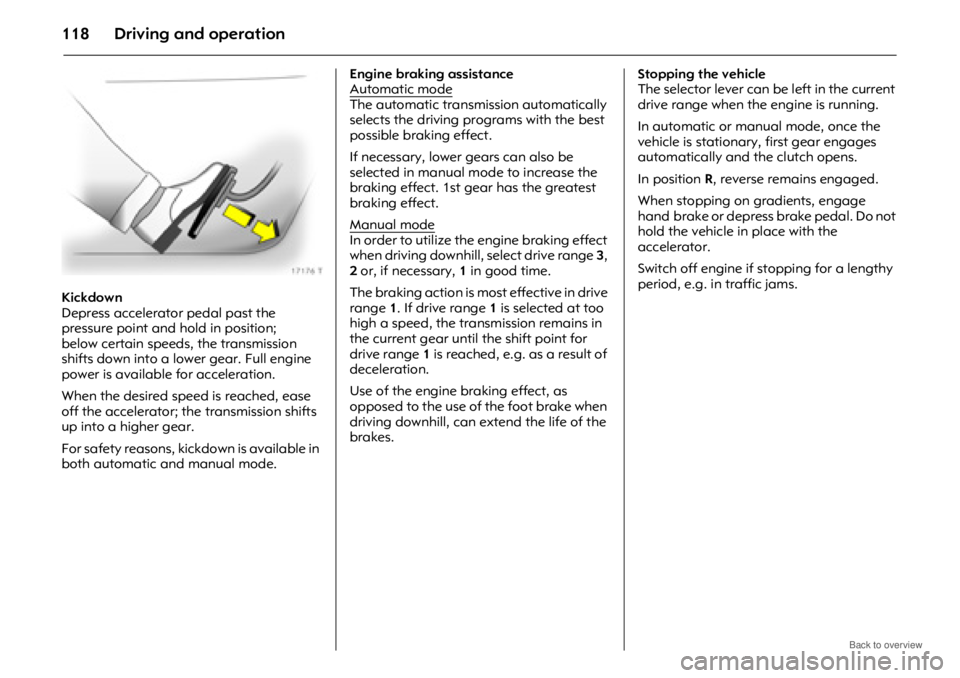
Kickdown
Depress accelerator pedal past the
pressure point and hold in position;
below certain speeds, the transmission
shifts down into a lower gear. Full engine
power is available for acceleration.
When the desired speed is reached, ease
off the accelerator; the transmission shifts
up into a higher gear.
For safety reasons, kickdown is available in
both automatic and manual mode. Engine braking assistance
Automatic mode
The automatic transmi
ssion automatically
selects the driving programs with the best
possible braking effect.
If necessary, lower gears can also be
selected in manual mo de to increase the
braking effect. 1st gear has the greatest
braking effect.
Manual mode
In order to utilize the engine braking effect
when driving downhill, select drive range 3,
2 or, if necessary, 1 in good time.
The braking action is mo st effective in drive
range 1. If drive range 1 is selected at too
high a speed, the transmission remains in
the current gear until the shift point for
drive range 1 is reached, e.g. as a result of
deceleration.
Use of the engine braking effect, as
opposed to the use of the foot brake when
driving downhill, can ex tend the life of the
brakes. Stopping the vehicle
The selector lever can be
left in the current
drive range when the engine is running.
In automatic or manual mode, once the
vehicle is stationary, first gear engages
automatically and the clutch opens.
In position R, reverse remains engaged.
When stopping on gradients, engage
hand brake or depress brake pedal. Do not
hold the vehicle in place with the
accelerator.
Switch off engine if stopping for a lengthy
period, e.g. in traffic jams.