engine OPEL ANTARA 2009 Workshop Manual
[x] Cancel search | Manufacturer: OPEL, Model Year: 2009, Model line: ANTARA, Model: OPEL ANTARA 2009Pages: 234, PDF Size: 3.01 MB
Page 169 of 234

Driving and operation169
Driving characteristics, towing tips
In the case of caravans/trailers with
brakes3, attach the breakaway stopping
cable to the eye 3 or loop around coupling
ball bar if no eye is available.
Ensure cable is crossed under the coupling
socket to ensure the caravan/trailer nose
cannot drop to the ground if it becomes
separated from the trailer hitch.
Do not allow the cable to drag along the
ground and always allow enough slack to
permit full turning. Fo llow the instructions
supplied with the towing equipment.
Before coupling the caravan/trailer,
lubricate the ball of the caravan/trailer
towing device. However, do not do so if a
stabilizer which acts on the coupling ball is
being used to damp rolling motions.
Handling is greatly influenced by the
loading of the caravan/trailer. Loads
should therefore be secured so that they
cannot slip and should be placed in the
centre of the caravan/trailer if possible,
i.e. above the axle.
Opel genuine parts an d accessories which
can be subsequently fitted aid trailer
operation, e.g. larg e mirrors for wide
caravans/trailers. In the case of caravans/trailers with low
directional stability, it is advisable to use a
friction-type stabilizer to damp rolling
motions.
Do not drive faster than 80 km/h (50 mph),
even in countries where higher speeds are
permitted.
When driving uphill, do not drive faster
than 30 km/h (20 mph) in 1st gear, or
50 km/h (30 mph) in 2nd gear.
Make sure that you have enough room
when cornering and avoid sudden
manoeuvres.
If the caravan/trailer starts to sway, drive
more slowly, do not attempt to correct the
steering and brake sharply if necessary.
If it is necessary to apply the brakes fully,
depress the brake pedal as hard as
possible.
The cooling fan is electrically operated.
The fan cooling capacity is not, therefore,
dependent on engine speed. It is not
necessary, when drivin
g uphill, to shift
down into a lower gear if the vehicle can
climb in a higher gear. When coupled to a caravan/trailer, the
vehicle requires more
braking effort when
driving down long grad ients, so select the
same gear as you would when driving
uphill and drive at roughly the same speed.
Automatic transmission in automatic mode
will select the drivin g program with the
optimum engine braking effect.
Remember that brak ing distances for
vehicles towing carava ns/trailers with and
without brakes is always greater than for
vehicles not towing a caravan/trailer. For
caravans/trailers with brakes, follow the
instructions carefully. Do not make any
modifications to the brake system.
Always check lamps on caravans/trailers
before towing. Ensure national regulations
are observed.
The fog tail lamp on the vehicle is
deactivated when towing a caravan/
trailer.
When reversing, if possible, have someone
provide assistance.
Drive slowly and shift down into a lower
gear when descending steep gradients
rather than holding the foot brake
depressed, to avoid overheating and
reduced brake efficiency.
Page 170 of 234
Driving and operation170
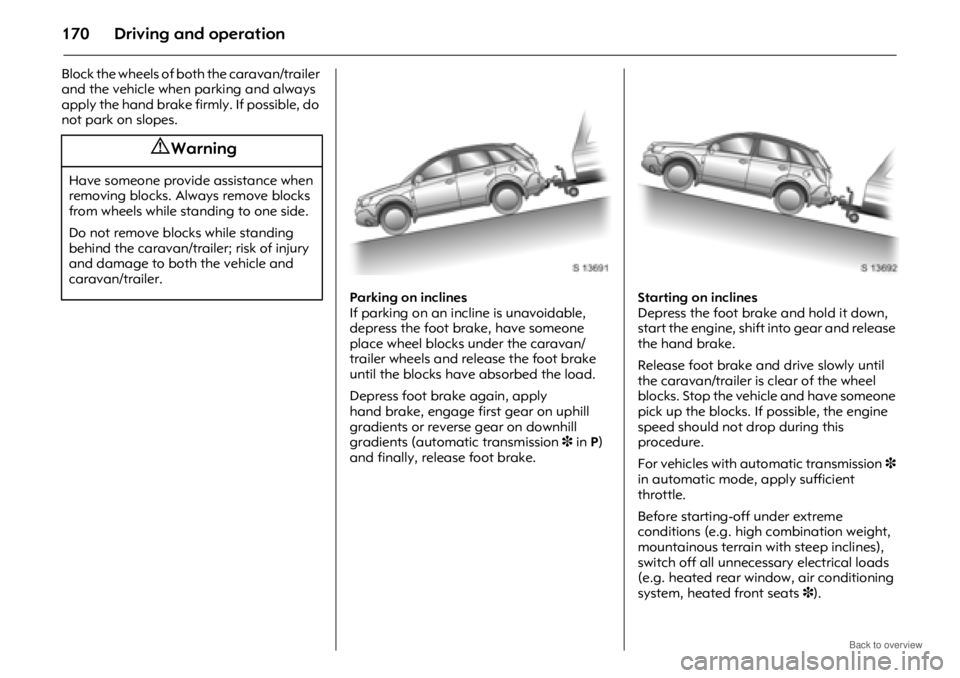
Block the wheels of both the caravan/trailer
and the vehicle when parking and always
apply the hand brake firmly. If possible, do
not park on slopes. Parking on inclines
If parking on an incline is unavoidable,
depress the foot brake, have someone
place wheel blocks under the caravan/
trailer wheels and release the foot brake
until the blocks have absorbed the load.
Depress foot brake again, apply
hand brake, engage first gear on uphill
gradients or reverse gear on downhill
gradients (automatic transmission 3 in P)
and finally, release foot brake. Starting on inclines
Depress the foot brake and hold it down,
start the engine, shift into gear and release
the hand brake.
Release foot brake and drive slowly until
the caravan/trailer is clear of the wheel
blocks. Stop the vehicle and have someone
pick up the blocks. If possible, the engine
speed should not drop during this
procedure.
For vehicles with automatic transmission
3
in automatic mode, apply sufficient
throttle.
Before starting-off under extreme
conditions (e.g. high combination weight,
mountainous terrain with steep inclines),
switch off all unnecessary electrical loads
(e.g. heated rear window, air conditioning
system, heated front seats 3).
9 Warning
Have someone provide assistance when
removing blocks. Always remove blocks
from wheels while standing to one side.
Do not remove blocks while standing
behind the caravan/trailer; risk of injury
and damage to both the vehicle and
caravan/trailer.
Page 171 of 234

Self-help, vehicle care171
Self-help, vehicle care
Diesel fuel system, bleeding
Never let the fuel tank run dry. If control
indicator Y illuminates, refuel as soon as
possible.
It is possible to restart the engine if the tank
has been run dry. A delayed start can be
expected. Switch on the ignition three times
for approx. 15 seconds. Then try to start
the engine for no more than 40 seconds. If
the engine will not start, wait at least
10 seconds before trying again. If the
engine will still not start, consult a
workshop.
Bonnet
To open the bonnet, pull release lever /
located on the left-hand side below the
instrument panel.
The bonnet will then be unlocked and will
partially open. Return release lever to its
original position.
Do not pull release lever while the vehicle is
moving.
Diesel fuel system, bleeding .............. 171
Bonnet ................................................. 171
Starting ................................................ 172
Starting the engine with jump leads
3 172
Towing ................................................. 174
Jack and vehicle tools ........................ 176
Warning triangle ¨ 3 ,
First aid kit +3................................ 177
Temporary spare wheel ..................... 177
Wheel changing .................................. 178
Electrical system ................................. 181
Fuses and the most important circuits they protect ...................................... 182
Bulb replacement ............................... 185
Opel genuine parts and accessories . 191
A note on safety ................................. 191
Checking and topping up fluids ........ 191
Windscreen wipers .............................. 198
Windscreen washer system ................ 199
Battery ................................................. 200
Protection of electr onic components 201
Vehicle storage ................................... 201
Vehicle care......................................... 201
9 Warning
Disregard of the instructions may lead to
injuries or endanger life. Vehicle
passengers must be informed
accordingly.
Page 172 of 234

Self-help, vehicle care172
To open completely, locate the safety
catch, found slightly left of centre on the
underside of the bonnet, push the catch
upwards and lift the bonnet gently. The
bonnet is held open automatically.
When the bonnet is opened, leaves, dirt or
snow on the bonnet can slide down and
obstruct the air intake. Remove any leaves,
dirt or snow. Air intake - see page 114.
Never drive with bonnet open.
To close bonnet, lower it gradually,
allowing it to drop from a height of approx.
30 cm.
Check that the bonnet is locked in position
before driving, by pulling at its front edge.
If it is not engaged, repeat closing
procedure.
Starting
Do not start with quick charger
This prevents damage to electronic
components.
Do not start by pushing or towing
Because your vehicle is fitted with a
catalytic converter, it must not be started
by pushing or towing - see page 133.
The vehicle can only be started using jump
leads - see following pages.
Starting the engine with jump
leads 3
A vehicle with a discha rged battery can be
started using jump leads and the battery of
another vehicle.
Start attempts should be made at intervals
of 1 minute and should not last longer than
15 seconds.
9 Warning
If the vehicle battery requires charging
whilst still in the vehicle, ensure there is
adequate ventilation in and around the
battery compartment, to prevent risk of
explosion.
9 Warning
This must be done with extreme care. Any
deviation from the following instructions
could lead to personal injury or damage
resulting from battery explosion, as well
as to damage to the electrical systems in
both vehicles.
Page 173 of 234
Self-help, vehicle care173
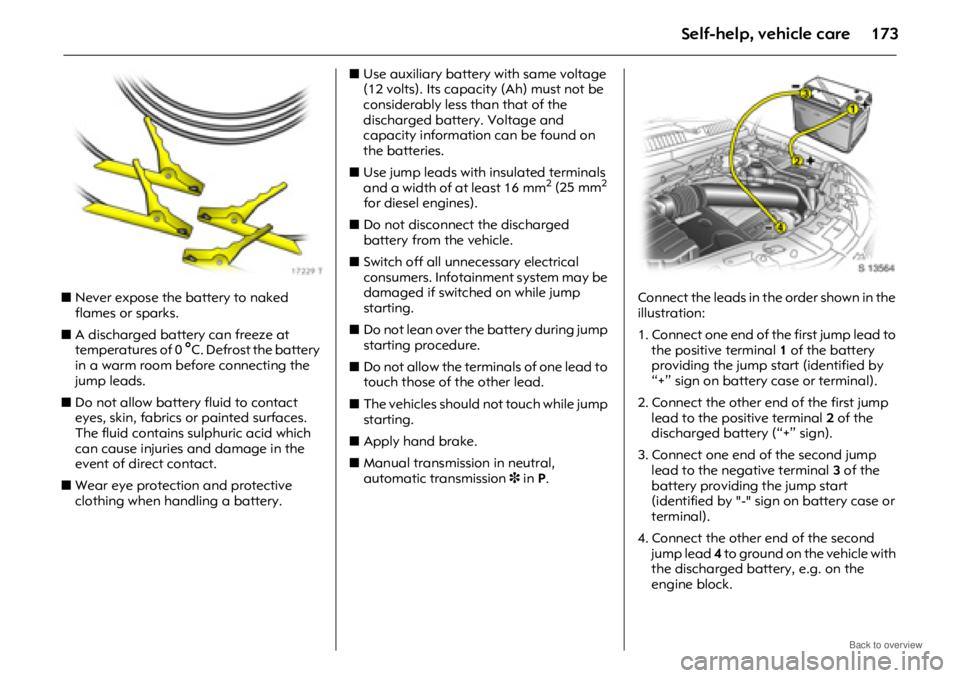
zNever expose the battery to naked
flames or sparks.
z A discharged battery can freeze at
temperatures of 0
°C. Defrost the battery
in a warm room before connecting the
jump leads.
z Do not allow battery fluid to contact
eyes, skin, fabrics or painted surfaces.
The fluid contains sulphuric acid which
can cause injuries and damage in the
event of direct contact.
z Wear eye protection and protective
clothing when handling a battery. z
Use auxiliary battery with same voltage
(12 volts). Its capacity (Ah) must not be
considerably less than that of the
discharged battery. Voltage and
capacity information can be found on
the batteries.
z Use jump leads with insulated terminals
and a width of at least 16 mm
2 (25 mm2
for diesel engines).
z Do not disconnect the discharged
battery from the vehicle.
z Switch off all unnecessary electrical
consumers. Infotainment system may be
damaged if switched on while jump
starting.
z Do not lean over the battery during jump
starting procedure.
z Do not allow the terminals of one lead to
touch those of the other lead.
z The vehicles should not touch while jump
starting.
z Apply hand brake.
z Manual transmissi on in neutral,
automatic transmission 3 in P. Connect the leads in th
e order shown in the
illustration:
1. Connect one end of the first jump lead to the positive terminal 1 of the battery
providing the jump start (identified by
“+” sign on battery case or terminal).
2. Connect the other end of the first jump lead to the positive terminal 2 of the
discharged battery (“+” sign).
3. Connect one end of the second jump lead to the negative terminal 3 of the
battery providing the jump start
(identified by "-" sign on battery case or
terminal).
4. Connect the other end of the second jump lead 4 to ground on the vehicle with
the discharged battery, e.g. on the
engine block.
Page 174 of 234
Self-help, vehicle care174
zDo not connect leads to negative
terminal of discharged battery.
z The last connection point should be as
far away from the discharged battery as
possible.
z Route leads so they cannot catch on
rotating parts in engine compartment.
z Start the engine of the vehicle providing
the jump start.
z After 5 minutes, start the other engine.
Start attempts shou ld be made at
intervals of 1 minute and should not last
longer than 15 seconds.
z After starting, allow both engines to idle
for approx. 3 minutes with leads
connected.
z In order to avoid excess voltage in the
electrical system, before removing a
lead, switch on an electrical consumer
(e.g. lamps, heated rear window) in the
vehicle receiving the jump start.
z Operate discharged vehicle for approx.
20 minutes to allow for recharging.
z Reverse above sequence exactly when
removing leads.
Towing
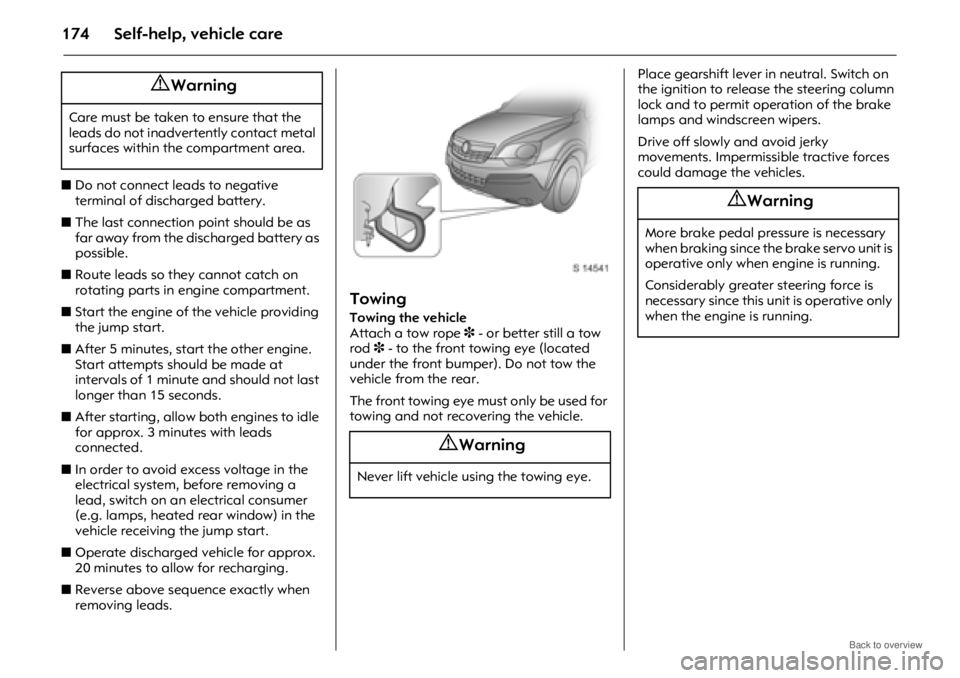
Towing the vehicle
Attach a tow rope 3 - or better still a tow
rod 3 - to the front towing eye (located
under the front bumper). Do not tow the
vehicle from the rear.
The front towing eye must only be used for
towing and not recovering the vehicle. Place gearshift lever in neutral. Switch on
the ignition to release the steering column
lock and to permit operation of the brake
lamps and windscreen wipers.
Drive off slowly and avoid jerky
movements. Impermissible tractive forces
could damage
the vehicles.
9 Warning
Care must be taken to ensure that the
leads do not inadvertently contact metal
surfaces within the compartment area.
9 Warning
Never lift vehicle using the towing eye.
9 Warning
More brake pedal pressure is necessary
when braking since the brake servo unit is
operative only when engine is running.
Considerably greater steering force is
necessary since this unit is operative only
when the engine is running.
Page 179 of 234
Self-help, vehicle care179
zRemove wheel trim 3.
z Slacken wheel nuts one turn only before
raising the vehicle, but do not totally
unscrew or remove the nuts until the
wheel is off the ground.
z Never change more th an one wheel at a
time.
z Block wheel diagonally opposite the
wheel to be changed, by placing wedge
blocks or equivalent in front and behind
the wheel.
z Do not jack-up the vehicle when traffic is
too close.
z Use jack only when changing wheels.
z Never exceed jack maximum working
load (900 kg).
z If the ground on which the vehicle is
standing is soft, a solid board (max. 1 cm
thick) should be placed under the jack.
Using a thicker board could lead to
damage of the jack and the vehicle. z
Do not raise the vehicle more than is
necessary to change a wheel.
z No people or animals may be in the
vehicle when it is jacked-up.
z Never start or run the engine or crawl
under a jacked-up vehicle.
z Before screwing on the wheel nuts when
changing a wheel, ap ply a light coating
of grease to the cone of each wheel nut.
z Fully tighten the wheel nuts after
lowering the vehicle all the way, ensuring
nuts have been tightened to the correct
torque (see page 223).
z If conditions are not satisfactory to
change a wheel safely, consult a
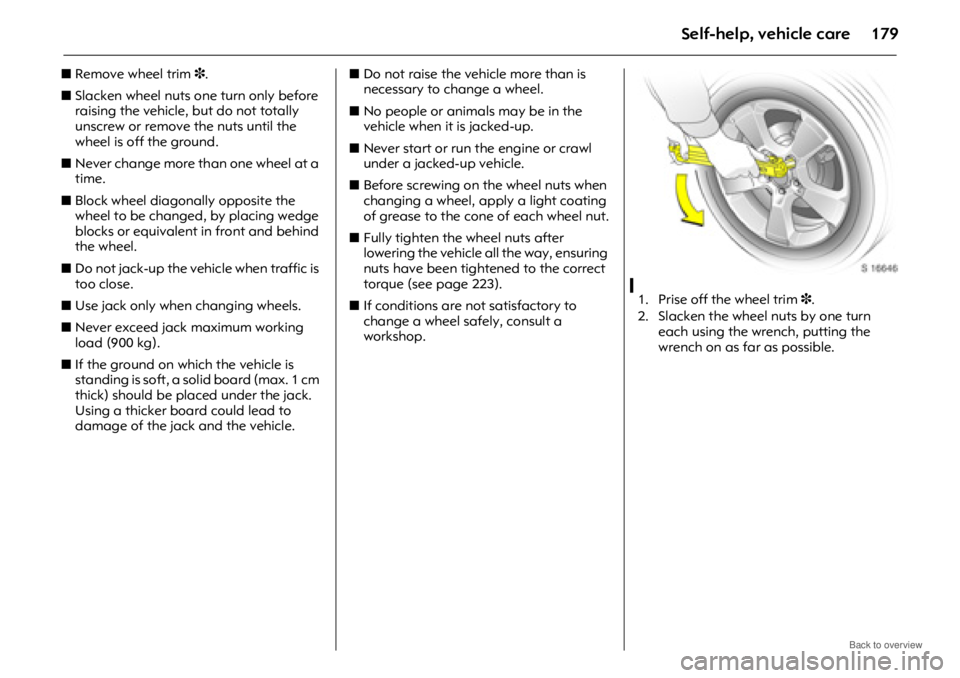
workshop. 1. Prise off the wheel trim 3
.
2. Slacken the wheel nuts by one turn each using the wrench, putting the
wrench on as far as possible.
Page 181 of 234

Self-help, vehicle care181
Electrical system
Fuses
There are two fuse boxes in the vehicle:
the instrument panel fu se box is located on
the left-hand side of the front passenger’s
footwell, the engine compartment fuse box
is located next to the coolant reservoir.
It is advisable to carry a full set of fuses.
Spare fuses are kept in the engine
compartment fuse box.
7. Change the wheel.
Notes on spare wheel - see page 178.
8. Screw on wheel nuts and tighten slightly by hand until wheel is held
against the hub.
9. Rotate wrench anti-clockwise and lower vehicle to the ground.
10. Tighten wheel nuts in a cross wise sequence, putting the wrench on as far
as possible.
11. Stow replaced wheel in luggage compartment.
12. Stow the jacking equipment and warning triangle 3 - see pages 176,
177.
13. Check the tyre pressure of the newly fitted wheel - see page 224. Adjust as
necessary.
14. Have the new wheel balanced on the vehicle and have the tightening torque
of the wheel nuts checked as soon as
possible, and if necessary, corrected.
Tightening torque - see page 223.
15. Replace defective tyre on the wheel that was removed.
16. Replace temporary spare wheel with a full specification wheel without delay.
9 Warning
Electronic ignition systems generate very
high voltages. Do not touch the ignition
system; high voltage can be fatal.
Page 182 of 234
Self-help, vehicle care182
When replacing a fuse, turn off the
respective switch and the ignition.
A defective fuse can be recognized by its
melted wire. A new fuse should only be
installed after the cause of the trouble has
been eliminated.
There is a fuse extractor in the engine
compartment fuse box. Do not use tools
that conduct electricity when changing
fuses.Only install fuses of the specified rating.
Each fuse has its rating written on it, in
addition the fuses are colour coded.Fuses and the most important
circuits they protect
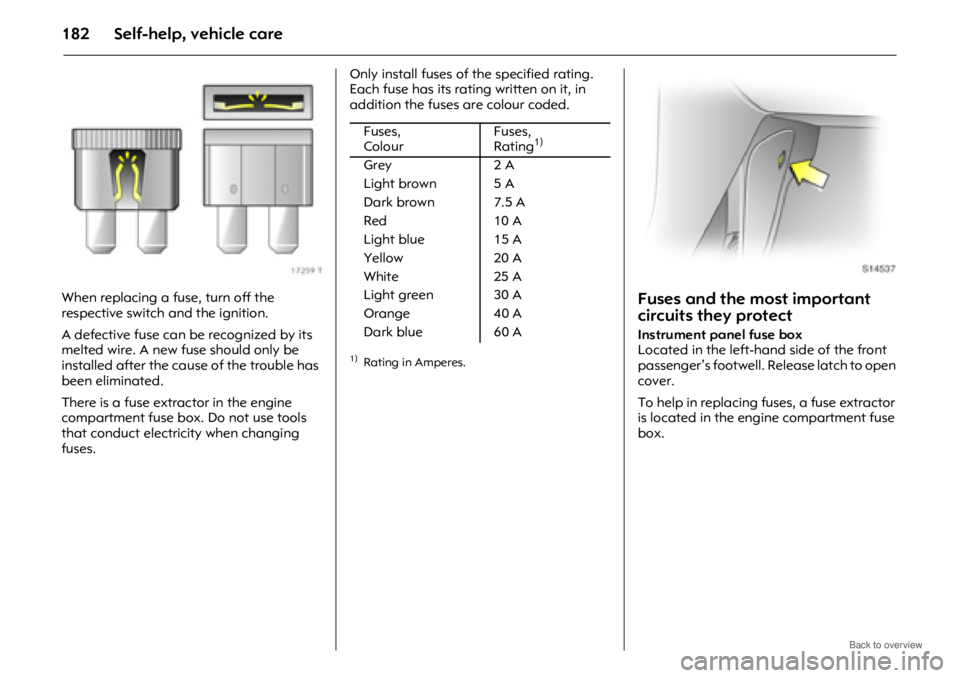
Instrument panel fuse box
Located in the left-hand side of the front
passenger’s footwell. Release latch to open
cover.
To help in replacing fu
ses, a fuse extractor
is located in the engine compartment fuse
box.
Fuses,
Colour Fuses,
Rating1)
1)Rating in Amperes.
Grey
2 A
Light brown 5 A
Dark brown 7.5 A
Red 10 A
Light blue 15 A
Yellow 20 A
White 25 A
Light green 30 A
Orange 40 A
Dark blue 60 A
Page 183 of 234
Self-help, vehicle care 183
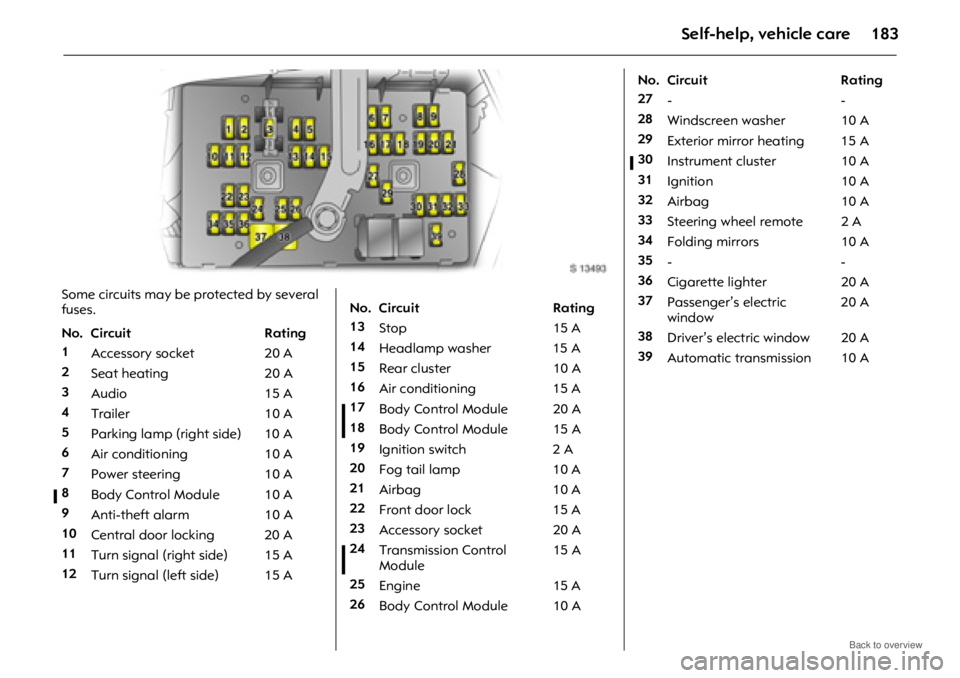
Some circuits may be protected by several
fuses.
No. Circuit Rating
1Accessory socket 20 A
2 Seat heating 20 A
3 Audio 15 A
4 Trailer 10 A
5 Parking lamp (right side) 10 A
6 Air conditioning 10 A
7 Power steering 10 A
8 Body Control Module 10 A
9 Anti-theft alarm 10 A
10 Central door locking 20 A
11 Turn signal (right side) 15 A
12 Turn signal (left side) 15 ANo. Circuit Rating
13 Stop 15 A
14 Headlamp washer 15 A
15 Rear cluster 10 A
16 Air conditioning 15 A
17 Body Control Module 20 A
18 Body Control Module 15 A
19 Ignition switch 2 A
20 Fog tail lamp 10 A
21 Airbag 10 A
22 Front door lock 15 A
23 Accessory socket 20 A
24 Transmission Control
Module 15 A
25 Engine 15 A
26 Body Control Module 10 A
No. Circuit Rating
27 --
28 Windscreen washer 10 A
29 Exterior mirror heating 15 A
30 Instrument cluster 10 A
31 Ignition 10 A
32 Airbag 10 A
33 Steering wheel remote 2 A
34 Folding mirrors 10 A
35 --
36 Cigarette lighter 20 A
37 Passenger’s electric
window 20 A
38 Driver’s electric window 20 A
39 Automatic transmission 10 A