brake OPEL ANTARA 2009 Service Manual
[x] Cancel search | Manufacturer: OPEL, Model Year: 2009, Model line: ANTARA, Model: OPEL ANTARA 2009Pages: 234, PDF Size: 3.01 MB
Page 175 of 234
Self-help, vehicle care175
Keep tow rope 3 clear of front bumper,
and ensure it is secure ly fixed to the towing
eye at both ends. Pull on the tow rope 3 to
check.
To prevent entry of exhaust fumes from
towing vehicle, switch on air recirculation
mode (see page 109) and close the
windows.
Never let passengers ride in a vehicle that
is being towed.
Never tow a vehicle with damaged parts
that are not secured to the vehicle or if
wheels, brakes or steering are damaged.
Do not tow the vehicle with a tow rope 3 or
tow rod 3 for extended periods, to avoid
damage to the vehicle. Only tow in this
manner on hard-surfaced roads.
For vehicles with automatic transmission 3:
use flatbed or wheel lift equipment only.
Towing can cause severe damage to the
transmission.
Seek the assistance of a workshop. Towing service
Entrust your vehicle only to the towing
service of your choice and obtain an
estimate on towing costs before employing
any towing service. This will prevent
unnecessary expense and possible
insurance problems during claim
processing.
Use flatbed equipment whenever possible.
If vehicle is to be towed using a wheel lift,
tow with all wheels off the road, using a
towing dolly.
Never use sling-type equipment to tow the
vehicle or tow the vehicle with the front or
rear wheels on the road, to avoid causing
serious damage to the vehicle.
Place the gearshift lever in neutral
(automatic transmission 3
in N), switch on
hazard warning lamps, turn key to ignition
switch position ACC and release the
hand brake before towing the vehicle. Towing another vehicle
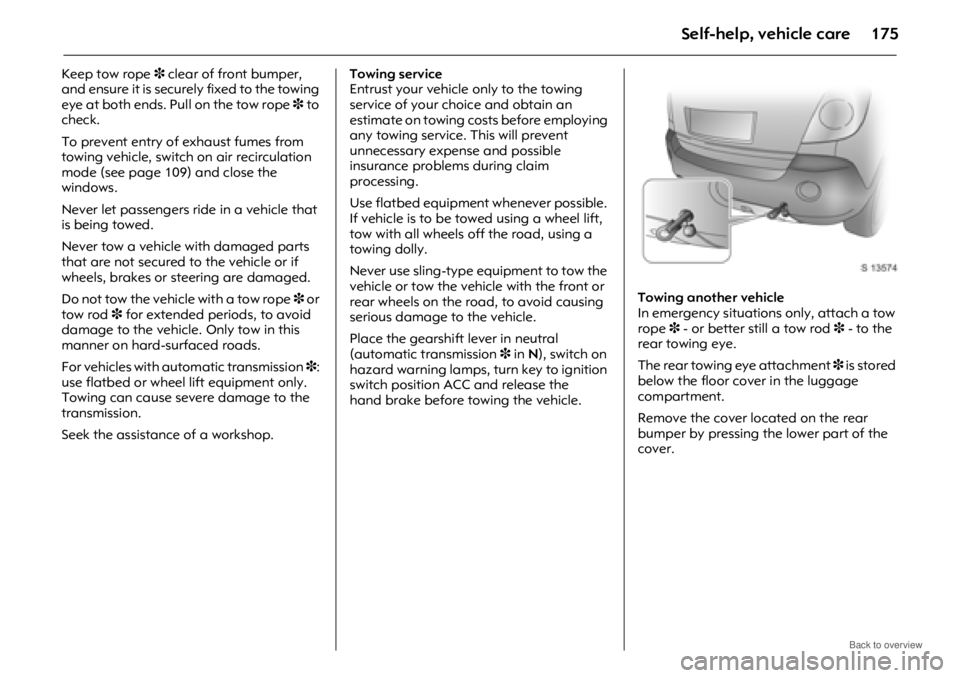
In emergency situations only, attach a tow
rope
3 - or better still a tow rod 3 - to the
rear towing eye.
The rear towing eye attachment 3 is stored
below the floor cover in the luggage
compartment.
Remove the cover located on the rear
bumper by pressing the lower part of the
cover.
Page 178 of 234

Self-help, vehicle care178
Notes on temporary spare wheel
zUsing a temporary spare wheel may
change the driving behaviour of the
vehicle, particularly if using winter
tyres 3. Replace defective tyre as quickly
as possible, balanc e wheel and fit to
vehicle.
z Fit only one temporary spare wheel.
z Do not drive faster than 80 km/h
(50 mph).
z Take curves slowly.
z Do not use the temporary spare wheel
for a lengthy period.
z Replace temporary spare wheel with full
specification wheel without delay.
z When temporary spare wheel is fitted, do
not take the vehicle through an
automatic car wash with guide rails. The
temporary spare wheel may get caught
on the rails, causing damage to the tyre,
wheel and other vehicle parts.
z Tyre chains are not permitted on the
temporary spare wheel.
If tyre chains are necessary after a front
wheel puncture, fit the temporary spare
wheel to the rear and a rear wheel to the
front. Check tyre pressure and adjust if
necessary - see page 224.
z Follow the temporary spare wheel
instructions on pages 153, 181, 223. Notes on directional tyres
3
Tyres with a prescribed rotating direction
can only achieve their maximum
performance if they are fitted in the
prescribed rotating direction.
If a tyre or spare wheel is fitted that is
rotating in the wrong direction due to a
puncture, the following must be noted:
z The handling of the vehicle may be
different. Replace defective tyres as soon
as possible, have wheel balanced and
fitted to the vehicle.
z Do not drive faster than 80 km/h
(50 mph).
z Drive particularly carefully on wet and
snow-covered road surfaces.
z For more information on tyres with a
prescribed rotating direction -
see page 149.Wheel changing
In order to reduce the chance of possible
injuries, make the following preparations
and note the procedure:
zPark on a level, firm and non-slippery
surface.
z Switch on hazard warning lamps and
apply hand brake. Engage 1st gear or
reverse (automatic transmission 3 in P).
z Correctly set up warning triangle 3.
z Ensure all vehicle passengers are out of
the vehicle and clear of the vehicle and
other traffic.
z Take the spare wheel from under the
luggage compartment floor cover -
see page 177.
z Before raising the vehicle, turn front
wheels to straight-ahead position.
Page 188 of 234
Self-help, vehicle care188
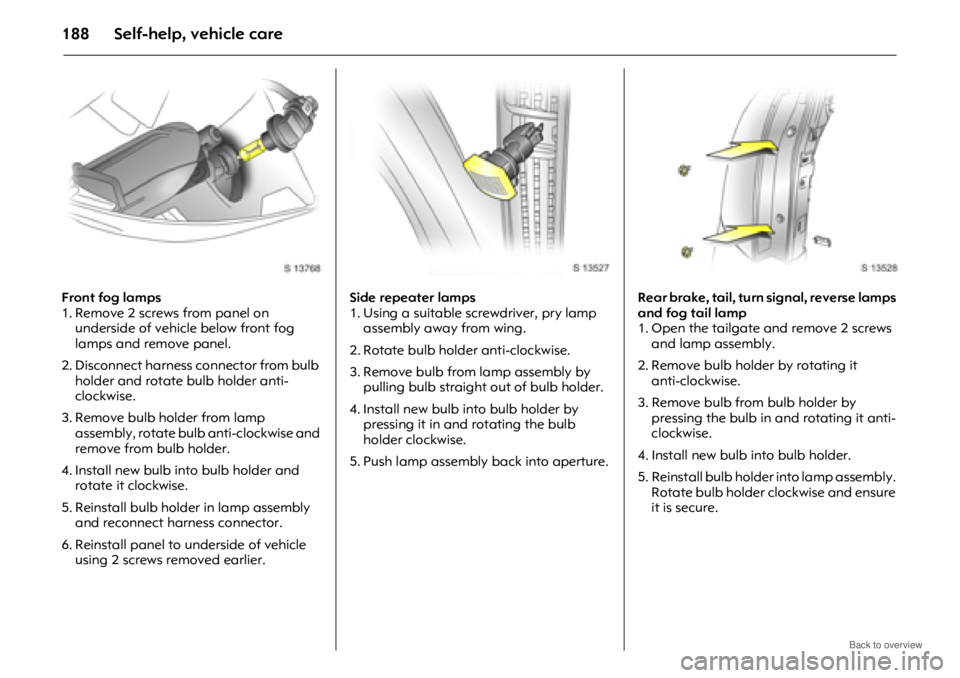
Front fog lamps
1. Remove 2 screws from panel on underside of vehicle below front fog
lamps and remove panel.
2. Disconnect harness connector from bulb holder and rotate bulb holder anti-
clockwise.
3. Remove bulb holder from lamp assembly, rotate bulb anti-clockwise and
remove from bulb holder.
4. Install new bulb in to bulb holder and
rotate it clockwise.
5. Reinstall bulb holder in lamp assembly
and reconnect harness connector.
6. Reinstall panel to underside of vehicle using 2 screws removed earlier. Side repeater lamps
1. Using a suitable screwdriver, pry lamp
assembly away from wing.
2. Rotate bulb holder anti-clockwise.
3. Remove bulb from lamp assembly by pulling bulb straight out of bulb holder.
4. Install new bulb into bulb holder by pressing it in and rotating the bulb
holder clockwise.
5. Push lamp assembly back into aperture. Rear brake, tail, turn signal, reverse lamps
and fog tail lamp
1. Open the tailgate and remove 2 screws
and lamp assembly.
2. Remove bulb holder by rotating it anti-clockwise.
3. Remove bulb from bulb holder by pressing the bulb in and rotating it anti-
clockwise.
4. Install new bulb into bulb holder.
5. Reinstall bulb holder into lamp assembly. Rotate bulb holder clockwise and ensure
it is secure.
Page 191 of 234

Self-help, vehicle care191
Centre high-mounted stop lamp,
instrument panel and glove compartment
illumination
We recommend having bulb replacements
carried out by a workshop.
Opel genuine parts and
accessories
We recommend the use of “Opel genuine
parts and accessories” and conversion
parts released expressly for your vehicle
type. These parts have undergone special
tests to establish their reliability, safety and
specific suitability for your vehicle. Despite
continuous market monitoring, we cannot
assess or guarantee these attributes for
other products, even if they have been
granted approval by the relevant
authorities or in some other form.
“Opel genuine parts and accessories” and
conversion parts approved by Opel can be
obtained from your Op el Partner, who can
provide comprehensive advice about
permitted technical changes and ensure
that the part is installed correctly.
A note on safety
To avoid the possibility of injury, only carry
out engine compartment checks (e.g.
checking the brake fluid level or the engine
oil level) when the igni tion is switched off. Never carry out any re
pairs or adjustment
and maintenance work on the vehicle
yourself. This especially applies to the
engine, chassis and safety parts. You may,
out of ignorance, infringe the provisions of
the law and, by not performing the work
properly, you may endanger yourself and
other road users.
Checking and topping up fluids
To aid identification, the engine oil filler
cap, the coolant filler cap, the lid of the
fluid container for the windscreen washer
system and the handle of the engine oil
gauge (dipstick) may be coloured yellow.
9 Warning
The cooling fan may be operated by a
thermoswitch and can therefore start to
operate unexpectedly, even when the
ignition is switched off; risk of injury.
Electronic ignition systems generate very
high voltages. Do not touch the ignition
system; high voltage can be fatal.
Page 196 of 234

Self-help, vehicle care196
When the engine is at operating
temperature, coolant level rises. It falls
again when the system cools. If it falls
below the MIN mark when the system is
cold, the coolant must be replenished.
Top up antifreeze. If no antifreeze is
available, top up with clean tap water.
If tap water is unavailable, distilled water
can be used.
When you top up with tap water or distilled
water, add concentrated antifreeze and
possibly mix in antifreeze as well. Have the
cause of the coolant loss eliminated by a
workshop.
Too low a coolant level can cause engine
damage.
When closing, tighten coolant filler cap as
far as it will go. Coolant temperature
Control indicator
W illuminates when
coolant temperature is too high. Check
coolant level:
z Coolant level low:
Top up coolant. Pay attention to the
instructions given under "Antifreeze and
corrosion protecti on" and "Coolant
level". Have the cause of the coolant loss
remedied by a workshop.
z Coolant level OK:
Have the cause of increased coolant
temperature remedied by a workshop.
Brake fluid
Brake fluid level
9 Warning
Allow engine to cool down before
removing coolant filler cap. If steam is
visible, move away from the vehicle until
the engine is cool.
Remove coolant filler cap carefully so
that pressure can escape slowly,
otherwise there is a risk of scalding.
9 Warning
Caution - brake fluid is poisonous and
corrosive. Do not allow it to contact eyes,
skin, fabrics or painted surfaces; direct
contact may cause injuries and damage.
Page 197 of 234
Self-help, vehicle care197
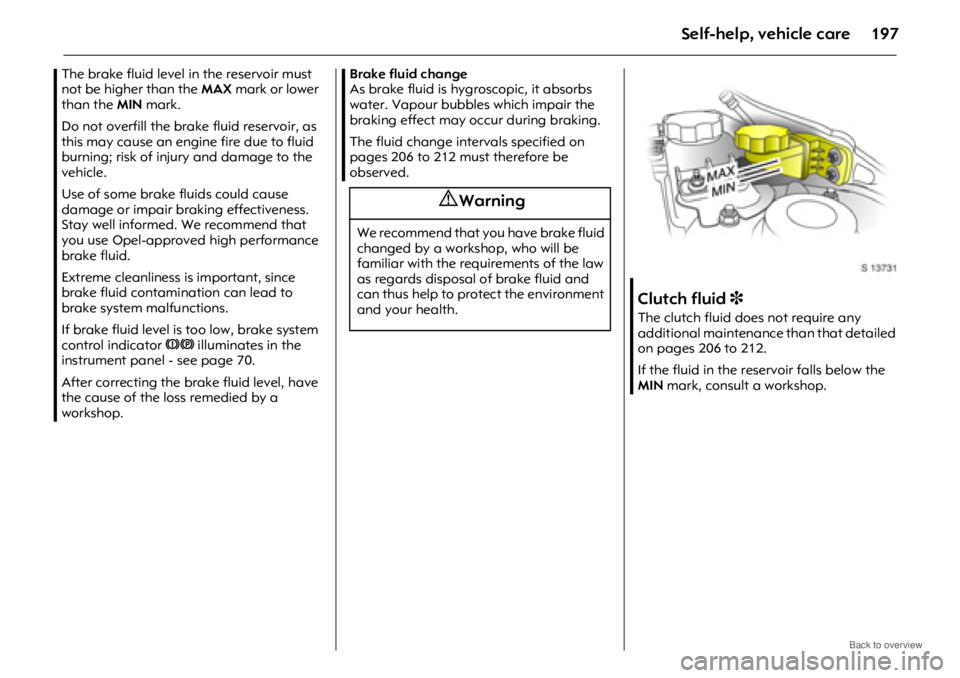
The brake fluid level in the reservoir must
not be higher than the MAX mark or lower
than the MIN mark.
Do not overfill the brak e fluid reservoir, as
this may cause an engine fire due to fluid
burning; risk of injury and damage to the
vehicle.
Use of some brake fluids could cause
damage or impair br aking effectiveness.
Stay well informed. We recommend that
you use Opel-approve d high performance
brake fluid.
Extreme cleanliness is important, since
brake fluid contamination can lead to
brake system malfunctions.
If brake fluid level is too low, brake system
control indicator 4 illuminates in the
instrument panel - see page 70.
After correcting the brake fluid level, have
the cause of the loss remedied by a
workshop. Brake fluid change
As brake fluid is hygroscopic, it absorbs
water. Vapour bubbles which impair the
braking effect may occur during braking.
The fluid change intervals specified on
pages 206 to 212 must therefore be
observed.
Clutch fluid
3
The clutch fluid does not require any
additional maintenanc e than that detailed
on pages 206 to 212.
If the fluid in the reservoir falls below the
MIN mark, consult a workshop.
9 Warning
We recommend that you have brake fluid
changed by a workshop, who will be
familiar with the requ irements of the law
as regards disposal of brake fluid and
can thus help to protect the environment
and your health.
Page 205 of 234

Self-help, vehicle care205
Windscreen wiper blades
Wax, such as that used in car washes, can
cause streaks to form on the windscreen
when the wipers are used.
Smearing wiper blades can be cleaned with
a soft cloth and Opel Cleaning Solvent and
Antifreeze, and replaced if necessary –
see page 198. Do not use abrasive
cleaners.
Locks
The locks are lubricated with a high-grade
lock cylinder grease at the factory. Opel
Lock Cylinder Grease prevents the locks
from freezing up.
Only use de-icing agents in emergencies,
as they have a degreasing effect and will
impair the function of the locks. After using
a de-icing agent, have the locks re-greased
by a workshop. Engine compartment
Areas of the engine compartment that are
painted in the same colour as the vehicle
must be looked after
like any other painted
surface.
It is advisable to wash the engine
compartment before and after winter and
preserve it with wax. Cover alternator and
fluid reservoirs with plastic sheets before
washing the engine.
When washing the engine with a steam-jet
cleaner, do not direct the steam-jet at
components of the Anti-lock Brake System
(ABS), the air conditioning system or the
belt drive and its components.
Protective wax that has been applied is
also removed during the engine wash. For
this reason, have the engine, brake system
components in the engine compartment,
axle components with steering, body parts
and cavities thoroughly preserved with
protective wax after the wash.
An engine wash can be performed in the
spring in order to remove dirt that has
adhered to the engine compartment,
which may also have a high salt content.
Check protective wax layer and make good
if necessary. Underbody
Your vehicle has a factory-applied PVC
undercoating in the wheel arches
(including the longitudinal members) which
provides permanent protection and needs
no special maintenance. The surfaces of
the vehicle underbody not covered by PVC
are provided with a durable protective wax
coating in critical areas.
On vehicles which are washed frequently
in automatic car wash
es with underbody
washing facility, the protective wax
coating may be impaire d by dirt-dissolving
additives. Check the underbody after
washing and have it waxed if necessary.
Before the start of the cold weather season,
check the PVC coating and protective wax
coating and, if necessary, have them
restored to perfect condition.
Caution
– commercially available bitumen/
rubber materials can damage the PVC
coating. We recommend that you have
underbody work carried out by a
workshop, who knows the prescribed
materials and has experience in the use
thereof.
The underbody should be washed
following the end of the cold weather
season to remove any dirt adhering to the
underbody since this may also contain salt.
Check protective wax coating and, if
necessary, have it restored to perfect
condition.
Page 207 of 234

Service, maintenance 207
European service schedule
(Antara Z 20 DM, Z 20 DMH, Z 24 XE, Z 32 SE) Service operations by year 1)
km ( x 1000)1)
miles ( x 1000)1)
1)Whichever occurs first.
15
101
30
20 45
30 2
60
40 75
50 3
90
60
Controls, lighting, signalling equi pment and airbags: visual check
steering lock and ignition lock: check xxx
Remote control batteries: replace Every 2 years
Windscreen wipers, windscreen washer system: check, correct xxx
Coolant level and antifreeze: check, correct
Hoses: check for tightness and secure seating xxx
Brake fluid level: check, correct xxx
Battery terminals: check for secu re connections and battery eye xxx
Vehicle system check with TECH2 xxx
Pollen filter: replace xxx
oMore often for when dust, sand or polle n is in the air Agreement with customer
Air cleaner element: replace
xxx
⊕Spark plugs and plug leads: replace Every 90 000 km/60 000 miles
Ribbed V-belt: visual check xxx
⊕Toothed belt and tension roller: visual check xxx
Toothed belt and tension roller: replace - Z 24 XE Every 8 years/120 000 km/80 000 miles
Toothed belt and tension roller: replace - Z 20 DM, Z 20 DMH Every 6 years/90 000 km/60 000 miles
Power steering system: check for leak s. Fluid level: check, correct xxx
Engine oil and oil filter: replace - fixed interval Z 24 XE
2)
2)On vehicles with oil life monitoring, it may be necessary to change the engine oil earlier (control indicator illuminates).
xxxxxx
Z 20 DM, Z 20 DMH, Z 32 SE, except2)xxx
Page 208 of 234

208 Service, maintenance
Service operations by year 1)
km ( x 1000)1)
miles ( x 1000)1)
1)Whichever occurs first.
⊕ Additional operations.
o Under extreme operating conditions and if required by country-specific conditions, the intervals are reduced.
15
10 1
30
20 45
30 2
60
40 75
50 3
90
60
⊕o Diesel fuel filter: drain water
(If relative humidity is high an
d/or fuel is of lower quality) Annually
Fuel filter: replace and drain water - diesel (g rade EN 590) Every 2 years/60 000 km/40 000 miles
Parking brake: check and adjust
Wheel mounting and suspension front an d rear, brake lines, brake pressure
hoses, fuel lines and exhaust system: visual check xxx
Corrosion protection: check and record in Service and Warranty Booklet Annually
Front and rear wheel br akes: check visually xxx
o
⊕Annual service check if annual mileage exceeds 20 000 km Annually
Engine, transmission, PTO, rear differential, A/C compressor: check for leaks xxx
Steering system boots, track rods , final drive: visual check xxx
Track rod end and supporting ball joint: check xxx
⊕Brake and clutch fluid: change Every 2 years
Wheel fastening: loosen and tighten to torque
Tyre condition and pressures: check, correct xxx
⊕Annual service check if annual
mileage exceeds 20 000 km Annually
First aid kit, tyre repair kit and lash ing eyes: visual check Every 2 years
Headlamp aiming: check, adjust x x x
Door hinges, door stop, lock cylinder, lock striker, bonnet catch, tailgate
hinges and check links: lubricate xxx
Test drive, final check
Service interval display and oil life monitor: reset - if applicable xxx
Page 209 of 234

Service, maintenance 209
International service schedule
(All except Z 24 XE) Service operations by year 1)
km ( x 1000)1)
miles ( x 1000)1)
1)Whichever occurs first.
15
101
30
20 45
30 2
60
40 75
50 3
90
60
Controls, lighting, signalling equi pment and airbags: visual check
steering lock and ignition lock: check xxxxxx
Remote control batteries: replace Every 2 years
Windscreen wipers, windscreen wa sher system: check, correct x x x x x x
Coolant level and antifreeze: check, correct
Hoses: check for tightness and secure seating Annually
Brake fluid level: check, correct xx
Battery terminals: check for secure connections and battery eye Annually
Vehicle system check with TECH2 Annually
Pollen filter: replace xxx
oMore often for when dust, sand or pollen is in the air Annually/15 000 km/10 000 miles
Air cleaner element: replace
xxx
oMore often for when dust or sand is in the air Annually/15 000 km/10 000 miles
⊕Spark plugs and plug leads: replace Every 90 000 km/60 000 miles
Ribbed V-belt: visual check xxx
⊕Toothed belt and tension roller: visual check Annually/15 000 km/10 000 miles
Toothed belt and tension roller: replace - Z 20 DM, Z 20 DMH Every 6 years/90 000 km/60 000 miles
Power steering system: check for leaks. Fluid level: check, correct Annually
Engine oil and oil filter: replace x x x x x x