engine OPEL ANTARA 2009 Owners Manual
[x] Cancel search | Manufacturer: OPEL, Model Year: 2009, Model line: ANTARA, Model: OPEL ANTARA 2009Pages: 234, PDF Size: 3.01 MB
Page 2 of 234

2
Data specific to your vehicle
Please enter your vehicle’s data here to keep it easily accessible.
This information is available under the section "Technical data" as well as on the identification plate.
Fuel
Designation
Engine oil
Grade
Viscosity
Tyre pressure
Tyre size for load of up to 4 persons for full load
Summer tyres FrontRear FrontRear
Winter tyres FrontRear FrontRear
Weights
Permissible Gross Vehicle Weight
– EC kerb weight
=L oa din g
Page 3 of 234

3
Your Antara
is an intelligent combination of forward-
looking technology, impressive safety,
environmental friendliness and economy.
It now lies with you to drive your vehicle
safely and ensure that it performs
perfectly. This Owner's Manual provides
you with all the necessary information to
that end.
Make sure your passengers are aware of
the possible risk of accident and injury
which may result from improper use of the
vehicle.
You must always comply with the specific
laws of the country that you are travelling
through. These laws may differ from the
information in this Owner’s Manual.
When instructed to consult a workshop,
we recommend that you consult an
Opel Partner.
All Opel Partners offer first-class service at
reasonable prices.
You will receive quick, reliable and
individual service.
Experienced mechanics, trained by Opel,
work according to specific Opel
instructions.
The Owner's Manual should always be kept
together with the Service and Warranty
Booklet in the vehicle: Ready to hand in the
glove compartment.
Make use of the Owner's Manual:
z Its "In brief" section will give you an initial
overview.
z The table of contents at the beginning of
the Owner’s Manual and within the
individual chapters will show you where
everything is.
z Its index will help you find what you
want.
z It will familiarise you with the
sophisticated technology.
z It will increase your pleasure in your
vehicle.
z It will help you to handle your vehicle
expertly.
The Owner’s Manual is designed to be
clearly laid-out and easily understood. This symbol signifies:
6
Continue reading on next page.
3 The asterisk signifies equipment not
fitted to all vehicl es (model variants,
engine options, mode ls specific to one
country, optional equipment, Opel
genuine parts and accessories).
Yellow arrows in the illustrations serve as
points of reference or indicate some action
to be performed.
Black arrows in the illustrations indicate a
reaction or a second action to be
performed.
Directional data, e.g. left or right, or front
or back, in the descriptions always relates
to the direction of travel.
We wish you many hours of pleasurable
driving
Your Opel Team
9 Warning
Text marked 9 Warning provides
information on risk of accident or injury.
Disregard of the instructions may lead to
injuries or endanger life.
Inform your passengers accordingly.
Page 12 of 234

In brief12
Control indicators
uABS (Anti-lock Brake System):
see page 148.
gTrailer indicator 3:
see page 70.
4Brake system:
see pages 70, 145.
rPark pilot 3:
see pages 71, 142.
5DCS (Descent Control System):
see pages 71, 138.
BAWD (All Wheel Drive):
see pages 71, 121.
7ESC Active & Warning
(Electronic Stability Control):
see page 136.
AESC Not Ready:
see page 136.
JESC OFF:
see page 136.
qAutomatic headlamp range
adjustment 3 :
see pages 71, 97.
WCoolant temperature:
see pages 71, 195.
oElectronic immobiliser:
see pages 22, 72.
9Door open:
see page 72.
3Engine electronics,
transmission electronics 3:
see pages 72, 134.
vAirbag systems 3,
belt tensioners:
see pages 44, 52.
1Tailgate open:
see page 72.
XDriver’s seat belt reminder:
see page 72.
OTurn signal lamps:
see pages 14, 72, 95.
YLow fuel level:
see pages 72, 76, 132, 225.
>Front fog lamps:
see pages 73, 96.
rFog tail lamp:
see pages 73, 96.
PHeadlamp main beam:
see pages 14, 73, 95.
GLow windscreen washer fluid:
see page 73.
NWater in diesel fuel filter 3:
see pages 73, 194.
CChange engine oil 3:
see page 73.
NPreheating for diesel engines 3:
see pages 19, 73.
IDPF (Diesel particle filter) 3:
see pages 73, 135.
mCruise control 3:
see page 140.
SEngine oil level 3:
see page 73.
2Power steering:
see page 73.
aAnti-theft alarm system activation
without monitoring of passenger
compartment and vehicle tilt 3:
see page 28.
IEngine oil pressure:
see page 74.
pAlternator:
see page 74.
ZExhaust emissions:
see pages 74, 134.
0Winter program:
see pages 74, 117.
Page 13 of 234

In brief13
Steering column lock and ignition:
Turn key to position ACC.
To release lock,
rotate steering wheel slightly
Positions:
6Starting - see page 19,
electronic immobiliser - see page 22,
parking the vehicle - see page 20.
Steering wheel adjustment:
Move lever down,
adjust height and distance,
move lever up and engage
Adjust steering wheel only with vehicle
stationary and steer ing column lock
released.
Push the lever firmly upwards to ensure
that the steering wheel is locked in position.
6 Airbag systems - see page 52.
Exterior lamps
Turn light switch:
Press button:
6Headlamp warning device - see page 92,
further information - see page 94,
headlamp range adjustment 3 -
see page 97,
headlamps when driving abroad -
see page 100,
daytime running lamps 3 - see page 94.
LOCK = Ignition off
ACC = Steering unlocked, ignition off
ON = Ignition on, with diesel engine:
preheating
START = Start (transmission in neutral)
J =Off
8 =Parking lamps
9 = Dipped beam or
main beam
AUTO = Automatic dipped beam activation
3
>=Front fog lamps
r = Fog tail lamp
Page 18 of 234

In brief18
Automatic transmission 3:
Starting is only possible in P or N. To move
from P or N, switch on ignition, depress foot
brake and press selector lever button.
Engage P or R: press selector lever button.
6 Automatic transmission - see page
115. Manual mode:
6
Further information - see page 117.
Before starting-off, check:
zTyre pressures and condition.
z Engine oil level and fluid levels in engine
compartment (see page 192).
z All windows, mirrors, exterior lighting
and license plates are free from dirt,
snow and ice and are operational.
z Objects are securely located and will not
be thrown forward in the event of
sudden braking.
z Seats, seat belts and mirrors are
correctly adjusted.
z All gauges and control indicators.
z Brake operation.
P=Park position
R = Reverse
N = Neutral (idle)
D = Automatic gear selection
P: Only with vehicle stationary,
first apply hand brake
R : Only with vehicle stationary.
<= Shift to higher gear
]=Shift to lower gear
Page 19 of 234

In brief19
Starting the engine:
Manual transmission in neutral,
Depress clutch and foot brake,
Automatic transmission in P or N,
Do not accelerate
Petrol engines:
TurnkeytoSTARTand release it
Diesel engines:
Turn key to ON, when preheating
control indicator N
extinguishes
1), turn key to START
and release it
Key returns automatically to ON position
when released. Start attempts should not last longer than
15 seconds. If engine does not start, wait
10 seconds before repeating starting
procedure.
The increased engine
speed automatically
returns to normal idling speed as the
engine temperature rises.
Drive at a moderate speed, especially in
cold weather, until normal engine
operating temperatures have been
reached.
6 Electronic immobiliser - see page 22,
diesel fuel system - see page 171,
further information - see pages 127, 129,
131.
Releasing the hand brake:
Raise lever slightly,
press release button,
lower lever fully
To reduce operating forces, depress foot
brake at the same time.
Do not drive with hand brake on, to avoid
damage to brakes on the rear wheels. Do
not apply hand brake while vehicle is in
motion or as a substitute for the foot brake.
Drive carefully, economically and with the
environment in mind. While driving, do not
do anything that could distract you.
6 Hand brake - see page 147.
1)Preheating system switches on only if outside
temperature is low.
Page 20 of 234

In brief20
Parking the vehicle:
Apply hand brake firmly,
close windows,
switch off engine, remove key,
engage steering column lock,
lock vehicle
6Further information - see pages 22, 128,
radio frequency remote control -
see page 23,
central locking system - see page 25,
anti-theft alarm system - see page 27.
Advice when parking:
z Always apply hand brake firmly and as
firmly as possible on slopes.
z Push key into igniti on switch before
removing (vehicles with automatic
transmission 3: depress foot brake and
shift into P before removing key). Turn
steering wheel until lock is felt to engage
(anti-theft protection).
z If the vehicle is parked on a level surface
or a hill, select 1st gear before switching
ignition off (vehicles with automatic
transmission 3: move selector lever to P ).
Also turn front wheels away from kerb if
parked on an uphill slope.
If the vehicle is parked on a downhill
slope, select reverse gear before
switching ignition off (vehicles with
automatic transmission 3: move selector
lever to P). Also turn front wheels
towards kerb.
z Switch off exterior lamps, otherwise the
headlamp warning device will sound
when the driver’s door is opened.
z Cooling fans may run on after the engine
has been switched off.
z Do not park on easily ignitable surfaces
as hot exhaust system temperatures
could cause the surface to ignite.
That was the most important
information for your first drive in
your Antara in brief.
Your vehicle has still more
instruments and controls,
possibly also optional equipment.
The remaining chapters of the
Owner’s Manual contain
important information on
operation, safety and
maintenance as well as a
complete index.
Page 22 of 234

Locks, doors, windows22
Electronic immobiliser
The system checks whether the vehicle may
be started using the key that has been
inserted. If the key is recognised as
"authorised", the vehicle can be started.
The check is carried out via a transponder
housed in the key.
The electronic immobiliser is automatically
activated when the key is turned to LOCK
position and removed from the ignition
switch. Control indicator
o for immobiliser
The control indicator illuminates when the
ignition is switched on, then extinguishes.
If the control indicator stays illuminated
after the ignition is switched on, there is a
fault in the immobiliser system.
z Turn key to LOCK po sition and remove,
z wait approximately two seconds,
z then repeat starting procedure.
If the control indicator fails to extinguish,
try to start the engine using the spare key
and seek the assistance of a workshop. Note
The immobiliser does not lock the doors.
Therefore, after leaving the vehicle, always
lock it and switch on the anti-theft alarm
system 3
- see pages 25, 27.
Page 26 of 234
Locks, doors, windows26
Tailgate
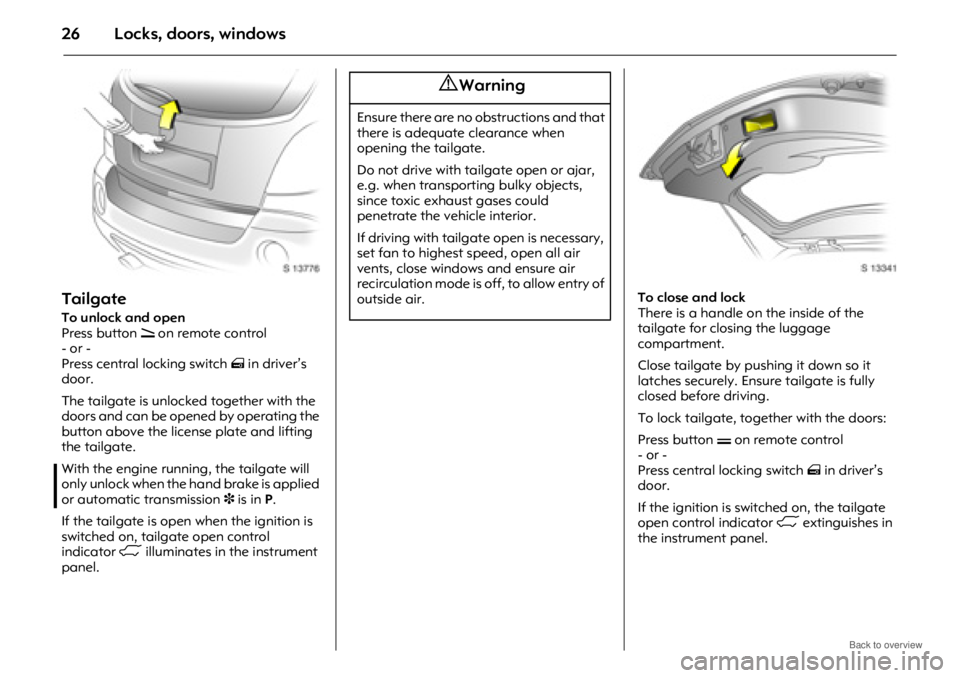
To unlock and open
Press button q on remote control
- or -
Press central locking switch
m in driver’s
door.
The tailgate is unlocked together with the
doors and can be opened by operating the
button above the license plate and lifting
the tailgate.
With the engine running, the tailgate will
only unlock when the hand brake is applied
or automatic transmission 3 is in P.
If the tailgate is open when the ignition is
switched on, tailg ate open control
indicator 1 illuminates in the instrument
panel. To close and lock
There is a handle on the inside of the
tailgate for closing the luggage
compartment.
Close tailgate by push
ing it down so it
latches securely. Ensure tailgate is fully
closed before driving.
To lock tailgate, together with the doors:
Press button p on remote control
- or -
Press central locking switch
m in driver’s
door.
If the ignition is switched on, the tailgate
open control indicator 1 extinguishes in
the instrument panel.
9 Warning
Ensure there are no obstructions and that
there is adequate clearance when
opening the tailgate.
Do not drive with tailgate open or ajar,
e.g. when transporting bulky objects,
since toxic exhaust gases could
penetrate the vehicle interior.
If driving with tailgat e open is necessary,
set fan to highest speed, open all air
vents, close windows and ensure air
recirculation mode is off, to allow entry of
outside air.
Page 29 of 234
Locks, doors, windows29
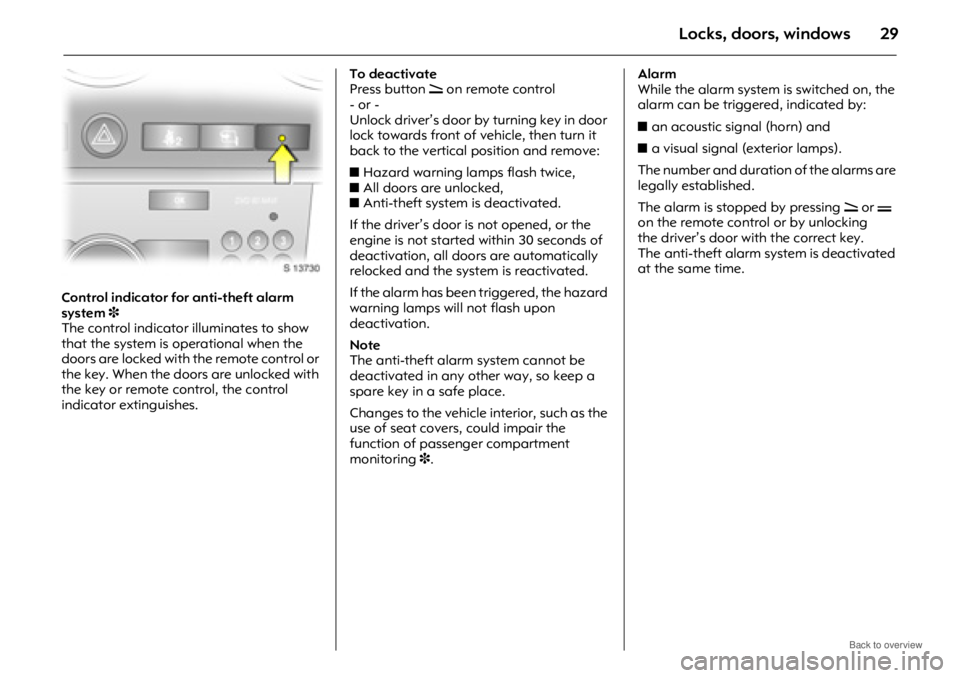
Control indicator for anti-theft alarm
system3
The control indicator illuminates to show
that the system is operational when the
doors are locked with the remote control or
the key. When the doors are unlocked with
the key or remote control, the control
indicator extinguishes. To deactivate
Press button
q on remote control
- or -
Unlock driver’s door by turning key in door
lock towards front of vehicle, then turn it
back to the vertical position and remove:
z Hazard warning lamps flash twice,
z All doors are unlocked,
z Anti-theft system is deactivated.
If the driver’s door is not opened, or the
engine is not started within 30 seconds of
deactivation, all doors are automatically
relocked and the system is reactivated.
If the alarm has been triggered, the hazard
warning lamps will not flash upon
deactivation.
Note
The anti-theft alarm system cannot be
deactivated in any other way, so keep a
spare key in a safe place.
Changes to the vehicle interior, such as the
use of seat covers, could impair the
function of passenger compartment
monitoring 3. Alarm
While the alarm system is switched on, the
alarm can be triggered, indicated by:
z
an acoustic signal (horn) and
z a visual signal (exterior lamps).
The number and duration of the alarms are
legally established.
The alarm is stopped by pressing q or p
on the remote control or by unlocking
the driver’s door with the correct key.
The anti-theft alarm system is deactivated
at the same time.